Showing posts with label Hi-YAH!. Show all posts

Wednesday, May 10, 2023

Review: Young Ip Man

Text © Richard Gary / Indie Horror Films, 2023
Images from the Internet

Young Ip Man (aka Young Ip Man: Crisis Time; 少年叶问之危机时刻; Shàonián yè wèn zhī wéijī)
Directed by Liming Li
iQIYI; Flying Youth Pictures; Lajin; Hi-YAH!; Well Go USA Entertainment
79 minutes, 2020 / 2023
https://wellgousa.com/films/young-ip-man
www.hiyahtv.com
#youngipman @WellGoUSA

While I could be wrong about this, it seems as much like the last 50 or so Amityville and [fill-in-the-blank]nado films do not really have anything to do with the original productions other than name usage, I wonder if that is true with the term “Ip Man.” Paraphrasing from Wikipedia, “Ip Man, born as (Y)Ip Kai-man (1893-1972) was a Hong Kong-based Cantonese martial artist and a grandmaster of the martial art of Wing Chun when he was 20. He had several students who later became martial arts masters in their own right, the most famous among them being Bruce Lee.”

“Ip Man” started as a series of films starring martial art legend Donnie Yen that was rightfully quite successful. Yen became iconic in the role. For this Chinese release in Mandarin (with English subtitles), Zhao Wenhao picks up the titular position as Ip Man.

Zhao Wenhao

The film opens with a bang, detailing the escape of villain Ma Long, who was set for execution for previous but not described felonies. One scene is reminiscent of Enter the Dragon (1973). Lots of shooting, stabbing, explosions, car chases, and so on. Nice way to begin, before we are even introduced to Ip Man, who is studying martial arts in said Hong Kong. We also meet his friend, Xuehu, who is wanting to impress his girlfriend, Xiaofeng.

Ip Man is also studying in a college. As this is set in 1917 in Hong Kong, which was under British rule, the school is hosting the First Xinsi Cup English Speech Contest. It is here we meet Yayun, a cute, yet spoiled rich girl who has a thing for our titular hero.

Before the contest can begin, all the students are kidnapped within the enormous building (shades of 1988’s Die Hard) by Ma Long and his gang, which includes assassin Ma Wei (Pantheras Freedman), and Xuehu, who is in need of money to buy a present for his sweetie. The purpose of the action by our villains is to hold the son of the British Police Commissioner for ransom, and possibly other nefarious reasons.

As you may have guessed, there is a socio-political component to this film, with high reliance on a dislike of the British rule in Hong Kong (much as the UK was the enemy in films about the American Revolutionary War). I have seen a number of Chinese martial arts releases which took place in the 1930s where Japan was the enemy after their invasion, but it is interesting to see it pointed at British colonialism.

Another interesting aspect is that in many of these films, the henchmen are anonymous and throw-away “machines” in the cog of the event (1997’s Austin Powers: International Man of Mystery had fun of this with Will Farrell’s character), and while most here fit that ilk, having Ip Man’s masked buddy Xuehu one of the crew makes it a bit more human.

Something I do not understand, and again, this is common for many films, is that doors are locked, but nobody thinks about breaking a window to escape. I was wondering if this was a cultural thing about destroying the property of the authorities, but they seem to have no qualms about wrecking furniture, and, in fact, break windows during fights.

Despite the drastic situation (which in the States, attacks on schools seems commonplace lately), and some decent martial arts fighting), the film actually starts a bit on the light side, often using humor, or being careful not to be too Die Hard deadly. For example, machine guns open fire on a crowd, and an explosive goes off, and yet, no one is killed. This could have been a fine John Wick intense moment, but that is not the direction of the film, which is action-based, rather than slaughter. The viewer sees lots of fights, but few killings onscreen, making those that are there more compelling. I say this not as neither a positive nor negative thing, but as an observation.

There is also a bit borrowed in theme from Kill Bill; Vol. 1 (2003), especially the House of Blue Leaves sequence, including Leng Yu, a female assassin using a chain with a deadly point, a la Gogo Yubari.

This is the director’s third feature film, and second “Ip Man” release (the first being 2019’s Ip Man: Kung Fu Master). One of the things that made Donnie Yen so iconic as Ip Man, other than his long black jacket, was his stoicism. That is one thing that is lost here, but perhaps it is because he is so young yet and has to learn the hard lessons that would bring him to that point.

There are quite a few fights, increasing in number as the film progresses, with some wire work, but not over the top (e.g., no one jumps from one storey to another). It is nice to see where Ip Man first developed his “trope” of numerous punches within seconds to the chest. I also like that sometimes things happen for reasons that are not expected, such as previous relationships.

Overall, as martial arts films go, the storyline is a bit thin and mostly follows a formula. Yet, this was a fun watch throughout; tropes are there because they are popular, after all.

As a note, as stated on IMDB: “This is supposed to take place in 1917, but the cars, clothes and many items are from at least two decades later.”

IMDB listing HERE


Monday, February 20, 2023

Review: Legend of Gatotakaca

Text © Richard Gary / Indie Horror Films, 2023
Images from the Internet

Legend of Gatotakaca (aka Satria Dewa: Gatotakaca)

Directed by Hanung Bramantyo
Horizon Film Entertainment; Netflix; Lumine Studio;
Satreia Dewa Studio; Well Go USA Entertainment; Hi-YAH!
129 minutes, 2022 / 2023
www.instagram.com/gatotkaca_official/?hl=en
https://wellgousa.com/films/legend-gatotkaca
www.hiyahtv.com
#LegendOfGatotakaca @WellGoUSA

When I see a name of a release or character like this, I tend to run it through Wikipedia. From this, I learned that, in Indonesia, where this film originated (abbreviated quote): “Ghatotkacha (Sanskrit for "Bald Pot") is a prominent character in the story of Mahabharata. He was important fighter in the Kurukshetra war and caused a great deal of destruction and killed many demons.” He has been the subject of many films, mostly out of India.

The "real" Ghatotkacha 

The name may not roll off the English tongue very easily, but he is a warrior hero. In the action-filled prologue, we are introduced to the child Yuda, who is sought by a band of assassins. Their purpose it to find an heirloom with mystical powers, a medallion called Brajamusti.

To be honest, I am not familiar with the Indonesian god-myth culture, nor their ancient literature, such as the referenced Mahabharata (~400 BCE-400 CE) here, in a similar way they may not be familiar with, say, Beowulf (~1000 CE), Grimm’s Fairy Tales (1812), or the ancient mythological pantheon of gods of Greece, Rome, or Scandinavia (Odin, Thor, etc.). It might be good to either have Wikipedia open to throw in some of the names or terms, or just say screw it and enjoy it as it lays, as one would with the Dynasty days films of the Shaw Brothers.

After the prologue, we focus on now college student Yuda (Rizky Nazar). His mother Animbi (Sigi Wimala) is suffering from memory loss, his father Pandega (Cecep Arif Raham , from John Wick Chapter 3), disappears at the beginning, and whose best pal (Jerome Kurnia) is assassinated by a masked man with superpowers during college graduation. Yudi knowing Silat (Indonesian martial arts) does not help. Yet.

Through a learned source, Arya Laksana (Edward Akbar) and his daughter, obvious love interest Agni (Yasmin Napper), Yudi learns that the gods of the Mahabharata are real, residing in the home of the gods, Kadewatan, where Lord Shiva (aka Batara Guru rules); think Asgard and Odin. In fact, it may be helpful to imagine this is part of the Indonesia version of the Marvel Universe (MCU). The stories of Dr. Donald Blake becoming Thor after finding his source of power, his hammer Mjölnir, in a cave. I realize that the story may sound complex, but even if you don’t know the fictional characters, the storyline is quite easy to follow. For example, if you were to sit down and watch any of the MCU films, you can mostly follow along even if you have never picked up a comic book. Going forward, I will use the MCU and DC Universe (DCU) myths equivalency in brackets.

The two gods in question in this story are Pandava [Thor], and his descendants who use their power for good, and his rival Kaurava [Loki] and his lineage, who use it for, well, you know. So the Pandava group [Justise League], such as archer Dananjaya (Omar Daniel) [Green Arrow] and young Gege (scene stealer Ali Fikry) are under threat of the Kaurava one [The Legion of Doom], to restore to power an evil upper echelon god, Aswatama via his masked and his mysterious cowled underling with superpowers to steal souls [Emperor Palpatine and Darth Vader] and bring the coming of the evil gods, which is scheduled for (wait for it) 2023. Mr. Cowl is helped by Beceng (Yayan Ruhian, who was in John Wick Chapter 3:and Star Wars: Episode VII: The Force Awakens). There is a lot of exposition given to the viewer throughout.

Of course, the sworn enemy to stop this is…good guy Gatotkacha. And who is the reincarnation of said Gatotkacha who will emerge with the help of the medallion? Pretty obvious. And that is when the action really picks up. There are some good fights in the early part of the film (including some wire work), but it is also filled with lots of talking, to explain what is going on to the uninformed watching it (e.g., me).

Agni is being pursed by marriage by bully Nathan (Axel Matthew Thomas). I can see where this is going as the lamb’s blood on a door frame. Same to be said about who is the unknown “Vader” villain. Through most of this, the medallion’s powers are minimal, post-human rather than superhuman, until the final fight.

There are lots of reflections on other films than the three I mentioned. For example, there is a bit of The Power Rangers, Mortal Kombat, and even Shazam!, thanks to the medallion.

The film is enjoyable but has three issues: first, if a bit hard to follow at times; second, they try to put too much into one film (the MCU and DCU 3-hour mega-extravaganzas tend to do this a lot), but the weakest link is its length. It does not need to be this long, nor complex. As I said, it is easy to view it for what it is and leave it at that. I mean, I did not read the Lord of the Rings books (never made it past page 25 in the first one), and it was also overcomplex, yet I enjoyed the films for what they presented. If one just goes to see it as an action film, well, there is plenty of that, along with mucho exposition and talking. I believe that perhaps maybe even the younger Indonesians may not know the legends well, and that is part of why it is so wordy with explanations.

Who the masked, unnamed villain is, came as no surprise to me as I figured it out early on. And, of course, it is setting up for either a sequel or a franchise. Understandable.

The film debuts exclusively on the martial arts streaming service Hi-YAH!, before landing on Digital, and Blu-ray.

IMDB listing HERE


Saturday, January 28, 2023

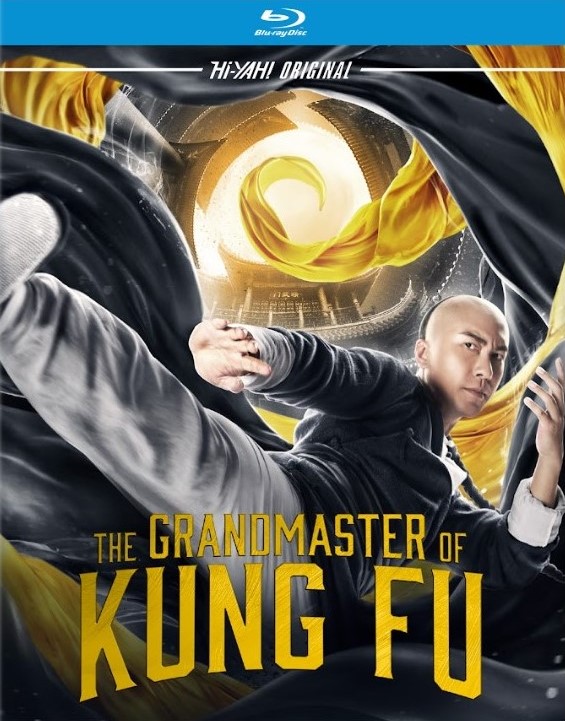
Review: The Grandmaster of Kung Fu

Text © Richard Gary / Indie Horror Films, 2023
Images from the Internet, unless indicated

The Grandmaster of Kung Fu (aka The Grandmaster of Kungfu)
Directed by Cheng Si-Yu

Zhonglele Pictures; Well Go USA Entertainment; Hi-YAH!
75 minutes, 2019 / 2023
https://wellgousa.com/films/grandmaster-kung-fu
www.hiyahtv.com
@WellGoUSA; #TheGrandmasterOfKungFu

Many of the Chinese kung fu/martial arts films of late that date back to a dynasty period, even a later one, tend to be stylized to the point of art, such as Crouching Tiger, Hidden Dragon (2000). This is a natural progression of the old Shaw Bros films of the 1970s-‘80s, but you may wonder whatever happened to the down and dirty fighting of those good old days?

In Mandarin and Japanese (with English subtitles) comes this little ditty that is relatively new to the canon, but has that old time feel, without being VHS blurry images that we all had to get used to when we rented them from the local video store. The period in which this takes place is the end of the Qing Dynasty, which was essentially during World War II, when Japan invaded China and decimated many of the people and cultural icons. It is also the focus of the story, as Japan tries to take over Tianjin, a city dedicated to the martial arts. If the city is wiped out, there are less warriors fighting for their home turf.

When Japan invaded China in 1931, it lasted until the fall of the Japanese Empire in 1945. Japan’s brutal reign over China was short-lived, but was replaced by so-called Communist China in 1949, and was modernized under a different brutal regime. This is also the time period of Ip Man (2008, also released by Well Go USA Entertainment). But enough with the contextual history lesson.

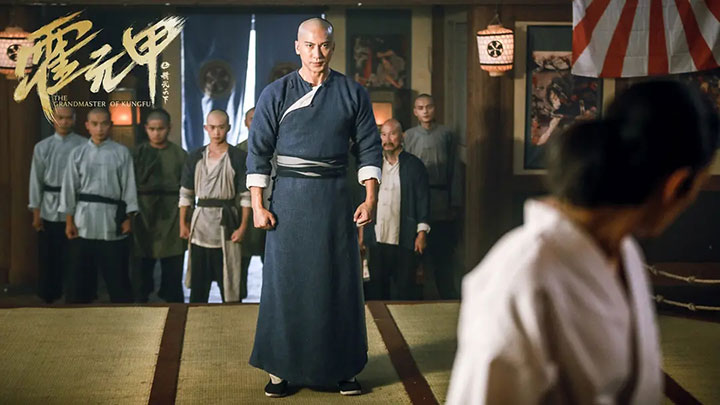
The protagonist of this story is Huo Yuanjia (former World Wushu Champion Du Yuhang (aka Dennis To). He is a lowly porter (with a large house, for some reason) with a wife (Mei Xue) and young child. Of course, he is a master at a specific kung fu, which is not recognized by the official wushu (an umbrella title for a form of kung fu; the other being kuoshu) association of Tianjin, and its new president, Zhao. His becoming the head of the group is the opening sequence of trial by fist and feet. Still, Huo manages to get a single disciple, Chen Zhen.

In comes the Japanese, led by trigger happy Commander Yoshida Masaichi and his Aikido sword wielding superior Colonel Takeda Kamesaburo, who takes over the association’s building to open a forbidden Japanese martial arts school. Of course, just minutes in, it is easy to tell that at some point it will be a fight between Yuanjia and either Masaichi or Kamesaburo in a match of Chinese kung fu vs. Japanese budō. Following the narration of nearly all these kinds of films This is a Chinese martial arts standard, and rightfully so.

Du Yuhang is very likeable, and his style is reminiscent of Donnie Yen (Ip Man). It should come as no surprise that he played the Ip Man character a year later in the prequel, The Legend is Born: Ip Man (2010). As far as the other actors, interestingly, the Japanese are played by Chinese actors, and the Japanese language is dubbed in. The film also stars Gao Xuemei, Yang Yongfeng, Li Ruoxi and Zhuang Han, but I do not know who played which role.

The film relies on a few cliches, such as the championship tournament, Japan’s overreach and malevolence, the final battle, and the one-against-many opponents (including Ninjas!). Because of this there are some formulaic narratives, but hell, we watch this stuff for the, well, Hi-YAH! quality. In this case, the action is both well-choreographed and shot/edited. There is a bunch of wirework, as is par for the course, but no ridiculous flying through the air or jumping from one roof to another. While obvious, it is done only within fights and not over-emphasized (e.g., no jumping from the ground to the top of a building).

My one complaint is that sometimes the subtitles roll by too fast for my aged eyes. But what the hell, it is the action sequences that are the backbone of any martial arts film, and this definitely delivers.

This is director Cheng Si-Yu’s first film and has since made the likes of Land Shark (2020). I am hoping he goes on to do a crime drama, or another martial arts release set in the Feudal period. Meanwhile, there is this gem.

A Hi-YAH! original, the film is available on the Hi-YAH! martial arts streaming service (link above), as well on Blu-ray and DVD.

IMBD listing HERE