All genres of suspense, terror, and horror will be reviewed by Richard Gary. His address to send preview copies supplied upon request to rbf55@msn.com.
At 50 minutes, this post-apocalypse
comedy thriller is too long to be considered a short, yet too short to be
considered a feature. I appreciate that the director made it just as long as it
is supposed to be, without much filler, or a truncated story. Plus, it helps
with the micro-budget, which I respect. It is also a perfect length for festivals.
In a similar theme to “The
Last of Us” television series, this story is about the survivors of a fungal
infection that transforms the affected into zombie-like people, who seem to
want to spread the disease more than eat living flesh.
Filmed mostly in black and
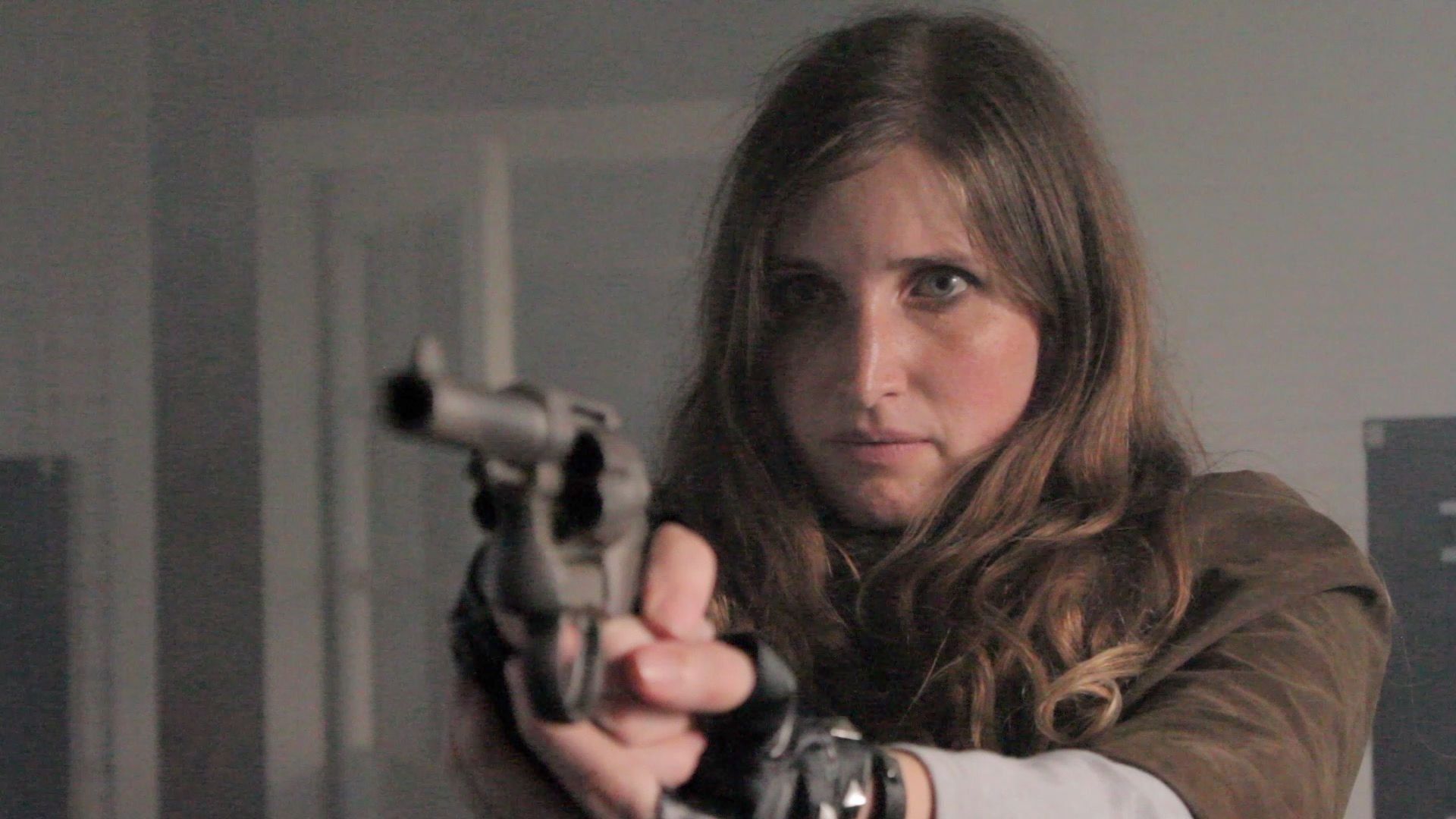
white, we meet artist/videographer Diane Keaton (Alexandra Slade; any relation
to Noddy Holder? Sorry…), who survived a massacre in a secured basement. She
manages to get to another floor and meets gruff General Gore (Nick Young). He
makes no bones that he is a hardass, giving similar, yet militarily edged vibes
of the John Goodman character in 10 Cloverfield Lane (2016).
I am not sure if the virus
was caused by a war, or the war was caused by the virus, but there seems to be
very few survivors, either by the infection or by gunshot (hence the basement carnage).
The black and white gives
this a noir feel, and the lighting is impeccable; it could be now, it could be
a 1940s film, though the assault rifles are a giveaway. The constrained spaces
of the rooms, the steam pipes, etc., give it an eerie, almost claustrophobic
feel, especially Gore’s habitat (okay, room). They slowly make their way
through the underground complex, not quite sure where they are going or how to
get out. Or if there is anything worth getting out for.
Diane (whom Gore calls String
Bean), is a Lefty, and cigar-chompin’ Gore definitely on the militaristic war
mongering Right, yet they occasionally find common ground. His comments, such as
his hostility towards LGBTQ in his comments, betrays that leaning. But through
it all, he’s more accepting of everything, where she is, well, let us say grumpy,
having trouble accepting a situation she does not appear to remember getting
into. Gore seems to keep her around not just for the only company, but for
procreation to get the world restarted, with him as its leader, like it or not.
Meanwhile, Diane misses
her girlfriend, Eva (Kathryn Schott), who we see (in color; there are a couple
of other color sections) in archival footage shot by Diane in the prologue.
As with Alice down the
rabbit hole, Diane and Gore transverse the space running into unusual
characters, such as a hairy and philosophizing “rat” man, Berenger (Michael C.
Burgess), among other surprises. Is this real, or is it part of hallucinations
due to a supposed vaccine they take?
While esoteric at times,
this short feature (see what I did there?) never talks down to its audience,
but at the same time keeps the attention throughout. A really well-made film.
Available on Troma Now!,
TubiTV, Plex, Prime Video, Apple TV and Xumo, among many others.
Doomsday Stories Directed
by Derek Braasch, Marcelo Fabani, Phil Herman, James Panetta, Joel D. Wynkoop
Cheevies Film Productions; Herman Productions;
IkuZo! Studios; Lonewolf Studios Uruguay; Wynkoop Productions
120 minutes; 2023 www.facebook.com/search/top?q=doomsday%20stories
It has been a while since
I reviewed an anthology film. Personally, I like them as a concept, generally. It
is like reading short stories instead of a novel. And as I have posited before,
anthologies tend to fall into three different categories: the first is a series
of short films cobbled together, such as The ABCs of Death (2012); the
second is a few stories strung together to tell a larger story like Bad Candy(2021); and the third is the one where the stories are all
mixed up together, going back and forth with either overlapping characters, or
jump around. What tends to be the most common aspect that is usually present is
the wraparound story, which introduces either the premise at beginning and end,
or each “chapter.”
The second point I have
also noted before, is that COVID was both a curse and a blessing, in a way. The
former is obvious, but the latter has to do mainly with the arts: people stuck
at home have written or created fine art more, and filmmakers either were
forced to make limited, smaller films with few cast and crew, such as Prince of the Crimson Void(2022), or as a subject matter, for it creating the
apocalypse, e.g., Ravage Nation(2022).
For this film, the stories
are 30 years after the apocalypse. As the intro voice-over states, the end
starts with COVID in 2019, which developed into the “Meanies” virus in 2025,
which wipes out all but 8,000 people. Our tales begin in 2055. So, what we are
looking at, is the second form of anthology listed above. The narration is handled
by Michael Moutsatsos, who directed Ravage Nation mentioned above.
Phil Herman
For the wraparound, a lone
man, Zorack (Phil Herman, curator of these tales and director of the
wraparounds) comes across a notebook with some stories in it. He roams the
countryside (which looks like it could be either the Jersey Shore or the Pine
Barrens) and narrates out loud to himself (hell, I do that too). When his
memories – which we see in stark and vague backsplashes – get too much for the
lonely guy, he reads the stories in the marble-themed scratcher. What we get to
see is the realization of those tales. Whether these stories are supposed to be
the writer’s fiction or memories is unclear, and unimportant, but worth noting.
The first of these, “A
Broken Promise” (directed by Derek Braasch) is a about a man and his dog (no,
not Don Johnson). Rick (Justin Bower) wanders around a lot for food and water,
showing kindness to some and killing others by defending himself, while mooning
for his late wife, Emma (Lillian Lamour) and infant daughter, seen in
flashbacks. Most of the story is of him roaming through some rusty truck
graveyards (coolest thing about this one). The story is way longer than it
needs be, but it does tug the emotional heartstrings as well as having some
nice practical SFX.
Justin Bower, Lucy
In “Bomb Threats” (directed
by James Panetta), annoying phone-addicted Katrina (Debbie D, aka Debbie Dee, who
also wrote this section, and had appeared in a few Bill Zebub films) is getting
ready for a nice vacation the next day, when the titular bombs start a-flyin’
and she’s rightfully a-scared. The Meanie virus is just starting to take hold,
so she coerces a business associate, Alvin (Jim Ewald), to let her stay
overnight in his bomb shelter (that looks like a garage). I will not say how,
but things do not quite work out as planned. I will note that one of the scenes
reminds me of a classic image from a particular Hershell Gordon Lewis film in
the early 1960s.
Filling in for the Zorack
stories are some of his own, that show up occasionally with Herman in a bad
blond wig and baseball cap whiningly phoning various people he knows who are in
the “turning point” of the Meanie virus, such as much tattooed Kate (Constance
Payne), cute Kelly (Alba O’Neill), and his pal, Frank (Carl J. Grasso) who has
a thick Long Island accent. I am guessing these segments were filmed during the
actual COVID pandemic, because each person’s story is shot individually.
Alba O'Neill
“Forever Man” (directed by
Marcelo Fabani) uses some decent animation and SFX (along with some cheesy
ones). The main character who does not speak is Frank 21 (Chandra Mouli Nandy),
though we hear his inner narration. The area he lives in, post-Meanies, where
in this case turns people into zombies rather than maniacs, demands its
denizens to sell their organs. In doing this, Frank 21 becomes a cyborg killing
machine. I think. To be honest, this segment tried too hard to be artsy in both
visuals and dialogue, and it becomes befuddling.
With an interesting
concept, “Joel D. Wynkoop’s 187 Times” (directed by Joel D. Wynkoop), James
Kirk (Wynkoop) had a wife, Diana (M. Catherine Wynkoop), that was killed, and
he spends the titular number of times going back in time from the year 2050 to
try and save her. But, of course, he keeps screwing up the timeline. He is
aided by an Alexa kind of electronic voice called Aistda (the voice of M.
Catherine). In this tale, it also explains how the whole Meanies virus got
started. There appears to be snippets from other films, probably made by
Wynkoop over the years, which is a nice choice. In one sequence, he goes back
to 1977, and I was thinking, dude, while you have the chance, go see the Ramones!
But I guess his priorities are different than mine…
A question I have is as
follows: It has been a while since the apocalypse, so water and food is understandably
scarce. So why are so many still overweight, and especially, why are they clean
in both body (including hair) and clothes? You would think washing…anything
would be an issue. For example, someone has a non-stained KISS shirt that looks
right off the rack, though the Motörhead one appears lived in a bit. While I am at it,
why are people scrounging for canned good?. Does no one grow anything? I have a
garden and that does pretty well for us most of the year. There is also no leaves
or weeds on what looks like freshly mowed lawns, and parked cars are shiny and
clean. And there is still electricity and television? Just sayin’, not
complaining. These tend to be true across many post-apoc films. There is a lot
of inconsistencies through the stories, but then again, if I read this right,
they are just stories written in a notebook, so that would explain the
differences from tale to tale.
Put together by the same
people who did the Horrortales.666 anthology franchise, this goes on
longer than it needs be (especially “Broken Promise”), but this is true indie
filmmaking with a budget of miniscule proportion. They work both as individual tales
and as a collective, which is nice. If you get a kick out of the duct tape
level of cinema, as I do, you might find this interesting. Not for anyone who
likes cohesive storylines or an artistic flair, but this is solid meat and
taters.
This movie is available
for $20, which includes postage. It can be acquired through contacting Phil Herman
or Joel D Wynkoop on Facebook Messenger. Add it to your post-apoc pile.
Super Z (aka Super
Z: Smart-Ass Zombies!) Directed by Julien
de Volte and Arnaud Tabarly La Ruche Productions; MVD Visual 80 minutes, 2022 / 2023 www.facebook.com/SuperZ www.MVDVisual.com
Zombie-love in the States
is obvious, but it is also far flung across the world, such as Train to
Busan (2016) in Korea, and in Europe, there is the recent Ever After (EndZeit) (2018) from Germany. Those films, however, are dead serious (pun intended).
On the other hand, there
is Super Z, hailing out of France, which is a bloody and gory comedy. There are
not too many zombie comedies in general, though there are the likes of Aaah! Zombies!!(aka Wasting Away) and Bong of the Dead(2011), not to mention the infamous Shaun of the Dead (2004), which even
predates this release. This feature is based on the directors’ 2014 short film,
“The Foodies.”
In French (with subtitles),
of course, this multi-level story of death, flesh and lust starts in a laboratory
called The Purgatory, of a corporation led by Le PDG/The CEO (Jacques Boudet,
who has had a long and storied career in French cinema). There is even a picture
of himself on his desk. He is assisted in this endeavor by the over the
top Le savant fou/The Mad Scientist (Jean-François Gallotte), who gleefully
tortures the people/zombies on whom he works. As you may notice, some characters
are expressed as their titles or roles, rather than their given names.
But the scientist has
taken an extra step on his own and has made them more than just killing and
eating machines, he has given them sentience, so they are aware of what is
going on and can even talk. However, that is mostly trash talk, taunting like
the French guards in Monty Python and the Holy Grail (1975), except full
of vulgarity and profanity.
Fabian Ara
The main test subjects are
a family of four: “father” Gertre (Johan Libéreau), “mother” Stephana (Julien
Courbey), and “daughters” Marcelline (Audrey Giacomini) and Georgette (Florence
Bebic-Veruni). After they escape the facility, along the way, while having – er
– dinner, they manage to turn a young man into one of them, Yvon (Fabien Ara),
whom they adopt. The transformation takes only seconds. Yvon confuses me,
though; is he supposed to be a teen? He plays his role like a man-child a la
Lou Costello or a Jerry Lewis character (remember how popular Lewis was in
France?). He is into rap, wears his extended cap sideways, pants hanging below
his butt, and has his name on a gold chain. And he’s a bit annoying; no where as
interesting as the foursome family. I do have to concede, though, that the “young”
daughters are also played by adults.
Sent after them is Le
mercinaire/The Mercenary (Lauren Bouhnik) and his cousin, La cousin (Jo Prestia,
who also has quite the filmography), out to hunt and kill the escapees. This
scenario, in some twisted way, reminds me a bit of Harriet Beecher Stowe’s 1852
novel Uncle Tom’s Cabin, with the hungry foursome as the escaped slaves being
Eliza and her family, and Le mercinaire as Simon Legree.
Holed up in a cabin (see?),
the extended zombie family fixes it up and feeds of people going by on a nearby
walking path in joyous and bloody ways. Some family dinner table scenes are hysterical
for both normality and – er – not (more on this later), and yet is extremely and
disturbingly full of blood and gore. They plot their revenge against the world
of humans, but what happens when one of them becomes infatuated by living, tooth-impaired,
Augustine (Marion Mezadorian)? There is a definite Romeo and Juliet
aspect to it, including a balcony scene. Smart.
While the excitement lasts
throughout, with very little lulls, it also picks up significantly in the third
Act when the mercenaries show up at the CEO’s insistence to do away with what
he considers a failed experiment(s).
Lauren Bouhnik
You can see the influence
of other films throughout, such as an homage to the ending of Mother’s Day (1980),
which made me smile. Another interesting aspect of the film is that as absurd
as it is, there is also a “normal” aspect of it, such as the zombies drinking
wine, smoking, taking drugs, sleeping (and snoring), loving and arguing. I
really enjoyed that. To them, even though they despise the living beyond the
food aspect, they are not much different in so many ways.
But what is most notable
is the gore effects and make-up, which look phenomenal. These were handled by Stéphanie
Couste, Harold Levy, Cédric Martin and Vanessa Ricolleau. It does not surprise
me it took four people, because there is a lot going on here, from zombie
make-up, the gore SFX, and body parts.
Taunting a second time...
Sexually, it is quite
crude, with masturbating and zombie sex, among other aspects I will not discuss
because I do not want to give too much away. This film just revels in absurdist
humor, which is bound to make some laugh, but will also guarantee some will
find repulsive in both visuals, comments made by characters, and the degree of
wit (mostly low level). But I found it quite fun and full of great moments.
Also, their voices are quite growly and screechy, almost as though their voices
have been sped up. This is especially true of Stephana. I am grateful for the English
subtitles, because even if it was in English, I may have trouble making out the
dialogue; however, the subtitles are not the best, being all white, but still
appreciated, as I was with the film in general.
Of his thirteen films to-date,
be it features or shorts, so far, I have seen/reviewed three of them (this will
be the fourth), each of a different genre. There was action thriller Elite (2017), post-apocalyptic anger infection Night Zero (2017), and slasher Massacre Academy (2021). This time at bat, it is the lycanthropy field.
While saying it fits into
the werewolf canon is true, there are so many horror genres mixed together here
in a Horror ghoul-ash. Y’gotcha cabin in the woods, backwoods hunters and murderers,
and even the meta-filmmaking (a group shooting a film within the film). The
latter with werewolves has been done before as well, such as Wolf Manor(2021). But every film is different, and I am looking forward
to this, as a werewolf fan.
Lynn Lowry
Filmed outside Pittsburgh,
PA, some of the scenery is quite awe inspiring, showing off the forests and mountains
of, I am assuming, Oak Hollow Park. You get to see less of it as time goes on
due to it being night, but meanwhile, enjoy.
With a prologue that
reflects on themes from both The Howling (1981) and Blade (1998),
we are off to a bloody start that had me smiling. A year later, there are two
storylines that are bound to converge. First, there is the film crew heading to
said Wolf Hollow to make their movie, starring washed up diva Marla Taylor (The
Lynn Lowry, of 1971’s I Drink Your Blood, GA Romero’s The Crazies in
1973, Cronenberg’s 1975 Shivers, and more recently, Debbie Rochon’s 2016
Model Hunger, among so many other classics). The second is that a larger township is commandeering a local area – yep, said
Wolf Hollow – and plans to kick out the Neuri (the name means the nervous
system) family, run by matriarch Evie (The Felissa Rose, most famous as
Angela in 1983’s Sleepaway Camp, but has become a major actor/producer
in the indie film field). The town leaders are quite obnoxious and
condescending about the land grab (i.e., their “tough nuggies” attitude).
Brian Ceponis, Feissa Rose (foreground)
There is tension all
around: for the Neuri family: a member of the clan who has run away to New
York, Ray (Noah J. Welter) has returned with the young and green film crew (e.g.,
one just graduated from NYU Film School), bringing additional tension between
him and his brother, Bart (Brian Ceponis), who is struggling financially, along
with his wife Evie. As for the potential filmmakers, well, it is one argument
after another, as they try to placate their spoiled faded star, Marla. I love
that many of the strongest characters are women, though it seems to me that
even though there tends to be more women victims in horror flicks, they also tend
to be the fiercest (check out Carol J. Clover’s amazing book, Men, Women andChain Saws: Gender in the Modern Horror Film).
With all the arguing going
on with both sides and each other, it makes it hard to find a connection with
some the characters, who tend to be a bit flat at times, though mostly undefined
personalities. But with mishaps and anger comes the night, and the filmmakers
are trapped in their trailer while the beasties beat on the door,
metaphorically and eventually literally. But that should come as no surprise.
Christina Krakowski
It should be quite
apparent to anyone who has a history of watching creature features to figure
out who are the werewolves. It starts with a slow burn first half (after the prologue),
but then it just spins the dial up. A major saving quality to the film is that
once the action really starts, about a third of the way in, it does not let up.
It is wolf-brutal with, to paraphrase Arlo, “blood ‘n gore ‘n veins in the
teeth.” While there are few surprises throughout the film, and parts are
predictable, that does not take away from the fun factor: there are a lot of
wolves, though you see one at a time. My guess is that there was only one suit
that was used over and over. This would make total sense given most indie’s budget
constraints.
That being said the wolfies,
designed by Midnight Studios FX, looks great, seeming to be modeled on those in
The Howling (no complaints there), with the exception of the head of the
lycanthropes, who’s initial change looks more like the human/cat face in Sleepwalkers
(1992). The overall gore effects are also quite well done, if sometimes a
bit dark (remember, it is night when the action comes).
Noah J. Welter
Most of the main
characters are likeable, though some of the cast is almost interchangeable given
such little exposition background (more time for action, I guess). Some of the
personality standouts include the meta film’s director, Alex Romero (Christina
Krakowski) – filmed near Pittsburgh, of course she is named Romero, duh – and her
beau, Ray (Noah J. Welter), brother of the head of the Nuri clan. Another role
of note is scene stealing Lucky Steve (Brandon Krum), who is the comedy relief
of the film crew, and definitely has the best lines. There are a lot of local police
who tend to blend into each other, even those at the higher level, but a standout
is Officer Mills (Valena Zitello).
The question that nagged
me for a while is why Ray brought the crew to Wolf Hollow, whether it was to
see family, to get comeuppance to the clan, or was he a Judas Goat. It becomes
clear by the end, and I ain’t spillin’ the beans.
It is pretty apparent that
the director, Mark Cantu, is a big Wes Craven fan. There are many references to
Craven’s cult films, such as the RV trailer-under-attack-by-bloodthirsty-locals
as in The Hills Have Eyes (1977), and one of the wounded characters
comments, “I’m feeling a little woozy here,” arguably the most requoted line from
Scream (1996). I believe Craven would have been proud to have his work
referenced here.
Jethica Directed
by Peter Ohs
Visit Films; Spartan Media Acquisitions; Pretty Ideas; Lightbulb Film Distribution;
Strike Media
72 minutes, 2022 / 2023 www.strike-media.com
Love-obsessed stalkers
fall into two categories: the first is the ex- that cannot accept that it is
over, the second is the one who is delusional and believes there is a
connection between the two parties, when there is none.
After a 20-questions type
prologue that introduces Elena (Callie Hernandez, who has some major credits such
as the recent Shotgun Wedding, 2016’s Blair Witch, and Alien: Covenant
in 2017), one of the three four characters of the story, we are told the events
as a flashback.
Callie Hernandez, Ashley Denise Robinson
From LA, she moves to New
Mexico to live in a trailer in the middle of nowhere (near Mountainair). Not
even a forest, so this is a cabin in the…desert? The introduction to her domicile
there is obviously a homage to the opening of Evil Dead (1981), perhaps signaling
to the viewer that something unearthly is afoot. Also noteworthy is a later
scene reminiscent of “The Hitchhiker” episode of “The Twilight Zone” (1960,
with “The Farmer’s Daughter” herself, Inger Stevens).
New Mexico is a beautiful
place. Much of what we see is open fields that go on for miles. It is winter
there (hence the coats) in the film, and desolate as you can get. Actually, it
reminds me of the Canadian prairies in the spring. There is an old joke that
says if you stand on a cigarette box, you can see a dog run away for three
days. This is the type of landscape that we see a lot in the film. It makes
sense as the backdrop is a symbol of the desolation of emotions felt by the
main characters, including Elena’s odd acquaintance, Benny (Andy Faulkner), who
looks as windswept as the environment.
Going to get some gas in
town, Elena runs into an old California high school mate, Jessica (Ashley
Denise Robinson), on the run from a stalker, Kevin (Will Madden), an classmate
in college, who keeps tracking her down; it is obvious to see where this is
going, but as it is the main focus of the plot and its selling point, I do not
believe I am giving anything away here.
At some point, the film
takes an unexpected supernatural element that I will not discuss, but it is
both disturbing, and yet, amusing (this is a very bleak and dark comedy…when it
wants to be that).
The cast and directors are
given co-writing credits, indicating that this was mostly ad-libbed around a
pre-conceived storyline. Sometimes that does not really work, but in this case,
it enhances the experience of tying the story and the language used in a lovers’
knot.
Though there is humor and
the supernatural involved, the main word I would use for this is minimalism.
The film is shot very serenely, considering the action, and there is a lot of
decent dialogue (kudos, especially if I am correct about the ad-libbing). The
landscape, which is a character unto itself, is reflective of the pace of the
story, wide and vacant, yet poignant.
Will Madden
The same could be said for
the excellent cinematography and editing by the director, lovingly showing the
beauty of the plains. I moved from the city to the prairies, and its starkness
and the quiet nature of the scenery is almost startling.
Equally haunting and understated
is the soundtrack by John Bowers, which is subtle throughout the story, lulling
and wrapping itself around the action, rather than startling with loud dissonant
notes, as in most supernatural films.
What I especially liked
was the way the story twists and turns, in ways that are completely unexpected.
There were bits I figured out, but it definitely went in a direction that was happily
unanticipated. This is also helped by the excellent acting all the way around,
especially by the ironically named (to the story) Madden.
There is no blood and
gore, little violence, a jump scare or two, and plenty of dialogue, as I said. However, this film is
story-based, and it is incredibly enjoyable. The only thing that confuses me is
the title; although it makes it easier to look up on search engines.
Considering the small
cast, it has a “filmed during Covid” feel, but that could just be my projection.
I have stated this before, that my theory is that Covid has made filmmakers
more creative by forcing them to use limited interactions and spaces.
Amazing for a release that
only cost $10,000. And stick around after the credits.
Available on AppleTV,
Amazon, Sky Store, Virgin Media, Google Play and RakutenTV.
This film has been a back burner
project of love for star, co-writer, and co-director Paul Chomicki for
literally decades. With the help of his buddies Christian Voss and Long Island
director Dave Campfield, his dream has become a reality.
Stories of fathers looking
for daughter who have become involved with serious situations is not new, including
Hardcore (1979) starring George C. Scott. But Chomicki updates it and
adds in ritualistic elements to up the ante. While Chomicki is mainly known for
off the wall comedies, such as the Caesar and Otto franchise, he sets down some
serious roots here.
Paul Chomicki
In the prologue, Alyanna Blackwater
(Katie Otten) escapes from a violent religious cult in Nevada (around Hay Spring)
called the Church of Ascension (aka Ascend), run by spooky “Father” Lucien Reed
(Avi K. Garg). Her disappearance is discussed over the radio newscasts throughout
the first act. You know this will be expository information for what is to
follow.
Meanwhile, Harry (Chomicki,
with his thick Long Island accent) is down on his luck. He is an unemployed alcoholic
who lives alone, and separated from his wife, Krista (Rae Hartwell). He is also
estranged from his daughter, Robin (Jama Bourne), though the division between
the two is not really examined here; she wants the connection, he does not.
When she vanishes, leaving a cryptic message on Harry’s phone, he sets out to
find her.
Katie Otten
Harry heads north towards
a First Nations/American Indian reservation (Cheyenne), where he believes her to
be held by the (white) cult, in a desolate part of the state (not surprising,
as Aboriginals were screwed out of their lands and placed in places that tended
to be nearly inhospitable, both in the US and Canada). But more about that
later.
There is a large, mixed
and overlapping bag of goodies here, from a religious cult (non-Satanic for once)
to human traffickers, to scavengers, and each one more dangerous than the
other. Add Harry searching for Robin and a revenge-fueled Alyanna, and you have
violence, mayhem, and a bit of a time clock as Harry needs insulin, and soon.
Also searching for Robin in a separate-but-equal storyline is Sherriff Ritter (co-director
Christian Voss).
Christian Voss
The landscape is stark,
and we see numerous (and beautiful) abandoned buildings and ruins among the windy plains to its desolate and disparate
foothills. Voss’s cinematography brings the area to life, to symbolize a form
of near death.
The social commentary is
deep and widespread through the story. It explores the dangers of cults and how
they prey on the lonely and scared/scarred, and how it is easy to fall victim.
But more central to the story is the long history of the plains (and of Western
Canada, as well) as far as the incredibly substantial number of Indigenous
women who go missing every year. There is an organization dedicated to this occurrence
called Missing and Murdered Indigenous Women (MIWW). It is of overwhelming numbers. Currently, I am watching a television program based
on a series of novels by Louise Penny called “Three Pines,” which centers around this topic.
There are some decent gore
effects, though it is happily limited, as this is more about the story than a
splatterfest. Most of the body effects are SFX, while there is some CGI used
sparingly, such as a rainstorm.
I have always known Chomicki
as a comedy actor in slapstick films, so it is good to see him get serious. While
his acting remains in a certain range, he shows that he can manage the drama as
well as the goofiness, when needed. The rest of the cast also does well,
including Dave Campfield, who literally phones it in (Zoom on a computer and by
cell phones), in a role that’s key to the story, however.
While recognizing this is
a life dream for Chomicki as lead actor (rather than co-lead), he has done
himself proud. The film is a good B thriller with bit of violence and a social
conscious. I like that.
Be sure to stick around
after the credits. Perhaps a sequel, with Disney nurse Scott Aguilar? I am hoping.
Ravage Nation (aka Ravage III: Ravage Nation) Directed by Michael Moutsatsos Dondi Inferno Productions
87 minutes, 2022
Before I even start,
please note that the fact that this is the second chapter in the series should
not matter, and I will explain below within the review.
When idjits refuse to
get mass vaxxed, as with the COVID virus, the disease has the chance to mutate.
So far, we have been fortunate that until now, the mutations have been slightly
lesser in severity. But what if they got worse, instead? That is the premise, in
part, of this film.
Jake Scozzaro, Ed Gage
By 2036, most of the
population has been wiped out by CV5., Let everyone thank the likes of Trump, DeSantis,
Bobert, Greene, etc., for this. According to the text scrawl that opens the
film, mothers gave birth to human mutations in the forms of beast-like
creatures, which hunted humans. If they bite or even scratch you and you live, you
turn into a flesh-eating zombie yourself in a mere 12 seconds. All this info and
exposition is presented before the credits (it also appears in the trailer,
below).
The mutants tend to be
people with either extreme white make-up on, or animal heads (masks), and they
go around either capturing and killing humans on their own, or murder them in
gangs, often with axes or sledgehammers, for some reason: a pragmatic choice
may be that because the mutants wear thick gloves, I am guessing to help with
the make-up expenses, rather than having to show the misshapen hands. If this
is true, I respect that.
Rather than a
narrative storyline, we see vignettes of people being killed, many bound up
beforehand. The film is mostly monochrome, usually black and white, and the slaughters
in red. These fragments are not exceedingly long, so if you tire easily, a new
one is coming up very shortly.
Because Act 1 of this
film is episodic, it really does not matter that there were two previous releases.
There are very few returning characters, except perhaps one of the main ones
from the previous releases, Dean (Jake Scozzaro), who has multiple personality
disorder (they are legion, including one from my home town of Brooklyn, NY) –
think of Split (2017), without The Beast – perhaps derived from PTSD resulting
from the effects of the first two films (which I have not seen), after what
happened to his family, shown in the prologue. He dominates nearly the entire
Act 2. Amusingly, he kills a chained zombie who wears a tee-shirt that says “Vaccinated.”
Perhaps a Right-Wing commentary, as they claim you will catch COVID even if you
had your shot(s)? That is true because too many, as I said, have not had their
shots to neutralize it communally. Also, one character discusses how COVID was
invented by the Chinese as a chemical weapon, a solid Republican talking point.
Again, I politically digress, but at least you know where I stand…
There is some humor
here and there, seemingly to revolve around a ventriloquist’s doll called Marv,
who not only Dean has conversations with, but so does a guy named Stan (director
Michael Moutsatsos), who not only
talks to Marv (and hears answers), but also to imaginary people. When Dean and
Stan get together at a picnic table with Marv to play cards, it feels like
sitting in on an ad-lib, off-the-wall conversation.
Another returning
character is survivalist Silver (Ed Gage) who is into martial arts; however,
his appearance in Act 3 is more of an extended cameo, though he does get to
show off his “moves” with fists and a sword.
Another aspect I found
of interest is both the external and internal actions of the two food groups,
as it were. The mutants kill humans randomly but like to eat babies. This leads
me to a question: if a mutant, also known as a hybrid, eats a human, is that
cannibalism, as they are both the same and varied species? Anyway, the mutants
mostly seem to work together (not counting the lone wolf zombies who are mindless
eaters, as they should be) to slaughter the humans they consider inferior.
However, the humans kill mutants, zombies, and other humans, the latter
for the competition of food, I guess. In this scenario, the mutants seem more
cohesive, socially.
While there are some squeamishable
scenarios, the gore looks decent, but, though the level of violence is quite
strong, shown steadily throughout the entire film. For me, I did not mind the
monochrome, but the way the red filter is used gives a “tell” that a kill is
about to occur, kind of ate away at the surprise value, even if it was obvious
what was coming.
The ending is a bit up
in the air, but considering the storyline, such as it is, it makes sense to
leave it open ended, because a title card at the end informs of a Ravage
Domination sequel. There is not an easy resolve for the world situation as
it depicts; no fixes. Sort of like the end of The Planet of the Apes (1968)
with Charlton Heston yelling on the beach, or I guess a better choice may be Night
of the Living Dead (1968).
Though the film
occasionally feels amateurish and cobbled together (yet it has won numerous
festival awards), it certainly is entertaining. I may have to go back and watch
the first release, and see the origins of the events that are recounted
here.