Showing posts with label MVD Entertainment. Show all posts

Friday, February 3, 2023

Review: Fortress of Sin

Text © Richard Gary / Indie Horror Films, 2023
Images from the Internet

Fortress of Sin
Directed by Paul Chomicki and Christian Voss
Ragged Sky Productions; Cinema626; The AKG Adjacent; Wild Eye Releasing; MVD Entertainment
73 minutes, 2022
www.facebook.com/groups/3174577106153279 
www.wildeyereleasing.com
www.mvdvisual.com

“They got guns
We got guns
All god’s chillren got guns…”
– The Marx Brothers, Duck Soup (1933) 

This film has been a back burner project of love for star, co-writer, and co-director Paul Chomicki for literally decades. With the help of his buddies Christian Voss and Long Island director Dave Campfield, his dream has become a reality.

Stories of fathers looking for daughter who have become involved with serious situations is not new, including Hardcore (1979) starring George C. Scott. But Chomicki updates it and adds in ritualistic elements to up the ante. While Chomicki is mainly known for off the wall comedies, such as the Caesar and Otto franchise, he sets down some serious roots here.

Paul Chomicki

In the prologue, Alyanna Blackwater (Katie Otten) escapes from a violent religious cult in Nevada (around Hay Spring) called the Church of Ascension (aka Ascend), run by spooky “Father” Lucien Reed (Avi K. Garg). Her disappearance is discussed over the radio newscasts throughout the first act. You know this will be expository information for what is to follow.

Meanwhile, Harry (Chomicki, with his thick Long Island accent) is down on his luck. He is an unemployed alcoholic who lives alone, and separated from his wife, Krista (Rae Hartwell). He is also estranged from his daughter, Robin (Jama Bourne), though the division between the two is not really examined here; she wants the connection, he does not. When she vanishes, leaving a cryptic message on Harry’s phone, he sets out to find her.
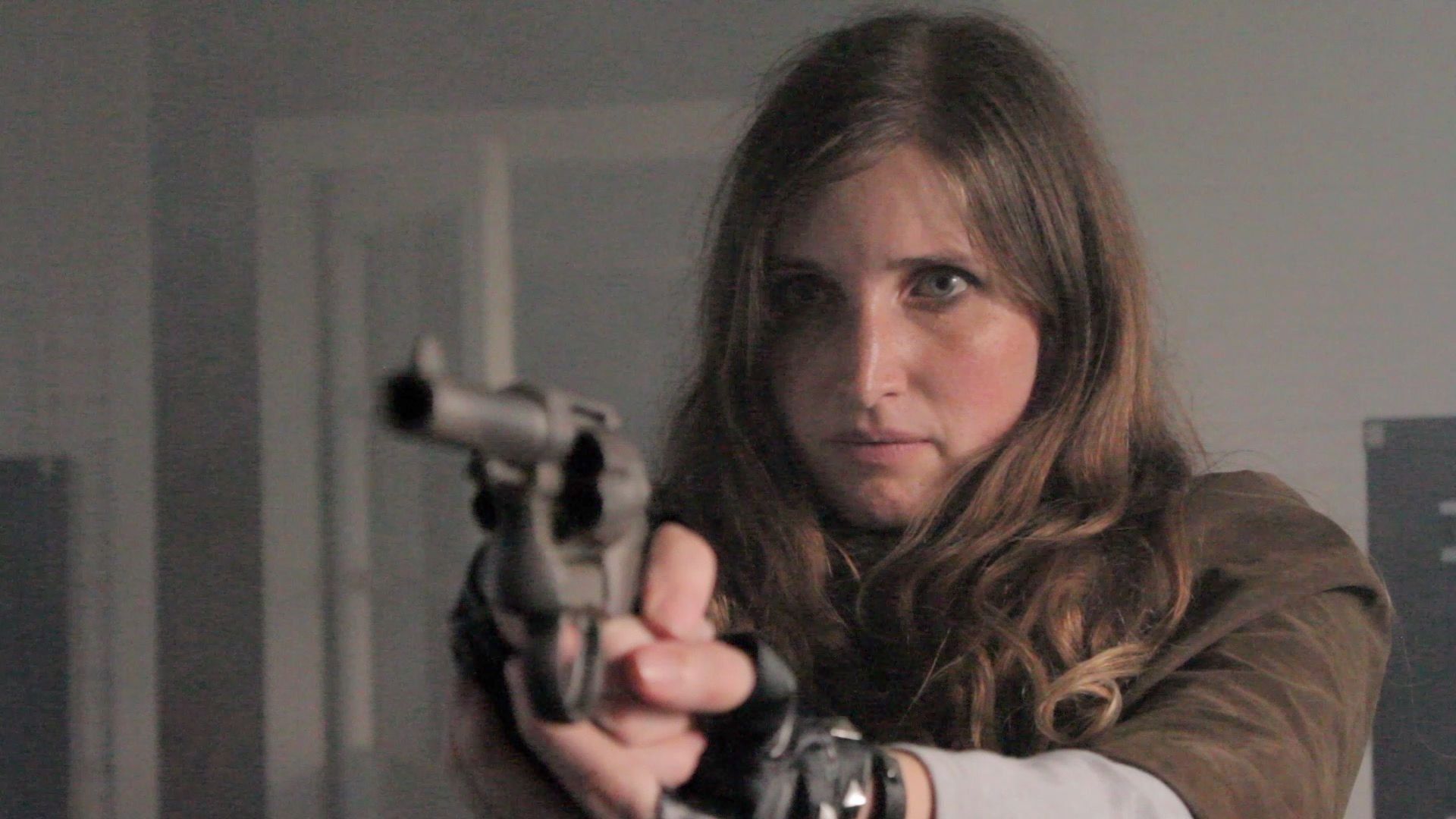
Katie Otten

Harry heads north towards a First Nations/American Indian reservation (Cheyenne), where he believes her to be held by the (white) cult, in a desolate part of the state (not surprising, as Aboriginals were screwed out of their lands and placed in places that tended to be nearly inhospitable, both in the US and Canada). But more about that later.

There is a large, mixed and overlapping bag of goodies here, from a religious cult (non-Satanic for once) to human traffickers, to scavengers, and each one more dangerous than the other. Add Harry searching for Robin and a revenge-fueled Alyanna, and you have violence, mayhem, and a bit of a time clock as Harry needs insulin, and soon. Also searching for Robin in a separate-but-equal storyline is Sherriff Ritter (co-director Christian Voss).

Christian Voss

The landscape is stark, and we see numerous (and beautiful) abandoned buildings and ruins among the windy plains to its desolate and disparate foothills. Voss’s cinematography brings the area to life, to symbolize a form of near death.

The social commentary is deep and widespread through the story. It explores the dangers of cults and how they prey on the lonely and scared/scarred, and how it is easy to fall victim. But more central to the story is the long history of the plains (and of Western Canada, as well) as far as the incredibly substantial number of Indigenous women who go missing every year. There is an organization dedicated to this occurrence called Missing and Murdered Indigenous Women (MIWW). It is of overwhelming numbers. Currently, I am watching a television program based on a series of novels by Louise Penny called “Three Pines,” which centers around this topic.

There are some decent gore effects, though it is happily limited, as this is more about the story than a splatterfest. Most of the body effects are SFX, while there is some CGI used sparingly, such as a rainstorm.

I have always known Chomicki as a comedy actor in slapstick films, so it is good to see him get serious. While his acting remains in a certain range, he shows that he can manage the drama as well as the goofiness, when needed. The rest of the cast also does well, including Dave Campfield, who literally phones it in (Zoom on a computer and by cell phones), in a role that’s key to the story, however.

While recognizing this is a life dream for Chomicki as lead actor (rather than co-lead), he has done himself proud. The film is a good B thriller with bit of violence and a social conscious. I like that.

Be sure to stick around after the credits. Perhaps a sequel, with Disney nurse Scott Aguilar? I am hoping.

IMDB listing HERE


Tuesday, November 15, 2022

Review: Moonchild (2-disc: Blu-ray + CD Soundtrack Edition)

Text © Richard Gary / Indie Horror Films, 2022
Images from the Internet

Moonchild
Directed by Todd Sheets
Visual Vengeance; Wild Eye Releasing; Jackalope Media; Extreme Entertainment; MVD Entertainment
102 minutes, 1994 / 2022
www.wildeyereleasing.com
www.MVDEntertainment.com/
Director Todd Sheets was known early in his career as a fantastical yet grainy cult-god filmmaker. After a health scare, he came back stronger than ever, with the likes of Clownado (2019), Bonehill Road (2017), Dreaming Purple Neon (2016), and House of Forbidden Secrets (2013).   

This film, however, is from his early cult days, and is well-beloved by his followers. Honestly, I have never seen it till now, like much of his early work, so I am looking forward to checking it out. This was originally shot on sVHS, so it is grainy, but this release was taken from the master tape by Sheets himself. This is the first time it has been released on Blu-ray.

Auggi Alverez

In much like the Mad Max franchise, we are introduced to a dystopian future of the Chicago area (though filmed in Kansas City) where a group called Sodality (meaning “Brotherhood” or “Community”; also, a devotional association of Roman Catholic laity) run the dictatorial government of the United Nations of America; I guess more like Gilead but almost post-apocalyptic as we see a run-down city that drives cars from the 1970s and ‘80s (it was released in 1994, so it makes sense in that way). Sodality is run by Kronos (Tom Berg), a blubbery too-white guy (think of 1971’s The Omega Man) who has 666 drawn onto his body.

Government scientists have an inner-city compound where they experiment on creating super soldiers, such as one who is a cyborg whose outer clothes makes him look a bit like a cockroach (sans extra limbs, but adds a body chainsaw). He is one of three of these hybrids that are in search of our protagonist, Jacob Stryker (Auggi Alvarez).

Dave Miller

Stryker is also a hybrid, but has retained his consciousness. He escapes from the Republicans…I mean the Sodality. He is in search of his son, Ethan (Stefan Hilts), who is being held captive somewhere. And while he is on the run after an action scene right at the start, he manages to hook up with the underground, run by Talon (Dave Miller), who mostly dress like the Arrakisians in Dune, with scarfs and hooded robes. Speaking of which, you know Stryker is the hero because of his knee-length, open military jacket (belonging to Alverez’s dad), reminiscent of The Matrix franchise.

After his experimentation results, Stryker can also turn into a semi-werewolf-like creature, hence the title, though it’s a misnomer, even though he does not need the moon to actually “change.” He’s more like The Hulk in that he turns when he is angry or in a fight. Oh, and did I mention there is a bomb in his stomach scheduled to go off in 72 hours? How Snake Pliskin!

Kathleen McSweeney, Rebecka Rose

He sets off with new love interest (his wife was killed) that took less than a day, Athena (Kathleen McSweeney) and some others: Talon, boppy Weasel (Kyrie King), Rocky (Julie King), and Teela (Rebecka Rose). From this point it is more or less a travelogue where they meet different groups, each one dresses alike within the group. Quite like The Warriors (1979).

It is worth noting that despite the low budget, the sets are amazing, the lighting and shadows work well, and the editing is spot on.

Carol Barta

Now, as for extras, oh my god, there are so many. This may take days to get through. It starts with two commentaries. The first is with Todd Sheets and star Auggi Alverez. These two are friends, and their commentary is easy and breezy, yet still informative. I really enjoyed this one. The other commentary is Sheets and Rob Hauschild of Visual Vengeance, who released the Blu-ray. That’s right, if you watch the film and the commentaries, it’s like watching the film three times. The second one is a bit more of a technical view, details on filming process, and Sheets’ career, but it is interesting for those who like this side of the method. There is very little overlap with the other commentary, which is worth a note. While this Blu-ray is the Director’s Cut, it also Includes the alternate VHS version of Moonchild as originally released, I respectfully bowed out of watching it a fourth time.

The first featurette is the documentary, “Wolf Moon Rising: The Making of Moonchild” (32 min). This is archival footage including an entire newscast about the production, backstage scenes and the creation of the music. There is no narration, just some interviews with the cast at crew at the time of filming. And speaking of “back then,” this is followed by “Original BTS Casts and Crew Interviews” (9 min) that is pure candy. The “Deleted Ending” is an extra fight scene, but honestly, the film’s ending as it stands now is much better.

The first of the last two biggies is the short film “Sanguinary Desires” (1988, I believe; 13 min), where a group of people are offered $10K to spend the night in this series of rooms, but of course, as the title indicates, there is lots of blood and guts involved as they meet up with various forms of the undead. Will any survive? The second, of course, is the additional disc that is the soundtrack of the film, which is quite good, including the expected synth pieces and the orchestrated songs as well. Worth a listen.

Then there are others like the original VHS trailer and one for one of my fave Sheets releases, Bonehill Road (another werewolf film), a music video by death metal band Descension of “Burn the Church,” and other Visual Vengeance trailers (including the new one for this film), which always plays whenever you put in the disc, and English subtitles upon request.

On the non-digital side, there is a reversible sleeve featuring the original VHS art, a four-page liner notes booklet by Matt Desiderio of “Horror Boobs,” stick your own VHS sticker sheet, and a folded mini-poster

One point in the full film that confuses me is that the terribly intentionally overacting bounty hunters, especially Lothos (Harry Rose) and Medusa (Carol Barta) from the Sodality – It reminds me of the villains from the old “The Power Rangers” series – seem desperate and will use any method to catch Stryker, but if he had a bomb inside of him, why bother, as he will be dead in a couple of days? Also, the fight choreography is kind of funky, and there is a lot of it. But my big bugaboo about the film is not enough transformations. But then again on the good side, it is important to remember how low-budget this was, and some mental leeway has to give way for the zeitgeist of the film as a whole.

All-in-all, though, this was a fun ride, from beginning to end. But I can totally understand why it is a cult classic, and rightfully so, in my opinion.

IMDB listing HERE

Saturday, November 12, 2022

Review: L.A. AIDS Jabber

Text © Richard Gary / Indie Horror Films, 2022
Images from the Internet

L.A. AIDS Jabber (aka Jabber)
Directed by Drew Godderis
Visual Vengeance; Wild Eye Releasing; MVD Entertainment
78 minutes, 1994 / 2022
www.wildeyereleasing.com
www.MVDEntertainment.com/
This relatively new imprint of Wild Eye Releasing, called Visual Vengeance, is an interesting idea. They deal with lowest of low budget archival films, usually shot on VHS or some other older medium, without correction. The stories are goofy, but usually not as much as the acting. And for all of that, I say ‘Woot Woot!!” It is great that these films are getting to see the light of day again. There are so many VV films that I have never heard of before, though I have read the name of this one before in indie horror mags. I am looking forward to seeing it.

Jason Majik

The cheesy synth score by John Martin Turner during the opening credits tells you exactly where you are in the indie horror food chain. The main character, who is also the antagonist, is 19-year-old Jeff Roberts (Jason Majik). He definitely has some borderline mental issues, especially with anger. And now he has been diagnosed with AIDS; wouldn’t he have HIV first, especially since he believes he contracted it from a particular prostitute six months previous? Saywhat?

His anger is having an effect on his world, including getting fired by his boss (Fred Nugent); his physician, Dr. White (Craig Harris) and a social worker (Victoria Crane) are worried about him, that he will hurt himself or someone else, including his girlfriend (Mitzy Tony), but they will not call the police. Saywhat?

Meanwhile, Jeff is making a list to take revenge upon, including the prostitute, by, yes, injecting them with his blood. But wait, if the prostitute (Susan Para) already has AIDS to his belief, what would be the purpose of injecting her with his blood? Saywhat?

Marcy Lynn, Tony Donangelo

Unstable Jeff starts going around stabbing people on his list, as well as random pedestrians. The cops (Marcy Lynn, Tony Donangelo, and then Justin Mack) almost catch him but he escapes. I bring this up because in an alley chase scene you can clearly see the shadow of the cameraperson, which made me smile. I love low-budget films just for reasons like that.

When Jabby calls a feisty female television reporter, Judith Campbell (Joy Yurada), to threaten her, she has a co-worker include the police on the call to try and nab him. Yet when the cops come a-callin’ to her house to see if she wants protection, she questions how they know about it. Saywhat?

But, to be honest, I am impressed by the sub-stories, like the cops who are trying to get him, and the reporter who is in danger from needle-boy. The film actually has more depth than I was expecting, despite some of the logical fallacies, such as the ones I mentioned above. There are others as well, just not as glaring.

Despite being taken from master SD tape, the film is grainy as all get out, especially the outside night shots (the time capsule imagery of seedy L.A. is enjoyable), and towards the end there is video noise that made me both grateful that it is uncommon with current digital technology, and ironically a little bit nostalgic. The acting runs from pretty flat to over-emoting, but that is to be expected.

The film ends exactly like one might think it would be concerning our AIDS gent (well, I did, anyway), but there is still a nice O. Henry-ish twist at the end that had me laughing and a bit confused.

Majik, Joy Yurada

Now, the bonus features of this Blu-ray are extensive, all done within the past two years. It starts with the “Director’s Introduction to Movie” (1 min), a nothing burger of thanks to the cast and distributor. The real meat starts with the full-length commentary with Godderis, Wild Eye Releasing’s Rob Hauschild, and low-budget director Mark Polonia (e.g., Camp Blood First Slaughter; Shark Encounters of the Third Kind;Virus Shark). Sometimes there is a bit of just describing what is happening on the screen, but that is only a small part of it. Most of it is pretty interesting as there is descriptions of what was going on with the scenes, talking about L.A. at that time, and explains some of the Saywhat? moments, like the disappearance of a particular character. It is a good schooling for indie, low-budget filming. Amusingly, no one mentions the shadow in the alleyway.


And if that wasn’t enough, next up is “Lethal Injection: The Making of L.A. AIDS Jabber,” with the director (10 min). While I found the full commentary interesting, this covers mostly new ground, and is just long enough to keep the interest going. It makes sense the next interview is “Bleeding The Pack: An Interview with Lead Actor Jason Majik” (29 min). It’s a bit rambling, but he discusses how he was chosen for the role, what it was like shooting the film, and he fills in some gaps which even Godderis is vague. He also talks about the post-filming in his life, including seeing it for the first time while tripping. While it’s kind of unfocused, and maybe because of it, it kept my interest.

The next featurette is “L.A. AIDS Jabber - 2021 Locations Visit.” (16 min). I always find these before and after location scenes fascinating. It is led by Godderis, and things are almost indistinguishable from 30 years ago. Following is an “Interview with Blood Diner Director Jackie Kong” (9 min). As an actor, Godderis co-started in Blood Diner, which became legend. Honestly, I did not watch it. Nor did I watch an interview with Godderis’ son who appeared briefly in the film when he was 3-years-old, called “Growing Up On Set: Justin Godderis” (9 min). However, I was curious about the next, “Actress Joy Yurada Interview” (7 min). She played the reporter. Some of it is a bit rambling, but it was fun when she pulled out a binder with the film’s notes and her lines.

The next talking head is the “Through the Lens: An Interview with Cameraman Rick Bradach” (6 min). It’s okay, but not very engaging to me. “Interview with Actor Gene Webber” (4 min) follows. He was a secondary police character, and doesn’t really bring much to the table. The last two digital extras are a photo gallery consisting of behind-the-scenes shots of the first day of shooting, and the new version of the trailer.

On the physical side, there are liner notes in a booklet titled “Rage in the Blood” by Tony Strauss of Weng's Chop magazine, a collectible folded mini-poster, stick your own VHS stickers, and a reversible BR sleeve featuring the original VHS art

This is Drew Godderis’ only directorial endeavor, though he’s acted in a number of well-known B horror films. When it came out, Godderis personally distributed the film on VHS. I am aware it has been decades since this was released, but I wonder if he will ever direct more, please.

IMDB listing HERE


Wednesday, June 15, 2022

Review: The Living Dead at Manchester Morgue

Text © Richard Gary / Indie Horror Films, 2022
Images from the Internet

The Living Dead at Manchester Morgue (aka No profaner el sueño de los muertos; Let Sleeping Corpses Lie; Don’t Open the Window)
Directed by Jorge Grau
Synapse Films; Star Films SA; Flaminia Produzioni-Cinematogrpahiche;
MVD Entertainment
95 minutes, 1974 / 2022
www.MVDentertainment.com

Despite using “Manchester” in the title, it sounds like this is a British film, but au contraire, it is actually of Italian Spanish origin. Which means it can be either really good or really bad, or so bad it’s good. I am a fan of Italian giallo films from the period, and also of the absolutely crazy Spanish-origin releases of the period, such as The Blood-Splattered Bride (1972).

To be fair, parts of the outdoor scenes of this was filmed in England, such as Lucio Fulci’s The New York Ripper (1982) was filmed in, well, you know, but most was in Madrid and Rome. However, both the English and the European actors are all dubbed into English, as was the style at the time.

Cristina Galbo, Ray Lovelock

On a road trip to deliver a small statue, obnoxious antique shoppe owner and future protagonist George (Ray Lovelock; d. 2017) has a fender-bender with redheaded and obvious future love interest Edna (Cristina Galbó), and so ends up sharing Edna’s car. For a liberal, he’s a real macho moron, full of toxic masculinity (“I’m driving!" he declares without asking, though it is her auto). He better chill out, or I’ll be on the side of the living dead. The gender roles are codified into “Me Man You Woman” kind of thinking, which I’m so glad that, as a culture, we are starting to break out of, if you’re not a modern Republican.

After a brief set-up of how the dead come to life via farm experimentations with radiation, I kid you not, and Edna being attacked by an obvious dead person reminiscent of Bill Heinzman in Night of the Living Dead (1968), they manage to find the farm of Edna’s sister Katie (Jeannine Mestre) and her photographer brother-in-law Martin (José Lifante) farm. Just in time for the dead guy to make another appearance (George and Edna drove…how did the dead guy beat them to it?; this happens a few times with various zombies).

Jeannine Mestre

Anyway, the point is that it brings the police, including a Sam Spade-meets-Dirty-Harry type of hard-bitten cliché Sergeant Inspector (American actor Arthur Kennedy on the other side of his Oscar-nominated career; d. 1990), who uses a gay slur word and bemoans the loss of being able to act violently against suspects who he deems guilty until proven innocent. You can tell by the tan trench coat.

While there are a nice number of flesh-eating zombies scattered throughout, though usually 3-4 at a clip, they indeed feed on the living, but also have quite a bit of strength (e.g., two of them pick up a grounded tombstone) as they stumble around. They also have an ulterior motive to what they are doing that is actually kind of uncommon for the genre; for that, I will happily give the filmmakers credit. One of the zombies even rises vertically stiff as a board, reminiscent of Nosferatu: eine Symphonie des Grauens (1922).

Arthur Kennedy (right)

There is a lot extrapositions used, such as obviously the living vs. the dead, but there is also the modern youth vs. the fascist elders (relatively speaking), and the strongest point may be the natural environment vs. agricultural technology that is polluting and killing the land.

The name of the film is actually a bit of a misnomer, as it doesn’t take place in Manchester (other than the opening montage), though there is a truck seen more than once with the name on it. It actually takes place (but not necessarily filmed in) the beautiful countryside near Southgate and Windermere in the U of K. This new 4K restoration of the original 35mm negative really shows off this visage. In general, this is a very good looking film, being stylish without being overly “arty,” making it more accessible, thanks to the amazing care of cinematographer Francisco Sempere (d. 1979).

The gore is plentiful when it is employed and looks great (possibly real offal and organs), and there is little nudity other than a seemingly gratuitous scene right off the bat (explanations about streaking as a political movement is given in the Blu-ray’s Extras Section). No complaints, but had me scratching me noggin.

There are tons of Extras on this Blu-ray, some may argue more than is necessary for a secondary-level release, but let’s dive in: It starts with a featurette about the director, who passed away in 2018: “Catalonia’s Cult Film King: A Documentary About Jorge Grau and His Manchester Masterpiece” (89 min.). This comprehensive coverage of the career of Grau includes a number of interviews, including Grau himself (in Spanish with subtitles) and numerous British film historians. They discuss his career, his entrance into horror, with The Female Butcher/The Legend of Blood Castle (1973) about Lady Bathory, and especially focuses on The Living Dead at Manchester Morgue. One of the writers notes that this film came out before the “zombie rules” were codified, so there are some notable differences from other general Living Dead inspired films to come. But what interested me the most is the discussion of the fact that Grau was coming out of the transition of Fascist Spain, and he represented some characters to reflect that, namely the modern and liberal (and douchey is you ask me) George, which was Grau’s leaning, and the Fascistic police inspector. Also, I was happy to hear the lone woman on this documentary, a critic, comment on the subservient and hysterical woman/strong and in-charge man stereotype. It kept me watching the entire length.

Another featurette is “The Scene of the Crime: Giannetto De Rossi in Discussion from Manchester” (16 min), which is new for this Blu-ray. De Rossi (d. 2021) is the make-up and special effects artist, who is interviewed by writer Eugenio Ercolani. This is in English, though De Rossi is subtitled due to his heavy accent. He also famously worked on a bunch of Fulci films, such as Zombie (1979) and The Beyond (1981). He discusses how he got to work on this film as well as Fulci’s, and what he feels about his accomplishments. Another Extra that also focuses on him is “Giannetto De Rossi: Q&A at the Festival of Fantastic Films, UK” (43 min.) recorded in the same year and at the same festival as the previous interview, in 2019. This is also moderated by Ercolani, and goes into more detail thanks to the larger time given. It also goes over much of the same territory as the first one, but without the video clip examples. I did a little skimming on this one.

However, the highlights are two full-length audio commentaries with film historians. The first is with Troy Howarth, an American who writes books about European Cult Cinema. Honestly, this sounds like every other historian’s commentary in every other Blu-ray for every other film. That being said, I found it interesting because I love film history and this guy is obviously more knowledgeable than I am on the topic, so give it a listen, but know what you are getting into (as the Herman’s Hermits sang in paraphrasing, “It’s into something good”). The second commentary is with film critics Nathaniel Thompson and Bruce Holecheck, who cover similar ground as the one with Howarth, but manage to cover even more material despite some overlap, and they also add some humor to their descriptions. As for other bits and pieces, there are the likes of the Original Theatrical Trailer, Original TV Spots, and “Radio Spots.”

While considered B-level in the Italian zombie giallo genre, this really should not be missed, because it has become a classic, and there are so many connections to the likes of Fulci and Argento that it certainly is now part of the storied canon. Besides, it is a hoot. Strong SFX, decent story, stirring music all combined into something eminently watchable. Enjoy. Mangiare!

IMBD Listing HERE 


Friday, June 10, 2022

Review: Don’t Let Her In

Text © Richard Gary / Indie Horror Films, 2022
Images from the Internet

Don’t Let Her In
Directed by Ted Nicolaou

Full Moon Features; MVD Entertainment
61 minutes, 2021 / 2022
www.facebook.com/fullmoonfeatures
www.fullmoonfeatures.com/
www.MVDentertainment.com

For those of us who either grew up in the ‘80s VHS video boom, or are a fan of that prolific period, this release has a definite draw. It was directed by Ted Nicolaou, who set off the infamous Subspecies franchise and gave us TerrorVision (1986).

I am assuming we have all heard the expression “roommate from hell,” and some may have even experienced this phenomenon. Well, what if that were more than just an expression? Imagine if the person sharing your flat was, say, the nanny who hung herself in The Omen (1976), or one of the building tenants in Rosemary’s Baby (1968). That is the starting point of this release.


Kelly Curran

A young couple live in a loft (at the iconic Nate Starkman & Son building in Los Angeles) that is freakin’ huge, and that they can’t really afford. There is Amber (Kelly Curran), who designs posters for indie horror films and looks like she popped out of an Archie Comic, with a blonde bob and teeth for miles. Her boyfriend is Ben (Cole Pender), a guitarist for an up-and-coming band. They need a roommate, and that person shows up in the form of Serena (Lorin Doctor), a dark and mysterious New Age-y artist who works with herbs and minerals, and also can be found chanting a lot. The direction this is going is pretty obvious from the start.

Of course, there is an ulterior motive for Serena being there while there is a stranger, Elias (Austin James Parker), who looks a bit like The Witcher, that is hanging around outside the building.

Lorin Doctor

We soon get to see Serena’s true nature (and often her boobs at the drop of a lingerie). She easily seduces the couple one by one, setting up the evil plan to spring forth from her involvement.

And now that Amber is pregnant, obviously with something beyond human, how will our young couple, who are about as committed to their relationship as they are to their breakfast cereal, deal with this situation?

Well, honestly, it’s pretty predictable, but please, keep reading. Even though the ending can be seen a mile away, this is a fun romp and so typical of the fare of Full Moon, short at an hour’s length, and to the point. You get what you wish for, and that is a Full Moon production. They aren’t known for rocket science, and that’s just the way it should be. This film definitely keeps on brand: nudity, gore, and demons. There is little to no fat that needs to be trimmed; it’s going in a direction and successfully gets there.

Cole Pender

Doctor has a kind of weird, almost Mortician Aadams kind of stroll when she’s in evil focus mode, with arms tight down at her sides and hands at nearly 90 degrees to her body. But everyone does their role well.

This is a very small, COVID-period cast of just four characters, but it’s Curran and Doctor who hold up the film. It’s sensual and bloody, with some really top notch practical demonic SFX.

There are essentially two extras added on the Blu-ray. The first is a bunch of Full Moon Production trailers of their newer stuff, such as The Resonator: Miskatonic U and Blade: The Iron Cross. This film is also represented. The other is a 9-minute Behind the Scenes featurette, that starts off focusing on the career of the director (including his work on the original The Texas Chain Saw Massacre), and then delves into the make-up and production of this film, with an interview with Curran.

Full Moon has a reputation for films just like this, that are quickly done and are effective, with extremely low budgets (but look really good) and tend to be a tad goofy. This is not a comedy, but there is an auteur feel to all their releases, and this one works. Also, there are a few times when characters are watching movies on the television, and you will never guess what production company they are from…

IMBD Listing HERE 

Wednesday, June 1, 2022

Review: Human Lanterns

Text © Richard Gary / Indie Horror Films, 2022
Images from the Internet

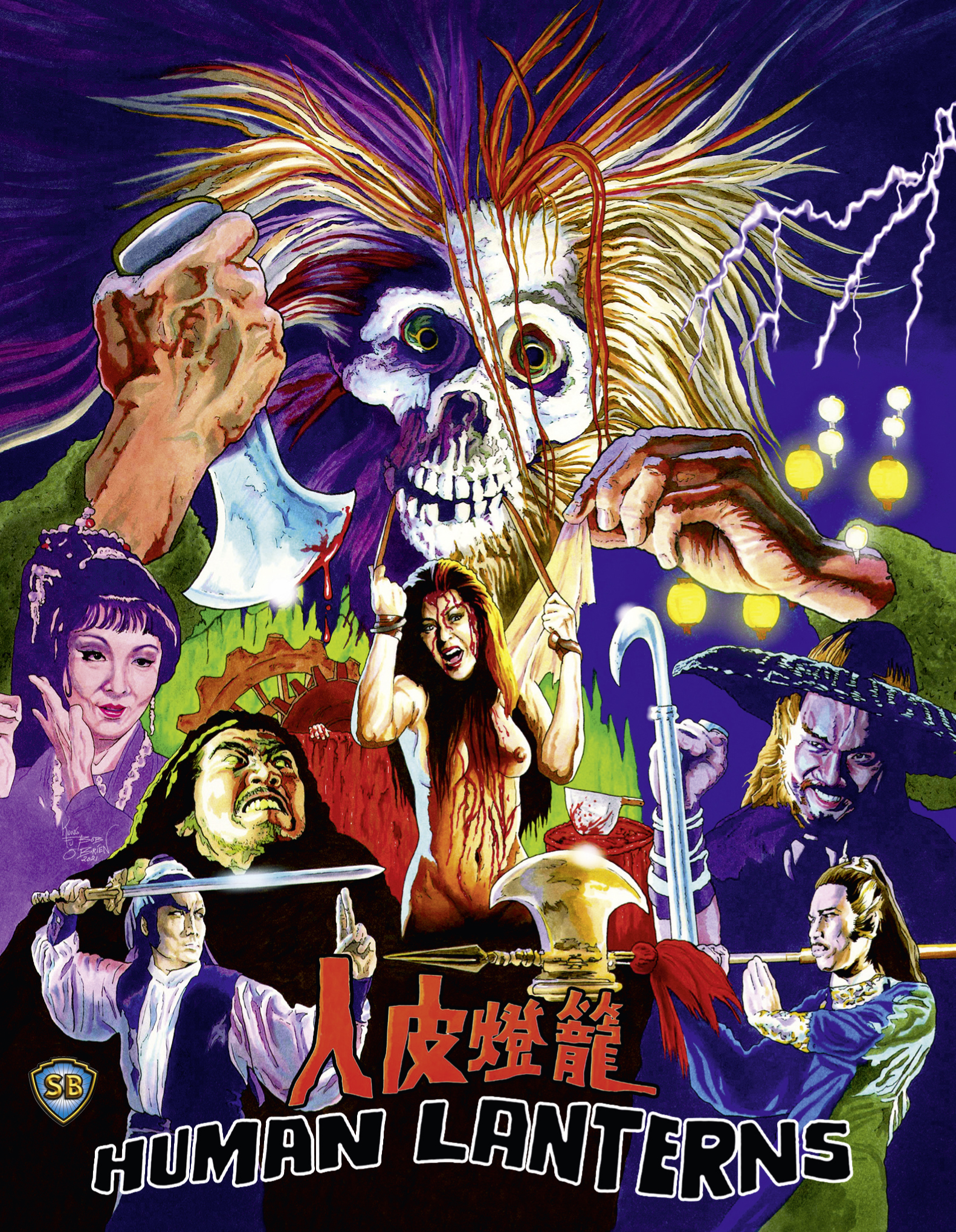
Human Lanterns (aka Ren pi deng long; Human Skin Lanterns)
Directed by Sun Chung
Shaw Brothers; Celestial Pictures; 88 Films; 88Asia Collection; MVD Entertainment
99 minutes, 1982 / 2022
www.MVDEntertainment.com

Back in the mid-1970s through the 1980s, if you were not there, it is hard to describe the effect and influence of the Shaw Brothers kung fu films, especially the ones taking place in some mystical time, long, long ago, when warriors with long hair could fly through the air, elderly people were the best fighters, and moustaches indicated evil.

Bruce Lee has survived the ages as far as legacy goes, but back then, it was the Shaw Brothers releases that were nearly omnipresent. There were theaters that dedicated themselves to showing them (such as one at the foot of the Manhattan Bridge), and a local New York station played their films every weekend at pre-set times.

But what I think helped popularize them were the sheer wackiness of the story mixed with a lot of martial arts action. Most were the equivalent of Roger Corman releases: you really needed to let go of any pretense towards art, and just enjoy the over acting and high drama for what it was: sheer entertainment. I have never seen this particular film before, so I am looking forward to it…

Tony Liu

The main theme of the story here, which is the complete and uncut version, is social jealousy in the feudal period of Phoenix Town. The main protagonist is wealthy warrior with classic Spock-like eyebrows, Lung Shu-Ai (Tony Liu), who is in rivalry with the local mustachioed Third Master T’an-Fu (Kuan Tai Chen). T’an provokes him by choosing Lung’s favorite prostitute, Yen Chu (Linda Chu) as his own concubine at a big feast, therefore causing Lung to lose face. To be fair, Lung is not a nice guy, who is consumed by competitiveness.

To retaliate, Lung decides to use the upcoming Lantern Festival contest (for best lantern, natch; remember the film’s title) by getting a skilled lantern maker, Chao Ch’un-Fang (Lieh Lo), who was Lung’s previous rival for Lung’s present wife, Lady Chin (Ni Tien), to create a masterpiece for him.

Then, again considering the title, there is a horror aspect to the story, represented by some dude in a mixed monkey/skull mask and costume who wants to destroy Lung. He kidnaps a woman and brings her to his underground lair, reminiscent of The Phantom of the Opera. There he very graphically does a Buffalo Bill/Leatherface on her. There is a reason the original name of the film was Human SKIN Lanterns. I don’t believe I’m giving anything away. I figured out almost instantly who was, as Lux Interior of the Cramps sang, “What’s behind the mask.” Actually, it’s given away pretty early, but I will not be the one to do it.

Kuan Tai Chen

Add an assassin into the mix to increase the action in the form of bearded Kuei Szu-Yi (Meng Lo, He does a lot of the fighting in the picture, which has its fair amount of martial arts, and yet less than usual for a Shaw Brothers release, though it certainly picks up by the third act. What is there, however, is imaginative, uses many different tools such as arm knives and fans, and there is a lot of wire work as they fly through the air with the greatest of ease. Meanwhile, the police, led by Sergeant P’an (Chien Sun), is trying to stop the jealousy-fueled violence and figure out why people are going missing.

Of course, the film is in Mandarin, with English subtitles. One thing that is not included in this package is the English dubbed version. Shaw Brothers films often used the same voice actors over and over, so they became easily recognizable by sound, if not by name. For me, it was one of the hallmarks of a Shaw Brothers release, but I can forgive them. I would have watched the film in the original Mandarin, and then again with the English dub, but that didn’t happen this time. Not a complaint, just an observation.

Lieh Lo and Hsiu-Chun Lin

Okay, let’s talk about some of the extraordinary Extras that are included with the new Blu-ray, both the physical and the digital. I’ll start with the latter. To begin, there is a full-length commentary by Kenneth Brorsson and Phil Gillion of the On Fire Network podcast. Both men are heavily accented (Swedish and British, respectively), and it was a bit of a strain to make out what they were saying, but it was worth the focus. At least until I gave up about halfway through.

Next is the featurette “A Shaw Story: An Interview with Susan Shaw” (14 min.), filmed in 2005. In this, the actor, who had a small role in the film, tells of her tumultuous career before Human Lanterns thanks to international politics, what it was like to work with the director and her opinion of the film, and her career after. She kept my attention. The next featurette is for one of the bigger stars of the film, “The Beauty and the Beasts: An Interview with Linda Chu” (14 min.). Chu talks about how she became involved with the Shaw Brothers films and her career there, and especially on her opinion about nudity. Again, it’s a good interview, but she does come off a bit vain here and there. Part of the charm, I guess. Both interviews are in Chinese with subtitles.

The last featurette is “Lau Wing: The Ambiguous Hero” (51 min.) And who is Lau Wing? That is the real name of this film’s star, Tony Liu. He goes into great detail about the art of acting, and his place in that, all while chewing gum. Of course, he discusses the film and the director, but he was working three films at the same time, and he admits his memory is hazy. It’s his relationship with actors and the studios that make this the most interesting. Lastly on the digital end is the Trailer, that the film is in HD (1080p), and the English subtitles have been retranslated.

On the physical side, there is a nice slipcover with new artwork by Robert O’Brien, a double-sided case cover with the original poster, a two-sided folded paper poster insert included with the clamshell, and lastly a lush, multi-page booklet with text and photos.

The trailer’s quality makes the viewer appreciate just how gorgeous this release looks now, with vibrant colors, incredible cinematography by An-Sung Tsao, and sharp editing. The sets by Ching-Shen Chen are shown in great and sharp detail. All of this brings up the value of the release that was most likely missing from the earlier VHS copies.

While the fighting throughout most of the film often feels like under-played and Kung fu-interruptus, the final battle royale certainly makes up for it. It is beautifully staged and includes everyone of importance that’s left alive at this point. It alone makes the rest of it worth the wait, but I should add that the whole story is pretty intense and enjoyable. My old pal, Mariah Aguier (2005), who was an infamous person on the New York punk scene in the 1970s and also a martial arts film aficionado, would have probably loved this (or already did). Now, so do I.

IMDB Listing HERE 


Thursday, March 31, 2022

Review: Tokyo Decadence

Text © Richard Gary / Indie Horror Films, 2022
Images from the Internet

Tokyo Decadence (aka Topâzu; Topaz)
Directed by Ryû Murakami

Cinemabrain; Melsat; Unearthed Classics; MVD Entertainment
112 minutes, 1992 / 2022
www.unearthedfilms.com
www.MVDentertainment.com

It is hard to nail this one down when it comes to categorization. Exploitation? Sexploitation? Asian Extreme Cinema? Transgressive? Well, I guess the film has its leather boot in and on all of them.

This film is infamous, and to be honest, before this, I have never seen it, so I am looking forward to catching up. Despite a penchant for vengeful ghosts, Japan genre releases are more known for violence, gangsters, and underage women and other sexual deviances (that term conditional to the individual viewer).

There are two versions of this film: the first is the U.S.-released “soft core” 92-minute version, but this is the longer, Japanese 112-minurte “harder” one, with more sado-masochism in certain scenes (neither of them is hardcore). Needless to say, the film is in Japanese with English subtitles. The director and writer, Ryû Murakami, is no stranger to over-the-top storytelling, having written the novel upon which was the foundation of Takashi Miike’s Audition (1999). This film is also based on one of his own best-selling novels.

This Japanese production was filmed in Tokyo, at a social stratum I am certain I will never achieve in my lifetime (unless there is a full Lotto in my future).

Miho Nikaido

Right off the bat, we meet a mostly nekkid and tied down Ai (Miho Nikaido) before the credits roll. She is a high-end call girl who specializes in sado-masochistic role playing for incredibly rich men, especially on the receiving end. Her exploits are shown in very loving photography and highly erotic stylings. The first half hour is dedicated to a couple of her couplings, but one really needs to be into that kind of thing for it to be effectives, but I must admit, it’s not my style, either the humiliation, the leather, nor the domination. Artistically, I can marvel at the lighting and the way the camera is used, but the action leaves me cold and – er – unresponsive. I never really understood Japanese kink.

Despite the psycho-sexual tone of the film, the story itself moves at a glacial pace, as Ai superstitiously gets advice from a medium (Yayoi Kusama), who gives her advice such as to put telephone books under her television (like to see her try that now).

Ai starts having a change of heart about her life’s work after a few clients go just a bit too far…okay, way too far, and she begins to want to get out (somewhere in my head I hear Al Pacino saying, “But they keep pulling me back in”). While she pines for an ex-lover, a well-known man (Hiroshi Mikami) who appears on television, and is now married to a famous opera singer (Chie Sema), she is also drawn to a statuesque dominatrix drug addict, Saki (Sayoko Amano).

Sayoko Amano

The camera seems to love Nikaido and shows her emotions through extremely contrasting use of light, with people wearing mostly black and white, with the background dark and the people lit sharply. But still, she looks quite beautiful even in this harshness. There is also a sharp use of the adding of the color red, used seductively, in things like shoes, nail polish, lipstick, and especially Ai’s nearly ever-present oversized handbag to hold all her sex-toy and attire accoutrements. The shots are long, following the action with relatively few edits. The scenery is also worth mentioning, as most of the first two acts is of the city at night, with incredibly tall building with industrially florescent lighting inside the structure’s windows. It feels both organic and incredibly designed at the same time. When we do see nature, usually trees, it almost seems out of place.

Ai’s journey of dealing with rich people who need her but do not really care about her, and trying to get out of the life reminds me quite a bit of the framework of the story of Bob Fosse/Neil Simon’s Sweet Charity (1968), except it’s not a musical, other than the incidental music here is by Oscar™ winner for The Last Emperor (1987), Ryuichi Sakamoto. The music is extra helpful because Ai doesn’t really have too much dialogue, relatively speaking to most of the other characters in the film, and when she does talk, often it is almost whispered. It is like she is on a boat without oars, and she just floats in the direction the waters take her.

While I found the S&M scenes cringe-worthy, for me the most uncomfortable moments were the last act, where Ai goes looking for her ex-lover, and her further humiliation on the journey itself, even before possibly meeting him, a series of bizarreness worthy of Fellini or even Philippe de Broca’s King of Hearts (1966).

The extras for this “Blu-ray Special Edition” include an English dub version for those who have an aversion to subtitles, but know that I watched the original Japanese versions with the English subtitles turned on. I did spot check in on it here and there, and the dialogue comes close to matching the subtitles, but not quite. As a non-Japanese speaker, I really cannot say which of the two is most accurate. A “Featurette” is included from when it was first released, which is an odd mix of an extended trailer that focuses on each of the actors through clips, and interviews and pieces from the film’s opening (it looks like at a festival, but it could just be a theater and the after-party. It’s in Japanese with subtitles, but that’s no surprise, I am going to surmise. Along with a “Stills Gallery,” and a nice box slip-cover, there are trailers that include a bunch of Unearthed Classic releases, and two different versions of the one for Tokyo Decadence: from Japan and Germany.

I can certainly understand why this is considered a classic: the beautiful way it is shot, its languid style among the brutality, and the story arc, almost like an opera, but I will not be revisiting it, honestly.

IMBD Listing HERE