Showing posts with label Science Fiction. Show all posts

Sunday, December 25, 2022

Review: No Escape

Text © Richard Gary / Indie Horror Films, 2022
Images from the Internet

No Escape (aka Escape from Absolom)
Directed by Martin Campbell
Columbia Tristar; Pacific Western; Platinum Pictures;
Allied Filmmakers; Unearthed Classics; MVD Visual
118 minutes, 1994 / 2022
www.unearthedfilms.com
www.MVDvisual.com

Doncha just love it when a (relatively) older film is a science fiction that predicts the actual year you are in? Released back in 1994, this film takes place in the far future of 2022 (by coincidence, also the year that the leading actor, Ray Liotta, died). Oh, yeah, 2022 is also the year in which Soylent Green (1973) takes place. Gee, I wonder what that year will be like, and how accurate the storyline will be. Will there be an idiot 45th President? Will there be threats of a civil war by some numbnuts in red hats and blue shirts? Hmmmm. I will start watching, and we can see. Odds are, I will be discussing not only the film, but its depiction of the year in which it takes place.

First of all, this film is a sausage-fest. Yeah, there are no women in the film at all, just macho dudes living a Lord of the Flies meets Mad Max: The Road Warrior (1981) life. Y’see, it takes place in a penile – er – I mean penal colony. In the opening placard, it states that all prisons are now privatized, something Obama fought against, and his ruling was overturned by the following Republican administration. This film is getting closer to reality in the first two seconds, though the computers we see are still somewhat cathode-looking as opposed to flat-screens.

Right at the opening credits, in Benghazi (yeah, I know), Libya, Special Forces Capt. J.T. Robbins (Liotta) kills his commanding officer and is sent to the remote, desert enclosed Leviticus Maximum Security Penitentiary, run by Warden (Michael Lerner). He gets there by super-cool monorail, similar in means to the AirTrain JFK that cuts through Queens, NY, to get to the airport. The prison is in the middle of a desert that is reminiscent of Dune (1984; 2000; 2021) landscape.

Ray Liotta

Thanks to a major infraction, Robbins is sent to the remote island of Absolom, where he is a stranger in a strange land. It is lush and beautiful (filmed in New South Wales, Australia), but he will learn he is a tough guy in an unfamiliar world run by convicts, much like Snake Plisskin in Escape from New York (1981), but without Adrianne Barbeau. Robbins is captured by “the Outsiders,” a grungy group led by sociopath Walter Marek (Stuart Wilson), who at first underestimates our anti-hero. This society is close to a Mad Max Beyond Thunderdome (1985) situation, where only the strong survive, and somehow Marek has the only gun (spears and arrows are the weapon of the day). They have stalled in tribalism and cannibalism when necessary.

After a fun Indiana Jones and the Raiders of the Lost Ark (1981) moment, thanks to Marek miscalculating Robbins’ prowess, Robbins escapes into the woods with the entire pack in pursuit. The chase scene through the jungle reminds me a bit of Apocalypto, even though it came out years later in 2006.

After a fall into a river that puts Butch Cassidy and the Sundance Kid (1969) to shame, he ends up in “the Insiders” camp. The viewer can tell this is a good place because of the swell of violins in the soundtrack music. It is run by benevolent The Father (Lance Henriksen) and his Head of Security, Hawkins (Ernie Hudson, who is fighting the Outsiders rather than busting ghosts although, apparently, is still wearing gray clothing). Here, life is communal, with farming and metallurgy to show progress.

If I may digress here for a second, and I am almost done with the exposition (and believe me, there’s a lot of action going on I am not mentioning), you may have noticed that I have been referencing many other films. Well, that is because there is some much built on those other releases, and it is fun to ping-pong back and forth between this and the others. There is even a Spartacus (1960) moment. Sure, there is some originality in this, and Liotta is a great Mad Max/Plisskin substitute, but there was a basic formula to these films (as is true with many releases, especially nowadays) at that time, and it mostly proved effective, though this one cost $20 million, and made $15 million back.

Injured, the angry, non-joiner, anti-authority Robbins is bound to adjust to the Insiders’ life, and even though I am only 30 minutes in, starting Act 2, I am willing to bet a dollar that at some point, the 600 Outsiders and the 100 Insiders will do battle, with Special Forces Robbins leading the defense.

You really can tell this is a big budget extravaganza (though they ran out of cash near the end), relative to the many films I am used to reviewing these days. Along with the stunning sets (especially the Insider’s camp), the action in Act 2 is larger than the entire budget of many other films. This is not telling anyone anything that is not obvious. In fact, one of the raids reminds me of the renegades attacking the fort, mid-The Road Warrior.
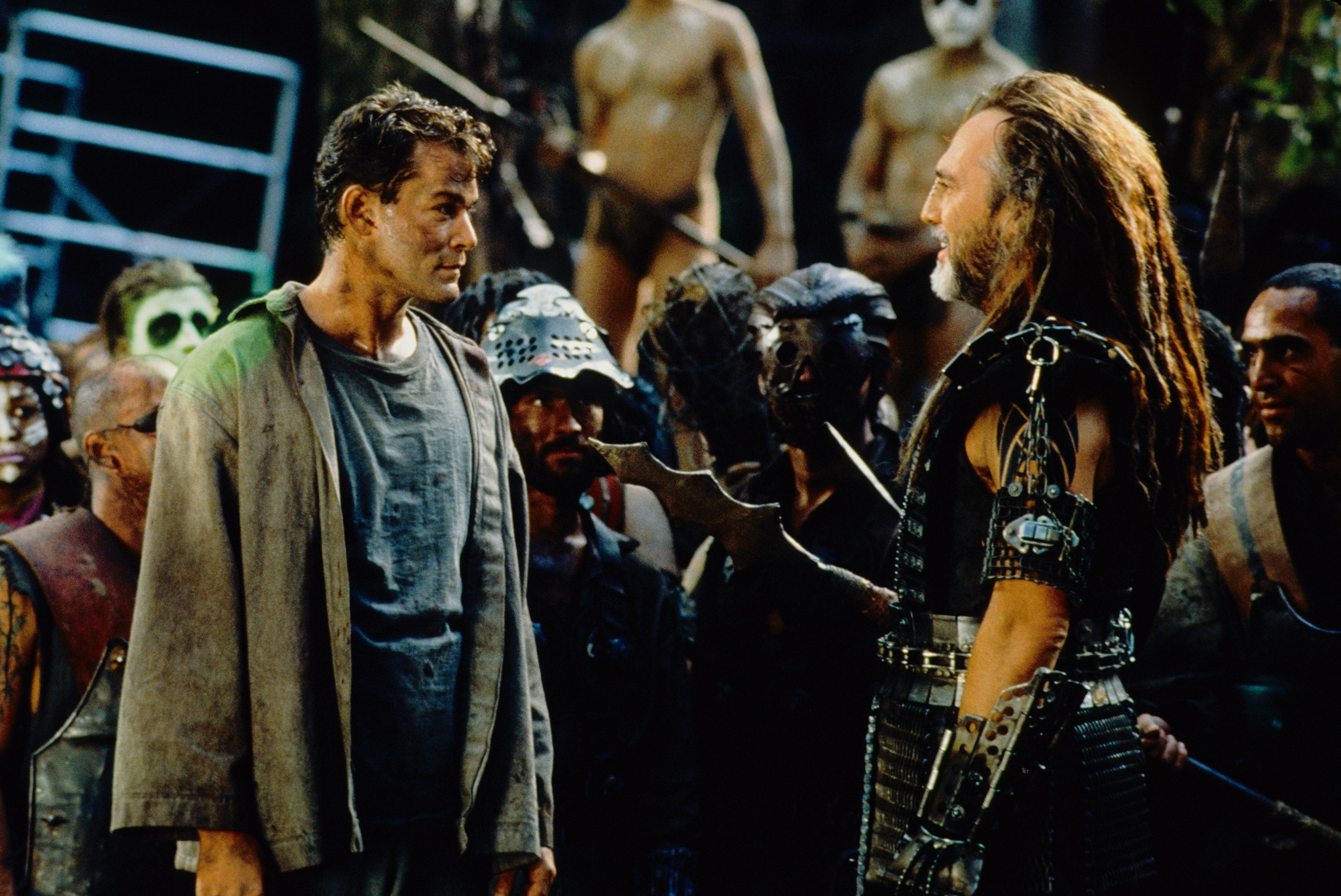
Liotta, Stuart Wilson

You will find a lot of Mel Gibson references in this review, a man I personally despise, but beyond that, The Road Warrior is a film I can watch over and over. And there is certainly a Mad Max moment when Robins tells The Father that himself knows how to help, in the same way Max boasts (rightfully), “You wanna get out of here, you talk to me.”

I believe part of the reason why this film has so many fans and has achieved cult level love, is that is really is action packed, with many scenes of action. Liotta does well as an action hero (he wanted to find out what it was like to be one, and he succeeded), as does his underling/comic relief Casey (Kevin Dillon). A nod should also go to Wilson, who plays the evil yet gallant and highly talkative Sherriff of Nottingham or Hans Gruber type character. As for Henriksen, well, the man makes you forget he’s acting, and while Liotta is superb as always, Henriksen still managed to hold his own, if not more so; why is he not on the poster instead of Dillon, who is okay, but he’s no Lance. The SFX, all practical, are a lot of fun, with explosions, and some surprisingly gory deaths. The make-up and wardrobe are done by the same person who did The Road Warrior, and it shows (meant as a compliment).

There are many anachronistic moments here and there, such as how did the Insiders get all the crossbows? Bow and arrows I can understand, but that is a technology that cannot bd found on an isolated island. And what do they eat? Okay, the Outsiders delve into cannibalism, but you see some turkeys and pigs being harvested in the Insiders’ camp. Where did they come from? It is clear both camps eat rats. And where did the Outsiders get their body armor? They do not have the technology nor the source material where they are stranded. But I’m willing to give up some suspension of disbelief, because It is a fun film. But I’m still aware

Lance Henriksen (left), Ernie Hudson (right)

As for extras, at nearly 2 hours, as much fun as the film was, I was glad there was no full-length commentary. What we do have is still a plethora of material. To begin with, there is “Welcome to the Future: The Sci-Fi Worlds of Gale Anne Hurd” (17 min), a new for this Blu-ray interview with producer Hurd, who worked for Roger Corman on films like Humanoids from the Deep (1980), Battle Beyond the Stars (1980), for which she hired James Cameron, and then on to such now-classics of the likes of The Terminator (1984) and Aliens (1986). Obviously, she also produced No Escape. A storied career, and an interesting monologue, and lots of clips.

“Survival of the Fittest: Directing No Escape”(13 min), a new interview with filmmaker Martin Campbell, who would go on to direct the likes of James Bond’s Goldeneye (1995) and Casino Royale (2006), as well as Green Lantern (2011). He has a decent sense of humor, and his stories are fun to which to listen. “Penal Colony: Writing No Escape”(7 min), is a new interview/monologue with co-writer Joel Gross. Which is okay for a one-time listen.

For older material, there is vintage featurettes, starting with “Making of Escape from Absolom” (21 min), the shooting title of the film. It includes on-set interviews with most of the major cast and crew, and is informative about the production. Actually, I enjoyed this one more than the previous three interviews. There is a second Making Of featurette (6 min) that seems to be untitled. It is very similar to the previous one, also shot on set, but is much shorter.

Lastly, there is the “Alternate Intro” (2 min), which is extremely similar to the one used in the film, just less “stylized.” Honestly, either one would have worked. Last are the original theatrical trailer, TV spots, and a photo gallery.

With one last reference, the big surprise for me is that, in some ways, this is a Christmas movie in the same way as Die Hard (1988).

IMDB listing HERE


Tuesday, November 15, 2022

Review: Moonchild (2-disc: Blu-ray + CD Soundtrack Edition)

Text © Richard Gary / Indie Horror Films, 2022
Images from the Internet

Moonchild
Directed by Todd Sheets
Visual Vengeance; Wild Eye Releasing; Jackalope Media; Extreme Entertainment; MVD Entertainment
102 minutes, 1994 / 2022
www.wildeyereleasing.com
www.MVDEntertainment.com/
Director Todd Sheets was known early in his career as a fantastical yet grainy cult-god filmmaker. After a health scare, he came back stronger than ever, with the likes of Clownado (2019), Bonehill Road (2017), Dreaming Purple Neon (2016), and House of Forbidden Secrets (2013).   

This film, however, is from his early cult days, and is well-beloved by his followers. Honestly, I have never seen it till now, like much of his early work, so I am looking forward to checking it out. This was originally shot on sVHS, so it is grainy, but this release was taken from the master tape by Sheets himself. This is the first time it has been released on Blu-ray.

Auggi Alverez

In much like the Mad Max franchise, we are introduced to a dystopian future of the Chicago area (though filmed in Kansas City) where a group called Sodality (meaning “Brotherhood” or “Community”; also, a devotional association of Roman Catholic laity) run the dictatorial government of the United Nations of America; I guess more like Gilead but almost post-apocalyptic as we see a run-down city that drives cars from the 1970s and ‘80s (it was released in 1994, so it makes sense in that way). Sodality is run by Kronos (Tom Berg), a blubbery too-white guy (think of 1971’s The Omega Man) who has 666 drawn onto his body.

Government scientists have an inner-city compound where they experiment on creating super soldiers, such as one who is a cyborg whose outer clothes makes him look a bit like a cockroach (sans extra limbs, but adds a body chainsaw). He is one of three of these hybrids that are in search of our protagonist, Jacob Stryker (Auggi Alvarez).

Dave Miller

Stryker is also a hybrid, but has retained his consciousness. He escapes from the Republicans…I mean the Sodality. He is in search of his son, Ethan (Stefan Hilts), who is being held captive somewhere. And while he is on the run after an action scene right at the start, he manages to hook up with the underground, run by Talon (Dave Miller), who mostly dress like the Arrakisians in Dune, with scarfs and hooded robes. Speaking of which, you know Stryker is the hero because of his knee-length, open military jacket (belonging to Alverez’s dad), reminiscent of The Matrix franchise.

After his experimentation results, Stryker can also turn into a semi-werewolf-like creature, hence the title, though it’s a misnomer, even though he does not need the moon to actually “change.” He’s more like The Hulk in that he turns when he is angry or in a fight. Oh, and did I mention there is a bomb in his stomach scheduled to go off in 72 hours? How Snake Pliskin!

Kathleen McSweeney, Rebecka Rose

He sets off with new love interest (his wife was killed) that took less than a day, Athena (Kathleen McSweeney) and some others: Talon, boppy Weasel (Kyrie King), Rocky (Julie King), and Teela (Rebecka Rose). From this point it is more or less a travelogue where they meet different groups, each one dresses alike within the group. Quite like The Warriors (1979).

It is worth noting that despite the low budget, the sets are amazing, the lighting and shadows work well, and the editing is spot on.

Carol Barta

Now, as for extras, oh my god, there are so many. This may take days to get through. It starts with two commentaries. The first is with Todd Sheets and star Auggi Alverez. These two are friends, and their commentary is easy and breezy, yet still informative. I really enjoyed this one. The other commentary is Sheets and Rob Hauschild of Visual Vengeance, who released the Blu-ray. That’s right, if you watch the film and the commentaries, it’s like watching the film three times. The second one is a bit more of a technical view, details on filming process, and Sheets’ career, but it is interesting for those who like this side of the method. There is very little overlap with the other commentary, which is worth a note. While this Blu-ray is the Director’s Cut, it also Includes the alternate VHS version of Moonchild as originally released, I respectfully bowed out of watching it a fourth time.

The first featurette is the documentary, “Wolf Moon Rising: The Making of Moonchild” (32 min). This is archival footage including an entire newscast about the production, backstage scenes and the creation of the music. There is no narration, just some interviews with the cast at crew at the time of filming. And speaking of “back then,” this is followed by “Original BTS Casts and Crew Interviews” (9 min) that is pure candy. The “Deleted Ending” is an extra fight scene, but honestly, the film’s ending as it stands now is much better.

The first of the last two biggies is the short film “Sanguinary Desires” (1988, I believe; 13 min), where a group of people are offered $10K to spend the night in this series of rooms, but of course, as the title indicates, there is lots of blood and guts involved as they meet up with various forms of the undead. Will any survive? The second, of course, is the additional disc that is the soundtrack of the film, which is quite good, including the expected synth pieces and the orchestrated songs as well. Worth a listen.

Then there are others like the original VHS trailer and one for one of my fave Sheets releases, Bonehill Road (another werewolf film), a music video by death metal band Descension of “Burn the Church,” and other Visual Vengeance trailers (including the new one for this film), which always plays whenever you put in the disc, and English subtitles upon request.

On the non-digital side, there is a reversible sleeve featuring the original VHS art, a four-page liner notes booklet by Matt Desiderio of “Horror Boobs,” stick your own VHS sticker sheet, and a folded mini-poster

One point in the full film that confuses me is that the terribly intentionally overacting bounty hunters, especially Lothos (Harry Rose) and Medusa (Carol Barta) from the Sodality – It reminds me of the villains from the old “The Power Rangers” series – seem desperate and will use any method to catch Stryker, but if he had a bomb inside of him, why bother, as he will be dead in a couple of days? Also, the fight choreography is kind of funky, and there is a lot of it. But my big bugaboo about the film is not enough transformations. But then again on the good side, it is important to remember how low-budget this was, and some mental leeway has to give way for the zeitgeist of the film as a whole.

All-in-all, though, this was a fun ride, from beginning to end. But I can totally understand why it is a cult classic, and rightfully so, in my opinion.

IMDB listing HERE

Saturday, November 5, 2022

Review: Something in the Dirt

Text © Richard Gary / Indie Horror Films, 2022
Images from the Internet

Something in the Dirt
Directed by Aaron Moorhead and Justin Benson
XYZ Films; Rustic Films; Lightbulb Film Distribution; Strike Media
116 minutes, 2022
www.xyzfilms.com/something-in-the-dirt

I belong to a few horror groups on Facebook, and this film has cropped up in comments on occasion. It sounded interesting so I was determined to review it here.

The film centers around two life-stagnant neighbors in Los Angeles, John (co-director Aaron Moorhead) and Levi (co-director and writer, Justin Benson). Scruffy and multiple-tattooed Levi, who drinks a lot, has moved into a new apartment with practically nothing. He meets downstairs neighbor, prim and proper John, who is a math teacher, photographer, and has recently separated from his husband.

Aaron Moorhead, Justin Benson

What binds them together is swapping cigarettes (they smoke a lot), and a strange crystal object that Levi has found on his doorstep. At certain times, the rock begins to glow, throw off odd lights, and levitate. They decide to work together to make a documentary about the strange phenomenon, setting up cameras and sound equipment focused on the crystal that Levi initially used as an ashtray.

The purpose of their attempted documentary is to gain some possible influence in the world, and perhaps even make some seed money for future projects (and better their lives). What stands in their way is both the dynamics of the two, lack of skills, and also personality differences with each other as time passes. But there is also the influence of the crystal, as it gains more power to influence objects in Levi’s apartment and then beyond.

It's subtle, but the crystal seems to also affect the personalities of Levi and John, making them verbally strike out at one another, even knowing they need each other. Or perhaps their different personalities are just starting to grate on each others nerves from constant close contact, like a band on the road in a van (e.g., Daltrey and Townshend often engaged in fisticuffs on the road early on).

The assemblage of the film is quite interesting, such as when many topics are discussed in conversation, from the intellectual to the mundane, and we are shown examples of it in a number of b-rolls with very quick editing. This definitely breaks up looking at mostly John and Levi, who dominate the cast, with just minutes given to the few other characters present. Most of these are “Interviews” with the pair individually, and with some “experts” in the field. On some level, their desire for fame has been met.

If I was to describe the film in a single phrase, it would be “wordy.” There is a lot of talk and most of it philosophical, math-driven, and then add in electromagnetism and conspiracy theories. The film does not talk down to its audience, but it also was above my head at times (and I have a Master’s), as they try to figure out why this phenomenon is happening. John is more educated than Levi, and shows it off as much as possible. Personally, I found John a bit unlikeable and insufferable. They both have their faults and we learn more oof Levi’s history than John’s, but John is always showing off with his theories. I found him annoyingly self-righteous.

That being said, the acting by the two leads is sensitive and nuanced at the same time, and kudos to them for that. Nearly every other character is seen in snippets, or brief talking heads interview, and are intentionally stiff, as are most in talking heads interviews.

Benson, crystal, Moorhead

The sets are pretty simple, mostly in Levi’s sparse apartment, and the SFX are well done, though mostly lights flashing and levitation of multiple objects (and people). The story itself is both simple and complex, alternatively. The basic premise of a recurring supernatural event(s) mixed with nearly academic-level language (to me), make this an odd stew of the sublime and quirky.

It is no surprise to me this has been getting a lot of attention. It is quite arty, with the b-rolls and general editing and cinematography, and yet it is visually accessible without being too “showy.” Moorhead and Benson have a lot of experience in writing, directing, acting, and cinematography, and I see a lot of those skills represented in here.

Something In The Dirt was an entry in the Sundance Film Festival and is currently in UK Cinemas. It will be on Digital Download and Blu-ray in early December.

IMDB listing HERE


Saturday, July 30, 2022

Review: Galaxy Games

Text © Richard Gary / Indie Horror Films, 2022
Images from the Internet

Galaxy Games (aka Sol Invictus)
Directed by Ben Carland
High Octane Pictures; Event Horizon Entertainment
84 minutes, 2022
https://pixelpictures.net/sol

Wisely changing the name of the film from Sol Invictus (meaning The Sole Undefeated), the new title is supposed, I assuming, bring up tingles of the popular and profitable The Hunger Games franchise, as well as hinting at Squid Game (2021). Actually, it was a smart marketing decision.

For this sci-fi drama, groups of rival Academy students (I’m not sure if they are meant to be high schoolers or college level, but the cast is definitely older than the range in the story) are sent off to another planet to participate in the Sol Invictus. The plan is to succeed in science and personal growth, and in Hunger Games fashion, only the winning team gets to go back to Earth.

Of course, pretty soon, things go off the rail, as the rival groups are stranded on that planet. Right off the bat, I am wondering if this situation is accidental, or part of it all, like in Stephen King’s 1979 novel, The Long Walk. Part of their problem is that not everyone shows up due to a malfunction, and worse than that, most of the supplies are somewhere in limbo as well… including a large portion of the food.

One of the team captains assumes totalitarian style methods to still try and accomplish the goals of the game (“I still have a competition to win”), so they can get home. Considering all that is going on, will Earth even miss them? The whole point of the story is to get them stranded because the masters of the Games do not like “mediocrity.”

The landscape of the planet confuses me a bit as it looks a lot like Earth. The heavily testosterone-laden group (no women in the Academies back on Earth? Damn that Supreme Court) arrive on a desert plain, with an ocean just over the hill, yet they can be seen running through a forest.

Of course, they are not alone, as you can tell with the film’s poster art. There are creatures on the planet, known as Hunters, that look like a cross between a beetle and an arachnid (among other insecty things like worm-snakes), signaling a Starship Troopers (1998), though budget constraints limit the number of CGI beasties. I should note that even though the budget is low, they look decent for what it is.

Perhaps a good question for the makers of the film would be, to whom exactly is this being marketed? All the male actors look like they just stepped out of a 1990’s boy band, so perhaps teenage girls? The sci-fi action may bring in some teen boys, but this is definitely not aimed at the adult market, unless perhaps one is into cosplay mentality (not meant derogatorily at all). Mind you, this is a level above, say, The Power Rangers (no full body monster costumes, for example), but it is also hardly sophisticated enough to be a generalized attraction for a wide demographic.

It is, however, relatively high energy, with the angst of Dorothy wanting to go home, but with handheld shaky cameras in the action scenes to emphasize the drive of the events onscreen.

Like Robert Heinlein’s 1959 Starship Troopers novel more than the film version, this is a treatise of how the government has become authoritarian and militaristic mindset has settled into a norm. It actually is interesting to see this film in a time when one political party in the US is using militaristic methods to grab control the populace, though no mention of religion is present here.

I can guarantee I will not be the first to say this, but there is definitely a Lord of the Flies (1963, 1990) vibe to the toxic macho masculinity of who gets to run the shebang, with kindness or cruelty, depending on the one grabbing the ranks at any time. This changes a number of times throughout, as some people disappear for various reasons, or others pop in from the Games.

This is not as savage as Flies, however, in that despite some deaths, from creatures or of human origin, there is cooperation and bonding mixed in with the duplicity of loyalties (i.e., to self vs. the Social Contract). It occasionally feels like The Martian (2015) idea, as the survivors adapt to their environment.

The cast is actually well seasoned with many credits to their names in most cases, so the acting is on line for the story. Tyl (Jake White) is obviously the lead from the start, and does well in the role. My favorite character, though, was Howard (Tyler Thomas), as the quirky guy. Then there is the bully of the batch, Lex (Sky King), who takes an action I do not believe as it is against his very character…but I will forgive it for the “Kumbaya” moment

For what it is, a film geared to the teenage mind, with no cursing, no nudity, very little blood (though one gross scene of infection), it was relatively sci-fi with some social commentary, where is just where sci-fi should be: there is an old axiom that states that films about the future are actually about the present. In this political climate, I can see that.

IMDB listing HERE 


Tuesday, March 15, 2022

Documentary Review: In Search of Tomorrow: A Journey Through ‘80s Sci-Fi Cinema

Text © Robert Barry Francos / Indie Horror Films, 2022
Images from the Internet

In Search of Tomorrow: A Journey Through ‘80s Sci-Fi Cinema
Directed by David A. Weiner

CreatorVC
301 minutes, 2022
https://80sscifidoc.com/
@80sscifidoc
www.creatorvc.com

Science Fiction can run from the sublime, like 2001: A Space Odyssey (1968) or Silent Running (1972), or it can fall into the B-level category of the likes of The Green Slime (1968) and It! The Terror from Beyond Space (1958; this was the basis for 1979’s Alien, as 1951’s The Thing from Another World was remade as John Carpenter’s The Thing in 1982). Despite some well-done classics such as the first two mentioned above, by the mid-1970s, Sci-Fi was a second-rate citizen as a genre, producing mostly cheese with bad effects.

This all changed in 1977, with the release of a little film called Star Wars, which reignited the genre aflame, giving rise to both big budget bonanzas and cheapie imitations, but the spark was set. In a perfect storm, this upswing came right on the advent of the VHS market, further spreading the fever. Please note that I am writing this intro before actually watching the film, so I am not sure it will reflect my sentiments. And so, it’s time to start the show. Cue Bugs and Daffy.

The focus of this all-star documentary is that period in the 1980s when everything exploded like all those ships in the film version of Battlestar Gallactica (1978).

After the initial introduction, which briefly goes as far back as Georges Méliès’ 1902’s A Trip tothe Moon, and various other highlights, with Wil Wheaton explaining how before Star Wars, most sci-fi was nihilistic and was a warning of things to come, such as The Day the Earth Stood Still (remember, sci-fi is not about the future or the past, but about the present of when the film was made).

This is followed by a host of hosts: interviews with actors, directors (such as Joe Dante, Paul Verhoeven, and John Carpenter), writers (both screenplays and critics), production crew, composers, and vloggers, etc. What is really nice is that the documentary does not only talk about the top-tier releases, but also the relatively smaller ones that did not raise as much of a blip as the multimillion-dollar mega-effects bonanzas. Year by year, they focus on film by film, so while there are the obvious ones like Star Wars: The Empire Strikes Back, E.T: The Extra-Terrestrial, and Blade Runner, I was pleased they went into detail about the likes of Saturn 3, Yor, Galaxina (RIP, Dorothy Stratton), and Spaceballs.  

One thing I hadn’t made the connection to before, while watching the segment focusing on Flash Gordon, is that the top effects in that film and many others of that period, are now in-reach and equal to numerous low budget Sci-Fi/horror film genres of the present day. In the less sophisticated CGI of the 1980s, it was a wow factor, but now one sees it compared to what the major studios are putting out, say the superhero releases, this was pretty basic by today’s standards. Sometimes modern films will try to purposefully look like the ‘80s as a “flashback,” but technology for indie and low-budget films have actually caught up to the ‘80s majors in their technology, especially with green screens. This is especially true with animated films discussed here, such as Heavy Metal, Tron, and the amazing anime Akira. I’m rambling a bit, so I hope this makes sense.

Among the looks back at particular films, between each year there are also segments of about 15 minutes each that give some grounding to the genre of the period, such as “Cold War Kids,” which talks about how people of that generation – especially kids – were immersed in the threat of the possibility of a nuclear bomb going off at any moment. As a child, I still remember the drills in elementary school where we would practice getting under our desks to practice in case of a regular bombing attack, and lining up in the hallways and crouching down in case of an atom bomb. Of course, in reality, neither of those would really do anything, but we heard about it all the time, including in the cinemas encased in the messages from the films we watched. Even those like Goldfinger (1964) had a big, scary bomb. Where’s McGruber when you need ‘im, right?

While not inclusive, some of the between-years other segments include how films were marketed in a pre-Internet world, visual effects, creature effects (among two of my favorite topics), and music scores. The last one is about the technological implications of the vision in the movies, very briefly focusing on the whole “the future in the story represents the now.” There should have been more about technological determinism, and perhaps throw in a bit of Neil Postman’s Amusing Ourselves to Death when describing the likes of Cherry 2000.

Another interesting point the documentary more hints at than is explicit, is that Sci-Fi is almost always blended with something else, such as a Western (Outland; Star Wars), horror (Alien), war stories (Aliens, Enemy Mine, Predator), or social commentary (Final Countdown; Alien Nation), for example. I find it especially the latter, and the nuclear aspect or the rise of computers, robots and technological determinism (e.g., The Terminator) as expounded by the likes of Marshall McLuhan or Jacques Ellul. This “layering” is part of what makes Sci-Fi not only effective, but makes the future relatable. As I said, whenever it takes place, it’s about the present.

The only sort of repetition in the film, which is unavoidable and yet still enjoyable, is the number releases of a franchise, each of which are covered individually if they came out in the ‘80s. This includes Superman, Star Trek, and of course, Star Wars. Lot’s of “Return of…”, “Part II,” and “The Wrath…” to deal with, but these films are classic and pleasing to rehash, so it still goes relatively flying by.

Each release covered gets about five to ten minutes, and includes lots of clips of the film itself, backstage footage and bits from the trailer, and interviews, none very long (hey, there are a lot of films here). They switch back and forth between the present-day discussions (no historical interviews, happily) with the likes of Alex Winter, Barry Bostwick, Dee Wallace, Billy Dee Williams, Nancy Allen and multiple dozens of others, that it is easy to keep the viewers’ attention and interest, even over the extended time frame. I know I had to break up watching it over two days, which was no problem as it’s individual segments, rather than a narrative where plot points can easily be forgotten. Many of the anecdotal stories told by the casts and crews are especially compelling and often humorous, such as someone discussing the pomposity of Shatner on the set of Khan.

The film is not afraid to shy away from pointing out the flaws of some of the films, such as Howard the Duck and Dune, and glorifying those that deserve it, like The Fly and Back to the Future. And while the film is joyfully comprehensive, it is not inclusive. There are many films not selected for discussion, and yet clips are shown, such as Heartbeeps and Night of the Comet. But, considering the information presented and the immensity of the time, I find no fault in that regard.

This release is a follow-up to a three-part series of documentaries by the director titled In Search of Darkness (2019), In Search of Darkness Part II (2021), and the obvious In Search of Darkness Part III (2022). I have not seen these yet, but it is interesting that it is broken up into three, rather than one honkin’ five-hour extravaganza.

The whole film is a big, “Oh, yeah,” if you were a fan of the genre back in that timeframe. And seeing the people involved and what they look like now is a lot of fun, as well.  And if you are wondering, yes, I did sit through all five hours of the documentary, and smiled through most of it.

IMBD Listing HERE 


Thursday, March 10, 2022

Review: Alien Danger 2! With Raven Van Slender

Text © Richard Gary / Indie Horror Films Blog, 2022
Images from the Internet

 Alien Danger 2! With Raven Van Slender
Directed by James Balsamo
Acid Bath Productions; Alien Donut Films
71 minutes; 2021
www.facebook.com/acidbathproductions/

The video starts with the same Toy Dolls silly music video with which the first film ended, but I do have to admit that it’s easy for it to become an earworm, so be warned (said with a smile)

I must say, the opening animated sequence (not sure if it’s cheesy CGI or stop-motion, of both) mixes a bunch of genres together, including a version of Japanese Mecha-Godzilla meets The Three Stooges, the Transformers, and the Power Rangers. It’s goofy (a word I’ve used and will continue to use often for these films), but I had a big smile on my face for the sheer ambition of it. Plus, there’s the cameos during it by Rob Halford (voice of Judas Priest) vs. Casey Orr (aka Beefcake the Conqueror, bassist of Gwar). And that’s before the always fun animated credits by Rob Yulfo, featuring a different song that is very similar by the Toy Dolls.

I need to make this clear: sometimes it may seem like I am insulting the film by saying the sets are cheap, the effects are corny and the acting is so over the top that they are in the stratosphere, but let us be explicit in that it is all purposeful, and it is fun because of all this nonsense, not in spite of it. If you’re looking for Star Wars, Star Trek, or even Battle Beyond the Stars (1980), well, you have either come to the wrong place or not stoned enough (note that I am straight-edge). Balsamo is infamously leaning towards the happy weed, so I am sure he is encouraging it with his films. I can understand if one gets more out of it in that headspace, but I’m enjoying it for what it is: a hot mess.

The cameo villain in this volume is General Legs (voiced by Pinhead himself, Doug Bradley), but meanwhile, genre bending is the key here, as the first segment of an actual story is leader, hero, and incredibly amusing Raven Van Slender (Bill Victor Arucan) and the same crew as the first film (this part was either filmed concurrently, or immediately after the first part), including slug sandwich obsessed Eepa.the Nood (director Balsamo), go to Ravenwood Forest in Robin Hood mode, to help King Mark Catapult (rather than Capulet; that made me laugh) and his princess daughter. Side note: I’m only 14 minutes into this thing, including the music video, Mecha- opening, animated credits, and some b-roll from the first film. To be clear to the audience, who most likely are quite lit by this point, Van Slender even points out that this is like Robin Hood and Sherwood Forest, for those baked or unread enough not to know.

Just a digression, in the first film, Van Slender’s catchphrase was the titular, “Alien Danger!” Here it’s “Adventure awaits!” However, the “Alien Danger” line is also used. No point in me mentioning this, just observing.

As with Part 1, most of the “alien” differentiation is face make-up of different colors (again, as with the previous review, I give you the original “Star Trek” series, which often employed this style to indicate difference of aliens). Here, there are also uses of some different masks, many of which actually look quite good, lots of CGI effects, and especially the use of Green Screen technology (I am convinced that “Star Trek” would have done the same if the means were available in the 1960s).

After we leave the forest, the next genre bending is based on the mythical Western at the Okie-Dokie Corral, with cowboys and cattle. Okay, forget the cattle, but there is a campfire (well, a fire pit anyway, and no beans). After the obligatory showdown, we next slide over to a world of professional wrestling, which explains the cameos by the likes of Sgt. Slaughter, Barry “Krusher Khrushchev” Darslow, and Sione “Tonga” Valihai. And still only 30 minutes in.

At around 45 minutes, the group is fighting monsters on another planet. We also find out some personal information about our titular hero. At 50 minutes, we’re back in ancient Egypt and Cleopatra (Tracee Cocco) and her killer Martian mummy(s) … yeah, you read that right. There are a bunch of short bits after that such as an intergalactic Ouija board, but I’ll leave it for now rather than cataloging.

The point of me stating the times is the indication tat there is a lot going on here. Perhaps its not a consistent narrative or cohesive story, but the set pieces keep the viewer from getting bored. After all, like puns – one of the director’s specialties to the point where he has a book published of them James Balsamo’s Total Pun-ishment; Bad Joke Book – if something that is silly goes on too long, it gets wearing, but by changing it around so much, the interest of “what the hell next?” may keep your attention.

Of course, there are a lot of cameos, such as director John Landis and the always fun Vernon Wells, who I still believe is the best character of Mad Max 2: The Road Warrior (1981), and actually shows some actual acting chop while seeming to really have fun with his role here, sans mohawk. But it is worth noting the following: used to be most of the cameos in early Balsamo releases tended to be filmed in an alley behind whichever horror convention or metal concert he attended, and usually they just insulted or beat up on Balsamo, sometimes both. While Landis is a quick come and go, others like Wells are actually incorporated into the story, in this case as a helmeted villain, The Shadow Knight (who subtly quotes John Cleese’s Black Knight in 1975’s Monty Python and the Holy Grail!). The quality of the cameos is improving.

Yes, there are more in the franchise coming, such as Alien Danger 3: With Raven Van Slender, and Raven Van Slender Saves Christmas, both expected by the end of this year.

IMDB listing HERE 


Saturday, March 5, 2022

Review: Alien Danger! With Raven Van Slender

Text © Richard Gary / Indie Horror Films Blog, 2022
Images from the Internet


Alien Danger! With Raven Van Slender
Directed by James Balsamo
Acid Bath Productions; Alien Donut Films
80 minutes; 2021
www.facebook.com/acidbathproductions/

James Balsamo must be one of the most prolific directors on the indie scene. In fact, I cannot think of anyone of the top of my head with the output level he has achieved, except possibly Mark Polonia.

Let’s say right from the start, if you are not familiar with the works of Balsamo, that he has a sharp auteur direction, with nearly all his films being not only comedies, but what you find when you go further than over-the-top. And yet, I’m a fan.

Despite his prolificosity (yeah, I know it’s not a real word, but go with me), I do believe that this is Balsamo’s first delving into science fiction. The feel of the film is mixed. It reminds me a bit of the outrageous 1970s sex space comedies like Spaced Out (1979) and 2069: A Sex Odyssey (1974), and yet retains the goofiness of television kids shows like “HR Pufnstuf” (1967-70) and ”Sigmund and the Sea Monsters” (1973-75).

Our hero is the funny Raven Van Slender (Bill Victor Arucan), whose space crew, including Eepa the Nood (director James Balsamo, who [purposefully] over-plays more than one role here), who runs afoul of the evil Overlord Enil (also Arucan) doing his best Ming the Merciless.

While much of the make-up is colorful face paint (remember the budget), the thing you may notice from the start is the large amount of animation. As usual, the credits are cartoons, but we get to see odd creatures on other planets that are either puppets, CGI or stop motion photography. Either way, it may not look realistic (again, budget), but it is incredibly imaginative and fun. And the main focus of a Balsamo film is the fun quotient, which overrides everything else, be it overacting, cheesy sets (more on that in a moment), the common use of green screen technology, or pastel make-up. Now, yes, the sets look like they cost about a dollar-fifty, but you know what, have you watched the original “Star Trek”? The sets (especially other planets) are comparable, so just enjoy it and don’t think too hard.

Much of the opening is exposition about the background of our hero (spoken by an animated Cyclops-eyed blob. But it also includes some nice easter eggs, such as a shot of a beach that is the locale of the iconic finale to the original The Planet of the Apes (1968). There are also subtle flashbacks to previous Balsamo releases, such as the bat from Bite School (2015) a creature from It Wants Blood! (2019), and the diver from Killer Waves (2016).

As always, Balsamo relies on a core of his usual cast, such as Arucan and the flexible Katherine Pegova, but there is the ever present and numerous cameos, as well, such as Rob Halford of Judas Priest, a seemingly confused Tommy Chong, Joe Estevez (Charlie Sheen’s brother), Tuesday Knight (1988’s A Nightmare on Elm Street 4: The Dream Warrior, Beverly Randolph (1983’s The Return of the Living Dead), and many others, including a version of the gorilla alien from Robot Monster (1953).

There is not as much a coherent story, though there is the backbone of one, as much as set pieces that give Balsamo a chance to show off the animation and imagination. Van Slender and his loyal crew of misfits battle against the Evil Overlord.

My only real quibble with the film is that sometimes the sound is either too low for this old man’s ears (too many Ramones – and others – shows in my youth), or occasionally the voice is manipulated electronically, and I can’t really make out what is being said. But if it is uttered by Eepa the Nood, you know it’s going to be a pun, since Balsamo is a pun king. Speaking of which, unlike most previous Balsamo films, there is no “Nood-ity,’ including toplessness. The sexiest thing is Pegova’s fully clothed silver onesie outfit. However, true to form, there is a subtle drug reference with some mention of mushrooms that are magic, though not consumed.

I could go as far as say that this could probably play on broadcast television practically uncut. I actually hope that does not deter anyone, because, and I’ll say it again, it is completely goofy fun, and if you are into imbibing in substances, liquid or plant, you might find yourself having WTF laughs.

Stick around after the credits for a music video directly connected to the film, by the… group? single performer? The Toy Dolls, from the UK. Reminds me of the early version of the New York band The Fast, or an upbeat adaption of Gary Numan-kind of synthesizer pop.

The review of the sequel Alien Danger 2! With Raven Van Slender, will be the next blog.

IMDB listing HERE 


Friday, November 15, 2019

Review: The Dark Side of the Moon


Text © Richard Gary / Indie Horror Films, 2019
Images from the Internet


The Dark Side of the Moon
Directed by DJ Webster
Wildstreet Pictures / Unearthed Films / MVD Entertainment
87 minutes, 1990 / 2019

There was a period of time where science fiction and horror crossed genres, and it was great. The Alien franchise, Galaxy of Terror (1981), and so many others fed off the success of previous films, and once the majors found the hits, the smaller studios and indies grabbed their boards and rode the dollar waves. If this sounds cynical, well, I mean it that way only about ten percent. I actually like some of the smaller films as much as the ones budgeted at a gazillion dollars.

That being said, here is this release. If Star Wars (1977) was A-list and Battle Beyond the Stars (1980) was B-level, then this is very competent C-cinema. Then add to it the ilk of demonic possession like The Exorcist (1973) and the questioning of identity such as John Carpenter’s The Thing (1982), and you’re a bit closer to this mash-up.

Will Bledsoe
Taking place in the far off space travel future of 2022 (wait…what?!), a cargo ship meets up with The 18th Discovery space shuttle, another NASA (non-commercial) craft from decades before, which had splashed down and crashed, disappearing into the Bermuda Triangle (also known as the Devil’s Triangle). And like so many other films, there is something aboard this abnormality that is not only evil, it’s Satanic. That’s right, not a monster, this is a possessive spirit that migrates from body to body, capturing the person’s soul along the way if they are a non-believer in the Christian god.

It’s a bit over the top (paraphrase: “The second you questioned the existence of God, you were mine!”), our good shipping crew was in peril, as the song says. But let’s backtrack to that a bit. The humans in question is a sextet of a repair crew sent to fix an orbital nuclear weapon (Space Force?!) but their spaceship malfunctions and ends up heading towards the surface of the dark side of the moon. That’s when they run into the errant shuttle and the fun begins. Well, for us viewers, natch, not for them. Also, in the “crew” is the robot system, based on a mixture of HAL and possibly the cyborg “Ash” character in Alien (1979). But in this case, the computer is shaped like a sexy female named Lesli (British actress Camilla More), who sits in a chair the entire time and wears a tight leather top that shows off some deep cleavage. Siri never looked this good.

Camilla More
The two “heroes” of the film are the Commander, Giles (Will Bledsoe), and the nice, Jewish [implied] doctor, Dreyfuss (Alan Blumenfeld). Giles is the strong-jawed type who will put himself in peril for others, and Dreyfuss is more of the laid-back… well, let’s just say he’s somewhere between schmuck and mensch, mostly to the former. Most of his dialog in the first half is “I don’t know.” So, it’s pretty obvious as some point he’s going to rise to the occasion when the need arrives in the third act. Oy. Another two actors that had other fame are Robert Sampson, who played the Dean/Megan’s dad in Re-Animator (1985), and Joe Turkel, instantly recognizable as bartender Lloyd in The Shining (1980).

Like in Alien (a touchstone in most of these kinds of films), the crew gets picked off one by one, but that’s obvious. And like The Thing (ditto), no one knows who has the evil within, so anyone who is alone at any particular time is suspect and paranoia = suspense for the viewer. All the check marks are there, and the first-time feature director (known for making music videos, such as Til Tuesday’s iconic “Voices Carry” and religious nut Amy Grant’s “Baby Baby”) uses it well, infusing darkness and shadow to keep you off kilter).

Alan Blumenfeld
The sets look great, considering this wasn’t a huge budget megafilm. Some of the explosion effects are kind of cheesy, but so were the ones in the original Battlestar Galactica (1978). Other than that, it’s what you could imagine a corporate repair ship might look like (i.e., one the administration would not care about – other than budgetary – because it’s a job they would never do), with dingy walls and dark corridors (again, see the Nostromo in Alien).

What is adorable, for lack of a better word, is the technology presented. This was filmed pre-Internet, and the computers used are obviously cathode-backed. Even the keyboards look antiquated, and the onscreen images are 8-bit at best (think first generation Tetris). Of course, there was no way a minor budget film could experiment much visually considering CGI was in its extreme infancy and would be highly cost inefficient.

Joe Turkel
The physical effects are practical, especially the bloody ones – and there are a few of them – other than those pesky explosions. Mostly we see a lot of snake-eyes, going back to the biblical serpent in the garden is one way to look at it.

Considering the director’s past with Amy Grant, I am assuming that there is a religious message here, to believe in the Christian god in order to (try and) defeat Satan. Or perhaps he’s arguing against that by Giles’ attitude. Honestly, I’m not sure.

So, let’s get to the extras, most of them are Q&A interviews led by Jay Kay, and then I will get back to discussing the film. First up is Alan Blumenfeld (40 min.). It’s a bit long, but mostly interesting as the discussion is centered around Alan’s career in general, and this film in particular. It’s not very deep, but enjoyable. The problem is with the sound, as the volume of Jay Kay’s mic keeps dipping; it’s Alan’s answers that are more central, so that’s okay albeit a bit annoying. Next up is FX artist R. Christopher Biggs (35 min.), who has done so much in genre films that I’m just gonna recommend looking him up on IMDB for his career list. Most of what he talks about his how rough the shoot was for the SFX crew, which kept my attention, but it was also cool hearing him talk about his work on other films such as the A Nightmare on Elm Street franchise. Then there is the interview with stuntman Chuck Borden (21 min.), who only worked on the film for one day; honestly, this one was a bit dry, but I muddled through.

Wendy MacDonals
For the commentary we get producer Paul White and Unearthed Films’ head the Stephen Biro. Again, Biro is the Q in the Q&A, though he does add a bunch of information as well. It’s not the most exciting commentary track but filled with good bits anyway.

The last digital extras are the Budget Breakdown (1 min.), which I’ve never seen on a extras list before that I can remember, and a Stills Gallery (mostly screen shots and posters; 2 min), and there’s a very nice and thick color booklet in the case cover filled with facts and pictures.

Two points of interest before I bust outta here: first, this is the first screenplay for the writing team of Carey W. Hayes and Chad Hayes, who would eventually find fame with the likes of The Conjuring (2013). The other is that this film is very similar in storyline to Event Horizon (1996), and I wonder about the connection.

As sci-fi horror goes, this is a really good example of what was being created on a regular basis back in those days of following the audience, and somehow as hokey as this sometimes is (Satan! In Space!), it manages to work.