Showing posts with label 1980s cinema. Show all posts

Friday, June 30, 2023

Review: Witchtrap (Special Edition)

Text © Richard Gary / Indie Horror Films, 2023
Images from the Internet
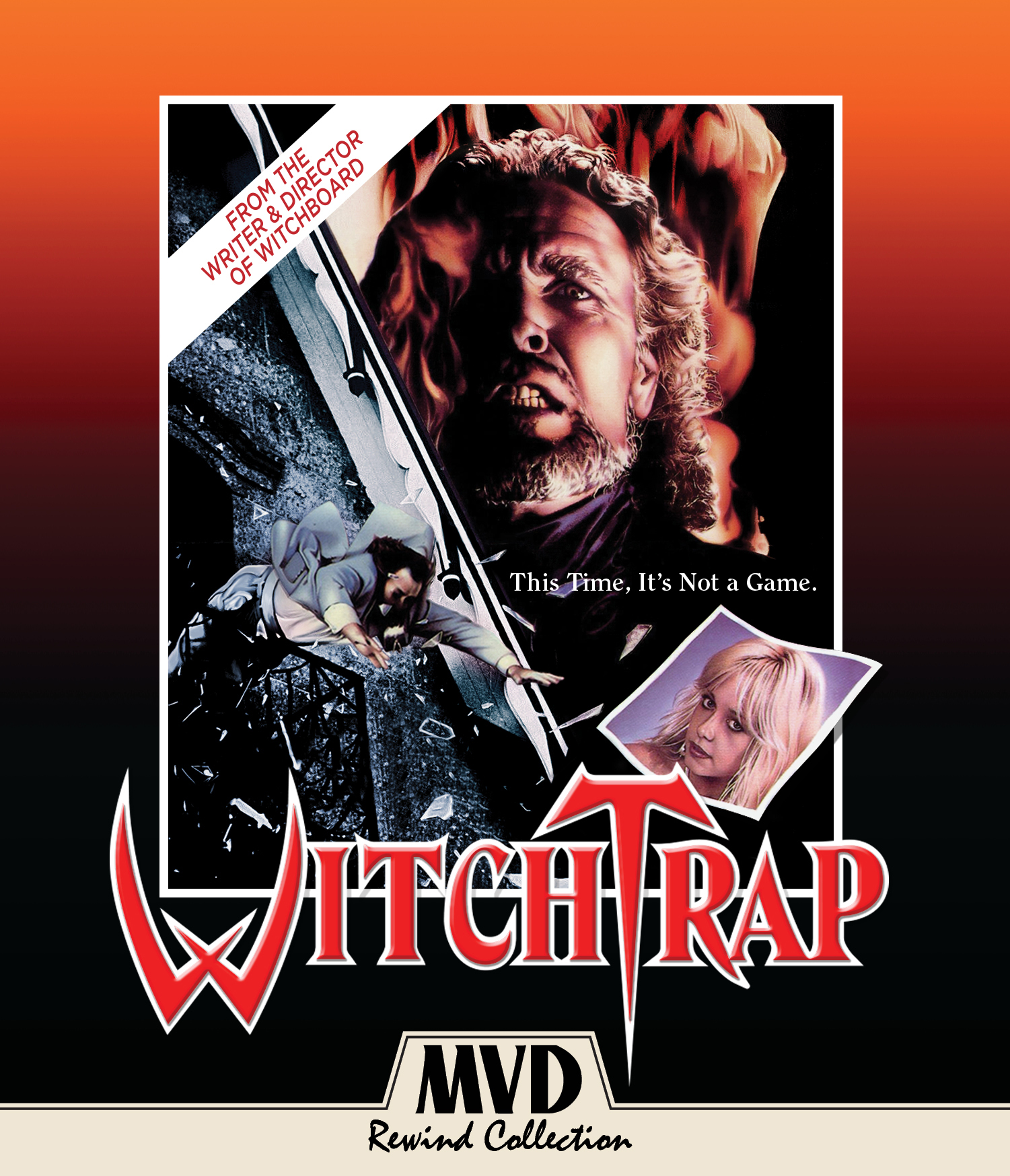
Witchtrap (aka The Haunted; The Presence)
Directed by Kevin S. Tenney
Moonstone Entertainment; Cinema Plus; CGO Pictures; Mentone Pictures; Magnum Entertainment; MVD Rewind Collection
https://mvdb2b.com/s/WitchtrapSpecialEdition/MVD12465BR
92 minutes, 1989 / 2023

One of my favorite ghost sub-genres is when a group of parapsychologist scientists go to a haunted house to investigate it. No, not like those silly “ghost hunting” shows on cable, but films with a darker turn, such as The Haunting (1963, based on Shirley Jackson’s excellent 1959 novel, The Haunting of Hill House), or The Legend of Hell House (1973, based on the 1971 book Hell House, by one of my favorite authors, Richard Matheson).

For Witchtrap, the script was written in 6 days and shot in Fairfield, California in 17. A nice quickie production, most likely designed for the VHS market, in which the second highest of the two top sellers at video stores was horror. That is why so many films came out in the 1980s. This one was just as the move towards laser discs and DVD was starting.

This is definitely a child of its time, when the demographics were geared more towards teen boys and young men, when women in these films were idealized and sexualized beyond the scope of the story. For example, every female character introduced, even the lead scientist, is either wearing next to nothing, high heels, or topless. Yes, there is a bathing and a shower scene (to be honest, the later is part of the story rather than just gratuitous), of course; at least one was mandatory at the time: wet women’s bodies were, if you pardon the cliché, the money shot.

The object of the investigation is to photograph and exorcise an evil ghost, hired by Devon Lauder (director Kevin Tenney) the nephew of the dead warlock (not witch) Avery Lauder (JP Luebsen; d. 2022). Devon wants to turn it into a B&B, but there is just that nasty and murderous spirit in the way, which is proven in the prologue.

Judy Tatum

The leader of the team is parapsychologist Dr. Agnes Goldberg (Judy Tatum) who is with her husband Felix (Rob Zapple) a mental medium. Next up is redheaded physical medium, stately Whitney O’Shea (Kathleen Bailey), followed by video technician Ginger Kowowski (the Linnea Quigley, top Scream Queen at that time, in an extended cameo and the shower scene). For security, along for the ride (and paycheck) is obnoxious boss Frank Murphy (Jack W. Thompson), who mentions that his beer is “as flat as my ex-wife’s chest,” and his two underlings, stereotypical for the time sauntering and horny (right down to often self lip-licking) for Ginger, Levi Jackson (Clyde Talley II), and the comedy relief, sceptic and sarcastic Tony Vincente (James W. Quinn) who could be the model for Chandler Bing; he really does have the best lines, including lots of references to other films and television shows, such as stating “Good night, Gracie.”

It takes 20 minutes of exposition (Act 1) for the team to get to the Lauter House (aka “Slaughter House”), where they meet the big, slow, and creepy – natch – groundskeeper Elwin (Hal Havins). Whose side is he on is the question – in genre films, it really can go either way – though it is obvious he is also a horndog. That is the way of films of this period: the women are either smart or bimbos, though dress the latter, and the men are either (but rarely) smart and obnoxious in one way or another. There is also a nice touch of racism beyond the stereotyping, such as Frank saying, “You’re gonna do what I say or I’m gonna kick your black ass down those stairs,” to witch – I mean which Levi responds, “Try it and I’ll tap dance on your ass like Bojangles Robinson.” But I digress…

Linnea Quigley, Clyde Talley II

This has been noted that the acting is quite wooden, but there is a reason in this case: as IMDB states, “all of the dialogue and sound effects had to be re-recorded in post-production because of a mix-up with the live sound recording.” All the dialogue is flat (same distance from the microphone) and it is hard to match emotions when you are trying to sync the sound to the screen. I was especially amused by the punches during a fight scene; not as “wooden” as in a Shaw Bros. release, but it does resonate like the same sound effect for each punch.

Kathleen Bailey

Of course, our intrepid troupe gets picked off one by one (nice body count with enjoyable blood and relative gore SFX by Judy Yonemoto). The issue for me is that each time it is about to happen, it is telegraphed in two ways. First, Whitney goes into extreme spasms whenever the ghost/warlock is about to do his due diligence. The second is when the music suddenly changes to an intense and dissonant string-based screech. The kills are still fun to watch, though, and a bit imaginative. There are also some decent jump scares, as was the trend at the time.

James W. Quinn

Starting off the Blu-ray extras is a group commentary track with: director Kevin Tenney, producer Dan Duncan, cinematographer Tom Jewett and actor Hal Havins. Fortunately, they kept their egos in the pockets and rarely talk over each other, and the obviously like each other, which comes across. There are lots of anecdotes, but much of it is a study on filmmaking that is not overly technical.

JP Luebsen

There are a series of interviews starting with Tenney (24 min), who also directed cult classics Witchboard (1986) and Night of the Demons (1988) before this one. He actually tells some interesting stories about the lead-up and making of the film that is not just the standard fare, including self-deprecating moments and insightful anecdotes. Next up is Linnea Quigley (14 min) who discusses how she got into the genre (though does not mention some of her earlier classic films), working with the director, and how much she loves acting in horror films (lucky for us). Then there is cinematographer Tom Jewett (15 min) discussing his career and has a bit more technical info. Last is with special effects supervisor Tassimo Baur (17 min), explaining his role with stunts, shootings, and explosions, for example. All the interviews have clips from the film, and they are solo talking head style, but the content is better than the form.

Added is the VHS version of Witchtrap (92 mins, with some of the extra gore removed thanks to the ratings board that wanted to give it an “X”). I did not watch this, only the uncut main film, not seen until the Blu-ray/DVD release. Last is a mostly on-set photo gallery and the original trailer, as well as other company coming attractions of films from the period. On the physical side, there is a reversible cover artwork and a really nice collectible poster, and for the technical, this is a “High Definition (1080p) presentation of the main feature in its original 1.85:1 aspect ratio, scanned and restored in 2K in 2016 from the 35mm Interpositive.” The audio is LPCM 2.0 Mono, and there are optional English subtitles.

Considering the budget and some of my comments, this is actually a surprisingly enjoyable film nearly all the way through. The effects are effective, it is shot well, and as is mentioned often in the commentary and interviews, the lighting throughout is quite noteworthy with its mixing of shadow and light.

This fits in well with the pantheon of 1980s horror cinema, despite its low budget, and even though it was released at the end of the decade, its heart is definitely on a VHS shelf, though seeing the full, uncut version is special.

IMDB listing HERE


Tuesday, March 15, 2022

Documentary Review: In Search of Tomorrow: A Journey Through ‘80s Sci-Fi Cinema

Text © Robert Barry Francos / Indie Horror Films, 2022
Images from the Internet

In Search of Tomorrow: A Journey Through ‘80s Sci-Fi Cinema
Directed by David A. Weiner

CreatorVC
301 minutes, 2022
https://80sscifidoc.com/
@80sscifidoc
www.creatorvc.com

Science Fiction can run from the sublime, like 2001: A Space Odyssey (1968) or Silent Running (1972), or it can fall into the B-level category of the likes of The Green Slime (1968) and It! The Terror from Beyond Space (1958; this was the basis for 1979’s Alien, as 1951’s The Thing from Another World was remade as John Carpenter’s The Thing in 1982). Despite some well-done classics such as the first two mentioned above, by the mid-1970s, Sci-Fi was a second-rate citizen as a genre, producing mostly cheese with bad effects.

This all changed in 1977, with the release of a little film called Star Wars, which reignited the genre aflame, giving rise to both big budget bonanzas and cheapie imitations, but the spark was set. In a perfect storm, this upswing came right on the advent of the VHS market, further spreading the fever. Please note that I am writing this intro before actually watching the film, so I am not sure it will reflect my sentiments. And so, it’s time to start the show. Cue Bugs and Daffy.

The focus of this all-star documentary is that period in the 1980s when everything exploded like all those ships in the film version of Battlestar Gallactica (1978).

After the initial introduction, which briefly goes as far back as Georges Méliès’ 1902’s A Trip tothe Moon, and various other highlights, with Wil Wheaton explaining how before Star Wars, most sci-fi was nihilistic and was a warning of things to come, such as The Day the Earth Stood Still (remember, sci-fi is not about the future or the past, but about the present of when the film was made).

This is followed by a host of hosts: interviews with actors, directors (such as Joe Dante, Paul Verhoeven, and John Carpenter), writers (both screenplays and critics), production crew, composers, and vloggers, etc. What is really nice is that the documentary does not only talk about the top-tier releases, but also the relatively smaller ones that did not raise as much of a blip as the multimillion-dollar mega-effects bonanzas. Year by year, they focus on film by film, so while there are the obvious ones like Star Wars: The Empire Strikes Back, E.T: The Extra-Terrestrial, and Blade Runner, I was pleased they went into detail about the likes of Saturn 3, Yor, Galaxina (RIP, Dorothy Stratton), and Spaceballs.  

One thing I hadn’t made the connection to before, while watching the segment focusing on Flash Gordon, is that the top effects in that film and many others of that period, are now in-reach and equal to numerous low budget Sci-Fi/horror film genres of the present day. In the less sophisticated CGI of the 1980s, it was a wow factor, but now one sees it compared to what the major studios are putting out, say the superhero releases, this was pretty basic by today’s standards. Sometimes modern films will try to purposefully look like the ‘80s as a “flashback,” but technology for indie and low-budget films have actually caught up to the ‘80s majors in their technology, especially with green screens. This is especially true with animated films discussed here, such as Heavy Metal, Tron, and the amazing anime Akira. I’m rambling a bit, so I hope this makes sense.

Among the looks back at particular films, between each year there are also segments of about 15 minutes each that give some grounding to the genre of the period, such as “Cold War Kids,” which talks about how people of that generation – especially kids – were immersed in the threat of the possibility of a nuclear bomb going off at any moment. As a child, I still remember the drills in elementary school where we would practice getting under our desks to practice in case of a regular bombing attack, and lining up in the hallways and crouching down in case of an atom bomb. Of course, in reality, neither of those would really do anything, but we heard about it all the time, including in the cinemas encased in the messages from the films we watched. Even those like Goldfinger (1964) had a big, scary bomb. Where’s McGruber when you need ‘im, right?

While not inclusive, some of the between-years other segments include how films were marketed in a pre-Internet world, visual effects, creature effects (among two of my favorite topics), and music scores. The last one is about the technological implications of the vision in the movies, very briefly focusing on the whole “the future in the story represents the now.” There should have been more about technological determinism, and perhaps throw in a bit of Neil Postman’s Amusing Ourselves to Death when describing the likes of Cherry 2000.

Another interesting point the documentary more hints at than is explicit, is that Sci-Fi is almost always blended with something else, such as a Western (Outland; Star Wars), horror (Alien), war stories (Aliens, Enemy Mine, Predator), or social commentary (Final Countdown; Alien Nation), for example. I find it especially the latter, and the nuclear aspect or the rise of computers, robots and technological determinism (e.g., The Terminator) as expounded by the likes of Marshall McLuhan or Jacques Ellul. This “layering” is part of what makes Sci-Fi not only effective, but makes the future relatable. As I said, whenever it takes place, it’s about the present.

The only sort of repetition in the film, which is unavoidable and yet still enjoyable, is the number releases of a franchise, each of which are covered individually if they came out in the ‘80s. This includes Superman, Star Trek, and of course, Star Wars. Lot’s of “Return of…”, “Part II,” and “The Wrath…” to deal with, but these films are classic and pleasing to rehash, so it still goes relatively flying by.

Each release covered gets about five to ten minutes, and includes lots of clips of the film itself, backstage footage and bits from the trailer, and interviews, none very long (hey, there are a lot of films here). They switch back and forth between the present-day discussions (no historical interviews, happily) with the likes of Alex Winter, Barry Bostwick, Dee Wallace, Billy Dee Williams, Nancy Allen and multiple dozens of others, that it is easy to keep the viewers’ attention and interest, even over the extended time frame. I know I had to break up watching it over two days, which was no problem as it’s individual segments, rather than a narrative where plot points can easily be forgotten. Many of the anecdotal stories told by the casts and crews are especially compelling and often humorous, such as someone discussing the pomposity of Shatner on the set of Khan.

The film is not afraid to shy away from pointing out the flaws of some of the films, such as Howard the Duck and Dune, and glorifying those that deserve it, like The Fly and Back to the Future. And while the film is joyfully comprehensive, it is not inclusive. There are many films not selected for discussion, and yet clips are shown, such as Heartbeeps and Night of the Comet. But, considering the information presented and the immensity of the time, I find no fault in that regard.

This release is a follow-up to a three-part series of documentaries by the director titled In Search of Darkness (2019), In Search of Darkness Part II (2021), and the obvious In Search of Darkness Part III (2022). I have not seen these yet, but it is interesting that it is broken up into three, rather than one honkin’ five-hour extravaganza.

The whole film is a big, “Oh, yeah,” if you were a fan of the genre back in that timeframe. And seeing the people involved and what they look like now is a lot of fun, as well.  And if you are wondering, yes, I did sit through all five hours of the documentary, and smiled through most of it.

IMBD Listing HERE 


Friday, April 10, 2020

Review: The Lurker


Text © Richard Gary / Indie Horror Films, 2020
Images from the Internet


The Lurker
Directed by Eric Liberacki
Forever Safe Productions, FFIILLMM, Silva Shots
80 minutes, 2020

I say this without sarcasm or negativity: another masked serial killer is on the loose, and the end result is not purity test perfection, but enjoyable.

Scout Taylor-Compton (far right) and future body count
Taking place at Crystal Lake High (no, this is not a spoof, nor a comedy) we are introduced to the cast of the school play, Shakespeare’s Romeo and Juliet. The Juliet lead is troubled Taylor (Scout Taylor-Compton; Lita Ford in The Runaways in 2010, and Laurie Strode in the Rob Zombie Halloween remakes) and her Romeo-in-name-only co-star is Miles (Michael Emery). Both Taylor-Compton and Emery are competent and have had a decent career to date, but as other reviewers have pointed out, they have aged out of the roles they are playing. But I’m willing to by-pass this, though it is a bit distracting.

While the performance is on stage, the first of the many kills that leads to a decent body count takes place in the hallway of the school to a guidance counselor (it’s the opening scene, so I’m not giving anything away). What I found a bit strange, and there were a few of these moments, is that the next day, the classes are going on with no grief counselor offered, no sign of the principal, and all while the yellow tape is still up and the crime scene officers are investigating. No one at the school seems to be talking about it much, either. A student was murdered in a bathroom in my high school back in the 1970s, and the school was closed for days, and it was main topic on everyone’s lips for the rest of the semester (true event).

Anyway, the main focus is on popular student Taylor, who has a career in acting envisioned ahead for her, but things have not been going well lately, and when we meet her, she is moody and not very likeable. But she’s a gem compared to rape-culture bully boy Miles. But Taylor seems to have a killer after her who wears a cool raven mask and a cowl, looking straight out of Amadeus (1984). I figured out who was, as the Cramps sang, “behind the mask” at the 17-minute mark, but thankfully, there’s also a nice twist at the end that I won’t reveal.

Michael Emery
This film gives a bit more of a backlight of story on the characters, making many of them not just there for the kills, which I appreciated. As much as I like a large kill number, I want to at least feel like some of the people getting butchered are actually there for a reason.

There is a subplot which is given to us in drabs, at the beginning mostly in silent b-roll; however you know that by the end of the film, it all will be clear, and that works okay, leading up to a not-necessarily expected climax (for me, anyway) that was not deterred by figuring out who is behind the slayings.

At first, the kills come far and between, but by the third act, the pace picks up significantly. And the murders look really good, with some nice physical SFX work without being overly graphic in most cases. Also, the murders are pretty imaginative (not just “I have big knife and I chop”); that being said, I am going to suggest you not see the trailer below because it give too much information and shows too many of the slaughters, which I understand it’s supposed to be the draw, but too much is too much. Why see the film if it’s all there already? Thankfully, I watched the trailer after viewing the film (I tend to do that, especially with indies).

The acting is mostly pretty solid, with some experienced players such as Taylor-Compton, so there is that benefit. Some of the writing is questionable and a bit cliched (such as a group in the woods splitting up to go searching separately). My big question is if you know a killer is after you at someone’s house, why would you go to the empty school rather than the police station? That’s where I would bee-line. Little things like that are bound to draw some groans from experienced slasher enthusiasts (while smiling with glee knowing more kills are on the way).

There’s a few decent cameos throughout, such as Ari Lehman (who has made a career out of popping into pix since being the original kid Jason at the end of Friday the 13th; though with that fancy Dali-esque goatee, he looks like he’s vying to play a Musketeer), triathlete Fast Eddie Huchro, and Rikki Lee Travolta (no relation to John) who sports a distracting Southern drawl for no apparent reason as this was filmed in Chicago.

One of the nice touches is that there is no single red herring here, but rather a slew (pun intended) of them. Lots of obvious killer possibilities to draw you away from what felt like the obvious to me; again, knowing who the killer was did not deter from the twist (which I had also partially figured out, though to be honest, I was not sure of the motive until later).

In summation, while there are some script issues and actors that are distracting by playing teenagers despite their obvious acting talent, this was a nice throwback to the 1980s style of slashers that are flawed, but even with those mistakes are part of what makes the viewing all the more interesting.


Friday, January 5, 2018

Review: Truth or Dare – A Critical Madness

Text © Richard Gary / Indie Horror Films, 2018
Images from the Internet


Truth or Dare: A Critical Madness
Directed, and written by Tim Ritter
Sub Rosa Studios
87 minutes, 1986 / 2010
www.SRSCinema.com
www.MVDvisual.com


Around the time VCRs came into fashion during the early to mid-1980s, the top two sellers / renters at video stores were porn and horror. This opened up a whole new genre of cinema, the made-for-video release. Most of the time these were shot on low budget, making some of Roger Corman’s films look expansive, on inferior quality stock and with actors who were, well, lets just say not exactly of Meryl Streep's caliber.

Director Tim Ritter was 18 or 19 when he directed this film, shot entirely on 16mm which gave it a grainy, ‘70s television feel (the main character driving a ’77 Firebird helps with that image; I kept expecting Dolemite to exit the car). The Chicago company that helped finance the project tried to take it away from him when they found out his age, but with a lawsuit, he retained "custody." In the meanwhile, they undermined him at every turn by changing plot points, actors, and even core storyline on second string shooting, making this an inconsistent mess as far as continuity, so the viewer must go beyond suspension of disbelief, and enter a land of no limits, to the level of Gilligan’s Island. A well-discussed point is that the main villain (there is no mystery on who the killer is from the first scene) keeps coming up with weapons out of nowhere, including machine guns, a (very fake looking) mace, a machete, and a large bolt-cutter.

Okay, that being said, if one is willing to accept the film for what it is and the period it was birthed, this is a fun popcorn-chomper. It really is a time capsule when the rules for straight-to-video product had not yet been written, and anything was possible. For this subgenre at that time, Truth or Dare is a fun ride almost because of the sheer ridiculousness of it all, and I do not mean this as a put-down at all. It is what it is, and this film is no better or worse than, say, 1978’s The Tool Box Murders (sans Pamelyn Ferdin, of course).

Lead nutcase Mike Strauber, acted at first as nerdy and rising to full insanity, is played by John Brace, whose previous credit is as a member of the Burt Reynolds’ Playhouse in Jupiter, Florida (near where this film was shot). His only other credit listed is also from 1986, which is an appearance on Cheers. Brace does some serious scenery chewing, but he manages to be one of the more professional actors in the picture; though I wonder how much he was actually there since during the last half he is wearing a full-face mask made of copper (wouldn’t that get really hot in Florida?) and his body shape and hair changes often, as his character is obviously being played by stunt people.

Most of the cast is amazingly amateurish, in a fun way, though. Raymond Carbone plays a wild police detective named Rosenberg who is obviously from the Chicago area (and a real ex-cop), Terence Andreucci plays the comic relief cop who is way too old and physically stiff for his part (it’s fun watching him try to crouch behind, say, a small rider mower), and Kerry Ellen Walker portrays a baffling hitchhiker (though her brief role soon becomes clear) who was obviously hired more for her cleavage, boxy figure, and big hair then for her acting talent (this is her only credit). And practically the entire Duff family makes an appearance in various roles (perhaps since the film was cast by Priscilla Duff?). I was especially laughing at the “teen punks” who were obviously in their overweight 30s. Then there is the wonderfully named actor Asbestos Felt, one of the only people in this film that has an upcoming credit.

The only on-camera cast-person who had a somewhat healthy career is Mary Fanaro, who played Stauber’s wife, though her many credits seem to peter out in 1999. Of course, there is an infamous cameo by a then-tween A.J. McLean, who would go on to have silly facial hair in the Backstreet Boys.

Perhaps because of the time period before MTV was influencing everything with music video style editing, or maybe it was that Ritter just didn’t really know what he was doing, the edits are kept to a minimum, with shots lasting much longer than one would expect these days, lingering in imaginative ways. For example, when Mike leaves his house after finding his wife in bed with her boss (hey, the first shot is of them in action, so no spoiler alert needed here), he storms out with his wife standing at the door. The camera stays steady on her back and the door as he storms out of frame for a few seconds, and then his car appears backing out of the driveway into the street. With such slow editing and pacing, more drama is built up. Sure, Sergei Eisenstein said that editing equals action, but in these days of 2-second cuts, this works by doing the opposite.

Yes, there is gore and appliance special effect, and some of them are well done, though most of kind of cheesy, of course. A majority of the action is done off-camera, such that the viewer will see the knife come down, and then the next shot the limb is already cut in CSI full gore. It’s rare to actually see the action itself rather than the aftereffect, and yet it still retains a nice blood-to-gore ratio.

There are a lot of enjoyable holes in the story, of which my favorite – even more than the mysterious appearing weapons – being that the police have trouble finding Mike, even though he drives around in his ’77 Firebird, wearing a full-face copper mask (surely a nod to Jason and the Shape), with his blinkers on throughout the whole film. And I won’t even go into him shooting three people at a bus stop with a machine gun while traffic continues to flow around him on a busy street.

There are some obvious comedy set pieces, as well as the unintentional, such as the use of the text crawl under the image of the Sunnydale Mental Institution, or the complaining neighbor who rants, oblivious to Mike loading up on weapons from the car.

The music deserves some comment: wow. Tacky ‘80s synth (usually one bar repeated over and over) for the tense moments, lame piano twinkling (probably also the synth) for the softer emotional parts, and the final credit song, “Critical Madness,” which is just, well, bad (in a fun way), sung occasionally on key by Kay Reed with the Church of Our Savior Choir (I kid you not), from Chicago.

There are extras on this DVD. Trailers for this and the next two (shot on video) Truth or Dare sequels (fourth is currently in production) – they look more like porn S&M tapes – and an interesting Behind-the-Scenes documentary, which is essentially Ritter talking over clips, like a commentary. And speaking of commentaries, there is a full length one by Ritter and a couple of the actors. Now, don’t go expecting a shot-by-shot analysis, but the conversation is pretty interesting about getting funded, the lawsuit, and the like, to keep it from getting dull (like any of the Farrelly Brothers’ or Kevin Smith bore-fest talks).

The word classic has been bandied about for this film, and in its way, it is. It was one of the first of a new direct-to-video genre, and while it’s far from perfect, it’s more than adequate if one is willing to take the step to just accept it for what it is. I probably won’t be the only one to say this, but: go ahead a get this film… I dare you.

This review was originally published in ffanzeen.blogspot.com.