Showing posts with label psychological drama. Show all posts

Thursday, April 27, 2023

Review: Wolf Garden

Text © Richard Gary / Indie Horror Films, 2023
Images from the Internet
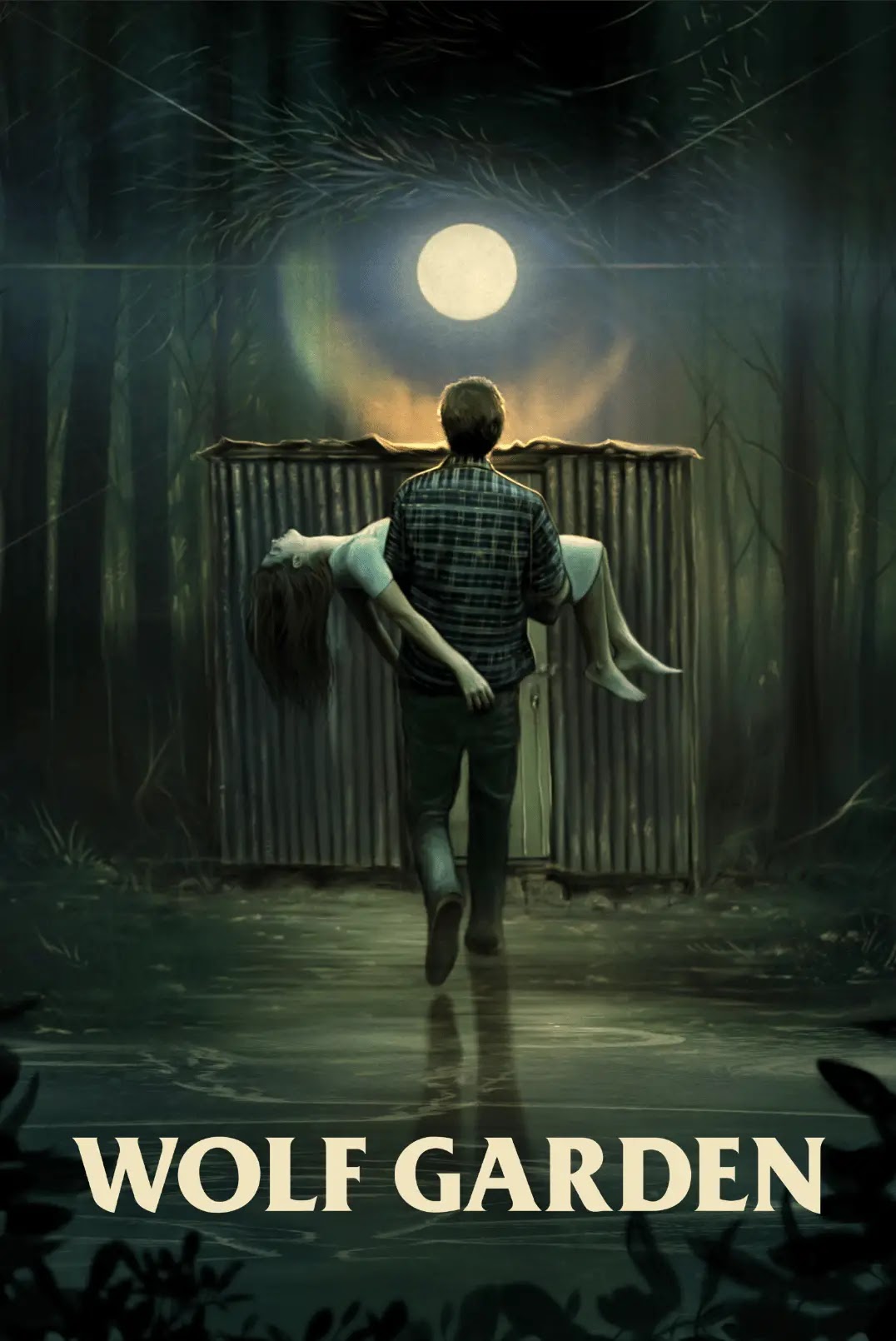
Wolf Garden
Directed by Wayne David
Lightning Strike Pictures; Gravitas Ventures; Strike Media
89 minutes, 2023
www.strike-media.com

For some reason which I care not about nor to be explained, the production of the werewolf genre seems to be more focused out of the UK than in the US. And this release is no exception. This is true even though the arguably biggest werewolf film, An American Werewolf in London (1981), is actually a North American release, though filmed across the lake.

For this film, which is both arty and gritty, William (Wayne David, who also wrote and directed) is a man living in an isolated location in Hertfordshire in a relatively big house (referred to in the film as “The Cottage”) on large grounds. He is sad and despondent. William thinks back, thanks to many montages of flashbacks, to his beloved wife, Chantelle (Sian Altman).

Wayne David

The woods and the mood are dark (but not too visually dim) that reflect his inner emotions, as he goes out to a padlocked shed (called “The Garage” though it is too small to hold a car; perhaps it is a British term?) on the property where he feeds cut up raw meat to something inside that is growling.

An extremely slow burn, with little dialog, mostly between William and Chantelle in the flashbacks, William’s loneliness is palpable. And who is the stranger (Grant Masters) who keeps appearing?

Sian Altman

Twenty minutes in, and it has been all mood and mostly William, pouting his depressed way throughout the house and woods intercut with happier memories. Still, It is interesting that it is often hard to tell what his reality is, and what is in his mind. Isolation can screw with thoughts, and it does not appear that he has a television or even a book to pass the time, just to mull the situation, whatever it is, and stew in it.

There is a bit of gore, but this is not a film for fans of that subgenre. This is definitely more psychological, and there is more emoting than there is rampaging. Most of the wolfism is seen POV and in the sound of the growling and howling, though it is not hard to figure out just who is the wolf in question, if there actually is a lycanthrope, or if it is in William’s possible madness.

There are only three characters seen on screen (other than in the background or heard on the phone), keeping the story tight and almost claustrophobic, even with William often being in the woods, many times in the dark. Those three prove themselves to be able to hold up the film, and this is certainly a tour de force by David, who is in nearly every scene, usually by himself.

Grant Masters

It is also a very beautiful looking piece, with luscious cinematography and well-timed editing. With the exception of a single scene near the beginning, all of it takes place in The Cottage, the woods, and at the shed.

The small cast gives me the impression that this was filmed during COVID. Or perhaps it is budget constrains. Or both?

I really enjoyed the film, with its near gothic moodiness and lighting, though I was sometimes confused about the storyline. Even though everything coalesces during the third act, there are so many flashbacks to various periods that I occasionally felt like Billy Pilgrim, unstuck in time.

IMDB listing HERE


Tuesday, January 25, 2022

Review: Saul at Night

 Text © Robert Barry Francos / Indie Horror Films, 2022
Images from the Internet

Saul at Night
Directed by Cory Santilli
JawDoc Productions; Utopia
85 minutes, 2019 / 2022

Covid vaccines. Voting suppression. Conspiracy theories. In all of these, and more, there is a contingent of people who believe that the government is trying to control our lives. Of course, this is mostly nonsense, but this film takes it as reality in a dystopian, twisted way. No, there’s no martial law, no Big Brother monitors. It’s all sort of mundane, really. And it is expressed in the opening shot of sheep, which could be referring to sleep, or…

In this version of society, sleep is mandatory from 10 PM to 6 AM. For everybody. Well, everybody except the titular – unrelated to “Please Call” – Saul (Kentucker Audley). For he alone is, in the words of Rhonda Sheer, up all night, for the same 8 hours everyone else is in sleepyville. While he sleeps, the world goes on around him, including his wife, Kathyrn (Stephanie Ellis) and their early teenaged daughter, Cleo (Acadia Colan). Sleep is enforced and controlled, so you fall asleep and wake up on the dot, and do not wake up in-between (do people wear adult diapers to bed, or is that controlled, too, I wonder…).

Kentucker Audley

They’re all in the same house, at the same time, but when the females are sleeping, Saul is awake with nothing to do all night, and vice versa during the day as Kathyrn goes to work and the kid attends school. For him, there is no television (no one to watch it, technically, so nothing is aired), no radio, no open stores – though everything seems to be unlocked as he wanders about, including a shopping center (Swansea Mall) and museums – since no one else is awake to steal anything; and like a vampire, no sunlight (I hope he’s getting enough Vitamin D). There are only handwritten notes passed between Saul and his family. In this world, there are no home computers, and cell phones will not work for him since there is no one awake to talk. Well, the one computer proper we do get to see is an old cathode monitor rather than a slim type. And when Saul needs to check in with the government at an office, we see green text on black screen, like coding before WYSIWYG.

Suzanne Clément

When he’s not at home, he’s roaming around an empty Providence, RI (I’m surprised the street lights are on, because in real life, they would be turned off to save government funds), until he suddenly meets someone else who is awake, French-only speaking Amalur (Suzanne Clément, who is Quebecois). After being essentially alone after over 800 days with no one to talk to, or hug, this is a blessing, and a curse. Until they meet, there is perhaps only a dozen words spoken in the film. When Amalur talks, there are very easy to read big, yellow subtitles, I’m grateful to say.

For the longest time, this is a personality study about loneliness, and the lack of mutual spontaneous affection. Even though Saul and Amalur don’t understand each other’s monologs, talking past each other, the sound of another’s voice draws them to each other, even though they both have families. And yet, for some reason, we see the effects on the daytime side of Saul’s family, but not Amalur’s husband and three sons (we only see a photo of them).

There is a very subtle commentary on propaganda and mind control, as we see the rare television commercial (there is no new programming, apparently, as all we see is a clip from the politically safe The Dick Van Dyke Show from the early 1960s; MAGA?) and a billboard, both promoting sleep.

Stephanie Ellis

It’s interesting, of course, to see the slow burn relationship between Saul and Amalur, as they both try to communicate the best they can, and not let emotions muck things up, which of course they do, but not necessarily how one might imagine. The film does not take the easy or obvious road, but perhaps a more realistic one. Emotions and nerves are close to the edge for all involved, not just for Saul and Amalur.

The film has been described as science fiction, which is nonsense. I’m sure in the mind of whomever wrote their publicity the fact that it’s a dystopian, authoritarian existence that may be what gave them that idea as a descriptor, but with voting rights being stomped on and a possible Gilead in our future, where technology is controlled by the government, the alterations would be in shades of difference from our current reality, rather than some grand Zardoz (1974), Logan’s Run (1976) or even Orwell’s 1984 perspective. There is an old bon mot that states that films about the past and future are really about the present. This one is especially true.

Considering this is the director’s initial feature after a few shorts, it is quite the impressive debut. The acting is all top notch, though considering the history of the talent that is hardly surprising, and despite the slow and steady pace, there is still a feeling of tension and urgency among the angst. A beautiful and moving film, as well as a warning of what may be around the corner.

Available on AppleTV, Amazon, and Altavod.

IMBD Listing HERE 


Saturday, July 25, 2020

Review: Choke


Text © Richard Gary / Indie Horror Films, 2020
Images from the Internet


Choke
Directed by Gregory Hatanaka
CineRidge Entertainment; Cinema Epoch
73 minutes, 2020

Choking is a fetish I have never understood, but like many other fetishes in films like Fetish Dolls Die Laughing (2012) that cover tickling, bondage, and other sexual sports, they have been creeping into an ever more common sub-genre in the indie scene. Just ask David Carradine (what, too soon?).

Most fetish-related films, if they aren’t comedies, are finger-on-the-side-of-nose to those who enjoy the topic, but Choke takes itself very seriously while drowning in artiness. The art is another fetish – albeit a more stylistic one – that sometimes disguises itself in the ends justifying the means. In other words, while it’s trying to be special, sometimes it can – err – choke on its own petard (yes, I’m mixing metaphors, to be artistic, of course).

Shane Ryan
Brandon (Shane Ryan, who directed 2012’s My Name is ‘A’ By Anonymous, reviewed HERE)  is a possible serial killer who disposes of his (female only) victims by, well, you know. Or does he? Is it real, or is he another Patrick Bateman (American Psycho)?

The film follows his relationship with Jeanie (Sarah Brine; back in the day, this role may have been played by Lauren Ambrose), a 17 year old he meets on a train; jailbait, anyone? Their relationship is interspersed with scenes of his partaking of his life in general (such as visits with his ailing mom) and his hobby. Which parts are real and which are in his imagination are the questions of the day. Perhaps he’s fixating on a past victim, Payton, and creating this fantasy life with her?

Meanwhile, policeman Robert (British actor Scott Butler), who is down and out with both his girlfriend (Bella Cruz) and a prostitute (Jennifer Field), is also having a sado-sexual relationship with his psychologist, Stephanie (scream queen Lisa London), in which he is the M response to her S. But he’s just been given a case of someone found strangled. Wanna guess? The story flips back and forth between the lives of these two twisted men, Brandon and Robert, each significantly damaged in their own way.

Sarah Brine
The set up – and as far as I will go plot-wise – takes almost half the film. At this point it leaves so many questions, just the start of which is who’s lives are real, or just a figment. Is this like the short story “An Occurrence at Owl Creek Bridge” (1890; clips of the 1959 television presentation based on this is interspersed throughout) and all in the mind of a person in the moment before they die of asphyxiation? These are just some of the ponderances that were ricocheting through my mind by the halfway mark. But no, I won’t answer any of them; no spoilers.

Scott Butler
One might call this a psychological thriller, and I would be okay with that (as if I had a say), but it really feels like it is trying too hard to make no point. It’s certainly beautiful to look at, but the structure needs a better foundation. For example, there is too much dialog that doesn’t really progress the story by being too vague, or it just seems to go on way too long, such as a motivational speech by a New Age-y snake oil salesman (Sal Landi), who promotes self-choking.

Though the film is relatively short, it feels too padded by throwing montages left and right, as people wander over music (good soundtrack, mostly, though). I’m sure they were trying to show developing relationships, but the point was made, and then made, and then made, all the while the emphasis was on style and the story seems to have been lost in the shuffle toward making “art.”

Lisa London
I appreciate “art” in a film, but not if it takes away from the narrative. That is where the biggest fault lies in the release, in my opinion, that there is not enough story and motivations given to the viewer – even with all the narration, including by characters and over the soundtrack like thought bubbles – to support the foundations on which the zeitgeist and synergy is built. If you’re going to use a loose form, say, like Slaughterhouse Five, it needs to be built on something to stand on, not just float over. I’m not sure I’m making sense. The end results in something that looks good, but its aspirations are lost in its pretentions.

The film isn’t a failure, though if one is looking for a good fetish film or murder spree (both of which are present), it’s like looking through a fog. I see this film as an exercise by the director, to test his stylistic wings in the cinema art. He has been quite prolific, but in this case, I mean, working out some kinks.

Meanwhile, now I have the desire to listen to Detroit-based punk band, Choking Susan.


Monday, May 25, 2020

Review: A Knight’s Tour


Text © Richard Gary / Indie Horror Films, 2020
Images from the Internet


A Knight’s Tour
Directed by Marvin Choi
Fugitive Frames; Terror Films
77 minutes, 2018 / 2020

Perhaps it’s a post-Covid 19 world, or maybe even a zombie apocalypse. Whatever brought our two characters into proximity to each other in the middle of nowhere, we are there with them.

Humorously, the joke is the “Black guy” is the first to get killed in genre films, yet here we have a two-person story, both of whom are African-American. This is the first feature I can remember other than Sleuth (1972) to consist of only a duo of actors.

Darnel Powell and Joseph Price
Injured, Joseph “JD” Dauber (Darnel Powell) stumbles upon the humble abode of elder Henry LaMoe (Joseph Price) in the middle of some mighty hills (filmed in California). Like 10 Cloverfield Lane (2016), the homeowner is suspicious of the newcomer, and promptly locks him in chains less than 5 minutes into the film, so hopefully I am not giving a spoiler to anyone. The irony of a Black man chaining up another Black man is something that can be discussed at length, obviously, but I am not going to go into that right now. Needless to say, this is more of a psychological drama than an action-packed shoot-‘em-up.

Unlike John Goodman’s modern and spacious underground lair, Henry’s home is more of a wooden shack, with no running water (and though unseen, I am assuming an outhouse). It’s a backwater hovel that is probably way more realistic to the situation than the big budget Goodman sci-fi film.

The story takes place with enough years after “the outbreak” (sounding scarily familiar to our modern times) that JD, I’m thinking in his mid-20s, pretty much grew up in the post-apocalypse to the point of where it has become somewhat the new normal for him. Old school Henry is not as sure of his footing in this abandoned world of understandable paranoia and clings to the cabin and his past. Everyone he has cared about is gone, and he faces the world alone. That’s when JD comes into the picture.

Naturally, there is suspicion at first that slowly builds into a necessary friendship between the two, though trust is harder to come across in this world of short supplies and roving gangs. As much as the game of chess is a central motif, including the title, Henry and JD try to figure each other out while keeping their own “king” on guard against being hurt, or worse. For them, it’s a game of literal survival.

This is an odd choice to be reviewed on this blog, because despite its internal time period, technically the film is not what one would normally place in a horror or thriller genre. It’s more a psychological piece of two strangers who are trying to survive their surroundings as things change from what has become the routine. JD’s world changes more often as he is roaming, but for Henry, it is much harsher, like the lick of a cat: it’s something you may crave, but the roughness does not always make it easier.

Both Powell and Price fit their roles well, with JD being curious and almost casual about what is happening around him (sort of a personification of the look Willem Defoe gives Amy Madigan when she bursts into his room with a gun in 1984’s Streets of Fire). Henry is more intense and tightly wound, having spent years on his own with no one to share his thoughts. His humanity is on the line, and JD willingly or involuntarily has the ability to shine some reflection on that area. Or, perhaps, he has some other nefarious aims that come to light when Henry finds out just how JD survives.

This is a first full-length feature film for director Marvin Choi, who also wrote and edited it. Man, if this is his first, I can only imagine where he can go, say, by 10 years from now. Again, if you are expecting a “The Walking Dead,” change the channel. Sure, there is some serious tension here, but if what you seek is an intelligent dance between two lost souls who are seeking out any hint of humanity left in the world, I strongly recommend this release.