All genres of suspense, terror, and horror will be reviewed by Richard Gary. His address to send preview copies supplied upon request to rbf55@msn.com.
My apologies for the delay in new reviews, etc. My hard drive crashed and I am in the process of getting the recovered. And, may I say sincerely, siiiiiiigh.
Quite truthfully, I’ve kind of been hesitating reviewing this. Lately,
it just seems that watching films with two or more commentaries is too time
consuming. However, I just reviewed another film called Scream Park [HERE] which co-starred Steve Rudzinski, who directed Everyone Must Die! (EMD), and it got me
curious. There are also a number of cast members that overlapped these two
films.
EMD! takes a new spin on
“death comes in threes” as a mysterious serial (or series of serial) killer(s)
strikes three small towns at a time, starting in Maine and making his way
southwest to “now,” in West Virginia (so much for being almost heaven, eh?).
After a brutal opening (among first killed going to the lead of Scream Park, Wendy Wygant, with one of
my fave make-up effects in the film), we are introduced to four friends in the
first set piece who would never, ever, ever be seen together in real life, never
mind out in the woods on a camping trip. The two guys are the annoying white
rap star (Seth Joseph, stealing his scenes) who only speaks in bad rhymes (and
dresses in florescent pale reds because his nom d’rap is MC Pink – pronounced
Paahnk; he has a CD called Fear of a Pink
Planet), a chubby OCD who over enunciates and is extremely exacting. The
two women are the backwards baseball cap-wearing social justice feminist with
the arm-ring tattoo, and the busty New Ager that is into pseudo-spirituality
and tarot. It’s nice that Rudzinski is trying different characters than the
standard, but this is really a stretch. What I am proud of Rudzinski, though,
is that the couple formation is not what you’re expecting. From the start, though,
it doesn’t bode too well for the characters.
After the butchering, the main storyline group (yes, there are two fun opening set pieces) we get to follow
to slaughter is a party of seven, again, most non-standard types and yet
somewhat familiar. Yes, there’s the football jock who is dumb and obsessed with
one of the women in the group, but there is also the guy obsessed with eggs,
another equally obsessed with golf (film co-writer Derek Rothermund), and one
obsessed with being Student Body President (played by the director). The women
include the sexy redhead (Nicole Beattie, looking incredibly different than she
did as a goth punk in Scream Park),
the rich racist, and the other one who is a grumpy goth whiner (Aleen Isley,
who was also on the crew). This cast really works well together. They are also
not your standard slim-jim model types, but actually look like human beings
(even Beattie, who actually does model). It’s great when you get a troupe dynamic
of some sort going.
The motive behind the killings is never given, thankfully, which of
course makes a perfect opening for a sequel (or, dare I say it, franchise),
which I am happy to see. My theory is that it is all part of a cult, since it’s
pretty obvious the assassins are different people (much of the cast filling in
for the black Kevlar covered killers).
There is a very strong sense of humor that runs throughout that is
quite smart, often in throwaway lines, such as someone commenting that DJ Pink
missed out on being the fourth Beastie Boy when he argued that partying was a privilege,
not a right. Or, one character is excited about a new video game called Misdemeanor Petty Larceny, where you
score points by doing things like kicking over garbage cans. Gotta love it!
Even the end credits have a fun moment in the warnings. Oh, and make sure you
stay until after the credits, it’s a hoot.
What is also nicely added is some of the wrap-around killings that had
nothing to do with the main groups of middle-20s “teenagers” (or, as the
director keeps calling them in the commentary, “kids”), but adds some nice
kills, more nudity (the prerequisite shower scene), and a large round of
laughs, additionally added to by the reading of Dan Christmas (any relation to the
late [d. 2000] actor Eric Christmas?).
Despite some pretty badly choreographed fight scenes (even on the
commentary they note that the golfer can’t swing a club), the gore is plentiful
without being overdone, and the appliances (and even a couple of CGI shots)
look good. There is one scene though, where the blood on a sink looks like
barbeque sauce, but I’m going to generously give that to them for balance. We
get a bit of amble boobage (both figuratively and literally) and lots of ways
of meeting the Lord, though sharp items are a favored method. The acting is
iffy and over the top at times, such as the news reporter, and the guy who’s
sister is offed and seeks revenge who often acting with his eyebrows and body
tics; amazingly he has the most credits of the cast on IMDB.
Among the many extras is a decent blooper reel, the film’s trailer, a
couple of music videos (especially check out Seth Joseph’s turn as MC Pink), an
22-minute interview short with Rudzinski, Rothermund, and a bunch of the actors,
and two commentary tracks, as stated above.
The first track offered (which was recorded second) features Rudzinski,
Rothermund, and some of the actors from the interview short. I usually hold
that more than two or three people on an audio track is just plain annoying as
people talk over each other, it’s hard to distinguish who’s who, and the macho
(of all genders) tends to come through, making it just a silly mess. But here
they make constructive use of their time, telling filming anecdotes and, even
among the kidding around, still manage to stay mostly on point and don’t step
on each other, which I believe goes to showing more professionalism, and makes
this an interesting and enjoyable track.
The second is just Rudzinski and Rothermund, and amazingly, just these
two come across goofier than the troupe on the other, but there is still enough
information (yes, we get it, it was hot out during the filming) to keep the
information interesting and flowing. In total, between the film and extras, you’re
about four hours in.
EMD! Is essentially an extremely fun genre flick that is well
written and takes chances on adding to the canon without stepping all over it. Rudzinski
and Rothermund make a great team, and I hope they continue to work together
because it’s envelope stretching time and a job well done. Watching this was definitely
time well spent.
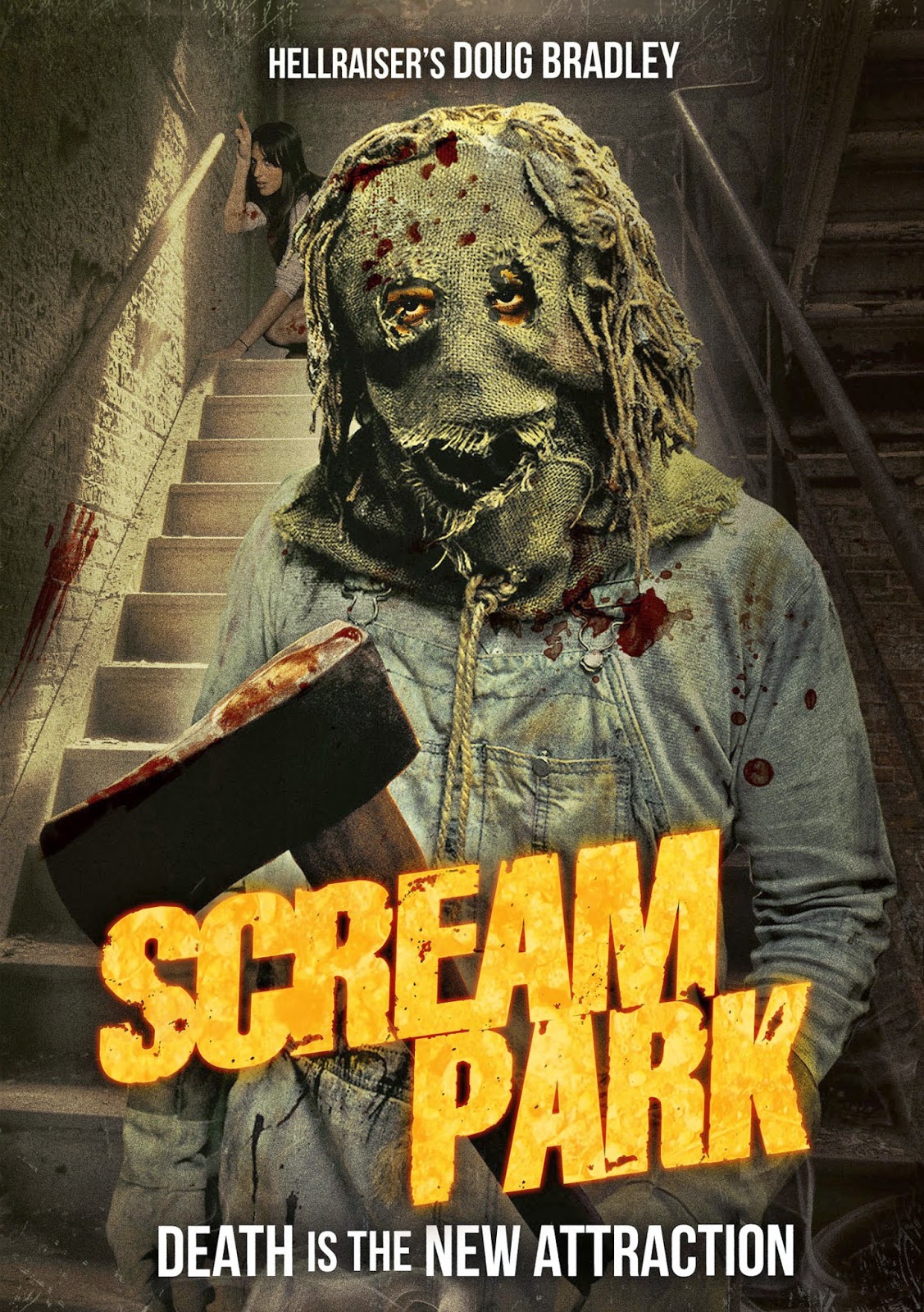
First-time feature director Cary Hill is obviously a genre fan. Filmed
in Pittsburgh, there is a number of nods to George A. Romero and zombies, even
though there are none in the film; however, the copyright-free Night of the Living Dead is shown in a couple of scenes on a monitor
screen.
Shot in the spooky Conneaut Lake Park (where scenes from the more
mainstream The Road was also filmed
in 2009), Hill gives it an ‘80s/’90s slasher feel to the level that one of the
characters (the punk guy) actually uses a cassette (before it was cool again),
and the manager wears those really big framed glasses that we all wore back
then. I dunno, it feels like a time warp with cell phones being the flip kind. Wouldn’t
be the first time someone thought of that, but that also doesn’t take away from
it being cool.
At a run-down local amusement park – which reminds me of when we used
to go to Crystal Beach (d. 1989), Ontario, not to be confused with Camp Crystal
Lake – we meet a half-dozen or so co-workers who show various levels of
enthusiasm for the job, as the park is on the brink of closure from lack of
public interest. We see mostly empty rides and sideshow games with a number of
vacant seats. This group is typical of film teens, expressed through high
school jackets, though it’s obvious they are at least in their mid-twenties and
even some receding hairlines (I’m thrown back to MADTv’s “Pretty White Kids with Problems”). While there is the goth
(or punk) girl in a corset with tutu, the horny couple, and the good girl, among
others, happily Hill manages to steer away from too heavy handed clichés, such as the jock vs. the nerd. Bravo.
I promise I will try not to give away too much, but I do have to say,
the one black guy (who isn’t part of the Pretty Kids group, though equally
disgruntled) dies first by being hanged. Really? A black lynching? Things that
make you go hmmm, indeed. In my own
defense, it’s pretty clear he’s a character that is gonna get it quickly, so I hope
I’m not giving away too much. Okay, I’m
backing off on the spoilers now.
There are some subtle homages here and there, such as the orange-haired
punk guy who is reminiscent of Linnea Quigley’s Trash character from Return of the Living Dead (1985), and
one death is right out of The Toxic
Avenger (1984). The lead character, Jennifer (Wendy Wygant), reminds me of
a taller version of Jennifer Love Hewitt of I
Know What You Did Last Summer (1997), and another’s (the exceedingly cute
and diminutive Alicia Marie Marcucci) hair style, shirt and plaid skirt is
right out of Drew Barrymore’s in Scream
(1996). Also like that film, there are two killers (they make that clear from
the beginning as they both wear different masks). Perhaps these are
coincidences, or subconscious leanings, but I’m willing to bet that it is an
honorarium, more than anything else. Then, of course, there is Pinhead himself, Doug
Bradley, in a 4 minute cameo flashback as the amusement park owner, Mr. Hyde
(first name Henry?).
This film follows along with the model of Carol Clover’s excellent 1992
analysis, Men, Women and Chainsaws of
the women actually being braver and more intelligent than the men. If you haven’t
read this book and you’re a genre fan, it’s well worth it.
One flub that annoyed me, and I am saying this with a genuine smile and
without a hint of sarcasm, is one person (male) is inside a building and is
fumbling with the keys to open the door to let the heroine in before the guy
with the ax gets to her, when it is obviously the door has a lever turn-latch,
not a key one. Oh, and why does one of the
killers, played by Kevin "Ogre" Ogilvie (AKA Nivek Ogre) from the industrial band Skinny Puppy have (a wavering) southern accent in
Pittsburgh? I truly believe it’s important to embrace these kinds of questions
with these films, because it means you pay attention to what is going on. Man,
I love indie cinema! Hey ho, let’s go! Punk rawk!
While the ending had a nice touch, the theory was clear to me pretty
early on.
There is only one topless scene, by the extremely bodacious,
attractive, and oddly grayish-toothed Kailey Marie Harris (yes, there are two
actors whose middle name is Marie). As for the gore, there’s lots of it, most
of it quite effective, even though the fresh blood is bit too dark and heavy on
the viscosity (looks like motor oil); the splatter looks much better. Scalpings,
beheading, axes, knives, they all look good and the after effects are successful,
thanks to Arvin Clay. And that’s what matters, right? Of course, right.
The editing is sharp, the color over-saturation works in the retro genre
nod, and the day-for-night functions well. There are the usual first-film
inconsistencies (one of the fun things to find for me), such as after someone
pulls out a huge bag of raw french fries from under a sink and is then called away,
when she comes back she pulls it out again. Shades of Vincent Price’s sweater
in The Last Man on Earth (1964). Sure
there are the occasional holes here and there, as is fitting the micro-budget
and genre, but here’s a thought. If the place is named “Fright Land,” wouldn’t
that have made as good a name for the film as Scream Park?
The commentary track by the director is interesting with anecdotes and techniques,
but it is a revelation at 1:06 that made a whole shitload of sense to me that I
hadn’t thought of before, so kudos for that, Cary. There is also an amusing
bloopers reel which is more the cast letting off steam than errors, and as
usual with Wild Eye releases, some great company trailers.
As a directorial debut, this has been pretty highly accepted, with rightfully
a bunch of festival nods. If you’re a fan of the ‘80/’90s pre-torture porn
slasher films, I don’t believe you’ll be disappointed.
Written and directed
by Paolo Fazzini E2=G
Production Elite Entertainment 60 minutes, 2011 / 2013 www.MVDvisual.com
Let me say right at the start, the title
of the film is a brilliant pun.
Director Fazzini is not only a
filmmaker, but also a historian of Italian giallo
films, especially from the ‘80s, and even put out an interesting documentary
about the genre, titled Hanging Shadows:
Perspectives on Italian Horror Cinema (reviewed directly below this one, or
at HERE)
Like any genre, there are subgenres
that make up the pie chart of the whole. And where does this one fit in? Well,
it’s definitely closer to some of the noir works of Mario Bava and Dario
Argento’s Deep Red (1975), say, than
anything by Fulci or Lamberto Bava. Fazzini is certainly helped here by
renowned cinematographer Mirco Sgarzi, who shot some incredibly beautiful works
such as House of Flesh Mannequins (2009),
reviewed by me HERE. His style various from artsy to perfectly lit reality, creating moods along the
way that fit the tale
For this “inspired by true events”
story, we meet our protagonist/antagonist, Davide (Gianluca Testa), a laborer
who is let go from his blue collar job thanks to a downturn in the Italian economy
(a result of the US collapse around 2008 thanks to the unelected president,
Little Georgie Bush). But money is not his only problem, as we come to see him
for the schizophrenic sadist that he is.
We come to realize that he has
kidnapped a rich industrialist’s daughter (the beautiful Eleonora Bolla), and
is keeping her tied up in his rented home in as hillside village on Sicily. But
this is more than just a kidnapping, as his mental disease starts getting the
better of him. After all, the tagline for this film is Witness the birth of anew serial killer.” While there is a healthy
number of cast members, this really is about Davide and “the girl” (as she is known).
As people come looking for her, or those who become involved with the drugs he
has come to help sell to make some cash, bodies begin to pile up in somewhat
gruesome ways.
Cinema giallo was recognized by a number of genre-specific elements, such
as the quick zoom (I believe Mario Bava created it and Argento perfected it),
and something that is used abundantly and quite effectively here, which is
using primary colors to saturate a scene indicating affect or emotion. For
example, while the girl is crying, Davide’s head cradled on her lap, they are
bathed in a pale blue light; when Davide is having a scary hallucination, the
room from where the fear is generating is a sharp red.
Some of the best of the gore and effects
happen during these freakouts, such as a woman with a distorted mouth (check
out the photos in the extras for a clear view of it), or being in the woods
with a group of people biting chunks out of his flesh. While there is more
story tension than gore (which is why this is a noir rather than horror), it
looks incredibly well done, and the blood has just the right color and
viscosity.
The location is also part of the story,
with abandoned stone buildings contrasted by wooded areas. One of my favorite
shots is of a wooded area you think is isolated, is revealed in a pan to be
just on the outskirts of town. The best part of the genre, with this included,
is that there are some truly unexpected moments that took me by surprise, which
is a nice – er – surprise.
The extras are a 15-minute interview
with the director as he walks us through some of the locations (no sets were
used), back-scene photos, and two music videos.
There are some long gaps between
physical violence, but the malevolence runs throughout. Gorehounds may balk at
the space between kills, but those who understand these things will know that
the tension building is all part of the fun, and Fazzini shows he knows how to
do just that.
Written,
produced and directed by Paolo Fazzini Elite Entertainment 60 minutes, 2005 / 2013 www.MVDvisual.com
Before the VHS explosion of the ‘80s,
it was rare to see an Italian horror films either on the screen or especially television.
What we did get was usually directed by
Mario Bava, such as La maschera del
demonio, aka The Mask of Satan,
though it as more commonly known as Black
Sunday (1960), and the terrifying
I tre volti della paura, or as we
knew it, Black Sabbath (1963), possibly
Boris Karloff’s last truly scary role.
Of course, we kids didn’t know it was Italian,
we just knew it was dubbed. Most of the films shown on this side of the
Atlantic whatever the presentation medium, were highly edited, thanks to
nudity, blood, and the last remnants of the Hollywood Code system. Besides,
most horror viewers back then were teenage couples with the guys looking for
reasons to put their arms around their dates.
In college, during the late 1970s, I
was introduced to New Wave Italian
cinema, such as Luchiano Visconti, Roberto Rossellini, and the realism auteur
Michael Antonioni. They were great, technically superb, but the left me kind of
cold. I wasn’t sure why I was supposed to care about many of the characters and
left me asking, “che cosa?” But it
wasn’t until a few short years later that I discovered the piasan niche for which I was looking.
Italian horror cinema, as I said,
really came into its golden days in the 1980s, when video stores were springing
up every few blocks, its clients hungry for new products, with the two biggest
sellers being horror and porn. It was easy to walk into any store and find
campy and bloody delights. Names started to be known, like Leo Fulci, Dario
Argento, and Lamberto Bava. The posters alone would become iconic, such as
Fulci’s Zombie (aka Zombi 2, 1979.
What made these films so popular was the
sheer audacity of them. Many of them were silly, campy, or made no sense, but
we later found out that was because they were edited, and usually had multiple
names with each version being slightly different. We were seeing lots of gore,
but distributors seemed to think that the bleak endings would not fit well with
Middle America. It took many years to finally see the real end of The Gates of Hell (aka City of the Living Dead aka Paura nella citta dei morti veventi,
1980); in fact, it wasn’t until it was released on DVD.
The gore effects in these films were
stunning: maggots falling out of zombie eyeholes, eyes yanked into shards of
wood, bodies pulled apart, bugs eating away at flesh, heads pulled through a drill
press, and blood spontaneously pouring out of eyes. Again, they ran from realistic
to “fakey,” but it was always mechanical rather than digital. I used to love to
try and figure out how they did it. I remember seeing a film where a women
spews out her entire intestinal tract and laughing, and then not being able to
look at work the next day when someone cut her finger.
If
you talk to most of the up-and-coming filmmakers I’ve reviewed, such as Sean
Weathers, Dustin Wayde Mills and Richard Marr-Griffin, they will all proudly
bear witness to their Italian horror viewing backgrounds. This genre’s
popularity has not changed over time, either. Just this past fall, a pal had a
day of zombie film viewing with his friends (I was included), and two of them (Zombie and Michele Soavi’s Cemetery Man [aka Delamorte Delamore, 1994]) were of Italian origin, and it was still
visceral.
This
hour-long documentary is an Italian import as well, created nearly a decade
ago, but only recently released in a non-academic forum. We meet many of the
directors, writers, and special effect artists that contributed to the field,
most of them among the most cherished by the genre’s fans, such as Argento,
Bava, and late-comer Soavi.
The
film explores the methods behind the madness. For example Soavi explains he
hates horror films, but is more into realistic images, so cannibals, rather
than zombies, eating people is not horror, and he posits that he does not like
the title of horror he is often
labeled. .He interestingly comments on the comparative and real graphic images
often shown on the television news.
Lamberto
Bava tells how he came up with the idea for Demons
(aka Demoni, 1985), comparing it to
mass media: The first film takes place in a movie house where the demons come
out of the projected images; in Demons 2 (aka Demoni 2… l’incubo ritorna, 1985), they come out of the even more
accessible television; and in a planned but unrealized third film, it was to
come out of the press.
In
Italian with English subtitles, the talking parts are pretty short and jump
from person to person often, though gratefully the subject’s name is presented
often. It comes out a bit disjointed, but once you get the rhythm, it’s
fascinating.
Mixed
in with the taking heads are many shots from the films, usually the gore scenes
and often with nudity, though it’s rare that any clip lasts longer than 10
seconds, and there is hardly any that have dialog.
There
are two extras here, focusing in on one director each
The first is of my favorite director of
the period, “Leo Fulchi, Italian Godfather of Gore.” Lasting a mere six
minutes, it delves into the man rather than the movies, which is great. One of
the three people discussing Fulchi (d. 1996) is his daughter, Antonella. The second
short is “Mario Bava: Wizard of Fear” is slightly shorter, but again, three
people describe Bava (d. 1980) and part of his process, such as his use of quick
close-ups, that was copied into spaghetti westerns. The main clip they show is
from Black Sunday¸ as they call it
here, with the lovely Barbara Steele.
If
you’re a fan of these kinds of film, and we are legion, this is a must see.
Otherwise, you might find the visuals quite shocking.
“Tragedy is
when I cut my finger. Comedy is when you fall into an open sewer and die.” –
Mel Brooks
It’s been a while since I saw a Bill
Zebub release, and I’m happy to have the opportunity to do so again.
To me, Zebub is sort of the modern Ed
Wood. Now, now, don’t be mean, I’m serious. His output is meagerly acted,
slimly written, doesn’t always make sense, the director is often the lead, and
is almost always a hoot. Like Wood, Zebub does it for the joy it brings him, as
well as a career.
In one of his early features, Assmonster: The Making of a Horror Film (2007),
he uses the story to explain why he got into the indie horror industry; e.g., films
sell at conventions for large mark-up, and you get to see and touch lots of
naked women while you film them. Also like Ed, Bill looks at the dark side of life,
sometimes by mocking it. It is not easy sticking to a conviction, but over the
years Zebub has become one of the leading Jersey indie film auteurs.
Like Assmonster, this is sort of an autobiographical tale with Zebub
playing himself after having made a number of films (which are mentioned – ergo
promoted – frequently). You could arguably say this is actually a sequel in the
sense of that British film that looks at some people every seven years.
While the storyline is written, I’m
willing to bet that much of the incidents involved, such as distributors balking
at some of his titles, which include the likes of Jesus the Total Douchebag, Jesus
the Daughter of God, ZombieChrist
and The Worst Horror Film Ever Made: The
Sequel (actually, the latter is one of my Zebub faves).
I’m not bothered by the anti-religion
tone, the death metal music, the sheer amount of nudity, but there is the
frequent – and I mean a lot – of
homophobic comments that are used as humor, such as Zebub describing the
difference between “jazz hands” and “gay fingers” (aka air quotes). Any time he wants to insult a man, he calls him
gay. This part I’m not impressed. That being said, as I once stated, I’m not
really sure if hanging out with Bill Zebub socially would be totally cool, or
totally tool (yes, I used that as a verb…wanna make somptin’ of it?). If he is
like he is in his films, well, I don’t know if I’d want to have a beer with him
because he really does come across as an asshole (rather than assmonster).
There is also some “humor” talk about
rape and domination. Again, I don’t mind film violence. Hey, pull someone’s arm
out of a socket; stick a cleaver up somebody’s face; tie someone to two bound
trees and then let them go…all good. But unless there is a revenge story on the
other side (e.g., I Spit on Your Grave),
or a point to it in the story, I find it hard when it’s a comedy, even if the
rapist is Jesus (a common Zebub theme). To give you an example, the work title
of the meta-project he is making is called Raped
by a Rapist.
To be somewhat fair, he addresses this
here. After a film of his is banned by “PayFriend,” he exasperatedly says to a
pal, “I made a career out of doing everything wrong. Nobody else has blasphemy.
Nobody else has racial humor. Nobody else depicts rape in movies, not even as a
joke. I do things everybody else is afraid to do. … I wanted to test boundaries.
...The real balls are depicting the sexual sadist onscreen.” Despite finding it
despicable, I also understand what he is saying. “Roughies” have a history in
cinema, even dating back to James Cagney pushing a grapefruit half into Mae
Clark’s face in The Public Enemyin
1931.
There used to be an entire catalog of these kinds of films on a brand called
W.A.V.E., in which some of today’s scream queens came to relative prominence
such as the lovely Tina Krause.
Okay, enough with the moralizing and justifying.
Let’s get back to the film, eh wot? Though quite pointed, this is still a comedy.
Much of it relies on two things: one is an actor trying to keep up with Bill’s verbal
bullshit and/or ad libbing, and the other is some of the stuff Bill says.
Despite a number of repeated jokes (“See you later, crocodile” and jumping when
his phone rings, for example), some of his word play is quite witty in that
12-year-old mentality; my favorite is when he says almost as a throwaway line, “I
know you’re a methadone actress…” I wonder how many viewers actually caught
that.
Unlike some of his other releases,
there is no gore make-up and no laughable digi SFX (love the zomb-bees in an
earlier film, or Jesus flying through the air still nailed to the cross). This
is mostly set pieces of action, inaction (e.g., two guys talking while sitting
on a couch), and any excuse to throw in some nekkid bodies, such as the bodacious
Angelina Leigh, playing Zebub’s girlfriend, who we see the most – and most of –
including on the throne (though her reading of putting that tail on words, like
“I know-wah... It’s fine-nah” started to get to me by the end).
Ah, yes, let’s talk about Zebub’s
women. As is common in one of his shoots, just about no women will be seen
unless at some point they are not wearing a G-string (there is only one here).
They range from very cute (such as the slim, braces-baring Sheri Medulla) to
the big boobed and thick thighed. While not all stunning, he does have a wide
range of body types, which I respect. However, one thing that is somewhat
consistent (though not completely) is skin art. Most have multiple tattoos,
including the very colorful ones of Stephanie Anders, who has a great one on
her side that looks like her ribs are sticking through. Another actor has one
of the worst tats I’ve ever seen. Seriously.
Getting away from all political comments
about what is appropriate and what is not, the main weakness of this film is
its length. There are too many scenes that could have been severely cut down
which would have not made a hoot of difference to the story, such as Anders’
(purposefully) confused reading of what Bill was trying to say, or the scene where
Bill is trying to film an actress, Svetlana (played by Clover St. Claire), who is
completely distracted.
On the other hand, despite all the nonsense,
if you pay attention to what is being said rather than how it is presented, this
is actually quite a detailed primer on how (and how not) to not only make a micro-budget film, but how to deal with
distributors, what to be careful of when it comes to picking financing and distribution,
how not to get sucked into your own ego, along with some of the pitfalls of
just everyday shooting and dealing with a cast who are more interested in their
own promotion than the actual part. Amazingly, Zebub is the nutzoid voice of reason here. His nearly 10 years of experience
of dealing with all these issues and frustrations are pure gold information for
those wanting to follow the indie horror film path.
Just as a side note that has nuthin’ t’do
wid nuthin’, I’m pleased there is an explanation as to why Zebub’s name is
listed twice on the credits on the box. Plus, it’s cool that there is a death
metal lesson at the end during the credits, as Bill Zebub has also directed some
documentaries about the musical subgenre, such as Extreme Metal Retardation.
There are some jump cuts, but there is
also some fine editing, including a nice slice between two actors saying the
same words (“calm/down”). Part of this
was filmed at a horror convention, possibly the Chiller Theatre in NJ, I don’t
know. There are shots of crowds in costumes, women doing hula hoops, creature
feature miniature models, and I had a good smile when there’s a brief shot of
the antichrist killer bunny puppet from Dustin Mills’ Easter Casket!
There are a few extras, including bloopers
and deleted scenes reel, each about 20 minutes long, and a bunch of Zebub’s
trailers.
I’ve seen quite a few (all?) of director
Sean Weathers’ released movies, and this one seems to be by far the most
ambitious, and also the most accomplished. Weathers is, as far as I know, the
only (Ghana-born) African-American auteur filmmaker, not to mention that he’s
from the other side of the tracks of Brooklyn. But as he shows on his influential
podcast radio interview show (HERE), he knows his indie genres in quite detail.
The
Trade Off is less a horror film as much as,
well, I guess the best descriptor I can think of is a Blaxploitation sex
thriller. Casting himself in the lead role of Arthur, we meet him as he is
involved in connubial relations with one of his paramours (Anna Brown). Nice way
to set the tone of the film (sans sarcasm).
Arthur is a morally bankrupt person
just oozing masculinist training (as feminist theory may say). He sees nothing
wrong in dropping his pants for a two bi-women three-way, his ex-boss’s wife, and
his best friend’s wife (he mentions it happens once a week). It is hardly
surprising his life is in a bit of a tailspin. Early on he loses his corporate job
at the age of 30, and thinks his live is “over,” which is ridiculous, of
course. There is a scene where the person who takes over Arthur’s accounts asks
him for his help. This actually once happened to a good friend of mine in the
same situation, who rightfully refused.
My point is that wrapped up in this
relatively explicit (softcore) film is a dressing of social conditions that
come with living in the modern world. We see the calloused and self-centered
view Arthur has for his loving and pregnant wife and, the corporatization of
culture (his wife Rose, played by Stephany Ramirez, says upon hearing of his
job loss, “The cold, hard fact is, this is par for the course in the corporate
world, baby”), and the emotional detachment of a mediated world that focuses so
hard on selling sex and instant gratification.
Even though Arthur is no saint, he is
hardly the only villainous (as it were) one in the film. There are no black and
white roles here, everyone having various levels of flaws and cracks. That shows
some development in characters from Weathers’ previous films.
Weathers is definitely betting better
at writing dialog, especially for himself (yes, here I meant that as a snicker)
such as, ”You see my back? Why don’t you get off of it,” and “Holy fuck. I ask
you what time it is and you tell me how to build a clock.”
There is no real gore to speak of here,
other than a bloody lip, but there is plenty of sex with a multitude of
partners. Even in his love-making, if you want to call it that, Arthur is rough
and ready.There is no emotion, no care,
just “wham-bam.” It also gives Weathers a chance to show off his six-pack, and
be nekkid with a bunch of attractive women.
I also enjoyed the “establishment”
shots of Brooklyn, mostly around Prospect Park, such as the Grand Army Plaza Arch
and the main branch of the Brooklyn Library (down the block – Eastern Parkway –
from the Brooklyn Museum and the Brooklyn Botanical Garden…I miss Brooklyn).
The shooting name of this film was Tortured by Regret, but Weathers was
correct in changing the name. The Trade
Off says much more of the direction of the story, and is certainly more
accurate.
There are oodles of extras including
bloopers, rehearsals, screen tests, podcasts, (female) cast interviews, and all
of his trailers (thanks for using my quote in one of them, Sean!).
I see so much potential in Sean Weathers
films, and I’m hoping he can focus his direction in stories like this, as much
as the exploitation parts.
It has been a year and a half or so
since I interviewed Sean Weathers [HERE] about his films and life as a writer, director, and musician, and I am happy to
see something (partially) new by now there is this collection of “4 nihilistic
tales of dread & horror.” The two centerpiece films are public domain
horror classics, and the two bookends are new. Let’s go in order, though for
this review I am going to focus more on the new material.
The series opens up with the 41-minute
“Maniac Too,” directed by Weathers. In a somewhat plotless story, we follow a
serial rapist as he stalks and attacks a series of women, and then strangles
them barehanded. Lots of female flesh is flashed, but none of the title
villain. The women play scared, but don’t seem to fight very hard (especially
the first one, who amusedly watches not to hit her head on a guardrail as she
becomes horizontal. They all tend to stand in one spot and cry while the guy
takes off their clothes and assaults them.
The box describes this as a “sex
horror,” which is apparently accurate. It’s interesting that while the rapist
is black, most of the victims are white. If a white person were directing this,
I might think that he was racist portraying a black rapist attacking whites. If
any other black director was making this other than Sean, I would say it was
racist because all the women that are attacked are white. But from what I know
about Sean, he is trying to make a comment on modern culture, using the horror
theme as its vehicle, much like Romero so often did.
When we finally do see an interaction
between the guy and an African-American woman, she is a hooker/prostitute, who
spends five minutes stripping to some rap music and then meets a similar end,
before he goes out again to perpetrate more attacks.
This seems to happen all in one night,
and he must be some kind of superman to be able to be aroused through
completion (in less than 15 seconds a time) within a one night timespan. In
fact, there is actually nearly no threading plot line, just a series of set
pieces of attacks. Because of this, I wonder if this is all meant to be inside
the perpetrator’s head, much like in Russ Meyer’s much gentler comedy, The Immoral Mr. Teas (1959).
Sure he feels regret each time, but it
sure doesn’t stop him. However, we have no idea why he is on this sudden rape
and kill spiral, as there is literally zero character development, just the set
pieces. Skill wise, Sean’s work has improved, even with the handheld running
camera shot. Personally, I would have liked more of a story than just a series
of unexplained violence. I’ve seen lots of excruciating brutality, including A Serbian Film (2010) and Weathers’ own They All Must Die! (1998), but even with
that one, there was a motivation.
The second film is the public domain
1979 film called The Driller Killer,
directed by (and starring) Abel Ferrara. It is introduced and ended by an audio
discussion between Sean and Aswad. It makes sense that this film is included
because like the first film in this collection, it deals with someone with a
compulsion to commit horrendous acts.
While The Driller Killer can never be called a good film, it is important
for a number of reasons. First of all, it was a lynchpin in the history of
video in British history. Despite the space between the bloody murders,
supposedly the VHS cover was considered so gruesome that it changed the laws of
what was permissible to be shown in that country..
Another reason is that part of it is
filmed at Max’s Kansas City (d. 1981). Sure, they moved the tables for filming
so people can dance, but actually no one danced in front of the stage at Max’s
in real life, which was one of the complaints of Eddie & the Hotrods when I
saw them play there about 1977.
Lastly, it is a pretty accurate picture
of what the Lower East Side was like at that time, before the whole Koch-Giuliani-Bloomberg
sanitation/gentrification of the grittier parts of the city. Lots of artists, winos,
drugs, black mold, and bad bands (the one at the center of the film, the
Roosters, was typical at the time; the lead singer here sounds like Mario
Cantone on helium). Plus there are little moments, like when pizza is eaten and
the crust is left in the box - this was common when I was growing up - or the
thick New York accents, especially the girlfriend of the Roosters’ singer.
The third film is Romero’s classic 1968
groundbreaker, Night of the Living Dead.
I’m not going to discuss it because is there anyone reading this who has not
seen it? Hell, not seen it numerous times? The one comment I will make is that
I can understand why this is included here, because the interactions between
races is a key component. As with The
Driller Killer, Sean and Aswad discuss the film at the intro and outro,
with the latter being the most interesting.
Last up is another original film, this
time directed by Sean’s cinematographer, Aswad Issa. Lasting only 4 minutes, it
tells a subway story of “no good deed goes unpunished.” Shot guerrilla style,
this three-part fable is based on a true story, as we are told in the opening
credits), and it’s not hard to believe if you’ve ever ridden the subways late
at night as I have more times than I can count; I’ve been phenomenally lucky.
Sean Weathers acts in it as the titular
character, as he swaps directing roles. Issa does a great job in that amount of
time of telling a “postcard” story that is completely believable. Weathers and
Issa make a good team, no getting around that. If I was to be assumptive and
make any suggestions (as I’ve never made a film other than a couple of group super-8
nothings in college for a class), Weathers works better with long-form, full-length
tales that tell a story. Some of his later stuff is super violent but sometimes
feels gratuitous. I like the guy, and I like his indie style. I do wish he
would go back to more straight horror stories, rather than gangster/gangsta or
rape, violence and/or revenge. He’s a good storyteller, and I want to see more
of his nightmares, not just slash and burn.