Tuesday, October 5, 2021

Review: Hanger (2-Disc Collector’s Edition)

Text © Richard Gary / Indie Horror Films, 2021
Images from the Internet

Hanger (aka Wired)
Directed by Ryan Nicholson
Plotdigger Films; Unearthed Films; MVD Visual
90 minutes, 2009 / 2021
www.plotdigger.com/movies/hanger-2009/
www.unearthedfilms.com 
www.MVDVisual.com

Vancouver-based director Ryan Nicholson left quite a legacy before he passed on in 2019, including Gutterballs (2008), Collar (2014; reviewed HERE), and this little gem that I have heard of but had never seen. Now it’s out in a two-disk Blu-ray.

Nicholson was known for his extreme version of cinema, with violence, gore, sex and lots and lots of other nastiness. His films are not for the weak of heart, and this one certainly lives up to the legend that has followed it.

Right from the start, we meet very pregnant prostitute Rose (the ever amazing and brave performer, Debbie Rochon; there are definitely aspect of the opening that are a nod to her history with Troma, such as a television in the motel room playing 1986’s Class of Nuke ‘Em High, and Lloyd Kaufman has a cameo as a “tranny,” which is how it is listed in the credits). Rose’s violent pimp, Leroy (Ronald Patrick Thompson, the only black actor in the cast with dialogue, is a vicious pimp; that’s all I’m sayin’) not only wants her to keep making money, but also demands she get rid of her baby through despicable means, despite it being close to popping.

Debbie Rochon

Her time is close, so the pimp decides to take things into his own closet, the new Texas style of abortion in what is definitely an extremely cringey scene that most, especially women, are bound to turn their heads. If I may digress, I used to work in a movie theater, and whenever any man got kicked in the gonads on-screen, you would hear a collective and deep “Oof” by the men in the audience, followed by giggling in higher, female voices. Nearly every time. This is kind of the reverse of that.

Somehow, the baby survives this assault with many lacerations to the face, teeth like Belial in Basket Case (1982), and a not-fully-developed brain. He is thrown out to be brought up by a homeless man (director Nicholson), and is named Hanger (Nathan Dashwood), a nod to his method of birth. When he hits 18, he’s put on the street and given a job in a junk yard’s recycling yard by a creepy, monotone guy who had a thing for Rose called The John (Dan Ellis, really standing out in the acting department). Actually, this is true in Canada – where this is filmed – that people with disabilities work in recycling centers. However, rather than those who have mental disabilities or Down Syndrome, the people in this film (of course) are not only mentally and physically handicapped, they’re also degenerates.
Dan Ellis

Tall and lanky Hanger is matched up as roommates with beer and porn obsessed co-worker Russell (Wade Gibb, a white guy playing an Asian character, who seems to ad lib a lot to great effect). Soon we see Hanger’s innate lust for violence and a bit of cannibalism come to the front, which makes him a perfect vehicle for revenge against Leroy and others. Hanger is directed by the John towards getting even for his mama.

There is a lot to digest in this film, all of it stuff you may want to puke out at some point, be it tampon tea, GHB sex with colostomy holes, the infamous abortion scene, and…well, let’s just leave it there for now, shall we?

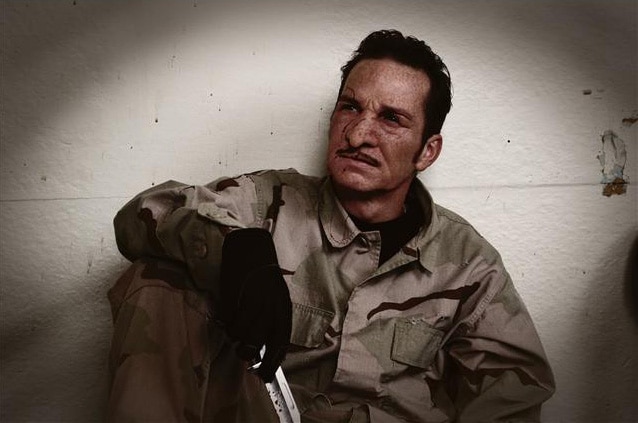
There are also a ton of facial prosthetics that are used (by Michelle Grady) on nearly every male in the story, making everyone look as warped as the storyline, including sores, pimples, an amazing nose on the John that seems right out of Sin City (2005). And like Sin City, the look of the film is quite unique and, well, dirty looking, with some phenomenal lighting, silhouetting, and angles that work with the prosthetics to make them look even more fantastical (by cinematographer and editor Jay Gavin, his first time for both).

This can only be described as extreme cinema, though the word transgressive comes to mind. Blood, gore, violence, coarse language including the use of the N-word, and abnormal sex are the theme, which is right up where Nicholson wanted it to be. This is the kind of film he loves to watch, and as he explained in the commentary, he makes his films for himself, not for the fans, of which there are rightfully many, even though it is a niche market.

Nathan Dashwood, Wade Gibb

The gore is plentiful, which is no surprise, the makeup is as extreme as the violence, and the women are quite beautiful, with standouts being a junkyard admin assistant named Nicole (Candice Le, aka Candice Lewad) who likes to show a lot of cleavage and pleasure herself in explicit ways, a full-lipped prostitute named Trashy (Stephanie Walker), and of course there is Ms. Rochon, in an extended cameo. Women are pretty secondary to the story, which focuses more on Hanger, The John, Leroy and odd Russell.

Being a 2-disc special Blu-ray release, let’s take a look at the hours upon hours of extras. First up is a Triple-X version of the film. Call me crazy, but I watched it and the regular, and I did not see a difference. It’s pretty hardcore anyway. There is also a full-length commentary by the director, Ryan Nicholson, completed for the DVD release in 2010, which he manages to remain interesting throughout. Most of the extras were filmed during this period.

Next up is “Behind the Stoma: The Making and Taking of Hanger” (20 min.). In case you don’t know, a stoma is “an artificial opening made into a hollow organ” (thank you Wikipedia). This is a really well shot collection of interviews with the director and some of the cast, mixed with behind-the-scenes clips. Generally, it was quite engaging, with everything being long enough to get a grip on it, but short enough not to overstay its welcome. Other films’ Makings Of featurettes could use this as a model. This is followed by another “Making Of” featurette (26 min). It’s a rehearsal with Nicholson working through the introduction to Leroy scene with the cast, including Rochon. While fun to watch, I don’t think I would turn it on again, though I was happy to have seen it once.

Ronald Patrick Thompson

“Taking of Hanger, Enough Dope to Hang Yourself With: On the Stet with Lloyd Kaufman” (12 min.). If Kaufman is there on set, one should always do a featurette with this film legend and ad lib maven. Most of the footage here was shot by Kaufman himself, and then the camera is handed off to Ryan’s (adult) son for Lloyd’s “Melvina the Tranny” scenes. It’s a funny, unusual behind the scenes, but what else would you expect from Kaufman? His friendship with Rochon, whose career turned a corner in his films, is evident and smile-worthy.

The “Blooper Reel” (2 min.), “Deleted Scenes” (6 min.), which is also a blooper reel, and Additional Scenes” (20 min.), which is more of a behind the scenes kind of deal, could all have been combined into one 28-minute piece. Nothing very special. Again, glad I saw it, but would probably not watch again

“Black on White Bred” (3 min.) is the film within the film of the porno (hard “R”) that stars Hanger’s mom Rose and Leroy, including the money shot. Don’t really know what more to say about this, except Rochon is definitely one to give for her art.

Gibb

The second disc is “The Raw Tapes, Volume 1” through “Volume 5”. These are the raw footage and can be seen as almost a Master’s Class in indie filmmaking. Each one of these five are on average 3 hours long, Honestly, no, I did not sit through all of them, but I did some zooming around. I have a life, as there are over 18 hours of extras in total. Maybe one day I will come back to these.

There is a photo gallery, and the usual sound and chapter choices on the first disk. Even with the “everything but the kitchen sink” mentality, the only thing missing was English subtitles for those of us with a bit of a hearing thing (too much seeing the Ramones, Johnny Thunders’ Heartbreakers, etc., in small clubs and loud volume).

Sometimes I wonder where Nicholson, who also did make-up for some very major releases, would have gone in his directorial career if he had not succumbed to brain cancer before the age of 40. Gratefully, he is being appreciated after the fact.


Friday, October 1, 2021

“What Walks There Walks Alone”: A Comparison of Shirley Jackson’s “The Haunting of Hill House” and Robert Wise’s “The Haunting”

 Text © Robert Barry Francos / FFanzeen, 2021
Images from the Internet
Originally published HERE:

“What Walks There Walks Alone”: A Comparison of Shirley Jackson’s The Haunting of Hill House and Robert Wise’s The Haunting

While going for my advanced degree in Media Ecology at New York University, I took a class with Professor Joy Boyum, “Fiction into Film,” and wrote this as a report. It matches one of my favorite books with one of my best-loved films. The paper is dated May 5, 1993. Please note for those who have neither read the book or viewed the film, there are spoilers.

Clown:
“O mistress mine, where are you roaming?
O, stay and hear, your true-love’s coming.
That can sing both high and low
Trip no further, pretty sweeting;
Journeys end in lovers meeting.
Every wise man’s song doth know.”
– Twelfth Night, Act 2, Scene 1

Robert Wise’s direction of The Haunting (1963), an adaptation of Shirley Jackson’s The Haunting of Hill House (1) (1959), remains one of the more memorable psychological supernatural thrillers brought to the screen. The film’s success has much to do with the cinematic elements brought to the story as the tale itself.

Wise’s choice to not show the apparition(s), with one brief exception a heartbeat long, is an effective tool for presenting a stronger psychological narrative edge to the story that perhaps might have been lost if he had chosen the easier “fright” route of wraith effects. The doorknob jiggling and mysterious hand-holding is all the more convincing because of the riddle of who or what is roaming the halls of Hill House.

Wise also emphasizes an element of claustrophobia that is sometimes lacking in the novel. Jackson places much of the action during the day on the grounds and hills surrounding the house; invisible footfalls in the grass appear less horrific. Wise, however, used the darkness of mahogany interiors, earth tones and shadows to give the viewer a sense of entrapment and depraved evil. Once the lead protagonist, Eleanor, arrives at Hill House, the only outdoor scenes are two on the terrace (first in daylight, then at night) and two on the grounds, by the front door, when Mrs. Markway arrives (day) and Eleanor’s final departure from the house (night).

One of the perplexities of Hill House is the way the house is designed. Eighty years earlier than the story is set, the house’s architect, the overbearing Hugh Crain, build a structure that was as distorted and enigmatic as its contriver. Wise sets a somber tone through the use of quick, jerky editing and especially irregular camera angles to reveal the skewed house design and a conundrum of doors that shut themselves (by design, not spirit).

The key theme of the film, as well as the novel, is loneliness. Both are introduced by a prologue (narrated on film), “Hill House, not sane, stood by itself against its hills, holding darkness within… and whatever walked there, walked alone.” Entering into this dark isolation are four characters, each lonely in his or her individual way. Eleanor Lance (Vance, in the novel), played by Julie Harris, arrives after years of isolation spent taking care of her domineering and sickly mother. Eleanor views her stay at Hill House as a chance to flower, to belong. In the novel, she repeatedly utters a line from Shakespeare’s Twelfth Night: “Journey’s end in lovers meeting.” Though this is only quoted once in the film, the theme remains the same: there is a sense of love’s absence, of a desire to find a place in the universe where she is her own person, accepted by others for who she is. Eleanor has no real home (she lives with her sister’s family), no one to love, and no one to love her.

There is an almost claustrophobic feel of dread and naivete about the world within her, as she created a dream life of an apartment of her own with matching stone lions on the mantlepiece. Eleanor is desperate to fit in and gain back what she believes she had lost through many years of solitude.

The future owner of Hill House, Luke Sanderson (Sannerson in the film, played by Russ Tamblyn), is also rejected by his family. His lonely past has produced a “liar…also a thief.” The novel presents Luke as an in-depth character who is a scalawag, but also has a heart, and is merely acting out of his sadness and need to be accepted. He is presented as the first possibly lover at “journey’s end” for Eleanor. In the film, however, he remains undefined, reduced to comic relief.

Whereas in the novel, Dr. John Montague (Markway in the film, Richard Johnson), who leads the supernatural “expedition” into the house, is known by Eleanor to be married from his first introduction; this fact is hidden from her in the film, setting up a possible liaison between them. Is John the lover at “journey’s end”? Many of the romantic actions taken by Luke in the book are given to John in the film, such as offering a steadying hand to Eleanor as she looks up at the tower (nearly toppling over a balcony), or rescuing her from the shaky ladder in the library. The novel presents John as lonely, due to the shrewish nature of his wife, unnamed except as Mrs. Montague. She is presented as a person who has no regard for her husband’s methods, dismissive of Montague as a person, self-promoting, and a supernatural “expert.” The film merely hints that John is lonely, and might end up in the company of Eleanor.

A subplot of possible lesbian romance is then presented by the last of the four main characters, introduced by Theodora (Claire Bloom). This theme is interjected in the novel as Theo arrives at Hill House after a painful fight with her “roommate,” feeling dejected and somewhat bitter. In the film, Theo’s orientation is broached through dialogue, presented more as the reason for her loneliness: “By the time I’m through with you Nell, you’ll be a different person”; elsewhere asked what she is afraid of, Theo responds, “Of knowing what I really want.” Her sarcastic manner is treated as rooted in the sexual orientation, as well. Though Eleanor is repulsed by Theodora’s sexuality in the film (“The world is full of inconsistencies. Unnatural things. Nature’s mistakes, they’re called. You, for instance.”), in both the film and the novel, Eleanor eventually wants to go off and live with Theodora. The author posits this as another possibility of “journey’s end where lovers meet”.

A third theme of the story is that of parental/daughter relationships. Although Hugh Crain designed the house, he barely resided there, and eventually died in Europe. It is his warped vision that dominates the house, however, with a malevolent (male-violent) influence. His evil is that of control. Even in designing the house, he materialized his own vision rather than relying on others, with skewered angles and unmatched lines, going against architectural conformity to express his will. It was with this will that he ran his house while occupying it with his daughter(s). His religious fanaticism, which evolved from his bitterness over his wife’s/wives’ demise led him to warn his daughter, “Honor thy father and thy mother, daughter, authors of your being, upon whom a heavy charge has been laid, that they lead their child in innocence and righteousness, along the fearful narrow path of everlasting bliss…” Though his physical presence in the house was minimal, his influence remains, and it is this warped domination which seems to affect the weakest of those who enter the house, subduing them to the power of his control.

Hugh Crain’s malevolence is directed at women. All who die at Hill House are women: first the wife of Crain, who is killed in an accident on the grounds before even viewing the house; second, their eldest daughter (only daughter in the film), Abigail (Sophia in the novel), who dies of pneumonia at an elderly age in her bedroom, the nursery (“the heart of Hill House”), while her young servant/companion “dallied in the garden with some village lout”; third is the companion, who inherits Hill House, who hangs herself in the library. The last woman to die is Eleanor herself, a possible suicide who seeks to remain at Hill House, under the influence of the evil will of Hugh (2) Crain.

There are overlapping images in the context of the story. An example is that both Eleanor’s mother and Hugh Crain’s daughter die while banging on the walls for help. This “mother/daughter” parallel is further mirrored by Eleanor’s guilt over presumed negligence in having slept through her mother’s knocking, as did the companion, who “dallied” while her mistress died in distress. Both Eleanor and the companion become obsessed with the house and the staircase in the library. Both eventually commit suicide. Similarly, Hugh Crain’s wife died without ever having entered the house, whereas Eleanor dies driving into a tree at the same spot on the grounds so she does not have to leave.

In Wise’s vision even more than Jackson’s, Eleanor is treated by all as a woman-child, though she is in her early 30s, because of her innocent and cloistered life. In a scene where she is seeking permission to use what is essentially her half-owned car from her sister’s family, the relatives reject her request because they view her as childlike and consequently irresponsible. This scene is dramatized while a child’s melody is played in the background. Also, throughout the film, again more than the novel, Theo often calls her by the nickname “Baby,” sometimes in a patronizing tone. This, of course, reflects back to the nursery, the heart of Hill House, which has been collecting victims for years. The inflection is present in the novel, but in a more subtle, sardonic way.

The characterization that is most changed from novel to film is that of Mrs. Montague (named Grace for the film, played by Lois Maxwell). Whereas she is a totally disagreeable character in the book owing to her obnoxious ego and dismissal of concern for nearly all others, the cinematic version lives up to her first name, presenting her as a strong and decent person who is unintentionally triangled between John and Eleanor. In the movie, Eleanor suggests Grace sleep in the “evil” nursery in a pique of jealous spite, while in the novel, John makes this suggestion because he is acquiescing to his wife.

Two other characterizations that are altered from the original source are those of Dr. Montague/Markway and Luke Sannerson/Sanderson. In the book, Montague, while the leader of the psychic exploration to Hill House, is seen as a three-dimensional character who is sometimes flawed and always human. In the film, perhaps because he is presented as a potential love-interest for Eleanor, Markway becomes a near-swaggering Petruchio-type hero; one can almost her him slap his knee in self-righteousness. Luke, on the other hand, is treated the opposite: whereas Montague to Markway comes from human to hero, Luke Sanderson to Sannerson goes from possible love-interest to practical joking comic chorus.

An obvious problem in adapting the novel to the film would be similar that of any phycological drama, the inner narrative voice. Thought processes are the crux of psychological drama, as the protagonist struggles with distressing events, and the consequences that are faced become more severe. Wise takes the most direct approach, and has Eleanor’s thoughts presented via voice-overs. Though this may be a potentially overbearing and distracting technique, Wise uses it to optimum effect, holding back and letting the actor’s expressions tell us of her own inner turmoil in particular scenes, while voice-overs detail the trauma in others.

In the novel form, the horror story, be it temporal, spiritual or psychological, has its work before it. Unless the subject matter touches on the personal fear of the reader, such as something/someone hiding in a closet or a phobia, like fear of heights (e.g., Vertigo, 1958), the printed word needs to be worked harder to be shocking, especially to those who grew up watching film. Historical horror novels such as Mary Wollstonecraft Shelley’s Frankenstein (1818) or Nathaniel Hawthorne’s “Rappaccini’s Daughter” (1844), were written when there were no moving images that could shock with a sudden “Boo!”, so the imagination of the reader of the stories is needed to be able to horrify. Present-day writers such as Clive Barker and sometimes even Stephen King manage to frighten, but their shocks come from the gross and the gory. The Haunting of Hill House was published during a period when the horror novel was based more on the psychological than “visual” manifestations, therefore crating a timeless horror that does not need to go “boo” or bleed.

Film has a great potential for frightening the viewer. Whereas the novel can horrify by leaving the terror “unnameable” (as H.P. Lovecraft was fond of doing) and inviting the reader to realize his or her worst fear. A film can frighten by presenting a haunting image or a sudden shock. For example, while the echoing, pounding on walls and jiggling of the doorknob as “whatever walked there” searches for Eleanor and Theodora in the Haunting of Hill House creates fear, in The Haunting, the dimension of fear is heightened by watching the door bend under the weight of the spirits, the wall- and door-pounding becomes deafening (especially as the cadence gets perceptually louder, faster and more menacing), and the dissonant disembodied voices of the mysterious forces (such as what sounds like hard fire and brimstone preaching by Hugh Crain to his daughter) fill the senses by filling the screen. Add to this the cinematic touches of shadow and light, juxtaposing camera angles, eerie music (3) by Humphrey Searle, and dissonant editing (4).

Through cinematic devices, Wise hold back on visual information about the antagonistic spirits, to heighten the sense of mystery and fear through the unknown. He uses the occasional lack of music to make the terror feel more imminent and tangible, and skewed closeups to place a fearful image immediately before the viewer in arresting perspective. While Jackson has Eleanor see spirits in one form or another (spying invisible foots falls in the grass or viewing ghostly picnics), Wise chooses not to rely as much on the visual to frighten, but by way of a literary perspective, employing the imagination, all the while using the cinematic process to make the viewer’s imagination hold one in terror. The fear of the unknown usually tends to be less challenging to accept on film because of the temptation to show precisely what is there for which to be afraid. By choosing not to display some blatantly showy special effects (other than an occasional breathing door, for example), and relying on cinematic techniques, wise raises the stakes from cheap thrills to high horror, without gore and without hackneyed effects (5).

By viewing the film before reading the novel, I was able to grasp some concepts that may not have been so obvious from using the book as the primary source. Details in print are usually more thorough in pointing out specifics, consequently more information is passed to the reader. Due to the time in literary history the book was published, however, less emphasis was placed on the homosexual aspects of the characters of Theodora and, more subtly, Eleanor (6). The subtlety of this aspect may have been lost on the reader, but to the viewer, these themes were clearer and more straightforward.

Another interesting aspect of the film that Wise added is having the final prologue spoken by Eleanor, after her death. The closing line was changed from “Whatever walked there, walked alone, to “We who walk there, walk alone.” By adding this change, Wise solidifies the realization that the main character and antagonist in both the film and the novel is Hill House itself. It is the neediest and most demanding. It is the most appalling, and yet seductive. It is Hill House that is the lover Eleanor meets at “journey’s end.”

Footnotes:
1. Screenplay by Nelson Gidding.
2. “Hugh” is Old German for “Will”.
3. Music
by Humphrey Searle.
4. Editing by Ernest Walter.
5. For the opposite school of thought, see the Roger Corman films of the same period.
6. Though novels such as Radclyffe Hall’s
The Well of Loneliness (1928) and Lillian Hellman’s play, The Children’s Hour (1934) had already been published with the themes, mainstream fiction still apparently considered the subject a taboo.


Thursday, September 30, 2021

Review: Demented

Text © Richard Gary / Indie Horror Films, 2021
Images from the Internet

Demented (aka The Demented)
Directed by Nigel Hartwell
New Blood Entertainment; Flawless Video Creations;
Gate Three Films; Homemade Pie Productions; KBI Productions
96 minutes, 2021
www.newbloodentertainment.com/newblood_demented.html

Just before its release, the film made a subtle title change, from The Demented, as it is currently listed on IMDB, to just Demented, so as not to be confused with another film dealing with zombies with the same name released in 2013. This should also not be confused with the I Spit on Your Grave-ish cult classic Demented (1980, co-starring Harry Reams). So ends the history lesson.

This Canadian film is quite different that those others in that this falls well into the category of torture porn, with a supernatural touch. And in an extremely micro-budget way.

Cheyenne Ennis

Lovebirds Senica (Dakota House) and Amanda (Cheyenne Ennis, giving a brave performance) go up to Senica’s cottage on the lake (filmed at Parry Sound, Ontario, about 2 hours north of Toronto). After dropping a ring on her, they spend the night. When Senica awakes, Amanda is gone. According to a police detective (the ever-fun Felissa Rose), so are her parents, and he’s the central person of interest.

Meanwhile, somewhere there is a room where women are systematically tortured and snuffed for the Dark Web (it’s always the Dark Web, right?) by a burly guy dressed in black, including a bullet-proof vest, and a leather hood. His voice is digitally manipulated, and honestly, I can only make out about half of what he says.

Dakota House

We watch as he’s a-rapin’ (with his pants all the way on and her underwear intact) and a-chokin’ and a-tauntin’ his chained-to-a-bed victims. We see the room through his video camera, a fuzzy black-and-white CCTV on a celling corner, and whichever lens the film’s cameraperson is using to fill in the gaps and keep these scenes from being “found footage” style.

There is also some playing with time, with numerous flashbacks to various periods and present day, making the narrative timeline a bit confusing for a while. In one of these vignettes (past? present? future?), Amanda is a chainee, abused by the dark and mysterious man (though at 30 minutes in, I have a guess on who it may be; I’ll let you know if I’m right, but not who it is, okay? No spoilers).

Between the patterns of abuse, Amanda is visited by knowing spirits (including one played by wrestler Angel Williams), who are helpless to aid her, but communicate quite easily. Don’t get me wrong, this supernatural element is actually what made the film for me. The violence compared to most torture porn is relatively mild and mostly threats (and yes, much full-dressed raping).

But the rules of the film change with Amanda. Her accomplishments are the closest this comes to empowering women (not counting that the main authority figure is the police detective). Women generally are seen as torture victims and strippers. Misogyny? Maybe, but it felt good to have these women get some of their umph back, a lot of good it will do them in the long run.

Nigel Hartwell and Felissa Rose
doing her iconic Angela face

There is a lot of topless women (did I mention the strippers?), and nothing real to talk about in the blood department. There are some cheesy CGI effects at a point, but I believe it was meant to be that way. Y’see, from the way they use scratchy rolling noise on some of the camera images (though new equipment) made to look like VHS in the 1980s would explain the ‘80s look of the company’s logo at the beginning of the film.

The film is overlong at 96 minutes, but there is easily quite a bit that could be excised and not lose any of the story. For example, the “torment” scenes are incredibly mild considered next to something like the Hostel or Saw franchises, but they are on for what feels like a really long time of just the killer yakking away in his hard to make out digitized voice. Too many of the scenes and shots – especially the punishment ones – just seem too “samey,” in part due to the static cameras in the torture room

The acting is okay, but nothing to write home to mother about, though as always, Rose easily holds her own; the two main leads often don’t look like they are trying too hard, especially House, from whom I was expecting more. There are some really well-done shots, including some drone work, which was refreshing after the obvious green screen parts.

Ari Lehman, whose band performs during the final credits

The production pattern is a bit different, but I’m not sure if some of it is intentional on the director’s part, a stylistic choice, or just a distance necessity (i.e., people recorded in different places made to look like they are together). Many times, especially in the police station scenes with Rose, it is pretty obvious that – despite some similar motifs on the walls that I am pretty sure are green-screened – the detective and two of the people she is interviewing are single shots and not in the same room. It seems like House doesn’t know which direction to look, often off to the wrong side of where the Detective would be standing. When she interviews a porn/snuff provider, Brad (Canadian wrestling champion Bret Hart), his acoustical tone is different than hers, and he also looks in the wrong direction. This “separation” with green screen and different sound is also employed with a bartender (by cameo-king Ari Lehman). When Amanda and Senica are introduced as a couple on the drive north, at first this single shot method was used in the car, but then finally a double shot.

One weird plot point to me is that Amanda’s parents are also missing, as it is a family thing with the bad guys. But this is not shown for any other victims. It feels like a pretty big plot can of worms hole that did not need to be opened in the first place.

Speaking of sound, there is an almost amusing moment when we hear a character’s thinking processes, and it was obviously recorded later in a studio by how well it sounds, but also that there is a comment when the actor obviously accidentally falls during the filming, and the narration goes, “Oh, that hurt.” I am so glad they put that in.

The extras are three music videos and three company trailers (including this film).

If I had my druthers, I would like to see them take this film, re-edit it or have third party do it, and see where it goes. It has some nice potential, and I would like to see that fulfilled. And for the record, I was way off on who was the killer.


Saturday, September 25, 2021

Review: Funhouse

Text © Richard Gary / Indie Horror Films, 2021
Images from the Internet

Funhouse
Directed by Jason William Lee
Ti Bonny Productions; Sandcastle Pictures; Invention Films;
Magnet Releasing/Magnolia Pictures
106 minutes, 2019 / 2021
http://www.magnetreleasing.com/funhouse/

Here is a bit of irony for ya: as much as I despise reality programming, especially shows like “Survivor” and “Fear Factor,” I so do tend to enjoy when films use it as fodder for a storyline. Media fascinates me, in a Marshal McLuhan/Neil Postman/Jacques Ellul sort of way. Mixing reality television with social media? Even more better.

Social critic Neil Postman famously posited that media such as television (and hence computers) is served best when it is mere entertainment and minimal on education. Entertainment as distraction is nothing new, as even the Roman Empire knew about “bread and circuses.” This Swedish/British Columbia, Canada-filmed release definitely leans in that direction. While the overarching premise is not novel in the horror genre, people fighting for their lives for the entertainment of others – recently in films about, say, Escape Rooms – the addition of Reality Programing gives it a nice twist.

Valter Skarsgård

A rich and sadistic man (think Jeffrey Epstein-type [alleged]) that tends to tilt his head to the side, Nero (Jerome Velinsky), who as no moral compass and is willing to pay people large sums to do dastardly things, puts together an online reality show titled “Furcus’ House of Fun” (aka “Funhouse”). He gathers a group of eight attractive mix-gendered (but no LGBQ) C-Level has-beens from around the world for what they think is a “Big Brother” or “Survivor” kind of show for a prize of USD$5 million, but it ends up the latter program is more literal than figurative.

The central character is Kasper (Valter SkarsgÃ¥rd), a Swedish man whose claim to fame is that he was married to a pop star who, like the others – a nice touch is that most of the actors are actually from the countries they represent – arrives in a house in an undisclosed location with no memory of how they got there (after they had signed the contract). They all have different colored shirts to make it easy to identify by the world-wide web audience. The rest include the likes of an Influencer, Mixed Martial Arts fighter, a model, and a one-hit wonder singer, for example.

At first, it is all fun and games as the contestants (someone uses the word “dysfunctional”) get to know each other, make out, sing karaoke, go into the hot tub, drink a lot of alcohol, and be served by people dressed in odd Panda masks (the animal is the logo of the program). There is even the old “confession booth” they all must enter and try to win the favor of the audience, who votes out whomever they choose every three days, though it gets progressively quicker. And this is where events get dicey. Of course, they are being filmed 24/7.

The first act of about 20 minutes, helps the film’s viewers to both get to understand the premise framework of the show, and also sets up some background to the characters. When you have eight of them, it is easy to just see them as fodder for the violence to come, but this way we can get to know and either like or dislike them. There are some friendships made and some rivalries (a memorable quote: “People like me…bitch.”). This will make it more emotional as shit hits the fan into the second act when the blood begins to flow in challenges that take on an elaborate, almost Saw franchise fashion. It also kind of reminds me of Cube (1997).

Again, as a student of media, I find it equally fascinating when the story focuses on the audience, the “Perez Hilton” kind of snarky webcasts making puns about deaths (e.g., “How can you take selfies without arms?”), and the CNN type of newscasts and interviews. As each kill naturally gets more gruesome, in some ways, like Dog Bites Man! (1992), it puts the film viewer as a participant in the action similar to the web show’s audience. Are we sitting there enjoying the painful killing of this octet, one by one? Most likely, yes. You know there are going to be those who sit in front of their large HD screens and pump fists screaming “yes!” while the other hand holds the beer (or popcorn).

Yes, I realize that this is not reality, but does it inoculate us to real violence? That is a question that has seriously been asked in modern cinema since at least the 1980s (remember the “Video Nasties” situation in England, and the PMRC in the States?). I have no opinion one way or another, as I enjoy these kinds of films, but I also like to look at the sociological aspects, as well.

The Head Panda gives a twisted but accurate description of what society considers entertainment, amusingly using the Kardashians as an example of decline. But, as I said above, it predates that. Just look how many copies of the Faces of Death VHS sold (or was rented), and is even discussed now on many genre chat boards. On those very chat boards, people often request suggestions for the bloodiest, goriest, and most disturbing releases. Yes, I agree that there is a difference between reality and cinema magic, but shows like those I mentioned above, like “Fear Factor,” “Survivor,” and even those like “The Bachelor,” “Hell’s Kitchen,” “The Housewives of (Wherever),” and that nasty recent Ellen DeGeneres’ “Ellen’s Games of Games, has helped make violence and social interactions into entertainment. While meta-commentary in the film is explicit, it is also not preachy and stays off the soapbox, unlike my annotation.

And speaking of cinematic magic, the SFX is damn fine here if that is your thing, as it is mine. Lots of violence, torture (not in a focused, body horror kind of way), and missing or separated body parts. The acting in the film, for the most part, is quite good, with the standouts being Cat (Amanda House, aka musician Mandy Mouse) and especially scene stealer Nevin (Dayleigh Nelson, playing a Brit, but is from British Columbia).

My complaints are minimal and twofold: first, it was a tad long though the pacing of the kills is nicely distributed once they start; second, I found the sex scene later on a bit unbelievable considering both the circumstances and the conversation that preceded it. But both of these were not enough to take away from the story, which had more than a couple of interesting twists and turns to keep up the attention and enjoyment level. As for the social observations, well in this case, it actually adds to the story rather than bogging it down. This is a competent and fun thrill ride by sophomore feature filmmaker Lee.


Monday, September 20, 2021

Review: Skinwalker: The Howl of the Rougarou

Text © Richard Gary / Indie Horror Films, 2021
Images from the Internet

Skinwalker: The Howl of the Rougarou
Directed by Seth Breedlove

Small Town Monsters; 1091 Pictures
70 minutes, 2021
www.smalltownmonsterss.com

One of the things I enjoy about Small Town Monsters’ releases is that not only does each documentary focus on a particular cryptid, but they centralize the story; they will pick a part of the country and focus on that area, even if it covers a corner of multiple states, situating the events, including the more commonly widespread ones, such as Bigfoot.

So, after covering the likes of the Bell Witch, Bigfoot and Mothman, among many others, here they focus on one of my favorite topics, the werewolf. This mystical creature has been having a resurgence lately, with films like Bonehill Road (2017), Night Howl (2017), Lyncanimator (2018), and the upcoming The Beast Comes at Midnight, so it makes sense to check on one in the real world. in this case, southern Louisiana. This is a change since most of the previous films by STM I have seen involve the Northeast. It is great to see them stretching their (literal) boundaries.

Like Bigfoot, which has multiple names depending on the location (e.g., Yeti, Sasquatch), the “Skinwalker” down in the bayou is known by the Cajun (Acadians originally from Nova Scotia) term, Rougarou (or as I, as a Brooklyn boy heard it, Loup-garou). The story of a man-wolf hybrid has been around for centuries in those swampy areas, giving rise to multiple alleged sightings and stories of meaning.

That is where this story takes off, into the swampy, spooky landscape that has appeared in so many horror releases, such as in Hammer Films’ The Mummy (1959) and many voodoo zombie B-films of the 1940s. It’s a mysterious place full of danger, like quicksand, poisonous snakes, alligators, and the legendary Rougarou.

The film is narrated by Lyle Blackburn, who has done so for a few other Breedlove releases, but he is also the lead vocalist and guitarist of the gothabilly band, Ghoultown, and has written an appropriate book to this film called Swamps: Monsters and Mysteries from the Mire (2020). He does a fine job in a slow and measured manner that’s appropriate for the location of the story, though without the drawl.

The film is broken into chapters. The first wisely mixed a few of the legends with a smattering of the background of the area, including some stunning photography as always; another is how the legend of the Rougarou started both by the American Indians/First Nations who lived in the area, and then by the French settlers. Apparently, the werewolf is historically common folklore in French literature.

The story continues in how the Rougarou is created, be it half-human, half-wolf, or mostly wolf but standing upright. It also includes some fun first- and second-hand stories by the locals, including the person who runs the Rougarou Fest held in Houma, LA, and members of the local Houma Tribe for whom the city is named.

An interesting aspect to me is the variations of the Rougarou. Most of the other cryptids tend to hold steady in their concept and aim, but because the Rougarou is a mixture of Indigenous tribes and European influence, the look, the means of transformation, and even modus operandi changes often. For some, the Rougarou almost takes the Boogeyman/Krampus role of being used to keep kids in line (e.g., “If you’re bad, the Rougarou will getcha!”), for others they are merely wood-and-swamp creatures, and mostly they are humans who have been cursed (one example is a wife who puts the lycanthropy on her good-fer-nuthin’ husband).

While there are certainly similarities between the various visions of the creature, there definitely appears to be a more human aspect, even with the occasional fear-mongering of either eating human flesh or souls. The latter is subtly explained by the very Catholic-based religions in the region. Most other beliefs, such as Baptist or Lutheran, would most likely (in my opinion) just express the Rougarou as either the work of the Devil, or to be a minion of such (Demon). Catholicism is often more varied in possibilities of evil entities, although Devils and Demons are right up there (ever hear of a Lutheran exorcism?).

Because of the addition of the human aspect of transformation, even though it is made clear that the Rougarou can appear as any animal or human, or even a bird or tree, it is usually associated with white clothing and fur (such as rabbits) except for the werewolf version. The consistent seems to be the red glowing eyes. This makes the creature more engaging in a The Thing (1983) way because it could be anyone, even the person sitting next to you in church, as one person interviewed posits.

As with most of the Small Town Monsters releases, there is a mixture of live interviews and travelogues of the area under discussion, some creative artwork and cartooning, and in this case, some really fabulous recreations. The wolf suits are stunning, easily as good as some of the more popular films like Dog Soldiers (2002), which relies more on man-wolf hybrids than, say, the mostly wolf shape of An American Werewolf in London (1981). It is these recreations that really flesh out the stories and give visuals beyond the talking heads syndrome.

With modern technology, salt-water flooding of the sweet water swamps thanks to climate change, and the different directions of the winds of culture, the documentary also tackles the possible future for the Rougarou.

For a company and director that is incredibly prolific, it is admirable that the quality of these films never diminishes. If you are into cryptids or just cryptid-curious, this will not disappoint, as is true with the other STM fare available at the link at the top of the page.


Thursday, September 16, 2021

Oldie-But-Goody-Review, Part 2: Mortuary (Special Edition)

Text © Richard Gary / Indie Horror Films, 2021
Images from the Internet

Mortuary
Directed by Howard Avedis (d. 2017)
Hickmar Productions; Scorpion Releasing; Multicom Entertainment; MVD Rewind Collection
93 minutes, 1983 / 2021
www.MVDVisual.com

This reissue has an interesting aspect for me: from the mid-1960s to the early 1980s, Lynda Day George and Christopher George were the television golden couple. It seemed like they were in everything either apart or together in the likes of “Mission Impossible” (Lynda) and “The Rat Patrol” (Christopher), but not after this film, as it was Christopher’s last role before his sudden death in 1983. Ironically, over the years, their importance faded enough that even though they are among the leads of this film, their names don’t even appear on the cover of the Blu-ray (and DVD). Sure, they were secondary to the three main characters, but their names should be there under the others, as most likely they were a large draw for the original release. Instead, they list Mary McDonough (she played Erin on “The Waltons”), Bill Paxton (1986’s Aliens, 1987’s Near Dark; d. 2017) in an early starring role, and David Wallace (aka David Wysocki, who appeared in numerous soaps).

Now, after that pondering, let’s examine the film. I saw it in the theater when it first came out, but I have no memory of it, so it’s like watching it new, which makes me happy.

David Wallace, Mary McDonough

We are introduced to tall and lanky Greg (Wallace) first, as he and his friend Josh (Denis Mandel, who played the recurring character Eugene in the post-shark jumping, no Richie “Happy Days”) visit the mortuary warehouse, where Josh worked, to steal some tires. There they see a “séance” (looking more like a cult with long, hooded black gowns) led by mortuary owner Hank (Christopher George). Of course, being that time in our culture and the genre, the leader is a man, and the rest of the following coven is all women. Let the social commentary by the readers commence.

This brings Greg to hang out with his sleepwalking girlfriend and star of the film, Christie (McDonough). Just to date the film, part of the first act takes place at a roller rink (the subtitles say “roller ring,” that’s how long ago it is that whoever did the captions did not know better). Classic imagery, with women in short-shorts and tank tops skating around in circles, just for the film’s teenage boy demographics. Even McDonough gets to wear some flimsy clothing when she’s not decked out in top ‘80’s fashion, like pink loose pants and a matching sweater tied around her neck. She lives in a huge house right on the ocean with her widowed and gaslighting mom, Eve (Lynda Day George). To add to it all, nerd and perky Paul (Paxton), son of Hank, has a thing for Christie. They are college students, I am assuming, as part of this was filmed at California State University Northridge.

Bill Paxton

Of note, there are two interesting cameos here, both as Greg’s parents. First, there’s his mom, played by Marlene Schmidt, who has appeared in most of director Avedis’ films. His dad is portrayed by the legendary Hank Kimball…I mean Alvy Moore (d. 1997). He’s almost unrecognizable, but at the same time, easy to spot by his physical mannerisms, and especially that amazing voice and syntax.

Meanwhile someone mysterious has been following both Greg and especially Christie, dressed in white make-up that looks a lot like Pazuzu from The Exorcist (1973). It isn’t hard to figure out who he/the killer is; I figured it out in the first 10 minutes. But will the Sheriff (Bill Conklin) listen to the teens about smug Hank and crew? I am sure you have seen enough of genre films to be able to answer that yourself; it seems pretty damn obvious.

Lynda Day George, Christopher George

There is also a fine level of humor (though I would not refer to this as a comedy), such as one person looking to buy a casket, saying to her husband, “Honey, I don’t think you’re going to be comfortable in this one.”

The blood and gore SFX are nicely done and plentiful, relatively, though a small body count considering the slashers of the day, but they manage to add some effects in other ways. There is also a lot of typical tight or wet clothing and cleavage (including the two female leads), along with a fair bit of nudity (though McDonough uses a body double with different colored hair; did I mention she was in “The Waltons”?)

McDonough, George

I do have some questions, such as if a group is holding a séance in a mortuary after hours, why isn’t the front door locked? Of course, this could be said about any business, and not just ones doing occult stuff. And if you just saw someone close to you in a cult setting, would you go home and have carnal relations in a laughing, calm manner, for a while?

Anyway, the film is shot really well, with some fine editing to enhance the action. The cast is, needless to say, lovely to look at for all genders, and the acting is, well, considering most of the cast comes from the television world, that type, especially from the time period.


Pazuzu wannabe?

Even with an obvious villain, there are still surprises here and there, and numerous jump scares that I enjoyed. This is considered a minor classic, and it’s easy to understand why. Lots of hallmarks are here, like walking down dark hallways. One thing missing is a shower scene. That being said, one unusual take is that the friends of the leads are inconsequential and merely there as comic relief, appearing exceedingly sparingly, with the film mainly focusing on the five leads. That was a nifty and unexpected turn of events.

Extras on the Blu-ray are that the film is in HD (1080p) from the original internegative, and audio choices. Also, there is an English subtitles option, and interview with the composer, John Cacavas (unwatched by me), and a mini-poster in the clamshell. Added is a bunch of MVD Rewind trailers including the original one for this film and Tobe Hooper’s Mortuary (2005) that deals with zombies rather than a slasher, among others.

For the director, Howard Avedis (d. 2017), this was his first forage into horror. Before, he was known mainly as an exploitation/sexploitation filmmaker, with such classics as The Specialist (1972, with Adam West), Dr. Minx (1975, with Edy Williams), and especially The Teacher (1974, with Jay North and the underrated Angel Tompkins). The previous experience of these low budget action releases prepared him well for Mortuary, to make it a product of which to be proud.

Be forewarned, the trailer gives too much away. If you haven’t seen the film yet, watch it at your own risk.