Showing posts with label extreme cinema. Show all posts

Sunday, October 31, 2021

Review: Evil Dead Trap

Text © Richard Gary / Indie Horror Films, 2021
Images from the Internet

Evil Dead Trap (aka Shiryô no wana)
Directed by Toshiharu Ikeda
Joy Pack Film; Unearthed Classics; MVD Entertainment
102 minutes, 1988 / 2021
www.Unearthedfilms.com/carronamovie/
www.mvdb2b.com

Japanese extreme cinema has thematically come a long way since this was originally released in 1988. There are still some tropes that are often repeated, such as women abused while wearing schoolgirl uniforms usually by middle aged men, adult stars, and especially torture porn. A good example of this is the infamous gore-spectacle Guinea Pig series, starting by predating this film by half a decade. In fact, a couple of the then-top Japanese adult actors were used in the filming of this movie (much as Marilyn Chambers appeared in 1977’s Rabid and Harry Reems in 1980's Demented).

It is pretty obvious where they lifted the title of this film back in the day, but it is arguable whether there is anything supernatural going on here. An insomnia-plagued late-night talk show host, Nami (Miyuki Ono), receives a VHS snuff tape in the mail, that we get to see in loving, grainy detail. Does she call the cops? Of course not, but rather goes out to investigate. You know how in 1980s films you can spot all the stupid decisions and actions that characters make (e.g., going upstairs instead of out the door)? This one sticks out like a knife in the eye. Oh, yeah, the snuff film…

Miyuki Ono

Nami takes off with the future body count: three other women who are her production team, and a goofy, sexist male assistant director, who calls his superiors “girls.” Gotta love the ‘80s. A slight sidebar here: it may sound like I am talking this movie down, but I am not; part of the fun of this period’s genre films is the sometimes sheer ridiculousness of some of the cultural and cinematic motifs, but it is said by me in a full-smile way. This hindsight really is part of the joy of these gruesome releases. If I have a real problem with something, I will certainly let you know, so in the meanwhile, please know the basis of the snark.

The video tape leads our intrepid-but-not-so-wise group to an abandoned military base (filmed at Camp Drake, a deserted since the 1970s US Army/Air Force quarters, in Saitama, Japan) from 1956 says a sign, which is not on the map (of course). And what’s our group to do once they get there? Why lift and separate into two groups of two, with Nami off on her own. They seem to repeatedly rejoin and cleave into individuals roaming around the expansive space, down long corridors or into booby-trapped rooms.

Yuji Honma

The base setting is actually superb, if you are fascinated by abandoned buildings as I am. It is incredibly atmospheric and creepy as hell with dusky rooms, boarded windows, old furniture and equipment. You can just feel the destitution practically reeking off the screen, and the anticipation for the violence to come. And come it does. A perfect setting for a torture abattoir. Dark shades mixed with flashes of color make it a labyrinth of decay and death.

While the kills are violent, I would not categorize it as torture porn. Most of the butchery is pretty quick (albeit explicit) and not lingering.


While all hell breaks loose in malevolent ways, there are also some interesting characters floating around the base that show up at unexpected times. such as a relatively stoic man, Daisuke (Yuji Honma), who is in search of his younger brother, a man who is being systematically tormented and ordered to kill to be free, and the mysterious masked and hooded parka-wearing killer himself.

This all sets up for a third act of mano e majer, or I guess, otoko tai on’na. Throughout the film, Nami shows an interest – if not attraction – to the mindset of the mentality that would cause such a wave of nasty behavior. This helps set up the final extended showdown that is both psychological and physical, and by far the most interesting part, even though it is pretty obvious early on who is the killer and certain aspects of his behavior. That is not to say this is the only segment that will keep the viewer riveted, but the build-up is worth the nail-biting wait.

Booby-traps abound, and one might wonder if this was possibly an inspiration for the Saw franchise, especially the first one, but as with most proto-films, the ideas are there, just not as detailed in their execution, though bloody enough. And by the end, you could easily sing, “I’ve seen fire and I’ve seen rain.”

Of course, I won’t give away the ending, but while I had a close approximation of where the story was going, it certainly took a left turn that could have been influenced by the likes of David Cronenberg or Frank Hennenlotter that I did not expect, I am happy to say.

I cannot emphasize how beautiful this film is shot by cinematographer Masaki Tamura and edited by Akimasa Kawashima. The visuals are stunning, with artistic (yet not heavy handed) elan, close-ups, and the occasional (and sped up) blue-filtered monochrome. It seems a bit ahead of its time, and is jaw-droppingly framed. The gore is plentiful, of course, and looks amazing, unsurprisingly, handled by Shin’ichi Wakasa (who has also done special effects for Godzilla and Mothra films since the 1990s). This is overlaid by a repetitive and eventually annoying electronic soundtrack that reminds me of the Italian giallo films of the period.

Extras on the 4K Blu-ray include three full-length commentaries. The first is by director Toshiharu Ikeda (d. 2010) and SPFX Manager Shinichi Wakasa (badly dubbed into English) from the mid-2000s, which is somewhat sparsely discussed, mostly innocuous anecdotes about the filming, rather than deep meanings. I jumped around a bit on this one after about 30 minutes. Next is by filmmaker Kurando Mitsutake, director of films like Gun Woman (2014). It is contemporary and in English, and much more in-depth and interesting than the previous one.  The last is with James Mudge (English), of the Website easternkicks.com. Mudge not only tells anecdotes about the film, but also places it in the context of Asian Cinema – especially Japanese – writ large.

There is also a contemporary featurette, “Trappings of the Dead: Reflecting on a Japanese Cult Classics” (19 min.; English), focusing on cinema academic and author Calum Waddell. He shows both the influences of other films that led to this one, and how Evil Dead Trap has influenced others that followed, dropping dozens of names and others such as some of the ones I mentioned above, and the likes of Dario Argento and Oliver Stone. Also, he puts the film in context of Japan’s relatively modern history, from its role in World War II and the post-atomic period. Then there is the Storyboards, Behind the Scene Stills, Promotional Artwork, and a few Unearthed Trailers, including for this film.

In 1992, there was a sequel of sorts to this release, Evil Dead Trap 2 (aka Shiryô no wana 2: Hideki) that perhaps will be a future Unearthed Films release. I would definitely watch it, though it was directed by Izô Hashimoto, rather than Ikeda.


Tuesday, October 5, 2021

Review: Hanger (2-Disc Collector’s Edition)

Text © Richard Gary / Indie Horror Films, 2021
Images from the Internet

Hanger (aka Wired)
Directed by Ryan Nicholson
Plotdigger Films; Unearthed Films; MVD Visual
90 minutes, 2009 / 2021
www.plotdigger.com/movies/hanger-2009/
www.unearthedfilms.com 
www.MVDVisual.com

Vancouver-based director Ryan Nicholson left quite a legacy before he passed on in 2019, including Gutterballs (2008), Collar (2014; reviewed HERE), and this little gem that I have heard of but had never seen. Now it’s out in a two-disk Blu-ray.

Nicholson was known for his extreme version of cinema, with violence, gore, sex and lots and lots of other nastiness. His films are not for the weak of heart, and this one certainly lives up to the legend that has followed it.

Right from the start, we meet very pregnant prostitute Rose (the ever amazing and brave performer, Debbie Rochon; there are definitely aspect of the opening that are a nod to her history with Troma, such as a television in the motel room playing 1986’s Class of Nuke ‘Em High, and Lloyd Kaufman has a cameo as a “tranny,” which is how it is listed in the credits). Rose’s violent pimp, Leroy (Ronald Patrick Thompson, the only black actor in the cast with dialogue, is a vicious pimp; that’s all I’m sayin’) not only wants her to keep making money, but also demands she get rid of her baby through despicable means, despite it being close to popping.

Debbie Rochon

Her time is close, so the pimp decides to take things into his own closet, the new Texas style of abortion in what is definitely an extremely cringey scene that most, especially women, are bound to turn their heads. If I may digress, I used to work in a movie theater, and whenever any man got kicked in the gonads on-screen, you would hear a collective and deep “Oof” by the men in the audience, followed by giggling in higher, female voices. Nearly every time. This is kind of the reverse of that.

Somehow, the baby survives this assault with many lacerations to the face, teeth like Belial in Basket Case (1982), and a not-fully-developed brain. He is thrown out to be brought up by a homeless man (director Nicholson), and is named Hanger (Nathan Dashwood), a nod to his method of birth. When he hits 18, he’s put on the street and given a job in a junk yard’s recycling yard by a creepy, monotone guy who had a thing for Rose called The John (Dan Ellis, really standing out in the acting department). Actually, this is true in Canada – where this is filmed – that people with disabilities work in recycling centers. However, rather than those who have mental disabilities or Down Syndrome, the people in this film (of course) are not only mentally and physically handicapped, they’re also degenerates.

Dan Ellis

Tall and lanky Hanger is matched up as roommates with beer and porn obsessed co-worker Russell (Wade Gibb, a white guy playing an Asian character, who seems to ad lib a lot to great effect). Soon we see Hanger’s innate lust for violence and a bit of cannibalism come to the front, which makes him a perfect vehicle for revenge against Leroy and others. Hanger is directed by the John towards getting even for his mama.

There is a lot to digest in this film, all of it stuff you may want to puke out at some point, be it tampon tea, GHB sex with colostomy holes, the infamous abortion scene, and…well, let’s just leave it there for now, shall we?

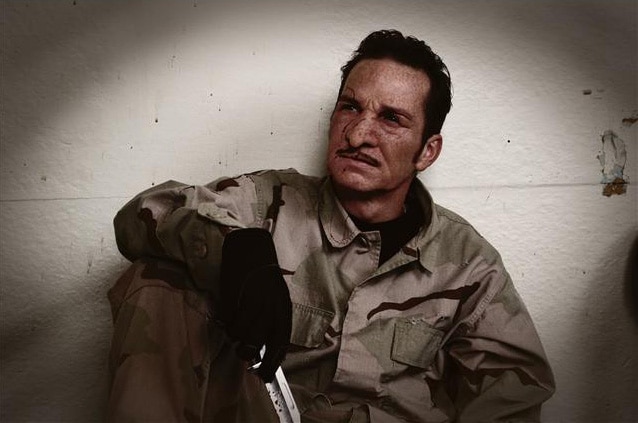
There are also a ton of facial prosthetics that are used (by Michelle Grady) on nearly every male in the story, making everyone look as warped as the storyline, including sores, pimples, an amazing nose on the John that seems right out of Sin City (2005). And like Sin City, the look of the film is quite unique and, well, dirty looking, with some phenomenal lighting, silhouetting, and angles that work with the prosthetics to make them look even more fantastical (by cinematographer and editor Jay Gavin, his first time for both).

This can only be described as extreme cinema, though the word transgressive comes to mind. Blood, gore, violence, coarse language including the use of the N-word, and abnormal sex are the theme, which is right up where Nicholson wanted it to be. This is the kind of film he loves to watch, and as he explained in the commentary, he makes his films for himself, not for the fans, of which there are rightfully many, even though it is a niche market.

Nathan Dashwood, Wade Gibb

The gore is plentiful, which is no surprise, the makeup is as extreme as the violence, and the women are quite beautiful, with standouts being a junkyard admin assistant named Nicole (Candice Le, aka Candice Lewad) who likes to show a lot of cleavage and pleasure herself in explicit ways, a full-lipped prostitute named Trashy (Stephanie Walker), and of course there is Ms. Rochon, in an extended cameo. Women are pretty secondary to the story, which focuses more on Hanger, The John, Leroy and odd Russell.

Being a 2-disc special Blu-ray release, let’s take a look at the hours upon hours of extras. First up is a Triple-X version of the film. Call me crazy, but I watched it and the regular, and I did not see a difference. It’s pretty hardcore anyway. There is also a full-length commentary by the director, Ryan Nicholson, completed for the DVD release in 2010, which he manages to remain interesting throughout. Most of the extras were filmed during this period.

Next up is “Behind the Stoma: The Making and Taking of Hanger” (20 min.). In case you don’t know, a stoma is “an artificial opening made into a hollow organ” (thank you Wikipedia). This is a really well shot collection of interviews with the director and some of the cast, mixed with behind-the-scenes clips. Generally, it was quite engaging, with everything being long enough to get a grip on it, but short enough not to overstay its welcome. Other films’ Makings Of featurettes could use this as a model. This is followed by another “Making Of” featurette (26 min). It’s a rehearsal with Nicholson working through the introduction to Leroy scene with the cast, including Rochon. While fun to watch, I don’t think I would turn it on again, though I was happy to have seen it once.

Ronald Patrick Thompson

“Taking of Hanger, Enough Dope to Hang Yourself With: On the Stet with Lloyd Kaufman” (12 min.). If Kaufman is there on set, one should always do a featurette with this film legend and ad lib maven. Most of the footage here was shot by Kaufman himself, and then the camera is handed off to Ryan’s (adult) son for Lloyd’s “Melvina the Tranny” scenes. It’s a funny, unusual behind the scenes, but what else would you expect from Kaufman? His friendship with Rochon, whose career turned a corner in his films, is evident and smile-worthy.

The “Blooper Reel” (2 min.), “Deleted Scenes” (6 min.), which is also a blooper reel, and Additional Scenes” (20 min.), which is more of a behind the scenes kind of deal, could all have been combined into one 28-minute piece. Nothing very special. Again, glad I saw it, but would probably not watch again

“Black on White Bred” (3 min.) is the film within the film of the porno (hard “R”) that stars Hanger’s mom Rose and Leroy, including the money shot. Don’t really know what more to say about this, except Rochon is definitely one to give for her art.

Gibb

The second disc is “The Raw Tapes, Volume 1” through “Volume 5”. These are the raw footage and can be seen as almost a Master’s Class in indie filmmaking. Each one of these five are on average 3 hours long, Honestly, no, I did not sit through all of them, but I did some zooming around. I have a life, as there are over 18 hours of extras in total. Maybe one day I will come back to these.

There is a photo gallery, and the usual sound and chapter choices on the first disk. Even with the “everything but the kitchen sink” mentality, the only thing missing was English subtitles for those of us with a bit of a hearing thing (too much seeing the Ramones, Johnny Thunders’ Heartbreakers, etc., in small clubs and loud volume).

Sometimes I wonder where Nicholson, who also did make-up for some very major releases, would have gone in his directorial career if he had not succumbed to brain cancer before the age of 40. Gratefully, he is being appreciated after the fact.


Monday, May 10, 2021

Documentary Review: Underground Horror

Text © Richard Gary / Indie Horror Films, 2021
Images from the Internet

Underground Horror
Directed by Tony Newton
Tony Newton Productions
119 minutes, 2021
www.facebook.com/TonyNewtonFilm/

Before the term independent – aka indie – was commonly used for low budget cinema not produced by a major studio, especially if it fell under the genres of art, transgression, exploitation, sexploitation, or blaxploitation, it was known as underground. The reason for this is that they were generally shown in showcases that were dives, such as along 42 Street or across America in what is known as Art Houses.

This could be anything from Andy Warhol’s early releases like Empire (1964) and Chelsea Girls (1966), or the likes of Hershell Gordon Lewis’ The Wizard of Gore (1970) and The Gore Gore Girls (1972). This also include nudie flicks like those done by Doris Wishman, such as Bad Girls Go to Hell (1965).

Stylistically? Well, as one of the opening quotes in this documentary by director/writer/actor Phil “Chip” Herman states, “The difference between underground and mainstream movies is balls.” That can be taken both figuratively and literally. Jim Towns, the director of House of Bad (2012; reviewed HERE), essentially states that underground cinema is not bound to studio interference. This is true, as most indie films are created by the directors and writers directly, rather than through a third-party studio. This started to happen in the 1960s as underground films fought the Hays Office gatekeeping and theater monopolies, by going all the way to the Supreme Court, thanks to law suits due to the lack of distribution of a non-genre Italian film called Ladri di Bicilette (Bicycle Thieves; 1948).

Through the use of talking head interviews, this documentary on independent/underground horror is broken up into unofficial segments, such as defining what exactly is underground cinema, and how the interviewees, all of whom are in the field, began their careers and manage with such tiny budgets.


A large segment is about what they consider to be the most extreme film. The three that come up the most are no surprise, though they are not all, and their explanations about the films are interesting. They include Salo, or 120 Days of Sodom (1975), Nekromantik (1987), and the winner apparently is A Serbian Film (2010; reviewed HERE), which is being rereleased uncut soon by Unearthed Films. Writer and director Dane Keil gives an excellent analysis of it. As Tony Newton, this documentary’s director understandably says – and I agree – “It didn’t scare me as much as shocked me.”

Another topic is pondering the future of underground films. Surprisingly, this was not the last question. The general consensus was, and again, I agree, is that the future (and somewhat the present) is DIY: Do It Yourself. With the proliferation of technology for films, editing, etc., being made easier (many mention cell phones), it is only natural that the river of beginning filmmaking would flow that way; in my opinion, that started with Super 8mm and expanded with VHS. One thing not mentioned is that the process of homemade cinema has exponentially exploded with people staying home due to COVID. Not only has it lit a fire under the cause of homegrown filmmaking, but it has created new genres around social distancing and software such as Zoom; for example, this film this one, where no two people are in the same frame, and check out Zoë Bell’s “Boss Bitch Fight Challenge” on YouTube; reviewed HERE). 

Fortunately, the future for indie films looms positive, as is somewhat discussed within these parameters. Progression from outlets for these films have gone from dodgy cinemas to owning VHSs and DVDs, and now to streaming services, from specialists like Shudder, to bigger outlets like Amazon and Netflix, to finally the smaller venues, like TubiTV.


Another relatively surprising segment is about a film I have not yet seen, Circus of the Dead (2014). Fortunately, one of the stars of the film, Parrish Randall, and its director, Billy Pon appears among the present crowd. Amusingly, there is an 8x10 photo of Bozo on the wall behind Pon.

Speaking of which, most filmmakers are also collectors, and it is always fun to look behind the person speaking to see what films they are displaying on a shelf. Most collectors may need to watch this a second time without being distracted (a good thing) by the “Got it. Got it. Need it. Got it” consistent with the collecting bug. For example, Dustin Ferguson, the owner of SCS, now the U.S. Division of VIPCO Distribution, has numerous Tony Newton releases on a shelf behind him, such as VHS Lives and VHS Lives 2 (both 2017).

As with all of Newton’s documentaries, he has gathered his buddies to state their opinions and tell about themselves, such as filmmakers Jim Towns, Phil “Chip” Herman, Peter Goddard, Matthew Fisher, JD Ellenberger, Tim Ritter (Truth or Dare: A Critical Madness; 1986, reviewed HERE), the great Todd Sheets (such as Bonehill Road, reviewed HERE, but I have also reviewed others), and bringing up the Italian end, David Pesca and Domiziano Christopharo (Red Krokodil, 2012, Reviewed HERE; one of three of his features reviewed on this site). Others include writers/reviewers Martin Unsworth from Starburst, and the omnipresent Shawn C. Phillips, who has his own podcast.


Smartly, the talking heads are broken up with clips from numerous films, from the underrated Dreaming Purple Neon (reviewed HERE) to the more obvious ones like Texas Chain Saw Massacre (1974). There are also some behind the shoot scenes from Circus of the Dead during its section.

The only real drawback, in my opinion, is that this is a complete testosterone fest, as there are no female filmmakers included. Like the porn industry during the reign of the video nasties of the 1970s and ‘80s, the women are the draw, but they get the (no pun intended) short end of the production side credit, even though they were there.

The last section is about what the directors are working on now. It may be dated quickly once those works are released, but over time, it will be a fun nostalgia piece to look back upon.

Newton is quite prolific with his documentaries and his writings (including horror-related poetry), so I am looking forward to the next release, which should not be too much longer, especially as the COVID isolation continues.

Trailer TBD

Monday, August 5, 2019

Review: A Serbian Film (Srpski Film)

Text © Richard Gary / Indie Horror Films, 2019
Images from the Internet

A Serbian Film: Unrated Version
Produced and directed by Srdjan Spasojevic
Invincible Pictures / MVD Visual
103 minutes, 2010
Invinciblepictures.com
Serbianfilmmovie.com
MVDvisual.com

”It’s dangerous, Max…it’s more – how can I say – more political than that… It has something you don’t have, Max. It has a philosophy, and that’s what makes it dangerous.”
– Marsha, in Videodrome

David Cronenberg’s Videodrome should almost be a prerequisite for watching this film from the former Yugoslavia. They both deal with the issue of violence through media with a political bent. But Videodrome only brushes where Srpski Film takes off.

We are introduced to retired porn star Milos (Srdjan Todorovic), whose specialties were having a bit of a violent streak and being fatigueless. But now he has a (understanding) wife, Marija (Jelena Gavrilovic) and a six-year-old son. He is struggling to not only survive financially, but part of him misses the action, though he won’t admit it to himself.

Asked to come back for just one film by an ex-co-star, Lejla (Katarina Zutic), he is hesitant, but the promise of a big paycheck and “the itch” calls him. With Marija’s blessing, he meets with the director, Vulkmir (Sergei Trifunovic), who states that he wants Milos to just be himself, and so refuses to let him know what the film is about. Reluctantly, Milos agrees. And you just know it’s not going to end well.

Now, the North American audience has spent years watching graphically violent and disturbing films like Wolf Creek, and the Hostel and Saw franchises. This genre has come to been labeled by the term “torture porn.” Well, A Serbian Film pushes the scale ever further toward the latter. The most graphically and disturbing scene that comes to mind in previous films I have seen is the fire extinguisher incident from Irreversible, but parts of this one if not beat it, come thisclose.

Slowly but surely, through his own dark nature and a bit of an injected “sex drug” (a comment on Viagra or Calais?), Milos doesn’t just lose whatever is left of his moral compass, he becomes the pawn in a game that is completely out of his control as he suffers blackouts, only to find out later through videos and flashbacks just what kind of sick actions he’s been in the middle of performing.

No, I won’t go into detail, but there is a point to it all. Truthfully, I’m not aware of much Serbian history or politics, so a great deal of the context is stripped away leaving mostly the violence and sex (sometimes graphic, landing somewhere between softcore and hardcore in various degrees, including an erect penis, though I’m assuming it is a prosthetic, considering the length), without the point of a good deal of it.

I do get some of it, though, such as when Milos is wandering around Belgrade in a sex-drug-induced fog, and seeing all different forms of acceptable sexually suggestiveness, such as lingerie billboards, and magazines at a deli.

But it is pretty obvious that the film has, as posited at the beginning, a philosophy. It’s not simply violence for violence sake, especially when viewed in the Serbian historical perspective, but as I said, the message is hazy to one (e.g., me) unfamiliar with the background.

On YouTube, you can find lots of videos of people watchg the film, the most I've seen since the infamous two women and the cup reactions.

How far can one man go into the depths of his own depravity? And who is there to push him over that line? And to what purpose? The answer lay at the end of the film, but it’s not a pretty picture, both figuratively and literally, and as I said and which is pretty obvious, it does not end well for many. Does art imitate life/politics?

Does politics/life imitate art? Where does art begin and politics end, and vice versa? These are chicken-and-egg questions that the film addresses. Whether they answer it or not seems unimportant since, as one philosophy states, the question is as – if not more – important than the question.

This review was originally published HERE


.

Saturday, September 15, 2018

Review: The Song of Solomon


Text © Richard Gary / Indie Horror Films, 2018
Images from the Internet


The Song of Solomon (aka American Guinea Pig: The Song of Solomon)
Directed by Stephen Biro
Oddtopussy Films / Unearthed Films / MVD Visual
91 minutes, 2015/2016
www.unearthedfilms.com

There are key phrases you come across that instantly gives you a lot more information on what is happening than is conveyed by the simple message. If you’re a genre fan, one of these is “Guinea Pig.” This may drive you away or draw you near, but you know it means extreme and transgressive cinema. Stephen Biro, who runs Unearthed Films and also directs features, has taken on the Guinea Pig moniker and concept from Japan and created his own branch series to continue the franchise, called American Guinea Pig [AGP].

This is the second of the AGP series that he directed, though he produced and/or wrote others. Happily, he’s starting to branch into more story-based tales of gore and mayhem. It seemed like the first films had limited narrative that was there to support the extremity, but finally it’s starting to feel like the story came first in importance, without losing any of the ultraviolence. Of course, that is not to say that the gooey stuff doesn’t ride shotgun.

Exorcism films (being possessed by demons, not to be confused with merely controlled by ghosts as in the haunted house genre, e.g., the Amityville franchise or The Black Room) seemed to be the rage just a few short years ago, and they have certainly ramped up the violence from, say, The Exorcist days, to where on occasion the host dies in the process; unfortunately in real life, during many deluded exorcisms, the religious figure gets overzealous, as told in 2005’s The Exorcism of Emily Rose.

Jessica Cameron: The eyes have it
In our story, Mary (the lovely Jessica Cameron under a lot of well-done make-up) is hooked up by our demon before the film even starts, so we don’t get to really know much about her as a single entity. Now, she has a way of talking sarcastically out the side of a twisted mouth (such as, and this is not a direct quote, “so you think you can do something?…let’s see”).

In a parallel and overlapping story, a high-ranking Roman Catholic Bishop sends in a series of priests who have been drained and damaged by previous exorcisms (think of the action film trope where the hero is living on an island somewhere and is “damaged,” and then the boss comes and says, “I got one more job for ya.”). This all seems to take place over a single night, so there is an expectation of a sinister overarching purpose to it all.

Speaking of which, it’s easy to see the ending coming from early on – in fact it’s kind of telegraphed if you listen to the dialog (something I strongly recommend, as does Brio in more than one interview), a habit I tend to do – but it’s important to remember the genre, and the purpose is the very violent and extreme road to getting to reach the conclusion, not just to achieve being there.

There are a number of nods to other exorcism films, such as The Exorcist, with a younger priest accompanying the older, more experienced one. Of course, things don’t follow the same flight pattern, thankfully. I should point out that if you’re a devout Roman Catholic, well, first of all, what the hell are you doing watching a film like this? Lately, the RC Church has been getting a lot of (rightful) flack for behaviors of (most?) of its priests, so they have made themselves the prime targets of films like this, and again, I’m okay with it for that reason. It should also be noted that Biro is a devout Catholic and tried to make the story and dialogue as realistic as possible.

For a story this controlled, especially since a large portion of the action takes place in one beautiful wooden house (essentially the entranceway, staircase and the bedroom), there is a nice relative body count. And beyond the fatality number, the level of violence we witness is… heavenly?

For me, the big drawback of this genre of film is that often the violence goes beyond the function and it becomes almost fetishized, so the scenes tend to last longer than they need to, honestly. Stab someone in a body part and twirl it around, yeah; keep the close-up of the twisting for five minutes straight, well, it becomes tiresome and loses some of its power. While it doesn’t happen all that often here, there are a few bits that could have been – err – chopped down a bit. Please note that this is my own take on it, and I’m not being critical, actually, it’s just a personal choice of comfort/attention level.

Cameron, who is also a writer, producer and director in her own right, holds her own as her worsening character is the center hub of the story as the demon gets more control over her and her environment. Cameron seems to revel in the role and it shows. Most of the other cast is played a bit broadly, especially the priests, but considering all that happens, it’s kind of the wiser directorial choice.

In previous releases in the AGP collection, there is little dialog, minute character development and nothing to stand in the way of caring about the victims who are being tortured in the most gruesome manner by those in control. This film, I’m happy to say, takes another direction, but still manages to stay loyal to the premise. For example, while there is some mind control by the demon on those around it, most of the violence done to the human physicality is performed directly by the victim in response to past sins that come to the surface.

Need I add that the gore looks spectacular? Marcus Koch’s and Jerami Cruise’s practical / appliance SFX and make-up are central to what we watch, and both shoot for the top. There are also come really cool eye lenses used to great effect.

There are hours of extras on this Blu-ray, such as individual single-camera interviews with lead actor Jessica Cameron (20:52) who is almost unrecognizable as Mary (so kudos to Marcus and Jerami) giving great anecdotes about filming key scenes, writer/director Stephen Biro (26:37), SFX master Marcus Koch (28:07; one of the fuckin’ most fuckin’ interesting of the fuckin’ group), and Director of Photography Chris Hilleke (35:15; I lasted until 15 min) discusses how he approached the shoot and what it was like to shoot SFX.

Cameron cleans up nicely
On top of that there is an informal Behind the Scenes featurette (70:22) that is not organized but rather a collection of the shoot through set-ups that are interesting – albeit rather long – as its main focus is the SFX. For me especially, I was fascinated by the creation and workings of the magic bed. This is followed by Outtakes filled with both oopsies and practice (8:31), and a Photo Gallery containing 161 images of mostly behind the scenes stills. Oh, and did I mention there are a bunch of Unearthed trailers? Most of them have been reviewed on this blog.

Of course, the centerpieces are the two full-length commentaries. The first is with Brio and Cameron: Biro does most of the talking while Cameron sits a bit far from the microphone so she fades a bit in and out. About half of it is really good (i.e., better than most), with stories about not only the filming, but the research behind it. Being a history buff, this piqued my interest. The second is Brio, Koch (and his distinctive arm ring tats) and Cruise (who has since worked on a number of mainstream Marvel multi-million dollar extravaganzas), again filled with anecdotes about the filming; the guys go into detail about their work, though sometimes it’s a bit hard to tell who is talking. But in this case, the content is what matters, so that’s fine.

This may sound a bit strange, and I mean this in all respect to Biro and his work: as much as I like his American Guinea Pig franchise, I’m kinda hoping he’s got a comedy up in sleeve at some point soon. Hear me out. Biro co-wrote the hysterical 2014 Bubba the Redneck Werewolf, so I know he’s got it in him, and I truly believe it’s important to mix it up a bit in order to keep some sense of balance and freshness. Like, if all you eat is White Castle (mmmmmm…), you’d want to mix it up with some Asian or Tex-Mex occasionally to help you appreciate your next mini-cheeseburgers with pickles and ketchup.

Oh, and by the way, where I grew up the proper term for the first means of death in the film is a Sicilian necktie.