Showing posts with label Fairy Tale. Show all posts

Thursday, September 15, 2022

Review: Pink Rabbit

Text © Richard Gary / Indie Horror Films, 2022
Images from the Internet
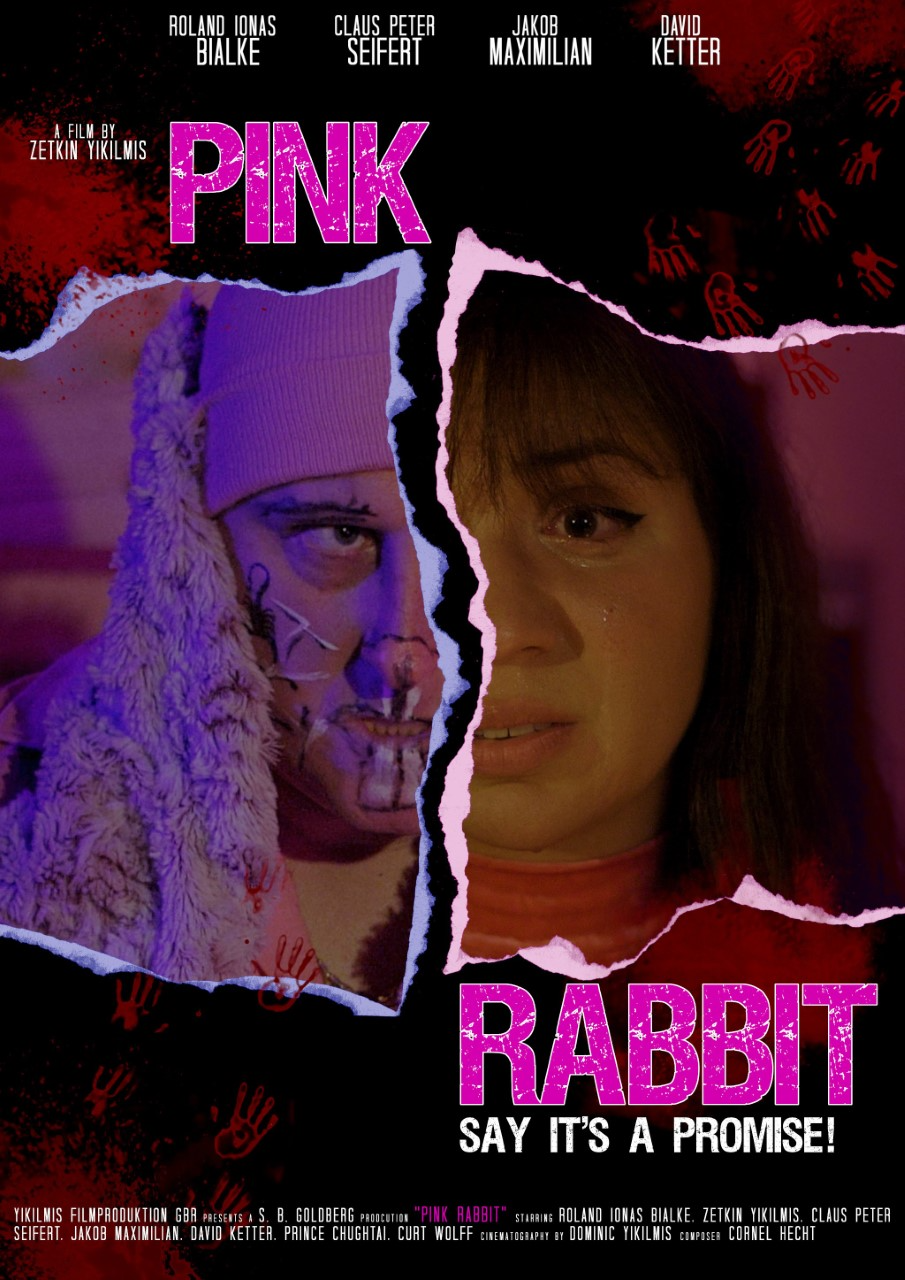
Pink Rabbit
Directed by Zetkin Yıkılmış
Yikilmiş Filmproduktion; Gravitas Ventures
105 minutes, 2022
www.facebook.com/pinkrabbitthemovie/

Somewhere in my head, I hear Sly Sylvester Stone’s voice singing, “It’s a family affair…” That is hardly surprising as the star of the film, as Martha, is the director/writer, Zetkin Yıkılmış, her husband is played by her husband, Dominic Yıkılmış (who is also cinematographer), and her kid is played by her toddler son, Emil I. Yıkılmış. Zetkin also fills many other shoes, such as make-up, editing, and art direction. Something tells me this is going to be a micro-budget film. I am truly excited.

From a Turkish background, Zetkin filmed this in Germany, but it is done entirely in English, so for those who are subtitle-phobic, there should be no issue in this department; sometimes heavy accents prevail, though.

We are introduced to the “Pink Rabbit” (Roland Bialke) during the credits – well, his feet anyway – as they stomp on a bunch of flowers. Right from the start, we are told the rabbit is up to no good. And what exactly is the rabbit? It’s an adult male in a bunny suit and exaggerated make-up.

Even from the first five minutes, the film has the feel of a fairy tale. Remember, Grimm’s Fairy Tales by the Brothers Grimm (1812) also came from Germany, and if you had the chance to read the original (or early translations), as I did, they are incredibly disturbing, often containing physical torture, dismemberment, and death to men, women, and children (for example, you didn’t think Hansel and Gretel were the first children in the witch’s house, did you?). It’s this feeling of “magic” that permeates the story.

Zetkin Yıkılmış

Martha is a harried office worker who has done so much overtime that she has not seen her husband and child in days. But on her way home, on a lonely road, the real journey begins as she is zapped out of her car by the Rabbit (using ‘80s style CGI), and into the dark woods, where she is held captive by a hunter and his father, and covered in white mice (tell me, that does not sound like a fairy tale to you). But like Dorothy Gale, all she wants to do is go home.

The style of fairy tale includes a chapter where a cabin is run by two bad hunters and potential cannibals, Caleb (Jakob Suchentrunk) and his grizzled father, Kain (Claus-Peter Seifert), where they are holding Martha captive. It is almost like they are in the Middle Ages in dress and house interiors (really good set designing), though in actuality, it takes place just after the end of the American War Between the States; what is odd, though, is that they have a huge Confederate “Stars  and Bars” flag hanging in their living room. Is that some kind of political commentary? There is also an odd conglomeration of American Indian/First Nations culture and one bit of modern technology all thrown in the mixer. The language is also purposely stilted to give it a fairy tale ambience (to paraphrase, “Oh, good sir, I just want to go home”).

Roland Bialke

All of the dialogue is spoken slowly, as if being read to children, though profanity prevails, and very carefully enunciated, though the “Rabbit” is over-the-top in facial expressions, and sounds more like Snidely Whiplash as he emotes by gnashing his teeth (would that make Martha “Nell”?). Did I mention that the “Rabbit” also has an alarm clock around his neck like the White Rabbit in Alice in Wonderland?

In other films, the over exaggeration in emoting and movement would be the signs of amateurism, but as a purposeful stylistic choice, it covers a lot of bases, and because of it being consistent throughout rather than one or two actors trying their best, it flows quite well into the fairy tale narrative and motif.

A wise choice is as the scenarios change as she “kills all enemies” (Rule 2 of 3 given by the guy in the pink rabbit suit), the film nicely plays with how much is outside the scope of Martha, and how much is in her head, a manifestation of a possible psychic break after an alleged tragic event (again, real or Rabbit manipulation?). This is nicely exemplified in the character of Police Detective Fox (David Ketter, looking like he just stepped out of a Beach Boys’ cover band).

The SFX (the killings are practical and the titles that pop up on occasion or flashes when there is movement from scene to scene are digital) by Zetkin are extremely cheesy and are as cartoonish as the rest, which is appropriate. However, the set design and lighting are incredibly well done and are a spotlight, and yet still fits into the overall tone of everything else.

I have, quite honestly, not seen any of Zetkin’s other films, such as Planet Zee (2021), so I cannot compare them, but as a standalone, I was impressed by the level of the mixing of mediums of film and fairy tale. Despite sometimes having a bit of an issue with the accents (as I said earlier), especially with Bialke’s teeth gnashing, overall, I had fun with this accepting it as it is and what I feel like the mood it was going for, which I believe was achieved. This is indie filmmaking at its most basic level, a family affair, and I ended it with a smile. It feels like it was left open for a possible sequel, which I would look forward to viewing.

IMDB listing HERE

Trailer is HERE 

Saturday, January 20, 2018

Review: Tấm Cám: The Untold Story (Tấm Cám: Chuyện Chưa Kể)

Text © Richard Gary / Indie Horror Films, 2018
Images from the Internet


Tấm Cám: The Untold Story (aka Tấm Cám: Chuyện Chưa Kể)
Directed by Veronica Ngo (aka Ngo Thanh Van)
VAA Productions / BHD Vietnam Studios / Cleopatra Entertainment / MVD Visual
115 minutes, 2016 / 2017

Well, I must say, this is my first Vietnamese film viewing that has nothing to do with the action there during the 1960s and early ‘70s. This is more the sweeping epic kind of period story one would expect from either Japan, or especially China; Crouching Tiger, Hidden Dragon (2000) comes to mind.

Asia has a history of taking Western stories and Easternizing them, such as Macbeth (Throne of Blood, 1957) and King Lear (Ran, 1985). Then again, the West has taken the Eastern stories as well, and either transplanted them (The Magnificent Seven, 1960; A Fistful of Dollars, 1964;, more recently The Ring, 2002), or merely placed themselves in the story in Asia (Shogun, 1980 and The Great Wall, 2016, for example).

For this release, it is in part a reimagining of the Cinderella story, set in the magical past of Mainland Southeast Asia.  We see sweeping vistas and mountain castles as the camera swoops and flies in both the real and digital realm, and it’s all beautiful and lush (and easy to distinguish between the two, but that’s alright).

Ha Vi and Isaac
Even before the credits, the handsome prince with Spock-like eyebrows, Thái Tử (translated as “Prince”; Isaac), is all bedecked in gold armor while racing to see his dying father. He and his posse almost runs over Tâm (“Center”; Ha Vi), and it is love at first sight. But, as the story goes, he takes off without finding out who she is, which he will later regret.

While pretty accurate to the Grimm’s Fairy Tale, there is also a lot of minor tweaking along the way. For example, along with the evil step-mother Dì ghẻ (“Step Mother”; director Veronica Ngo), there is only one nasty step-sibling, Cảm (“Cold”; Ninh Duong Lan Ngoc), who is a horribly spoiled brat. Also, rather than a fairy godmother, there is a fairy godfather, But (“Shoes”; scene stealer Loc Thanh), who is obviously based on the Robin Williams’ Genie character from the animated Aladdin (1992). He has a nasty sense of humor and also mentions things that have no place in the story or time, such as the Energizer Bunny. Dressed like the White Wizard phase of Gandalf (sans hoodie), with eyebrows that go down to his chin, he is quite hysterical.

The Cinderella part is actually quite abbreviated, even if it gets the most credit, with the entire story taking only the first 30 minutes. For example, the whole “fit the foot to the shoe” bit takes place at the initial ball when Tâm first walks in dressed in her fine outfit.

People may not remember this, but fairy tales were often quite dark, such as in the original Cinderella story, one of the step-sisters cuts off part of her foot to try and make the shoe fit. Here, while nothing this gruesome visually occurs, there ae some sad and surprising moments with death, the threat of murder, and war never far away. You may certainly begin to wonder about the “Happily Ever After” part.

Huu Chau
There are many layers of fantasy here, including ghost stories, reincarnation, and a bit of another Fairy Tale, “Beauty and the Beast.” I’m not necessarily up on my Tales since I haven’t read them (or had them read to me) since I was a small kinder, but there is much in the way of intrigue, betrayal and resurrection. And like many Tales, this is a bit over the top; honestly, though, this is the kind of production that is built for it. When I was in Xi’an, China, a few years ago, I saw an opera/ballet called A Song of Everlasting Sorrow, about the first Emperor of China and his Concubine; there are some similarities here, as well. This also is a story of love that goes beyond death, treachery and friendship.

As for the betrayals, some come as a surprise (as they should be in the true definition of the word), but the obvious one is the main villain, a Fu Manchu-ish, Saruman-like Magistrate, Thừa Tướng (“Prime Minister”; Huu Chau). He is more cartoonish in a Ming the Merciless way, though the main difference is that he is actually is played by an Asian actor (unlike anyone in the West who has played Mr. Merciless).

Ngoc Trai
Along with the character But, my favorite is Nguyên Lực (“Resources”; Ngoc Trai): who is a friend to the prince, and also an outstanding comic relief. Trai is never ridiculous to the point of losing credibility, sort of in the way that Donald O’Connor would play to the likes of Gene Kelly.

Of course, there must be sweeping battle scenes, and there are a few, which are very well composed and shot. Yeah, they fly through the air with the greatest of ease, though not always getting the outcome you might expect. Once again, there is a strong mix between real, harnesses, and digital. The end and inevitable battle between good and evil is nearly all Digi, and it looks a bit silly and great at the same time.  

The story is, well, a Fairy Tale, and I wonder how much of it is based on Vietnamese folklore that I haven’t a clue about. I mean, while someone in the West may wonder, what?!, I’m betting there’s probably somebody saying the same thing there about a story of someone who is nailed to a piece of wood and comes back to life three days later. It’s all perception and culture.

The only extras on this disk are the trailer and the chapters.

The lovely director Ngo, who can also be seen in the new Star Wars: The Last Jedi (2017), does a splendid job with her second directed film in bringing this all together, and I’m looking forward to seeing more of her output.