Showing posts with label German Cinema. Show all posts

Wednesday, May 17, 2023

Review: La Petite Mort 2: Nasty Tapes

 Text © Richard Gary / Indie Horror Films, 2023
Images from the Internet

La Petite Mort 2: Nasty Tapes (aka La Petite Mort II)
Directed by Marcel Walz;
Matador Film; Bogatzki-movie.com Movie Production;
Unearthed Films; MVD Visual
90 minutes, 2014 / 2023
www.facebook.com/la.petite.mort.2/
www.unearthedvideo.com
https://mvdb2b.com/s/LaPetiteMort2NastyTapes/UN-1149

This is the second chapter of this German transgressive cinema directed by goremaster Marcel Walz (who as since moved and started filming in Los Angeles). In the first installment, the yucky stuff was handled by Olaf Ittenbach, who is absent this time. Still, I have no doubt that will not slow down the ultraviolence. Again, the film is in German with English subtitles. But honestly, I get the feeling, the libretto is not going to matter as much as the visual. The gore effects this time are handled by The Gruesome Twosome, and Megan and Ryan (d. 2019) Nicholson. A cult SFX wizard, Ryan also directed the likes of the Gutterball franchise, Hanger (2009), and Star Vehicle (2010). 

In the first piece, LaPetite Mort, released in 2009 (though taking place in 1998), we are introduced to the Masion La Petite Mort in Frankfurt, where travelers are tortured for the deep web viewing pleasure, as well as an opportunity for rich people to fill their violent fantasies (a la the Hostel franchise), but online. Honestly, I would not be surprised if this actually happens, but as I have never been on the dark web and have no intentions of doing so, I will never know, nor do I want to see that.

Yvonne Wolke, Annika Strauss

The new owner of La Petite Mort is sexually amorphous Monsieur Matheo Maxime (Mika Metz; d. 2017), with his two hench – er – women, brunette Dominque (Annika Strauss), who returns from the first film, and blonde Monique (Yvonne Wölke). Both could have been in the video for the Divinyls’ song “Pleasure and Pain.” They are aided by others, such as the Sexy Nurses (Gabriela Wirbel and Nicole Neukirch), the well-named Eva Brown (Bea La Bea), and Matheo’s wife, Jade (Micaela Schäfer).

In the first film, we are introduced to some tourists who end up at the Jail Bar, and how they end up in Masion La Petite Morte, as well as the follow-up. Here, there is no context, just torture broken up into segments that have title cards such as “Sushi Time” with info on the victim, and how much someone is paying to have them eviscerated. As Ralph Kramden may say, “Pins and needles, needles and pins…” Victims are of both sexes, so there is that. There are also “between” segments with testimonials from happy customers who either paid for the chance to kill, or do the body work themselves. And all of it on camera.

Micalea Schafer, Mika Metz

Much of it is from the perspective of the Web cameras, so it is nearly found footage style, but there is also some “backstage” drama with Matheo and the women who work for him. Even this internal tension is caught on video, as the characters occasionally look directly at the camera and comment.

A sort of by-product of this style is that the person watching this is not just a viewer, but is a participant of the feed.

Gabriela Wirbel, Nicole Neukirch

Stylistically, it is actually shot beautifully, focusing on the faces (or parts thereof) in close-ups of most of the characters, in a darkish, reddish tone. Also, for some reason, there is some clips of Carnival of Souls (1962) and Night of the Living Dead (1968) shown on a monitor (the former also of facial close-ups).

Each set piece has a slightly different feel, such as one called “Gasrechnung” (“Gas Bill”) which has a definite World War II feel, with Eva Brown giving herself a Hitler moustache in blood. Most of this segment is in black and white as in a Leni Riefenstahl-style propaganda film. Interestingly, there is an added censor image over certain parts of the uniforms, which show Nazi iconography. German film: detailed torture permitted, but no symbols of the “fatherland.”

Like Tod Browning in films like Freaks (1932), some odd humans are thrown into the mix, such as The Twins (Barbara and Patrizia Zuchowski). There are also some cool cameos throughout from cult genre filmmakers and/or actors, such as Dustin MillsHaley Madison, Uwe Bowl, Mike Mendez, Adam Ahlbrandt, and Ryan Nicholson (d. 2019).

Despite splashes (drips?) of laughter in a couple of moments, everyone seems to be unhappy, be it through body dysmorphia, boredom while inflicting pain out of repetition, and of course, the subjects of the sharp objects. This is a pretty joyless film, with minimal humor, though there are some dark moments of it scattered throughout.

The first extra on the Blu-ray is the “Making of La Petite Mort 2” (13 min), which is essentially extended scenes showing more detail of some of the tortures. Then there is an “Alternate Scene” (4 min) that is the “Gas Bill” part, without the edited-out images of the Iron Cross, the “SS” Schutzstaffel logo, and of course the swastika armband (wonder if they ever play Lech Kowalski’s 1980 documentary D.O.A. over there).

The ”Behind the Scenes Gallery” (3 min) is lots of nice shots of the make-up and the cast, and I quite enjoyed it. As for the “Advert” (30 sec), I have no idea what I was looking at. Last, there are a few company trailers, as well as two from this film, and the first La Petite Mort.

As I stated in my review of the first film, “The problem with stories like this, and this is my opinion, is the plot revolves around the action, rather than the action being a result of the story…sometimes it goes beyond what even I can tolerate. If this is your idea of fun, well, please, have at it.”

I realize that this film is a few years old now, but I have to say, the whole premise of strangers being tortured for the pleasure of the rich and/or on the Net for clicks/cash, is becoming a bit cliché, and is merely an excuse for some graphic body horror. Sure, I like a bit of ultraviolence, but my tastes run more to the cartoonish violence, even when explicit, than just someone being tied up and put through the wringer. Also, I like more of a narrative than a string of events. How can one feel anything about any character if there is nothing to bolster the why, other than greed.

 MDB listing HERE

Friday, December 30, 2022

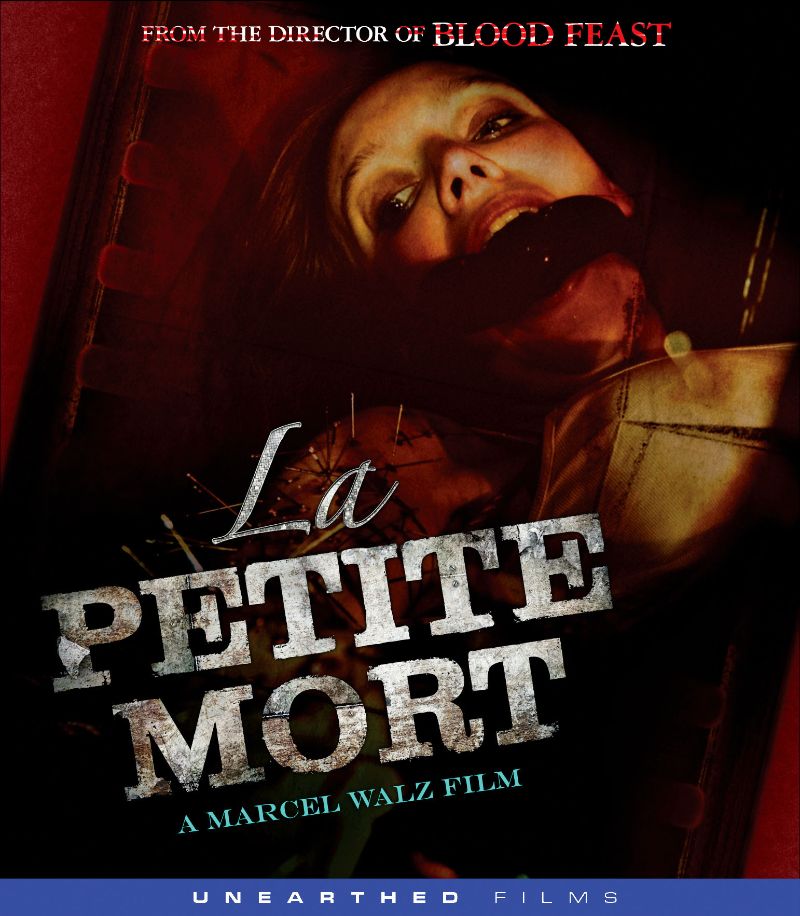
Review: La Petite Mort

Text © Richard Gary / Indie Horror Films, 2023
Images from the Internet

La Petite Mort (aka La Petite Mort: Die Nasty)
Directed by Marcel Walz
Laser Paradise; Matador Film; Unearthed Films; MVD Visual
77 minutes, 2009 / 2022
www.unearthedfilms.com
www.mvdvisual.com
https://myspace.com/lapetitemortmovie

German transgressive cinema, at the moment, has two shining stars of gore and, well, more gore: one is Marcel Walz, and the other is Olaf Ittenbach, both of whom deal with a combination of directing and practical SFX. Their films are certainly not for the squeamish. Naturally, the film is in German, with well-defined English subtitles.

For this film, we get a double-whammy. It is directed by Walz, and the SFX are under the guidance of Ittenbach. What can these two come up with? Well, this release of purposefully questionable taste.

The (translated) title cards let us know this is in 1998, and states this is a true, infamous story, and lists the names of the victims. I hate when that is done (and, unfortunately, so many “true stories” or “found footage” – which this is not – does that very thing). I do not want to know; I want to see and be surprised.

Inés Zahmoul, Anna Habeck

We are introduced to our protagonist/victims right off the bat, as they arrive in Frankfurt during a stopover on their way to Mallorca. They are the couple Simon (Andreas Pape, who was also producer and cinematographer) and blind Nina (Inés Zahmoul), and their companion on this vacation, Dodo (Anna Habeck)

After a way-too-long exposition of the three walking through the city, including the seedy, industrial side, they get mugged. To drown their sorrows, they end up in a local bar called, ironically (or not) Jail’s, where the music is loud, the dancing is raucous, the denizens are scary, and kidnapping is nigh after an argument with their obnoxiously flirtatious waitress, Dominique (Annika Strauss).

From this point (i.e., Act 2), they are now in what is known as Maison la Petite Mort (“House of Little Death”), located in an abandoned factory, which has rooms with the names of the likes of “Slaughterhouse” and “Surgery,” each of which has its own primal colors of blue, red, and cyan. If this is starting to sound a bit like Hostel (2005), yeah, it is a similar theme, but instead of just having customers pay to torture, the action is live streamed for profit.. The joint is run by middle aged Maman (Manoush), who runs it like a business, stealing from her victims.

Magdalèna Kalley, Habeck

I will not continue on and tell you the types of ordeals they go through, as this is typical torture porn at its highest standard. However, I will honestly say, I turned away when the rusty-looking sewing needles came out (needles and eyes are my Kryptonite, and while it is not all that happens, it happens). After all, the whole purpose of these types of transgressive cinema pieces is to revolt and disturb its audience in intimate detail, most of whom watch it with glee or disgust. There is no middle ground, though my tolerance is somewhat varied, depending on the action.

The problem with stories like this, and this is my opinion, is the plot revolves around the action, rather than the action being a result of the story. This is not meant as finger-pointing, as I have a relatively high tolerance for onscreen violence, but sometimes it goes beyond what even I can tolerate. If this is your idea of fun, well, please, have at it.

The film looks really good, with just the right industrial tone, and acid-laced and occasionally philosophical dialogue. The imagery of the story proper actually looks really fine, which is no surprise since both Walz and Ittenbach have experience as filmmakers (and SFX), knowing how to get the right look, tone, and desperation feeling that suits the gorehound’s tastes.

The women who run the Maison, Maman and her “servants” Dominique and blonde Angélique (Magdalèna Kalley), are almost like Cenobites, Maman phrases it by telling Dodo that she will “…take you into a world of your own. A world of your own secret dreams and fantasies…” as she begins her work on Dodo.

While estrogen-based at its core, like Hostel, Maman “rents” out the victims to men who pay large sums to do as they wish, all of which is painful. For example, there is Klaus de Kobold (Thomas Kercmar), with half his face burned and mutilated (fire? Acid?), who gleefully watches as the women are tortured to his specific requests (he does not do it much of it himself, unlike Hostel).

And through all the explicit gore, I still laughed at the occasional title cards that separates some scenes, which are all in French, rather than German. I wonder if this was a nod to Donatien Alphonse François, also known as the Marquis de Sade (d. 1814). Or, perhaps, Giles de Rais (d. 1440). Or both.

It is interesting that there is a subtle Christmas theme to parts of this. But will there be some revenge or will the bad guys…I mean girls win?

As gross as the film was, as it was meant to be, the credit can easily go to Ittenbach who did all the practical SFX. There is no doubt this does not have a cartoonish look, but instead has a strong sense of realism. Tom Savini learned about the insides of the human body as a medic in Vietnam. I wonder where Ittenbach learned his craft, as it is that exact.

Just know, along with the heaping of torture and gore, on occasion there is an additional sense of unsettling, thanks to a shaky, handheld camera. Not to the nauseating level of, say, Cloverfield (2008), thankfully, but it serves it purpose to keep the action on uneven ground, as it were.

I did not see the Blu-ray, which has the following features: a “Making of La Petite Mort” featurette, a commentary with Marcel Walz, an interview with director Marcel Walz and with SFX wizard Olaf Ittenbach, deleted scenes, a gallery, and trailers.

If this film floats yer boat, there is also the sequel, La Petite Mort II: Nasty Tapes (2014).

IMDB listing HERE


Thursday, September 15, 2022

Review: Pink Rabbit

Text © Richard Gary / Indie Horror Films, 2022
Images from the Internet

Pink Rabbit
Directed by Zetkin Yıkılmış
Yikilmiş Filmproduktion; Gravitas Ventures
105 minutes, 2022
www.facebook.com/pinkrabbitthemovie/

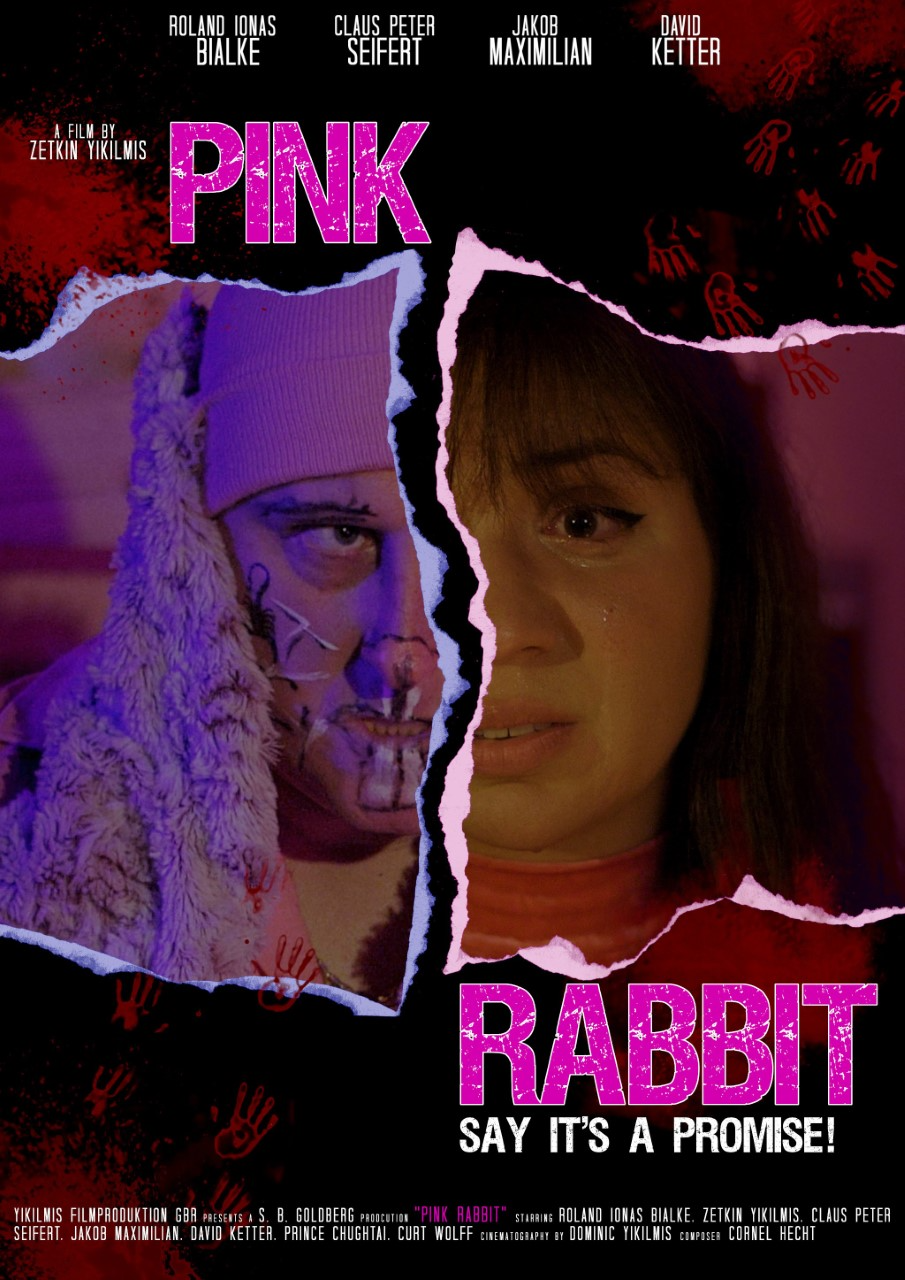
Somewhere in my head, I hear Sly Sylvester Stone’s voice singing, “It’s a family affair…” That is hardly surprising as the star of the film, as Martha, is the director/writer, Zetkin Yıkılmış, her husband is played by her husband, Dominic Yıkılmış (who is also cinematographer), and her kid is played by her toddler son, Emil I. Yıkılmış. Zetkin also fills many other shoes, such as make-up, editing, and art direction. Something tells me this is going to be a micro-budget film. I am truly excited.

From a Turkish background, Zetkin filmed this in Germany, but it is done entirely in English, so for those who are subtitle-phobic, there should be no issue in this department; sometimes heavy accents prevail, though.

We are introduced to the “Pink Rabbit” (Roland Bialke) during the credits – well, his feet anyway – as they stomp on a bunch of flowers. Right from the start, we are told the rabbit is up to no good. And what exactly is the rabbit? It’s an adult male in a bunny suit and exaggerated make-up.

Even from the first five minutes, the film has the feel of a fairy tale. Remember, Grimm’s Fairy Tales by the Brothers Grimm (1812) also came from Germany, and if you had the chance to read the original (or early translations), as I did, they are incredibly disturbing, often containing physical torture, dismemberment, and death to men, women, and children (for example, you didn’t think Hansel and Gretel were the first children in the witch’s house, did you?). It’s this feeling of “magic” that permeates the story.

Zetkin Yıkılmış

Martha is a harried office worker who has done so much overtime that she has not seen her husband and child in days. But on her way home, on a lonely road, the real journey begins as she is zapped out of her car by the Rabbit (using ‘80s style CGI), and into the dark woods, where she is held captive by a hunter and his father, and covered in white mice (tell me, that does not sound like a fairy tale to you). But like Dorothy Gale, all she wants to do is go home.

The style of fairy tale includes a chapter where a cabin is run by two bad hunters and potential cannibals, Caleb (Jakob Suchentrunk) and his grizzled father, Kain (Claus-Peter Seifert), where they are holding Martha captive. It is almost like they are in the Middle Ages in dress and house interiors (really good set designing), though in actuality, it takes place just after the end of the American War Between the States; what is odd, though, is that they have a huge Confederate “Stars  and Bars” flag hanging in their living room. Is that some kind of political commentary? There is also an odd conglomeration of American Indian/First Nations culture and one bit of modern technology all thrown in the mixer. The language is also purposely stilted to give it a fairy tale ambience (to paraphrase, “Oh, good sir, I just want to go home”).

Roland Bialke

All of the dialogue is spoken slowly, as if being read to children, though profanity prevails, and very carefully enunciated, though the “Rabbit” is over-the-top in facial expressions, and sounds more like Snidely Whiplash as he emotes by gnashing his teeth (would that make Martha “Nell”?). Did I mention that the “Rabbit” also has an alarm clock around his neck like the White Rabbit in Alice in Wonderland?

In other films, the over exaggeration in emoting and movement would be the signs of amateurism, but as a purposeful stylistic choice, it covers a lot of bases, and because of it being consistent throughout rather than one or two actors trying their best, it flows quite well into the fairy tale narrative and motif.

A wise choice is as the scenarios change as she “kills all enemies” (Rule 2 of 3 given by the guy in the pink rabbit suit), the film nicely plays with how much is outside the scope of Martha, and how much is in her head, a manifestation of a possible psychic break after an alleged tragic event (again, real or Rabbit manipulation?). This is nicely exemplified in the character of Police Detective Fox (David Ketter, looking like he just stepped out of a Beach Boys’ cover band).

The SFX (the killings are practical and the titles that pop up on occasion or flashes when there is movement from scene to scene are digital) by Zetkin are extremely cheesy and are as cartoonish as the rest, which is appropriate. However, the set design and lighting are incredibly well done and are a spotlight, and yet still fits into the overall tone of everything else.

I have, quite honestly, not seen any of Zetkin’s other films, such as Planet Zee (2021), so I cannot compare them, but as a standalone, I was impressed by the level of the mixing of mediums of film and fairy tale. Despite sometimes having a bit of an issue with the accents (as I said earlier), especially with Bialke’s teeth gnashing, overall, I had fun with this accepting it as it is and what I feel like the mood it was going for, which I believe was achieved. This is indie filmmaking at its most basic level, a family affair, and I ended it with a smile. It feels like it was left open for a possible sequel, which I would look forward to viewing.

IMDB listing HERE

Trailer is HERE 

Tuesday, May 31, 2022

Review: Premutos: The Fallen Angel (2-Disc Extended Director’s Cut)

Text © Richard Gary / Indie Horror Films, 2022
Images from the Internet

Premutos: The Fallen Angel (aka Premutos: Der gefallene Engel)
Directed by Olaf Ittenbach
IMAS Filmproducktion; Unearthed Classics; MVD Entertainment
106 minutes, 1997 / 2022
www.unearthedfilms.com
www.MVDentertainment.com

As I said when I reviewed the only other film by Bavarian writer/director Olaf Ittenback that I have seen in its entirety, No Reason (2010), his films are basically bat-shit crazy, and I wanted to see this one because of that, rather than in spite of it. This is the “Director’s Cut” of the film, which is longer and has never before been released in North America. More bizarre for the buck.

For this story, the basis of which is told in narrative form over the credits and lots of bloody violence throughout history shown, the titular Premutos is a fallen angel older than Lucifer, who had power over the dead, with instructions on how to raise the deceased. One man in 1943 uses it to try and revive his dead wife and others who become flesh-gobbling zombies, while villagers with torches search for the madman. This is all presented in a 20-minute prologue before our actual story starts. There is already more blood and gore than most slasher films put together.

Ella Wellmann, André Stryi

The protagonist to start, in the modern era, is ne’er-do-well man-child Matthias (the director, Ittenback), who lives with his S&M-interested sister, Rosina (Heike Münstermann) his mom Inge (Ingrid Fischer), and his military-obsessed, Nazi-era-loving father, Walter (Christopher Stacey, who is arguably too young for the role, but what the Hölle). The latter, while digging up his garden for a plant, finds the hidden potion for raising Premutos. Meanwhile, Matthias is having flashbacks to previous lives during the Plague-ridden 13th Century and in Russia for the Battle for Stalingrad during World War II, among other periods, where he was reincarnated as the son of the titular Fallen Angel, each time meeting a bloody and painful end.

Coming to visit for Walter’s birthday party is Matthias’ sister Tanja (Ella Wellmann), who has been away in China, and has been mooning over a lost love, Hugo (André Stryi), now married to spoiled, comic relief Edith (Anke Fabré). They also show up at Walter’s party. Meanwhile, Matthias has some of that Premutos potion spilled on his…sensitive area, so you know that’s not going to be good for the people at the party, but most likely joyous for the viewer.

Olaf Ittenbach

As Matthias transforms into…well, is it the son of Premutos or Premutos himself? – it could be both; given how much Christian myth is also in the story, since Jeebus and “his father” are different but one in the same according to some versions of the Biblical story – he becomes increasingly violent and ugly (reminding me a bit of Rawhead Rex with less of a make-up budget), and the dead rise up from the mortuary to attack the living, including in pub (where someone is wearing a Ramones shirt with the circle design created by Arturo Vega, d. 2013) and, ‘natch, Walter’s party. As a side note, when the zombies attack, there is a sole Black guest, the amusingly named Christian (Fidelis Atuma), who makes me think of Night of the Living Dead (1968)

There is an enormous cast here, and the director has certainly stretched his budget to the max, with weaponry, explosions, a tank(!), and just gallons upon gallons of fake blood, relying heavily on practical SFX. Peter Jackson would, indeed, be proud. The zombies look cool, and on occasion, so does Premutos/son. What was free and well spread was the sharp sense of humor

Christopher Stacey

There is a lot of Christian symbolism, including a back-story scene of Jeebus and the crucifixion/resurrection (thanks to the “potion” administered by Mary). No one in the film seems overly religious, but that doesn’t keep it from getting knee-deep in the imagery. Even without the religious iconography, the style of the film reminds me quite a bit of Michael Armstrong’s classic Mark of the Devil (1970). But there is also a strong influence by the Italian giallo films of Dario Argento and Lucio Fulci, especially The Beyond (1981), with some George A. Romero thrown in for good measure.

There are some fun extras on this Special Edition, including a “Making of Premutos” featurette (50 min.; available in English and German, and also filmed in 1997). There are lots of interviews with the core cast, and especially the director, discussing the motivation of the characters, the philosophy of gore and free speech without getting preachy, and a large focus on the practical SFX, both the good and bad of it, and discussion about the wintery shooting in Prague. The English dubbed version seems to not translate everything, but the gist is easily gotten and it is worth the watch, even at this length.

“Olaf Ittenbach, ‘The Early Years’” (13 min.), is essentially a “Making Of” of Ittenbach’s earliest films, including Deadly Night (Todliche Nacht) from when he was still a teen, and he was still learning and experimenting. With interview commentary by the director, we see scenes that describe what he is discussing; the main focus is on developing his skills as an SFX artist. If these gore effects interest you, this is both a good primer, and it is interesting to see the limitations of the technology at the time compared to now.

There is also the original cut of the film from its initial release available in both German and an English dub international release. Honestly, I did not watch this, but did see the Director’s Cut in its entirely. There are also some Unearthed trailers, including of this one, and a “Photo Gallery.” Also included is a second CD disc of the film’s soundtrack, which is fun.

This certainly was an insane ride, from the beginning right through to the ironic ending. It was more coherent than I was expecting, I’m happy to say, and it certainly lived up to its reputation. It may be aging like wine over time, because it is so worth the experience.

IMBD Listing HERE 


Saturday, February 20, 2021

Review: The Midas Touch

Text © Richard Gary / Indie Horror Films, 2021
Images from the Internet

The Midas Touch
Directed by Tilman Borck
FTB Productions; Indie Rights Movies
110 minutes, 2020
https://www.themidastouch.online/

In the words of Seth Meyers, “what we need right now” is a good sexually religious farcical comedy that is not afraid to push that proverbial envelope to beyond its flap. Director, writer, and actor Tilman Borck dips his – err – toe into the pool with this updating of the Greek legend of King Midas, but with a tug n twist, if not several.

Gino Wilson

We are introduced to milquetoast Felix Blythe (Gino Wilson), who is a low-level advertising drone in an office. Unlike the meaning of his name – “Felix” is happy and peppy, “Blythe” (blithe) indicates carefree – Felix is a humdrum worker who is constantly bullied by his boss Ron (Clayton Nemrow) and co-workers, and looked down upon by others for his shy spirit. While he has literal dreams of sexual exploits with beautiful women, in actuality, like the chartered accountant in the Monty Python’s Flying Circus sketch, his life is “dull, dull, dull…” He is a “very quiet man in a very loud world.”

The other main characters are the polar opposite of Felix, in that they are colorful, but bizarre. There’s self-help guru Sviatoslav Rău (the director, Borck) and his hapless Sidekick (Bernhard Bozian), both of whom dress as if it were the 19 Century, with cane and cape; a Trump-ish self-centered right-wing politician James Walker (Nicolas Buitrago); and his sensuous and statuesque wife, Sarah (Transylvania-born Noémi Domokos), upon whom Felix has a crush. Sarah also runs a small religious cult comprised of women.

Tilman Borck, Bernhard Bozian

While drowning his sorrows, Felix manages to inherit the titular Midas Touch. In a nutshell, it is a hex that can become a curse, even to him. This is not a fairy tale so it does not make princesses fall in love with whomever they touch, but rather makes them hornier than a hoot owl. But can Felix live – err – up to it? Even a young man needs to recoup. I remember a line by comedian David Brenner saying that after once, for him it was something like trying to chop down a tree with an overcooked asparagus. How much of a good thing is too much?

Anyway, what this means for the viewer is that there is plenty of onscreen (softcore) sex and full nudity of both men and women. Sure, this is a male’s fantasy, they make an emphasis about that, and there is even an anti-Feminist nod in the scroll at the bottom of a news report, but I will say that this is pandering to the male audience rather than trying to make a huge political comment about the role of sex. I would have liked to see what would happen if Felix touched a gay man, to see if it would affect that way as well. The film is reminiscent of sex comedies that were popular in mostly art houses and Times Square in the late 1960s and ‘70s, such as The Erotic Adventures of Robin Hood (1969) and Alice in Wonderland: An Adult Musical Fantasy (1976; the latter softcore version played at a neighborhood theater in which I was an usher).

Noémi Domokos

As the names of the actors may hint at, this is a European production (Germany, I believe), though filmed in crisp English for those who struggle with accents. 

It is smartly filmed, even initially with characters who have not yet met move in and out around each other as the story progresses and they keep passing or literally bumping into each other. But of course, by the end, all will converge, with the evil attempting to persuade the poor Felix.

The acting is kind of goofy, but again, this is an extremely broad comedy with a really low moral bar, and the over-emoting belies that, but it is also very funny in parts, with Rău being the oddest character with the best lines, and his reading of his “cult” speech is definitely a highlight of the film, reminiscent of the “Spanish Inquisition” bit from, again, Monty Python. Wilson is actually spot on in his character, as a squeaky mouse that finds his teeth. The Ron/boss character reminds me a lot of the similar Gary Cole role in Office Space (1999).

While mostly it is comedy and nekkidity, there is also surprisingly a body count (albeit relatively small), and some unexpected gore. It made me smile.

Cayton Nemrow

One of the interesting aspects of this film is that there is no real love interest for Felix, just an object of lust in Sarah. Usually, there’s a secondary or friend character who, at the end, becomes the heroine of the piece, and I find that truly different and admirable. Also, I enjoyed the O. Henry-ish surprise at the end.

There is an extremely large cast of extras here, which is also commendable. While ridiculous, it doesn’t fall into the sheer stupidity trap of the likes of some of the sex comedies from the States, like the Porky’s series or the those with Seth Rogan (sorry, but I am not a fan); perhaps it’s the European sensibilities.

Sure, parts of this are pure goof, but there is an undercurrent of smartness, a relish of skewering topics, and a joyousness in its total abandon. Add some decent filmmaking, and this is definitely watchable, especially for a first-time feature director. Honestly, though, I would not consider it a date movie as it is the antithesis of the Hallmark Channel fare, but rather along the lines of the old Cinemax Channel.


Wednesday, February 5, 2020

Review: Ever After (EndZeit)


Text © Richard Gary / Indie Horror Films, 2020
Images from the Internet


Ever After (aka EndZeit)
Directed by Carolina Hellsgård
ARTE / Das Kleine Fernsehspiel (ZDF) / Grown Up Films /
Juno Films / MVD Entertainment
90 minutes, 2018 / 2020

You say you’re looking for something lighthearted with zombies along the lines of Zombieland (2009)? Man, you’ve come to the wrong Blu-ray. However, if you’re looking for a deeply serious Euro-centric post-Z-Apoc universe where everything is dire, well, have I got the film for you!

When the film opens, the Z-Apoc happened two years previously, and in Germany, there are only two barricaded cities left. In one (Weimer), that I think of as Republican, the zombies are shot on site with zero tolerance. In the second (Jena), which I envision as Democrat, they are working hard to find a cure. We start off in the former, and meet our central character, (dyed) redhead Vivi (pop and soul singer Gro Swantje Kohlhof), who suffers from severe PTSD from an experience as the munching pandemic virus took a bite into humanity. We see it in snatches of flashback. She’s withdrawn and nearly child-like.

Gro Swantje Kohlhof and Maja Lehrer
She manages to get out of Republicanville and meet up with fellow ex-pat Eva (Maja Lehrer), who is also running away after an incident. Eva is the opposite of Vivi in that she’s hard as nails and not exactly cuddly. They both decide to try to make it to the Democrat land by cutting through the Black Forest.

Along the way, Vivi befriends an older, mother-figure type (Tryne Dyrholm, who played the title role in 2017’s Nico, 1988). She’s a philosophical flower child who sees what is happening around the globe in a specific purpose as part of the natural world. Of course, we don’t really know what set off the Z-Apoc, whether natural or man-made, but it is all part of what nature is, according to her (I’ll leave most of her philosophizing for when you see it).

For this adventure, the zombies are fast, growl like beasts as their only verbal communication, and of course are ruthlessly vicious with no sense of their previous personhood. Like sharks, they’re mindless machines lookin’ for a snack of gristle and gore. An odd thing about that is even though there are some cringe-worthy moments, this is definitely not Fulci-like. It is more story-driven, so there is a dependence on character development rather than focused on shots of viscera.

There is also a philosophy that runs throughout, and that is to ponder what our place is in a world in which society as we know it is no longer strong enough to support us. Everyone seems to be searching for an answer to that, either directly or unconsciously.

In other words, while the zombies are fast, the storytelling mostly is not. There are thrilling moments where it’s do-or-die with Vivi and Eva against either single snackers or a group of them (or, horde, as the case may be).

Although essentially a three-person film, this is mostly Vivi’s story, and we basically see it through her eyes. It’s a world that is both harsh and beautiful as she mentions that one can see the stars again.

Despite the zombies roaming around snackin’, this is a very slow-moving film that makes Hereditary (2018) look like Mad Max: The Road Warrior (1981). This isn’t something you just pop in for a quick fun ride on a Saturday afternoon in your mom’s basement, this is a piece of cinema that is quite serious and deep, albeit that it keeps up the tension. I enjoyed it a lot, but it took some thinkin’ work to get through it all.

In German with subtitles, this picture is essentially a three-person piece, and except for the flesh eaters, all the main characters and most of the secondary ones are female. Director Carolina Hellsgård presents a bleak world yet filled with beauty, as I said, and takes us on a physical and philosophical journey that needs to be taken one step at a time.

The extras are chapters, sound choices, and two versions of the trailer: the original German and English. My one real complaint about the film is that although I’m happy to have the subtitles, they are pure white and small, and hard to read more than I would like, especially with a film this deep in its dialogue. Plus Vivi wears a white top and if the subtitles are superimposed on them, it’s damn near impossible to make out.

I’m not surprised this has won some festival prizes as this is the kind of film the serious viewers are itching for, rather than some found footage goofball release. With patience and thought, it’s worth a gander.


Saturday, August 25, 2018

Review: The League of Superheroes


Text © Richard Gary / Indie Horror Films, 2018
Images from the Internet

The League of Superheroes (aka ABCs of Superheroes)
Written and directed by Jens Holzheuer and Oliver Tietgen
Boesewicht Film / Wild Eye Releasing / MVD Visual
86 minutes, 2015 / 2018
www.wildeyereleasing.com

Oh man, the cinema and other mass media have just been inundated with superhero films. These mega-monsters are as big on CGI and they lack in story, or soul. As someone who grew upon comic books from the Silver Era into the Modern, who got to hang out with Jim Steranko and Grey Morrow in a semi-private manner, I find it just too… overwhelming is the word that comes to mind. Each film seems to need to add more heroes, bigger villains, more destruction, and it all becomes numbing. In the similar way as we drown in Freddy-Jason-Michael-Leatherface franchises, the same is true with the Marvel Universe (and to a lesser extent the DC Universe as they have generally been less financial successful than their rivals in the past couple of decades).

Every once in a while, a non-major, independently sponsored superheroes release makes it out there, and they tend to widely range from the excellent (such as Kick Ass, and the obscure and goofy Surge of Power mini-franchise) to the pretty bad (e.g., Rise of the Black Bat). There are lots of phenomenal fan videos out there as well, including the “Super Power Beat Down” series on YouTube. That’s why I was interested in seeing this German film, which began its life as ABCs of Superheroes. Alternative superheroes films are definitely a mixed bag, and then combine that with Euro-trash sensibility that has replaced Expressionism, I’m going in hoping for some wild rides.

Well, the original “ABCs” title makes way more sense than the new “League,” as like the ABCs of Death series, these are short tales of about 5 minutes each that follows in alphabetical order. One seriously needs to think about how you’re going to approach this film on a few different levels. For example, it’s recorded in English with some definite German dialect; it’s not hard to understand, fortunately. Next, the acting is atrociously bad and campy (I’m going to say purposefully), the effects are quite amateurish albeit fun, and the writing is kinda hokey; in the right frame of mind, however – and I’m there – one can see this for the amount of fun that it is.

There is also a bit of a wit about it among all the tomfoolery. For example, there is a He-Man send-off where the Skeletor (all with different names, of course) character goes through a portal and arrives on modern Earth, to become a hero; He-Man and She-Ra realize how boring their lives are without him.

Bai Ling
What’s used as a framework to join all these stories together, which we return to often, is an inattentive mother and her young daughter trying not to be bored by reading a comic given to her by mom to quiet her called, what else, ABCs of Superheroes. Each of the stories comes from this comic, and we see the girl’s reactions to them while her mom either ignores or chastises her.

There is certainly a level of social commentary that can also be found if one scratches down, such as a Yul Brenner-ish Westworld character (“Cowboy Man”) who goes against a Mexican Villain (Cheddar Guevara… get it?), which turns into a reality television show somewhat like Storage Wars. A great quote in this segment is, “This is how I roll: I got one hand on my Bible, one hand on my gun, and one hand on my credit card.” So you can see that while it’s not very serious and lots of WTF moments, it still occasionally manages to keep a level of witty smarts on some level. That’s what I like about the film.

There is lots and lots of female nudity of various body types, the blood splatter effects are almost all digital, and the costumes are, well, pathetic (one looks like the Muppet Grinch Who Stole the Hulk If He Was an Ape). There is a certain cheapness level, which adds to the fun, such as someone shooting people with his fingers as he makes a gun shape with his hand.

Playing with convention and clichés is common by turning them on their heads, such as a an electric eel being bitten by a radioactive human, which turns it into a beautiful woman (mostly nekkid) fighting evil, including a cameo by action actor Bai Ling. Throughout, other cameos are the likes of Lloyd Kaufman and Fred Olen Ray. I’m sure there are some that fans in Germany are going wow about, but I don’t know them.

There are certainly more superheroes than there are letters, and some are way more bizarre than others, such as MenstruGirl and Queen Osiris (interesting change of gender for the Lord of the ancient Egyptian Underworld). There are a number of different “leagues” here, including the First Fuck Force (Power Rangers), a bunch of martial arts pandas that certainly must be (more) profane Teenage Mutant Ninja Turtles (including a product commercial to mock the saleability of hero toys), and one group of topless women which comprises one who is pregnant, an older one who is “Bored Woman,” and a boy with a cat nose.

Each short has a particular focus, such as a profane version of an “Alf”-like television program, and sometimes weird combinations such as “Gerry Atricks vs. Hitler’s Brain” and “Jesus Space Missionary vs. King Satan (Star Wars).

The whole film, honestly, is just ridiculous, from the writing to the reading by the actors. However, and this is important, it is more towards why it works rather than works against it. When you’re dealing with pure insanity, sometimes it pays to go over the top, and this one goes waaaaaaaaay over. In fact, there was only one bit that didn’t work for me and was quite unsatisfying, which was a The Terminator spoof called “Rape Robot,” which is uncomfortable in so many different ways.

Another important note is even with the different styles for each segment, because it was directed by the same two people, there was a motif of consistency in feel throughout, defining this as a single piece in different chapters, something that sometimes gets lost when a film is a compilation of individual shorts by various directors. What’s also nice about this is that it’s easy to have characters overlap and show up unexpectedly in different stories.

Cool Jeebus
The film takes no prisoners. While no real animals are involved, we see the bloody killing of men, women and children indiscriminately, as well as the elderly. That being said, it’s also pretty even-handed when it comes to reflecting the large Afro-German population, including a Black Jesus. This was brave.

There are some nice extras, including a 35:56 Making Of featurette, which essentially is the two directors talking individually and spliced together going back and forth – in German (with subtitles). It’s actually quite interesting as they take the viewer through the usual inception, writing, financing, shooting, post-production, and showings. Rather than being dry, they both have an enjoyable sense of humor and come across as nice guys. Other topics include shooting anecdotes, how they got some of their cameos (there is a brief piece by Uwe Boll, also speaking German), and they even address the female vs. (lack of) male nudity.

Other extras are the original trailer, some of the great Wild Eye collection, and part of the “Hero Boy” segment (the one with Kaufman) at 4:31 which includes outtakes inserted. The last are two short films by the directors individually: “Licht aus Licht” (2012; 1:59, translated as “Light of Light”), which is similar in theme to the infamous Swedish short from 2013, “Lights Out”; “T is for Testicle” (2011; 2:55) that was titled “Testicular Apocalypse” in the 2016 anthology film, World of Death. In this quickie, a man’s testicles become sentient and escape while he’s watching some softcore film, and he goes chasing after it. It’s both gross and humorous.

Sometimes goofy fun is just what is needed in a world where superhero films just seem so serious in its wider zeitgeist, rather than some snappy Ant-Man / Iron Man / Deadpool quips within a gazillion dollar extravaganza. Like Badass Monster Killer (also 2015), the CGI was used for the good and cheesy, and makes it all the better for its off-the-wall, see if any of it sticks to the wall, WTF! G'wan, take a chance.