Showing posts with label Satanists. Show all posts

Sunday, January 22, 2023

Review: Heartland of Darkness

Text © Richard Gary / Indie Horror Films, 2023
Images from the Internet
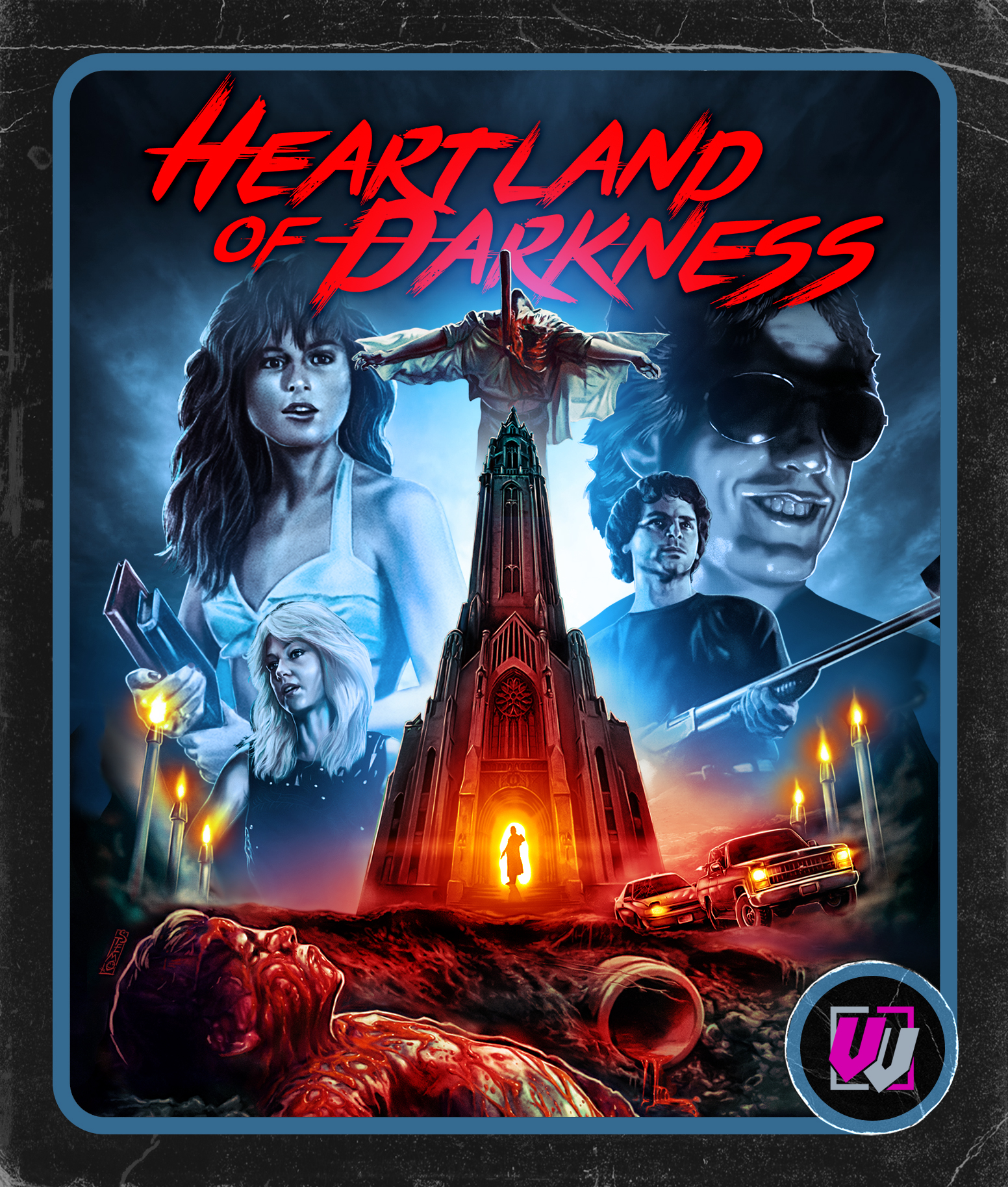
Heartland of Darkness (aka Fallen Angels; Blood Church)
Directed by Eric Swelstad
Donovan Productions; HOD Productions;
Visual Vengeance; Wild Eye Releasing; MVD Entertainment
101 minutes, 1992 / 2022
www.wildeyereleasing.com
www.mvdvisual.com

While this film was to be released in 1992 (though filmed in ’89, and not really finished until 30 years later), it had never been offered on any home format until now. And typical of the Visual Vengeance sub-brand of Wild Eye Releasing, this Blu-ray was supervised by director Eric Swelstad into an SD master from the original sources.

Who doesn’t love a good satanic cult movie, unless you are a fundamentalist yahoo? This film does not necessarily tread new ground, even though it is 30 years old. While many devil’s cult releases have come since then, it was preceded by the likes of The Devil’s Rain and Race with the Devil, both from 1975. But as I watch each film with an open mind, let’s hit the play button, shall we?

First of all, y’gotta love a film that, in its credits, presents Scream Queen Linnea Quigley with an “And” at the end of the cast list, even though it is 1992. Off to a good start.

Amusingly, I start off with a question about the prologue. Without giving away the reason, a man is being chased through the woods by said cult. I understand that the chasers are wearing sunglasses to indicate that they are a united group, but sunglasses after dark? Is this a Cramps song? Seems like a visual oxymoron, like someone wearing a baseball cap backwards, and shielding his eyes from the sun with his hand. The map does not match the territory.

Dino Tripodis, Sharon Klopfenstein

As the story begins, ex-Chicago Tribune writer (saywhat?) Paul (stand-up and future DJ Dino Tripodis in his first IMDB listing) and his teenage daughter Christine (Sharon Klopfenstein, in her only role, as with most of the cast), who wears less and less as the film goes on, has just moved into a small town in Ohio (though mostly filmed around the Columbus area). Paul has taken over the local newspaper, The Copperton Chronicle, which obviously has been shuttered for years. Love the old typewriters. As I was a phototypesetter for a local Brooklyn weekly newspaper (The Weekly) in Bay Ridge during the late 1970s, this may indicate it had been shuttered for quite a few years. He soon hires Evelyn (Mary Alice Demas). Also hired right off is ex-The New York Times writer (saywhat?) and shoulder-pads wearing Shannon (Shanna Thomas). Love interest or cult plant? We shall see.

There are lots of personality contradictions. For example, the Sherriff (Lee Page) is grumpy to Paul, but gives him information. The local priest, Rev. Donovan (Nick Baldasare), obviously the bad guy, pressures Paul and Christine to show up at church. Would not fly with atheistic me. I mean, the biblical god killed way more innocent people than Satan did in their holy book. But I digress… Another digressive question: Paul is trying to make the local, small-town newspaper into a journalistic hotspot. Have ya ever seen a small-town newspaper? Usually, it is 90% local business advertising (i.e., the paper’s bread and butter), and the rest is what is going on at the Rotary Club, “coffee time” jokes, or who has a 75th wedding anniversary. The hardest news you will find will be how the local crop did this year, or changes in the trucking rules.

Nick Baldasare

Meanwhile, back to the show, Donovan quickly presents himself to be the villain that he is (again, no surprise), through his sermon (of which Christine is enamored). I mean, you know something is off when the congregation says a communal “Yes” rather than “Amen.” He is also setting in motion a temptress, Julia (Quigley, who is topless within 5 minutes of her intro; gotta love it), to seduce the newcomers into the fold.

Paul and Shannon are joined by Reverend Kane (John Dunleavy), who is a Satanic cult expert. Perhaps the character was named after the Puritan Satanist hunter, Solomon Kane, from the Robert E. Howard novels. He, Paul, and Shannon, confront Donovan. Which leads me to some other questions: people are killed off by the cult for the smallest of infractions, even their own members (e.g., plans to leave town), so if confronted by this trio, why are they not immediately killed off like the others, especially after the newspaper first releases a story about the possibility of the local murders being cult-related? And when do students (Catherine) and especially teachers (Quigley) show up in high school (where they teach about Aleister Crowley and the positive side of Hitler) wearing belly-showing clothes and neck diving tops? Oh, yeah, in B-movies…

Linnea Quigley

When it is payback time, aka Act 3, the action naturally ramps up. I smiled how one scene near the end reflected an inverted version the beginning, something rare in most films.

The acting runs from quite decent, such as the two male leads, to just wooden and terrible (I will leave out the names), but that is to be expected in B-films. During the 1980s and ‘90s, indie films leaned towards bad acting, but that is also part of its charm, in my opinion.

There are hours upon hours of extras on this Blu-ray, so if you are interested in this kind of thing, you should be happy. It took me three days to watch everything, including these extras. First up is a full-length commentary with the director, Eric Swelstad, the lead actor Nick Baldasaere, cinematographer Scott Spears, and composer Jay Woelfel. I was amused that they brought up the sunglasses after dark; in fact, they mention a bunch of topics I did above, though I watched this after the film. While sometimes hard to tell who is talking, they are respectful, do not talk over each other, and tell interesting stories. It was better than I expected with this large a crowd. The second full lengther is with Tony Strauss of Weng’s Chop magazine. It a bit of a more academic deep dive into the culture before and after the film, info on the shoot itself, and histories of the actors. Often these dives are dull, but Strauss’ keeps it a bit light without losing any of his topic’s integrity. Some of what he says is reflective of the previous commentary, but even then, he adds more on top of it.

One of the noteworthy extras is the 2020 documentary featurette, “Deeper into the Darkness” (39 min). This is a well put-together collection of interviews of crew members and Baldasaere, mixed with archival footage both in front and behind the camera. Really fun to watch, actually. I really enjoyed the part about Quigley (though she is not interviewed), and the release has been dubbed “The Lost Linnea Quigley Film,” which I found amusing. There is also a trailer for “Deeper into the Darkness.” Meanwhile there are two Quigly-related shorts, a new interview called “Linnea Quigley Remembers” (6 min), and a very grainy, obviously VHS taped off the TV archival interview on the program “Close-up” (20 min). The newer one is just Linnea talking about her experience with the film and gets to plug her website. The older interview by Jane Sachs is from Columbus Fox Television, as Quigley not only talks about this film (under the title Fallen Angels), but her career and her animal rights work. All very cool, but I especially liked the many commercials between the two segments, including a promo for an upcoming Beach Boys special.

The complete, original Fallen Angels 1990 workprint (37 min), is also available with a commentary track with director Eric Swelstad, which is how I watched it. This was to be shown to promote investors. It has the timeclock on the bottom and is grainy, which helped me appreciate the modern, final cut. Unfortunately, there is no subtitles for this version, which is not surprising. It is extremely abbreviated, with some different moments here and there with more raw edits, including video noise between scenes. For the ritual scene, it is almost like a blooper reel as parts are shot over and over. Also, some scenes, such as a key Quigley bit, is shown both with and without nudity. A lot of the conversation is similar in information to the other commentaries. Naturally, there is a “The Making of Fallen Angels” (18 min), which is vintage newscast interviews with Quigley and Swelstad in a longer format. Again, it is a grainy and extremely “noisy” VHS copy, but it is interesting as a lot of the info is unique and not mentioned in the commentaries.

A 1990s abbreviated version of the film for distributor promotion, edited by someone out of the loop of the director, is Blood Church (13 min). Again, fuzzy, washed out, and time stamped. It is kinda weird and incoherent. A SFX featurette is “Heartland of Darkness: Filming [Name Redacted]’s Death” (3 min). I have removed the character’s name because it would be a spoiler. This was cool. Following, is an article scanned from Fantasm magazine, which I saw but did not read.

Then there is the behind-the-scenes image gallery, television spots, two versions of this film’s original coming attractions and the new one for this release, as well as a couple of Visual Vengeance trailers, and optional English subtitles.

On the physical side, there is a six-page liner notes booklet, a Limited Edition slipcase (first pressing only), a collectible Linnea Quigley folded mini-poster, a stick your own’ VHS sticker set, and a reversible sleeve featuring original Blood Church promotional art

For a low budget (appx $100,000) indie film (despite all the Pepsi placements), the practical SFX (with one exception) looks astoundingly good, and there is a lot of it. So is the nudity by more than one character.

Before this, I had never heard of Heartland of Darkness, which is no surprise considering it seen as a “lost film,” but despite my questions, I found it to be a very enjoyable vintage piece of its period.

IMBD listing HERE

Friday, January 15, 2021

Review: Witch Hunters

Text © Richard Gary / Indie Horror Films, 2021
Images from the Internet

Witch Hunters (aka Witch Hunt)
Directed by Richard Chandler
Boston Film Family; Gravitas Ventures
74 minutes, 2016 / 2020
www.bostonfilmfamily.com/

This film started its brief and succinct life a few years ago under the title Witch Hunt, at 53 minutes in length. A few additional shots over the years and now it is the full length Witch Hunters. And that concludes the history lesson part of this review.

 There are multiple substories going on here that will, of course, merge at some point. First, there’s the brother and sister witch hunters (shades of 2013’s Hansel and Gretel: Witch Hunters) from Bosnia and Herzegovina, who wear Hells Angels-type leather jackets that denote their profession: Dominic Damarus (director Richard “Rick” Chandler, who played Hansel in James Balsamo’s The Litch in 2018) and mute Morrigan Ramsey (Carver Riot). They slaughter – usually via knives – witches.

Richard Chandler and Carver Riot

Second, there is the coven of said witches, led by a literally bloodthirsty piece of work (Lilith Astaroth, from the metal band Sorrowseed, who was in Nun of That and the recent Blood Pi), who is not given a name. This is more the traditional film coven, like you may see in Suspiria (1977), Rosemary’s Baby (1968), or The Satanic Rites of Dracula (1973), rather than the cutsie ones of The Craft (1996), for example. They huddle over their victims and sacrifice them…yes, using knives.

The third follows a priest and failed exorcist, Father James Costello (Graham King). He’s having an existential crisis, questioning his faith and his once suppressed gay sexuality. He is one mixed up dude. Lastly, there is Sheriff Tormada (Tony Ramos Wright), possibly named after Torquemada, who devised the worst of the Spanish Inquisition (as Mel Brooks said in 1981’s History of the World, Part I, “You can’t talk him outta anything!”); after all, the original tag line for the film is “The Inquisition Returns.” He is a murderous hedonist, riding on his power trip and will take down whomever he likes, just for the momentary thrill of it.

Lilith Astraroth and her Cult

Religion as supernatural has really become almost a sub-genre of late. I am not talking about the general possession type which has been a staple topic since The Exorcist (1973), but rather evil in religious forms, such as The Nun (2018), Beyond Hell (2020), or Red Letters (2020). Here we delve into the Satanic, more than, say, Satan proper. All of these tropes have been used multiple times in previous films, but combining them all successfully creates something new-ish. The question is whether or not it is successful, of course.

Every character suffers from affliction of at least a few of the seven deadly sins, especially those of the flesh. There is a lot of cleavage, nudity, and sex of various forms with numerous participants of either or both genders. For some reason, I find that the films out of New England, specifically between Boston (the environs where this was filmed) and Providence, RI, especially, have been recently focusing more on pan-sexual play, which I think is great. There is as much LGBTQ+ lust here as straight, as it should be. While that is refreshing, it’s definitely more sexual than sensual, as it’s more a meeting of bodies than hearts. There is also a lot of blood, with little gristle, which is also nice. Most of the SFX appears to be practical, rather than digital.

Graham King
What we are presented with is a series of set pieces, where storylines and characters sometimes overlaps like a Venn Diagram. While it loses some on story narration fluidity, what is positive about it is that not all the action is displaced into sections, such as nothing happening in the first act (usually about 20-30 minutes), little in the second act (about 40 minutes), and then crammed into the third act (the rest of the remaining time). Here, the sex, drugs and violence are nicely dispersed throughout. I can live with that.

In this story, the women are pure, be they good or evil; they know who they are and are consistent. The men, however, are contradictions, behaving in ways that betray (or believe it to be so) what they represent.

And when all the stories truly converge near the end, as they are wont to do in multi-line plots, the question of who will live to kill again and who will die to – err – not, is pretty well done, as the viewer is not totally sure who will come out on top. After all, in most straight, big budgeters, the flawed always fall, but in genre films, that is a gray area, thankfully.

For me, I can live with the questionably narrative storyline, seeing each set piece on its own as well as part of the zeitgeist, helped by the editing and cinematography. The “quality” of the image degrades a bit in the darker scenes, but that is common with some cameras (to paraphrase, “the fault…lies within the equipment, not in the director”).

That being said, the weakest point here is the acting, which is often wooden, or over-emoted. Some actors fare pretty well, but one in particular – and I won’t name names – was sincerely off the mark into overacting.

This may sound strange, but I feel like I was underserved on Father Costello’s story. The IMDB Storyline makes it sound like he was the central focus, but of the main characters – and there are at least five – his is one that feels like there could be a lot more. Perhaps a prequel, if not a sequel? I would watch that. Meanwhile, make sure you sit through the credits for this one.


Thursday, January 5, 2017

Review: House of Forbidden Secrets

Text © Richard Gary / Indie Horror Films, 2016
Images from the Internet

House of Forbidden Secrets
Written, filmed, directed and edited by Todd Sheets
Extreme Entertainment / BD Productions / Full Moon Productions /Unearthed Films / MVD Entertainment
93 minutes, 2014

Although this film was released less than three years before the last one I saw by the director, Dreaming Purple Neon (reviewed HERE), I watched this one shortly after it, and it was interesting to see the differences, and especially the similarities.

Even at this point, Sheets is not new to the director’s table, and that experience and know-how shows, even with a micro-budget. Yeah, this is VHS-1980s-type fare, but it is also no surprise that this has been accepted and shown at dozens of festivals in its nearly four years of existence.

Antwoine Steele
The story starts with it being Jacob Hunt’s (Sheets go-to guy, Antwoine Steele) first day on the job at an office building as a night security guard. Meanwhile, in one of the rooms, a medium named Cassie Traxler (Nicole Santorella) is holding a benign séance to bring back the spirit of a customer’s husband. Instead, she manages to unleash the evil spirit of a demonic priest (the excellent Lew Temple, who has been in a slew of stuff, including The Devil’s Rejects, 31, and a run on The Walking Dead) and the restless souls of those he has killed.

By Cassie’s action, the building’s basement has now turned into the stomping ground of the murdered and angry spirits of a 1930s brothel which we see in flashbacks, that was run by a couple played by the one and only Dyanne Thorne (here not-ironically named after one of her most famous characters in 1977’s Greta, the Mad Butcher, and her husband, Klaus (Howard Maurer, Thorne’s real-life husband). This is Thorne’s first role in nearly a quarter century, and it’s great to see her in all her eye-raising, inconsistent accent acting. This may sound like I’m being negative, but she is amazing and an important touchstone in modern horror history. Plus, she’s still lovely at 70 years old; the Las Vegas air has done her well. As a side note, when I met her in the early ‘90s at a Chiller Theatre in New Jersey, she was very open and sweet.

So our two main characters and a bunch of others (i.e., the fodder), such as the building maintenance guy, a film crew, and Cassie’s assistant, go a-roaming through the endless basement, picked off one by one in a number of gruesome manners, including crucifixion.

Actually, there is a lot of religious overtones throughout the film, including a lustful and murderous priest, and the psychic can be seen as sort of the flip slide of the Christian dogma, but still being a kind-hearted person, i.e., it can be interpreted as someone Christian may be “evil, and another who is pagan can be “good.” Personally, I believe this is a positive thing, because in my book, dogma (formalized religion), especially in today’s Trump-ified United States, shows that belief does not necessarily = peace and love. While I don’t know what the director had in mind, that’s what I read into it.

This certainly is a nicely wet picture, with a few wonderful moments of explicit gore, including a face dismantling, and much of it appears to be appliances. In one of the differences between this and the later film, there is less of a latex look here to the visceral shenanigans and, well, is that the same large intensive? I ask that as a hypothetical question. There is some female nudity, usually with blood splashed on the breasts, but no male, though there are all gendered bits in the later film.

As for similarities between the two pictures, well there definitely are some story motifs that overlap. I’m not implying that one is a remake, or that there is a rip-off, just some interesting turns in an auteur kind of way. For example, both buildings (shot in the same complex, by the way) have unending basements that hold terrors of malevolent and demonous denizens, with a group of fodderites trying to find a way out. And this may be a bemused stretch, but they also both have a strong character whose last name is Cane/Kane.

Nicole Santorella
The acting here is pretty decent, with the zaftig Santorella leading the way. Okay, occasionally there’s the over emphasis here and there, but the cast fares really well. It’s amazing the difference in characters played by Steele here and in Dreaming Purple Neon. The hammiest role award, however, definitely has to go to Lloyd Kaufman in one of his typical vested (does he own any other clothes?) rants, even though this one is “drunken.” Lloyd is always a hoot as the buffoon and humor content, and I hope he keeps on doing it, and there are a couple of nice quick nods to The Toxic Avenger included. I’m just shocked that if Lloyd is here, where is Debbie Rochon? But I digress…

There is an abundance of cameos here that is quite impressive, such as the aforementioned Thorne and Temple, and then there’s the likes of Ari Lehman (the first Jason Voorhees, as a kid), George Hardy from Trolls 2 (1990), and Allan Kayser (from 1986’s Night of the Creeps and TV’s “Mama’s Family”).

The lighting is just right, which is no small thing, as I’ve seen too many films that take place in suspicious and dangerous places where it’s so dark, you lose the action: “Wait, I know there’s something happening, but what the heck, it’s hard to see!” Here it’s pretty clear from beginning to end. The basement set design is also quite well done.

But the most important thing these two have in common, however, is that they are both incredibly watchable and damn good fun.


Thursday, December 1, 2016

Review: Dreaming Purple Neon

Text © Richard Gary / Indie Horror Films, 2016
Images from the Internet

Dreaming Purple Neon
Written, filmed, directed and edited by Todd Sheets
Extreme Entertainment / MVD Entertainment
111 minutes, 2016

Fanzine publishers know it. Self-recorded musicians know it. So do indie film producers and directors. It is the knowledge and experience that sometimes you just have to go all in: take out the credit card, empty the bank account, fuel your dream and take a shot. It’s about putting into reality what you visualize in your head.

Thus is the micro-budget Dreaming Purple Neon, which went from Todd Sheets’ wallet to being available on VoD since Halloween of 2016. The thing is, experience has shown me that when it comes to indie…well, anything, some people know how to make the best of their finances by stripping down as much as possible (single room, minimal number of actors, shot in their own houses, for example). Others try to overdo it, making up for what can’t be afforded to be made up for more readily in digital post-production. Then there are the Todd Sheets of the world, who know how to work the balance between the simplified and the over the top digitalization.

Man, I don’t know how they did it with such a small budget, but there is a hell of a lot packed into this film, which looks way more than its budget suggests. Sure the acting is somewhat questionable (as with many indies), but the sheer size of the cast is amazing. The body count alone is bigger than most productions. Sure there is a lot of digitalization in the last 5 minutes (which looks great, by the way), but most of the gore – and there is a hell (pun intended) of a lot of it – is appliances and real liquid (as opposed to digital spray).

I’m kind of jumping ahead of myself here, but let’s get back to basics, namely the plot. There is a new recreational drug on the market called, of course, Purple Neon. But its root is even more nefarious and diabolical than just greed, which we also see in abundance. The focus is on a couple of drug dealers (while I’m not happy that they are Black, which can be interpreted by us PCers as stereotypical, they are not the only actors of color, so I’ll let it slide) in Kansas City, who are after someone who nipped their stash. [Postnote from Todd Sheets: "Ricky (Farr) was a manager at a chain store and he had a dream of playing that character, so I kind of tailored it to him, and Antwoine (Steele) has worked with me for 25 years and he wanted the part of Ray Ray to prepare for a similar role in a script he has been writing for a few years that I am going to produce for him."]

The dentist, the drug enforcer, the best friend
and the love interests
In a separate story, which you just know is going to link up with the other, poor lovesick Dallas (Jeremy Edwards) has returned to town, mooning over his lost love Denise (Eli DeGeer). I’m assumed he’s named Dallas because he wears a wide-brimmed hat, which is weird considering he’s from KC (though the name of the town is never mentioned). Anyway, with the help of his bestie, Chris (Grant Conrad), he’s out to see how she’s doing.

The catalyst of all the action, or the fork in the road of where the stories converge, is a demon-worshiping cult in a magical and unending basement that reminds me of a theme from Grave Encounters (2011), which is a link to hell. There are some other homages as well, to the likes of Hostel (2005), Demons (1985), and even arguably Goldfinger (1964), but nothing that really feels like a rip-off.

Even with the rubbery looking internal organs (there’s one intestine that looks like it was used a few times), the gore effects look pretty decent, and I’ll always go for appliance over digital. Lots of blood and gnawing and tearing with teeth give it a smile-inducing factor (for me). As the film flows on, the level of blood (and other secretions) pours even more.

Usually, I posit that indie films that are over 90 minutes really need to do some editing to keep interest keen. Now, at 111 minutes, this film could arguably use some trimming, but to be honest, it went by pretty fast as the pace of the film – especially the second half – is pretty consistently on a fast track.

Just for the heck of it,
a publicity shot of Millie Milan
Points of contention? Well, as I said, some of the acting is not very strong, and the two romantic leads are lacking in the chemistry department, but I like that most of the cast look like everyday people as opposed to prom queens/kings (one of the exceptions being the sultry Millie Milan, whose character is key to bringing all the storylines together). There is also one plot question which baffles me, and I’ll try to say this without giving away anything substantial: when a character leaves behind some drugs, why not keep the guns, considering the situation? Now, if that’s the worst I can come up with, well, this film is more than just leaning into the positive side.

I didn’t know what to expect walking into this release, but I was more than pleasantly surprised by how much fun it is. From the first scene, which always has to have a bit of violence in it to bring in the modern, jaded audience, we are pulled in, and even most of the expositions move at a decent pace.

The sets are interesting, as well. It’s obvious the scenes in the Dentist’s office (said DDS, played by Nick Randol, is possibly my fave character: unassumingly nerdy – despite the numerous tats – with the heart of a warrior) is an actual location, as the real dentist’s name is still on the door; I Googled it, which is how I knew it was in Missouri. The basement sets are cool and dark, but with decent lighting so you can see the action. The editing is sharp, with the occasional extreme-close-up that hides the ultra-violence, but again, overall it is very well done.

Other than a couple of moments here and there of “hunh?” dialogue, most of the storyline works well together, bringing it to a satisfying conclusion (watch past the credits for some eggs). The pace, as I said, is just right, which makes the few weaknesses here and there less egregious and forgivable.

There’s a fine line here walking the artiness of the whole gizmigollogy that still maintains its meat’n’taters horror base, which is where I like to go. Yeah, stripped down has its place, but when you add a flair to it, especially when dealing with a single camera, it’s the mark of a decent director.

If this is the kind of output Sheets can manage with a micro-budget, with some decent funding I bet he could open up the seams even more, and give a great bloodletting story that would soak your socks.

Link to trailer: HERE


Thursday, October 20, 2016

Review: All Sinners Night

Text © Richard Gary / Indie Horror Films, 2016
Images from the Internet

All Sinners Night
Directed by Bobby Easley
Horror Wasteland Pictures International /
High Caliber Films / World Wide Multi Media / MVD Visual
90 minutes, 2014 / 2015

You reap what you sow, I guess. This Satanic cult film was shot in the Hoosier state of Indiana, where the governor is a Far Right Christian by the name of Mike Putz…I mean Pence. Yep, he's the very same one that Trump guy picked as his running mate. That this was made in his state make me, well, smile.

The way the story is set up, we meet two people with something in common, though just how they found each other I’m not sure. David’s (Tom Sparx… hmm, I wonder if that’s his birth name, he asked with a nod and a wink) wife killed herself (on camera) on Halloween, and Lana’s (Brittany Jessee) brother disappeared at the same time. They meet in a town 12 hours away on the next Halloween, though I’m not clear how they knew where to meet either, or how they knew when.

As you can see, there are some issues in the story. Perhaps I missed the connector? Either way, they go to the sheriff and the deputy (who they do not shoot because they are not Bob Marley, nor Eric Clapton, but I digress…), who of course do not believe there is anything mysterious is happening there and now because, well, these occurrences happened 12 hours away a year before.

Meanwhile people in masks are killing men and kidnapping women left and right. Honestly, most of the masks are quite cool, and I kept thinking, “I want one of those!” even though I have nowhere to put them in my house. Of course, people are going to reference The Purge franchise because anytime anyone is silent and does things violently as a group in masks these days, that’s the vibe that resonates. In this case, however, I don’t think that applies to the actual Purge story, from what I could make of it. To me, The Purge chain is more equivalent to The Hunger Games.

Why the killing? Why the kidnapping? How do these two strangers fit into it all? That actually gets answered, but I’m not gonna be the one to break it to you and be a spoiler.

The film actually looks decent, with lighting and editing, though the storyline is somewhat compromised. Also, there are a couple of scenes towards the end where the sound is so highly modulated that the voices actually buzz. This should have been fixed in post, in my opinion, but I’ll move on. What I found likewise found strange was that it seemed like some of the sounds were looped, so you would hear something like screaming in a certain pattern, and then repeated in that exact same way with a jump between the two, so it definitely was a tape played over once or twice, if not sometimes more. Kinda distracting, quite honestly.

The one thing that’s consistent throughout, though, is incredibly bad acting by just about everyone. Sadly, the worst of the batch is Jessee, which is a shame because she really is attractive and I’d otherwise like to see her in more roles (so far, this is her only IMDB credit). She looks like she is always looking to the side to read cue cards, which I call the Saturday Night Live Syndrome. Hamming it up to the nine’s, though – in a different style of bad acting – is Bill Levin, who plays the hyper-intense Reverend Hiram Graves (if you can’t figure out his role in the whole shebang, you probably shouldn’t be doing crossword puzzles). With this forceful level, the irony to me is that Levin is the founder of the First Church of Cannabis! But even though he is chomping on the scenery every chance he gets, he has a great look for the part, with an angular face and penetrating eyes that fit the role perfectly. Not sure about the Joker purple and green wardrobe, but whatever.

Actually, the best acting is by John Dugan, who plays a small but pivotal role that is almost comic relief but not quite. For those who don’t know, he’s the guy who played Grandpa under the rubber mask in the original The Texas Chain Saw Massacre in 1974. It seems like every production needs to have at least one great genre cameo these days, and I say that with glee not derision. Coming in second acting-wise is Jackie Palmer who plays – er – Deputy Palmer. It’s not a flawless rendition, especially her last scene, but she has good conviction.

I will say that this is an earnest film, and the last act is definitely ramped up from the rest. Also, the raids to kill the men and kidnap the women that show up sporadically are usually handled well, despite the acting limitations. Throughout, the makeup effects by Phil Yeary are stupendous (with one exception, where there is a close-up of a shot-in-the-head victim who you can easy see the hole is drawn on). Everything else looks really great. The only nudity, since we’re talking about this kind of thing now, is the same person, twice, from the waist up.

For extras, there is a music video by Dead Dick Hammer which is fun but not spectacular, and a bunch of cool trailers (including this film and another by the same director). Then there is 7:02 set interviews feature with the director, cast and crew; it’s short and interesting. Also included is a 6:29 outtakes reel which is a combination of mistakes and pleased comments by the director that were taken off the original track in post.

All in all, it’s not a great film due to many factors, but it’s not so bad it’s bad, nor is it quite up to so bad it’s good. On the other hand, it certainly has its redeeming moments of action that make the in-between hunh? flashes livable.