Monday, April 5, 2021

Reviews: The Babysitter; The Babysitter: Killer Queen

Text © Richard Gary / Indie Horror Films, 2021
Images from the Internet

With the lockdown still going on and my job on hiatus, I have been expanding my viewing palate. Both of these releases are available on Netflix, who helped produce the films. Note that I was writing the reviews as I was watching them.


The Babysitter
Directed by McG (aka Joseph McGinty Nicol)
Boles/Schiller Film Group; New Line Cinema; Wonderland Sound and Vision; Netflix
85 minutes, 2017

Cole (Judah Lewis) is a shy, nerdy kid who is often bullied, if not ignored. He even wonders if he’s a “pussy,” though he is adored by the girl next door – okay, across the street and down the block, fellow intellectual, Melanie (Emily Alyn Lind) who has a total douche for a father (a hysterical Chris Wylde). He lives with his mom, Phyliss (Leslie Bibb; did they ad the extra “s” at the end of the character’s name to match the extra “b” in hers?) and dad (Ken Marino), who is trying to teach him to drive.

It seems his only supporter is his babysitter, Bee (Australian hottie Samara Weaving), who is way to old for him; she obviously knows it, but he doesn’t. Yet.

Right off the bat, the story telegraphs a lot of what is going to happen later, obstacles and weapons that Kevin – I mean Cole – will use against adversaries. It’s only 11 minutes in, and the director, McG, is setting up for the third act, as I am assuming at this point. Meanwhile, I like the theme where whenever Cole and Melanie talk, everyone else is in slow motion. Maybe by the end he’ll get the Nerd Love Connection.

There is some really good dialogue here and there, like “I don’t yell at you; I just speak in all caps.” There are also a lot of film references literally quoted, like from Billy Jack (1971) and The Godfather Part II (1974). Bee is as much of a culture hound as Cole. But there is a difference, as when she’s spending the weekend babysitting and Cole expects to see her making out, on the insistence of Melanie, probably trying to get him to realize he can’t have Bee.

Bee has invited a bunch of friends, both male and female in a nice racial mix, including Allison (model and somewhat singer Bella Thorne), jock Max (Robbie Amell, pulling a Taylor Lautner/”The Manny” bit), Sonya (Hana May Lee, the quiet rapper of the Pitch Perfect franchise), John (Andrew Bachelor) who is a bit stereotypical rapper type personality, and shy Samuel (Doug Haley). But things suddenly take a turn for the weird, stepping away from the horny teen comedy, and before you can say Race with the Devil (1975), it seems Cole has seen more than he should have, putting his life in danger to start the second act.

There are some really fine directorial decisions made here, beyond the mixing of speeds, such as words popping up on the screen and almost found footage style photography at one point. It’s bloody but retains its humor. This is a very dark comedy, and the dark is blood red.

Even though it’s kind of an update of Home Alone (1990), it’s not just electrifying a doorknob, but rather it’s Cole’s fight for survival with bodies piling up in thankfully gruesome and gory ways. Revenge is best served with home weapons. Oh, and before, when I commented on them projecting on future ways people were going to be getting theirs, I was right all the way. Still fun, though, because there are a number of quite a few unexpected surprises thrown in. Though not a masterpiece, it was truly better than I expected and left me interested in seeing the second part, which I’m about to start now.


The Babysitter: Killer Queen
Directed by McG
Wonderland; Boles/Schiller Film Group; Wonderland Sound and Vision; Netflix
102 minutes, 2020

This film takes place two years after the first. Cole was 12, so he’d should be 14 or 15 here, but is easily 16. This is due to the fact that the films were actually shot four years apart, according to IMDB. With an increased budget and a much longer run time, nearly all of the original cast came back for this (I will only list the new actors going forward). which is a credit to director McG, even though there are new writers.

The first film, despite the satanic theme, actually had no obvious supernatural nor metaphysical elements in it, but this one goes beyond that line in the brimstone.

Meanwhile, Melanie (looking even more like ChloĆ« Grace Moretz) is dating a jerk jock-off, Jimmy (Maximilian Acevedo) – what happened between her and Cole?! – though they are still friends and neighbors. But a new girl, Phoebe (Jenna Ortega) is in the class, entering in slo-mo to the Cramps’ – a band I saw often in their early voodoobilly days – “The Way I Walk”… now that’s cool as wearing sunglasses after dark!

Apparently, no one believes Cole’s story, even though everyone who has been disposed of (including two police officers) has disappeared and he was hiding with Melanie while gun-toting Bee was after them, so now everyone, including his parents, think he’s a bit of a psycho. The drugs he must take attest to that.

When Cole, Melanie, her bully beau Jimmy, and a couple of his friends, Diego (the interestingly named Juliocesar Chavez) and Boom Boom (Jennifer Foster) – future slaughter fodder, I’m sure – head out to “the lake,” I was assuming we were in “cabin in the woods” territory, but instead it’s more like the bikini and shorts mob scenes from the Piranha franchise (Phoebe is also at the lake on her own, taking off on a skidoo) – until they all take a houseboat up the waterway to a secluded spot: cabin in the woods on a lake, essentially. Guess it just took patience for me.

Melanie is an odd character. She has a stoner/computer game playing dad who cares more about his car than her, a doofus of a boyfriend that she knows is an idiot (her own description), a habit of playing hooky and is a bit sex obsessed, though deep down she’s smart, and is into Cole but keeps doing this Bill Cosby routine “Adam and Eve” thing (if it’s cool to use him as a reference here) of “come here; no, go away; no come here; no go away). I’m beginning to think Cole can do better.

Less than a third of the way in, and act 2 starts with a shocking act that I totally didn’t expect, I’m happy to say, and before you know it, the blood cult from the first film is back from hell, with Max still shirtless, Allison in her cheerleading outfit, Sonya serving cookies, etc., and they are all after Cole (and his blood). I’m not going to say too much more about the story itself, so don’t worry about spoilers.

There are a lot of stylistic carryovers from the first film, such as words popping up onscreen, blood splattering on other’s faces, slow-mo, the use of Queen on the soundtrack, and added here are the backstories of the cult, which was pleasurable (and informative). I love all the film references, such as Max consistently screaming “Come on out and play,” quoting and using the intonation from The Warriors (1979). There’s also lots of Star Trek and Terminator talk. So great for film geeks, like me.

As the first one had some predictability among the surprises and chaos, I’m halfway through and I have already figured out how this is going to play out. I’m not sure of the road to it, but I know how the highway is going to get laid.

There’s a recurring video-game aspect to the film that made me laugh every time, even with it being a bit of a nod to Scott Pilgrim vs. the World (2010). Also, what amazes me, is how much they tried to make Melanie look like Bee, with the red lipstick, blonde hair, and cleavage (she was 17 during filming).

For this film, there was a much larger Latino/a cast, which was wonderful. It was starting to feel like watching a very bloody “Mr. Iglesias.” Speaking of cast, I would like to give a shout out to one of my favorite characters, Cole’s school psychologist, Dr. Big Carl McManus, played to the profane hilt by Carl McDowell, stealing every scene in which he appeared.

While the film was a bit long, I do have to add that McG did a sharp-as-a-tack job keeping the flow going, as he did in the first film. Did it need to be this long? Probably not, but it was still well done. A great couple of rainy weekend afternoon viewings around the cozy fire: just you, your loved one if they’re into it, and some demons from hell. Party on.

Just be warned that these trailers give away too much information:


Wednesday, March 31, 2021

Review: Lake Michigan Monster

Text © Richard Gary / Indie Horror Films, 2021
Images from the Internet

Lake Michigan Monster
Directed by Ryland Brickson Cole Tews
Arrow Video; MVD Entertainment
78 minutes, 2020
www.arrowfilms.com
www.facebook.com/lakemichiganmonster
www.facebook.com/ArrowVideo/
www.mvdb2b.com

Let me start off by saying that I am straight-edge, and have been longer than the age of many people who are reading this. My history with drugs is I smoked pot about a dozen times in my teen years, and tried coke once when I was 22. Never really a drinker, I probably had the equivalent of a six-pack or two a year. I don’t really like the taste or feel of alcohol, so I gave them up, too. The reason I bring this up is because this film is a trip-and-a-half.

Beulah Peters, Ryland Tews, Daniel Long, Erick West

Almost like a Terry Gilliam fever dream, we are introduced to Capt. Seafield (director Ryland Brickson Cole Tews) who explains that his dear ole dad was killed by the titular creature, and gathers a crew together to find and kill it. There is snarky weapons expert Sean Shaughnessy (Erick West, Ryland’s friend), Sonar “individual” Nedge Pepsi (Beulah Peters, Ryland’s girlfriend), and former Naval Officer Dick Flynn (Daniel Long, Ryland’s childhood friend), or as Seafield calls them, “The Team of the Century.”

There is more to the cast, but many of them are actually related to the director, such as his father playing his pirate-clad brother Ashcroft (Wayne Tews, who wrote and sang the theme song, and also created a lot of the cool props), and his 87-year-old grandmother playing his wife, Martha (Lucille Tews). The cool-yet-chincey-in-a-good-way looking sea hag monster is played by the director, Ryland, that looks a bit like the titular The She-Creature (1956).

Of course, things don’t go as planned, as if there were a real plan, though that not-real plan gets played out more than once, leading to a mutiny of sorts. I will not give away much of the story, such as it is, and will instead revel in its insanity. Through what looks like it may be Paper Mache masks, scenery and monsters, along with the graphics, Tews’ vision is brought to life, in its own twisted world within our world.

There are some amazing set pieces, mostly either on or under the water, in Milwaukee (beer plays a key role in this, as should be, as beer could be what made Milwaukee famous), the North Point Light Station (lighthouse), or on the Lake X-press ferry. The whole third act’s setting is ridiculous at best, which is part of what makes its charm.

The film is shot in contrasty and grainy black and white with “film scratches” added in to “age” it. Even so, there is a lot of animation work going on; when it was filmed it was with a green screen to add texture and said computer graphics.

There are three ways to watch this film. The first is get shitfaced and to just mock it like you’re on “Mystery Science Theater 3000”; have a blast! The second is to see it straight, pay attention to the humor and catch the lines the stoners are bound to miss, and feel righteously smug (my category). Third is to just think it’s a stupid mess and turn it off after five minutes as you would with the likes of Monty Python and complain that “SNL” hasn’t been funny since John Belushi left.

Perhaps this is the evil plan for the first feature film for the four-named director to take over the world, by using a cast whose first acting credit is as a member of the Team of the Century. Sort of a human version of Python’s “Confuse a Cat” sketch. For me, I found it quite amusing, knowing I would be watching it again to dig for the jokes I missed, and I’m guessing there are a few. There are some influences here and there, some discussed during a commentary, such as Guy Maddin, and there is a bit of the good Capt. playing checkers with a ghost a la Ingmar Bergman’s The Seventh Seal (1957).

The Blu-ray is heavily loaded with bonus materials, as is wont with Arrow Video. It starts with three commentaries: two with the cast and crew (same group, but one while sober, the other drunk) featuring writer/director/actor Ryland Tews and actors Daniel Long, Beulah Peters, Erick West and editor Mike Cheslik. For the sober one, the group is self-depreciating while being informative and quite fun with each other; it is easy to tell they got along quite well, even as they sling insults around. There is a bit of talking over each other, but mostly it works and worth a listen. The “drunk” one is recorded the same day, so there is not much more info, and yes, they are drunk, but not sloppily so. Surprisingly, it remains somewhat amusing thanks to their camaraderie. Honestly (and I will always be honest with all youse), I was planning on seeing about half of it, but ended up watching it all the way through.

Another features Australian critics Alexandra Heller-Nicholas (an academic who specializes in genre gender politics and has published numerous books on the topics) and Emma Westwood (writer and film historian). What is nice about this is that rather than the dry kind of academic analysis, which is common on these things, is that these knowledgeable women approach dissecting the film more like a knock-hockey table in that they carom (as Ed Norton might say) back and forth between using film theory and a sense of joyous goofiness and self-reflection that is appropriate to this specific film.

Others include an “Effects Breakdown” (10 min) comparison of the film’s third act. Using four images, they show how the green screen is used to composite the scene, and the storyboard it is based upon. Really fun, including storyboards and pre-composited footage. Then we get a humorous (of course) music video by the Seafield Monster Sextet (led by Wayne Tews) of the Captain Seafield theme song, “Dear Old Captain Seafield” (5 min). It’s almost a karaoke version, as it’s mostly made of the lyrics, which is a blast.

There are three sets of interviews at film festivals: “Interview in a Cabin” (9 min) with Ryland Tews and Daniel Long at the Fantasia International Film Festival (Montreal) on Fantasia The Talkshow and the after-screening talk, “Interview in a Bar” featuring the cast and crew at the Beloit International Film Festival (Wisconsin) on Fest Track for SIRKtv (13 min), and the audio-only “Interview by a Fire” (24 min) with Mike Cheslik on Mark Borchardt’s Cinema Fireside radio show from Milwaukee, though Mike is in California at the time. All three are interesting and worth the listen.

The first season of “L.I.P.S” (22 min) and pilot episode “Ozanzigwan: Agent of L.I.P.S.” (7 min) from 2016, is Ryland Tews and director Mike Cheslik’s hybrid animation and live action sci-fi comedy web series. Tews plays Ozanzigwan, a not-too-smart but hyper-vain process server who gives out subpoenas, trying to break the record. It is some live action people over crude, SpongeBob kind of art if it was simpler and Cubist. It tries a bit too hard, but you can see the genesis to The Lake Michigan Monster mindset. With the pilot, Ozanzigwan and his partner are more stoic, seemly based more on the “Dragnet” series.

Along with the theatrical trailer and a behind the scenes photos, there’s a short on “5 Tips for Independent Filmmaking” by Tews, as the Capt. (3 min). While it’s done facetiously, there are useful kernels of truth in it. Also, a very brief and funny bit on a “Manufacturer’s Guarantee” (1 min) that there is a monster in the film… or is there?


On the physical side there is a reversible sleeve featuring original artwork by Jade Watring and newly commissioned artwork by Colin Murdoch, and if you manage to get the first pressing, there is an Illustrated collector’s booklet featuring a new article on the film by writer – he has multiple books on genre films – broadcaster and journalist Barry Forshaw.

It took me three happy days to watch the film and all the extras. This would be a great double bill with spiritually out there by-the-beautiful-sea cousin Subferatu (2020; reviewed HERE), which would make a great double bill some rainy night in Georgia, or Wisconsin, or anywhere else. 


Thursday, March 25, 2021

Review: Witness Infection

Text © Richard Gary / Indie Horror Films, 2021
Images from the Internet

Witness Infection
Directed by Andy Palmer
Mob Goo Productions; Petri Entertainment
82 minutes, 2021
https://www.facebook.com/witnessinfection

One way to look at this is as a comic mish-mash of “The Sopranos” (1999-2007) and Mob Boss (1990) meet “The Walking Dead” (2010-), with a touch of Street Trash (1987). The characters from Saturday Night Fever (1976) are also a good baseline for those presented. I can’t speak for anyone else, but that sounds like a fun combination, under the right helm.

We are introduced to two rival mob families from Jersey, who went into the witness protection program, and by an FBI mistake, both get sent to the same small city of Temecula, California, a real place, 85 miles driving distance south from Los Angeles (Hwy 10 to 71, then 15), known for its wine and resorts; it was also filmed in Lake Elsinore, 35 minutes away (up Hwy 15). But I digress… Needless to say, there are a lot of bowling shirts and jumpsuits. It all reminds me of growing up in Bensonhurst, Brooklyn, where the mob was omnipresent (my story is HERE). 

Vince DonVito, Jill-Michelle Melean, Robert Belushi

Rather than go to war and kill each other, they pull a Dark Ages type deal between them, where Carlo (Robert Belushi – Jim’s son) – who runs a pet grooming shop – and rival gang daughter Patricia (Erinn Hayes) have one week to get married, and then produce a kid. Neither is happy about this arrangement, especially Carlo’s co-groomer, Gina (ex-“MadTV” Jill-Michele Melean), who loves him. If you have already figured out where this goes, it will not matter in the long run.

To make matters even worse, Patricia is the girlfriend of Carlo’s goombah brother, Domonic (Bret Ernst). Shades of A Midsummer Night’s Dream! Rounding it off at this point is Patricia’s bestie and Carlo’s sister (I think), Filomena (Tara Strong, known mostly as a voice actor in some major roles, such as Harley Quinn/Barbara Gordon/Batgirl in various “Batman” cartoons such as “The Killing Joke,” and for the Bronies, she is Twilight Sparkle in “My Little Pony”), and along for the ride is Carlo’s older letch and cinephile cousin and (further) comic relief Vince (Vince DonVito), who has the best line in the film.

Tara Strong, Erinn Hayes

Anyways, there’s a popular street meat food truck selling sausage sangwiches that is having a disastrous effect on people, turning them into zombies, but while stumbling around can also be fast, and definitely with a George A. Romero-style hunger. Oh, and their skin starts to boil and melt, which is where the Street Trash comes in.

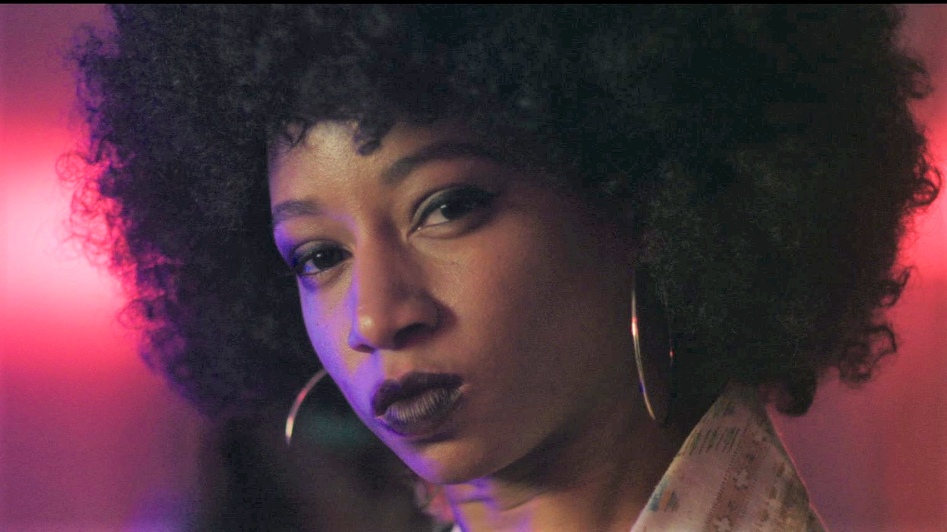
While the humor is mostly verbal and pretty consistent, it is worth paying attention because there are a lot of throw-away lines that are easy to miss, and are too good to ignore (even the groaners). Part of the fun is the many other film references, from the verbal mentioning of a few films from The Godfather (1972) to Blazing Saddles (1974), to the more subtle ones like two hit men (Joseph D. Reitman and another voice actor, Gary Anthony Williams) who seem to be right out of Pulp Fiction (1994), down to the suits, the ponytail, the silencers, and especially the nonsensical conversation. Then there’s Rose (Monique Coleman, from 2006’s High School Musical), presenting a fine Pam Grier/Coffy-like (1973) pose, right down to the shotgun, huge afro, hoop earrings, and cleavage; her meta-commentary on blacks in genre films is a hoot. It’s almost like you can make a drinking game out of “Name That Reference.” It is all part of the fun.

Monique Coleman

The first two acts, which are totally worth watching, is mostly comedy, but then the bloodbath starts in earnest in the third act. There is a huge body count, and copious amounts of blood, guns, gore, and guts. The gunshot blood spray looks to be pretty obvious CGI, though most of it is practical SFX, and looks spectacular.

Usually in a film like this, the tendency is to play the characters broadly – usually too much so – but director Palmer manages to squeeze out some really nice performances, even though a bit over the top in stereotypes. This is a good thing. It is not surprising to me, though, because the cast is well-seasons with large amounts of credits on IMDB. Coming out best are the leads, Melean and Belushi, with DonVito close behind. The whole cast is great, but these three stand out.

There is one rather large hole in the story, though: if the plan was to meld the two families with this arranged marriage, why couldn’t Patricia just marry Dom? It would certainly solve the problem. Oh, yeah, that would ruin the tension between the two opposing groups. That being said, this is one of the better zombie films I have seen in a while, especially in the comic vein (pun not intended).

Be sure to watch the end because there are a couple of epilogues and a question I had answered, which I will not give away. Heck, some of the credits are fun as well, especially toward the end. Chomp at the bit, and view away.


Saturday, March 20, 2021

Review: Dark Whispers: Vol 1

Text © Richard Gary / Indie Horror Films, 2021
Images from the Internet

Dark Whispers: Vol 1
Directed by Angie Black; Jub Clerc; Lucy Gouldthorne; Katrina Irawati Graham; Janine Hewitt; Briony Kidd; Isabel Peppard; Marion Pilowski; Madeleine Purdy; Megan Riakos; Kaitlin Tinker
Deadhouse Films; Hemlock and Cedar Films; Gold Hawk; Stranger With My Face
100 minutes, 2021
https://www.darkwhispersanthology.com/
https://www.facebook.com/darkwhispersanthology/

Nice. This release not only comprises short films made by women, but also exclusively from Australia. Perhaps they should narrow it down further to Wednesday afternoon between 3 and 4 PM? I kid because I am impressed. There are 10 stories here, so let’s break ‘em down and see whuts whut.

The wraparound story, “The Book of Dark Whispers,” is directed by Megan Riakos, who curated the anthology. In it, a woman, Clara (Andrea Demetriades) finds her grandmothers book with the title of this piece that has been passed down to her mum, and now that mummy is no more, she is the owner. She then proceeds to read it, giving us an opening and framework for the stories we will be seeing. These tales have been gathered together for this anthology.

First up is Angie Black’s “Birthday Girl” (2008). In this short tale, a sad woman (Sarah Bollenberg) takes an elevator in a hospital, and is visited by a spirit. This story is not scary, but rather is sad as you can feel for her. It’s beautifully shot, with lots of close-ups of her face. It was very touching and beautiful.

Next up is “The Man who Caught a Mermaid” (2014) by Kaitlin Tinker. What happens when a delusional older man (Roy Barker) who collects classical LPs and is obsessed with fishing – specifically to catch a mermaid – actually nabs one? Why, he chains her (Bilby Conway) up in the garden shed, of course. She is both scary and, in a way, beautiful (thanks to Sharp FX), and our anti-hero is fixated on her, in a male gaze kind of way. Is he any better than someone who kidnaps women and puts then in a secure place, even if she is half fish? And what happens when his lonely wife (Verity Higgins) finds her? These are the questions answered in this fish tail – I mean tale. The make-up is stupendous, and the filmmaking is spot on. This one, with a really nice twist or two, kept me on the edge of my gills.

For a step in a different direction, Isabel Peppard gives us “Gloomy Valentine” (2006) a stop-motion animation tale. Without dialogue, we meet the sole character, a humanoid-like doll with a porcelain face and a rag, sewn body. It is after a hard break-up with another human-like character. Slowly, her pain starts to manifest around her, threatening to swallow her up. The artwork is beautiful, and the action is smooth, rather than jumpy, as can be with this kind of animation. The backgrounds are worth paying attention to, as well, as the detail is nicely handled and interesting to look at. I watched it twice, once for the character, and then again for the “sets.”

Similarly, in the wraparound, between each short piece, we see the stories slowly and increasingly start to influence Clara’s world in small and then more tangible ways. Like Talking Tina, this is a book that will not go away.

Briony Kidd’s “Watch Me” (2016) deals with ego. An aging actress (Astrid Wells Cooper) likes attention. Craves it. She says, “When people stop looking at me, I fail.” But failing seems to be the least of her problems. It seems she needs to have somebody looking at her at all times, such as her failing relationship with her boyfriend (Tosh Greenslade) or a compromised assistant (Jazz Yap). What happens when there are no eyes to admire her, to acknowledge her existence. That is the premise of this story. It’s short and works well. Cooper does a good job at both loving the limelight and fearing the alone.

From the Aboriginal side, there is Jub Clerc’s tale of “Storytime” (2005). A tween girl, Cecelia (Verna Lawson) is out hunting overnight with her grandparents, some other men, and a group of kids around her age. Over the campfire, they hear the tale of a local creature, the Gooynbooyn, who kidnaps kids. Being that this is a campfire tale within a film about stories is an interesting idea in itself. When Celia and a “dare you” boy named Jhi (Jhi Clarke) set out to find the creature, that’s when the terror level rises a few notches. Beautifully shot among the gnarly mangrove trees helps to put the viewer in a state of unease. Cryptid stories tend to be fun, as is this one.

The big guns come out for “The Ride” (2011), directed by Marion Pilowsky. Filmed in England, it co-stars the well-known Aussie screen actor, Anthony LaPaglia, known for the many American shows he’s been in, such as “Without a Trace” and “Murder One.” He plays a Brit driver who picks up a university student (Ed Speelers; no small pataters either, having been a regular on “Downton Abbey”) at a deserted crossroad in the middle of farm country. The driver quickly proves himself to be a right wing, sports crazy racist who asks uncomfortable questions, such as whether the student has slept with “black girls.” Total Trumpite type. The action really begins when he hits an Asian man walking on the side of the road. Report it to the police? While the student freaks out, the driver calmly explains that it’s easier just to bury the dude. Kind of a reverse The Hitcher (1986). After, when he hooks up with his girlfriend (Emer Kenny, known to me as Bunty from the “Father Brown” series) back in the city, is where the knot is tied in the story. You’ll probably see it coming about 30 seconds before, but still worth the wait.

Another story in a story is Katrina Irawati Graham’s “White Song” (2006), dealing with Indonesian infamous ghost, Kuntil Anak. In Indonesian with noticeably clear subtitles, this time it is the spirit that is telling the tale, of a young woman, Raesita. She is a painter who is distraught at the death of her husband. She wishes her misery to end and that is where the Kuntil Anak comes in, telling Raesita’s story as well as her own terrible life in a patriarchal violent past. She is the only voice heard as she narrates in poetic fashion, while the dreamy images float by the screen in lovely sequences that seem lighter than air, despite the heavy topic. The whole story is elegiac and trance-like.

Told in black and white is Lucy Gouldthorpe’s “Grillz” (2015). Short and sweet, this is the story of Milla (Melanie Irons), who I must say, I almost wish actually existed. She scours the Internet dating scene and picks the scuzziest of men. And then, well, you’ll have to see. When she chooses a dentist (Tosh Greenslade, once again), it is for other reasons. What is a girl to do when she doesn’t like a mess? This is a black comedic tale with a nod to the side of the nose as it explores not only the Internet dating world and its precariousness – for both sexes – it also shines a light on the kind of toxic masculinity that would have no problem emailing dick pics. Very effective and fun to watch.

I was going to call this a black comedy, but perhaps a better description of Madeleine Purdy’s “Little Share House of Horrors” (2016) might be a “green comedy.” A young woman, Maeve (Georgia Wilde) gets ahold of a plant from a dicey shop owner (Colan Leach) and brings it home to the house she shares with three others, two of whom are hopeless potheads (Travis Jeffrey and Thuso Lekwape). She believes in all things natural as far as food goes, as they are into the natural stuff you smoke. The two doods mock her and suffer the unintended consequences that’s a toss between what the story is named for, and, say, Trolls 2 (1990), but with more credibility and less camp. Original part of the “Girt By Fear” Web series, it’s a fun tale of eco-power. And you can’t get cancer from this like windmills (snicker).

The final story is by Janine Hewitt, titled “The Intruder” (2005), which is a fun ghost story, in the classic gothic style, though taking place in the late 1960s or early 1970s (clothing and a rotary dial are the indicators). Zoe (Asher Kendie) is in fear of a stalker in her home, when she is visited by her friend, Angela (Bree Desborough). With the electricity out and lightening flashing as the sole light, it is a spooky situation that is also from the heart, as Angela asks Zoe for forgiveness. The story is well told, shot, and acted, and the ending has a curious back story. I actually wished this one was longer.

A lot of these stories are centered around loss: of a child, a parent, of a loved one, and especially of oneself, in various forms. Usually in a multi-storied anthology, there are a couple of clinkers, but not here. Each one is both individualized (even with the recurring theme I mentioned), in tone and style, and covers a wide gambit of emotions. A really fine collection, and I can honestly say I am excitedly hoping for a Volume 2.

Monday, March 15, 2021

Three Reviews: Ghost in the Shell

Text © Richard Gary / Indie Horror Films, 2021
Images from the Internet

The first two Ghost in the Shell films were anime, and the third a mixture of real actors, including Scarlett Johansson, and major CGI. I will take a look at these in order of their release. Note that I will not be including the revamped Ghost in the Shell 2.0 (2008), which is a retooling of the first film, the “Ghost in the Shell: SAC_2045” (2020) animated series, and other sequels. The films reviewed below can be found on TubiTV, Netflix, or YouTube, which is where I viewed them. The trailers will be at the bottom.

Ghost in the Shell (aka KƓkaku KidƓtai)
Directed by Mamoru Oshii
Kodansha; Bandai Visual Company; Manga Entertainment; Production 1.G.
83 minutes, 1995

This film is a classic piece of anime, based on the manga by Shirow Masamune. In the simplest description I can express, the “ghost” is the original memories of an individual – the core person (one may say the “soul”) – and the “shell” is the body, be it human or cyborg. In this world of the distant future, 2029, technology has advanced enough that most people are more a collection of a human body and implanted electronic circuits. This is sort of a present-day anti-vaxxer conspiracists nightmare. As some people today are part cyborg (pacemakers, artificial limbs attached to the brain that can “read” thoughts to move, etc.), the advent of this being an actuality is not all that far fetched.

In rare cases in this film, the entire body is, for lack of a better term, a replicant, with human memories, such as in Blade Runner (1992), RoboCop (1987), and Total Recall (1990). The key character here, Major Motoko Kusanagi is just such a cyborg, working in a special ops division called Section 9, dealing with counter terrorism and cyber crime.

She and her team are on the hunt for a cyber hacker named the Puppet Master (no Blade, Leech Girl or Driller in sight), who hacks into people’s brains and gives them false memories to bid his doing, which is to commit crimes for him.

The Major is partnered with Băto, a big lunk of a guy who is part human and part cyborg (she asked him how much). They make a good team, as they use their strengths to get the job done. For example, she can throw herself off a building Underworld (2003) style and make herself invisible in a Predator (1987) mode.

What makes this such a strong contender is its philosophical edge, discussing what makes a person themselves, what is considered living in general (i.e., is a cyborg a life?), and then there is also some global neo-capitalist politics involved. While there is no sex (do they even have sex organs?), but there is some nudity (The Major’s and another female cyborg, not Băto) and quite a bit of shoot-‘em-up violence and chases.

The animation is stunning, giving the impression of a cross between classic anime and Ralph Bakshi’s photo-automation (e.g., 1983’s Fire and Ice). One of my favorite things about the particular animation in this film is the backgrounds of the city, which are stunningly detailed and beautiful, in their compact and crowded visuals full of signs (mostly in Japanese), buildings, trash, puddles and pedestrians.

While this is definitely a sci-fi laden action flick with remarkable illustrations, it also goes pretty deep into philosophy, which actually improves the story rather than getting in its way. This is the second time I have seen this film, and I get more impressed with it each time.


Ghost in the Shell 2: Innocence (aka Inosensu: Innocence)
Directed by Mamoru Oshii
Kodansha; Bandai Visual Company; Manga Entertainment; Production 1.G.
100 minutes, 2004

This animated sequel, released nine years after the first, picks up three years later than the previous, in 2032 (still practically around the corner from now). Rather than the Major being the main characgter, this one focuses on Batou (yes, the spelling of the name has changed slightly), and his partner, Toguse, who also appeared in the first film as a Section 9 agent.

The animation here is different. As in the first film, the backgrounds are gorgeous and sumptuous, but many of the characters have a grayish look, and are flatter. Perhaps the budget was higher in this release, but the imagery of most of the characters is less engaging. The main improvement, however, is that motion is much more fluid, which is a boon. What is also interesting to me is that the computer readouts on the first film looked almost 8-bit, but here, they are much more sophisticated and imaginative.

There are a lot of POV (point of view) shots through the eye of a cyborg, mostly Batou, with the technical information, much like the title character in The Terminator (1984). Luckily, for some reason, I am happy to report that the language of this is in English.

This sequel focuses on “gynoids,” sex-robot geishas who are reprogrammed to kill – shades of Westworld (1973) – and then self-destruct. It is up to our intrepid Section 9 agents, Batou and Toguse, to figure out why, and to stop further slaughter…of the humans.

There is still a high level of philosophy. As one chain smoking scientist, “Miss Harawai” (not Dr.) ponders, “I wonder why humans are so obsessed with designing robots that resemble them.” I believe the answer to that is easy: because we are ingrained with Genesis 1:27: “God created man in His own image.” Batou brings up Descartes when discussing the different between animate and inanimate/surrogate humans (dolls). There is a lot of discussions about what is life, between humans, cyborgs, and “dolls” (robots). Included are mentions of the Bible, Milton, and Confucius, among others. I’m not sure how it translates from the original Japanese, but the dialogue is sometimes philosophically cryptic, and doesn’t talk down to the audience.

Sometimes, the story seems secondary to the mental musings between the characters. There is definitely more violent (mostly shootings) action than in the first film, but there are certainly extended dialogues about the meanings of lives.

Most people we meet have electronically enhanced noggins (referred to as e-brains). While this gives the advantage of high thought processes and a way to connecting to each other in a kind of Vulcan mind meld fashion, it also makes it where a person can be hacked with false memories, or sort of a virtual reality causing them to unknowingly harm themselves. The question it raises that I really liked is not as much what is human, but the degrees of how much. Marshall McLuhan (d. 1980) would probably be fascinated by this stuff.

Batou and Toguse set off to the far north to a lawless area of corporations and information hackers in search of the people involved with the robot gynoid geisha genocide. The artwork is especially spectacular there. Of course, there is the expected cameo which I won’t divulge, but it will probably not come as any surprise, nor will it be ruined either by knowing or not.

There is definitely some of The Matrix (1999) thought in here, in reality vs. technology, especially towards the end. While this film is “denser” than the first when it comes to deep thought, the action holds up and it is worth the view. Most people know the first film, but this sequel is a bit rarer.


Ghost in the Shell
Directed by Rupert Sanders
Paramount Pictures; Dreamworks Pictures; Reliance Entertainment; Shanghai Film Group; Huahua Media; Down By the Sea; Amblin
107 minutes, 2017

For the purposes of the mostly live action (with tons of CGI) version, the definition of “Ghost” is a bit different in that literally “a human brain is transplanted into a fully synthetic body,” rather than its “essence” or “soul,” as the beginning scroll explains. We see that in the Major’s creation in the opening sequence (as it was in the anime). Rather than looking like a normal human, as the cartoon showed, the synthetic body in the film looks smoother without nipples, like a Barbie doll. This keeps the actors from having to do nudity. That being said, there is an added interesting layer to The Major’s sexuality here, absent from the first two animes.

Speaking of which, the 800 lb. gorilla in the room is that the Asian main character of the Major is being played by a nice Jewish meydl from Manhattan, Scarlett Johansson. This has raised a ruckus and cries of appropriation. I understand that, but the original director, Mamoru Oshii, was okay with it, so I’ll just keep on going, especially since she is a new, created being, not her original Japanese self. A noteworthy point is that thanks to her work as the Black Widow in another cartoon world, the Marvel Universe, Johansson is used to both acting in from of a green screen, and is trained to do physical stunts.

The character’s name of Motoko Kusanagi has also been changed to US audience-friendly Mira Killian (though Motoko comes up in an interesting way). For this film, she is the initial full human brain/synthetic body “miracle,” so called by her creator, Dr. Ouelet (Juliette Binoche). Batou (same name) is now played by hulking Danish actor Pilou AsbƦk. Johansson is quite short, which makes AsbƦk look that much bigger. At least Togusa, who is barely in the film, is still Asian (Chin Han, from Singapore, Malaysia, who CNNGO – a division of CNN – named as one of Asia’s 25 greatest actors of all time).

It is kind of fun to notice both the similarities and the differences from the anime. This one sort of combines the first two films, with killer geishas (called geishabots, which is better than gynoids) with exploding faces as in the second film. There is also a mimicking of Mira’s creation in her body rising in liquid to its on reflection on the surface (looked so cool in the first film and is done quite decently here). They also revive the original’s Underworld-ish jump off the building and shooting into the window, and some The Matrix-style running along the walls during gunplay. By this time, Mira is also known as The Major and working for secretive Section 9. There is also a shadow of the Borg, as people on “the grid” can hear what others are saying when they are plugged into the outlets on the backs of their necks (like the dead Bishop on the landing).

While the anime duo are steeped deep in philosophy, there is less of it here, which is more about memories making us who we are rather than personhood per se. All seems as illusionary as the giant advertisement holograms present throughout the city streets, something that I can see becoming a reality. There is also some interesting symbolism, such as life coming out of liquid, and death going into water, bookending the film.

The enemy for this film is also a hacker, but rather than Puppet Master, it is Kuze (Michael Pitt). He is the one trying to destroy the company that built The Major, Hanka Robotics. I am about a third of the way in, and I can see the possibly motivation for it and the following common trope twist ending (which, of course, I will not reveal).

One of the cool aspects of the film is that one character, Mr. Aramaki (Takeshi “Beat” Kitano) speaks Japanese (with English captions) to everyone around him, who is speaking English, and is clearly understood by all. This is a nice nod to the original story. Speaking of which…

Binge watching all three films is interesting because the first two releases are still in my short-term memory, so I notice the differences and the similarities a bit easier. For instance, if it had been a while, I may not have noticed their using the garbage truck drivers – albeit for a different purpose – and the interrogation of one of them having false memories. And there is the spider tank, whose origin is different but is essentially the same.

At the halfway point especially, the film takes a totally different direction than the anime story, even while keeping it within the framework, which is an interesting choice, even though it borrows the zeitgeist of RoboCop, which influences the second half a lot, with Hanka Exec Cutter (Peter Ferdinando) filling in the Jones (Ronny Cox) role. Speaking of inspirations, many of the fight scenes, especially in corridors, is reminiscent of Johansson’s earlier film, Lucy (2014).

While they only kept partially faithful to the story, the character of Mira/The Major is mostly true to the original, but she is way more emotional here than in the anime, which is kind of manipulative on the audience. Having her more stoic in the anime with some sad wondering is expressed with her diving and the conversation with Batou on the boat in the harbor, shown in both the original and this one, but the emotion is definitely ramped up here as she tries to search for her original ghost/memories.

The film received some slack, especially from fans of the manga and anime version, but it is good action fun, though I miss the heady philosophy.