Showing posts with label Scorpio Films Releasing. Show all posts

Monday, May 15, 2017

Review: Long Night in a Dead City

Text © Richard Gary / Indie Horror Films, 2017
Images from the Internet

Long Night in a Dead City
Directed and edited by Richard Griffin
Scorpio Films Releasing
75 minutes / 2017

When I got my hot little hands on this film, written by Lenny Schwartz from a story by its director, Richard Griffin, I imagined myself in a smoking jacket in a comfy chair, with a cigar in one hand and a glass of sherry in the other, to celebrate what I am looking forward to being an enjoyable experience. The reality is me sitting in front of the computer which is firmly on my lap, with my cats occasionally walking across my belly. As I don’t drink or smoke, I have a cup of Bengal Spice tea by my side as I sit on a couch. Y’know what, doesn’t matter, the point is I’m thrilled. Yeah, there’s no bias here.

Thing is, this is not my first time to the Richard Griffin rodeo; that is, to watch one of his multi-genre multitude of productions, and they have never disappointed. Not even come close. Other genre reviewers I’ve talked to also hold him in high regard, so for now at least, I’m gonna shut up, close the curtains, and put this puppy on play.

Aidan Laliberte
This is a strange, ethereal and episodic story of Daniel (Aidan Laliberte), who awakens in an alley on New Year’s Eve, beaten and bruised. He begins a quest to find his brother Charlie (Anthony Gaudette), which brings him into contact with various characters in an ugly side of a city full of back streets, litter, snow and steam. Each set piece is skewed in its own quirky way.

The shadow side of Voltaire’s Candide, Daniel wanders into others’ lives, and vice versa, with something quite off about all of it. Mannequins, a possible serial killer, and a sultry bartender (Anna Rizzo) who knows his name in a tavern where everyone is photo-still, is just the start of some of those who will make this dead city night interesting, albeit bizarre.

In some scenarios, Daniel is the protagonist, in others he is an observer, as sort of a solo Greek Chorus in a modern day tragedy. In all, though, there is an either explicit or implicit invitation, spoken or not, for him to join, and to stay in that moment, in that place. A mysterious woman, Holly (fetching Griffin newcomer Sarah Reed), takes the place of both companion and Dante-esque guide.

So, essentially, this is a two-person story, with one recurring brother character. Many who appear in cameo in the set pieces are Griffin regulars, like Johnny Sederquist, Laura Pepper, and Casey Wright, who show up in brief moments, with others such Aaron Andrade and Bruce Church in more pivotal, yet short bursts. Laliberte and Reed make wonderful additions to the Griffin pantheon of his recurring troupe.

 It doesn’t feel like I am giving much away by saying there are other films with similar concepts, such as Jacob’s Ladder (1990) or the granddaddy of this sub-genre, Carnival of Souls (1962), but this takes a different path that’s worth the walk. The fact that Daniel repeatedly passes a Dead End street sign is no coincidence, and of course there is the title of the film.

A non-human character is the twangy guitar of Mark Cutler, whose score underlines the drama throughout most of the film. Its almost Western motif adds to the mood as the camera moves at a slow, languid and deliberate pace that matches the mood of the moment, and Daniel’s motions, like a walking sleep. There is an occasional use of either a selfie stick or a camera on Daniel’s belt that effectively gives it a personal feel, though I hope it’s not something that will crop up too much more in future films.

As with many Griffin releases, there is a heavy reliance on a primary color lighting scheme that further demarks emotions or state of being of the characters. Another aspect to the theme of the story is the editing, handled by Griffin. Despite the long and loving shots, there are also some parts of quick editing, and one truly enjoyable one of Daniel and Andrade’s car. Honestly, it does not seem like it was an easy film to piece together, but it looks great.

Sarah Reed
Many of Griffin’s films deal with heaven, hell, and other variations of what happens next, especially in the likes of Normal (2013), Accidental Incest (2014), The Sins of Dracula (2014) and Nun of That (2008). Griffin continues to take a different view of that aspect of life and death, which makes for a further interesting vision that one may not expect, keeping the viewer’s interest. Even if you have an idea of where the storyline is going, the ride there is still going to be from a perspective you probably would not have thought of, giving new blood to a not-so-new concept.

While a little less steeped in gender/body politic than usual for his later films, Griffin still manages to keep us guessing about direction of the story by giving some fresh ideas about choices of what is next for our protagonists. Part of the mystery is more of how and why they got to the moment they are in, and what becomes of them next.

There is definitely a feeling of surrealism, but not to the point where it’s so obliquely opaque in the events that it loses direction, even though it’s quite a bit over the map. It kind of makes sense that there is a scene where the characters take some acid, because this is a bit of a head trip anyway.

By the end, many explanations are divulged, and yet there is still room for interpretation. That is good filmmaking. Chalk yet another one on the plus side for Griffin. He shows he is far above average for low-budget filmmakers, making the most out of what he is given, and yet he continues to grow in scope. And, as always, I eagerly anticipate his next release.


Saturday, July 25, 2015

Review: Future Justice

Text © Richard Gary / Indie Horror Films, 2015
Images from the Internet

Future Justice
Directed and edited by Richard Griffin
Scorpio Films Releasing
83 minutes / 2014
www.facebook.com/futurejustice
www.mvdvisual.com
https://vimeo.com/ondemand/futurejusticemovie 

Before the new Disneyfied Star Wars comes our way, I’m glad that trans-genre maven Richard Griffin is getting a chance to stretch his sci-fi director’s legs. Now, I believe this is his first time with footprints in this space-time continuum, but hey, there’s a whole universe to expand into, right?

Nathaniel Sylva
This film was written by its lead actor, Nathaniel Sylva, who plays criminal Python Diamond (really?), a cross between Kurt Russell’s Snake Plisskin (Escape from New York, 1981) and Vin Diesel’s Richard Riddick (Pitch Black, 2000). He’s a dangerous insurgent responsible for killing swathes of people, who is being sent back to Earth for trial after 5 years of being cryogenically frozen in a prison near Saturn.  While Sylva doesn't have the over-the-top adrenaline machismo of Russell or Diesel, he does a more than capable job in the role, especially supported by this fine cast.

Considering what happened in those other bad-boy films, you know this isn’t going to end well for most of the soldiers in this transport crew, some of whom have a history with Python… Okay, I need to call him Diamond; Python sounds too… you know. What I would like to know is why they would unfreeze him before the four month trip back to Earth, rather than when they actually got there, if he’s so dangerous (not to mention the taxing of food supplies, waste, air, etc.). Anyhoo…

Steven O'Broin
When they get to Earth, it seems World War III (or something similar) has happened, and the East Coast of the U.S. is toast. On the West, it’s more militia law (though they refer to themselves as “pirates”). The malevolent and sadistic (of course) guy is charge is the strong-jawed Gazeebo (Steven O’Broin playing evil well). It’s important to realize that some in this gang have strange, post-Apocalypse names, such as Gazeebo’s right (and left?) hands, Rag and Tag. See, even after all the carnage, people still have a sense of humor.

Our valiant crew manages to hit upon a group of less than a dozen scientists who are living in the basement of a business complex, to see what they can do about the entire world being literally infertile, thanks to the radiation. Also among the group in nearly an extended cameo is Michael Thurber, hysterically (both literally and figuratively) playing a Norma Desmond version of himself, much as Bill Murray did in Zombieland (2009), or James Van Der Beek in Don’t Trust the B- in Apartment 23 (2012-2013).

Set desgin
Army and scientists vs. the militia and rag tag gang. Okay, that’s not giving away too much, is it? Now, let’s get down to some nitty gritty:

The in-space sets look pretty exceptional for the budget most of the time, and the CGI is applause worthy, again, for what it is. The computer screens and images, especially, are impressive. Back on earth, well, it’s more meat and potatoes, as a deserted brick building (filmed in Pawtucket, RI) and debris filled yard works perfectly for the story, with no extra computer graphic mumbo-jumbo exteriors needed. The military’s guns look present day, so does that mean they’re antiques here? I mean, during the real life U.S. Gulf Wars, soldiers were complaining about how their equipment was decades old. There are also some guns that shoot lasers, but unless I’m mistaken, they are held by the bad guys. Speaking of which, despite the relatively modern technology, the most accurate weapon used seems to be Gazeebo’s dart gun with exploding arrows.


Elyssa Baldassarri and Aaron Andrade
Like the mainstream films, apparently everyone is a bad aim, even in the future. I mean, think of Arnie or Sly standing in the middle of a field shooting at the multitude of bad guys with them shooting back, and hardly anyone gets shot. Yeah, some die, but most shots seem to just… miss. Not being critical, just observant, because you don’t wanna kill off everyone too fast or yaz don’t have a film, am I right? But don’t think that all the battles are waffles; there are some really well played-out fire fights, especially as time goes on, and a body count is itching to get started.

Despite all the hoopla and anger spewed, there is also a very sharp sense of humor that underflows, if you know how to look for it. For example, Diamond’s bulletproof vest has, written on the back in marker, “Careful, contents under pressure.” Another great line is said by Gazeebo (who definitely has some of the best dialog): “Yeah, right. Pull the other one, it plays Chopin.”

Anna Rizzo
While I would have liked a bit more background to some of the characters, like why Gazeebo wears a Civil War Union hat – made even more bizarre that he has a somewhat Southern accent – there is some indications of motive, such as why the head soldier, Uxbridge (appropriately hot-headedly played by Aaron Andrade to the point of being a controlling asshole who can’t see past his own status) hates Diamond so much. However, I would like to know why other characters, such as one of the survivors, Wren (Rich Tretheway, who puts in one of the best and most subtle performances in the film) sees Diamond as “a rock star,” as questioned by one of the soldiers/medic, Glass (the always welcome and expressive Elyssa Baldassarri, who has one of the best moments towards the end).  It is understandable that in any film with as many roles as this one, a writer and/or director must focus on some key people or the story gets swamped. Perhaps I’ve read too much Leon Uris in my life; but I digress…

Rich Tretheway
True, there are some well-worn themes here, there are also moments of emotion brought to the front by the action, which I place firmly in the workings of the director, Griffin, who has not let me down yet.  For example, when a particular character is killed off, I felt an “aww!” twinge. That’s good directing.

Then when you add in the unexpected Toxic Avenger component, well, things just go from the pot to the fire, and I was smiiiiiiiiling.

The extras include the trailer, a 2010 short created for a contest titled "Mutants of the Apocalypse" that is a bunch of goofy fun (including a device that would be used more fully fleshed out - pun intended - and just as effectively in Griffin's 2014 Frankenstein's [Wax Museum of the] Hungry Dead), and a commentary with the director, cinematographer, and most of the cast. While it's a large group, mostly those who talk do so when their scene is up. Lots of good stories and "making of" information, and thankfully it's well controlled rather than a mass mess. Sometimes it's hard to tell who is saying what, but mostly it's pretty clear and worth a listen. My only gripe is that it seems like there is only one mic, so some are easier to hear than others.

Overall the film has more of an indie/low-budget Battle Beyond the Stars (1981) meets Creepozoids (1986) feel to it than, say, Star Wars (1977) meets *batteries not included (1987), it’s arguably the better for it. 
 

Tuesday, May 26, 2015

Review: Nun of That

Text © Richard Gary / Indie Horror Films, 2015
Images from the Internet
 

Nun of That
Directed and edited by Richard Griffin
Scorpio Films Releasing
91 minutes / 2009
The film can be seen HERE.

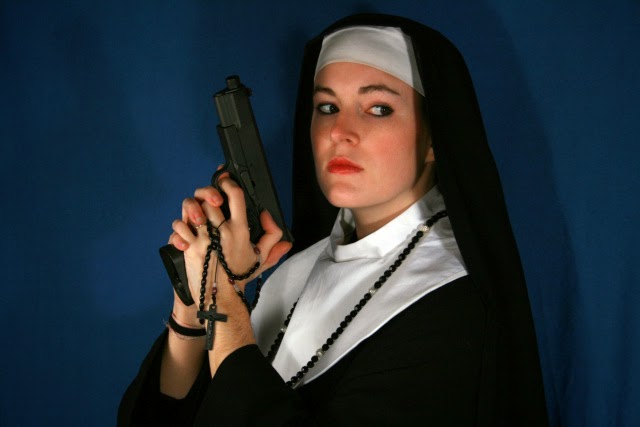
Religious comedies take a fine hand to craft, to be funny and irreverent with a feel and knowledge for the reverent. I’m not sure if I’m making sense, but it sure describes this film pretty well.

Based on the Strong Women and Blaxploitation genres (think Coffy [1973], Ms. 45 [1981] and Savage Sisters [1974; aka Ebony, Ivory & Jade], a group of super-Nuns – you heard me – take on the mob (of course, it’s the cartoonish versions of Italianos that would have made Joe Gallo crazy). And I’m sure that somewhere, some Mameluke is saying this is part of the “War on Christians.”


Sarah Nicklin as Sister Wrath
After a wonderful prologue where a nun on a stripper pole (no nun nudity here) guns down a bunch of mobsters, we get to meet the heroine of the piece, Sister Kelley (the amazing Sarah Nicklin), definitely a nun with an attitude problem that a few years of anger management may not have the power to cure. After beating up a pedophilic priest, she’s sent away to the bad nun parish in a poverty-stricken neighborhood. On the verge of being raped by a pimp in full Superfly regalia and his two goons, she does away with them with a can of whoop-ass, only to be shot by – yep – more nuns.

In heaven, she argues with her guardian angel asking where he was when she was shot; he defensively answers, “Getting smokes, Bitch! Do you know how hard it is to get menthol here?!” That line had me laughing hard enough to stop the film to gather myself. It’s a wild ride, indeed. And the film’s only just starting.

After meeting the J-Man (Michael Reed, and in a very cool idea, he also plays the Devil later in the film) and some training by the hosts of heaven (e.g., martial arts from Ghandi!), she comes back as a holy crusader known as Sister Wrath, as a member of the Order of the Black Habit, which is sort of like the nun version of the Black Ops. Don’t worry, I won’t be giving away too much more of the story, it’s just too delish. But I will be discussing observations of moments of course, as that’s mah thang.

Some of the humor is very subtle. For example, during a nun slumber party with a bottle of champagne to celebrate a victory, one of the priests named Father Thomas is looking through a crack in the door and enjoying the activity. One might think Doubting Thomas, but it’s more likely Peeping Tom is the reference. Less subtle joke that had me laughing refers to being so unlucky that someone could “fall into a vat of tits and come out sucking your thumb.” Such language from a woman of the cloth!

All the nuns in the order are named for the Seven Deadly Sins, including Sister Lust (attractive Shanatee Wilson, who easily is a take-off of Pam Grier sans the amount of curves) and Sister Gluttony (Ruth Sullivan, who was so memorable in The Disco Exorcist); a funny bit is that while all the sisters have a special cross around their neck, Sister Gluttony has three. Brilliant.

Not only is there a lot of incredibly funny material, but it is actually quite smart. The name of a tough-as-a-biker-bar hangout for nuns (most played by men)? Why Bar Nun, of course. And Italians/Catholics aren’t the only ones who get the treatment, there’s a mercenary killer named Viper Goldstein (David Lavallee, Jr.) so some Jewish jokes can also be made (more than one had me howling, such as “We invented ‘Old School’” and “Jew-Jitsu”); even Mohammed is taken down a notch, but don’t tell you-know-who.

I just have one question, and this may sound like a snipe but I say it in total respect: could you find faker looking moustaches and wigs? Wow! I take it as part of the humor, rather than a lack of trying.

The |Devil  (Michael Reed) and Mama Rizzo (Rich Tretheway)
And even with all the yucks, there is a gender politics and body politic that underscores the events. For example, a priest would rather side with mobsters because they’re men and are “supposed” to be in charge rather than with the nuns because they are women. Also there is much gender switching, with a man playing the woman who is running the mob (Rich Tretheway channeling Divine-meets-Little Orphan Annie), and as I said, many of the other nuns are definitely male.

There are two notable cameos. One is by the a bit unrecognizable Debbie Rochon thanks to a habit, who would be so powerful a few years later in Griffin’s Exhumed (2011), and the other a very hysterically funny Lloyd Kaufmann as the Toxic Av…I mean, the Pope, doing the worst Italian accent I have ever heard. You can just tell he ad-libbed his lines.

I mean, this is the kind of film I would imagine someone like Quentin Tarantino would twist his nut to have made, or at least watch.


Bonus video mock trailer (not from this film, but same characters)
Winner of the 2008 48-hour film award, where films are created in 2 days:


Friday, February 6, 2015

Review: The Sins of Dracula

Text © Richard Gary / Indie Horror Films, 2015
Images from the Internet


The Sins of Dracula
Directed and edited by Richard Griffin
Scorpio Films Releasing
80 minutes / 2014
The film can be obtained HERE.
www.mvdvisual.com

When I was an undergrad in Brooklyn, I was invited to a screening of a film on campus that was marketed to us as modelled on The Exorcist, and being the horror fan, I said sure. It ended up being sponsored by the Jews for Jesus and the Newman House Catholic Club organizations, with a mallet-heavy message of accept Jesus or burn! For the college newspaper, as its reviewer, I not only panned it, I ridiculed the message and had both those organizations try to kick me off campus. And this was a year before I started hanging out in CBGB’s.

There is a whole subgenre of accept Jesus or burn!!! films out there, this seems to play mostly on campuses and Southern high schools, or to teenage church groups. While it’s becoming more popular in the mainstream, with the Kirk Cameron Left Behind series at the forefront, it is still worthy of ridicule It’s about time someone did a spoof of it. Sure, Saved! (2004) did a nice job on the mentality behind these beliefs, this is the first I know to actually be modelled on the genre, and apparently Richard Griffin is just the guy to do that. The Sins of Dracula takes this sub-standard subgenre and methodically breaks it down, wisely taking the less-than-subtle message and making it a less-than-subtle comedy, using the same tropes to say the opposite.

Sarah Nicklin
If you haven’t been following Griffin’s career, this New England filmmaker has made some of my favorite films over the past few years, such as Exhumed (2011), The Disco Exorcist (2011), and Murder University (2012), all of which you can find my reviews elsewhere on this blog site. Also wisely, he has chosen a talented cast he is mostly familiar with from these other releases (I will use the initials of the films in which they appear from this list after their names).

Seemingly taking place in the late 1980s, if I’m judging the photos on the walls correctly, Billy (Jamie Dufault; MU) is a “pure” and innocent lad who sings in his church choir, but is itching for more. His girlfriend, Shannon (the ever exquisite Sarah Nicklin; E, DE) is a bit more… in the real world, i.e., her tempter Eve to his innocent Adam, and convinces him to join her theatre troupe (aka the body count). The company is full of out there characters, including the New Wave guy (who is more pre-Goth than New Wave, in my opinion), the shy gay guy, the hallucinating druggie guy, the nerd gamer girl Traci (the also exquisite Samantha Acampora; MU)… well, you get the drift.

Jamie Dufault
As preachy as this subgenre tends to be, this film, written by Michael Varrati, uses the form to be mockingly sermonizing in another direction, with such great lines as, “Your whole world is based around a man getting nailed to wood, and Lance’s whole world is based around getting nailed by a man’s wood,” or “I promise you, you won’t live to regret it!” There’s also a part where the main character is praying and he says, “Dear, Lord, it’s me, Billy. No, the other one? From choir? I know it’s been about a half hour since we last talked…” So many others, but I don’t want to show too much of the hand before you see it.

The over-the-top-ego and dressed all in red director of this theater production is, of course, named Lou Perdition (Steven O’Broin).  If you don’t know, Perdition is your time in hell after you die, if you follow Christian dogma. His assistant, the sarcasm-dripping Kimberly (the also exquisite Elyssa Baldassarri; MU), is equally smug with obviously a secret to hide (that I will not give away).

Samantha Acampora
It makes sense that the framework for the film revolves around an indie theater group, since so much of the cast has its history in local theater, especially Michael Thurber (E, DE, MU), who plays the titular character of Dracula with finesse and grace (of course), who also the founder and artistic director of the Theater Company of Rhode Island. What makes it even more charming is that Thurber is a graduate of Oral Roberts University. He is, one may say, Griffin’s acting muse, and has appeared in nearly all of his films. Thurber has shown a level of elegance in Exhumed and in a campy way that is appropriate for this release, he continues on that role. I’m definitely a fan.

This is one damn enjoyable piece of work, but at exactly one hour in, it ramps up and it’s almost like the same film on adrenaline. The comedy is more pointed (it was already sharp, but it goes from ginsu to katana), the visuals are bloodier, and the comedic drama even more enthralling. Fuck, let’s just break it down and say it gets even more fun. The dialog between Billy and the Pastor (Carmine Capobianco who is often a regular in James Balsalmo’s films, e.g., I Spill Your Guts (2012) and Cool as Hell (2013), both also reviewed elsewhere in this blog) had me laughing so hard, I actually had to play it again to hear the parts I missed!

Michael Thurber
Billy and Pastor Johnson head off to bring down Dracula and his minions. They are joined by an exorcising (another well-played short set piece reminiscent of Richard Pryor’s Saturday Night Live spoof from 1975) Latino hardass soul brother Pastor Gibson (Jose Guns Alvez) that could have been a replacement for Shaft. This is where I am going to stop with any kind of story description, because you really need to see this.

Rigidly religious films are not the only model used here. There are a lot of Hammer Films influences, from Thurber’s take on Christopher Lee’s Dracula (who also did not talk much in the heady early Hammer days of the 1950s-‘60s) to the stark primary lighting of red and blue (and some green), which gives it an appropriate ‘80s feel, like something out of Creepshow (1982), or Dario Argento’s canon. Usually the sharper the color, the more intense the action, is how this works, y’see. If you didn’t know that, horror fans, y’need t’do some schoolin’.

Elyssa Baldassarri
On a sociological level, there are many aspects that one could note. For example, there is a lot of playing with sexuality (plenty of sensuality and sex acts here, but no nudity to note). In one instance, there is a mash-up of two separate couples, one straight and one gay, as if to say there is no difference. I like that one could interpret that as both are expressing love, or both are equally sinning (to paraphrase a bumpersticker I once saw, “Oh, Lord, protect me from your interpreters”). In another moment, someone comments on someone who is transgendered, though taking place in the ‘80s, so there is no “populous” word for it. That was a sly addition by Varrati that made my media theory mind perk up. There is actually a lot of justifying of actions through both positive and negative religious followings, which I believe is where this film’s tongue is firmly in cheek, as it were.

Thurber makes a strong-but-silent Dracula. He plays his character with his eyes and mouth a lot, as did Lee, and also subtly uses his hand movements to indicate menace, or acknowledgement (e.g., see the ring? Beeeeware!). One of the thoughts that went through my head is that the center of evil is actually the Theater’s artistic director, a role Thurber possesses in real life. I hope he got as much a kick out of that thought as did I.

There are three extras, all worthwhile. The first is a short, 10-minute fake trailer which is amazing called "They Stole the Pope's Blood" (pssst, you can find it on YouTube, but don't tell anyone). There are also two excellent commentary tracks, one with the director, Richard Griffin, and the writer, Lenny Schwartz, and the other with lead pair Sarah Nicklin and Jamie Dufault, and again, but not least, Griffin. It actually was worth sitting through the film two extra times to hear it, as it's full of interesting anecdotes rather than fluff. A great package altogether.