All genres of suspense, terror, and horror will be reviewed by Richard Gary. His address to send preview copies supplied upon request to rbf55@msn.com.
A nice thing
about animation is that you can do things that cannot be done on a small budget.
Created in the stiff but “humanesque” iClone software, the shorts are
entertaining to look at. While the movement is a bit boxy, the faces look sharp.
All these films were written (with one exception) and directed by Jason J.
Cross, and are available in links at the bottom of each review. They are
released by Four Sides Cross Productions. These are not in a ranked order, but rather how they were sent to me.
What is
consistent in at least three of these four releases is that the central character
is a strong woman. That makes me happy.
Got to Eat 6:41 minutes, 2020 There is a masked serial killer on the loose, and he has chosen his next
family. They are transient and a bit oddball, but can they handle this young murderer?
The results are quite humorous and bloody. Very simple and to the point, which
is nice. And what is with the very end? Is there going to be a sequel?; I ask
because many of Cross’ releases are serials. This is off to a great start. Full film HERE
To Do 3:11 minutes, 2023 A serial killer ponders over a bound and gagged woman. We hear his
internal monologue of what he plans to do, which the viewer gets to viscerally
see. His thoughts are a poem including such things as biting off her nose.
Creepy and gruesome. Nice. Full film HERE
A Mother’s
Love 13:15 minutes, 2021 A woman is on a first date at her home with a nice man, and they are
just starting to get to know each other, when her daughter gets into some physical
trouble. The crux of the story is how the mother takes care of business and how
far she will go to protect her daughter. It is certainly not what one might
expect. It was cool and she is hot. As with the first story above, there is a
nice self-referential to Four Sides Cross. Full film HERE
Wanted 2:44 minutes, 2021 This is the only story not written by Cross, but rather his 11-year-old “Daughter
(Victoria) and staring my other daughter (Samantha), my wife (Carla), and myself,”
the director explained. Short and simple, a mother and her two young twin daughters
are being questioned at a police station, where the coppers are looking for her
ex-. But there is more going on than that. This may have been written by a
child, but it has a nice twist element to it. Full film HERE
Although this film is
Japanese in origin and language (with subtitles), it may be inspired by the real
Hong Kong serial killer portrayed in Dr. Lamb. He was also a taxi driver serial killer.
The opening credits’ title
states this is a “Japanese Giallo.” Well, the opening sequence screams of it,
as a woman in a spandex bathing suit sensually strips in a shower, and is
murdered by the titular, Fujinaga (Tomoki Kimura). The color palate (by Shuji
Hamamoto and Mitsuo Kojima) is correct for a Giallo, with lots of primary colors,
a knife, and a helmeted killer. Actually, what the opening made me think of was
a cross between Italian Giallo and the ending credits of What’s Up Tiger Lily?
(1966).
Tomoki Kimura, Iori Kogawa
The tone of the over-thought
narration describing the city definitely smacks of Taxi Driver (1976). Kimura
even looks a bit like a younger DeNiro; heck, there is even a scene with him in
front of a mirror holding a weapon and giving the whole “You talking to me?”
speech. I have no doubt this was meant as an homage, rather than a rip-off.
While this definitely has
a retro-Giallo feel, there is a Japanese spin on it. For example, as a
businesswoman is being chased, she takes off her jacket so the film camera can
get her braless bouncing, there is a close-up slo-mo shot of her backside where
you can see her underwear beneath her overly short skirt, and, of course, by
the end of the scene, her top is exposed. To be fair, in the body of the film
(pun not intended), there is also male nudity.
The driver is depressed after
his wife was murdered and he was stabbed in a home invasion by someone with the
same helmet as him. This sours him on society, and both wants to die and to
kill. But, how much of his killing his customers is real and what is fantasy?
This is a territory touched on in American Psycho (2020).
The nudity and sex is
a-plenty here, so it is no surprising that many of the women/victims in this
film come from the world of adult cinema, such as Saryu Usui, Ayumi Kimito, and
Ai Sayama (as is stated on the back of the Blu-ray box. Through fantasy and
memory, this turns out to be quite a softcore flick. There is also extraordinarily
little actual dialogue, with most of the philosophizing happening in the driver’s
head. It ranges from injustices, to positive feminism, to despair.
Slowly, as his anger as desperation
grows, he starts looking for a victim to take out his perceived vengeance on society
and to end his own miserable life. Meanwhile, we see him taking customers in
his cab numerous times, through a cab-cam with somewhat blocked faces. Did you
know that DeNiro drove a cab in New York for two months to get a better idea of
what the character goes through?
There are a lot of shots
of Tokyo and the editing (John Migdal) and cinematography (Makoto Hayashi) is
noteworthy, such as the city reflected through the moving hood of the dark
taxi. Most of the shooting is normalized, but the fantasies are in high-art
Giallo colors and lighting techniques. The music during these sequences are
also interesting, in a distorted way.
Things pick up when he
meets his (adult) “Jody Foster” in the form of injured Mayumi (Iori Kogawa),
and he finally sets in motion to carry out his idea for a murder/suicide. Heck,
there is even a long-haired villain (Yoshiki Kondô) who is reminiscent of Harvey
Keitel.
When the reality is
revealed and the facts are finally shown, well, some of it took me by pleasant
surprise. The ending nicely sums it up, but I won’t tell…
The extras on this Blu-ray
are as follows: an Audio Commentary by the director, Kurando Mitsutake, who
fortunately is very fluent in English, so no subtitles needed (born in Toyko,
grew up in Fresno, CA). He skillfully goes back and forth between descriptions
of what is happening on the screen, and anecdotes about the whole process and
the cast/crew. Worth at least one listen. We also learn that the title is a
mash-up of insane serial killer flick Maniac(1981), and said Taxi Driver.
The “Maniac Driver:
Behind the Scenes”-featurette (30 min) is exactly that, mostly setting up shots
(and then we see what they filmed), and includes some brief interviews with the
main cast. It is very basic but kept my interest. Finally, there is a Trailer (in
English) and Slideshow, along with a nice 4-sided box insert cover with images
of the film’s original posters. There are also subtitles available in three
languages.
There is a prestigious
amount of nudity, sex, and violence, not to mention blood and some gore (SFX by
Yoshinari Dohi). The story is a bit weak and repetitive at times, and seems to
circle around the point, but by the third Act, it is quite a ride.
I do believe this is the
first time I am reviewing a film from the Balkans, and I am excited. It is in Albanian
and mostly Italian, with subtitles. Unlike some, I love subtitles; comes from
seeing to many live, loud bands in my youth.
Taking place in the
Albanian capitol of Tirana, the prologue is set in 1997, after the fall of
communism in the area, and the rise of the infamous and bloody civil war that
followed. In a supposedly abandoned bunker stumbled young Matia
(Matia Çobanaj) meets the Commander (Francesco Rossini), and especially the
Commander’s Wife (Manuela Arcuri), who are hiding out in the bunker, which sets
up the story to follow, and will intermix back and forth for a while with the
present.
Emir Jouka
Back in modern day, arriving
in Albania from the UK – but speaking Italian – is Adrian (Ermir Jonka), his
girlfriend Nua (Ilirda Benleri), and Giulia (Ingrid Monacelli) and her
boyfriend Davide (Endrit Ahmeta). Carrying their money in a leather bag (you
can see that this is not a good idea, of course), they plan to open a
restaurant in an abandoned bunker with the help of Adrian’s restauranteur cousin,
Ilir (Arnold Damazzeti), who is a bit of a sketchy character, into MMA-style kickboxing
(as a participant, not viewer).
Ilirda Benleri
Thanks to a betrayal by
one or two of the group, with Romanian mobsters and drug dealers and money
owed, their savings are gone, but some do not know it yet. This leads to them
meeting up with the now insane and murderous Matia as an adult (Lorenzo Lapori,
also a co-writer and fight coordinator), who had been sealed behind a wall.
Years of loneliness and a seemingly perpetual 8mm propaganda film (200-foot
reel, or 20 minutes) has made Matia – now known as Eagle Man in the credits – a
bit tetched in the haid. He does, however, have a couple of cool and rusty
knives and reminds me a bit of Kruger’s infamous claw (he even tends to run it
along a wall), except one big blade for each hand. And, as the film shows, he
is not afraid to use it on associates and indiscriminates alike. Yes, he is both
mad, and angry, having his childhood and life taken away from him for a cause
that never recovered (think of the roundly defeated Confederates or Nazis who
hoped their evil beliefs would rise again.
There is a bit of a crime
drama mixed in at some point, as the abandoned bunker where Eagle Man is
captive behind a wall, is being utilized by a gang of drug dealers – we see a mound
of bricks of white powder, perhaps representing the wall of evil that held
Eagle Man captive – and their molls, more commonly known as the body count when
Eagle Man flies to coop, blood and sorrow will follow.
Arnold Damazzeti
Into this scenario comes
our Italian crew from England, hoping to make a new restaurant by recycling and
transforming the very same bunker. As I have quoted before, Marshall McLuhan
famously said when an object becomes obsolete, it comes back as art. Or in this
case, a fancy eatery. While they may have served bird on the menu, they become
the prey of an Eagle.
Our two couples arrive at
the nest – I mean bunker – late at night, and that is where I end my descriptions,
and the battle for life and death (mostly the latter, of course, as this is a literal
slasher film). Somehow, in my head, I keep mishearing Creedence Clearwater Revival
singing, “Down in the Bunker / Killing in the streets / The Eagle Man’s
a-playin’ / Killin’ with knives so sweet.”
Lorenzo Lapori
Eagle Man is actually
quite an interesting character by himself. He is as physically filthy as the
Pig-Pen character from the Peanuts cartoons from literally years of not bathing,
he wears the long coat and boots of the defeated army, his hair is long (though
his beard not as much), and he is extremely scarred thanks to a meeting as a
youth with some barb wire. Like most genre serial killers, he does not speak
(though he does scream), probably from decades of loneliness. His anger comes
out in the brutality of his kills. Most modern slashers, the killers like Jason
and Michael are stoic, or punsters like Freddie, but this is pure rage. And
then there are the cool booby-traps.
A certain level of disbelief
is definitely needed around the Eagle Man, mostly pertaining to longevity. For
example, he runs the projector constantly, but the bulb has not burned out, he
eats food from cans, but how large a supply did they have in 1997 to the
present? How does he shave (most of) his beard? How many gas drums does he have
for the generator; perhaps he is Jewish, and this is a Hanukkah tale? I kid…
Manuela Arcuri
What I find interesting is
that as brutal as Eagle Man is, and he really is, he is also a sympathetic
character, rather than a one-dimensional killing machine. The murders are
brutal and look great, without being overly graphic (i.e., not body horror),
though there is a nice amount of blood to keep the customers satisfied. Hell,
they even find a way for (female) nudity and a gratuitous sex scene.
While the acting is top-notch,
it is the cinematography by the director that stands out for me, especially the
last shot. Despite most of the film being in an ill-lit bunker, it was all
clearly seen (thank you, blue filter). The bunker itself is both a maze and
claustrophobic at the same time. Well done.
In his ninth film (I
think I have reviewed all of them), Denver's auteur filmmaker / writer / absinthe
guzzler Dakota Ray happily strikes again with his newest opus. And, as always,
he and his instantly recognizably idiosyncratic, gravelly deep voice and a
monochrome filter (this time red) presents another tale of depravity.
As usual, Ray plays
the lead character, in this case Fabian, who is a serial killer, drug user, and
absinthe drinker (the film uses real absinthe, since Ray is a connoisseur of
the beverage). His world is full of death and delusion, of evil and
self-glorification.
As in Henry:
Portrait of a Serial Killer (1986), Fabian has a companion-and-competitor in
the form of Kimball (Darien Fawkes). But as in Henry, do not trust
a serial killer. In the opening narration monologue, Fabian states he plans to
kill Kimball (aka the Necro Wizard), who is as murderous as he, and absorb not
only Kimball’s soul but the souls of all his victims. So, this story is going
into the supernatural deeper than Ray’s previous films. In many of the earlier
ones, Satan has played a role in either influence or presence, but this delves
deeper into the metaphysics.
Dakota Ray
Fabian and Kimball are
the only two living humans in the film (though there are plenty of corpses in
various conditions), and nearly all their dialogue is done in the form of
narration. Written by Ray, these inner conversations run from the vile and expletive,
to the nearly philosophical…and expletive. There are, as is typical in Ray’s
releases, title cards scattered throughout to denote chapters of a sort, with
names like “Descending into the Blackened Catacombs of the Necro Wizard.”
There are also lots of
shots of close-ups, be it faces, eyes, or mouths, especially as they imbibe in their
vices. We also see lots of full moons and clouds, and thunderstorms to
represent the mood of the moment. It has nearly a gothic feel to it, especially
considering the mood.
After Kimball’s
demise, when Fabian delves deeper into the world of Absinthe, oxycodone, and white
powder, he feels the power of Kimball inside of him, making him believe he is “god.”
This film, as with many of Ray’s, has a central character that has visions of self-grandiosity,
and it is this that actually makes him weaker (“need”) and more unhinged. Think
about those people who took LSD and thought they could fly, as their last acts.
Psychologically, that is where Fabian resides, especially post-Kimball.
Darien Fawkes
But like “The
Tell-Tale Heart” (1843) by Edgar Allen Poe, Kimbell’s spirit is haunting Fabian;
whether it is real or in his imagination is up for grabs, but considering the number
of substances (and lack of food) that are absorbed – to the point of nosebleeds
– it can easily go either way.
The SFX – all practical
as far as I can tell – look excellent. They were done by Ray and S. Donatello,
and it is one of the highlights of an already interesting film. That it is just
under an hour is actually perfect, rather than trying to bloat it out with
filler, and besides, it was filmed during June through October 2022, which
means Covid was still a factor, so the small cast makes sense.
I like that there is a
narrative line to the story (some of the early works are a bit sketchy in this
area), which is the backbone, but not the appendages, which are all the
add-ons, such as the sky shots, the asides (e.g., a body in a basement), and
the overwhelming, pure atmospheric mood. If you want to get a taste of Ray’s
releases, some of them are available on YouTube, but I must say Ray keeps
improving over time, so this latest release is one of his better, for those
reasons alone.
Norway is known for the
fjords, nice people, social equity (though debatable Sami/Indigenous
relations), and snow. So much like Canada. Anyway, I have reviewed a few
Norwegian films lately, and they were mostly stylish and arty. But there is a
dark side, represented by the likes of Krampus Day (December 5), days filled
with no or little sunlight, and the Vikings, who were known for their barbarism
(among many other things). Note that this film is in Norwegian with English
subtitles.
Right from the start, this
film lives up to its name with an ultraviolent and transgressive prologue,
fading into the backstory. Also, one of the first things the viewer will notice
is that the film has a brownish-yellow tint to it.
We meet three friends who
are making Krampus masks, giving exposition to just who or what the Krampus is
and the story behind it, as well as other Christmas fable baddies. There is Eilne
(Eilne Aasheim), Magne (Magne Steinsvoll), and Per-Ingvar (director Per-Ingvar
Tomren). Per-Ingvar is wheelchair bound and thanks to an accident, not of full
mind, but he is kind; Magne is a toxic masculinist asshole who treats Per-Ingvar
badly and has nothing positive to say about women. Eilne is the strongest of
the three, and personally, I cannot see why she has not dumped Magne as a
friend.
Tormond Lein (left0
In another scene, we meet
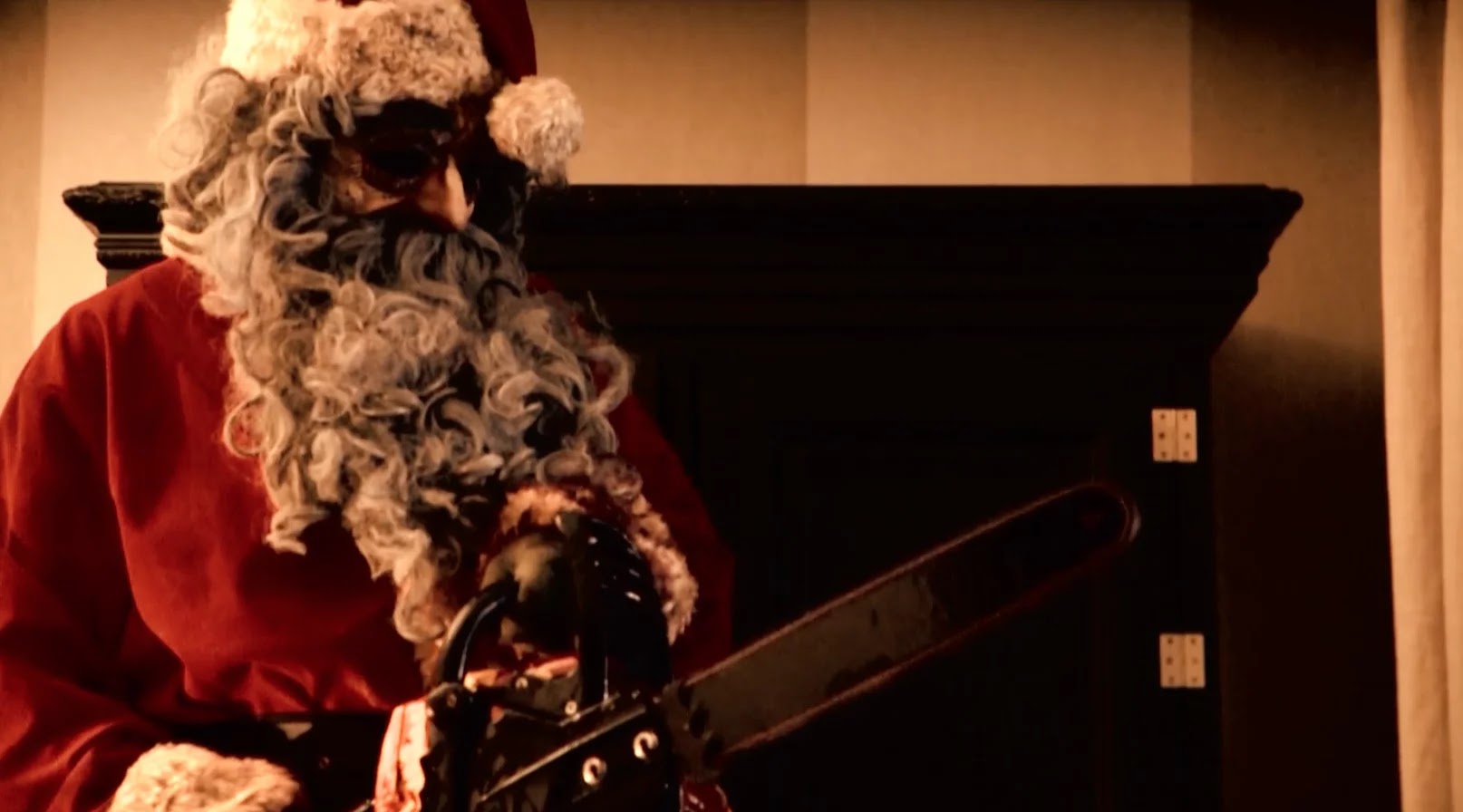
our Santa serial killer (Tormod Lein), a middle-aged and balding office worker
and family man. The film shows his fractured personality by very fast (and for
me, nauseating) edits. The viewer is also introduced a bit to his mindset,
which is full of violence and carnality. His grooming of his young daughter to
carry on after him is chilling. Ironically, Lein is a devout Christian, and
would not watch the film once it was released, even though he performed all the
acts of wanton killing.
In a brief shot of his
desk, we see a snow globe that has a frozen Jack Nicholson from The Shining (1980). There are actually a lot of references to many other films throughout,
sometimes in images and others in actions, such as Jaws (1975), The Big Lebowski (1998) and Goodfellas (1990), which could be a drinking game.
After the shocking opening,
the film, well, it lulls for way too long. Too much talking and lingering on scenes
of dialogue that can be considered exposition, but actually do nothing to
really advance the story much, and was a chore for this particular viewer. But
it did not build tension and I really fought the desire to skip ahead, though
since there were subtitles, I did occasionally go to double speed, especially during
an extended drunken scene between the three friends. Honestly, this film could
have been a good 20 minutes shorter and have been just as effective.
Tomren, Aasheim
Both our trio of – whatever
they are – and the nameless killer are seen preparing for Christmas, but in
wholeheartedly different ways, though all will end up at the same party, for
better or mostly worse.
Once the unnamed madman
starts on his rampage, though, which comes quite unexpectedly even though it is
predictable that it will happen at some point, the sheer velocity of it makes
the third act ramp up to 12, never mind 11. It is actually hard to look away, though
perhaps for others, they might have the opposite reaction. The SFX sometimes
looks cartoonish, but the actions themselves are so brutal that it actually overrides
that. I would say if you watch the film, and want to view it a second time as I
did, I watched the first 10 minutes and then skipped to the 1-hour mark.
Steinsvoll
Now, as for the bonus
material. Unearthed Films tends to overload the Blu-rays with features, which
is kinda cool in my opinion. It starts with a full-length commentary with Per-Ingvar
Tomren and producer/cinematographer Raymond Volle. For some reason, the volume
was quite low and even turning it way up, I had trouble hearing it; could be my
age, seeing bands like the Ramones too many times, or they were just too far
from the damn microphone. Again, I watched the first 10 and final 30 minutes
with the commentary on, which was interesting. Next is yet another full-length
commentary titled “Watch-a-long with Flesh Wound Horror,” where Tomren talks
with, well, the person behind FWH. He was mic’d fine, but Tomren, again, was
too far from the recorder, so I did the same 10/30 spiel.
One of the major additions
is the “How Cruelty Changed Our Lives” featurette, which is broken up into
three parts. Sorry, I just did not have the patience to watch all of them. Over
the opening credits of the film proper, there is a scene at a bar and the band
the Last Rebels are playing on stage. Here we get the music video for their
song, “Endless Highway” (not a C&W song). “Interview with Morten Haagensen”
(7 min), who runs the Rama Skrik film fest in Norway, follows as he discusses
this film playing there in 2013, including the reaction of the audience. It
makes sense what comes next is a “Press Conference” (23 min), also in 2013. It
consists of most of the major cast, the directors, cinematographer, SFX, etc.
Again, the sound is a bit low, but that is okay here as it is held in Norwegian
with English subtitles.
“The Blooper Reel” (7 min) is
amusing in parts, and then there are the Teaser Trailer and Photo Gallery. The
final is a short film, “Tradisjon” (Tradition) (2013; 6 min), directed by
Severin Eskeland. It is also holiday themed, and my mouth watered a bit when during
the credits they show some krumkake, but I digress… I was not quite sure where
this was going, and it certainly didn’t go where I thought it would, but I just
loved it.
If you are a gorehound, you
really do need to see Christmas Cruelty! at least once, because the violence is both gruesome and beautiful at
the same time. If your idea of extreme is the Marvel Universe, however, yeah,
step back and take a breather on this one.
Yeah, so I basically
begin nearly every review of director/writer/actor/etc. James Balsamo’s films
the same way every time, so to condense it: auteur, (usually horror) comedy, extremely
prolific output of work, Balsamo’s narration, shots from an airplane, full of
bad but enjoyable puns, female nudity (which is okay because nothing personal,
I really don’t need to see Balsamo’s naked bod, as he is always in his films, much
like Mel Brooks, another filmmaker I love but do not want to see in that way), animation
(both Claymation and cartoons), lately Bill Victor Arucan, and tons of cameos. And
yet, I am always happy to get to see his work. Some of these listed above are
bound to crop up in my comments, but they will all be in the film.
For this relatively
short opus, Balsamo plays Nathan Ender, a plastic surgeon who is out for
revenge by killing all the other plastic surgeons as “The Witch Doctor” (i.e.,
a masked killer). On his trail is Detective George Skully (Arucan) and his
assistant, Heather Gummer (blue-hair-tinted bodybuilder Ria Papageorgiou); we
see them interview 1980’s-1990’s star Jennifer Rubin, who plays Ender’s co-office
surgeon. Along with the killings, there is a lot of gratuitous nudity and
dancing, which is to be expected in a Balsamo release, of course.
While the revenge
premise of killing plastic surgeons is quite clear, the film has a bit of a
cobbled together feeling, which is both good and, well, a bit weak, especially
for a film this short. For example, there are a few mostly or totally nude
dance sequences that really are gratuitous and does nothing for the story with either
two or three women strippers and in one case a male (the latter is actually
better at it). Yeah, I know these will probably show up on one of Balsamo’s
anthology Sexy Time series (and rightfully so).
Joe Estevez
There is also a
ridiculously long sequence of three surgeons (including one played by Joe Estevez,
brother and uncle of other better-known actors, playing Dr. Richard Smothers –
where’s Tom?, or was he named after Smothers’ son, porn actor Dick Smothers?) walking
in a circular path through a Chinese...I’m not sure…Museum? Art gallery? While
this happens, the three riff off (ad lib) nonsense that does not promote the
story at all in a woe-is-me fashion, or just screaming dialogue. That
being said, the “Where’s Waldo” effect with the Witch Doctor in this sequence is
cool.
I am also confused
about one of the dancers on a ritualistic altar as the Witch Doctor runs a
(cool looking) knife over her body. Is she supposed to be a plastic surgeon as
well? It is incongruous with the story, especially with her smiling as the knife
skims her naked flesh. Then there is the topless dancer who sings and plays the
piano for what seems like a really long time. See, this is why it feels cobbled
together rather than an actual narrative story.
There are some
interesting cameos here and there, such as Brian Bonsall (the younger kid in
the TV show “Family Ties” and the Klingon youngster in “Star Trek: The Next
Generation”), wrestler (always a wrestler) Tonga Fifita reading poetry, and bizarro
filmmaker Jim Wynorski (I like his films), among those I have already mentioned among quite a few
others.
And what was the
reasoning for the stop-motion monster further on in the film? The story was
left quite open, I am assuming for a sequel at some point, as Balsamo has been
doing that a lot lately.
I have a theory: the
Witch Doctor is actually played by Bobby Canipe Jr., under the mask. The cinematography
is by Cagney Larkin. Balsamo’s actual role is a miniscule cameo and the rest is
voiceover. So, what I’m thinking is that this film was directed over the phone
(or Zoom) by Balsamo, but it was mostly produced and edited by him and shot while
he was away making multiple other films. That would explain the inconsistencies
and weirdness of whatever was going on in the plot, such as it was. This was
more an idea than a story.
While not the
strongest of the Balsamo releases that I have seen, and I have watched quite a
few – nearly all I enjoyed – there are some good elements to this, especially
the set designs and I like the Witch Doctor mask. Despite all my quibbling, I
am still looking forward to some of Balsamo’s upcoming releases, such as The
Righteous Adventures of Commander Star Shark and Guppy!, It Wants Blood 2,
and especially I Got a Bullet with Your Name on it!, among a dozen
others that are currently in pre-production, production, or post-production.
All Must Die (aka Utdrikningslaget; Alle
må dø)
Directed by Geir Greni Snurr Films AS; LevelK;
Breaking Glass Pictures 83 minutes, 2019
/ 2022 https://manymore.no/film/alle-ma-do/
Uff da. No, that is not a comment on the film,
but is just about the only Norwegian I know other than some foods (e.g., krumkake,
Lefsa, Lutefisk). I have been to Oslo and Bodø in Norway, and this was
filmed in the former; it is in Norwegian with subtitles. Thanks to Google
translate, I know the original title of the film (the long, single word above)
translates to The Bachelorette Party.
The original name
makes perfect sense because you will never guess what is the focus of the film,
at least at the start: Gina Moen’s Bachelorette Party! But hold on there, I
know there are some reading this thinking this is going to be silly, but the
thing is that Gina (Vicktoria Winge) is a fan of all things horror. So, guess
what the Bachelorette Party is going to be when it comes to a theme? And as
things being what they are in the genre world, that is a good thing for the
audience, but it certainly will not be for Gina and crew.
Vicktoria Winge
After an ominous start,
including a flashback of an argument with her fiancé Even (AndersV Rydning),
Gina and her pals are off to a – you got it – secluded farm out with out-buildings
(e.g., barn, workhouse) surrounded by woods, miles from anywhere in Heggelia,
to celebrate. If you think
all Norwegians are pale and blonde, the cast is quite diverse, which is more
accurate. Good choice on the director’s part.
Including Gina, there
are six women: Camilla (Julia Schacht), who wears a Brooklyn tee and drives the
van, Ida (Veslemøy Mørkrid) who is Even’s sister, Stine (Marte Sæteren) in a
checkered shirt, Marte (Tinashe Williamson) who is the Maid of Honor, and co-worker
Elise (Linni Meister) who is overdressed for the occasion (work clothes), considering
the locale of the event.
As is common for this getting-away-to-a-remote-location
genre goes, basically the first 20 minutes or so is the car ride, as we get
familiar with the half-dozen so the viewer can get an idea of their
personalities and some social dynamics. Normally I find these rides boring, but
I like the characters, so my interest remained focused. But there are also a bunch
of clues in there, on a second viewing of the film (yeah, I watched it twice).
By the end of the
first act, I have a guess on the killer, and the reason behind it. I will let
you know if I’m right, but not who it is, so no spoilers.
It’s clear these women
like each other, even with the occasional behind-the-back talk, which is part
of life in the real and reel world. Lots of shenanigans such as a twisted and
drunken “treasure hunt” of sorts with Gina that leads to territories beyond the
map (sorry, a little General Semantics snuck in there). Things dissolve quickly
at this point and follow some directions I was not expecting (again, always a
good thing). For me, the oddest thing was the plan to have all of Gina’s ex’s
come to the house, as well. That felt icky to me.
That Gina is a horror
fan, and there is a similar theme to the get together, this leads us to not be
sure at times what is part of the party and what is not for quite a while. What
this does is add a dimension to the story that most genre fans watching this
might connect to on various levels. I have to say, I was totally
impressed with how everything worked out.
In that vein, I was
totally wrong on my guess on the killer, but that is because so many red
herrings were weaved into the story, and that was part of why I liked this so
much. Also, the cast is quite engaging, especially Winge. That being said, I found
Schacht and Sæteren also strong in their roles.
The SFX appear to be
all practical, and they look great. There is lots of carnage, most seen after
the fact, but enjoyable nonetheless. I also enjoyed how Director and co-writers
Geir Greni and Robert Næss pace the film, and work in the reveal as nearly the entire
third act.
If you have ever been
to Norway, or even seen pictures, it should come as no surprise that the scenery
is beautiful, sometimes artfully shot by drones (as films now are wont to be if
there is any kind of traveling). Just breath-taking. In fact, through the whole
film, Torstein Nodland’s cinematography is lovely to watch, even though half
the film is shot at night.
Though I had some
issues, which seem to have stuck with me, I found this to be enormous fun that
takes some standard motifs and throws it on its ear a bit. At the end, as the
credits rolled, I found myself smiling with satisfaction. I hope there is a
sequel.
All Must Die will be available on Digital, VOD
platforms, including iTunes, Amazon Prime Video, Google Play, Xbox, and Vudu. In the US, there will be a dubbed version.
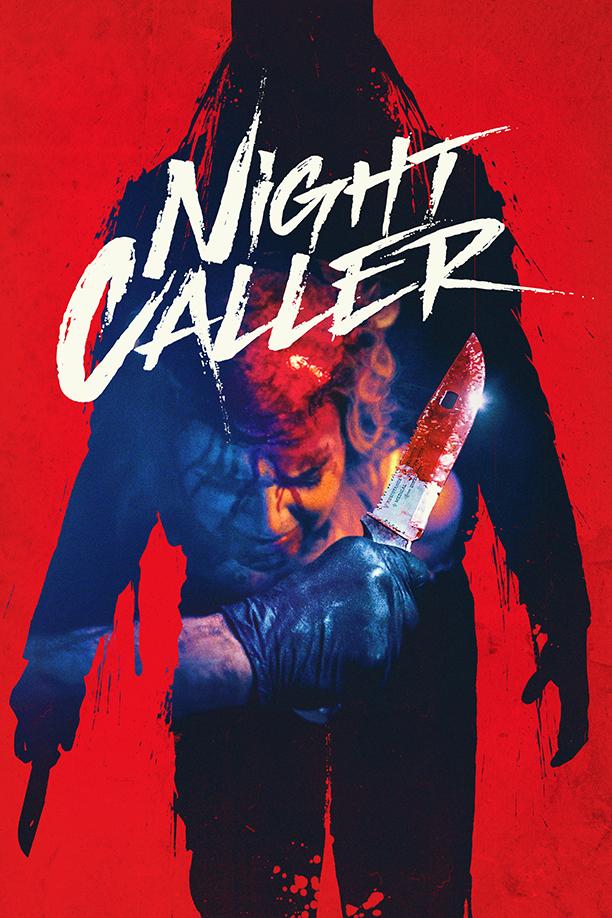
Night Caller
Directed by Chad Ferrin Crappy World Films; Girls
and Corpses Films; 123 Go Films
84 minutes, 2022 www.123gofilms.com/night-caller
Back in the 1980s, late night was filled with
commercials for things like telephone sex-talks and psychics. Personally, I don’t
believe in this form of spirituality (I dated the assistant of a professional
psychic a few years ago and saw how it worked). That being said, skepticism is
not a hindrance to watch films like this one because, hey, is an unstoppable guy
in a hockey mask reality?
Susan Priver
Anyway, now that I have gotten that caveat off my
chest, let us delve into this film, which focuses in on Clementine Carter
(Susan Priver), an attractive woman of a certain age who has a gift (what a
certain writer might call a “shining”). She works on the business end of a
telephone psychic hotline in a space she shares with fellow phone psychic and
boss Jade Mei (international star Bai Ling). Jade also has visions, so in this
story, both are legit psychics.
Bai Ling
At the very start of the film, Clementine gets a call
from a stranger (the underappreciated Steve Railsback of 1985’s Lifeforce,
among so many other classics) and gives her an obvious fake name (yet, Clementine
gives clients her real name!), and she sees him murder someone (comedian Kristi
McHugh) in her mind, with a big hunting knife. After, he does just that in the
real world, in a nice, gory, practical-effects way, including his signature (we
son learn) scalping. Shades of Maniac (1981)! This masked killer wears a black stocking over his face, a long blonde wig, and
a toque on top (it is filmed in Los Angeles though, not Canada). There is a bit
of sexual ambiguity with the killer, who likes to remove certain female body
parts, reminiscent of Buffalo Bill in The Silence of the Lambs (1991);
there is also a couple of nods to Psycho (1960). And like that film,
there is a deep psychological element to both the killer and the psychic that
both separates them, and makes them somewhat similar, dealing with the dead and
the beyond, whether it is “real” or in the mind.
Clementine’s life is a bit of a struggle. She lives
with a movie-loving dad, Charles (Robert Miano, who I’ve recently reviewed in Parasites
in 2016, by the same director as this film, which I listed as one of my fave releases
of the year) andGet Gone in 2019). His room is full of movie posters and VHS tapes. At one point he’s
watching Patrick (1978), which is an Easter Egg as it’s a film about
someone who kills, psychically. Her late mother, Emily (Kelli Maroney in cameo
form, who was in a number of great ‘80s classics, like 1984’s Night of the
Comet and 1988’s Chopping Mall), comes to visit her in dreams as a
Cassandra, to warn her of danger. Then there is her racist, Ponzi scheming,
violent and alcoholic ex-husband, Doug (Michael Cambridge) who is still
pestering her and blaming her for his hitting her (“You should have seen it
coming, ‘Madame Psychic’”). Will he redeem himself by the end, or will he be
another body for the serial killer? I know which side the majority of the
audience is probably on.
Robert Miano
One interesting concept is that, for the purposes of
this story, fate can be altered, so if someone has a vision, steps can be taken
to change it, which leads to unexpected developments rather than having a
vision written in stone (or brain, anyway). Playing with this concept is one of
the finer points on the story, and also keeps the suspense going, because even
if one of the psychics has a vision, which left alone is what would occur, that
does not mean it will happen that way.
The most frustrating thing about this film is that Clem
(as her father calls her) has a tendency of making some really stupid
decisions, such as going all Karen on the coppers (she even says, “Let me talk
to your supervisor,”), giving out too much information or going to dangerous
places alone (I get pissed at police procedurals where the cop goes in on their
own without back-up, as well; it’s a too common theme). You don’t need to be a
psychic to see the problems from a mile away. But it’s not just her: why does
the Hotline keep answering the killer’s calls, and if they must, how come they
don’t record them for the police? There is definitely, however, a nice
interplay of what is “real” and events occurring in the mind of one of the
seers.
Kelli Maroney
Another fine point with this film is that it is not
filled with starlets running around akimbo, but rather mature actors who are
more realistic for the roles (though Priver is only 17 years younger than Miano,
who plays her dad). Along with Maroney, there are a few other cameos of note,
such as Lew Temple (he’s been in a bunch of Rob Zombie’s films, including The
Devil’s Rejects in 2005).
Despite the ages of nearly all the main actors being
near or above senior citizen level, the photography makes them look good, even
with the over-use of close-ups (for some reason, it seems most of Ling’s shots
are a foot from her face; so close, in fact, that when she has scenes with Priver,
they practically look like conjoined twins to keep them in the same shot.
As much as I kvetched about some aspects of this
story, it still managed to keep the tension and interest high throughout, even
as I yelled at the screen, “Why are you doing that!?” There is no nudity, but
the gore is quite plentiful, top-notch looking, and all practical, by storied
indie make-up artist Joe Castro. It all works together well for the story, so
it lives up to its promise.
The film is available on a number of digital and cable
platforms, including iTunes, Amazon, Google Play, iNDemand, and DISH.


.jpg)