All genres of suspense, terror, and horror will be reviewed by Richard Gary. His address to send preview copies supplied upon request to rbf55@msn.com.
A nice thing
about animation is that you can do things that cannot be done on a small budget.
Created in the stiff but “humanesque” iClone software, the shorts are
entertaining to look at. While the movement is a bit boxy, the faces look sharp.
All these films were written (with one exception) and directed by Jason J.
Cross, and are available in links at the bottom of each review. They are
released by Four Sides Cross Productions. These are not in a ranked order, but rather how they were sent to me.
What is
consistent in at least three of these four releases is that the central character
is a strong woman. That makes me happy.
Got to Eat 6:41 minutes, 2020 There is a masked serial killer on the loose, and he has chosen his next
family. They are transient and a bit oddball, but can they handle this young murderer?
The results are quite humorous and bloody. Very simple and to the point, which
is nice. And what is with the very end? Is there going to be a sequel?; I ask
because many of Cross’ releases are serials. This is off to a great start. Full film HERE
To Do 3:11 minutes, 2023 A serial killer ponders over a bound and gagged woman. We hear his
internal monologue of what he plans to do, which the viewer gets to viscerally
see. His thoughts are a poem including such things as biting off her nose.
Creepy and gruesome. Nice. Full film HERE
A Mother’s
Love 13:15 minutes, 2021 A woman is on a first date at her home with a nice man, and they are
just starting to get to know each other, when her daughter gets into some physical
trouble. The crux of the story is how the mother takes care of business and how
far she will go to protect her daughter. It is certainly not what one might
expect. It was cool and she is hot. As with the first story above, there is a
nice self-referential to Four Sides Cross. Full film HERE
Wanted 2:44 minutes, 2021 This is the only story not written by Cross, but rather his 11-year-old “Daughter
(Victoria) and staring my other daughter (Samantha), my wife (Carla), and myself,”
the director explained. Short and simple, a mother and her two young twin daughters
are being questioned at a police station, where the coppers are looking for her
ex-. But there is more going on than that. This may have been written by a
child, but it has a nice twist element to it. Full film HERE
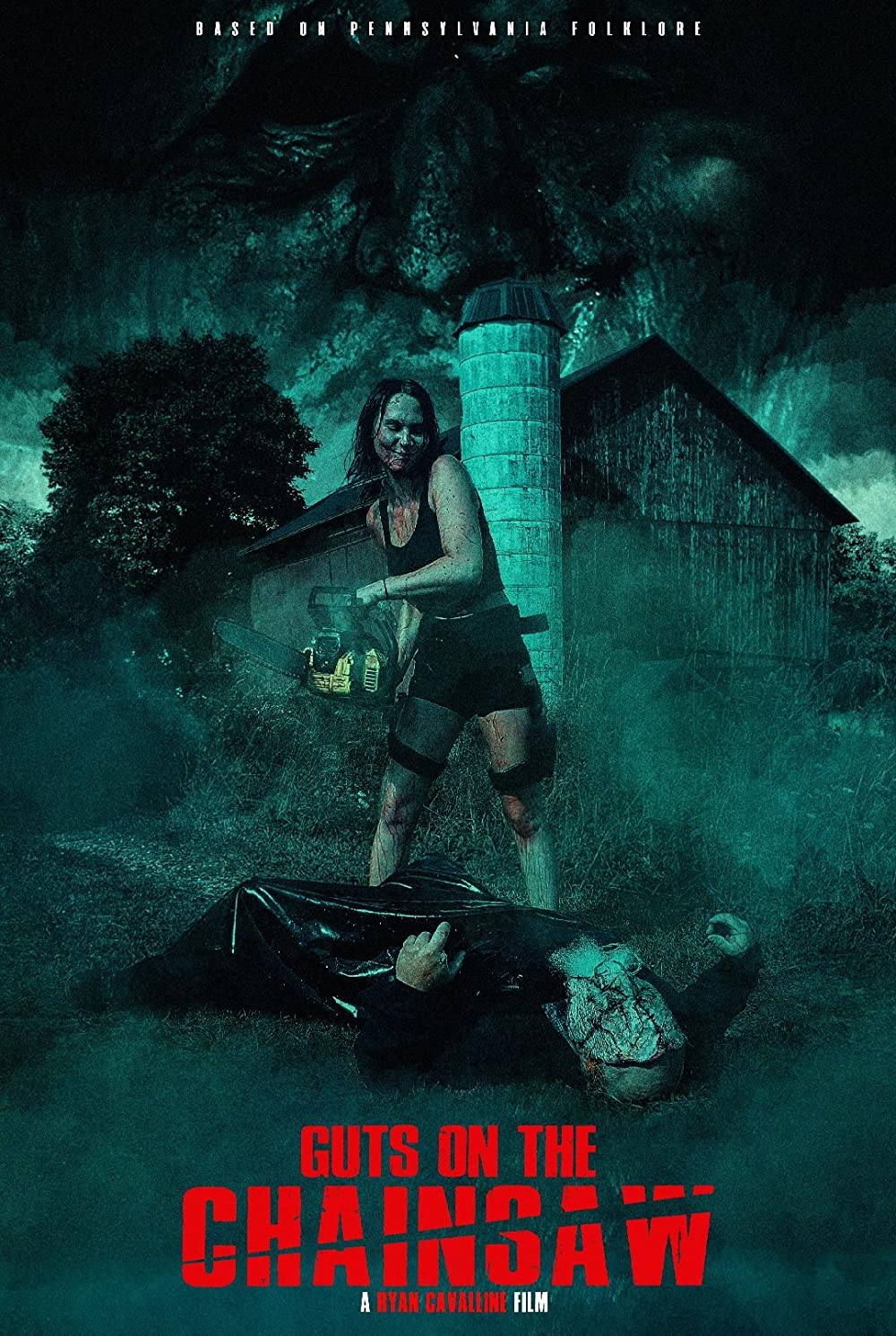
Guts on the Chainsaw Directed
by Ryan Cavalline
Legend Hunters Films
80 minutes, 2023
https://legendhuntersfilms.com/
“The hills are alive, with
the sounds of shotguns…” as it once said in a Mad Magazine spoof, I
believe. This is a case of genres-in-a-blender, but I will get more into that
later.
Nova (Nikki Carlson) is a
woman who is cleaning out from substance abuse after an earlier trauma, looking
for a purpose to her life, and trying to escape from recurring nightmares that
reflect the ending of The Texas Chain Saw Massacre (1974), with a
chainsaw wielding man in a flesh mask (I do believe the mask was also used in
Cavalline’s 2021 film Myths & Mutants), chasing her down a country
road, swinging the ‘saw around wildly. This is an icon moment that’s repeated
as much as vampires rising stiffly from a coffin, a la Nosferatu (1922).
So, what does Nova do, to
help refocus her life? Take a multiple days-long solo walk around Beaver Run
Dam’s forest area in the Delaware State Forest in Eastern Pennsylvania, a place
she is not even familiar, and cannot read a map, naturally. And why is she roving
around the woods sometimes without following trails, just randomly roaming? Oy.
Even in reality, I would never, ever do that. Stick to the trails only (and
stay off the moors…sorry, I was distracted…). Please note, I don’t mean this in
a sexist way, I don’t think anyone should be traipsing around the deep woods
by themselves, especially off trail. It is good for there to be at least two
people in case something happens, such as an accident.
Nikki Carlson
As she walks, one can feel
the backwoods inbred cannibals being just around the corner, even though there
is no indication of it other than the dream. I do not think I am revealing
anything, honestly, given the name of the film, the location, and the dream.
Anyone with even a low level experience with these types of films can almost
smell it. Now, to be clear, I am not in any way complaining. I honestly like
these kinds of films.
Getting off my soapbox
now, even pretty early on there are some nice murders by, yes, silent masked
killers, such as a farm couple (the woman has amazing hair), though I wonder
why their german shepherd did not come to their rescue. He just sort of
vanishes (i.e., s/he’s not killed, for those who hate that sort of thing).
Intercut (no pun intended)
into the story every so often is “news” clips about hikers that have gone
either missing or murdered along the Appalachian Trail, for example. These are
b-roll dramatizations narrated by Robert Slone (a director of documentaries whose
topics include JFK’s assassination, Patty Hearst’s kidnapping and Vietnam). The
film is, allegedly, based on “Pennsylvania folklore,” a pet topic of the
director (does he know about the Small Town Monsters brand? May be right up his
alley, though they deal more with cryptids than chainsaws).
Nova runs into some kooks
along the way, such as a guy really into possum jerky (called The Hermit by
someone), as well as an expositionary hiker who warns her about the people
living in the woods, and how they were effected by radioactivity waste buried
in the ground that had an effect on them. Radioactivity causing cannibal
mutants? Sound familiar? He even says, “These mountains, they have eyes.” As
that wise philosopher once said, “A nod’s as good as a wink to a blind bat”
(say no more!).
The first half, at least,
is mostly her walking and walking, with occasion action shots in-between. The
action finally starts to really pick up when Nova is chased by those in the
woods, and she cannot get reception on her flip-phone (when was this filmed?).
While the appetizer killings are appealing, of course the main course will be in
the third act when the action is revved up to 11 (sorry about the This is
Spinal Tap reference…).
Like the Marilyn Burns
character of Texas Chain Saw Massacre, Nova naturally winds up in the
home of The Family, full of misfits, cross-dressers (glad this is not
Tennessee), and other murderous types; however, the house is immaculate, unlike
the Sawyers’. Time for revenge…and guns and masks and chainsaws. Plus, Nova
gets to dress like Lara Croft at one point. That was an enjoyable visual.
The acting is pretty
low-key, but not wooden (with one exception), not overly filled with dialogue,
and just about everyone does their jobs nicely. The effects are a mixture of
practical and digital, which mostly look okay, but the digital is pretty obvious,
and the occasional practical at times (such as the guts in the first killing)
looks questionable, though at others looks really good. For its budget, though,
it is effective.
My main quibble about the film is sort of meta, in that there is little
information on who played which role, which is true both in the end credits and
on IMDB. That is why I had to be so vague in the descriptions above.
The film is obviously low budget, and there are some continuity errors,
but overall, it was a good watch, especially the last third, despite the
reliance on some well-worn tropes. It also sets itself up for a possible
sequel, which I would gladly watch.
Nightmare Symphony (aka Nightmare Symphony: The Peacock’s Tale) Directed
by Domiziano Cristopharo and Daniele Trani
Enchanted Architect; 8-Films; DiabolikDVD; Reelgore Releasing; MVD Visual
78 minutes, 2020 / 2022 www.mvdvisual.com
The main director of this
film, Domiziano Chrisopharo, is a name that is familiar to me, as I have reviewed
three of his many previous films: House of Flesh Mannequins (2009), Museum of Wonders (2010), andRed Krokodil (2012)
His work is seriously underappreciated,
and from what I have seen, his name should be as familiar as Argento or Fulci.
They are odd, dark, and eminently enjoyable, on the side of weird and highly influenced
by giallo. Hopefully, this one will live up to my expectations.
This was filmed mostly in
Pristina, East-Central Kosovo by and Italian crew, but recorded in English (DTS_HD
Maser Audio 2.) with some Italian and Albanian, and a German overdub is also available
on this Blu-ray. The subtitle choices are English SDH and Swedish. That this us
steeped in a giallo, right down to the theme music by Fabio Frizzi (Fulci’s
A Cat in the Brain and The Beyond in 1981 among others; Kill
Bill Vol. 1 in 2003), should be no surprise as this was written by Antonio
Tentori (who penned Fulci's 1990 A Cat in the Brain); this release has a
similar theme.
Frank LaLoggia and Antonella Salvucci
After an opening prologue in
Rome with a gratuitous and ferocious shower scene (Antonella Salvucci) that is
steeped in giallo lighting and mood – and violence – perpetrated by someone
in a peacock mask (Federico di Pasqual) – who has no crystal plumage – we are
introduced to our central character, struggling film director Frank LaLoggia
playing a version of himself (who looks a bit like my dad at a point in his
life), an American living in Italy (with a red passport rather than blue) as he
travels to Kosovo, giving him a chance to let us know about his charity of
spirit (how the film got the rights to a Disney film clip, I do not know; is
Mickey now public domain?).
Poison Rouge and Hasan Lushi (foreground)
In a meta-film storyline (the
film shoot within a film is getting to be quite common these days), Frank is a
director who is trying to finish up a project, The Peacock’s Tale, and
make his investor, Fernando (Hasan Lushi), who arrives with his girlfriend Lola
(Poison Rouge, who also directed the cult classic body horror, American
Guinea Pig: Sacrifice, in 2017) and the screenwriter, Antonio (screenwriter
Antonio Tentori), happy. The problem is they both want different things, and
Frank is in the middle. He has come to Kosovo to do the post-production work, including
with editor Isabella (also Salvucci). LaLoggia actually was a director of a
trio of cult classic films in the 1980s and 1990s. We get to see some footage
(including backstage) of his Fear No Evil (1981, though he claims it as 1970
in this film). That was a cool addition,
Merita Budakova
Frank is constantly being
set upon by a drunk neighbor (Iimi Hajzeri), a hyper-aggressive actor looking
for work, David (Halil Budakova), or being stalked by a mysterious woman (Merita
Budakova; she could definitely play Monica Lewinsky). As we meet all the characters around Frank, someone else in a
peacock mask (Blin Budakova…yes, there is a number of cast members with that surname)
is starting to kill people who surround Frank, some close associates, some not
as much. But each one is appropriately gruesome, and in various ways, as is
befitting a giallo. As for the killer, there are numerous nice red
herrings throughout.
Of course, this is a giallo,
so the question is bound to come up: what is real, what is not, what is
psychosis? Pressure can sometimes make that distinction a gray area left open for
the viewer to decide. Lucio Fulci (d. 1996) was famous for opaque endings that
did not harm the story proper. Note that this film is dedicated – and rightfully
so – to Fulci. After all, the title of this film is a nod to the French name of
Fulci’s A Cat in the Brain, which was called Nightmare Concerto.
But more after this commercial
break: There are a few extras on the Blu-ray, but nothing too overwhelming.
First is the Making Of, which is actually a Blooper Reel (9 min) which was okay,
albeit mostly in Italiano. This is followed by a couple of interview
tracks. The first is with director Chrisopharo (14 min), which is in accented English.
He discusses, among other things like narrow budgets and the growth of the film’s
idea to fruition, the influence of Fulci. The other is with screen writer Tentori
(6 min), which is in Italian with subtitles. He talks about the actors, and naturally,
Fulci. I found the second one more engaging, without taking anything away from
Chrisopharo. Along with the soundtrack I mentioned earlier, the last two extras
are the Teaser and the Trailer.
Okay, getting back to the
meat of the matter, having Americans as leads in Italian giallo films is
certainly not new. For example, there was John Saxon (d. 2020) in The
Scorpion with Two Tails (1982), and Jennifer Connolly and Donald Pleasance
(d. 1995) in Argento’s Phenomena (both these films to be reviewed here,
soon).
The cinematography by co-director
Trani, is exquisite and arty without being overdone. The scenes of the city,
and the like are just lovely, even the slummy areas. Long tracking shots abound,
rather than MTV-ish quick-cuts that have become the norm, sadly. Giallo
has proven that Sergi Eisenstein (d. 1948) is only sometimes right, that
editing equals action, but not always, or here.
There were two
distractions for me. The first was that so many of the scenes were filmed
either at night or in an unlit room, using a dark blue filter, which made the
action (and some killings) hard to see. The second, and I do not really blame
anyone because it helps with the budget, there were obvious product placements,
such as a particular soda-pop, whose logo is seen prominently in a number of times
in more than one place.
This release gives me every reason to stay a Domiziano Chrisopharo fan.
It should come as no
surprise that the centerpiece of this film is second generation Scream Queen
Tiffany Shepis. But she is so much more than just that, she is a force of
nature. I have reviewed a number of her films over the years, including Model Hunger (2016) and The Black Room (2017, by the same director), and even Caesar and Otto’s Paranormal Halloween (2015). Heck, she goes back as far as the “classic” Tromeo and Juliet (1996),
among other Troma flicks, which is where I first became aware of her. But
before most of those, there was Nightmare Man.
The center of the film,
however, is a couple trying to conceive: Ellen (busty Blythe Metz, who gets to have
a gratuitous shower scene in the first five minutes) and toxic masculinist know-it-all
Bill (Brazilian actor Luciano Szafir, who was once married to singer/television
personality XuXa). To help “get it up” in William’s words, they try a fertility
mask, which ends up being a horned, ugly thing, that you just know is going to
be nuthin’ but trouble.
Tiffany Shepis, Hanna Putnum, Blythe Metz
This leads to the personification
of the Nightmare Man (Aaron Sherry), who keeps cropping up in her – er –
nightmares. For this, Bill is on the way to take her to a mental hospital as
paranoid schizophrenic, but along the way, trouble occurs, forcing her into the
woods and a lone cabin near Big Bear Lake, California, with some participants
(the body count) that she befriends. But can they stop The Nightmare Man? I am
now 15 minutes into the film, and I have a guess about the ending. I will state
later if I am right or wrong, but will not disclose what that is.
Jack Sway, Shepis, James Ferris
In the cabin are two
college friends, Mia (Shepis) and Trinity (Hanna/Johanna Putnum) and their respective
boyfriends, loveable doofus Ed (Jack Sway, who has no IMDB credits since 2008;
he wears a shirt for an earlier Kanefsky film from 1991) and macho man Jack
(James Ferris). Being a Kanefsky release, there is a strong sexuality (more
than sensuality) element to the film, which interplays (and sometimes inter-cuts
through editing) of both. He is both known for his softcore as his horror work,
so they usually combine in some ways. For example, every female in the story
gets to strip to their bra at some point, and most show their ”goods” as well.
To be fair, there is also male nudity (from behind).
About halfway through, I now know I was wrong. I have a second guess, but
I certainly hope I am mistaken, because it is too obvious (which is why I had
the first guess).
I do not usually talk to the screen – you know, “get out of there!!” “Don’t
do [whatever stupid action]!!”) – but in this case, after a bit of carnage,
someone goes into the woods by themselves and hears a rustle and says, “Somebody
out there?” even after being warned about the killer. I sarcastically said to
the television, “Well, duh! You deserve to die!”
The gore SFX looks good, reminiscent of the early Friday the 13th franchise.
While not overly bloody, the kills are nice and gruesome. Definitely retro to
the ‘80s, which is appreciated. There are also a few well-done jump scares.
There are quite a few
extras included, two of which are new for the Blu-ray release. The first is the
featurette, “There’s Something Out There: The Making of Nightmare Man” (26
min). This includes interviews with writer/director Rolfe Kanefsky, Tiffany
Shepis and Blythe Metz, producer Esther Goodstein, and makeup effects artist
Jeff Farley. It is well done and worth the watch, discussing the likes of
origin of the idea, casting, anecdotes, and on-set tensions, all told with a
wink of the eye. Another newbie is the Film Score Audio-Only Track (unplayed by
me).
Archival from the previously
released DVD in 2007 includes another, similar themed featured, “Creating a
Nightmare: The Making of Nightmare Man” (22 min), with the difference
being that this is mostly behind the scenes of the filming, with some
interviews, audition reels, SFX, and includes a gag reel. with interviews from
writer/director Rolfe Kanefsky, all with a sense of humor. Also, there is “Tiffany's
Behind-the-Scenes,” (18 min) which is mostly shot and narrated live-on-camera by
Shepis. It is pretty damn funny.
Of course, there is an Audio
Commentary with Kanefsky, Shepis, and Goodstein. You can tell they had fun
doing it. They joyfully discuss what is on the screen, personalities, shooting
anecdotes, incontinuities, and the usual stuff. Again, worth the watch, though
there is the occasional talking over each other. Then there are the Extended
Scenes (16 min), which were good but right to be edited, and the “Flubbing a
Nightmare Gag Reel” (7 min).
Finally, there is a Promo
Reel (5 min), which is like an extended trailer, and Stills Gallery On the tech
side, this is a 1080p High-Definition Widescreen Presentation (1.78:1) with 5.1
Surround DTS-HD Master Audio, and English Subtitles for the Deaf and Hard of
Hearing.
While this is not a comedy, there is definitely some humorous lines here
and there, mostly spouted by Shepis, who has a natural comedic talent that is
often overlooked (also, the role was written specifically for her). The acting overall is quite decent, though Shepis is
more of a natural talent and excels in this regard, and please note that I am
not just saying that because I am a fan. It is why I am a fan. Same is
true with some of the better Scream Queens, like Debbie Rochon. There are also
a couple of really nice cameos by Robert Donovan (who was also in The Black
Room and Night of the Tommyknockers), and especially THE Richard Moll, who is almost unrecognizable, even with
the height.
As for my guesses, they
were both right and wrong. There was an element to the story that I was not
expecting, which not only was a wonderful surprise, but tied everything up
nicely.
Although this film is
Japanese in origin and language (with subtitles), it may be inspired by the real
Hong Kong serial killer portrayed in Dr. Lamb. He was also a taxi driver serial killer.
The opening credits’ title
states this is a “Japanese Giallo.” Well, the opening sequence screams of it,
as a woman in a spandex bathing suit sensually strips in a shower, and is
murdered by the titular, Fujinaga (Tomoki Kimura). The color palate (by Shuji
Hamamoto and Mitsuo Kojima) is correct for a Giallo, with lots of primary colors,
a knife, and a helmeted killer. Actually, what the opening made me think of was
a cross between Italian Giallo and the ending credits of What’s Up Tiger Lily?
(1966).
Tomoki Kimura, Iori Kogawa
The tone of the over-thought
narration describing the city definitely smacks of Taxi Driver (1976). Kimura
even looks a bit like a younger DeNiro; heck, there is even a scene with him in
front of a mirror holding a weapon and giving the whole “You talking to me?”
speech. I have no doubt this was meant as an homage, rather than a rip-off.
While this definitely has
a retro-Giallo feel, there is a Japanese spin on it. For example, as a
businesswoman is being chased, she takes off her jacket so the film camera can
get her braless bouncing, there is a close-up slo-mo shot of her backside where
you can see her underwear beneath her overly short skirt, and, of course, by
the end of the scene, her top is exposed. To be fair, in the body of the film
(pun not intended), there is also male nudity.
The driver is depressed after
his wife was murdered and he was stabbed in a home invasion by someone with the
same helmet as him. This sours him on society, and both wants to die and to
kill. But, how much of his killing his customers is real and what is fantasy?
This is a territory touched on in American Psycho (2020).
The nudity and sex is
a-plenty here, so it is no surprising that many of the women/victims in this
film come from the world of adult cinema, such as Saryu Usui, Ayumi Kimito, and
Ai Sayama (as is stated on the back of the Blu-ray box. Through fantasy and
memory, this turns out to be quite a softcore flick. There is also extraordinarily
little actual dialogue, with most of the philosophizing happening in the driver’s
head. It ranges from injustices, to positive feminism, to despair.
Slowly, as his anger as desperation
grows, he starts looking for a victim to take out his perceived vengeance on society
and to end his own miserable life. Meanwhile, we see him taking customers in
his cab numerous times, through a cab-cam with somewhat blocked faces. Did you
know that DeNiro drove a cab in New York for two months to get a better idea of
what the character goes through?
There are a lot of shots
of Tokyo and the editing (John Migdal) and cinematography (Makoto Hayashi) is
noteworthy, such as the city reflected through the moving hood of the dark
taxi. Most of the shooting is normalized, but the fantasies are in high-art
Giallo colors and lighting techniques. The music during these sequences are
also interesting, in a distorted way.
Things pick up when he
meets his (adult) “Jody Foster” in the form of injured Mayumi (Iori Kogawa),
and he finally sets in motion to carry out his idea for a murder/suicide. Heck,
there is even a long-haired villain (Yoshiki Kondô) who is reminiscent of Harvey
Keitel.
When the reality is
revealed and the facts are finally shown, well, some of it took me by pleasant
surprise. The ending nicely sums it up, but I won’t tell…
The extras on this Blu-ray
are as follows: an Audio Commentary by the director, Kurando Mitsutake, who
fortunately is very fluent in English, so no subtitles needed (born in Toyko,
grew up in Fresno, CA). He skillfully goes back and forth between descriptions
of what is happening on the screen, and anecdotes about the whole process and
the cast/crew. Worth at least one listen. We also learn that the title is a
mash-up of insane serial killer flick Maniac(1981), and said Taxi Driver.
The “Maniac Driver:
Behind the Scenes”-featurette (30 min) is exactly that, mostly setting up shots
(and then we see what they filmed), and includes some brief interviews with the
main cast. It is very basic but kept my interest. Finally, there is a Trailer (in
English) and Slideshow, along with a nice 4-sided box insert cover with images
of the film’s original posters. There are also subtitles available in three
languages.
There is a prestigious
amount of nudity, sex, and violence, not to mention blood and some gore (SFX by
Yoshinari Dohi). The story is a bit weak and repetitive at times, and seems to
circle around the point, but by the third Act, it is quite a ride.
It can be really interesting
to see a debut directorial effort (which tends to be in the horror genre), but
double the pleasure, double the fun because this is true for both of those who
helmed this slasher project.
Ricky Glore
Mixing a few subgenres,
such as masked killer, cabin in the woods, and social anxiety, the story wraps
around the lead character, Matt Wilbee (co-director Ricky Glore), who is
suffering from a severe case of depression. Once a star athlete in high school,
he’s now let himself “go,” including having a drinking problem (in the first 7 minutes,
he drinks more than I have in 7 years). Though working in a lowly position in a
bar cleaning up, he is about to be homeless thanks to drinking his money away.
Despite his present
destitute status, Matt was once part of an exclusive group in high school known
as The Pack, who he has not been in contact with in years. Deciding to end his
life, he inadvertently assembles The Pack one last time in a secluded campground
around Bellevue, Kentucky (the filming location), where they last met around
graduation, consisting of the imaginatively named perky Sarah Sunnrae (Eileen
Earnest), bully Derek Pummel (Jason Ervin), now rich, buff and obnoxiously narcissistic
Greg Neighsayer (Patrick M. Johnston), gay Larry Cochran (Chance Kilgour), and Larry’s
lonely bestie, Lorie Blotter (Kira L. Wilson). Another good name for The Pack
might be The Fodder.
Kira L. Wilson, Chance Kilgour, Patrick M. Johnston
Whereas the first Act
introduces the protagonist, the second fills the viewer in on The Pack, and
what a pack they are. There is no problem in distinguishing one personality
from another, they are all their own beings, be it good or bad. There is also a
truer level of angst between them and Matt, as well as between each other. Sparks
fly (not necessarily the fun kind) as they stake their egos on their
presentations.
I also enjoyed the certain
level of meta going on, with discussions about how this would be the ideal
setting for a slasher film, which of course this becomes in the third Act when
the masked killer comes a-callin’.
Eileen Earnest
There are some nice red
herrings to who is behind the mask. Honestly, I figured it out early on, but it
was still worth sitting through the film to confirm. Lots of nice slice and
dicing going on, with both decent practical effects and over the top CGI (as
usual, mostly the splatter).
This is a dry comedy (with
some out-loud laughs), dealing with both dialogue and characterizations. The
actors give some credence to the parts they play, though sometimes reach a bit
over the top. However, Glore seems to be in his element, ranging from sympathetic
depression to maniacal.
Of course, as with most
slashers – especially micro-budget ones – the instruments of death tend to be
long and sharp albeit sometimes gas-fed. Speaking of budgets, the overall tone
of the film is not quite minimalist, but definitely has a low-key flair that
suits it well. You can tell they got every penny out of their budget. What I
like about that is that the film – particularly the story – does not try to be
more than it is; in other words, it does not pretend to be artsy or have too
deep a meaning, but is out there for the fun of it, as well as getting
experience for both first-time directors.
While the release is fun
to watch, despite the somewhat depressing life of Matt, it is also worth sitting
through the credits for a few reasons that I will not give away. Just ask
yourself, “What hath Marvel started?!”
Fans of limited run
special edition horror movies will have the opportunity to pre-order the film
at the SRS Cinema’s Website (see eAddress above). The disc will include
extras, such as a “Making Of” featurette, a commentary by the Director and
Producers, the film’s trailer, and a host of other SRS trailers.
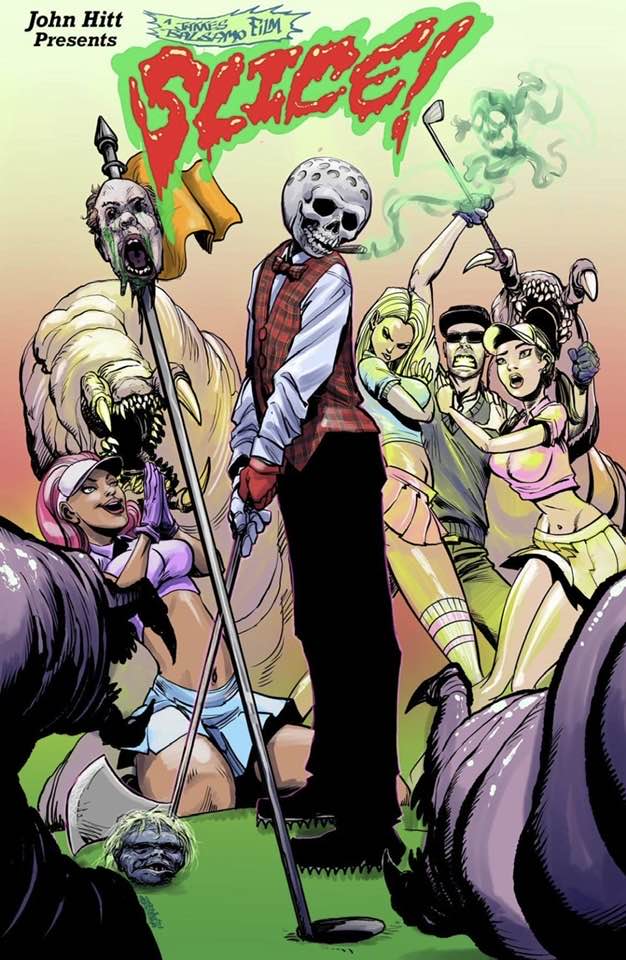
Slice! Directed by James Balsamo
Acid Bath Productions; Apokalupto Enterprises
73 minutes, 2022 www.jamesbalsamo.com
Generally speaking,
other than Putt-Putt, I find golf and golf-related films exceptionally boring,
be it The Legend of Bagger Vance (2000), Happy Gilmore (1996) or
cult comedy Caddyshack (1980). However, this is a James Balsamo release,
so my interest is piqued.
Sorry to give this
away, but you gotta love a film that starts in the short, pre-credit-prologue
with the killing of Robby Kriegerof the Doors on the Tender Holes Golf
Course (get it?)…with a door. His acting is horrendous, but who the hell cares!
James Balsamo, Robby Krieger, John Hitt
This helps introduce
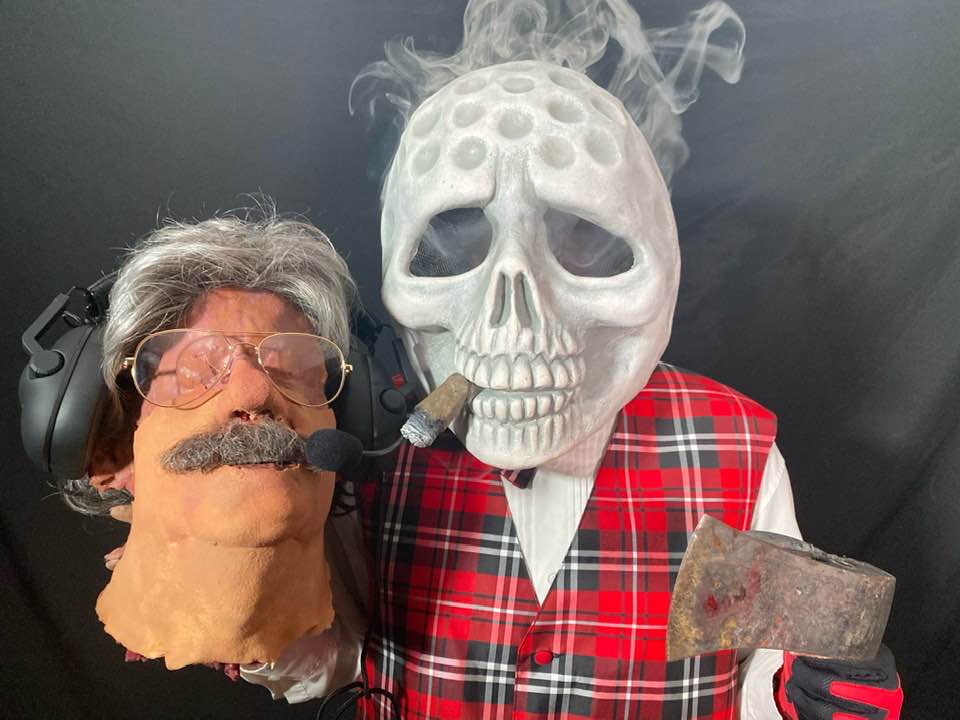
our main villain, Iver Rose, aka the Bogeyman (get it?) who has a human body,
but whose cigar chompin’ skull head is huge and round, and has the golf ball dimples
on the top of its head, which was designed by Tom Martino. Somehow, it reminds
me of the killer in Killer Waves. He is silent and is happy to make divots
of golfers whenever (just because I am not a fan of the sport, does not mean I
do not know the lingo; I have multiple family that live or lived at golf
resorts in Boca Raton, not at Mar-A-Crapo). He kills mostly with a golf club
with an ax handle at the end (nice touch). While the Bogeyman is not played by
Balsamo (different body shape), but he is certainly voiced by him.
Right off the ball –
er – iron, we are introduced to the mayor of the town, Eric Roberts, who has
been in a few of Balsamo’s later films, mostly sitting, as usual. The mayor is
as slimy as they come as he refuses to acknowledge the deaths on the golf
course to keep it open for a money-soaked Tournament (shades of the mayor in Jaws).
There are tons of
cameos, as in all Balsamo’s efforts, such as (but hardly only) Rikki Rockett
(drummer of Poison), PJ Soles (the Riff Randall), Mark Scheffler
(Last House on the Left), and director Brian Yuzna (Bride of
Re-Animator and Faust). A complaint I have had, but had not mention
in earlier reviews, is that many of the cameos went over my head; even if I
knew who they were, I may not have recognized them (such as CJ Graham, who was
Jason in Friday the 13th Part 6: Jason Lives, or John Kassir, who was
the voice of the Cryptkeeper on “Tales from the Crypt”). But here, in many
cases the Bogeyman mentions both the names and affiliations of the guests, for
which I am very grateful.
My one true issue with
the film is that there is obviously no redubs of the voices, so there is a lot
of echoes and mumbling, sometimes making it hard to understand what purposefully
ridiculousness they are saying (which is why I watched this with the subtitles
on).
The Bogeyman
Lots of blood splatter
and gore, which has steadily been better looking as Balsamo’s film go on. That
is not to say some of it is pure cheese, but in general, the splatter gives the
film its center, and there is an enormous body count, some off camera (i.e.,
the celeb cameos, one obviously taken at a horror convention table). Who could
ask for anything more?
This is completely
pun-filled, as is the wont of Balsamo, including a short but hilarious bit
concerning the sheriff (Casey Orr, aka Beefcake the Mighty), who has a southern
drawl despite the film taking place in California, and his two violent
deputies, the punny Officer Downs (Danielle Stampe) and Sy Borgg (Hunter
Jackson) (get them?). One of the Sheriff’s targets is the main hero of the
tale, Chase (co-writer John Hitt). He’s just one of the many characters who
show up on occasion, such as Rodney Callaway (Balsamo, who also plays Alabaster
Dick, a heavily made-up sports announcer).
Speaking of which, in
many of his films, there is oral narration by Balsamo to give us some
exposition and occasional puns. Well, while he voices the Bogeyman that sort of
does the same thing, here there is a series of set pieces, introduced by title
cards, such as “The Mayor’s Office,” or “Pro golfers daughters [sic] slumber
party.”
Speaking of the daughters,
there is a lot of gratuitous full-frontal nudity with pillow fights, showers,
and dancing by (I am assuming) three strippers, combined with the amusingly
gratuitous poster on the wall of Balsamo’s film, Alien Danger! With Ravenvan Slender. Heck, why not both?
My idea of a Brooklyn slice...
The ending is bat-shit
crazy what-the-hell. While I will not give it away, there’s lots of stop-motion
creatures, puppets, full-sized rubber suits, and even a cameo by the bat from Bite School.
Films like this defy
convention and are in a whole subgenre of their own, such as those by Balsamo
or Bill Zebub. Their work cannot be categorized, have a lean towards sexism in
the form of said gratuitous nudity, and are so off the wall in weird
productions, gaffs, and just plain nonsense, that the end product is all the
better for it. I generally admire that. They also almost always have the
director in some role, often as the lead, which is just fine and dandy. Films
like this are non-pretentious, and clearly are self-promotional in a way that
is enjoyable. They tend to push the envelope, and while both these directors
have a different motivation, they have a similar style that one could call
amateurish, but I call just non-clean fun.
Yeah, so I basically
begin nearly every review of director/writer/actor/etc. James Balsamo’s films
the same way every time, so to condense it: auteur, (usually horror) comedy, extremely
prolific output of work, Balsamo’s narration, shots from an airplane, full of
bad but enjoyable puns, female nudity (which is okay because nothing personal,
I really don’t need to see Balsamo’s naked bod, as he is always in his films, much
like Mel Brooks, another filmmaker I love but do not want to see in that way), animation
(both Claymation and cartoons), lately Bill Victor Arucan, and tons of cameos. And
yet, I am always happy to get to see his work. Some of these listed above are
bound to crop up in my comments, but they will all be in the film.
For this relatively
short opus, Balsamo plays Nathan Ender, a plastic surgeon who is out for
revenge by killing all the other plastic surgeons as “The Witch Doctor” (i.e.,
a masked killer). On his trail is Detective George Skully (Arucan) and his
assistant, Heather Gummer (blue-hair-tinted bodybuilder Ria Papageorgiou); we
see them interview 1980’s-1990’s star Jennifer Rubin, who plays Ender’s co-office
surgeon. Along with the killings, there is a lot of gratuitous nudity and
dancing, which is to be expected in a Balsamo release, of course.
While the revenge
premise of killing plastic surgeons is quite clear, the film has a bit of a
cobbled together feeling, which is both good and, well, a bit weak, especially
for a film this short. For example, there are a few mostly or totally nude
dance sequences that really are gratuitous and does nothing for the story with either
two or three women strippers and in one case a male (the latter is actually
better at it). Yeah, I know these will probably show up on one of Balsamo’s
anthology Sexy Time series (and rightfully so).
Joe Estevez
There is also a
ridiculously long sequence of three surgeons (including one played by Joe Estevez,
brother and uncle of other better-known actors, playing Dr. Richard Smothers –
where’s Tom?, or was he named after Smothers’ son, porn actor Dick Smothers?) walking
in a circular path through a Chinese...I’m not sure…Museum? Art gallery? While
this happens, the three riff off (ad lib) nonsense that does not promote the
story at all in a woe-is-me fashion, or just screaming dialogue. That
being said, the “Where’s Waldo” effect with the Witch Doctor in this sequence is
cool.
I am also confused
about one of the dancers on a ritualistic altar as the Witch Doctor runs a
(cool looking) knife over her body. Is she supposed to be a plastic surgeon as
well? It is incongruous with the story, especially with her smiling as the knife
skims her naked flesh. Then there is the topless dancer who sings and plays the
piano for what seems like a really long time. See, this is why it feels cobbled
together rather than an actual narrative story.
There are some
interesting cameos here and there, such as Brian Bonsall (the younger kid in
the TV show “Family Ties” and the Klingon youngster in “Star Trek: The Next
Generation”), wrestler (always a wrestler) Tonga Fifita reading poetry, and bizarro
filmmaker Jim Wynorski (I like his films), among those I have already mentioned among quite a few
others.
And what was the
reasoning for the stop-motion monster further on in the film? The story was
left quite open, I am assuming for a sequel at some point, as Balsamo has been
doing that a lot lately.
I have a theory: the
Witch Doctor is actually played by Bobby Canipe Jr., under the mask. The cinematography
is by Cagney Larkin. Balsamo’s actual role is a miniscule cameo and the rest is
voiceover. So, what I’m thinking is that this film was directed over the phone
(or Zoom) by Balsamo, but it was mostly produced and edited by him and shot while
he was away making multiple other films. That would explain the inconsistencies
and weirdness of whatever was going on in the plot, such as it was. This was
more an idea than a story.
While not the
strongest of the Balsamo releases that I have seen, and I have watched quite a
few – nearly all I enjoyed – there are some good elements to this, especially
the set designs and I like the Witch Doctor mask. Despite all my quibbling, I
am still looking forward to some of Balsamo’s upcoming releases, such as The
Righteous Adventures of Commander Star Shark and Guppy!, It Wants Blood 2,
and especially I Got a Bullet with Your Name on it!, among a dozen
others that are currently in pre-production, production, or post-production.






.jpg)