Showing posts with label drug dealers. Show all posts

Friday, January 27, 2023

Review: Blades in the Darkness

Text © Richard Gary / Indie Horror Films, 2023
Images from the Internet

Blades in the Darkness (aka Kthetrat e Shqiponjes)
Directed by Alex Visani
Aspide 1 Productions; J&K Media Partners/Unimaginable Productions
84 minutes, 2022
www.facebook.com/BladesInTheDarkness/
www.instagram.com/blades.in.the.darkness/

I do believe this is the first time I am reviewing a film from the Balkans, and I am excited. It is in Albanian and mostly Italian, with subtitles. Unlike some, I love subtitles; comes from seeing to many live, loud bands in my youth.

Taking place in the Albanian capitol of Tirana, the prologue is set in 1997, after the fall of communism in the area, and the rise of the infamous and bloody civil war that followed. In a supposedly abandoned bunker stumbled young Matia (Matia Çobanaj) meets the Commander (Francesco Rossini), and especially the Commander’s Wife (Manuela Arcuri), who are hiding out in the bunker, which sets up the story to follow, and will intermix back and forth for a while with the present.
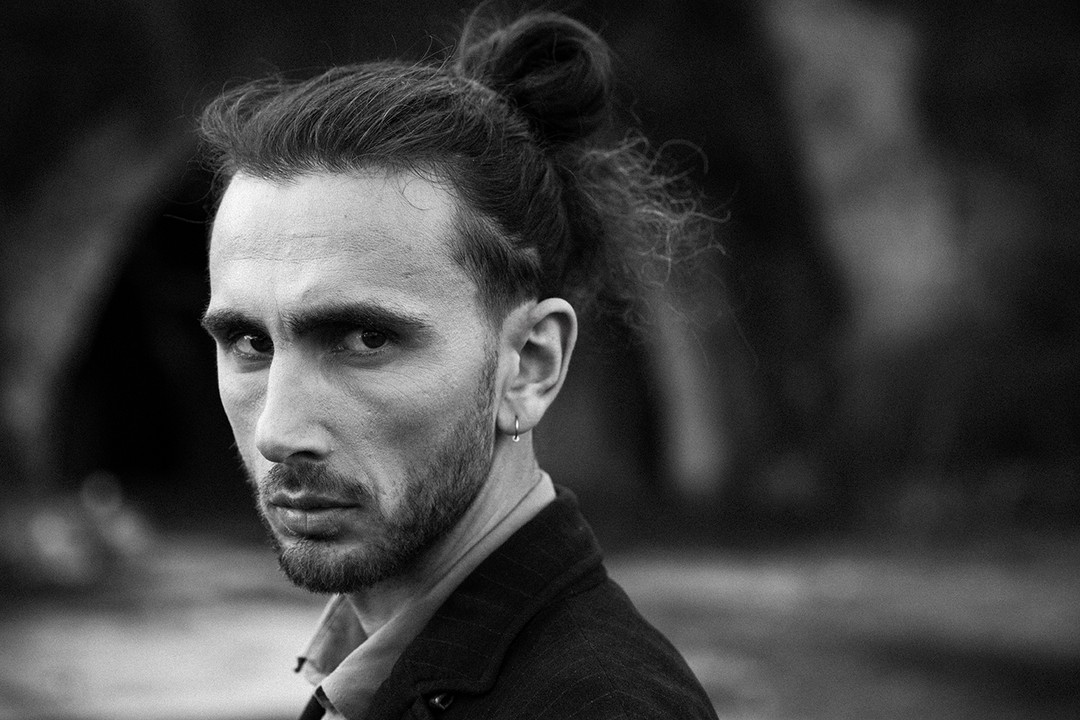
Emir Jouka

Back in modern day, arriving in Albania from the UK – but speaking Italian – is Adrian (Ermir Jonka), his girlfriend Nua (Ilirda Benleri), and Giulia (Ingrid Monacelli) and her boyfriend Davide (Endrit Ahmeta). Carrying their money in a leather bag (you can see that this is not a good idea, of course), they plan to open a restaurant in an abandoned bunker with the help of Adrian’s restauranteur cousin, Ilir (Arnold Damazzeti), who is a bit of a sketchy character, into MMA-style kickboxing (as a participant, not viewer).

Ilirda Benleri

Thanks to a betrayal by one or two of the group, with Romanian mobsters and drug dealers and money owed, their savings are gone, but some do not know it yet. This leads to them meeting up with the now insane and murderous Matia as an adult (Lorenzo Lapori, also a co-writer and fight coordinator), who had been sealed behind a wall. Years of loneliness and a seemingly perpetual 8mm propaganda film (200-foot reel, or 20 minutes) has made Matia – now known as Eagle Man in the credits – a bit tetched in the haid. He does, however, have a couple of cool and rusty knives and reminds me a bit of Kruger’s infamous claw (he even tends to run it along a wall), except one big blade for each hand. And, as the film shows, he is not afraid to use it on associates and indiscriminates alike. Yes, he is both mad, and angry, having his childhood and life taken away from him for a cause that never recovered (think of the roundly defeated Confederates or Nazis who hoped their evil beliefs would rise again.

There is a bit of a crime drama mixed in at some point, as the abandoned bunker where Eagle Man is captive behind a wall, is being utilized by a gang of drug dealers – we see a mound of bricks of white powder, perhaps representing the wall of evil that held Eagle Man captive – and their molls, more commonly known as the body count when Eagle Man flies to coop, blood and sorrow will follow.

Arnold Damazzeti

Into this scenario comes our Italian crew from England, hoping to make a new restaurant by recycling and transforming the very same bunker. As I have quoted before, Marshall McLuhan famously said when an object becomes obsolete, it comes back as art. Or in this case, a fancy eatery. While they may have served bird on the menu, they become the prey of an Eagle.

Our two couples arrive at the nest – I mean bunker – late at night, and that is where I end my descriptions, and the battle for life and death (mostly the latter, of course, as this is a literal slasher film). Somehow, in my head, I keep mishearing Creedence Clearwater Revival singing, “Down in the Bunker / Killing in the streets / The Eagle Man’s a-playin’ / Killin’ with knives so sweet.”

Lorenzo Lapori

Eagle Man is actually quite an interesting character by himself. He is as physically filthy as the Pig-Pen character from the Peanuts cartoons from literally years of not bathing, he wears the long coat and boots of the defeated army, his hair is long (though his beard not as much), and he is extremely scarred thanks to a meeting as a youth with some barb wire. Like most genre serial killers, he does not speak (though he does scream), probably from decades of loneliness. His anger comes out in the brutality of his kills. Most modern slashers, the killers like Jason and Michael are stoic, or punsters like Freddie, but this is pure rage. And then there are the cool booby-traps.

A certain level of disbelief is definitely needed around the Eagle Man, mostly pertaining to longevity. For example, he runs the projector constantly, but the bulb has not burned out, he eats food from cans, but how large a supply did they have in 1997 to the present? How does he shave (most of) his beard? How many gas drums does he have for the generator; perhaps he is Jewish, and this is a Hanukkah tale? I kid…

Manuela Arcuri

What I find interesting is that as brutal as Eagle Man is, and he really is, he is also a sympathetic character, rather than a one-dimensional killing machine. The murders are brutal and look great, without being overly graphic (i.e., not body horror), though there is a nice amount of blood to keep the customers satisfied. Hell, they even find a way for (female) nudity and a gratuitous sex scene.

While the acting is top-notch, it is the cinematography by the director that stands out for me, especially the last shot. Despite most of the film being in an ill-lit bunker, it was all clearly seen (thank you, blue filter). The bunker itself is both a maze and claustrophobic at the same time. Well done.

IMDB listing HERE


Sunday, October 30, 2022

Review: The Hostage

Text © Richard Gary / Indie Horror Films, 2022
Images from the Internet

The Hostage
Directed by Gino Alfonso
Ginome Films; Javelina 98 Productions
87 minutes, 2022

With the popularity of 8mm and occasionally 16mm if your parents had some cash, there was the inevitable rise of the “anyone can make a movie” genre. Interestingly, mostly this was horror and sci-fi. Then came the camcorder, and this mentality exploded with the amount of home-made filmmaking as the technology progressed. Now anyone with a camera has a decent one (even on cell phones), and the momentum continues.

A lot of viewers despair of this amateur level of filmmaking, but then there are those of us who encourage it. How else would we get films like Johnny Dickie’s Slaughter Tales (released 2012), or the films in the Henderson Brothers’ WinnersTape All (released 2016)? Occasionally, the director will manage to snare a name actor to help along with the project; in this case it is Robert LaSardo (I think this is the third film with him I have reviewed in the last month).

In the opening sequence, a guy with hair like the poster of Eraserhead (1977) summons the cloaked demon Arooka (LaSardo), bringing him into the world, though it does not end well for him, and now Arooka is free to cause some human damage.

This film is being called an “urban horror,” meaning that ,it takes place in the city (filmed in central Colorado, such as the films of Dakota Ray) rather than a cabin-in-a-remote-area motif which seems to dominate the field recently (possibly only second to zombies), that there will be people of color and others swearing non-stop, and probably there will be drugs involved. All are present here.

Amanda Rabinowitz, Sam Delossantos

We meet loser drug dealer wannabe and lead protagonist Jeremy (Sam Delossantos), a white guy who you know is cool because of his sleeveless white tee and the backwards baseball cap. Does not come across as well educated (the kinda guy who wears the backward cap and shields the sun with his hand). He and his pal Will (Arnold King), who is far advanced mentally to Jeremy despite his religious bent, try to buy some weed to sell, but…

Seeking revenge on the drug dealer, Ericson (Brian McGee), they hire a cousin-in-law, Derek (Rion Evans), to fix the sitch, but he is a bit unpredictable. All this is mixed up in “urban” language that often went over this milquetoast white bread reviewer who is more comfortable in the punk world than hip-hop. Meanwhile, except for the prologue, every scene so far 25 minutes in has been in a room, but mostly in cars, parked and dialogue-enriched.

Enter the two females of the story: there is Jeremy’s hyper-aggressive girlfriend, Katie (Amanda Rabinowitz) who stumbles onto some really bad planning by Jeremy and crew, and Ericson’s titular junkie girlfriend who is kidnapped by this group of knuckleheads as leverage for cash, Melissa (Sonja Cimone). The problem with this  – perhaps not the only one – is that she is possessed by Arooka. So, not only are they having to deal with a deadly drug king, but a titular demon host, predicting everyone’s short demise, of course. This includes Jeremy and Will’s stoner friend, Grady (Tamir Nemekhbayar), in whose house – well, garage – where the hostaging [sic] is taking place.

Most of the action is arguments between the main characters, even with a bunch of possessions, which helps crank it up a notch. Arooka is keeping busy taking people to his CGI world and bringing most of them back with a bit of alterations, which help move the story and the conflict along.

There are some other flaws I have found, particularly the sound quality, which is weak (so weak the auto-captioning does not always work and certainly mis-translates). The slang is also a hindrance. There is way more dialogue than there is violence, and certainly little blood other than in the prologue (or nudity).

Robert LaSardo

Okay, on the good side, this is the director’s full feature premiere, after a few shorts. The shorts brought him to the level of where the editing and framing are well done, the storyline has some glimmers, and there is the indication of what is possible as he keeps up the work, which I hope he does and gets even better over time. As I have said before, a lot of horror directors’ early films have been questionable in terms of writing and acting, such as Cronenberg’s Shivers/They Came From Within (1975) or the really early works of Peter Jackson. As the band Sparks sang, “You cannot start off and be Yehudi Menuhin.”

There is quite a bit of imaginative chances, specifically in the second half and especially in the third act. I see this film as a stepping stone on the career path of the director, and I will enjoy watching his progress.

IMDB listing HERE


Thursday, January 31, 2019

Reviews: Albert Pyun Twosome: Blast; Crazy Six

Text © Richard Gary / Indie Horror Films, 2019
Images from the Internet

 Albert Pyun, for those young’ns who don’t know, is a director who specializes in both action and sci-fi genres, and is still actively churning out films. That being said, his career had seen better days before the Millennium, with such classics as Cyborg (1989), the Wrecking Crew (2000) and Dollman (1991). Both of the films reviewed below came out the same year, in 1997.


Blast
Directed by Albert Pyun
Moonstone Entertainment / Imperial Entertainment /
Filmwerks / MVD Marquee Collection

105 minutes, 1997 / 2018
www.mvdvisual.com

There are three key elements to this film, tapped from other sources. The first is obvious: this is a direct tie-in of the classic Die Hard (1988), but rather than a tall building, as hinted by the Blu-ray’s cover, it’s an attack by terrorists on the Atlanta Olympic Games. More on that in a sec. Also, in this story the hero (vas Van Damme busy? Too expensive? Too egocentric?) Jack (Linden Ashby) is an ex­-Martial Arts Bronze Medal winner who is sidelined by an injury, while his ex-wife, Diane (Kimberly Warren), is the coach of the Women’s swimming team, and is in the occupied building being threatened. This should also sound familiar to Die Hard fans.


Linden Ashby
Second, as this is pre-9/11, the opening title cards let us know that there were FBI stings on possible terror action at the real Atlanta games, and one was found credible. Blast is explained as a what-if story of what might have happened had they not been caught, as at the Munich Games when Palestinian terrorists murdered Israeli athletes, which is the third part of bringing this story together.
The bare bones of the plot is that a group of terrorists of various nationalities are led by the Russian, Omodo (Andrew Divoff), essentially in the Hans Gruber role. They set bombs throughout the Aquatic Center where the American team of female athletes are practicing, but of course not before the young lasses have the chance to don their bathing suits (including Shannon Elizabeth in one of her early roles). HHHpwowpowHHardWhat is the goal of these terrorists? Well, odds are you’ll figure it out before Interpol.

Along the way we meet eccentric terrorist expert Mr. Leo (Rutger Hauer, seemingly to be channelling a The Island of Dr. Moreau-era Marlon Brando) who has been following our baddie for a while, and the police commissioner (Tim Thomerson, who is well-underused here in basically an extended cameo donning a Southern accent).


Andrew Divoff,  Kimberly Warren
While it’s obvious this is not the same budget level as Die Hard, Pyun does well to keep the story moving along with fisticuffs, gun fire, and some digitally layered explosions, the latter of which real look fake, but hey, 1997 technology, eh wot?
There are definitely some shortcomings, such as few of the actors here have the personality or appeal of the Die Hard characters (yes, the comparisons continue), and there’s no Yippie-ki-yay-type quotables, but on the other hand, the film moves along in a rapidly paced manner, keeping the attention going.

Speaking of which, it was nice to see a woman in one of the leading bad-guy roles, and while Warren is no Bonnie Bedelia, she eventually manages to hold her own. As for the swim team, they seem to just there for the swimsuits and to be hostages.

For a Blu-ray, there actually aren’t that many extras, being only chapters and a quartet of MVD Marquee Collection trailers, including the one for this film. I’m not complaining; all those extras take time.

Only thing that pissed me off, though, was that I was going to make a reference here about “the Burning of Atlanta,” and the film beat me to it. Snap. Anyhoo, this is pretty solid action flick that’s solid meat’n’taters.
 

Crazy Six
Directed by Albert Pyun
Moonstone Entertainment / Imperial Entertainment /
Filmwerks / MVD Marquee Collection

94 minutes, 1997 / 2018
www.mvdvisual.com

This is a crime drama, but honestly, the tone is solid Western, in the same way For a Fistful of Dollars (1964) was a Western that was a crime drama. But rather than the Old West or even Italy, this film takes place in the ruins of the USSR, 10 years after little Ronnie took credit for “tearing down this wall.”

Beyond the Fall of the Bloc, according to the storyline (and no too far from the truth), crime and corruption quickly replaced the totalitarian regime before it. Of course, many players on the international field have shown up to take a slice of the pie. As we all know that a slice is never enough.


Rob Lowe
It’s quite the cast in this film, such as Burt Reynolds (d. 2018) as a Texan – Stetson included – who is a police detective over there (say what?), Ice-T as the head of a drug dealing crew, and Mario van Peebles (I’m a fan of his dad, but I digress…) who runs a prostitution ring out of his club; and yet, the lead actor and titular character (aka Billy) is junkie and thief Rob Lowe, who was riding a bit higher on the star status at the time. While still acting regularly, he’s cropping up more in B-films. But now back to this review.
Where the Blast was pretty straight forward in story and technique, Pyun shows his artistic side with this release. Between shadows, editing, and especially the primary colors of lighting, he takes us on a grander tale of a robbery gone badly, and the result of that: never rob a drug dealing gang, please. Within the story they always say it’s an easy mark, but it always turns out bad.

Lots of shoot-em-ups, knives and fisticuffs abound (some things stay consistent between films), but add the element of drugs (crack, in this case), and watch the camera lilt about. On one hand, this shows that Pyun has an artistic edge that does not get expressed very often in his action releases, but honestly, on the other hand, in this case it feels heavy handed and convoluted. The story suffers a bit as we wait through the miasma of style to get to the next beating or firing of lots of hand guns by many people usually in a tight space (such as a single room). It’s hard to tell who is killing whom, sometimes.


Ivana Milicevic
This is not a bad film, but honestly it doesn’t feel very successful in what it was trying to achieve, because it was being pulled in too many directions. I mean the opening shot feels like it’s right out of Pulp Fiction (1994), mixed with Italian giallo (lighting) and like I said, the crime/Western genre mix. While I respect what Pyun was trying to do, the characters don’t really achieve much as far as personalities go, and it’s Ice-T that comes across as most solid. Reynolds looks like he’s making his grocery list as he recites his lines, Van Peebles has this cliché dandy French accent, and Lowe’s junkie is so toned down I was hoping his character would switch to Meth so he wouldn’t stumble around so much. The two women in the film, the constant smoking Ivana Milicevic and Blanka Kleinova fare better as characters, and are both stunningly beautiful, so there’s always that.
Again, for a Blu-ray, there are just chapters and a quintet of MVD Marquee Collection trailers, including the one for this film.


Saturday, December 15, 2018

Review: American Antichrist

Text © Richard Gary / Indie Horror Films, 2018
Images from the Internet
 

American Antichrist
Written, cinematography, directed and edited by Dakota Ray
RA Productions
50 minutes, 2018
 
It’s always interesting to get a view into the creepy, nihilistic underworld vision of Dakota Ray. None of his characters are likeable; they are all human monsters in their own way, and it presents a Denver perspective of street trash that most people will (hopefully) never truly encounter in this intimate detail. But again, that’s also what makes Ray’s work also so compelling.
 
Dakota Ray
In this, his most moody piece to date, we meet a delusional serial killer named “Smoke” (Ray) who thinks he’s god; however, through an accidental drug overdose, dies and is buried. But as the narration by him states, “Evil never dies, it just grows stronger.” Needless to say he returns from the dead (after three days, I’m assuming) as The Antichrist, of the film’s title. There is a lot of mixing of good/evil – God/Devil, which I find interesting.
 
It’s always easy to tell a Ray film because he has developed his own style, which is rare these days. He uses monochrome filters in primary colors, title cards to separate segments that overlap in the stories anyway, non-populist religious symbolisms, highway underpass walkways, and blasts of death metal. But with each passing film, he has honed his camera’s eye to be a bit more artistic without losing the grip of presenting human suffering, either by their own hands or to others. His editing is worth noting as well; for what I am assuming is a single-camera shoot, he manages to use the footage to show motion and even more important, agitation, aggression, and transgression.
 
Another auteurism of Ray’s that I have come to appreciate is that there is more audio commentary to show the inner thoughts of the characters than actual dialog, which shows an even darker side of the skel mentality. Mostly it’s Smoke at the beginning, but then we get introduced to other characters, each one like someone we pass on the street every day, yet their inner thoughts are exposed to us, and we hear what we cannot see: the dark side of human nature, and that’s part of what makes Ray’s films so fascinating, story-wise.
 
There is very little when it comes to back stories; we just meet these people as they are, and it’s scary for me because if you’re as straight as I am (a no smoking, no drugs, no hard booze nerd), it’s an exposure to a world that, well, as I’ve said in an earlier review of a Ray film, I’d rather be a fly on the wall, as it were, than actually present in the company of any of these characters.
 
Meg Lacie Brown
As usual, it’s not a huge cast, but the characters are quite defined, and each shares their own thoughts with the viewer. There’s Crystal, a desperate drug addict who is willing to do nearly anything (Meg Lacie Brown), a drug dealer/addict named Chris who is into rough sex and snuff films (Nick Benning), Sid (Damien Rimmon) who makes said films, and Benjamin (a for once clean-shaven L.B., aka Larry Bay, one of my fave Ray regulars), a hooded religiousnik who stands on corners preaching against sins and is getting messages from…God? Satan? He takes his crusade to a whole ‘nother level.
 
One of the odd things about this film is that characters rarely interact with each other, with the exception of Crystal. Most seem to be in their own world of decay and despair, not to mention delusion. There were two that I was hoping would cross paths as they are both so opposite, yet alike in their fashion. Perhaps a sequel? I would be up for that.
 
As for the cast, it is filled with non-professional actors who are friends of the director, and rather than being stilted and wooden, in most cases Ray manages to get them to be more natural, sort of playing to themselves – though I honestly hope that the characters don’t represent the personalities of the actors in real life; that would be… sad? scary? As a person who hung out at CBGBs and Max’s Kansas City in the second half of the ‘70s, I’ve seen some strong addictive personalities, and while I admire the musicianship of some, the lifestyle is one of desperation, looking for that next hit of…anything.
 
Nick Benning
Ray has stated (on IMDB) that he considers himself an artist more than a filmmaker, and I can understand why. With each film, he gets stronger. What I would like to see is more of the background story to some of Ray’s characters to understand further motivation of how and why, for example, Smoke became a serial killer other than being drug induced, even if it’s as thoughts narrations overlaid on the soundtrack.
 
If you’re tired of seeing the same old kinds of films, and want to stick your toes into something that’s avant-garde enough to be artistic and open ended, but not so opaque that you get lost in the miasma of arty masturbation, it may be time to try one of Ray’s films.
 
And Ray, thanks for the shout out in the “Thank you” section at the end!


Sunday, October 15, 2017

Review: The Short Films of Dakota Bailey 2014-2015

Text © Richard Gary / Indie Horror Films, 2017
Images from the Internet


The Short Films of Dakota Bailey 2014-2015
Written, produced, directed and edited by Dakota Bailey
R.A. Productions
About 30 minutes, 2017

If you are familiar with any of the trilogies of filmmaker Dakota Bailey’s work, you know his subgenre of super gritty and grainy life of the denizens of the lowest of low, consisting of nothing but serial killers, drug sellers and addicts, prostitutes and generally people with whom you would not want to be on the same street as, never mind the same room.

Like most auteurs, Bailey started small with short films as he developed his style that remains pretty unique, as there is no one I can think of who presents characters and situations so socially corrupt with a fly on the wall creepy feeling, and yet makes them feel alive and fearsome. These three shorts have now been released in a collection as a companion to his features.

As the director explains: “While these short films are not masterpieces, they are important because this is where our filmmaking style originated, and these shorts provided us with a template to build off of. Without these shorts, films like The Acid Sorcerer [2017, reviewed HERE], American Scumbags [2016, reviewed HERE] or My Master Satan: 3 Tales of Drug Fueled Violence [2016, reviewed HERE] may not have existed."

As most of his features are three intertwining tales, it only makes sense that this release is comprised of three of his shorts. The consistency of his characters, even if he considers some of his films in the horror genre and others not, makes this for an enjoyable WTF viewing (in a good way). I’ve enjoyed all of the Bailey films I have watched, even though they could practically all run together and it would still work. I have watched the growth from his first film right to his latest. He also shows that if someone wants to just pick up a camera and start filming, it can be done, much in the way so many people heard the gritty guitar of Johnny Thunders and wanted to start a band.

Scumbags: A Day in the Life of a Drug Dealer
8:08 minutes, 2014
Despite it being Bailey’s first film, so many of the footprints that would appear in his features are already there, such as the insertion of character description and story bit title cards, and the travelog footage of drug dealer Marshall (Matt Marshall) driving around giving way too much information about his crimes away on a cell phone (hey, Marshall, that’s illegal!) which also works for passing along exposition to the viewer.  There is an inconsistent sound quality as most of it is recorded straight onto the camera as it is shot al(though the reliability of it will improve with time and future films). In this story, Marshall wants to do away with ex-high school friend and partner, and now rival dealer, the heroin addicted Johnny (Bailey, already sporting his trademark knee-length short pants). The film, which is in mostly black and white, is short, and yet covers some nice ground as bullets fly and vapes are vaped. The pace is a bit meandering at times, yet there is still quite a bit of action in this short amount of footage. It’s a bit on the rough side, as it is most first films, but it’s also easy to see the kernel of what is to come. I am certainly enjoying watching the progression of a style that Bailey has since made great use of over the past couple of years.

Satan’s Coming for You
19:37 minutes, 2015
The longest film on this set, it appears to be a collection of outtakes and additional footage from one of Bailey’s other films, My Master Satan. Then again, in a chicken and egg paradigm, perhaps this was filmed first, and it was used to make up one of the three stories from Master. Again, in black and white with some color, especially during an acid trip, this is a loose yet somewhat coherent story about the revenge for Bubba (again Matt Marshall) and Alister (Bailey) against the person who was having the affair with Bubba’s since-deceased wife. With body exhuming from a cemetery and a bit of blowtorch behavior, Bubba and Alister go on said acid trip and meet up with Satan. From there on in it’s the two friends working through the kinks of getting away with literal murder.

I Spread Hate Like Herpes
2:12 minutes, 2015
This is a short-yet-not-sweet uncompleted fictionalized documentary starring “BK” (Brian Knapp). In its two scenes, BK discusses his own psychopathic behavior (while driving of coruse, since this is a Dakota Bailey film, and it’s a given someone will do that). There is no direction, no point, just a camera pointed at BK as he riffs. What I’m not sure of and wonder about is whether this is going to be part of a whole film on this character, if the footage is going to be included into a future Bailey feature, or was this just some goofing around that was too good not to do something with it. Too short to be boring and just long enough for head scratching, it makes a nice coda to the rest of the shorts.  

Trailer for one short is HERE.

Tuesday, January 10, 2017

Review: American Scumbags

Text © Richard Gary / Indie Horror Films, 2017
Images from the Internet

American Scumbags
Written, produced, directed and edited by Dakota Bailey
R.A. Productions
70 minutes, 2016

Director Dakota Bailey is lucky. And smart. He has found a genre niche that fits him well, and is sticking to it. His stories are fly-on-the-wall tales of pure human animal need vs. want vs. humanity that are incredibly down-to-the-ground gritty. I hope he gets used to the word, because gritty is probably a buzzword that will become ever more associated with his work. This is a compliment.

What makes his films “horror” is not some guy in a mask and machete that can’t be killed, or evil raised by people in cloaks, or something buried that returns; rather it’s the guy on the street you pass that is thinking about his next fix and will do anything to get it, or the person in the car next to you sharing the street light who is planning to pour acid on someone to avenge a perceived wrongdoing. It is meaner streets, where Joe Pesci’s character Johnny “Am I a clown?!” Devito would be considered a punk ass (and not in a Ramones kinda way).

Bailey deals with similar themes as his previous film, My Master Satan (reviewed by me HERE); in this one, we a given three stories in a city ironically named Sunnydale that are so interconnected they overlap to the point of melding into a narrative of anger, fear, and depravity – all for the benefit and enjoyment of the viewer. In this way we are introduced to the main characters: a convict who is a sadistic sociopath named Billy the Kid who needs to control the women in his life even if it means killing their pets (Darien Fawkes), the drug kingpin with the man-bun Chester (Fred Epstein), a crazed ex-con who is in a money-pickle named Lucifer who believes his own designation (Nick Benning), and Johnny (director Bailey), a hitman who kills for his drug needs. Others include a wheel-chair bound alcoholic Vietnam vet, an equally drunkard pedophile who likes little boys just out of the can, and… well, you get the idea.

After the title-carded character introduction, the first story set-up is “Billy the Kid”, and the others include “Raping the World with Guns and Drugs.” Through it all, even with the mostly ex-girlfriend (Katy Katzar) obsessed Billy, we see mostly men acting at their basest. This is a macho world we are presented. The only “carded” female character is naturally a bombastic and zaftig prostitute, Angel (Bianca Valentino). Whether she lives up to the “Scumbag” descriptor, I’ll leave you to find out.

Dakota Bailey as Johnny, on the phone
In a similar feel to the earlier flick, we meet these characters who all seem to know each other in a kind of underworld miasma, but rarely do we see them interconnect physically for any length time (other than to kill), except via the technology of cell phones. By this means we get to know the individual characters better (well, more than we’d want in real life). Perhaps it is not the history of what got them there, but certainly a higher-level vision of where they are, which is more than you get with most modern “people = death fodder” films.

There’s nothing fancy in the production. For example, the camera work is obviously handheld with a feel of found footage, though with editing it is not meant to be that. It actually works for this kind of story, making it feel in part like you are there, but not like someone just turned on a camera and shot it, which ironically takes the viewer out of the moment. The black and white also gives the grit more of a kick, with a mixture of the view being high contrast, dark, or washed out, depending on the moment (and lighting). It could also be a metaphor for a colorless life of despair, crime, narcissism and high drama (and ego-and-drug induced stupidity).

As for the acting, well, there’s no Joe Pesci, but at the same time – and more importantly – it really does feel like these guys are just being themselves (with one exception), so there’s fumbling when talking as one would in real life. Some of the dialog definitely has an improv vibe. Again, while in other circumstances in films that make take the viewer out of the action through distraction, here it is used to bring you into the hyper-realism of these characters and situations that you would never really want to be a part of in real life (hopefully). It truly feels like a form of voyeurism, as if looking through someone else’s eyes.

Despite all the violence against others, what makes these people stand out is the level of self-destructive behaviour, even if it comes out as external expression. Deep down, every one of these characters is committing slow suicide on some level, enticing others to do action against them as much as they are putting dangerous substances into themselves.

I don’t want to end this without mentioning the really great soundtrack, featuring classic hardcore style by the band Pizzatramp, from South Wales, UK.