Showing posts with label crime drama. Show all posts

Monday, July 25, 2022

Review: Love Crime

Text © Richard Gary / Indie Horror Films, 2022
Images from the Internet


Love Crime
Directed by Nicole D’Angelo
CineRidge Entertainment; Cinema Epoch; MSC Productions
67 minutes, 2022
www.facebook.com/cineridge/
I have been really been impressed by this local collective of multi-pronged actors/directors/writers/filmmakers. They all support each other both in front and behind the camera, and still manage to be prolific on a meager financial means.

One consistency is that their films tend to be minimalist, taut, and more often than not psychological. I have reviewed a number of them, such as Quarantine Girl (2020; also directed by D'Angelo), Choke (2020), and Heartbeat (2020). 

Nicole D'Angelo

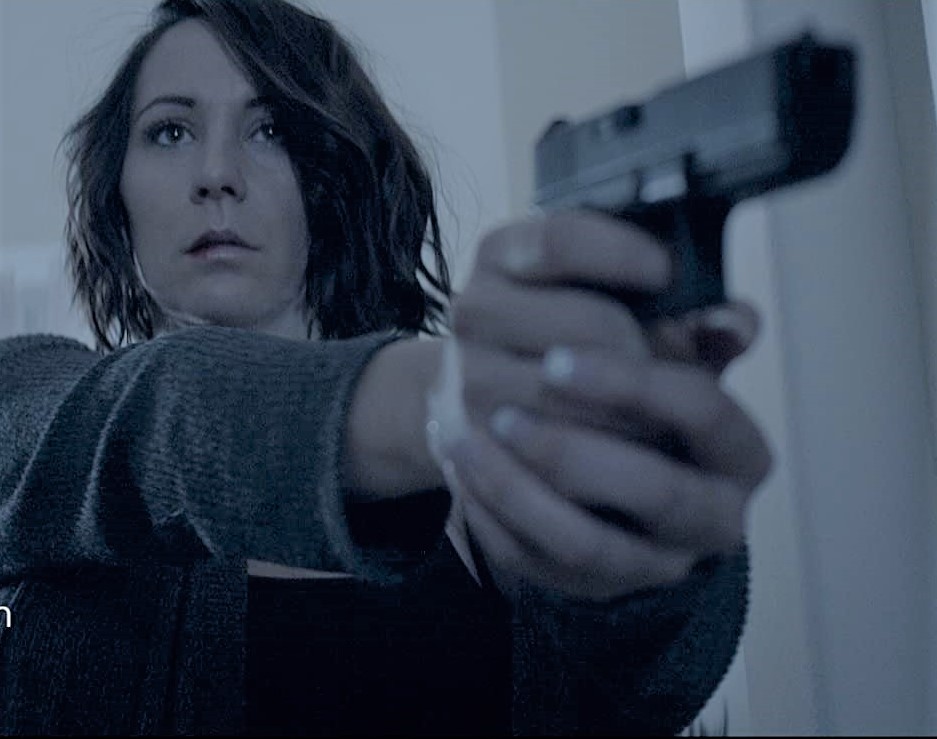
Our fare for today is a crime drama, founded somewhat on Arizonas-based Jodi Aria (director Nicole D’Angelo), who murdered her lover of a tempestuous relationship in 2008, Travis Alexander (Shane Ryan-Reid). I don’t obviously know what their real relationship was like, so when I refer to the actors’ role, I will use the first name, and for the real person, their last in this review to slow down the confusion.

Time is very fluid in this story, as the chronology is bounced around, yet the timeline of where we are at any scene is clear, thanks to some good direction and editing (more on that later). For the prologue, Jodi is already arrested and in holding as she interacts with grizzled police officer Ross (Sam Dobbins). He is stern, yet sympathetic to Jodi, unlike his boss, Detective Mace (Lisa London), who sees this as a case to be a publicity slam dunk (the real trial was heavily mediated).

Deeply religious, Jodi projects the same onto Travis, as the devout tend to do. She is way more committed to this relationship than Travis, yet she is still a believer. As I said, the real relationship was tumultuous, and this is expressed between break-ups and rejoinings. This is smartly symbolized in the editing, as some B-roll scenes are shown both going forward and backwards.

The personalities of the two main characters are also back and forth, in that they often complement each other, and yet they are quite different. Jodi is what I call god-delusional, grasping on to the weights of faith to keep herself steady. Travis, on the other hand, is a motivational speaker who is quite glib and sometimes impatient with Jodi’s questions about remaining “pure” in some ways; he is constantly using his experience with words and charm to console her, but you know he is being dishonest and it is almost as uncomfortable to watch as her divinity focus. As they swirl around each other, Mace makes like a bulldog trying to break Jodi’s façade, which may be her truth or her self-imposed wall to protect herself from what she has done.

Shane Ryan-Reid

It is easy to see the cracks in both Jodi’s armor of love of Travis and god, as much as it is to see through the weakness of Travis in both. Her overwhelming needs outweigh his lack of them, and in the film, there is no black and white personalities nor actions, as they both have their issues that they bring to the relationship. The fact is that this was a long-distance relationship, with him on the road a lot (Arias and Alexander actually lived in different states).

With multiple events happening over the overlapping timelines, I was quite impressed with the video editing by Michael Tang, which highlights the minimalist and stark (there’s those words again) cinematography by Gregory Hatanaka and Caleb Tou. For example, there can be two opposite events happening, such as an argument and a sex scene interwoven together, and it works. Occasionally, the writing by Jamie Grefe shows some nice flairs as well, such as when Mace states to Ross, “If truth is bitter, my coffee should be, too.”

D'Angelo’s double duty as both lead actor and director proves she is capable for the task. I was truly impressed with the artful directorial skill in which she handles the story. The film may be on the short side, but it was the perfect length to tell it.

The film is available to watch for free on Tubi, and on demand by Amazon and Vimeo.

IMDB listing HERE 


Thursday, May 20, 2021

Review: The Long Way Back

Text © Richard Gary / Indie Horror Films, 2021
Images from the Internet

The Long Way Back (aka Pacing the Cage)
Directed by EB Hughes
EBFilms; Breaking Glass Pictures
72 minutes, 2020
https://www.facebook.com/The-Long-Way-Back-552584021456390/

The opening shot is not only beautiful in a harsh way, but sets up the mood right from the start. We see a close-up of barbed wire on a wall, with a clear blue sky, the sound of the wind howling and the soundtrack piano plinking.

Denny Dale Bess

We are at first silently introduced to the protagonist of the story, Max (Denny Dale Bess) as he gets out a prison just west of Atlantic City after six months, and heads back to his old haunts in Alphabet City, on the Lower East Side (LES) of Manhattan. I remember once driving around there with a member of the Dead Boys and his new band, in the early 1980s, and he made me stop and jumped out so he could cop (I found that out later). That’s the kind of neighborhood we are talking about. Max is a seriously flawed human: an addict who is still using, but he claims he is trying to straighten up as he moves into a fleabag hotel. There he meets a neighbor on his way in, Sara (Reyna Kahan).

Mark Borkowski, Ron Rey

Max wants to “move forward,” but there are things holding him back, such as his addiction, and the fact that he ripped off his supplier, “Uptown” Lucius (award-winning playwright Mark Borkowski, giving off a Harvey Keitel vibe) for 20 grand just before he went to jail. So, you can see it is like that iconic line from The Godfather: Part III (1990), when Pacino laments, “Just when I thought I was out, they pullme back in!” Violent and controlling, Lucius has sent out his right-hand man, Johnnie (Ron Rey) to “fetch” Max to settle the score.

The main thread is following Max and Lucius as they spin around each other, with the connection being Johnnie. As the film goes on, the revolving gets tighter and tighter, until they start to collide, as one would expect.

Reyna Kahan

However, expectation here is wisely kept so the viewer (i.e., me) has one anticipates where the film is going, and then, where it actually does follow. Meanwhile, Max keeps trying to improve, and Lucius continues down into the spiral. Also following these men are their relationships, which reflect their current positions. It is all very engaging, watching this cat and mouse game and how it affects those around it.

New York City is practically one of the characters in the story, sometimes appearing beautiful, others leaning more towards how it looked and felt in Taxi Driver (1976). I marveled at how beautiful and ugly the city can be, having moods just like a person. There are some keynote locations used, such as the Landmark Tavern, deep in Hell’s Kitchen. While I have never been inside, I have passed it many a time.

In the neither-here-nor-there rhetorical question department, why is it that nearly any movie that shows someone walking “uptown” (e.g., Upper East – or West – Side), at some point they will be walking under some building scaffolding? Also, in the Special Thanks section of the credits, it is nice to see my old Jersey-based fanzine publisher/editor/writer acquaintance Chip Lamey listed. But I digress…

It is easy to tell the director was heavily influenced by the early, gritty works of Martin Scorsese, such as Mean Streets (1973); there is also a hint of the up-close-and-personal unflinching of Abel Ferrara’s The Bad Lieutenant (1992). Like those, this film is more character based than anything else, with subtle violence and reactions that get under the skin.

Sayra Player, Rey

There are a few interesting secondary characters, such as the manager of the hotel and Max’s friend, Ziggy (Don Striano) and especially Lucius’s tweaking coke-head girlfriend, Mona (excellently portrayed by Sayra Player). She had a stand-out scene with Johnnie that, to me, is an anchor example of good acting and writing in the film. That is not to say the rest of the cast is slacking in any kind of way. Everyone does a bang-up job, which is a rarity in independent, low-budget cinema. If this was released in the ‘80s, it could have easily had played at either art house or mainstream cinemas.

Cinematographer William J. Murray is worth noting, as well. This is especially true in the lighting, such as in Lucius’s apartment, a beautiful mix of shadows and light.

This crime drama is understated in what one might expect, and I liked it even more for that. Rather than an overladen, too long ego-trip, it is short, succinct, and gets the job done. Like I said, it’s more based on the personality of the characters than anything else, which is quite refreshing.


Tuesday, April 20, 2021

Review: Rage

 Text © Richard Gary / Indie Horror Films, 2021
Images from the Internet

Rage
Directed by John Balazs
Prima Lux Films; La Rosa Productions; Gravitas Ventures
142 minutes, 2020
www.larosaproductions.com/
www.primaluxfilms.com/

This comes from a land down under; Melbourne, specifically. It is a hybrid crime drama and psychological thriller. It is both gritty and vicious, and fraught with emotion, as well. Think of it as a Scandinavian television murder mystery that spans over half-a-dozen episodes, as there are at least five distinctive acts in the film.

Unlike other revenge films like Death Wish (1974) or perhaps I Spit on Your Grave: The Day of the Woman (1978), where the revenge is a general takedown of either numerous assaulters or a bad guy in general, this one has a very specific purpose.

Matt Theo

An unhappily married couple, Noah (Matt Theo, with a bearded Hugh Jackman vibe) and Madeline (Hayley Beveridge), are coping through their lives, hoping to reconnect but not willing to extend themselves much. Then, after a lot of exposition, two bad guys break in, and wreak havoc on them, leaving bodies, Madeline is roughed up in a much longer than needed scene, and Noah lands in a coma for a while.

There is some nice time jumping in both directions just after the assault, done with slow and deliberate editing, that shows the post-attack period of both Madeline and Noah. We also get introduced to Detective John Bennett (Richard Norton, who has played in a lot of action/martial arts/gladiator films, including one in 1993 called – wait for it – Rage), who heads the investigative team. There are a lot of montages in the film, silent b-roll over emotional music, such as one with Noah re-falling in love with the mentally absent Madeline, and regretting his time with Sophia (attractive Natasha Maymon). Another, later montage scene is segmented between the five main characters, much in the way that Stephen Sondheim tends to do in songs (think of “Quartet” from 1963’s West Side Story, but without lyrics or libretto/dialogue), and each shot of many lasting about 15 to 20 seconds apiece.

Hayley Beveridge

With the introduction of Bennett, the film is also partial police procedural, with both good and bad cops, including Officer Patricia Davidson (Melissa Barias), who was underused, and profane Officer Tommy Wells (Tony Kotsopoulos).

The pace finally picks up (somewhat), when Madeline accuses someone to Noah as the one who attacked her. The revenge stage of the story begins and pulses forward. This is where the previous nearly 2 hours has brought us, and the doors to the story blow wide open. They say revenge is best served cold, but vengeance can also be a snare more full of acid than a venus flytrap.

Most of the time the music is spot-on appropriate, but occasionally it sounds like a soap opera’s piano plinking, such as when Noah and Maddie first get together after the incident. It becomes a bit distracting at moments like this, but again, most of the time it is well-suited for the scenes, especially those with action.

Richard Norton

What honestly confuses me is that the director, John Balazs, has been a professional editor for years, and yet this film, with its pretty simple premise, is 2 hours and 23 minutes. Seriously, you could not find a way to cut this down to 90 minutes or so? This is not a John Wick or MCU action film, though it does somewhat fit into the thriller genre. As a brief example, the two-directional walk when we are introduced to Detective Bennett could easily have been cut down to a few seconds rather than being literally 2 long minutes. It did not advance the story, but rather seems a mood piece. Also, without this being in reference to the acting, which is well done by Tottie Goldsmith, most of the character of Madeline’s psychiatrist could, with one exception, be cut down to two or three quick scenes and, again, not an ounce of story would be lost.

Another issue with the film is that the violence may be too graphic for the soap opera-ish romantic drama audience, and the romantic drama may have the action seekers impatiently waiting for the violence. When it occurs, the ferocity is quite explicit and well done, but if one is not expecting it, it could be off-putting (during a date movie night for most, for example). It firmly has its feet in two different yards, swaying back and forth over the fence between them. It’s almost like it is trying to be two emotionally different films at the same time.

Natasha Maymon

All that being said, let me end with some praise that this release truly deserves: The film is actually incredibly well shot, despite its tendency to be on the dark filtered side, and the acting is pretty solid, especially from the three leads (Theo, Beveridge and Norton, the latter of whom leans toward stoic, but you get that he’s frustrated), but all fare well. As for the story, it is interesting, but pulled like a Stretch Armstrong doll. Despite its leaning towards telenovela material, it addresses the process of violence, grief, recovery and vengeance deeply, hence the time.

Overall, this is a thoughtful piece with some viciousness in a few spots, so it is not necessarily a throw-a-viewing-party-in-the-basement-with-weed-and-drinks kind of film, but rather an introspective look at relationships and the effect of violence placed upon it.


Sunday, February 28, 2021

Review: Faceless

Text © Richard Gary / Indie Horror Films, 2021
Images from the Internet

Faceless
Directed by Marcel Sarmiento
Blackbear Studios; Producer Capital Fund; Indican Pictures
97 minutes, 2021
www.indicanpictures.com/new-releases/faceless

Imagine taking a bowl and throwing in the 800 lb. gorilla of face changing movies, Face/Off (1997) and then add in some elements of Old Boy (I prefer the 2003 Chan-Wook Park version, but if you want to keep with the overemoting theme of Face/Off, we can go with the 2013 U.S. remake), stir it vigorously, and you end up with something different than either of them.

After a short prologue showing a low-life gambling addict who is betting on a dog fight under a highway, we meet the protagonist of the story, George (Brendan Sexton III, who has made lots of films, but I recognize him from 2010’s The Runaways), who wakes in the hospital having had a complete face transplant and no memory of how he got there. The operation during the credits and the gauze removal was painful to watch (scalpels and needles are an admitted weak spot for me).

With a Coen Brothers’ languid pace and artistic flair, the film has a dark, almost sepia tone, and a disorienting feel as George tries to figure out who he is, both in the past and now with a new and scarred face that even his parents repel at, giving the audience a taste of his new life and mood.

When a mysterious masked man in a bunny hug – I mean a hoodie – starts popping up in a threatening manner, it seems to be subtly implying that George, a man in a human mask, is meeting a man in a full blanched-out teddy bear mask. Is this real or is it a trick of his mind, possibly the original owner of his new countenance? Or, as his boss askes, “Are you sure it’s not your meds fuckin’ with you?” Is he and the audience being gaslit?

What is obvious and explained early is that pre-face replacement George was a man of questionable actions, and the new George has to reckon with it, much like Geena Davis’s character in The Long Kiss Goodnight (1996) or the titular mystery man in The Bourne Identity (2002; especially in the better 1980 Robert Ludlum novel).

Just who is the mysterious tall, willowy, and beautiful redheaded woman, Sophie (Alex Essoe, who has recently been Wendy in 2019’s Doctor Sleep, and a regular in 2020’s Netflix mini-series “The Haunting of Bly Manor”)? He doesn’t remember her, but she certainly knows him. The bigger question is if she’s connected to George or the original face owner? Or perhaps both?

As is a common theme in these memory loss kinds of pictures, there are flashes of remembrances that make no sense to either the character or the audience due to context, but I have learned to wait it out, because it all tends to come clear by the end as the past and the present come colliding together, usually violently (I am halfway through at this point; yes, I write as I watch).

The gore is brief but graphic, and the scar make-up is incredibly well done. As a sidebar, I must add that with the twisted scar around George’s mouth and bruises around the eyes, he looks a bit like the medical staff in the infamous “Eyeof the Beholder”  episode of “The Twilight Zone” (1960, with Donna Douglas). One of my pet peeves on a lot of action shows, be it film or tv, is that when someone is hurt, they will have a really nasty cut (usually on the brow), and the next “day” it is just a line, and then it’s gone in less than a cinematic week; “Young Wallander” comes to mind as an example. So not realistic, but cheaper on the make-up budget. Here, George gets some bruises, and they are there for the duration, as the main part of the film (post-hospital) takes place over a few days. Not only that, but with wear and tear…and punches, etc., as time goes by he actually looks worse for wear than he did at the beginning. Kudos and thank you to the relatively large make-up crew who did such a smash-up job (pun intended).

Meanwhile, George is having issues with his family and the two thugs out to get their money owed to him in his previous life. As is common in these thriller kinds of films (i.e., non-supernatural), there’s crime, double crosses, and plot twists, all working together to that explosive ending I mentioned earlier. All I can say about the conclusion, though, is that I would have loved a postscript on one year later.

The film does get a bit confusing on who is who and the whys here and there, but generally it keeps the interest, especially by the half-way point. Luckily, the beauty of the visuals kept drawing me in. My one real quibble is that the sound is sometimes either too low or mumbled for my decrepit ears (too many live Ramones [etc.] concerts in my youth).

Whatever the weak points are, they are well overshadowed by the artistic merit that was put into the final work. Overall, its feel reminded me of Blood Simple (1984), a film that I felt had some issues but liked, and it ended up becoming considered as a classic. This has that kind of hallmark, leaning in that direction.

The film is full of bubbling under actors, with lots of credits in both films and television series, sometimes as semi-regulars. In other words, even though this is a solidly independent feature, the cast is strong without any of the usual acting foibles associated with this kind of budgeted film. Combined with director Sarmiento’s skills, this is a strong contender.

The film is available in digital formats, as well as DVD as of March 2, 2021.


Monday, August 10, 2020

Review: Heartbeat


Text © Richard Gary / Indie Horror Films, 2020
Images from the Internet


Heartbeat
Directed by Gregory Hatanaka
CineRidge Entertainment; Cinema Epoch; Mad Sin Cinema
73 minutes, 2020
www.madsincinema.com

For his third feature release of the year (with another one, Quarantine Girl, expected by year-end), prolific director Gregory Hatanaka has gathered his standard troupe of players and delivered a bit of a different twist of a thriller. There is so much cast overlap with his last film, Choke (reviewed on this blog), I wonder if they were filmed concurrently. The reason I believe that is quite often the smaller the role in Choke, the more prominent the one in Heartbeat, and vicey-versey (yes, I’m leaving it that way).

Nicole D'Angelo
Jennifer (Nicole D’Angelo) is a hard-bitten and prickly news journalist who has written about a company recently, whose employees and owners are getting whacked. We get to see one of them in the prolog, which is beautifully done, though the victim (Sarah Brine, the star of Choke), is stabbed with a barber’s razor? This type of instrument is meant for slashing, not for stabbing, due to its blunt, flat top, but I’m nit-picking.

For slashing, not stabbing
What I find interesting, and I mean this not as a criticism, is that for an award-winning investigative journalist, Jennifer doesn’t really seem to be very inquisitive. When a photographer, Rick (Shane Ryan), tries to show her the connection between the murders and the article she wrote, even with evidence, she brushes him off. I feel that a good journalist would see this as another article, possibly award winning, and would jump on it. Our gal is too aloof. She has trouble even entertaining helping the local police detective on the case, Santoro (Chris Spinelli).

She’s also that way with an ex-boyfriend, the Norwegian-named Torsten (Scott Butler) – which means Thor’s Hammer, or literally, Thor’s Stone – who is a bit aggro with her boss, so I can understand why she dumped him, though they are pretty similar in the bellicosity department. Jennifer, albeit the protagonist, doesn’t really seem to try to ingratiate herself with the audience, but perhaps as the plot thickens, she’ll become less hostile like a good heroine (I’m 20 minutes in at this point); she seems to lead an extraordinarily lonely and mundane life for such an exciting profession. Though, I must add that the fact that she doesn’t follow the expected lead’s stereotypical pattern is a brave step, and I applaud it.

As the death toll rises, it circles around Jennifer until it is bound to be directed at her, much like the Saltsraumen Maelstrom, a strong eddy that whirls around her, dragging her into the fray.

Chris Spinelli
The film has an Italian giallo feel, sort of like Dario Argento’s Bird with the Crystal Plumage (aka L’uccello dale piume di cristallo, 1970), though the whispery voice on the phone, especially for the first kill during the prolog, sounds a bit like the quacky one from Leo Fulci’s The New York Ripper (aka Lo squartatore di New York, 1982).

The acting of the leads, or at least the usual suspects of what I’ll call Hatanaka’s troupe, is rather good. D’Angelo, despite her character’s bristle, does well in the lead role, making her interesting even if not overly likeable, which is a decent balancing act. Spinelli is pretty solid as the detective, easing his way into Jennifer’s life. Ryan plays against type by becoming a nerdy, almost simple-minded photographer who takes candid pictures (snap-snap, grin-grin, wink-wink, say no more) of events and people through their window, obsessing a bit on Jennifer.

With a few of the minor roles, the actors sometimes seem to stumble over their lines. Ah, the joys of indie film making; as usual, you get a mixed bag. It is part of the fun of watching these kinds of films, actually. You want perfection? Go watch an A-List overdone production, not one with a heart, like this one. But I kinda digress…

For an indie, low-budget film, this is certainly well populated with characters, which is noteworthy. And with all these people floating in and out of the story, thirty minutes in, I had it down to three suspects. Though despite the gruesome murders, like most giallos, this is essentially a crime drama about the Chinese mob and, well, I won’t go into it and give it away.

Share Ryan
The kills never come as a surprise. They are always telegraphed by POV shots and, well, the plotlines. Despite the blood, there is nothing actually gory and this relies more on the story and the fact that people are murdered to further the action, rather than just relying on SFX splatter, like Argento and Fulci did in the 1980s. Also, again, there’s that budget.

At 40 minutes, I was back down to one suspect, the first one I picked. I won’t give away who it is nor who it isn’t, as I’m not that kind of reviewer, but I will say I was right. The location of one of the murders was the giveaway for me. But that’s okay, and honestly, that’s part of why I like these kinds of films, trying to figure it out along with the protagonist.

If there is one real fault I would pick, it would be that the soundtrack is sometimes turned up too high, which at times makes it hard to hear the dialogue, such as in the final reveal. I had to watch the ending a couple of times to make out what was being said over the plunking piano and high-pitched screech on the music track. I wish I could have had some subtitles.

The story is both simple and complex at the same time, which is part of what works. It’s simple in that it goes in pretty much a straight line, and doesn’t get bogged down in complexity, even as the viewer wonders why something is happening (that will be eventually explained). The complex part is the myriad of characters, including some mandatory red herrings, that get thrown at us to help try to throw us off the track.

Is it a good film? Yes, and an enjoyable way to spend some time if you appreciate this genre. It’s a noble homage to the Italian crime giallo cinema of the 1980s, and it works in style (love the stop frames) and formula. Does it match the likes of Fulci and Argento? Well, my answer to that is, does anyone? As a fan of giallo, I kept finding myself unconsciously nodding when Hatanaka hits the right note, which was often.


Wednesday, May 15, 2019

Review: Walking Tall

Text © Richard Gary / Indie Horror Films, 2019
Images from the Internet

Walking Tall
Directed by Kevin Bray
20 Century Fox / MGM / MVD Marquee Collection
86 minutes, 2004 / 2018
www.mvdvisual.com

I like Dwayne Johnson as an actor. He’s versatile with good chops in many genres, including action, drama, and even his comic timing is top notch. But this remake of the 1973 film of the same title (though the characters’ names change here) does not star Dwayne Johnson; rather, it is wrestling superstar The Rock. Yes, there is a difference, and it all comes down to money, i.e., who is doing the financing.


The real Buford Pusser
This film is based also on the life of Buford Pusser (d. 1974) though more glitzy than the original in which stoic-yet-slow-burn Joe Don Baker played him as a man finally fed up and seeking revenge, as his town is turned into a Pottersville, if you will, and his wife is killed by the mob. Here, The Rock plays him as Chris Vaughn, a U.S. Army Special Forces Sergeant with combat training, who is highly skilled in the art of killing. And he certainly does plenty of it here.
Many of the key scenes are redone from the ’73 release, which is somewhat more accurate to Buford’s real life, but here liberties are definitely taken (e.g., Vaughn is unmarried). Actually I don’t have a problem with the re-vision of the original story, as that’s common practice in cinema history. It’s the level of the amping of testosterone in a video game world that I find, well, kinda meh. Back in Tennessee when the real story happened, one could possibly get away with the things that Buford did, never mind the mob. I can’t really imagine Vaughn in then-modern 2004 sneaking out of getting jail time. All the mob had to do is donate minimal money to a right-wing cause, and as we’ve seen in real life, people will follow blindly.


The Rock, Johnny Knoxville
See, this here version was produced by Vince McMahon, head of the wrestling association that The Rock is affiliated with, so it’s going to amp up the machismo and violence because they want to market their product (i.e., The Rock). What they ended up with was a film that basically has no character, no sense of proportion, and in which women are there to be mainly strippers and hookers, with zero personalities. His new girlfriend (Ashley Scott) is a pole dancer/call girl who works for the casino, and spends much of her screen time in red bra and panties.
As in the wrestling ring, it’s essentially mano-a-mano as The Rock goes against ex-friend and now drug dealer/casino owner Jay (seemingly perpetual villain Neal McDonough). Rounding out the group is the “comic relief” of The Rock’s sidekick, played by the ever annoying Johnny Knoxville.


Neal McDonough
Everyone gets the crap beaten out of them at some point or another, but you know who will prevail in an apparently never ending string of fights between The Rock and any number of Jay’s henchmen. And who will be the final victor? Follow the funding.

The bonus material, which I honestly did not watch, includes subtitles, an audio commentary by The Rock, and another one with the Director, Film Editor and Director of Photography, a “Fight the Good Fight” stunts featurette, deleted scenes, blooper reel, an alternate ending, a photo gallery, and the original theatrical trailer.

I don’t mind films with fighting. The Kung Fu craze of the ‘70s and ‘80s was fun and I still get a kick (pun not intended) out of those. Imaginative ones like Die Hard and Fight Club prove that it can be quite interesting, but this is just a bunch of nothing set pieces that are there to serve the purpose of promoting a product (again, The Rock), rather than telling a story. The film did well, financially, and helped The Rock become Dwayne Johnson, out of the banner of the wrestling venue. So in the long run that’s a good thing, right?


Thursday, January 31, 2019

Reviews: Albert Pyun Twosome: Blast; Crazy Six

Text © Richard Gary / Indie Horror Films, 2019
Images from the Internet

 Albert Pyun, for those young’ns who don’t know, is a director who specializes in both action and sci-fi genres, and is still actively churning out films. That being said, his career had seen better days before the Millennium, with such classics as Cyborg (1989), the Wrecking Crew (2000) and Dollman (1991). Both of the films reviewed below came out the same year, in 1997.


Blast
Directed by Albert Pyun
Moonstone Entertainment / Imperial Entertainment /
Filmwerks / MVD Marquee Collection

105 minutes, 1997 / 2018
www.mvdvisual.com

There are three key elements to this film, tapped from other sources. The first is obvious: this is a direct tie-in of the classic Die Hard (1988), but rather than a tall building, as hinted by the Blu-ray’s cover, it’s an attack by terrorists on the Atlanta Olympic Games. More on that in a sec. Also, in this story the hero (vas Van Damme busy? Too expensive? Too egocentric?) Jack (Linden Ashby) is an ex­-Martial Arts Bronze Medal winner who is sidelined by an injury, while his ex-wife, Diane (Kimberly Warren), is the coach of the Women’s swimming team, and is in the occupied building being threatened. This should also sound familiar to Die Hard fans.


Linden Ashby
Second, as this is pre-9/11, the opening title cards let us know that there were FBI stings on possible terror action at the real Atlanta games, and one was found credible. Blast is explained as a what-if story of what might have happened had they not been caught, as at the Munich Games when Palestinian terrorists murdered Israeli athletes, which is the third part of bringing this story together.
The bare bones of the plot is that a group of terrorists of various nationalities are led by the Russian, Omodo (Andrew Divoff), essentially in the Hans Gruber role. They set bombs throughout the Aquatic Center where the American team of female athletes are practicing, but of course not before the young lasses have the chance to don their bathing suits (including Shannon Elizabeth in one of her early roles). HHHpwowpowHHardWhat is the goal of these terrorists? Well, odds are you’ll figure it out before Interpol.

Along the way we meet eccentric terrorist expert Mr. Leo (Rutger Hauer, seemingly to be channelling a The Island of Dr. Moreau-era Marlon Brando) who has been following our baddie for a while, and the police commissioner (Tim Thomerson, who is well-underused here in basically an extended cameo donning a Southern accent).


Andrew Divoff,  Kimberly Warren
While it’s obvious this is not the same budget level as Die Hard, Pyun does well to keep the story moving along with fisticuffs, gun fire, and some digitally layered explosions, the latter of which real look fake, but hey, 1997 technology, eh wot?
There are definitely some shortcomings, such as few of the actors here have the personality or appeal of the Die Hard characters (yes, the comparisons continue), and there’s no Yippie-ki-yay-type quotables, but on the other hand, the film moves along in a rapidly paced manner, keeping the attention going.

Speaking of which, it was nice to see a woman in one of the leading bad-guy roles, and while Warren is no Bonnie Bedelia, she eventually manages to hold her own. As for the swim team, they seem to just there for the swimsuits and to be hostages.

For a Blu-ray, there actually aren’t that many extras, being only chapters and a quartet of MVD Marquee Collection trailers, including the one for this film. I’m not complaining; all those extras take time.

Only thing that pissed me off, though, was that I was going to make a reference here about “the Burning of Atlanta,” and the film beat me to it. Snap. Anyhoo, this is pretty solid action flick that’s solid meat’n’taters.
 

Crazy Six
Directed by Albert Pyun
Moonstone Entertainment / Imperial Entertainment /
Filmwerks / MVD Marquee Collection

94 minutes, 1997 / 2018
www.mvdvisual.com

This is a crime drama, but honestly, the tone is solid Western, in the same way For a Fistful of Dollars (1964) was a Western that was a crime drama. But rather than the Old West or even Italy, this film takes place in the ruins of the USSR, 10 years after little Ronnie took credit for “tearing down this wall.”

Beyond the Fall of the Bloc, according to the storyline (and no too far from the truth), crime and corruption quickly replaced the totalitarian regime before it. Of course, many players on the international field have shown up to take a slice of the pie. As we all know that a slice is never enough.


Rob Lowe
It’s quite the cast in this film, such as Burt Reynolds (d. 2018) as a Texan – Stetson included – who is a police detective over there (say what?), Ice-T as the head of a drug dealing crew, and Mario van Peebles (I’m a fan of his dad, but I digress…) who runs a prostitution ring out of his club; and yet, the lead actor and titular character (aka Billy) is junkie and thief Rob Lowe, who was riding a bit higher on the star status at the time. While still acting regularly, he’s cropping up more in B-films. But now back to this review.
Where the Blast was pretty straight forward in story and technique, Pyun shows his artistic side with this release. Between shadows, editing, and especially the primary colors of lighting, he takes us on a grander tale of a robbery gone badly, and the result of that: never rob a drug dealing gang, please. Within the story they always say it’s an easy mark, but it always turns out bad.

Lots of shoot-em-ups, knives and fisticuffs abound (some things stay consistent between films), but add the element of drugs (crack, in this case), and watch the camera lilt about. On one hand, this shows that Pyun has an artistic edge that does not get expressed very often in his action releases, but honestly, on the other hand, in this case it feels heavy handed and convoluted. The story suffers a bit as we wait through the miasma of style to get to the next beating or firing of lots of hand guns by many people usually in a tight space (such as a single room). It’s hard to tell who is killing whom, sometimes.


Ivana Milicevic
This is not a bad film, but honestly it doesn’t feel very successful in what it was trying to achieve, because it was being pulled in too many directions. I mean the opening shot feels like it’s right out of Pulp Fiction (1994), mixed with Italian giallo (lighting) and like I said, the crime/Western genre mix. While I respect what Pyun was trying to do, the characters don’t really achieve much as far as personalities go, and it’s Ice-T that comes across as most solid. Reynolds looks like he’s making his grocery list as he recites his lines, Van Peebles has this cliché dandy French accent, and Lowe’s junkie is so toned down I was hoping his character would switch to Meth so he wouldn’t stumble around so much. The two women in the film, the constant smoking Ivana Milicevic and Blanka Kleinova fare better as characters, and are both stunningly beautiful, so there’s always that.
Again, for a Blu-ray, there are just chapters and a quintet of MVD Marquee Collection trailers, including the one for this film.