Showing posts with label violent. Show all posts

Wednesday, May 17, 2023

Review: La Petite Mort 2: Nasty Tapes

 Text © Richard Gary / Indie Horror Films, 2023
Images from the Internet

La Petite Mort 2: Nasty Tapes (aka La Petite Mort II)
Directed by Marcel Walz;
Matador Film; Bogatzki-movie.com Movie Production;
Unearthed Films; MVD Visual
90 minutes, 2014 / 2023
www.facebook.com/la.petite.mort.2/
www.unearthedvideo.com
https://mvdb2b.com/s/LaPetiteMort2NastyTapes/UN-1149

This is the second chapter of this German transgressive cinema directed by goremaster Marcel Walz (who as since moved and started filming in Los Angeles). In the first installment, the yucky stuff was handled by Olaf Ittenbach, who is absent this time. Still, I have no doubt that will not slow down the ultraviolence. Again, the film is in German with English subtitles. But honestly, I get the feeling, the libretto is not going to matter as much as the visual. The gore effects this time are handled by The Gruesome Twosome, and Megan and Ryan (d. 2019) Nicholson. A cult SFX wizard, Ryan also directed the likes of the Gutterball franchise, Hanger (2009), and Star Vehicle (2010). 

In the first piece, LaPetite Mort, released in 2009 (though taking place in 1998), we are introduced to the Masion La Petite Mort in Frankfurt, where travelers are tortured for the deep web viewing pleasure, as well as an opportunity for rich people to fill their violent fantasies (a la the Hostel franchise), but online. Honestly, I would not be surprised if this actually happens, but as I have never been on the dark web and have no intentions of doing so, I will never know, nor do I want to see that.

Yvonne Wolke, Annika Strauss

The new owner of La Petite Mort is sexually amorphous Monsieur Matheo Maxime (Mika Metz; d. 2017), with his two hench – er – women, brunette Dominque (Annika Strauss), who returns from the first film, and blonde Monique (Yvonne Wölke). Both could have been in the video for the Divinyls’ song “Pleasure and Pain.” They are aided by others, such as the Sexy Nurses (Gabriela Wirbel and Nicole Neukirch), the well-named Eva Brown (Bea La Bea), and Matheo’s wife, Jade (Micaela Schäfer).

In the first film, we are introduced to some tourists who end up at the Jail Bar, and how they end up in Masion La Petite Morte, as well as the follow-up. Here, there is no context, just torture broken up into segments that have title cards such as “Sushi Time” with info on the victim, and how much someone is paying to have them eviscerated. As Ralph Kramden may say, “Pins and needles, needles and pins…” Victims are of both sexes, so there is that. There are also “between” segments with testimonials from happy customers who either paid for the chance to kill, or do the body work themselves. And all of it on camera.

Micalea Schafer, Mika Metz

Much of it is from the perspective of the Web cameras, so it is nearly found footage style, but there is also some “backstage” drama with Matheo and the women who work for him. Even this internal tension is caught on video, as the characters occasionally look directly at the camera and comment.

A sort of by-product of this style is that the person watching this is not just a viewer, but is a participant of the feed.

Gabriela Wirbel, Nicole Neukirch

Stylistically, it is actually shot beautifully, focusing on the faces (or parts thereof) in close-ups of most of the characters, in a darkish, reddish tone. Also, for some reason, there is some clips of Carnival of Souls (1962) and Night of the Living Dead (1968) shown on a monitor (the former also of facial close-ups).

Each set piece has a slightly different feel, such as one called “Gasrechnung” (“Gas Bill”) which has a definite World War II feel, with Eva Brown giving herself a Hitler moustache in blood. Most of this segment is in black and white as in a Leni Riefenstahl-style propaganda film. Interestingly, there is an added censor image over certain parts of the uniforms, which show Nazi iconography. German film: detailed torture permitted, but no symbols of the “fatherland.”

Like Tod Browning in films like Freaks (1932), some odd humans are thrown into the mix, such as The Twins (Barbara and Patrizia Zuchowski). There are also some cool cameos throughout from cult genre filmmakers and/or actors, such as Dustin MillsHaley Madison, Uwe Bowl, Mike Mendez, Adam Ahlbrandt, and Ryan Nicholson (d. 2019).

Despite splashes (drips?) of laughter in a couple of moments, everyone seems to be unhappy, be it through body dysmorphia, boredom while inflicting pain out of repetition, and of course, the subjects of the sharp objects. This is a pretty joyless film, with minimal humor, though there are some dark moments of it scattered throughout.

The first extra on the Blu-ray is the “Making of La Petite Mort 2” (13 min), which is essentially extended scenes showing more detail of some of the tortures. Then there is an “Alternate Scene” (4 min) that is the “Gas Bill” part, without the edited-out images of the Iron Cross, the “SS” Schutzstaffel logo, and of course the swastika armband (wonder if they ever play Lech Kowalski’s 1980 documentary D.O.A. over there).

The ”Behind the Scenes Gallery” (3 min) is lots of nice shots of the make-up and the cast, and I quite enjoyed it. As for the “Advert” (30 sec), I have no idea what I was looking at. Last, there are a few company trailers, as well as two from this film, and the first La Petite Mort.

As I stated in my review of the first film, “The problem with stories like this, and this is my opinion, is the plot revolves around the action, rather than the action being a result of the story…sometimes it goes beyond what even I can tolerate. If this is your idea of fun, well, please, have at it.”

I realize that this film is a few years old now, but I have to say, the whole premise of strangers being tortured for the pleasure of the rich and/or on the Net for clicks/cash, is becoming a bit cliché, and is merely an excuse for some graphic body horror. Sure, I like a bit of ultraviolence, but my tastes run more to the cartoonish violence, even when explicit, than just someone being tied up and put through the wringer. Also, I like more of a narrative than a string of events. How can one feel anything about any character if there is nothing to bolster the why, other than greed.

 MDB listing HERE

Thursday, September 15, 2022

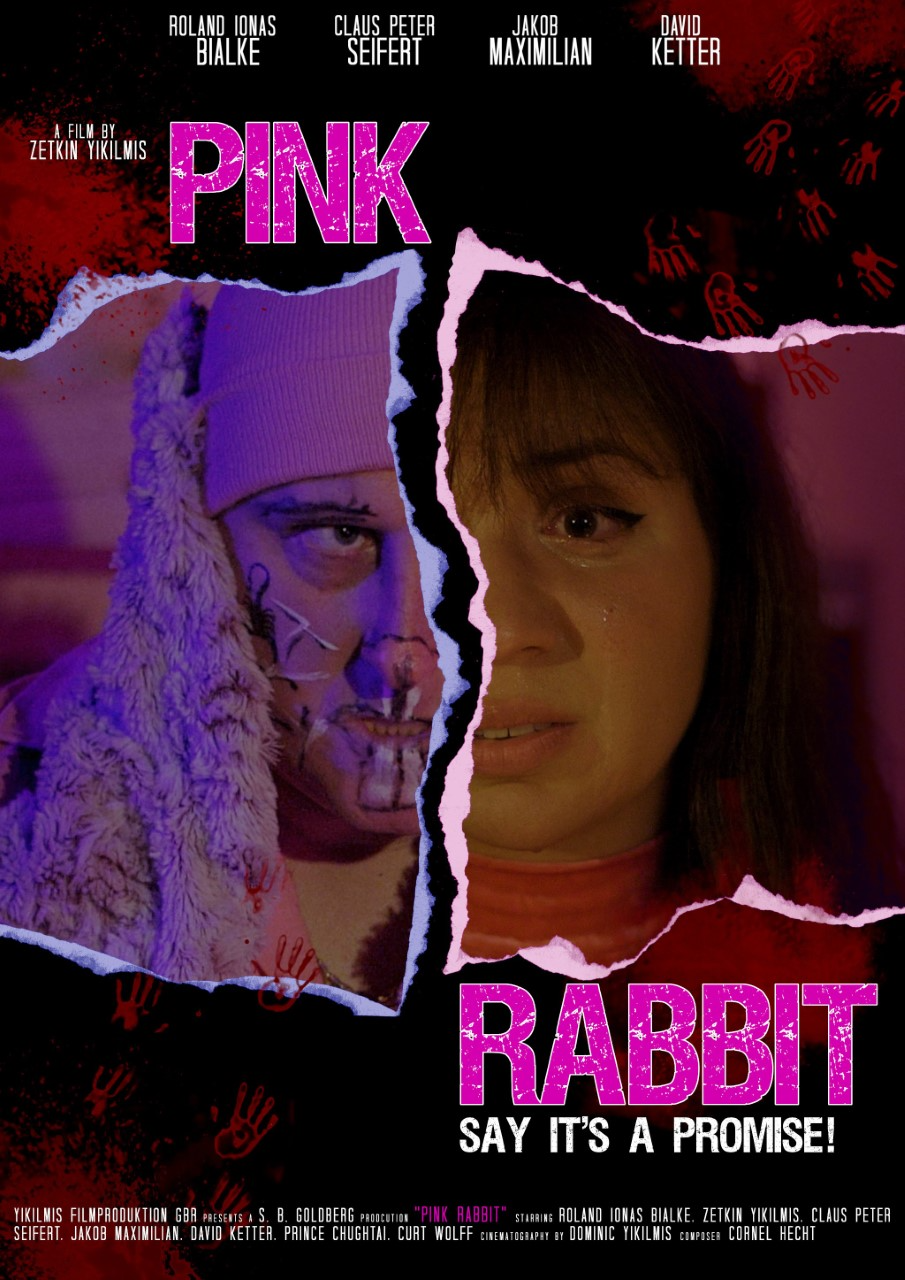
Review: Pink Rabbit

Text © Richard Gary / Indie Horror Films, 2022
Images from the Internet

Pink Rabbit
Directed by Zetkin Yıkılmış
Yikilmiş Filmproduktion; Gravitas Ventures
105 minutes, 2022
www.facebook.com/pinkrabbitthemovie/

Somewhere in my head, I hear Sly Sylvester Stone’s voice singing, “It’s a family affair…” That is hardly surprising as the star of the film, as Martha, is the director/writer, Zetkin Yıkılmış, her husband is played by her husband, Dominic Yıkılmış (who is also cinematographer), and her kid is played by her toddler son, Emil I. Yıkılmış. Zetkin also fills many other shoes, such as make-up, editing, and art direction. Something tells me this is going to be a micro-budget film. I am truly excited.

From a Turkish background, Zetkin filmed this in Germany, but it is done entirely in English, so for those who are subtitle-phobic, there should be no issue in this department; sometimes heavy accents prevail, though.

We are introduced to the “Pink Rabbit” (Roland Bialke) during the credits – well, his feet anyway – as they stomp on a bunch of flowers. Right from the start, we are told the rabbit is up to no good. And what exactly is the rabbit? It’s an adult male in a bunny suit and exaggerated make-up.

Even from the first five minutes, the film has the feel of a fairy tale. Remember, Grimm’s Fairy Tales by the Brothers Grimm (1812) also came from Germany, and if you had the chance to read the original (or early translations), as I did, they are incredibly disturbing, often containing physical torture, dismemberment, and death to men, women, and children (for example, you didn’t think Hansel and Gretel were the first children in the witch’s house, did you?). It’s this feeling of “magic” that permeates the story.

Zetkin Yıkılmış

Martha is a harried office worker who has done so much overtime that she has not seen her husband and child in days. But on her way home, on a lonely road, the real journey begins as she is zapped out of her car by the Rabbit (using ‘80s style CGI), and into the dark woods, where she is held captive by a hunter and his father, and covered in white mice (tell me, that does not sound like a fairy tale to you). But like Dorothy Gale, all she wants to do is go home.

The style of fairy tale includes a chapter where a cabin is run by two bad hunters and potential cannibals, Caleb (Jakob Suchentrunk) and his grizzled father, Kain (Claus-Peter Seifert), where they are holding Martha captive. It is almost like they are in the Middle Ages in dress and house interiors (really good set designing), though in actuality, it takes place just after the end of the American War Between the States; what is odd, though, is that they have a huge Confederate “Stars  and Bars” flag hanging in their living room. Is that some kind of political commentary? There is also an odd conglomeration of American Indian/First Nations culture and one bit of modern technology all thrown in the mixer. The language is also purposely stilted to give it a fairy tale ambience (to paraphrase, “Oh, good sir, I just want to go home”).

Roland Bialke

All of the dialogue is spoken slowly, as if being read to children, though profanity prevails, and very carefully enunciated, though the “Rabbit” is over-the-top in facial expressions, and sounds more like Snidely Whiplash as he emotes by gnashing his teeth (would that make Martha “Nell”?). Did I mention that the “Rabbit” also has an alarm clock around his neck like the White Rabbit in Alice in Wonderland?

In other films, the over exaggeration in emoting and movement would be the signs of amateurism, but as a purposeful stylistic choice, it covers a lot of bases, and because of it being consistent throughout rather than one or two actors trying their best, it flows quite well into the fairy tale narrative and motif.

A wise choice is as the scenarios change as she “kills all enemies” (Rule 2 of 3 given by the guy in the pink rabbit suit), the film nicely plays with how much is outside the scope of Martha, and how much is in her head, a manifestation of a possible psychic break after an alleged tragic event (again, real or Rabbit manipulation?). This is nicely exemplified in the character of Police Detective Fox (David Ketter, looking like he just stepped out of a Beach Boys’ cover band).

The SFX (the killings are practical and the titles that pop up on occasion or flashes when there is movement from scene to scene are digital) by Zetkin are extremely cheesy and are as cartoonish as the rest, which is appropriate. However, the set design and lighting are incredibly well done and are a spotlight, and yet still fits into the overall tone of everything else.

I have, quite honestly, not seen any of Zetkin’s other films, such as Planet Zee (2021), so I cannot compare them, but as a standalone, I was impressed by the level of the mixing of mediums of film and fairy tale. Despite sometimes having a bit of an issue with the accents (as I said earlier), especially with Bialke’s teeth gnashing, overall, I had fun with this accepting it as it is and what I feel like the mood it was going for, which I believe was achieved. This is indie filmmaking at its most basic level, a family affair, and I ended it with a smile. It feels like it was left open for a possible sequel, which I would look forward to viewing.

IMDB listing HERE

Trailer is HERE 

Saturday, September 10, 2022

Review: The Retaliators

Text © Richard Gary / Indie Horror Films, 2022
Images from the Internet

The Retaliators
Directed by Samuel Gonzalez Jr.; Bridget Smith; Michael Lombardi
Better Noise Films; K Phat Productions; CineLife Entertainment
97 minutes, 2022
www.retaliatorsmovie.com/
 

Presently, we live in a world full of conspiracy theories and beliefs in shadowy cabals out for control. Modern stories are awash with them, from the high-octane assassins of the John Wick franchise to the more intimate mundanity of Stephen King’s 1978 stop-smoking short story, “Quitters, Inc.”

To be honest, when I read the premise of the film, I thought it was going to be a revenge action thriller. While that is not totally inaccurate, there are at least three stories going on here. First, there’s the violent prologue, which I’m sure will meld with the other two at some point. Second has to do with two rival motorcycle gangs dealing with a revenge motif, thanks to the brother of the leader of one of them, Ram (Joseph Gatt; Thenn Warg in “Game of Thrones”).

Michael Lombardi

The third and central story, which also involves Ram, circles around the family of a pastor, amusingly named John Bishop (Michael Lombardi, from “Rescue Me”; he was also an “additional director” for this release). He’s a “turn the other cheek” kind of guy, but his beloved daughter, Sarah (Katie Kelly) has been murdered, and he’s out for revenge. The Detective on the case is hardnosed Jed (Marc Menchaca; he played a recurring character on “Ozark” and “Homeland”). All three parts take place in New Jersey, filmed in Vineland.

And what would you do if you were given the opportunity to have 5 minutes alone with the person responsible for the brutal death of a loved one? Yes, this has been covered before in the likes of Sympathy for Lady Vengeance (2005), but here it is more mano-a-mano, as Bishop is given that opportunity “to heal,” hence the name of the film. His link to the Retaliator(s) is no surprise, but that is hardly important to the flow of the story. The biggest added element here is the fact that (a) he is a pastor, and (b) has preached turning the other cheek. As he looks over the mean, nasty, ugly implements of destruction, that instantly made me think of the cliché of the angel and devil on the shoulder paradigm. This is an interesting moral dilemma.

Marc Menchaca

His decision, which I will not reveal, leads us to the final act of the film, where all hell breaks loose, when Ram’s brother’s motorcycle gang shows up to find Ram, armed to the teeth. But that’s not where the danger originates, which, again, I will not give away, but it is an interesting concept that reminded me of a part of Enter the Dragon (1973). And what about Bishop? Think about Straw Dogs (1971; 2011).

The prologue is finally addressed in a way that made me smile despite the gruesomeness of it (because of it, perhaps?), as Bishop looks closer to Ash Williams than to a preacher. But I was waiting for a particular moment, hoping it would come (again, no giveaways, though it seemed pretty obvious to me).

With a mostly well seasoned cast (not counting the musician newbies), this was well-acted, with Lombardi giving his all, and I have to say, Gatt makes an amazing villain, looking so much more massive than his 6’1” frame; who knew he was a self-described Star Wars geek and collector?

While Bishop is a pastor and there are a couple of scenes in his church (both concerning sermons and scripture), I would totally say that this is not a religious-themed film, and is totally non-preachy in that way. Sigh of relief from Agnostic Atheist me.

A key element to the meta of this film is its cameos, which include Mötley Crüe’s Tommy Lee as the strip club’s DJ, Jacoby Shaddix (the voice of Papa Roach) in his first acting role as a serial killer, the band Five Finger Death Punch who play at Bishop’s church, and a whole bunch of other musicians. The soundtrack, which features the music to those and other high-line bands is also available on Better Noise Music, including the Crüe’s (plus others) “The Retaliators,” ‘natch. Speaking of cameos, watch for modern Scream Queen Sarah Nicklin as Emily, a crisis counselor.

I have to say I was surprised and pleased by the amount of blood, gore and violence that was throughout the film, with a beautifully done third act that kept me smiling as things went crash and boom. The SFX were practical, as far as I could tell, and flowing.

Oh, and did I mention this was a Christmas movie?

IMDB listing HERE


Wednesday, July 20, 2022

Review: Baby Assassins

Text © Richard Gary / Indie Horror Films, 2022
Images from the Internet, unless indicated

Baby Assassins (aka Beibî warukyûre)
Directed by Yugo Sakamoto

Rights Cube; Far East Films; Well Go USA Entertainment; Hi-Yah!
95 minutes, 2021 / 2022
www.wellgousa.com/films/baby-assassins
@WellGoUSA

When I first read the title, I was confused: was this about infants in diapers who kill people, or adults who kill toddlers? Of course, in both cases, I was wrong (pretty sure I would be). I should have known better as this film is from Japan.

The “babies” in question are two teenage high school girls and possibly future cosplay objects, Chisato (Akari Takahasi). and blonde Mahiro (Saori Izawa). They are the innocents who are both about to graduate from assassin school, and are highly trained to kill. Needless to say, there are some strong comic elements to the story as they butt heads.

The film is on a couple of different tiers: first, there is the stereotypical two opposites needing to work together to survive with fun and merriment, and then there are the (literally) deadly serious assassinations, where the ladies come into their own. Like many teenagers, even with their killing expertise, it’s the simple and every day tasks that are filled with angst (such as adding whip cream to a meal).

Like “The Odd Couple” (whatever incarnation), their personalities are different, and yet they overlap in Zinn Diagram means. For example, Mahiro is Gen Whatever, with a slacker attitude of not-caring or wanting to be bothered, whose wardrobe choice is PJ bottoms and a tee (at one point it’s a Lou Reed Transformers one); and yet, she has an inclination towards philosophy. Chisato, on the other hand, is more focused, but just as lost in menial tasks. Thing with Assassin School is that, as implied, they teach killing but not social skills needed for employment or fitting into society. This is a really interesting added on touch.

Reminiscent of the series “Dead Like Me” (2003-04), between assignments the women are expected to hold down jobs that will not bring much attention to them. For example, Chisato, at some point, works in a small waffle eatery as wait- and kitchen staff, but is totally out of her element.

Now, 20 minutes into the film, and we are somewhat familiar with their sitch, enter the credits and a flashback to them first being thrust together. The commentary on government bureaucracy, such as taxes, housing and basically not taking care of their own (sound familiar?) permeates the underscore of the film. This is used both as comedy fodder and with a figuratively pointed stick.

Another jab of the elbow in the side is the Japanese tendency for older men to be attractive to younger women, as I mentioned previously. Be it an assassination target or a store clerk, the two are hit on mostly by adult men. Creepy; always was, always will be.

Things get a bit darker in the third act, as our heroines are at odds over attitudes, and to add to the mix is confrontations with a Yakuza (must be powerful; he has all of his fingers), his blowhard son Kazuki (think Sonny Corleone), and revenge seeking, psychotic, over-the-top enthusiastic daughter, Himari, who seems to be about the same age as our two killin’ protagonists.

In the first two acts, there are some decent kills scattered throughout, and somewhere along the way I made a note for myself, “Increased violence in the third act?” Of course there is, including one superb fight with Izawa, who has some Taekwondo training, and a Yakuza. Now, the fight scenes are not overly choreographed to ridiculous level, with people flying through the air, or stylized like the infamous corridor scene in the original Oldboy (2003). This is sloppy in a good way, more like fighting than something sterile in a mainstream release.

I also really liked this dive into modern Japanese culture. In fact, there are two things discussed that I had to look up: the first was a food called Oden, which is a fish cake stew (ironically, I was eating fishcakes while I was watching this… ”it’s a small world, but I wouldn’t want to paint it” – Steven Wright. But I digress…). The conversation about it takes on almost a Tarantino-eque quality, without the camera needing to swirl around the couch. The other is the use of the expression Moe Moe Kyun, which apparently means something like happiness to a level of blushing.

The director does really well in translating the personality of our two assassins to be likeable characters, even when they misbehave. He also has a way of showing the mixture of action and the lull between without getting boring. It is a mash-up of the mundane and murderous mayhem. Sometimes the action comes as a surprise, which was quite pleasant, and other times, it builds up. Also, pleasant.

By the end, it kind of leaves it off as a possible franchise, as the Japanese are wont to do with police procedurals and gangster mayhem. If this comes to be true, I will enjoy seeing what happens next with Mahiro and Chisato.

The film is available on the martial arts streaming service Hi-Yah!, and the digital and Blu-ray versions will be accessible on August 16, 2022.

IMBD Listing HERE


Saturday, May 29, 2021

Review: No Reason

Text © Richard Gary / Indie Horror Films, 2021
Images from the Internet

No Reason
Directed by Olaf Ittenbach
IMAS Film Entertainment, Unearthed Films; MVD Entertainment
77 minutes, 2010 / 2021
www.unearthedfilms.com
www.mvdb2b.com    

Bavarian director Olaf Ittenbach is infamous for his gore films. His previous release, The Burning Moon (1992) was so over the top that it was banned for extreme violence (honestly, I have never seen it). No Reason was first released in 2010, and quickly became an out-of-print collectors’ item, often bootlegged. Actually, that says a lot for his reputation.

Der Anfang dieses Films ist ein Heimfilm, der auf Deutsch, aber nicht ubersetzt ist. Leider spreche ich kein deutsch. It certainly seems benign at this point at the beginning of the credits. But what one needs to keep in mind is that the film is being re-released by Stephen Biro’s infamous gore-gore group, Unearthed Films, so you just know this is just to lull the viewer in, and blood and uncomfortable body horror is to follow. Plus, films from Germany are known for their extreme cinema (think Nekromantik, for example).

Irene Holzfurtner

I guess this review is going to be shorter than usual, because the entire film has no translation in the version I viewed. There is some deep psychological and philosophical shit going down, and basically, I missed most of it. There are long stretches of dialog, sometimes shouted, between the main character, Jennifer (Irene Holzfurtner) and a mysterious person in a Lovecraftian Cuthulu-esque mask (though it is pretty easy to figure out, in the words of The Cramps, “What’sBehind the Mask”). 

We see a number of possibilities of Jennifer’s life, from the wholesome to the – err – not. Is she a loving mother and wife, or a drug-crazed bank robbing insaniac? As Queen said, “is this the real life, or is this just fantasy?” Or perhaps this is all a “An Occurrence at Owl Creek Bridge” motif?

While there is a lot of general violence scattered throughout, the centerpiece of the film and what will be discussed the most, is Jennifer’s trip through…hell? It’s sliced (pun intended) into four sections represented by primary colors. Each is slightly different, and to get from one to another, Jennifer must make some physical sacrifice.

While in each of these rooms, they represent different “sins,” such as sexual deviations/extreme S&M, or drug-related. Everything is excessive, from close-ups of genital mutilation, a whipping scene that is reminiscent of a part of Irreversible (2002), and yet another “Jesus wept” type SFX from Hellraiser (1987).

There is a lot of thematic playing with time, changing the order of events, sometimes showing events that seem to occur at the same time in another multiverse of Jennifer’s life. There is definitely some confusion on my end, but I honestly do not know because the film was unclear or that I just could not understand the literal language.

Speakers of the German language have a history of really complex philosophies, such as Kant, Heidegger, Schopenhauer, Hegel, Schlegel, and there’s nothin’ Nietzsche couldn’t teach ye ‘bout the raisin’ of the wrist… Even in English, the title of the film has at least a double meaning (as in “someone having no reason to do that” or “not making sense”). Both work, but show the possible intricacies of meanings. Much like Jennifer’s degradation in the story: is it her own, or was it thrust upon her?

Jennifer spends most of the time roaming around full-naked, and there is male frontal nudity, as well. As for the gore, well, it is hyper-realistic. After all, Ittenbach made his name as a practical SFX person, and he proves he is certainly in his element.

I have read a few reviews (hoping to get an inkling of the story that I may have missed), and many of them, even from hardcore horror fans, were uncomfortable with this level of violence and torture porn. In some instances, I agree with them. Please know that I am not trying to restrict Ittenbach’s art in any kind of way – more power to him – but I also believe the viewer needs to know what they are getting into.

Note that the trailer below does have English subtitles, as does the DVD/Blu-Ray release, but, again, not the version I saw. The full release also contains an interview with actor Timothy Balme, a Making Of featurette, a photo gallery, and some trailers. So, if you are anywhere near squeamish, you may want to pass on this coming attraction, but if not, this is an exquisite package for you.


Tuesday, April 20, 2021

Review: Rage

 Text © Richard Gary / Indie Horror Films, 2021
Images from the Internet

Rage
Directed by John Balazs
Prima Lux Films; La Rosa Productions; Gravitas Ventures
142 minutes, 2020
www.larosaproductions.com/
www.primaluxfilms.com/

This comes from a land down under; Melbourne, specifically. It is a hybrid crime drama and psychological thriller. It is both gritty and vicious, and fraught with emotion, as well. Think of it as a Scandinavian television murder mystery that spans over half-a-dozen episodes, as there are at least five distinctive acts in the film.

Unlike other revenge films like Death Wish (1974) or perhaps I Spit on Your Grave: The Day of the Woman (1978), where the revenge is a general takedown of either numerous assaulters or a bad guy in general, this one has a very specific purpose.

Matt Theo

An unhappily married couple, Noah (Matt Theo, with a bearded Hugh Jackman vibe) and Madeline (Hayley Beveridge), are coping through their lives, hoping to reconnect but not willing to extend themselves much. Then, after a lot of exposition, two bad guys break in, and wreak havoc on them, leaving bodies, Madeline is roughed up in a much longer than needed scene, and Noah lands in a coma for a while.

There is some nice time jumping in both directions just after the assault, done with slow and deliberate editing, that shows the post-attack period of both Madeline and Noah. We also get introduced to Detective John Bennett (Richard Norton, who has played in a lot of action/martial arts/gladiator films, including one in 1993 called – wait for it – Rage), who heads the investigative team. There are a lot of montages in the film, silent b-roll over emotional music, such as one with Noah re-falling in love with the mentally absent Madeline, and regretting his time with Sophia (attractive Natasha Maymon). Another, later montage scene is segmented between the five main characters, much in the way that Stephen Sondheim tends to do in songs (think of “Quartet” from 1963’s West Side Story, but without lyrics or libretto/dialogue), and each shot of many lasting about 15 to 20 seconds apiece.

Hayley Beveridge

With the introduction of Bennett, the film is also partial police procedural, with both good and bad cops, including Officer Patricia Davidson (Melissa Barias), who was underused, and profane Officer Tommy Wells (Tony Kotsopoulos).

The pace finally picks up (somewhat), when Madeline accuses someone to Noah as the one who attacked her. The revenge stage of the story begins and pulses forward. This is where the previous nearly 2 hours has brought us, and the doors to the story blow wide open. They say revenge is best served cold, but vengeance can also be a snare more full of acid than a venus flytrap.

Most of the time the music is spot-on appropriate, but occasionally it sounds like a soap opera’s piano plinking, such as when Noah and Maddie first get together after the incident. It becomes a bit distracting at moments like this, but again, most of the time it is well-suited for the scenes, especially those with action.

Richard Norton

What honestly confuses me is that the director, John Balazs, has been a professional editor for years, and yet this film, with its pretty simple premise, is 2 hours and 23 minutes. Seriously, you could not find a way to cut this down to 90 minutes or so? This is not a John Wick or MCU action film, though it does somewhat fit into the thriller genre. As a brief example, the two-directional walk when we are introduced to Detective Bennett could easily have been cut down to a few seconds rather than being literally 2 long minutes. It did not advance the story, but rather seems a mood piece. Also, without this being in reference to the acting, which is well done by Tottie Goldsmith, most of the character of Madeline’s psychiatrist could, with one exception, be cut down to two or three quick scenes and, again, not an ounce of story would be lost.

Another issue with the film is that the violence may be too graphic for the soap opera-ish romantic drama audience, and the romantic drama may have the action seekers impatiently waiting for the violence. When it occurs, the ferocity is quite explicit and well done, but if one is not expecting it, it could be off-putting (during a date movie night for most, for example). It firmly has its feet in two different yards, swaying back and forth over the fence between them. It’s almost like it is trying to be two emotionally different films at the same time.

Natasha Maymon

All that being said, let me end with some praise that this release truly deserves: The film is actually incredibly well shot, despite its tendency to be on the dark filtered side, and the acting is pretty solid, especially from the three leads (Theo, Beveridge and Norton, the latter of whom leans toward stoic, but you get that he’s frustrated), but all fare well. As for the story, it is interesting, but pulled like a Stretch Armstrong doll. Despite its leaning towards telenovela material, it addresses the process of violence, grief, recovery and vengeance deeply, hence the time.

Overall, this is a thoughtful piece with some viciousness in a few spots, so it is not necessarily a throw-a-viewing-party-in-the-basement-with-weed-and-drinks kind of film, but rather an introspective look at relationships and the effect of violence placed upon it.