Showing posts with label martial arts. Show all posts

Wednesday, May 10, 2023

Review: Young Ip Man

Text © Richard Gary / Indie Horror Films, 2023
Images from the Internet

Young Ip Man (aka Young Ip Man: Crisis Time; 少年叶问之危机时刻; Shàonián yè wèn zhī wéijī)
Directed by Liming Li
iQIYI; Flying Youth Pictures; Lajin; Hi-YAH!; Well Go USA Entertainment
79 minutes, 2020 / 2023
https://wellgousa.com/films/young-ip-man
www.hiyahtv.com
#youngipman @WellGoUSA

While I could be wrong about this, it seems as much like the last 50 or so Amityville and [fill-in-the-blank]nado films do not really have anything to do with the original productions other than name usage, I wonder if that is true with the term “Ip Man.” Paraphrasing from Wikipedia, “Ip Man, born as (Y)Ip Kai-man (1893-1972) was a Hong Kong-based Cantonese martial artist and a grandmaster of the martial art of Wing Chun when he was 20. He had several students who later became martial arts masters in their own right, the most famous among them being Bruce Lee.”

“Ip Man” started as a series of films starring martial art legend Donnie Yen that was rightfully quite successful. Yen became iconic in the role. For this Chinese release in Mandarin (with English subtitles), Zhao Wenhao picks up the titular position as Ip Man.

Zhao Wenhao

The film opens with a bang, detailing the escape of villain Ma Long, who was set for execution for previous but not described felonies. One scene is reminiscent of Enter the Dragon (1973). Lots of shooting, stabbing, explosions, car chases, and so on. Nice way to begin, before we are even introduced to Ip Man, who is studying martial arts in said Hong Kong. We also meet his friend, Xuehu, who is wanting to impress his girlfriend, Xiaofeng.

Ip Man is also studying in a college. As this is set in 1917 in Hong Kong, which was under British rule, the school is hosting the First Xinsi Cup English Speech Contest. It is here we meet Yayun, a cute, yet spoiled rich girl who has a thing for our titular hero.

Before the contest can begin, all the students are kidnapped within the enormous building (shades of 1988’s Die Hard) by Ma Long and his gang, which includes assassin Ma Wei (Pantheras Freedman), and Xuehu, who is in need of money to buy a present for his sweetie. The purpose of the action by our villains is to hold the son of the British Police Commissioner for ransom, and possibly other nefarious reasons.

As you may have guessed, there is a socio-political component to this film, with high reliance on a dislike of the British rule in Hong Kong (much as the UK was the enemy in films about the American Revolutionary War). I have seen a number of Chinese martial arts releases which took place in the 1930s where Japan was the enemy after their invasion, but it is interesting to see it pointed at British colonialism.

Another interesting aspect is that in many of these films, the henchmen are anonymous and throw-away “machines” in the cog of the event (1997’s Austin Powers: International Man of Mystery had fun of this with Will Farrell’s character), and while most here fit that ilk, having Ip Man’s masked buddy Xuehu one of the crew makes it a bit more human.

Something I do not understand, and again, this is common for many films, is that doors are locked, but nobody thinks about breaking a window to escape. I was wondering if this was a cultural thing about destroying the property of the authorities, but they seem to have no qualms about wrecking furniture, and, in fact, break windows during fights.

Despite the drastic situation (which in the States, attacks on schools seems commonplace lately), and some decent martial arts fighting), the film actually starts a bit on the light side, often using humor, or being careful not to be too Die Hard deadly. For example, machine guns open fire on a crowd, and an explosive goes off, and yet, no one is killed. This could have been a fine John Wick intense moment, but that is not the direction of the film, which is action-based, rather than slaughter. The viewer sees lots of fights, but few killings onscreen, making those that are there more compelling. I say this not as neither a positive nor negative thing, but as an observation.

There is also a bit borrowed in theme from Kill Bill; Vol. 1 (2003), especially the House of Blue Leaves sequence, including Leng Yu, a female assassin using a chain with a deadly point, a la Gogo Yubari.

This is the director’s third feature film, and second “Ip Man” release (the first being 2019’s Ip Man: Kung Fu Master). One of the things that made Donnie Yen so iconic as Ip Man, other than his long black jacket, was his stoicism. That is one thing that is lost here, but perhaps it is because he is so young yet and has to learn the hard lessons that would bring him to that point.

There are quite a few fights, increasing in number as the film progresses, with some wire work, but not over the top (e.g., no one jumps from one storey to another). It is nice to see where Ip Man first developed his “trope” of numerous punches within seconds to the chest. I also like that sometimes things happen for reasons that are not expected, such as previous relationships.

Overall, as martial arts films go, the storyline is a bit thin and mostly follows a formula. Yet, this was a fun watch throughout; tropes are there because they are popular, after all.

As a note, as stated on IMDB: “This is supposed to take place in 1917, but the cars, clothes and many items are from at least two decades later.”

IMDB listing HERE


Monday, April 3, 2023

Review: Calamity of Snakes

Text © Richard Gary / Indie Horror Films, 2023
Images from the Internet

Calamity of Snakes (aka Ren she da zhan; 人蛇大)
Directed by Chi Chan;
Chi He Film Company; Kee Woo Film (HK) Co; Unearthed Classics; MVD Visual
86 minutes, 1982 / 2022
www.unearthedvideo.com
www.MVDVisual.com

Definitely not one to watch if you have Ophidiophobia like Indiana Jones: a fear of snakes. The snakes used are real, so there is no – er – squirming out of this.

This Category 3 film from Hong Kong (though shot in Taiwan), has been never released on digital discs in the form of DVD or Blu-ray until now. Available here are the original Mandarin, as well as the English dub of its initial release. There is also a “Cruelty-free Version,” which I will discuss later in this review.

There is a level of infamy for this, for many reason, but mostly being bat-shit (snake-shit?) crazy. It is vicious, nasty, and deadly. And then there are the snakes. In a theme similar to the Italian giallos filmed in South America such as 1980’s Cannibal Holocaust, numerous real reptiles were viciously and vividly killed during the making of it, but that is where the “Cruelty-free Version” comes in if you do not want to see that aspect. Also, it is worth noting that a percentage of all profits, whatever the format, will be donated to Save the Snakes in continuation of their mission to protect snake populations around the world.

Needless to say, I watched the original in Chinese and uncut, not because I hate snakes (I am only afraid of ones I know are dangerous, or ones that I meet in the wild and am not sure), but to place it in the context of when the film was released, during the heyday of Hong Kong horror. There is a new, 2023 documentary on that topic included on the disc, From Shaw to Snakes: The Venom and Violence of Early Chinese Language Horror Cinema (116 minutes), directed by Naomi Holwill.

Like films such as Frogs (1972) or The Happening (2008), this is a supernatural revenge of nature to atone for violence against its creatures. Do I need to say what kind? Did not think so. The basic set up is that a conglomerate wants to build a new high rise apartment complex (I have been to China, and they are still doing it in droves to temporarily bolster the economy; again I digress…). However, they discover a multitude of snakes on the spot where the building is to be constructed, so Fu-Ren “time is money” Jiang, the CEO who is overseeing the project with his lacky and comedy relief Peter Ma (Ping-Ou Wei, d. 1989), gives the orders to kill all the snakes to make it habitable for the new tenants-to-be.

Jiang’s wife, Shumei, who witnesses the slaughter (which I found profoundly sad, especially the level of glee as they actually torture the poor creatures), prays to Avalokitasvara, who helps Bodhisattva (people on their way to enlightenment; thank you Wikipedia) for forgiveness in fear of retribution for her husband’s evil deed.

On the side of the snakes, is the architect from Harvard, Dr. Zhengfeng Xu (Yun-Peng Hsiang, aka Wan-Pang Heung, who passed away recently). He is slowly building a relationship with Jiang’s spoiled but cute daughter, Xiumei. Surely a comeuppance is coming after by the third act (I am at the beginning of the second as I write this).

The real fun starts when the building is opened, and the condos start selling to various types, including a “Karen” and the flirtatious young girlfriend of an elderly rich man. You just know who will be future fodder because the story focuses on them, and they act like they deserve a “spanking” from Avalokitasvara.

The snakes include poisonous cobras (I wonder if they “drained” them first), but the lead snakes are huge pythons that are not to the ridiculous size of 1997’s Anaconda, but still impressive. To try to get rid of the snakes, they call in a professional snake handler/entertainer, Master Lin (Yuen Kao, rather than Samuel L. Jackson). Their centerpiece man-vs.-snake kung fu scene is definitely a highlight, though there is more than one martial snake involved (as puppets, with that boing “springing” sound used popularly in kung fu films of the period as things go flying).

The scenes where snakes are killed be it by humans or by a bunch of mongooses (to upbeat and cheerful music!), lasts way longer than necessary, lingering on the snakeicide in almost fetishistic fashion. This is technically a comedy, but it seems like being cruel is a point. There are literally thousands of the creatures that are killed on screen, and only two of the reptiles on the screen are fake (those puppets I mentioned earlier)

I was amused that at one point, in the background soundtrack, you could hear Tchaikovsky’s “Overture 1812.” Also, when was the last time you saw an elevator with a 13th floor, other than the Texas psychedelic band? Then there is the “Benny Hill” sped-up with bouncy carousel music moment that also fat shames.

The other extras on the Blu-ray are “Reptilian Recollections: Lin Kuang-Yung in Conversation with Chui-Yi Chung” where one of the actors talks with the director and co-writer, and a full-length commentary with writer and editor Nathan Hamilton and film director Brad Slaton. Last are an “Alternate Credits” and an image gallery.

Generally, as films go, this was a hoot. The story was silly as shit, as one might expect (and hope for the period and topic), reminding me of the likes of Squirm (1976) and Slugs (1988), but honestly, I will never watch this again, due to its level of cruelty to living creatures who were killed for no reason (even if in the film they have snake soup, eat organs, and drink snake blood). If this was made today, and it was CGI or even practical SFX, I would see the same scenes and smile. But this is inexcusable.

Now I know that what I have just said is actually going to intrigue a certain group of people into seeing it, and I have no problem about it (at least the snakes would not have completely died in vain, nor vein), but I am at an age now where I prefer the SFX and CGI fakery to the actual destruction of animals for profit.

IMDB listing HERE

Monday, February 20, 2023

Review: Legend of Gatotakaca

Text © Richard Gary / Indie Horror Films, 2023
Images from the Internet

Legend of Gatotakaca (aka Satria Dewa: Gatotakaca)

Directed by Hanung Bramantyo
Horizon Film Entertainment; Netflix; Lumine Studio;
Satreia Dewa Studio; Well Go USA Entertainment; Hi-YAH!
129 minutes, 2022 / 2023
www.instagram.com/gatotkaca_official/?hl=en
https://wellgousa.com/films/legend-gatotkaca
www.hiyahtv.com
#LegendOfGatotakaca @WellGoUSA

When I see a name of a release or character like this, I tend to run it through Wikipedia. From this, I learned that, in Indonesia, where this film originated (abbreviated quote): “Ghatotkacha (Sanskrit for "Bald Pot") is a prominent character in the story of Mahabharata. He was important fighter in the Kurukshetra war and caused a great deal of destruction and killed many demons.” He has been the subject of many films, mostly out of India.

The "real" Ghatotkacha 

The name may not roll off the English tongue very easily, but he is a warrior hero. In the action-filled prologue, we are introduced to the child Yuda, who is sought by a band of assassins. Their purpose it to find an heirloom with mystical powers, a medallion called Brajamusti.

To be honest, I am not familiar with the Indonesian god-myth culture, nor their ancient literature, such as the referenced Mahabharata (~400 BCE-400 CE) here, in a similar way they may not be familiar with, say, Beowulf (~1000 CE), Grimm’s Fairy Tales (1812), or the ancient mythological pantheon of gods of Greece, Rome, or Scandinavia (Odin, Thor, etc.). It might be good to either have Wikipedia open to throw in some of the names or terms, or just say screw it and enjoy it as it lays, as one would with the Dynasty days films of the Shaw Brothers.

After the prologue, we focus on now college student Yuda (Rizky Nazar). His mother Animbi (Sigi Wimala) is suffering from memory loss, his father Pandega (Cecep Arif Raham , from John Wick Chapter 3), disappears at the beginning, and whose best pal (Jerome Kurnia) is assassinated by a masked man with superpowers during college graduation. Yudi knowing Silat (Indonesian martial arts) does not help. Yet.

Through a learned source, Arya Laksana (Edward Akbar) and his daughter, obvious love interest Agni (Yasmin Napper), Yudi learns that the gods of the Mahabharata are real, residing in the home of the gods, Kadewatan, where Lord Shiva (aka Batara Guru rules); think Asgard and Odin. In fact, it may be helpful to imagine this is part of the Indonesia version of the Marvel Universe (MCU). The stories of Dr. Donald Blake becoming Thor after finding his source of power, his hammer Mjölnir, in a cave. I realize that the story may sound complex, but even if you don’t know the fictional characters, the storyline is quite easy to follow. For example, if you were to sit down and watch any of the MCU films, you can mostly follow along even if you have never picked up a comic book. Going forward, I will use the MCU and DC Universe (DCU) myths equivalency in brackets.

The two gods in question in this story are Pandava [Thor], and his descendants who use their power for good, and his rival Kaurava [Loki] and his lineage, who use it for, well, you know. So the Pandava group [Justise League], such as archer Dananjaya (Omar Daniel) [Green Arrow] and young Gege (scene stealer Ali Fikry) are under threat of the Kaurava one [The Legion of Doom], to restore to power an evil upper echelon god, Aswatama via his masked and his mysterious cowled underling with superpowers to steal souls [Emperor Palpatine and Darth Vader] and bring the coming of the evil gods, which is scheduled for (wait for it) 2023. Mr. Cowl is helped by Beceng (Yayan Ruhian, who was in John Wick Chapter 3:and Star Wars: Episode VII: The Force Awakens). There is a lot of exposition given to the viewer throughout.

Of course, the sworn enemy to stop this is…good guy Gatotkacha. And who is the reincarnation of said Gatotkacha who will emerge with the help of the medallion? Pretty obvious. And that is when the action really picks up. There are some good fights in the early part of the film (including some wire work), but it is also filled with lots of talking, to explain what is going on to the uninformed watching it (e.g., me).

Agni is being pursed by marriage by bully Nathan (Axel Matthew Thomas). I can see where this is going as the lamb’s blood on a door frame. Same to be said about who is the unknown “Vader” villain. Through most of this, the medallion’s powers are minimal, post-human rather than superhuman, until the final fight.

There are lots of reflections on other films than the three I mentioned. For example, there is a bit of The Power Rangers, Mortal Kombat, and even Shazam!, thanks to the medallion.

The film is enjoyable but has three issues: first, if a bit hard to follow at times; second, they try to put too much into one film (the MCU and DCU 3-hour mega-extravaganzas tend to do this a lot), but the weakest link is its length. It does not need to be this long, nor complex. As I said, it is easy to view it for what it is and leave it at that. I mean, I did not read the Lord of the Rings books (never made it past page 25 in the first one), and it was also overcomplex, yet I enjoyed the films for what they presented. If one just goes to see it as an action film, well, there is plenty of that, along with mucho exposition and talking. I believe that perhaps maybe even the younger Indonesians may not know the legends well, and that is part of why it is so wordy with explanations.

Who the masked, unnamed villain is, came as no surprise to me as I figured it out early on. And, of course, it is setting up for either a sequel or a franchise. Understandable.

The film debuts exclusively on the martial arts streaming service Hi-YAH!, before landing on Digital, and Blu-ray.

IMDB listing HERE


Saturday, January 28, 2023

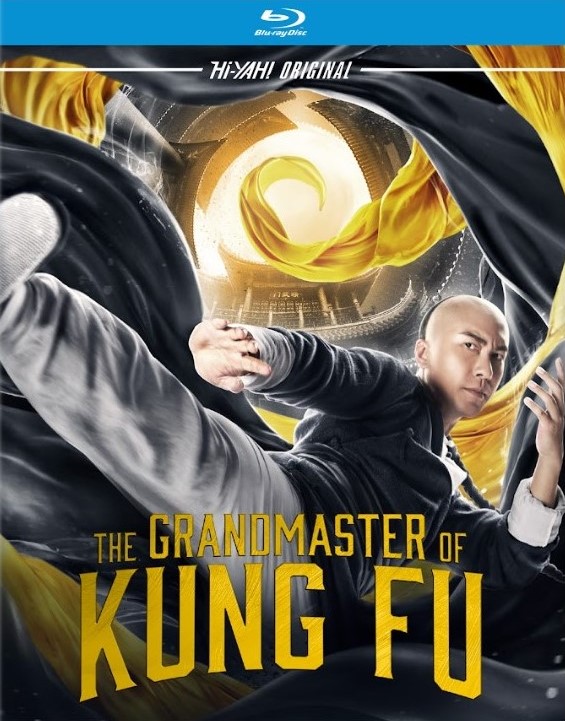
Review: The Grandmaster of Kung Fu

Text © Richard Gary / Indie Horror Films, 2023
Images from the Internet, unless indicated

The Grandmaster of Kung Fu (aka The Grandmaster of Kungfu)
Directed by Cheng Si-Yu

Zhonglele Pictures; Well Go USA Entertainment; Hi-YAH!
75 minutes, 2019 / 2023
https://wellgousa.com/films/grandmaster-kung-fu
www.hiyahtv.com
@WellGoUSA; #TheGrandmasterOfKungFu

Many of the Chinese kung fu/martial arts films of late that date back to a dynasty period, even a later one, tend to be stylized to the point of art, such as Crouching Tiger, Hidden Dragon (2000). This is a natural progression of the old Shaw Bros films of the 1970s-‘80s, but you may wonder whatever happened to the down and dirty fighting of those good old days?

In Mandarin and Japanese (with English subtitles) comes this little ditty that is relatively new to the canon, but has that old time feel, without being VHS blurry images that we all had to get used to when we rented them from the local video store. The period in which this takes place is the end of the Qing Dynasty, which was essentially during World War II, when Japan invaded China and decimated many of the people and cultural icons. It is also the focus of the story, as Japan tries to take over Tianjin, a city dedicated to the martial arts. If the city is wiped out, there are less warriors fighting for their home turf.

When Japan invaded China in 1931, it lasted until the fall of the Japanese Empire in 1945. Japan’s brutal reign over China was short-lived, but was replaced by so-called Communist China in 1949, and was modernized under a different brutal regime. This is also the time period of Ip Man (2008, also released by Well Go USA Entertainment). But enough with the contextual history lesson.

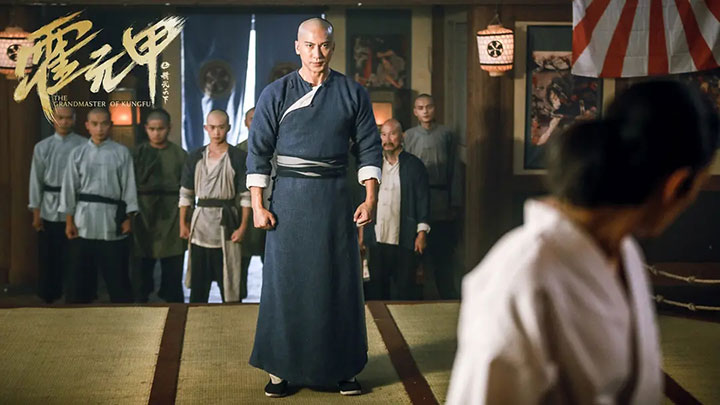
The protagonist of this story is Huo Yuanjia (former World Wushu Champion Du Yuhang (aka Dennis To). He is a lowly porter (with a large house, for some reason) with a wife (Mei Xue) and young child. Of course, he is a master at a specific kung fu, which is not recognized by the official wushu (an umbrella title for a form of kung fu; the other being kuoshu) association of Tianjin, and its new president, Zhao. His becoming the head of the group is the opening sequence of trial by fist and feet. Still, Huo manages to get a single disciple, Chen Zhen.

In comes the Japanese, led by trigger happy Commander Yoshida Masaichi and his Aikido sword wielding superior Colonel Takeda Kamesaburo, who takes over the association’s building to open a forbidden Japanese martial arts school. Of course, just minutes in, it is easy to tell that at some point it will be a fight between Yuanjia and either Masaichi or Kamesaburo in a match of Chinese kung fu vs. Japanese budō. Following the narration of nearly all these kinds of films This is a Chinese martial arts standard, and rightfully so.

Du Yuhang is very likeable, and his style is reminiscent of Donnie Yen (Ip Man). It should come as no surprise that he played the Ip Man character a year later in the prequel, The Legend is Born: Ip Man (2010). As far as the other actors, interestingly, the Japanese are played by Chinese actors, and the Japanese language is dubbed in. The film also stars Gao Xuemei, Yang Yongfeng, Li Ruoxi and Zhuang Han, but I do not know who played which role.

The film relies on a few cliches, such as the championship tournament, Japan’s overreach and malevolence, the final battle, and the one-against-many opponents (including Ninjas!). Because of this there are some formulaic narratives, but hell, we watch this stuff for the, well, Hi-YAH! quality. In this case, the action is both well-choreographed and shot/edited. There is a bunch of wirework, as is par for the course, but no ridiculous flying through the air or jumping from one roof to another. While obvious, it is done only within fights and not over-emphasized (e.g., no jumping from the ground to the top of a building).

My one complaint is that sometimes the subtitles roll by too fast for my aged eyes. But what the hell, it is the action sequences that are the backbone of any martial arts film, and this definitely delivers.

This is director Cheng Si-Yu’s first film and has since made the likes of Land Shark (2020). I am hoping he goes on to do a crime drama, or another martial arts release set in the Feudal period. Meanwhile, there is this gem.

A Hi-YAH! original, the film is available on the Hi-YAH! martial arts streaming service (link above), as well on Blu-ray and DVD.

IMBD listing HERE


Saturday, December 10, 2022

Review: Karate Ghost

Text © Richard Gary / Indie Horror Films, 2022
Images from the Internet

Karate Ghost (aka Black Belt Joe)
Directed by Bobby Canipe Jr.
Acid Bath Productions; Is This Las Vegas Productions
90 minutes, 2022
www.jamesbalsamo.com/#/

If you are wondering if this is serious or a goofy comedy, well, I mean, look at the title. If you dig a little closer, the name of the titular character, Black Belt Joe is a pun named after a much beloved blaxploitation era character played by Jim Kelly (d. 2013). 

Now, when I say “goofy,” please note that I am not saying bad, but I am saying stupidly silly with a very broad (and yes puns) comedy. In other words, this is like the Keystone Kops as opposed to, say, Lenny Bruce. And there is also a need for that level of broad and bawdy humor. That this was co-written and produced by James Balsamo, who also appears in the film wearing a ridiculous wig in an astoundingly purposefully overacted role where he even stares directly at the camera and often talks to it, should say a lot. But this is directed by Bobby Canipe Jr, and I will take it from that point of view.

Joe Balsamo

Black Belt Joe (Joe Borlik) is a Ju-Jitsu expert, but with a mean streak (and not just for his puns) that likes to kill his opponents, rather than just subduing them. One of them is the brother of Nick Laser (Balsamo), who vows revenge, by adventuring to learn the martial art, after a few drinks, ‘natch.

After a vision in the clouds reminiscent of god’s appearance in Monty Python and the Holy Grail (1975), this leads Laser to a ju-jitsu master, Wong Chong Smitch (Garrick Lane). I was amused how they make it as though the Japanese passive martial art sound like some secret wonder system, like the one taught to Uma Thurman by Sonny Chiba in Kill Bill, Vol 1 (2003).

Joe Borlik

Of course, there is the mandatory training montage, but it certainly is not up to the level of Rocky IV (1985), The Karate Kid (1984), or any of the Shaw Brothers releases. Laser is incompetent, confused and overwhelmed, which is quite amusing.

Of course, the actual fighting choreography is somewhere akin to the “MadTV” spoof of Rudy Ray Moore’s Dolemite (1975), but what else would you expect? This is a broad comedy, and fighting authenticity is not quite a requirement, even in a film about fighting. And rightfully so.

I love the posturing over-the-top machismo, where people talk (especially Laser in a forced gravelly voice) with extended last words (e.g., “You’re not leaving here aliiiiiive. You’re leaving in a body baaaag.”). I do get the feeling that much of Balsamo and Borlik’s dialogue was ad libbed, which would make sense of the two of them having co-writer credits, along with Canipe. And Joe does not leave the tournament alive (am I giving away too much, considering the name of the damn film?).

Cagney Larkin

Later (and 30 minutes into the film), Laser is a maintenance man at a Dojo recently bought by boob-obsessed to the point of cringy Allen (Cagney Larkin), who has a cute and heavily tatted girlfriend, Selena (Morrigan Thompson). They set forth an event that brings back BB Joe, who also likes to orate directly into the camera. And he is out for revenge against not only Dick – I mean Nick; damn that Allen – Laser, but anyone else who crosses his path. This leads to some fun if cartoonish gore.

And who gets killed? People who happen to wander into the Dojo when no one is around, such as a homeless guy played by Canipe, the director. But you know the big rematch showdown is coming between Laser and zombie Joe. But I wonder how they will fight each other while both looking at the camera (I kid).

Morrigan Thompson

Most of the action, be it the training, the newly bought Kali Filipino Martial Arts Dojo, and the martial arts tournaments are actually all in the same space that the crew (I am guessing Balsamo as he is the Producer) managed to find that works well. I would not be surprised if they found the place first, and then wrote the story after (that was sort of the philosophy of some of Roger Corman’s pictures: if he liked the poster, he created the film).

As ridiculous as the film is on so many levels, it is also so obvious that the cast had a lot of fun making it. What is more, that level of enjoyment is passed along to the viewer. If you are expecting to see a film with the technical capabilities and budget of, say, the Insidious franchise, you are barkin’ up the wrong cinema. However, if you delight in the likes of low budget action films like Dolemite, and “get it,” you might find yourself smiling as I did.

Much as one can almost tell when a film is under the Unearthed Films banner by its content, it is easy to watch this release and know that it is an Acid Bath Productions, and not just because Balsamo has such a central part in it; it is more the style, the laissez-faire attitude as far as storyline consistency and acting, and cheesy gore. There is also a cast, but not the overflow of celebrity cameos. However, it is nice to see this under Canipe’s direction, giving a bit of a different-yet-familiar feeling to the piece. I hope he gets to direct more.

IMDB listing HERE

Trailer TBD

Wednesday, July 20, 2022

Review: Baby Assassins

Text © Richard Gary / Indie Horror Films, 2022
Images from the Internet, unless indicated

Baby Assassins (aka Beibî warukyûre)
Directed by Yugo Sakamoto

Rights Cube; Far East Films; Well Go USA Entertainment; Hi-Yah!
95 minutes, 2021 / 2022
www.wellgousa.com/films/baby-assassins
@WellGoUSA

When I first read the title, I was confused: was this about infants in diapers who kill people, or adults who kill toddlers? Of course, in both cases, I was wrong (pretty sure I would be). I should have known better as this film is from Japan.

The “babies” in question are two teenage high school girls and possibly future cosplay objects, Chisato (Akari Takahasi). and blonde Mahiro (Saori Izawa). They are the innocents who are both about to graduate from assassin school, and are highly trained to kill. Needless to say, there are some strong comic elements to the story as they butt heads.

The film is on a couple of different tiers: first, there is the stereotypical two opposites needing to work together to survive with fun and merriment, and then there are the (literally) deadly serious assassinations, where the ladies come into their own. Like many teenagers, even with their killing expertise, it’s the simple and every day tasks that are filled with angst (such as adding whip cream to a meal).

Like “The Odd Couple” (whatever incarnation), their personalities are different, and yet they overlap in Zinn Diagram means. For example, Mahiro is Gen Whatever, with a slacker attitude of not-caring or wanting to be bothered, whose wardrobe choice is PJ bottoms and a tee (at one point it’s a Lou Reed Transformers one); and yet, she has an inclination towards philosophy. Chisato, on the other hand, is more focused, but just as lost in menial tasks. Thing with Assassin School is that, as implied, they teach killing but not social skills needed for employment or fitting into society. This is a really interesting added on touch.

Reminiscent of the series “Dead Like Me” (2003-04), between assignments the women are expected to hold down jobs that will not bring much attention to them. For example, Chisato, at some point, works in a small waffle eatery as wait- and kitchen staff, but is totally out of her element.

Now, 20 minutes into the film, and we are somewhat familiar with their sitch, enter the credits and a flashback to them first being thrust together. The commentary on government bureaucracy, such as taxes, housing and basically not taking care of their own (sound familiar?) permeates the underscore of the film. This is used both as comedy fodder and with a figuratively pointed stick.

Another jab of the elbow in the side is the Japanese tendency for older men to be attractive to younger women, as I mentioned previously. Be it an assassination target or a store clerk, the two are hit on mostly by adult men. Creepy; always was, always will be.

Things get a bit darker in the third act, as our heroines are at odds over attitudes, and to add to the mix is confrontations with a Yakuza (must be powerful; he has all of his fingers), his blowhard son Kazuki (think Sonny Corleone), and revenge seeking, psychotic, over-the-top enthusiastic daughter, Himari, who seems to be about the same age as our two killin’ protagonists.

In the first two acts, there are some decent kills scattered throughout, and somewhere along the way I made a note for myself, “Increased violence in the third act?” Of course there is, including one superb fight with Izawa, who has some Taekwondo training, and a Yakuza. Now, the fight scenes are not overly choreographed to ridiculous level, with people flying through the air, or stylized like the infamous corridor scene in the original Oldboy (2003). This is sloppy in a good way, more like fighting than something sterile in a mainstream release.

I also really liked this dive into modern Japanese culture. In fact, there are two things discussed that I had to look up: the first was a food called Oden, which is a fish cake stew (ironically, I was eating fishcakes while I was watching this… ”it’s a small world, but I wouldn’t want to paint it” – Steven Wright. But I digress…). The conversation about it takes on almost a Tarantino-eque quality, without the camera needing to swirl around the couch. The other is the use of the expression Moe Moe Kyun, which apparently means something like happiness to a level of blushing.

The director does really well in translating the personality of our two assassins to be likeable characters, even when they misbehave. He also has a way of showing the mixture of action and the lull between without getting boring. It is a mash-up of the mundane and murderous mayhem. Sometimes the action comes as a surprise, which was quite pleasant, and other times, it builds up. Also, pleasant.

By the end, it kind of leaves it off as a possible franchise, as the Japanese are wont to do with police procedurals and gangster mayhem. If this comes to be true, I will enjoy seeing what happens next with Mahiro and Chisato.

The film is available on the martial arts streaming service Hi-Yah!, and the digital and Blu-ray versions will be accessible on August 16, 2022.

IMBD Listing HERE


Wednesday, June 1, 2022

Review: Human Lanterns

Text © Richard Gary / Indie Horror Films, 2022
Images from the Internet

Human Lanterns (aka Ren pi deng long; Human Skin Lanterns)
Directed by Sun Chung
Shaw Brothers; Celestial Pictures; 88 Films; 88Asia Collection; MVD Entertainment
99 minutes, 1982 / 2022
www.MVDEntertainment.com

Back in the mid-1970s through the 1980s, if you were not there, it is hard to describe the effect and influence of the Shaw Brothers kung fu films, especially the ones taking place in some mystical time, long, long ago, when warriors with long hair could fly through the air, elderly people were the best fighters, and moustaches indicated evil.

Bruce Lee has survived the ages as far as legacy goes, but back then, it was the Shaw Brothers releases that were nearly omnipresent. There were theaters that dedicated themselves to showing them (such as one at the foot of the Manhattan Bridge), and a local New York station played their films every weekend at pre-set times.

But what I think helped popularize them were the sheer wackiness of the story mixed with a lot of martial arts action. Most were the equivalent of Roger Corman releases: you really needed to let go of any pretense towards art, and just enjoy the over acting and high drama for what it was: sheer entertainment. I have never seen this particular film before, so I am looking forward to it…

Tony Liu

The main theme of the story here, which is the complete and uncut version, is social jealousy in the feudal period of Phoenix Town. The main protagonist is wealthy warrior with classic Spock-like eyebrows, Lung Shu-Ai (Tony Liu), who is in rivalry with the local mustachioed Third Master T’an-Fu (Kuan Tai Chen). T’an provokes him by choosing Lung’s favorite prostitute, Yen Chu (Linda Chu) as his own concubine at a big feast, therefore causing Lung to lose face. To be fair, Lung is not a nice guy, who is consumed by competitiveness.

To retaliate, Lung decides to use the upcoming Lantern Festival contest (for best lantern, natch; remember the film’s title) by getting a skilled lantern maker, Chao Ch’un-Fang (Lieh Lo), who was Lung’s previous rival for Lung’s present wife, Lady Chin (Ni Tien), to create a masterpiece for him.

Then, again considering the title, there is a horror aspect to the story, represented by some dude in a mixed monkey/skull mask and costume who wants to destroy Lung. He kidnaps a woman and brings her to his underground lair, reminiscent of The Phantom of the Opera. There he very graphically does a Buffalo Bill/Leatherface on her. There is a reason the original name of the film was Human SKIN Lanterns. I don’t believe I’m giving anything away. I figured out almost instantly who was, as Lux Interior of the Cramps sang, “What’s behind the mask.” Actually, it’s given away pretty early, but I will not be the one to do it.

Kuan Tai Chen

Add an assassin into the mix to increase the action in the form of bearded Kuei Szu-Yi (Meng Lo, He does a lot of the fighting in the picture, which has its fair amount of martial arts, and yet less than usual for a Shaw Brothers release, though it certainly picks up by the third act. What is there, however, is imaginative, uses many different tools such as arm knives and fans, and there is a lot of wire work as they fly through the air with the greatest of ease. Meanwhile, the police, led by Sergeant P’an (Chien Sun), is trying to stop the jealousy-fueled violence and figure out why people are going missing.

Of course, the film is in Mandarin, with English subtitles. One thing that is not included in this package is the English dubbed version. Shaw Brothers films often used the same voice actors over and over, so they became easily recognizable by sound, if not by name. For me, it was one of the hallmarks of a Shaw Brothers release, but I can forgive them. I would have watched the film in the original Mandarin, and then again with the English dub, but that didn’t happen this time. Not a complaint, just an observation.

Lieh Lo and Hsiu-Chun Lin

Okay, let’s talk about some of the extraordinary Extras that are included with the new Blu-ray, both the physical and the digital. I’ll start with the latter. To begin, there is a full-length commentary by Kenneth Brorsson and Phil Gillion of the On Fire Network podcast. Both men are heavily accented (Swedish and British, respectively), and it was a bit of a strain to make out what they were saying, but it was worth the focus. At least until I gave up about halfway through.

Next is the featurette “A Shaw Story: An Interview with Susan Shaw” (14 min.), filmed in 2005. In this, the actor, who had a small role in the film, tells of her tumultuous career before Human Lanterns thanks to international politics, what it was like to work with the director and her opinion of the film, and her career after. She kept my attention. The next featurette is for one of the bigger stars of the film, “The Beauty and the Beasts: An Interview with Linda Chu” (14 min.). Chu talks about how she became involved with the Shaw Brothers films and her career there, and especially on her opinion about nudity. Again, it’s a good interview, but she does come off a bit vain here and there. Part of the charm, I guess. Both interviews are in Chinese with subtitles.

The last featurette is “Lau Wing: The Ambiguous Hero” (51 min.) And who is Lau Wing? That is the real name of this film’s star, Tony Liu. He goes into great detail about the art of acting, and his place in that, all while chewing gum. Of course, he discusses the film and the director, but he was working three films at the same time, and he admits his memory is hazy. It’s his relationship with actors and the studios that make this the most interesting. Lastly on the digital end is the Trailer, that the film is in HD (1080p), and the English subtitles have been retranslated.

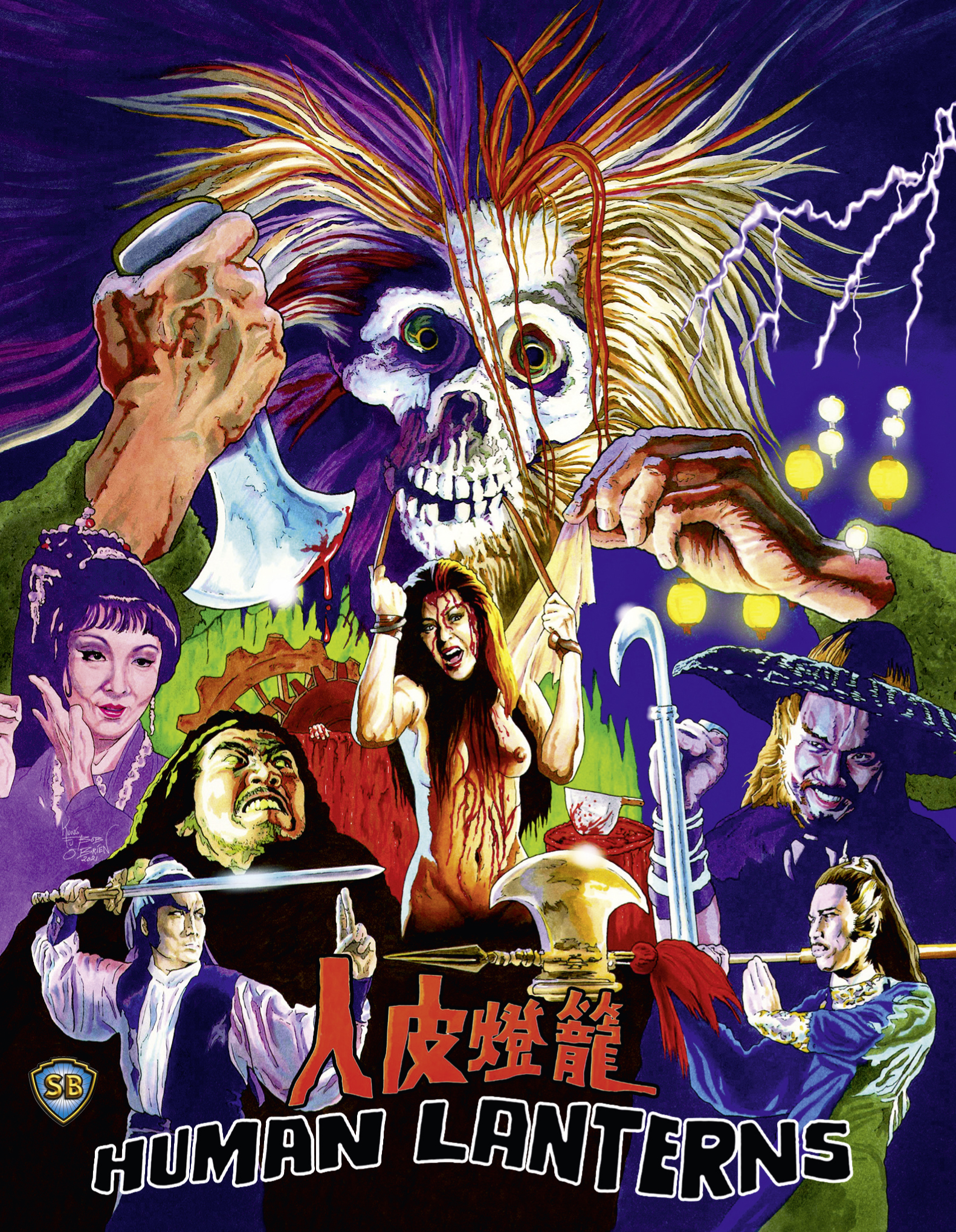
On the physical side, there is a nice slipcover with new artwork by Robert O’Brien, a double-sided case cover with the original poster, a two-sided folded paper poster insert included with the clamshell, and lastly a lush, multi-page booklet with text and photos.

The trailer’s quality makes the viewer appreciate just how gorgeous this release looks now, with vibrant colors, incredible cinematography by An-Sung Tsao, and sharp editing. The sets by Ching-Shen Chen are shown in great and sharp detail. All of this brings up the value of the release that was most likely missing from the earlier VHS copies.

While the fighting throughout most of the film often feels like under-played and Kung fu-interruptus, the final battle royale certainly makes up for it. It is beautifully staged and includes everyone of importance that’s left alive at this point. It alone makes the rest of it worth the wait, but I should add that the whole story is pretty intense and enjoyable. My old pal, Mariah Aguier (2005), who was an infamous person on the New York punk scene in the 1970s and also a martial arts film aficionado, would have probably loved this (or already did). Now, so do I.

IMDB Listing HERE 


Sunday, February 20, 2022

Review: Seobok: Project Clone

Text © Richard Gary / Indie Horror Films, 2022
Images from the Internet

Seobok: Project Clone (aka Seobok; The Clone)
Directed by Lee Yong-ju (aka Lee Yong Zoo)

CJ Entertainment; Well Go USA Entertainment
114 minutes, 2021
www.wellgousa.com/films/seobok-project-clone

Korean cinema is going through a bit of a Renaissance right now, in part thanks to Train to Busan (2016), a glorious zombie flick which set the fire burning in the West, along with the more mainstream and Oscar© winner for Best Picture Parasite (2019; though, personally, I would rather watch the 1982 film with that name).

But like every other culture’s art, there must be the B-pictures, which tend to fall into the area of genre films. For Seobok, it is two-fold, touching on both action and sci-fi elements. Think RoboCop (1987), Scanners (1981), and arguably Captain America: The First Avenger (2011) as the toe-dipping into these mutual categories of taking the human form and making it into the next generation of what is a person, as it were.

Part of the opening premise is a tale as old as time…well, at least since the 1960s secret agent film period. Through a bunch of intrigue that you know will make sense at some point involves a secret medical project under attack (it is not hard to figure out that it has something to do with cloning, considering the title), a retired and addicted government agent is reluctantly called out of retirement for one last job by the powers that be, referred to as (of course) The Company. In this case, that ex-retiree would be Ki-Heon Min (Gong Yoo).

Gong Yoo and Park Bo-Gm

As an aside, there was a cultural moment I found interesting. Ki-Heon is talking to a male doctor, Dr. Song (Ron Guan) on the project, and is introduced to the woman who heads the whole thing, Dr. Im Se-Sun (Jang Young Nam) and then Ki-Heon turns his back on her to ask him a question, which he mansplains. Why would he not ask the head? And it’s interesting to see someone smoking a cigarette in a scientific lab. Perhaps I am too woke? But, as always, I digress…

Obviously, Seobok (Park Bo-Gum) – which is alternatively spelled Seo Bok in places – is said first human clone (though I get the feeling that somewhere in the world there are real human clones). But he’s closer to Sil in Species (1995) than pure human, for he cannot naturally die (though under certain circumstances, and that he can be killed). He has grown to a full adult in 10 years, and can also control objects around him with telekinesis like Carrie (1976/2013), and his blood can cure diseases. Among other things, Ki-Heon is entrusted to save him from whomever is trying to squash the project through violent means. Seobok is also an innocent, Jesus-like character in his manner and the “miracles” he can perform through things like healing and telekinesis. But we all know how that story turned out for JC.

While K Ki-Heon is a bundle of tension and energy, Seobok is awkwardly stoic and unemotional, and a bit naive about the world, sort of like the Jim Carey character in The Truman Show (1998), but without the charm and peace of mind. He’s spent his whole life in a lab being painfully experimented upon, and no companion to entrust his thoughts, other than the doctors who are torturing him. He is both enlightened in some ways, and completely oblivious in others. Either way, he has no social skills.

Because we are dealing with secret government agencies, of course we must add in the genre of the likes of The Bourne Identity (2002), with a lot of intrigue, and double and triple crosses. Some you will see coming, such as the well-worn trope of a transport truck and cars being ambushed on the road. I am not giving anything away, because a 5 grader will see it coming a mile away.

One of the things I find amusing (because it is fiction) is in this film, as with many imports, the Americans are the villains. Remember, this was filmed during the Trump years, so I can understand the contempt considering this is made in South Korea, and Trump idolizes their enemy, the leader of North Korea. Jingoistic yahoos from the US South may be offended by this notion of US baddies, without looking at the socio-political implications that imbue it. For obvious reasons, while most of the film is in Korean (with pretty clear captioning), there is some English as well.

There is also a bit of a buddy movie subtheme going on, as Ki-Heon and Seobok bond trying to get out of dangerous situations. There is no real humor as with most buddy pics, but the bonding is there as both men need each other is other ways to save their lives. They are both reliant on each other, one for their abilities of the mind, the other of the body (i.e., shooting and martial arts fighting).

Unlike some of the Asian action films, this starts off more as a character study with occasional bits of violence thrown in, but I really enjoyed some of the quieter bits, such as Seobok experiencing a marketplace for the first time, or he and Ki-Heon talking over a bowl of instant Ramen Noodles, Seobok’s first “real” food (are those packaged soups really food?; it certainly is filled with sodium) as he’s only had “supplements” at the lab.

By the half-way mark, the two main characters are on their own, trying to survive a number of different elements after them, with Ki-Heon’s skill and arms (both physical and McLuhan-esque extensions, i.e., guns) and Seobok’s almost Buddha-like-calmness and telekinesis as their shields to fight their way to possible safety.

The film is overly long at 1:54, but some obvious moments are bound to happen, including some philosophizing about life and death since Seobok can stay alive under the right circumstances and Ki-Heon has six months to live. Also, you just know that Ki-Heon will bring up the “human” emotions in Seobok, and in return Seobok will give Ki-Heon strength to face the inevitable. Despite their differences and cliché distrust at the onset, they form a friendship that goes beyond their expected roles in each other’s lives.

While there are spirts of action sprinkled throughout, most of the film deals with the psychology of our two main protagonists, philosophizing about life and especially death, and what is our purpose, with just a hint of religiosity thrown in between the lines. Naturally, the main thrust of the real action is in the final reel, as it were, reminiscent of both Carrie and Lucy (2014).

The film is beautifully shot, with scenes of what I believe is Seoul, and the countryside as well. The visuals are crisp and the action is not overly edited, which is a rarity these days. While there are some cliches, as I have stated earlier, the story remains interesting albeit overly long. There is also a nice use of brief flashbacks that help us understand the protagonists and antagonists a bit better as far as motivation toward, well, let’s say good and evil. All in all, it was a good watch, even if it is, for me, a single-viewing film.

IMBD Listing HERE