Showing posts with label 1980s. Show all posts

Wednesday, June 1, 2022

Review: Human Lanterns

Text © Richard Gary / Indie Horror Films, 2022
Images from the Internet

Human Lanterns (aka Ren pi deng long; Human Skin Lanterns)
Directed by Sun Chung
Shaw Brothers; Celestial Pictures; 88 Films; 88Asia Collection; MVD Entertainment
99 minutes, 1982 / 2022
www.MVDEntertainment.com

Back in the mid-1970s through the 1980s, if you were not there, it is hard to describe the effect and influence of the Shaw Brothers kung fu films, especially the ones taking place in some mystical time, long, long ago, when warriors with long hair could fly through the air, elderly people were the best fighters, and moustaches indicated evil.

Bruce Lee has survived the ages as far as legacy goes, but back then, it was the Shaw Brothers releases that were nearly omnipresent. There were theaters that dedicated themselves to showing them (such as one at the foot of the Manhattan Bridge), and a local New York station played their films every weekend at pre-set times.

But what I think helped popularize them were the sheer wackiness of the story mixed with a lot of martial arts action. Most were the equivalent of Roger Corman releases: you really needed to let go of any pretense towards art, and just enjoy the over acting and high drama for what it was: sheer entertainment. I have never seen this particular film before, so I am looking forward to it…

Tony Liu

The main theme of the story here, which is the complete and uncut version, is social jealousy in the feudal period of Phoenix Town. The main protagonist is wealthy warrior with classic Spock-like eyebrows, Lung Shu-Ai (Tony Liu), who is in rivalry with the local mustachioed Third Master T’an-Fu (Kuan Tai Chen). T’an provokes him by choosing Lung’s favorite prostitute, Yen Chu (Linda Chu) as his own concubine at a big feast, therefore causing Lung to lose face. To be fair, Lung is not a nice guy, who is consumed by competitiveness.

To retaliate, Lung decides to use the upcoming Lantern Festival contest (for best lantern, natch; remember the film’s title) by getting a skilled lantern maker, Chao Ch’un-Fang (Lieh Lo), who was Lung’s previous rival for Lung’s present wife, Lady Chin (Ni Tien), to create a masterpiece for him.

Then, again considering the title, there is a horror aspect to the story, represented by some dude in a mixed monkey/skull mask and costume who wants to destroy Lung. He kidnaps a woman and brings her to his underground lair, reminiscent of The Phantom of the Opera. There he very graphically does a Buffalo Bill/Leatherface on her. There is a reason the original name of the film was Human SKIN Lanterns. I don’t believe I’m giving anything away. I figured out almost instantly who was, as Lux Interior of the Cramps sang, “What’s behind the mask.” Actually, it’s given away pretty early, but I will not be the one to do it.

Kuan Tai Chen

Add an assassin into the mix to increase the action in the form of bearded Kuei Szu-Yi (Meng Lo, He does a lot of the fighting in the picture, which has its fair amount of martial arts, and yet less than usual for a Shaw Brothers release, though it certainly picks up by the third act. What is there, however, is imaginative, uses many different tools such as arm knives and fans, and there is a lot of wire work as they fly through the air with the greatest of ease. Meanwhile, the police, led by Sergeant P’an (Chien Sun), is trying to stop the jealousy-fueled violence and figure out why people are going missing.

Of course, the film is in Mandarin, with English subtitles. One thing that is not included in this package is the English dubbed version. Shaw Brothers films often used the same voice actors over and over, so they became easily recognizable by sound, if not by name. For me, it was one of the hallmarks of a Shaw Brothers release, but I can forgive them. I would have watched the film in the original Mandarin, and then again with the English dub, but that didn’t happen this time. Not a complaint, just an observation.

Lieh Lo and Hsiu-Chun Lin

Okay, let’s talk about some of the extraordinary Extras that are included with the new Blu-ray, both the physical and the digital. I’ll start with the latter. To begin, there is a full-length commentary by Kenneth Brorsson and Phil Gillion of the On Fire Network podcast. Both men are heavily accented (Swedish and British, respectively), and it was a bit of a strain to make out what they were saying, but it was worth the focus. At least until I gave up about halfway through.

Next is the featurette “A Shaw Story: An Interview with Susan Shaw” (14 min.), filmed in 2005. In this, the actor, who had a small role in the film, tells of her tumultuous career before Human Lanterns thanks to international politics, what it was like to work with the director and her opinion of the film, and her career after. She kept my attention. The next featurette is for one of the bigger stars of the film, “The Beauty and the Beasts: An Interview with Linda Chu” (14 min.). Chu talks about how she became involved with the Shaw Brothers films and her career there, and especially on her opinion about nudity. Again, it’s a good interview, but she does come off a bit vain here and there. Part of the charm, I guess. Both interviews are in Chinese with subtitles.

The last featurette is “Lau Wing: The Ambiguous Hero” (51 min.) And who is Lau Wing? That is the real name of this film’s star, Tony Liu. He goes into great detail about the art of acting, and his place in that, all while chewing gum. Of course, he discusses the film and the director, but he was working three films at the same time, and he admits his memory is hazy. It’s his relationship with actors and the studios that make this the most interesting. Lastly on the digital end is the Trailer, that the film is in HD (1080p), and the English subtitles have been retranslated.

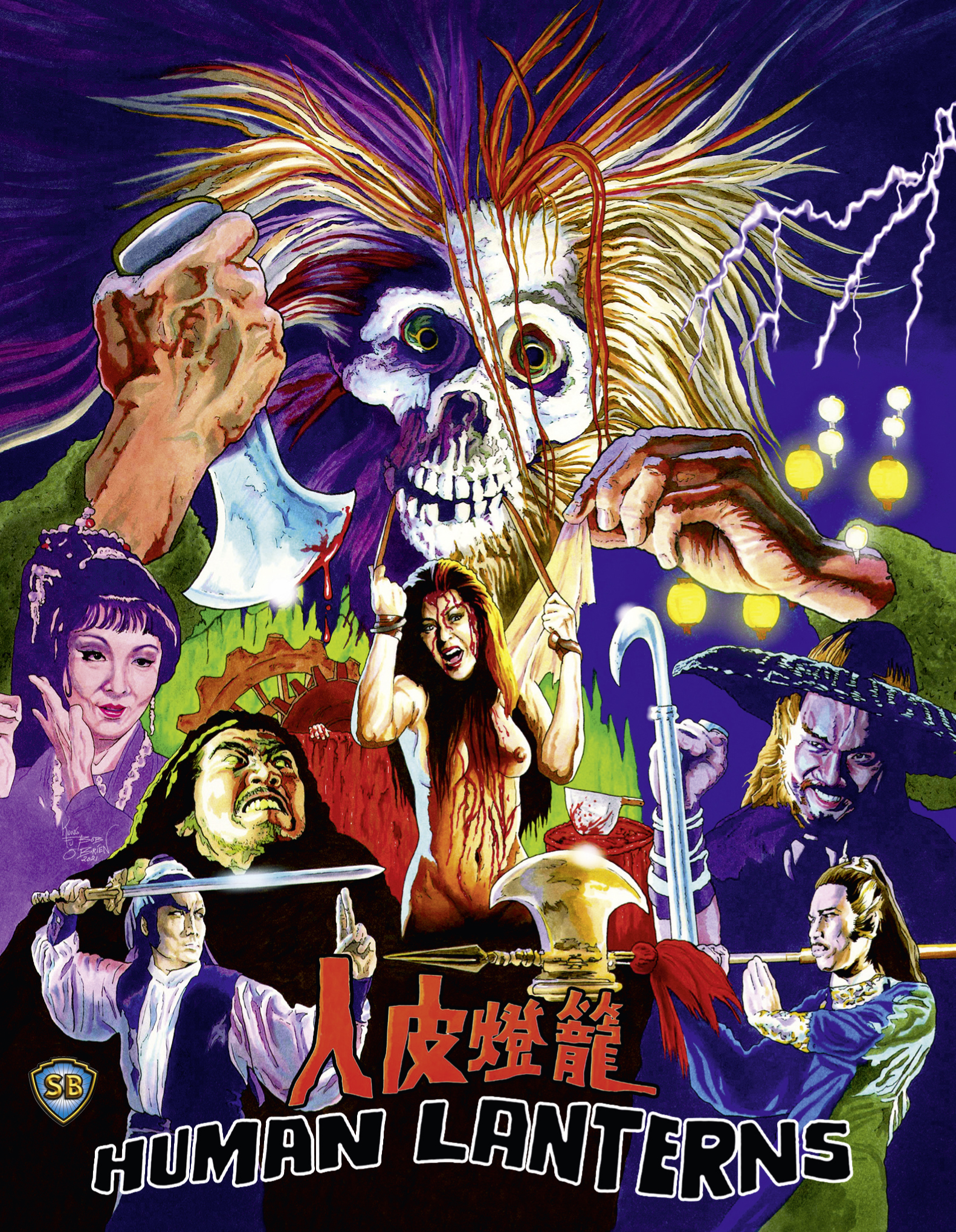
On the physical side, there is a nice slipcover with new artwork by Robert O’Brien, a double-sided case cover with the original poster, a two-sided folded paper poster insert included with the clamshell, and lastly a lush, multi-page booklet with text and photos.

The trailer’s quality makes the viewer appreciate just how gorgeous this release looks now, with vibrant colors, incredible cinematography by An-Sung Tsao, and sharp editing. The sets by Ching-Shen Chen are shown in great and sharp detail. All of this brings up the value of the release that was most likely missing from the earlier VHS copies.

While the fighting throughout most of the film often feels like under-played and Kung fu-interruptus, the final battle royale certainly makes up for it. It is beautifully staged and includes everyone of importance that’s left alive at this point. It alone makes the rest of it worth the wait, but I should add that the whole story is pretty intense and enjoyable. My old pal, Mariah Aguier (2005), who was an infamous person on the New York punk scene in the 1970s and also a martial arts film aficionado, would have probably loved this (or already did). Now, so do I.

IMDB Listing HERE 


Wednesday, July 15, 2020

Review: Awesomely Righteous & Radical


Text © Richard Gary / Indie Horror Films, 2020
Images from the Internet


Awesomely Righteous & Radical
Directed by Luc Bernier, Michael D’Ambrosio, Jason Ewert, Dustin Ferguson, Dean Houlihan, Oliver Jolliffe, Shane Ryan, Matti Soikkelli, Aaron Stielstra, Jim Townes
Mad Sin Cinema; Vestra Pictures; Social Cinema Studios
101 minutes, 2020

It is a bonus when an anthology film is not only just a bunch of random cobbled together shorts (which I also like, I should add), but has a theme that runs through them. Bookends are always welcome, to help tie things in, but here there is an overarching theme of all the stories taking place in the relatively Internet- and cell phone-free 1980s. You know, the dark ages, when you needed pay phones. Back in those days, you played films on this grainy image thing called a VHS (which could stand for Very Hard to See). And like so many of those films, nearly all of these presented here have a heavily synth score of repeating, dissonant rounds.

All the films are pretty short, which is nice, so if there is one you don’t like, there’s another one just a few minutes away. On the other hand, if you like it, it’s time well spent.

The film starts off swinging with Jason Ewert’s “Swamp Buck” (2015; Media Storm Home Movie Ent.; Cinema Gold! Production Classics). It’s a tale told by an old feller around a campfire with some high-school aged (I’m assuming) young’uns of a hunting trip when he was just a wee teen with his dad. Rather than getting game, they attract the scent of a were-stag in the woods. It’s a bit cliché, but this is an ‘80s homage, so it’s a fitting story to start, with some major tropes including said-creature’s POV shots and the shock ending. One of the interesting aspects of this is that the “newer” parts of the story is VHS-ish fuzzy and full of video “noise,” but the flashbacks are clear as a bell. Despite the clichés, or perhaps because of them, it is smile inducing.

Shane Ryan, who put this collection together, contributes with “Guerrilla” (2018), a film I reviewed previously HERE

Luc Bernie’s “Wallet” (2019), again, is a basic idea: a young woman finds a wallet with some ducats in it, and decides to keep the kash. This turns into more than she expected: a free dinner with a friend paid for by the stolen shekels. I suppose the sepia-toned filter is a nice touch to give it a throwback feel (perhaps too far back for the period? Never mind, it truly doesn’t matter, does it?). In typical short horror fashion, there isn’t anything too deep here, just some electronic back score, a basic theme, and a fun twist end. What more can one ask, I suppose?

As the name of Dustin Ferguson’s “Los Angeles Connection” (Social Cinema) hints at, this is more crime drama and a revenge genre, rather than horror or terror. After some gang members or mobsters attack his girlfriend, a man (Raymond V. Williams) trains to become a version of (but not costumed like) the Punisher. Getting back is his motive. The acting is pretty wooden and the story a bit cliché, but I like the VHS filter giving it a low rez and spotty video noise…and then there are the numerous sleeveless white tees. Interspersed to place it in its proper time frame is 1980s stock footage. My favorite was the Rocky-ish electronic music during the mandatory training montage. The style of the action scenes were definitely more like Dolemite than Rocky, though, which is more ideal.

From the UK is Oliver Jolliffe’s “Party Like It’s 1984” (2020). Between the accents and the echoing sound, my ears were having trouble making out the dialog. In this loose comedy, Bob (Tom Jolliffe) wakes up in the woods after a coke bender with no memory of how he got there, soon joined by the singer he manages, Cyndi (Sarah Dyas) and her bodyguard Harry (the director). Cyndi has a gig to get to, and Bob and Harry are trying to get the reluctant Cyndi to get to it, if they can find their way. To be honest, this one had me baffled as to just what was happening, including the ending.

Not to be confused with the XTC non-LP B-side song, Jim Townes “The Somnambulist” (2020; Shadow Kamera Film and Entertainment) is a short piece about three scientists trying to gain access to another dimension through the use of a woman who has been in a coma for a couple of months. It plays slow, but the fun bits happen fast, so pay heed. It’s a simple story with an equally simple set. Kept me interested, but that does not surprise me from its director, who gave us the incredibly enjoyable slow burn of House of Bad (2013; reviewed HERE). 

In a very quick short of about a minute called “Tank Soon Do,” director Michael D’Ambrosio uses a Super 8 filter to show a martial artist practicing his moves in the woods. There is no plot, no narrative, just the form. Okay…

I actually sat through Dean Houlihan’s “Odyssey of the Disturbed” (2019) twice, because the first time I wasn’t sure what was going on. After the second, I’m just as confused. Each edited piece lasts about 5 seconds and folds into the next through a fade-out/fade-in. We are introduced to a couple in which the male is being bullied, a second couple where the guy is bullying the first with the help of his enforcer, and a goth girl (witch?) sits in a room and writes kaons really large in a date book while smoke bellows around her. Okay, I get there’s the bullying and revenge motif, possibly within a dream, but what the hell? The lack of dialog adds to the mystery, in my opinion. Looks good but it annoyed me that it needed to be so cryptic. Or maybe I’m just a fool and am missing something blaring.

Also without dialog is Matti Soikkelli “Luna di morte” (2019), about a murder-suicide, I believe. Again, artistic licence gets a bit in the way of the narrative, but there is a lot of blood shot-for-shot, with guns and knives and masks. Oh, and nearly every scene is in a varied, dark monochrome, usually blood red, giving it a nearly European feel (I get the impression that was the goal, considering the title, and that the director is Finnish). It’s quite short, but also jarring, so in that way it was effective. The last shot of the film left me uncomfortable and stuck with me, so I guess that worked, as well.

The final short is Aaron Stielstra’s “Tumor Hunter” (2020; Depth Charge Pictures). It’s also a bit shallow in the narrative department, but has lots of emotion in the way it is presented. We meet a young alcoholic man in a wheelchair who I assume is homeless, and a bunch of his friends. Between ripping off liquor stores of brew and getting chased by other street thugs, his life is directionless and certainly filled with harm of self or others. Then there appears, I believe, the titular anti-hero defender. There is no real ending, just a glimpse into a violent life. This feels like a scene that was lifted out of a longer film, and it looks like it was shot on 16mm, then videoed off the projection screen. Both the image and the sound is muddled, much like the character’s life.

As the bookends at the beginning and end, there is a period piece looking-back-in-amusement PSA with Clint Eastwood (as Dirty Harry, it looks like), warning about the dangers of crack cocaine. At the end, is a trailer for the film, Samurai Cop (which is actually from 1991, not the 1980s). The only spacing between films is a b-roll of a VHS starting.

As anthologies go, it’s a bit hit and miss, as nearly all culled collections are, but if you’re similar to me and like genre shorts, it’s worth the watch. There is a decent variety of genres and styles, so lots of the audience should be pleased. There is so much filmmaking talent here, even if the occasional story left me bewildered. But make sure you sit through everything, as I did. The artists deserve the view.

Friday, May 10, 2019

Review: Maniac: Limited Edition 3 Blu-ray/CD disc set

Text © Richard Gary / Indie Horror Films, 2019
Images from the Internet


Maniac
Directed by William Lustig
Magnum Motion Pictures / Blue Underground / Red Shirt Pictures / MVD Visual
87 minutes, 1981 /2010 / 2018
There are certain people who just look like their signature roles, whether it fits their personality or not. Sly Stallone was so popular in Rocky because he looked and sounded the part, even though he is quite intelligent. Vincent Schiavelli (d. 2005), the angry subway car spirit in Ghost (1990) similarly was so memorable because his face fit that role. For Maniac, we get the underrated Joe Spinell (d. 1989) in the portrayal of his lifetime that will always be associated with him as a badge of honor.
Spinell plays Frank Zito, an artist who grew up with an abusive mother, and now has issues with women in that he feels compelled to do them brutal harm. Being schizophrenic a la Norman Bates, he hears his mother’s voice even though she’s passed on, but normally his bicameral mind as far as we the audience hear it, it’s his own. He argues with himself that he doesn’t want to be doing these gruesome murders, but he comprehends it as being obliged, or to be punished.
As for the kills, well they are so beautifully done by Tom Savini, and so severe that Savini himself believes he went a bit too far. Perhaps that may be somewhat true in the American market by 1981 standards, but not today’s world of torture and body mutilation releases. Savini, who was a medic in a war zone, was familiar with how the body works in bloodletting situations, and used that to become the top of his field of blood and gore at that time.
A chunk of the money that was used to make the film came from the director, who made some pretty pesos in the adult industry, giving him the opportunity to cast extras from that genre. Some are easily recognizable to those of that generation, such as Sharon Mitchell and Abigail Clayton (billed as Gail Lawrence).
There are actually three stars in the film. Of course, there’s Spinell; as the female lead is the beautiful British actress Caroline Munro who plays a photographer, having gotten the role through her producer husband at the time that came up with the largest chunk of backing cash. While Munro is totally fine in the role and lovely to look at, it’s hard to imagine her photographer character being attracted to Brooklynite and shlubby Frank. She is so beyond his league. Of course, the discussion is whether she is actually gay or bi-, and theirs is only a friendship to her.
The third star of the film is the city of New York at that time, when subways were graffiti bound, the street lights were dimmer, and the skyline was as beautiful as ever. Like Taxi Driver (1976) and They Might Be Giants (1971), the simmering city is intricately connected to the actions and becomes its own character.
The film has pretty much aged okay, though in moments it feels kind of hackney as far as the story goes. The kills, however, are as stunning today as they were back then, and for that alone is worth the watch, especially in this restored 4K presentation, taken from a recently uncovered 16mm original camera negative. Lustig is known for making crime films that were on the odd side of the B-film scale, such as Vigilante (1982) and the Maniac Cop trilogy (1988-93), but this may be his finest work, overall. He was 24 years old at the time.
This three-disc set is just loaded with extras, which I will get to now. It is a mixture of new material and some from a previous, non-HD re-release from 2010. The first thing I want to talk about is the languages and captions. There are multiple languages available: English, Spanish, French, Italian and German. Captions can be in English SDH, French, Spanish, Portuguese, German, Italian, Danish, Finnish, Dutch, Swedish, Russian, Korean, Japanese, Chinese, and Thai, but as I only speak one (not counting Brooklynese, in which much of the film is dripping wet), I went for the English.
For the first Blu-ray disc, there are two audio commentaries. The first is with producer/director William Lustig and producer Andrew W. Garroni. It’s actually nearly perfect in that they tell stories about the production, the actors, the distribution, the guerilla filmmaking, and how it was a joint contribution between everyone. There is no idle banter, it’s all relevant to the making of the film, and they keep it going. For the second Audio Commentary, again with Producer/Director Lustig, we get to hear Special Make-Up Effects Artist Tom Savini, Editor Lorenzo Marinelli, and Joe Spinell's Assistant (friend) Luke Walter. There is a little bit of repetition from the first commentary, but enough new stuff to keep it nearly as interesting, though there are some gaps of quiet here and there. Most importantly, though, they almost never talk over each other, giving us a chance to hear what everyone is saying. The voices are so different (i.e., level of New York accents) that it’s easy to identify who is who, a problem I often have with multiple person commentaries. Besides, it was enjoyable watching Savini talk about his head blowing up real good.
Disc one finished with seven theatrical trailers, nine TV spots and four radio spots. Disc two is broken down into three categories starting with Featurettes, most of which are from the 2010 rerelease, though some are brand new. It begins with the 19 minute “Maniac Outtakes.” The footage is not only of interest, but is overdubbed by a commentary by director Lustig. I like seeing the old footage of New York, such as 42nd Street. Following is “Returning to the Scene of the Crime with William Lustig.” For 8 minutes, Lustig discusses the differences between the shoot locations in 1979 and now. The videos comparing of then and now shots is fascinating.
“Anna and the Killer with Caroline Munro,” covers her career from before Maniac and into the film in 13 minutes. “The Death Dealer with Tom Savini,” is an interview with the Special Make-Up Effects Artist, who has always been a great conversationalist, so his stories are fun for the entire 12 minutes. “Dark Notes with Jay Chattaway” discusses composing of the eerie, yet beautiful background music for 12 minutes.
I was looking forward to the 11 minute “Maniac Men - Interview with Songwriters Michael Sembello and Dennis Matkosky,” who are questioned by Lustig. The rumor had been going around that the song “Maniac” from Flashdance was originally supposed to be in Maniac, with different lyrics {“He’s a maniac… / And he’ll nail your cat to the door”), as Sembello was a horror fan. This lively interview clears it up once and for all. The star of Maniac, Spinell (d. 1989), was known as a party animal, even being married to a porn star for a while, appearing in major films like The Godfather and Rocky, but he was also a horror fan. Naturally, there should be a featurette documentary on his life, as there is here with “The Joe Spinell Story.” This is a special production from 2001 that covers Spinelli’s life and has lots of good stories told by some heavy hitters, such as Jason Miller (d. 2001), Robert Forester, and of course the director of Maniac, Lustig. For 49 minutes, we are regaled on what it was like to know Spinell, and depending on the period of his too brief life and how inebriated he was as the time, it could be heaven or hell.
The last featurette in this section is an 8-minute “Mr. Robbie: Maniac 2 Promo Reel.” This was supposed to be a sequel to the first Maniac with a different director, but was not completed due to Spinell’s death at age 52. It’s grainy but looks a bit wack, though the gore looks good.
In the publicity section, there’s “Paul Wunder,” an 18 minute radio interview with Lustig, Spinell and Munro on WBAI-NY. The sound quality varies widely, but still interesting. Then “William Lustig on ‘Movie Madness,’” a cable access show in black and white that’s a bit more interesting as various people phone in and ask some wild questions for 47 minutes. I miss Manhattan Cable Access, and this is a good reason why. Lasting about 1 minute we see a brief interview with “Joe Spinell at Cannes.” What’s more fun is the 13-minute “Joe Spinell on ‘The Joe Franklin Show’,” in 1981. If you grew up in New York and watched Franklin, you know what you’re dealing with. Franklin (d. 2015) is a cult figure that bands like the Ramones and the Dictators hung out with as well as Broadway actors, ventriloquists and psychics.
“Caroline Munro TV Interview” is with NBC New York’s Chuck Scarborough and the awful Katie Kelly (worst film reviewer ever; d. 2018) in New York at 3 minutes. Of course, next up is “Barf Bag Review Policy,” Kelly’s on-air review of Maniac. Man, this woman is terrible at her job, and not just because she pans the film. She generally had really bad taste, and in 2 minutes she disses the film and says absolutely nothing. The 23 minute “Grindhouse Film Festival Q&A,” which was shot recently enough to mention the Elliot Spitzer scandal, features Lustig, producer Garroni and actress/doctor Sharon Mitchell. They discuss the film (duh) and working with Spinell. Good stuff. This section ends with a 120+ Still and Poster Gallery of film shots, behind the scenes, and, well, posters.
Next section is “Controversy.” I knew this was going to be fun and shrill, and I will comment more on that near the end of the review. It is broken down into sections, the first being “Los Angeles,” where we see newscasts against the film in 1981 on “Channel 7 News” (Ann Martin), “Channel 11 News” (Judi Bloom), and “NBC Tomorrow Coast to Coast” (Rona Barrett).
For “Chicago,” we see a newscast by Gene Siskel (d. 1999) on CBS News. He hated the movie, so what he says is no surprise, referring to it as part of a “women in danger films.” In “Philadelphia,” there are reports from Channel 10 News, two from Channel 3 News, and Channel 6 Action News. Under the banner of the “Newsbeat” television show, we have “Violent Movies” (13 minutes) and “Movie Violence” (21 minutes; the titles made me laugh), which discusses the “effect” of violence in films on its audience.
The next two actually took me by surprise as we watch Al Goldstein (d. 2013) rant and rave against violent films and mutilates a sex doll on his cable access show, “Midnight Blue.” I thought he was a First Amendment proponent, and the fact that Maniac has porn actresses throughout should have been a positive for him, considering the nature of the show. Last in this section is titled “Gallery of Outrage,” which shows pull-out quotes from reviews that are, well let’s say unfavorable. This includes a letter from the film board of the Philippines, turning it down for distribution.
The last two bonuses are big ones. First there is a full CD of the Original Motion Picture Soundtrack by Jay Chattaway. Lastly, there is a nicely written and designed thick booklet with a new essay by Michael Gingold, former Editor-in-Chief of Fangoria Magazine.
There have been a lot of charges of sexism against Maniac, as Zito is what is now called an incel, and strikes back at women who he identifies with his malevolent deceased mother. But some of the most violent kills in the film, which include garrotting and a shot gun shooting, are done to men, as well.
Either way, the film was considered quite successful for an indie release. Its budget was estimated at $350,000, and earned more than $6 million in the US, alone. The fact that it’s still being rereleased almost 40 years later shows its power. And with literally hours of extras, this one is of particular interest; yes, I sat through all of it; it took about a week.

Monday, May 26, 2014

Reviews: Bookending Jim Wynorski: Gila!; The Lost Empire

Text © Richard Gary / Indie Horror Films, 2014
Images from the Internet
 
Jim Wynorski is in good company. Although he arrived on the scene later in the game, starting in 1983, he deserves to be included with the likes of Roger Corman, Dave Friedman, and Hershell Gordon Lewis as purveyors of low budget and often transgressive cinema that is designed for fun and profit on a micro-budget. Wynorski has used many different directorial names (e.g., Sam Pepperman, Harold Blueberry) to cover 150 films within various genres, including horror, fantasy, exploitation and sexploitation. What I am reviewing here are re-releases of his films by Polyscope Media Group from the very beginning to the near recent.


The Lost Empire
Produced, written and directed by Jim Wynorski  
Polyscope Media Group Inc.                  
83 minutes, 1983 / 2013
 
The 1980s was to video indie micro-budget horror films what the 1950s were to, well, cinema house micro-budget horror films. In the case of the former, it was a new market desperate for new product to put on shelves, and the two most popular genres for quickie flicks were porn and horror. Fed on the big screen by the likes of the magic trio of Freddy, Jason and Michael, the nascent direct-to-video (D2V) hunger produced many a marvellously wondrous WTF fantasy world. This film is just one example of it.
 
I remember seeing this film on VHS back in the mid-1980s and thinking it was a piece of shit. Part of the problem with D2V is that back then it was rare to find letterboxing, which companies thought people would not like. It’s not surprising, really, since nearly all televisions had square screens and if a film presented was letterboxed, the image became really tiny. And if you had less than a 19”-er, it was unwatchable; don’t let me get started on foreign films and trying to read subtitles. They used a method called pan-and-scan, which meant you only saw as much as a third of the screen at a time. If two people were talking in one shot, it would flip back and forth between them, and action scenes became as muddled as, well, the new Transformer series (aka, “what the fuck just happened? All I saw was movement!”).
 
As televisions became larger and the quality of VHS gave way to more defined DVD (etc.), The Lost Empire became a lost film. It hadn’t made its way into the new technology, leaving it in the lost empire of grainy and pan-and-scan dimension. Thirty years later, Polyscope has given Wynorski’s early work a hand up, and have re-released the film in full-screen, cleaned-up, theater-ready glory. But is this film worth it?
 
Seeing it now again, after all these years, yeah, it was. Sure it’s not a great film, but it sure as hell is a fun one. I see lots of first releases by directors, and there are certainly problems due to small budget, writing, and acting that tend to be consistent that even remain right this very minute.
 
In the case of this film, it’s partially a feeling of “this may be my only shot, so I better cram as much as I can into it at once” (Wynorski confirms this on the commentary track). While it’s fun to play spot the reference¸ this can also lead to clichés. However, sometimes – as in this case – there are so many, it surprises you because you can never predict which homage he will use. The biggest and most obvious are Enter the Dragon, Dirty Harry, and James Bond, specifically Dr. No.
 
The premise is tough cop Angel Wolfe (Melanie Vincz) – as in savior / lone wolf – has a brother who was a cop, killed during a hysterically funny and bloody pre-credits robbery. She swears revenge when she learns that it was engineered by a sinister group that has an island where they are training beautiful women to fight, lured in by a large-prize contest. Leaving behind her porn-star looking boyfriend, federal agent Rick Stanton (Paul Coufos, a future Wynorski repeater), she sets on a path to investigate and seek retribution. Along the way she picks up two more associates to help in her plan. First there is Whitestar (Raven DeLaCroix, a star in Russ Meyer’s Up! and at the time Wynorski’s girlfriend; she also rightfully earned a producer’s credit here, a Native American who Angel once saved. DeLaCroix, who designed her own cleavage-bearing costumes, is mostly Native with some Métis thrown in). Despite her ample bosom, it was her blue eyes I actually found most beguiling. Go figure. Last there is the gum-poppin’, prison-sprung Heather McClure (the ill-fated Angela Aames, who would die of a heart condition not long after this), who had been placed there by Angel.
 
The premise behind the plot is the search for an ancient jewel that has mystical powers, and when combined with its twin already held by the island’s “mastermind,” supposedly brings enough power to control the world. Everyone is looking and killing for it, but it has a mind of its own. So the three women, who often crack wise, set off to the island kingdom to seek out and kick some cult butt, even before knowing about the gem, which ultimately makes itself known.
 
That’s about as much as I’m willing to give away, storywise. Let me say right off, that even though it was Wynorski’s first release (he has at least one previous that has never been publicly released), it actually looks quite good. Sure, some of the sets and matte painted backgrounds look a bit like the first season of Star Trek, but by using the Roger Corman playbook (and the Corman studio lot, among other locations), he manages to make the most out of what he has. The SFX look really cheezy, but unless you were at Lucas level, this is how most of it appeared for indie films at that technological juncture. The laser machine at the end, however, just made me laugh and laugh.
 
Despite his lack of directorial credits, there is actually a pretty impressive cast of secondary characters that is worth noting. For example, the villain (not giving away anything because it’s in the credits) is the Tall Man himself, Angus Scrimm, chewing scenery his entire time on screen, acting more with his eyes than anything else (squint…wide…squint…wide). Also from the Phantasm franchise (there is a new Phantasm scheduled to be released in 2015 with the original cast!) is Bill Thornbury, who played the older brother, and here plays Angel’s younger brother. Next up is softcore icon Angelique Pettyjohn, known mostly for an episode of Star Trek as a fellow “thrall” with Shatner, here is practically unrecognizable (to me) as a prison gladiator who wears a black leather dominatrix costume that she peels piece by piece.
 
As a police captain in a short cameo near the start is redheaded Kenneth Tobey, known mostly as the lead in the original version of The Thing From Another World (1951). Then for an even briefer moment there is Tom(my) Rettig, who was the original owner of Lassie in the first series of the television show (1954-57).
 
One other notable actor is Blackie Dammett, the one person who could out-scenery-chew Angus. I couldn’t remember where I had seen him before, and after looking it up, it was from National Lampoon’s Class Reunion (1982). Considering the way he overacts, it’s not surprising that (a) his last role was in 1990, and (b) he will be better known through history as the real-life drug dealing dad of the lead singer of the overrated Red Hot Chili Peppers. Man, is he a bad actor.
 
Wynorski had made some weird choices here. For example, no matter what the occasion, everyone is going to be showing lots of cleavage. In fact, when Angel goes to visit her brother in the hospital, she wears a shiny gold one-piece that is skin tight and cut down to nearly the navel. Even on the island, everyone’s hair is perfectly quaffed, and Angel’s changes from straight to poufy to having ringlets. Apparently, even on an isolated island used for women gladiators, girls will be girls.
 
Of course, in the story, there are so many holes, not even counting the lead henchman (stunt man and real-life bully, according to Wynorski’s commentary, Robert Tessier) and his ever-changing eyebrows. For example, the shuriken (Japanese throwing stars) are way too thick to stick into anything, the three female leads are constantly snarking at the island’s – er – management, as if the guards cannot hear them, and they manage to sneak out of the facility a few times, despite there being cameras everywhere, and more importantly sneak back, even after there is reports of “intruders.” There is one character that has a broken leg (portrayed well by Linda Shayne) in scene, and is walking around the next day.
 
Although it was “acceptable” at the time, in hindsight, there is a lot of less-than-subtle racism floating around here. For example, a Chinese character cameo is Charles Chang (yes, dressed identically to Charlie Chan), played by occidental character actor Art Hern, with all the stereotypical broken Engrish. For DeLaCroix’s character, she is constantly using clichés (and remember, she’s also one of the producers) such as, “Yes, kimosabe.” She bares her overly large cleavage while wearing a Native headdress. As for sexist, well, duh, that’s the genre, and that’s an enjoyable given.
 
While most of the electronic music is terrible, sounding like many of the television cop show themes of the period (electric keyboard going “ooo-wahhhhh ooo-wahhhhh”), it is hard to criticize it because it was the style for the time. What is notable, however, is that some of the humor – and there is a lot here – actually works. Groaners for sure, but bound to bring either a happy “Oy!” or genuine smile.
 
The disk has only two extras, a truly interesting commentary track by Wynorski that confirms many thoughts I had while watching the film, and a silly “stills” track that is merely screen grabs from the film itself, rather than during shooting. However, it was nice to see one shot of Shayne’s fate that Wynorski discusses but is really hard to see while watching the movie.
 
Looking back, this film is actually important in a way, in the larger scheme of things. It is a time capsule of a particular style that propelled the home-grown market in a time when even low-budget films had to be shot on film (in this case, Cinemascope!), and be opened to a greedy market that was in a sometimes painful growth spurt. Though I did not like it when it was first released, I can now appreciate it for what it was, and especially for what it was trying to be in the cultural arena.


Gila!
Directed by Jim Wynorski      
Polyscope Media Group Inc.                  
91 minutes, 2012 / 2014
 
Gila! Is actually a made for television (Sci-Fi Channel) remake of the 1959 low-budget monster film, The Giant Gila Monster. It was part of the popular subgenre of supersized creatures, such as Them!, The Giant Behemoth, The Killer Shrews (made by the same group that did …Gila Monster), Gorgo, Konga, and even Gojira.
 
In an very similar storyline, also taking place in 1959, a bunch of 30-year-old teenage hotroding friends discover there is a dinosaur sized poisonous (though this aspect is never used in the plot) Gila Monster roaming around their Texas-based, Indiana shot town. The head of this motley crew is hero Chase (played with gusto by Brian Gross, currently starring as Kirk on the Star Trek: New Voyages series) and his best gal is girl-next-door-with-a-smart-mouth Lisa (Madeline Voges). If this were a western, Chase (what else would you call someone who races hotrods?) would definitely be wearing a white hat, though he’s so goody-goody, it would probably be white bread. He makes Steve McQueen in The Blob (1958) look like Marlon Brando in The Wild One (1953).
 
Chase’s nemeses (i.e., the “black hat”) would be the stereotypical JD type “Waco” Bob (Jesse Janzen), who is a short-tempered, woman-abusing thug that spent three years in “juvie.” His squeeze is the hot Carla (Christina DeRosa, who looks like a rounder version of Alyssa Milano), who of course has the hots for Chase. While she is also cartoonish, Christina actually manages to make her into a fuller (no pun intended) character, which is actually a large compliment. Like most of the roles, hers is written quite two-dimensional, though she successfully gives her some nuances. She is also the one who supplies any form of sex appeal, with or without the cleavage and self-butt slaps.
 
The other two main characters are the local Sherriff (veteran actor Terence Knox, who was a regular on St. Elsewhere, among others; you’ll probably recognize his face, especially if you’re over 30). He’s sort of a substitute dad to Chase, who has a mother and baby sister suffering from the after-effects of polio, but no father.
 
As with previous films, Wynorski has managed to dig up some aging teen actors who look well beyond their years, and yet for some reason makes me happy (that they are there, that is). First up is the mayor’s wife, played by Julie McCullough, who infamously was future religious fanatic-tea party spokesperson-asshole Kirk Cameron’s steady in the Growing Pains television series. The wife is kind of a harpy, but her character sort of disappears after one scene. I was waiting for her to be swallowed whole, as that’s how they set up the tone. But more important (to me, anyway) is Kelli Maroney, who was in one of the only soapers I watched, Ryan’s Hope, and in such classics (seriously) as Night of the Comet (1984) and Fast Times at Ridgemont High (1982). She’s the deputy who doesn’t fare as well as McCullough (hey, it’s in the trailer). The coup d’état though is getting Don Sullivan in a minor role. Who that, you ask? He was Chase in the original …Gila Monster.
 
The monster is, in this case, caused by toxic waste hidden in a cave. The townsfolk have to find the scaly critter and get rid of it before it can lay eggs, which makes me thing about Lena Dunham’s comment about having, “like, a thousand follow-up questions, such as…” how do they know it’s female (i.e., does a male Gila monster have a dangling participle?), and doesn’t there need to be another that size for it to mate with, which means there would be at least two? There are lots of issues I have, but I believe this has more to do with the four (yes, four) writers more than director-for-hire Wynorski.
 
With an estimated budget of nearly a million buckerinos, I can think of so many micro-budget directors who would have been able to create much better effects for half that amount. I’m guessing most of the money went towards the CGI monster itself, but the CGI blood, CGI explosions, CGI feedings, CGI car crashes all look more 2002 than 2012. Perhaps1992. I will have to say, though, that there is a couple of really good face meltings toward the beginning of the film, which appear more appliance than graphic.
 
One of the highlights of the film is the soundtrack, which includes a number of rock and roll classics by the likes of Bill Haley and the Comets, the Everly Brothers, Dion and the Belmonts, and even the true king of rock and roll, Chuck Berry. There are a couple of decent original songs and a mediocre cover of “Fever” (using the pre-Peggy Lee-added text).
 
The best of the extras are the trailers for both this film and the original. The rest of them are kind of meh. There is a slide show, a text description about the original film, a text narrative of Drive-In culture, and the original recording of Don Sullivan’s “Mushroom Song” (with lyrics) from the first film. I like the way Wynorski does commentaries, but there is none here, again I am assuming because he didn’t write or produce.
 
So, do I recommend this? Yeah, without a doubt. Sure it lags in parts, but it is a fun escapist nonsense that has a relatively decent sense of humor when it wants, the acting is purposefully juuuust over the top, and the monster is, well, huge. Now if he can only bring back Traci Lords, like he did with Not of This Earth (1988). Oh, wait, that’s right, he is, in a new feature called Sharkansas Women’s Prison Massacre, due later this year.
 
 The Lost Empire trailer here: http://www.youtube.com/watch?v=Kng-5N7YCXk

Gila:


Thursday, May 15, 2014

Review: The Deadly Spawn: Millennium Edition

Text © Richard Gary / Indie Horror Films, 2014
Images from the Internet

 
The Deadly Spawn: Millennium Edition
Directed by Douglas McKeown            
Elite Entertainment
81 minutes, 1983 / 2012
www.thedeadlyspawn.com
www.mvdvisual.com

When this direct-to-video film first came out, it was a divisive moment. The general public saw this as a piece of cheezy shit to be mocked and used as an example of bad cinema. For the fan, especially a newbie to the nascent VHS home market, it was a touchstone moment in indie cinema that was one of the leaders in the explosion in micro-budget horror, opening the door to what was to come. And y’know what, it’s a pretty damn fine film.

My issue with it was that the tape looked terrible: grainy and too color saturated that made the creature and gore look unclear, especially since many of the scenes take place in a dark basement. So much was viewed through my squinted eyes trying to figure out just what was going on.

In a scene that could have come straight out of the original The Blob (1958), two campers find a fresh meteorite that apparently has a stowaway in the form of a multi-headed creature with massive rows of teeth and a hunger for blood, which helps it grow and reproduce. After the subtextual homoerotic tenters become spawn fodder, the blind creature finds its way into a suburban basement, where, for a while, people seem to be constantly going down to the basement (where are the Ramones when you need ‘em?) and are chomped on in various, and graphic and enjoyable fashions.

Although obviously a puppet-like appliance that apparently takes four people to operate, the creature looks great, having rows and rows of sharp teeth, looking much better in this release taken from the original 16mm print than the faded and fuzzy VHS one. The use of primary colors, the gore, and the creature are all clearer for personal enjoyment. There has been some controversy over an earlier Synapse released DVD version that is reported to be even clearer than this Blu-ray, but as I never saw it, I’ll go with what I have seen.

The story itself is kind of slim, as we are introduced to quite an extended New Jersey family (the state where this was filmed). In the house are a husband and wife (supplying the only shot of a mild milf midriff though a lacy nightgown). Their high school age son, Pete (Tom DeFranco), is a science nerd, presented in a positive light. The younger son, Charles (Charles George Hildebrandt), who is around Bar Mitzvah age, is also highly bright and probably easily identifiable by the presumed target audience, a horror film and effects fanatic (and the lead role in the film). He has cool 1950s-‘60s indie film posters on his bedroom wall. Then there are the visiting aunt and creepy uncle (who gets the best kill in the picture). The New Agey vegetarian (i.e., mocked) grandmother lives a few blocks away, and we meet her and her biddies – er – I mean buddies for social (herbal) tea and non-meat goodies. Lastly, we are introduced to the older son’s possible love interest, Ellen (Jean Tafler) who is as bright as he is, their clueless friend Frankie (Richard Lee Porter, wearing overalls like he just stepped out of a hillbillies cosplay), and the friend’s possible love interest, Kathy (Karen Tighe, a Farrah Fawcett type you actually want to see in the see-through nighty). Of course, a large cast means a larger amount of victims, so it’s all good.

Just about all the effects, by John Dods, from faces being chewed off to small-but-toothsome slithering eel like offshoots (an idea borrowed in Cloverfield [2008], perhaps?) are done with practical appliances, rather than then-crude digital effects. This gives it an interesting appeal that’s the equivalent of seeing a thrashing punk band like the Heartbreakers (JT, not TP), and thinking, I could do that; let’s make a movie!

Like much of the films of the period that used unknown actors, and for many here this is their only IMDB credit (including the director), the acting is occasionally iffy, but the filmmaking itself is actually very well done. With an inexperienced cast, a creature needing many handlers, an often confined space, and a budget of spit and tape, they manage to make a turning point production that deserves the accolades it has received, especially as the years roll on. However, whoever designed the décor of the house, be it a real one or just a set, deserves to be put in a pillory for making us look at the world’s fugliest wallpaper throughout. One eyesore after another! Obviously not much of the cost of $25,000 (equivalent to $60,000 in 2014) went into this aspect.

Extras include a dopey opening with producer Ted A. Bohus (who, for some reason, is better known than the director), commentary track, gag reel, interesting backstage slide show, some pointless images of a Deadly Spawn comic book (the whole comic, that would have been nice), local television coverage from the ‘80s, and the casting tapes.

Despite the controversy, and whether you buy this or the previous DVD, the film itself holds up after all these years, and in fact is more enjoyable over time. As the person I watched this with said, “This is awesome; how did I not see this before now?”