Showing posts with label Mad Sin Cinema. Show all posts

Friday, June 25, 2021

Review: Quarantine Girl

Text © Richard Gary / Indie Horror Films, 2020
Images from the Internet

Quarantine Girl
Directed by Nicole D’Angelo, Gregory Hatanaka
CineRidge Entertainment; Cinema Epoch; Mad Sin Cinema
62 minutes, 2020
https://cinemaepoch.com/
www.madsincinema.com

As negative as the COVID-19 pandemic has been for world health, I have oft commented that a flip side to that has been the absolute explosion of artistic endeavors, especially in the cinema realm, that have been launched during the lockdown. Whether it be a Zoom-shot release or more traditional story-based as is this one, this film is a prime example of that – err – outbreak.

A lot of the leading cast is the same as the Gregory Hatanaka release Choke (2020; reviewed HERE), and with it being released around the same time, my assumption is they were filmed either back-to-back, or concurrently. Of course, this film has a limited number of players, considering the pandemic going on around while it was being shot.

Nicole D'Angelo

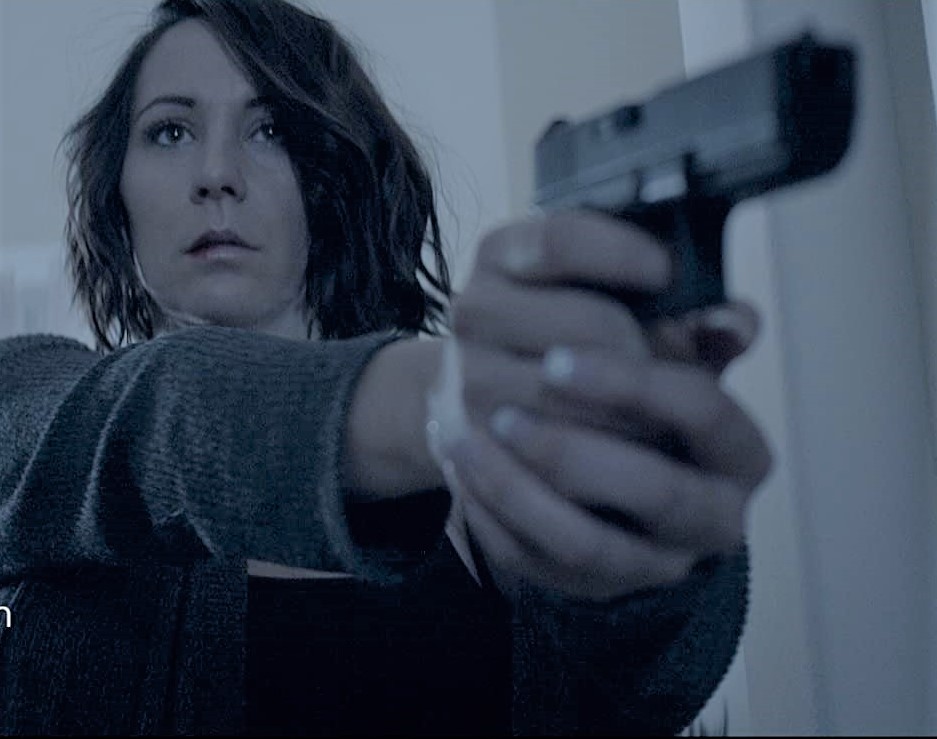
Ruby (Nicole D’Angelo) is a business woman who is returning from an overseas work trip, just in time for a pandemic to hit. Obviously, the disease in question in the story is COVID or at least COVID-based, but the disease is never mentioned by name, only that it effects the respiratory system, and that it is a Novel Virus. The timing of this filming is perfect, as we see Ruby walking through a supermarket early on, and the shelves are empty, especially the paper goods aisle.

We find out what is going on with her thought processes as she phones her dad (David Marc) and pal Anjie (Craijece Lewis), and on the television there is always alarms, read by the newscaster on KLOL (haha), Wendy (the Lisa London). There are some beautiful shots of nearly empty city streets, some from an overpass, or handheld cameras of city blocks devoid of humans. Her world, like the streets, is empty, but it is not vacant.

Slowly, but surely, the disease is getting worse, and those around her are affected, such as multiple shots of usage of hand sanitizer, even when not leaving the house. For a while, Ruby is still going out on jogs, has her friend Nate (Shane Ryan) over for company and a drink (there is a lot of wine, vaping and cigarette imbibing by our Ruby), a visit from her dad, and lots of conversations via media with Anjie (dammit, I keep hearing the Stones’ song in my head whenever I type her name).

Shane Ryan

Odd things keep happening, such as packages repeatedly showing up at her door (disease or not, Amazon sends its drivers out) with random things inside, and someone has hacked into the camera on her computer (the story does not try to hide who it is, but I will leave it for you to find out).

 While events worsen, and things get tighter and more closed off, it starts to wear on Ruby. Personally, I do not understand this completely. She has the Internet, a cell phone, and a television, though I did not see any books or magazines. Sure, that can be tiring to some point, but all one really needs is a hobby. One of them for Ruby is “deep cleaning,” but that’s not the same thing, nor does it last. I have been indoors for over a year (with four exceptions) and with my hobbies, such as this blog, I keep myself occupied and somewhat out of trouble. But, as always, I digress…

 By the end of the first month, as some unexplained medicines begin to run low or out, Ruby is already losing it. Not in the Gerald’s Game (2017) kind of supernatural way, but she’s starting to put on darker lipstick (for whom?), and talking to whomever is watching her through her computer, playing around with S&M with online dominatrix…Wendy the anchorwoman? Is this real or in her mind? Also, Ruby is contemplating doing some harm to herself in anger and frustration. After a month. Wow. She must be some serious Type A personality. It’s been a year and I’m still quite sane. Wait, who said that?!? Where are you?!?! Err, never mind.

Lisa London

There are some really good musical choices for incidental background, though there is also an odd use of a comical tone. Not quite Benny Hill level, but it sometimes feels out of place, such as with a neighbor peeking in her window.

By the conclusion of this story, which is hardly the end of the pandemic, as we are still in it and this was filmed before the vaccine, Ruby is a woman on the verge. But a relationship may be a change. Personally, I didn’t buy this for a second, and was ready to yell at the writer because it seems improbable, but the writer is also the main director and star of the film, D’Angelo.

Even though I generally liked the film, the dad character felt a bit underdeveloped, and there were definitely some cringy moments, which especially includes the wind-up. I did read someone who said they found it “sweet.” Huhwha? I am assuming that in real life, in those circumstances, that would not really happen. More likely someone would end up at the worst physically hurt, at the best, never talked to again. D’Angelo does an overall good job in presenting her material, and she is a good enough actor to pull it off, and I have seen her in several roles now, but that ending…

The overall film is a perfect hour-length for its story. Any more would make us all a bit restless considering the topic. Hopefully, you will get to see this film in a nostalgic way, as in “Oh, remember that pandemic; wasn’t that sumptin’?” Bet there are going to be people (me) who will miss sitting around all day in their pajamas, watching television, scanning the Internet, and shopping online. All the things that are driving people like Ruby a little bit cray-cray.


Monday, August 10, 2020

Review: Heartbeat


Text © Richard Gary / Indie Horror Films, 2020
Images from the Internet


Heartbeat
Directed by Gregory Hatanaka
CineRidge Entertainment; Cinema Epoch; Mad Sin Cinema
73 minutes, 2020
www.madsincinema.com

For his third feature release of the year (with another one, Quarantine Girl, expected by year-end), prolific director Gregory Hatanaka has gathered his standard troupe of players and delivered a bit of a different twist of a thriller. There is so much cast overlap with his last film, Choke (reviewed on this blog), I wonder if they were filmed concurrently. The reason I believe that is quite often the smaller the role in Choke, the more prominent the one in Heartbeat, and vicey-versey (yes, I’m leaving it that way).

Nicole D'Angelo
Jennifer (Nicole D’Angelo) is a hard-bitten and prickly news journalist who has written about a company recently, whose employees and owners are getting whacked. We get to see one of them in the prolog, which is beautifully done, though the victim (Sarah Brine, the star of Choke), is stabbed with a barber’s razor? This type of instrument is meant for slashing, not for stabbing, due to its blunt, flat top, but I’m nit-picking.

For slashing, not stabbing
What I find interesting, and I mean this not as a criticism, is that for an award-winning investigative journalist, Jennifer doesn’t really seem to be very inquisitive. When a photographer, Rick (Shane Ryan), tries to show her the connection between the murders and the article she wrote, even with evidence, she brushes him off. I feel that a good journalist would see this as another article, possibly award winning, and would jump on it. Our gal is too aloof. She has trouble even entertaining helping the local police detective on the case, Santoro (Chris Spinelli).

She’s also that way with an ex-boyfriend, the Norwegian-named Torsten (Scott Butler) – which means Thor’s Hammer, or literally, Thor’s Stone – who is a bit aggro with her boss, so I can understand why she dumped him, though they are pretty similar in the bellicosity department. Jennifer, albeit the protagonist, doesn’t really seem to try to ingratiate herself with the audience, but perhaps as the plot thickens, she’ll become less hostile like a good heroine (I’m 20 minutes in at this point); she seems to lead an extraordinarily lonely and mundane life for such an exciting profession. Though, I must add that the fact that she doesn’t follow the expected lead’s stereotypical pattern is a brave step, and I applaud it.

As the death toll rises, it circles around Jennifer until it is bound to be directed at her, much like the Saltsraumen Maelstrom, a strong eddy that whirls around her, dragging her into the fray.

Chris Spinelli
The film has an Italian giallo feel, sort of like Dario Argento’s Bird with the Crystal Plumage (aka L’uccello dale piume di cristallo, 1970), though the whispery voice on the phone, especially for the first kill during the prolog, sounds a bit like the quacky one from Leo Fulci’s The New York Ripper (aka Lo squartatore di New York, 1982).

The acting of the leads, or at least the usual suspects of what I’ll call Hatanaka’s troupe, is rather good. D’Angelo, despite her character’s bristle, does well in the lead role, making her interesting even if not overly likeable, which is a decent balancing act. Spinelli is pretty solid as the detective, easing his way into Jennifer’s life. Ryan plays against type by becoming a nerdy, almost simple-minded photographer who takes candid pictures (snap-snap, grin-grin, wink-wink, say no more) of events and people through their window, obsessing a bit on Jennifer.

With a few of the minor roles, the actors sometimes seem to stumble over their lines. Ah, the joys of indie film making; as usual, you get a mixed bag. It is part of the fun of watching these kinds of films, actually. You want perfection? Go watch an A-List overdone production, not one with a heart, like this one. But I kinda digress…

For an indie, low-budget film, this is certainly well populated with characters, which is noteworthy. And with all these people floating in and out of the story, thirty minutes in, I had it down to three suspects. Though despite the gruesome murders, like most giallos, this is essentially a crime drama about the Chinese mob and, well, I won’t go into it and give it away.

Share Ryan
The kills never come as a surprise. They are always telegraphed by POV shots and, well, the plotlines. Despite the blood, there is nothing actually gory and this relies more on the story and the fact that people are murdered to further the action, rather than just relying on SFX splatter, like Argento and Fulci did in the 1980s. Also, again, there’s that budget.

At 40 minutes, I was back down to one suspect, the first one I picked. I won’t give away who it is nor who it isn’t, as I’m not that kind of reviewer, but I will say I was right. The location of one of the murders was the giveaway for me. But that’s okay, and honestly, that’s part of why I like these kinds of films, trying to figure it out along with the protagonist.

If there is one real fault I would pick, it would be that the soundtrack is sometimes turned up too high, which at times makes it hard to hear the dialogue, such as in the final reveal. I had to watch the ending a couple of times to make out what was being said over the plunking piano and high-pitched screech on the music track. I wish I could have had some subtitles.

The story is both simple and complex at the same time, which is part of what works. It’s simple in that it goes in pretty much a straight line, and doesn’t get bogged down in complexity, even as the viewer wonders why something is happening (that will be eventually explained). The complex part is the myriad of characters, including some mandatory red herrings, that get thrown at us to help try to throw us off the track.

Is it a good film? Yes, and an enjoyable way to spend some time if you appreciate this genre. It’s a noble homage to the Italian crime giallo cinema of the 1980s, and it works in style (love the stop frames) and formula. Does it match the likes of Fulci and Argento? Well, my answer to that is, does anyone? As a fan of giallo, I kept finding myself unconsciously nodding when Hatanaka hits the right note, which was often.


Wednesday, July 15, 2020

Review: Awesomely Righteous & Radical


Text © Richard Gary / Indie Horror Films, 2020
Images from the Internet


Awesomely Righteous & Radical
Directed by Luc Bernier, Michael D’Ambrosio, Jason Ewert, Dustin Ferguson, Dean Houlihan, Oliver Jolliffe, Shane Ryan, Matti Soikkelli, Aaron Stielstra, Jim Townes
Mad Sin Cinema; Vestra Pictures; Social Cinema Studios
101 minutes, 2020

It is a bonus when an anthology film is not only just a bunch of random cobbled together shorts (which I also like, I should add), but has a theme that runs through them. Bookends are always welcome, to help tie things in, but here there is an overarching theme of all the stories taking place in the relatively Internet- and cell phone-free 1980s. You know, the dark ages, when you needed pay phones. Back in those days, you played films on this grainy image thing called a VHS (which could stand for Very Hard to See). And like so many of those films, nearly all of these presented here have a heavily synth score of repeating, dissonant rounds.

All the films are pretty short, which is nice, so if there is one you don’t like, there’s another one just a few minutes away. On the other hand, if you like it, it’s time well spent.

The film starts off swinging with Jason Ewert’s “Swamp Buck” (2015; Media Storm Home Movie Ent.; Cinema Gold! Production Classics). It’s a tale told by an old feller around a campfire with some high-school aged (I’m assuming) young’uns of a hunting trip when he was just a wee teen with his dad. Rather than getting game, they attract the scent of a were-stag in the woods. It’s a bit cliché, but this is an ‘80s homage, so it’s a fitting story to start, with some major tropes including said-creature’s POV shots and the shock ending. One of the interesting aspects of this is that the “newer” parts of the story is VHS-ish fuzzy and full of video “noise,” but the flashbacks are clear as a bell. Despite the clichés, or perhaps because of them, it is smile inducing.

Shane Ryan, who put this collection together, contributes with “Guerrilla” (2018), a film I reviewed previously HERE

Luc Bernie’s “Wallet” (2019), again, is a basic idea: a young woman finds a wallet with some ducats in it, and decides to keep the kash. This turns into more than she expected: a free dinner with a friend paid for by the stolen shekels. I suppose the sepia-toned filter is a nice touch to give it a throwback feel (perhaps too far back for the period? Never mind, it truly doesn’t matter, does it?). In typical short horror fashion, there isn’t anything too deep here, just some electronic back score, a basic theme, and a fun twist end. What more can one ask, I suppose?

As the name of Dustin Ferguson’s “Los Angeles Connection” (Social Cinema) hints at, this is more crime drama and a revenge genre, rather than horror or terror. After some gang members or mobsters attack his girlfriend, a man (Raymond V. Williams) trains to become a version of (but not costumed like) the Punisher. Getting back is his motive. The acting is pretty wooden and the story a bit cliché, but I like the VHS filter giving it a low rez and spotty video noise…and then there are the numerous sleeveless white tees. Interspersed to place it in its proper time frame is 1980s stock footage. My favorite was the Rocky-ish electronic music during the mandatory training montage. The style of the action scenes were definitely more like Dolemite than Rocky, though, which is more ideal.

From the UK is Oliver Jolliffe’s “Party Like It’s 1984” (2020). Between the accents and the echoing sound, my ears were having trouble making out the dialog. In this loose comedy, Bob (Tom Jolliffe) wakes up in the woods after a coke bender with no memory of how he got there, soon joined by the singer he manages, Cyndi (Sarah Dyas) and her bodyguard Harry (the director). Cyndi has a gig to get to, and Bob and Harry are trying to get the reluctant Cyndi to get to it, if they can find their way. To be honest, this one had me baffled as to just what was happening, including the ending.

Not to be confused with the XTC non-LP B-side song, Jim Townes “The Somnambulist” (2020; Shadow Kamera Film and Entertainment) is a short piece about three scientists trying to gain access to another dimension through the use of a woman who has been in a coma for a couple of months. It plays slow, but the fun bits happen fast, so pay heed. It’s a simple story with an equally simple set. Kept me interested, but that does not surprise me from its director, who gave us the incredibly enjoyable slow burn of House of Bad (2013; reviewed HERE). 

In a very quick short of about a minute called “Tank Soon Do,” director Michael D’Ambrosio uses a Super 8 filter to show a martial artist practicing his moves in the woods. There is no plot, no narrative, just the form. Okay…

I actually sat through Dean Houlihan’s “Odyssey of the Disturbed” (2019) twice, because the first time I wasn’t sure what was going on. After the second, I’m just as confused. Each edited piece lasts about 5 seconds and folds into the next through a fade-out/fade-in. We are introduced to a couple in which the male is being bullied, a second couple where the guy is bullying the first with the help of his enforcer, and a goth girl (witch?) sits in a room and writes kaons really large in a date book while smoke bellows around her. Okay, I get there’s the bullying and revenge motif, possibly within a dream, but what the hell? The lack of dialog adds to the mystery, in my opinion. Looks good but it annoyed me that it needed to be so cryptic. Or maybe I’m just a fool and am missing something blaring.

Also without dialog is Matti Soikkelli “Luna di morte” (2019), about a murder-suicide, I believe. Again, artistic licence gets a bit in the way of the narrative, but there is a lot of blood shot-for-shot, with guns and knives and masks. Oh, and nearly every scene is in a varied, dark monochrome, usually blood red, giving it a nearly European feel (I get the impression that was the goal, considering the title, and that the director is Finnish). It’s quite short, but also jarring, so in that way it was effective. The last shot of the film left me uncomfortable and stuck with me, so I guess that worked, as well.

The final short is Aaron Stielstra’s “Tumor Hunter” (2020; Depth Charge Pictures). It’s also a bit shallow in the narrative department, but has lots of emotion in the way it is presented. We meet a young alcoholic man in a wheelchair who I assume is homeless, and a bunch of his friends. Between ripping off liquor stores of brew and getting chased by other street thugs, his life is directionless and certainly filled with harm of self or others. Then there appears, I believe, the titular anti-hero defender. There is no real ending, just a glimpse into a violent life. This feels like a scene that was lifted out of a longer film, and it looks like it was shot on 16mm, then videoed off the projection screen. Both the image and the sound is muddled, much like the character’s life.

As the bookends at the beginning and end, there is a period piece looking-back-in-amusement PSA with Clint Eastwood (as Dirty Harry, it looks like), warning about the dangers of crack cocaine. At the end, is a trailer for the film, Samurai Cop (which is actually from 1991, not the 1980s). The only spacing between films is a b-roll of a VHS starting.

As anthologies go, it’s a bit hit and miss, as nearly all culled collections are, but if you’re similar to me and like genre shorts, it’s worth the watch. There is a decent variety of genres and styles, so lots of the audience should be pleased. There is so much filmmaking talent here, even if the occasional story left me bewildered. But make sure you sit through everything, as I did. The artists deserve the view.