Showing posts with label kung fu. Show all posts

Wednesday, May 10, 2023

Review: Young Ip Man

Text © Richard Gary / Indie Horror Films, 2023
Images from the Internet

Young Ip Man (aka Young Ip Man: Crisis Time; 少年叶问之危机时刻; Shàonián yè wèn zhī wéijī)
Directed by Liming Li
iQIYI; Flying Youth Pictures; Lajin; Hi-YAH!; Well Go USA Entertainment
79 minutes, 2020 / 2023
https://wellgousa.com/films/young-ip-man
www.hiyahtv.com
#youngipman @WellGoUSA

While I could be wrong about this, it seems as much like the last 50 or so Amityville and [fill-in-the-blank]nado films do not really have anything to do with the original productions other than name usage, I wonder if that is true with the term “Ip Man.” Paraphrasing from Wikipedia, “Ip Man, born as (Y)Ip Kai-man (1893-1972) was a Hong Kong-based Cantonese martial artist and a grandmaster of the martial art of Wing Chun when he was 20. He had several students who later became martial arts masters in their own right, the most famous among them being Bruce Lee.”

“Ip Man” started as a series of films starring martial art legend Donnie Yen that was rightfully quite successful. Yen became iconic in the role. For this Chinese release in Mandarin (with English subtitles), Zhao Wenhao picks up the titular position as Ip Man.

Zhao Wenhao

The film opens with a bang, detailing the escape of villain Ma Long, who was set for execution for previous but not described felonies. One scene is reminiscent of Enter the Dragon (1973). Lots of shooting, stabbing, explosions, car chases, and so on. Nice way to begin, before we are even introduced to Ip Man, who is studying martial arts in said Hong Kong. We also meet his friend, Xuehu, who is wanting to impress his girlfriend, Xiaofeng.

Ip Man is also studying in a college. As this is set in 1917 in Hong Kong, which was under British rule, the school is hosting the First Xinsi Cup English Speech Contest. It is here we meet Yayun, a cute, yet spoiled rich girl who has a thing for our titular hero.

Before the contest can begin, all the students are kidnapped within the enormous building (shades of 1988’s Die Hard) by Ma Long and his gang, which includes assassin Ma Wei (Pantheras Freedman), and Xuehu, who is in need of money to buy a present for his sweetie. The purpose of the action by our villains is to hold the son of the British Police Commissioner for ransom, and possibly other nefarious reasons.

As you may have guessed, there is a socio-political component to this film, with high reliance on a dislike of the British rule in Hong Kong (much as the UK was the enemy in films about the American Revolutionary War). I have seen a number of Chinese martial arts releases which took place in the 1930s where Japan was the enemy after their invasion, but it is interesting to see it pointed at British colonialism.

Another interesting aspect is that in many of these films, the henchmen are anonymous and throw-away “machines” in the cog of the event (1997’s Austin Powers: International Man of Mystery had fun of this with Will Farrell’s character), and while most here fit that ilk, having Ip Man’s masked buddy Xuehu one of the crew makes it a bit more human.

Something I do not understand, and again, this is common for many films, is that doors are locked, but nobody thinks about breaking a window to escape. I was wondering if this was a cultural thing about destroying the property of the authorities, but they seem to have no qualms about wrecking furniture, and, in fact, break windows during fights.

Despite the drastic situation (which in the States, attacks on schools seems commonplace lately), and some decent martial arts fighting), the film actually starts a bit on the light side, often using humor, or being careful not to be too Die Hard deadly. For example, machine guns open fire on a crowd, and an explosive goes off, and yet, no one is killed. This could have been a fine John Wick intense moment, but that is not the direction of the film, which is action-based, rather than slaughter. The viewer sees lots of fights, but few killings onscreen, making those that are there more compelling. I say this not as neither a positive nor negative thing, but as an observation.

There is also a bit borrowed in theme from Kill Bill; Vol. 1 (2003), especially the House of Blue Leaves sequence, including Leng Yu, a female assassin using a chain with a deadly point, a la Gogo Yubari.

This is the director’s third feature film, and second “Ip Man” release (the first being 2019’s Ip Man: Kung Fu Master). One of the things that made Donnie Yen so iconic as Ip Man, other than his long black jacket, was his stoicism. That is one thing that is lost here, but perhaps it is because he is so young yet and has to learn the hard lessons that would bring him to that point.

There are quite a few fights, increasing in number as the film progresses, with some wire work, but not over the top (e.g., no one jumps from one storey to another). It is nice to see where Ip Man first developed his “trope” of numerous punches within seconds to the chest. I also like that sometimes things happen for reasons that are not expected, such as previous relationships.

Overall, as martial arts films go, the storyline is a bit thin and mostly follows a formula. Yet, this was a fun watch throughout; tropes are there because they are popular, after all.

As a note, as stated on IMDB: “This is supposed to take place in 1917, but the cars, clothes and many items are from at least two decades later.”

IMDB listing HERE


Monday, April 3, 2023

Review: Calamity of Snakes

Text © Richard Gary / Indie Horror Films, 2023
Images from the Internet

Calamity of Snakes (aka Ren she da zhan; 人蛇大)
Directed by Chi Chan;
Chi He Film Company; Kee Woo Film (HK) Co; Unearthed Classics; MVD Visual
86 minutes, 1982 / 2022
www.unearthedvideo.com
www.MVDVisual.com

Definitely not one to watch if you have Ophidiophobia like Indiana Jones: a fear of snakes. The snakes used are real, so there is no – er – squirming out of this.

This Category 3 film from Hong Kong (though shot in Taiwan), has been never released on digital discs in the form of DVD or Blu-ray until now. Available here are the original Mandarin, as well as the English dub of its initial release. There is also a “Cruelty-free Version,” which I will discuss later in this review.

There is a level of infamy for this, for many reason, but mostly being bat-shit (snake-shit?) crazy. It is vicious, nasty, and deadly. And then there are the snakes. In a theme similar to the Italian giallos filmed in South America such as 1980’s Cannibal Holocaust, numerous real reptiles were viciously and vividly killed during the making of it, but that is where the “Cruelty-free Version” comes in if you do not want to see that aspect. Also, it is worth noting that a percentage of all profits, whatever the format, will be donated to Save the Snakes in continuation of their mission to protect snake populations around the world.

Needless to say, I watched the original in Chinese and uncut, not because I hate snakes (I am only afraid of ones I know are dangerous, or ones that I meet in the wild and am not sure), but to place it in the context of when the film was released, during the heyday of Hong Kong horror. There is a new, 2023 documentary on that topic included on the disc, From Shaw to Snakes: The Venom and Violence of Early Chinese Language Horror Cinema (116 minutes), directed by Naomi Holwill.

Like films such as Frogs (1972) or The Happening (2008), this is a supernatural revenge of nature to atone for violence against its creatures. Do I need to say what kind? Did not think so. The basic set up is that a conglomerate wants to build a new high rise apartment complex (I have been to China, and they are still doing it in droves to temporarily bolster the economy; again I digress…). However, they discover a multitude of snakes on the spot where the building is to be constructed, so Fu-Ren “time is money” Jiang, the CEO who is overseeing the project with his lacky and comedy relief Peter Ma (Ping-Ou Wei, d. 1989), gives the orders to kill all the snakes to make it habitable for the new tenants-to-be.

Jiang’s wife, Shumei, who witnesses the slaughter (which I found profoundly sad, especially the level of glee as they actually torture the poor creatures), prays to Avalokitasvara, who helps Bodhisattva (people on their way to enlightenment; thank you Wikipedia) for forgiveness in fear of retribution for her husband’s evil deed.

On the side of the snakes, is the architect from Harvard, Dr. Zhengfeng Xu (Yun-Peng Hsiang, aka Wan-Pang Heung, who passed away recently). He is slowly building a relationship with Jiang’s spoiled but cute daughter, Xiumei. Surely a comeuppance is coming after by the third act (I am at the beginning of the second as I write this).

The real fun starts when the building is opened, and the condos start selling to various types, including a “Karen” and the flirtatious young girlfriend of an elderly rich man. You just know who will be future fodder because the story focuses on them, and they act like they deserve a “spanking” from Avalokitasvara.

The snakes include poisonous cobras (I wonder if they “drained” them first), but the lead snakes are huge pythons that are not to the ridiculous size of 1997’s Anaconda, but still impressive. To try to get rid of the snakes, they call in a professional snake handler/entertainer, Master Lin (Yuen Kao, rather than Samuel L. Jackson). Their centerpiece man-vs.-snake kung fu scene is definitely a highlight, though there is more than one martial snake involved (as puppets, with that boing “springing” sound used popularly in kung fu films of the period as things go flying).

The scenes where snakes are killed be it by humans or by a bunch of mongooses (to upbeat and cheerful music!), lasts way longer than necessary, lingering on the snakeicide in almost fetishistic fashion. This is technically a comedy, but it seems like being cruel is a point. There are literally thousands of the creatures that are killed on screen, and only two of the reptiles on the screen are fake (those puppets I mentioned earlier)

I was amused that at one point, in the background soundtrack, you could hear Tchaikovsky’s “Overture 1812.” Also, when was the last time you saw an elevator with a 13th floor, other than the Texas psychedelic band? Then there is the “Benny Hill” sped-up with bouncy carousel music moment that also fat shames.

The other extras on the Blu-ray are “Reptilian Recollections: Lin Kuang-Yung in Conversation with Chui-Yi Chung” where one of the actors talks with the director and co-writer, and a full-length commentary with writer and editor Nathan Hamilton and film director Brad Slaton. Last are an “Alternate Credits” and an image gallery.

Generally, as films go, this was a hoot. The story was silly as shit, as one might expect (and hope for the period and topic), reminding me of the likes of Squirm (1976) and Slugs (1988), but honestly, I will never watch this again, due to its level of cruelty to living creatures who were killed for no reason (even if in the film they have snake soup, eat organs, and drink snake blood). If this was made today, and it was CGI or even practical SFX, I would see the same scenes and smile. But this is inexcusable.

Now I know that what I have just said is actually going to intrigue a certain group of people into seeing it, and I have no problem about it (at least the snakes would not have completely died in vain, nor vein), but I am at an age now where I prefer the SFX and CGI fakery to the actual destruction of animals for profit.

IMDB listing HERE

Wednesday, June 1, 2022

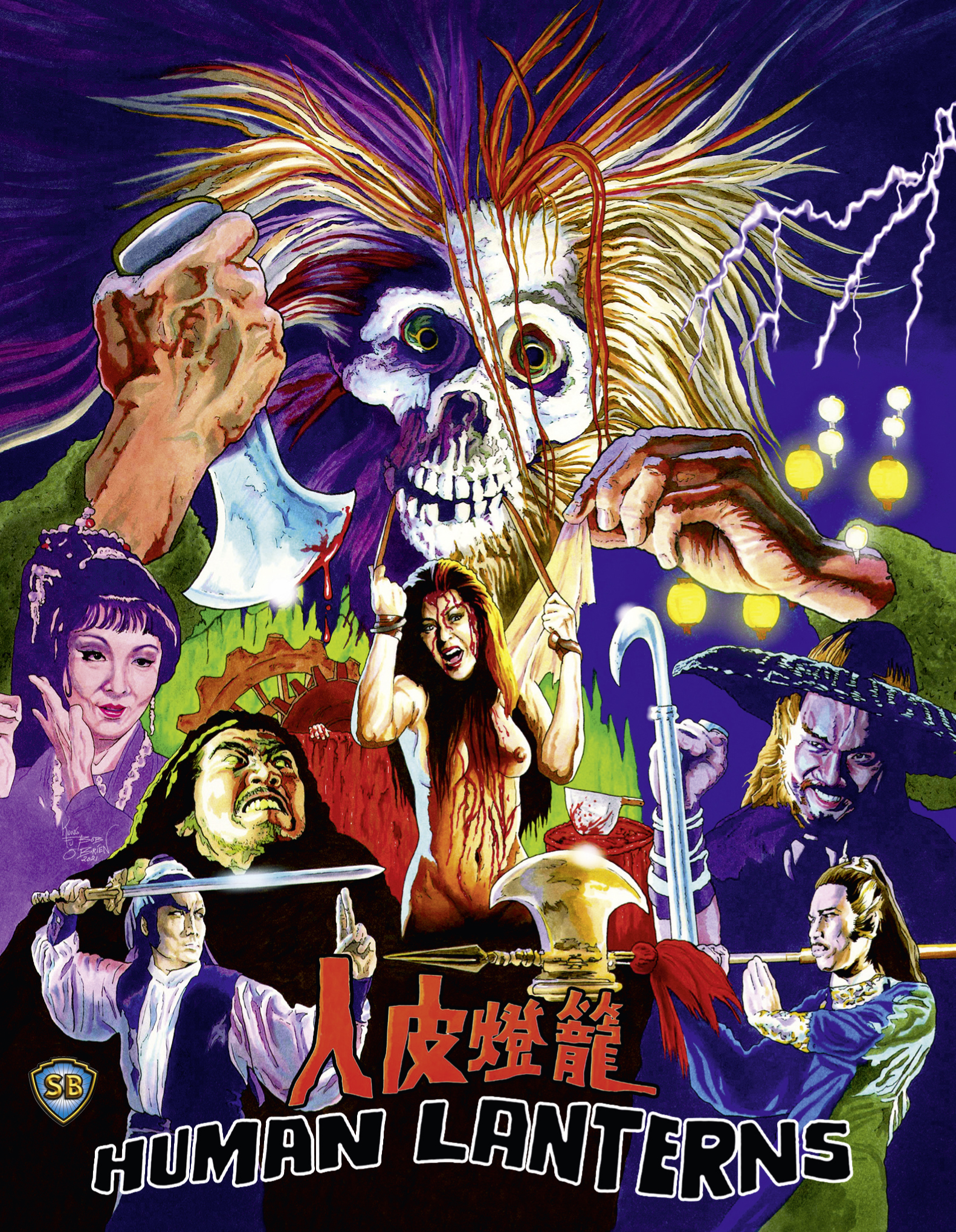
Review: Human Lanterns

Text © Richard Gary / Indie Horror Films, 2022
Images from the Internet

Human Lanterns (aka Ren pi deng long; Human Skin Lanterns)
Directed by Sun Chung
Shaw Brothers; Celestial Pictures; 88 Films; 88Asia Collection; MVD Entertainment
99 minutes, 1982 / 2022
www.MVDEntertainment.com

Back in the mid-1970s through the 1980s, if you were not there, it is hard to describe the effect and influence of the Shaw Brothers kung fu films, especially the ones taking place in some mystical time, long, long ago, when warriors with long hair could fly through the air, elderly people were the best fighters, and moustaches indicated evil.

Bruce Lee has survived the ages as far as legacy goes, but back then, it was the Shaw Brothers releases that were nearly omnipresent. There were theaters that dedicated themselves to showing them (such as one at the foot of the Manhattan Bridge), and a local New York station played their films every weekend at pre-set times.

But what I think helped popularize them were the sheer wackiness of the story mixed with a lot of martial arts action. Most were the equivalent of Roger Corman releases: you really needed to let go of any pretense towards art, and just enjoy the over acting and high drama for what it was: sheer entertainment. I have never seen this particular film before, so I am looking forward to it…

Tony Liu

The main theme of the story here, which is the complete and uncut version, is social jealousy in the feudal period of Phoenix Town. The main protagonist is wealthy warrior with classic Spock-like eyebrows, Lung Shu-Ai (Tony Liu), who is in rivalry with the local mustachioed Third Master T’an-Fu (Kuan Tai Chen). T’an provokes him by choosing Lung’s favorite prostitute, Yen Chu (Linda Chu) as his own concubine at a big feast, therefore causing Lung to lose face. To be fair, Lung is not a nice guy, who is consumed by competitiveness.

To retaliate, Lung decides to use the upcoming Lantern Festival contest (for best lantern, natch; remember the film’s title) by getting a skilled lantern maker, Chao Ch’un-Fang (Lieh Lo), who was Lung’s previous rival for Lung’s present wife, Lady Chin (Ni Tien), to create a masterpiece for him.

Then, again considering the title, there is a horror aspect to the story, represented by some dude in a mixed monkey/skull mask and costume who wants to destroy Lung. He kidnaps a woman and brings her to his underground lair, reminiscent of The Phantom of the Opera. There he very graphically does a Buffalo Bill/Leatherface on her. There is a reason the original name of the film was Human SKIN Lanterns. I don’t believe I’m giving anything away. I figured out almost instantly who was, as Lux Interior of the Cramps sang, “What’s behind the mask.” Actually, it’s given away pretty early, but I will not be the one to do it.

Kuan Tai Chen

Add an assassin into the mix to increase the action in the form of bearded Kuei Szu-Yi (Meng Lo, He does a lot of the fighting in the picture, which has its fair amount of martial arts, and yet less than usual for a Shaw Brothers release, though it certainly picks up by the third act. What is there, however, is imaginative, uses many different tools such as arm knives and fans, and there is a lot of wire work as they fly through the air with the greatest of ease. Meanwhile, the police, led by Sergeant P’an (Chien Sun), is trying to stop the jealousy-fueled violence and figure out why people are going missing.

Of course, the film is in Mandarin, with English subtitles. One thing that is not included in this package is the English dubbed version. Shaw Brothers films often used the same voice actors over and over, so they became easily recognizable by sound, if not by name. For me, it was one of the hallmarks of a Shaw Brothers release, but I can forgive them. I would have watched the film in the original Mandarin, and then again with the English dub, but that didn’t happen this time. Not a complaint, just an observation.

Lieh Lo and Hsiu-Chun Lin

Okay, let’s talk about some of the extraordinary Extras that are included with the new Blu-ray, both the physical and the digital. I’ll start with the latter. To begin, there is a full-length commentary by Kenneth Brorsson and Phil Gillion of the On Fire Network podcast. Both men are heavily accented (Swedish and British, respectively), and it was a bit of a strain to make out what they were saying, but it was worth the focus. At least until I gave up about halfway through.

Next is the featurette “A Shaw Story: An Interview with Susan Shaw” (14 min.), filmed in 2005. In this, the actor, who had a small role in the film, tells of her tumultuous career before Human Lanterns thanks to international politics, what it was like to work with the director and her opinion of the film, and her career after. She kept my attention. The next featurette is for one of the bigger stars of the film, “The Beauty and the Beasts: An Interview with Linda Chu” (14 min.). Chu talks about how she became involved with the Shaw Brothers films and her career there, and especially on her opinion about nudity. Again, it’s a good interview, but she does come off a bit vain here and there. Part of the charm, I guess. Both interviews are in Chinese with subtitles.

The last featurette is “Lau Wing: The Ambiguous Hero” (51 min.) And who is Lau Wing? That is the real name of this film’s star, Tony Liu. He goes into great detail about the art of acting, and his place in that, all while chewing gum. Of course, he discusses the film and the director, but he was working three films at the same time, and he admits his memory is hazy. It’s his relationship with actors and the studios that make this the most interesting. Lastly on the digital end is the Trailer, that the film is in HD (1080p), and the English subtitles have been retranslated.

On the physical side, there is a nice slipcover with new artwork by Robert O’Brien, a double-sided case cover with the original poster, a two-sided folded paper poster insert included with the clamshell, and lastly a lush, multi-page booklet with text and photos.

The trailer’s quality makes the viewer appreciate just how gorgeous this release looks now, with vibrant colors, incredible cinematography by An-Sung Tsao, and sharp editing. The sets by Ching-Shen Chen are shown in great and sharp detail. All of this brings up the value of the release that was most likely missing from the earlier VHS copies.

While the fighting throughout most of the film often feels like under-played and Kung fu-interruptus, the final battle royale certainly makes up for it. It is beautifully staged and includes everyone of importance that’s left alive at this point. It alone makes the rest of it worth the wait, but I should add that the whole story is pretty intense and enjoyable. My old pal, Mariah Aguier (2005), who was an infamous person on the New York punk scene in the 1970s and also a martial arts film aficionado, would have probably loved this (or already did). Now, so do I.

IMDB Listing HERE 


Thursday, November 25, 2021

Review: Nightshooters

Text © Richard Gary / Indie Horror Films, 2021
Images from the Internet

Nightshooters
Directed by Marc Price
Ascendant Films; Dead Pixel Productions; White Hot Productions;
Indican Entertainment; Lightening Entertainment;
Mop Media; Nowhere Fast Productions
100 minutes, 2018 / 2021
www.facebook.com/nightshootersmovie
www.tribal.film/nightshooters 

I am not quite sure why, but I tend of like films that show mayhem behind the camera at a movie shoot. In this case, we are in London, and the crew is doing some final pick-ups overnight – a very common practice – when the space is clear. Most of the releases that fit into this category tend to be slashers, such as Lights Camera Dead (2007), or even A Serbian Film (2010).

Nightshooters, however, falls directly into the action and gangster film categories, rather than horror. It’s closer to Die Hard (1988) than a slice-‘em-up. That being said, the film-within-the-film that is being made is a nice mix of martial arts and an incredibly visceral and bloody zombie flick, Dawn of the Deadly. Those who wish for the gore, just the opening alone can make you smile (It did for me).

Rosanna Hoult, Kaitlyn Riordan

The location for this film (and the meta shoot) are two abandoned office buildings, high rise towers that face each other, ready for demolition. This gives a great cavernous feel that is both wide and broad, yet at the same time a bit claustrophobic. If you have ever been in a buidling that has been stripped down to its skeleton, you will know what I mean. Same no permits by the story's film crew were obtained.

Both the cast and crew of the meta film are a bunch of characters, including Harper (Doug Allen), a petulant, lecherous and alcoholic lead actor who is so vain he has his own picture on his phone case; Marshall (Adam McNab), a harried director who has no issues with shortcuts or legalities to get the shot, safety be damned; Oddbod (Nicky Evans), a sound guy who likes to complain (though I can’t really see where he is wrong); Kim (Mica Procter), an assistant who can’t get the coffee machine working; an ammo expert, Ellie (Rosanna Hoult); put-upon producer Jen (Canadian actor Kaitlyn Riordan) who amusingly wears an Montreal Expos hat; and a stunt coordinator, Donnie (real-life stuntman and martial artist, Jean-Paul Ly).

Jean-Paul Ly

And while our hearty, dysfunctional crew are setting up for the last night of shooting before the walls come tumblin’ down in the morning, there is something else going on in the building across the way: some gangsters, led by Tarker (Richard Sandling), are taking care of business by fiery execution (as mobsters do).

As they do what comes natural in the gangster world if you have watched such fare as “The Sopranos,” guess who happens to be watching the whole thing in the window across the way? Yep. Of course, the order is given by Tarker to his crew to take care of the problem in their own, initiable, mobster ways: go full Die Hard (see, I mentioned it for a reason).

Richard Sandling

The bad guys group are professional killers. The film crew are not, but they have their own talents, as we learn. It is definitely and us versus them situation, but will it be a Little Big Horn massacre scenario or something else? Good thing is, with this many people involved, it is guaranteed to have an interesting body count number. It does seem strange, though, that there were this many people needed for a mob hit, but who am I to complain about it? The more, the merrier, the more the messier. The practical SFX, done by Lea James, is nicely mixed with some CGI blood splattering.

The acting is top notch, and these are some well-honed talents, but for me the standout is Sandling, who reminds me of some of the gritter work done by Bo Hoskins in films like The Long Good Friday (1980), especially a speech he gives early on before the initial execution. The other bad guy worth mentioning is Nicholas Aaron as O’Hara, second-in-charge.

While technically not horror, as I stated above, there is definitely a level of high action drama with lots of blood and viscera as our tribes do what they need to survive. The martial arts action is actually quite amazing. No ridiculous wire work or spinning to the roof like many modern genre films, but rather more Jet Li solid body pounding work. Ly is definitely fun to watch. Some people have referred to this as a comedy, but I don’t see it, other than a couple of funny lines here and there. But I am totally comfortable considering this a solid action drama with a bit of comic relief.

As the side of advantage changes often and quickly, there is quite a lot of fun cat and mouse games between the groups for a while, as they are both maladjusted and some not so smart, but once the killing finally does begin, it’s graphic and brutal. There were multiple ones that were so impressive, I backed it up to watch again. Wheeeeee.

Mica Procter

The only odd thing in the film that poked my rassoodocks is that Marshall seems to disappear somewhere late in the second act, and then suddenly reappears towards the end of the film with no explanation that I caught.

The film crew aspect can be seen as a subtle commentary on what it is like to work on a low budget, to do whatever it takes to make it work. I have been on one indie set in my life, so it’s not like I have a wealth of experience, but I am assuming that this is pretty much more damn accurate than not, more often than not. On a modern, cultural aspect, while this was filmed three years ago (and now being released on disc and a number of digital and cable outlets after a Festival tour), it is interesting to see the questionable set safety dynamics in a post-Alec Baldwin/Rust period of filmmaking history.

The director, Marc Price, has proven himself with the likes of the zombie epic Colin (2008), and here he continues to do well to mix the gritty gangster style of, say, early Guy Ritchie, and to mix it with martial arts. The filmmaking aspect of this, such as the cinematography by Tom Barker is occasionally mouth-droppingly good, especially the lighting during the fighting scenes, and the editing by Price is tight and tense. The film is 100 minutes long, and keeps the attention for the full time.


Wednesday, July 7, 2021

Review: Silat Warriors: Deed of Death

Text © Richard Gary / Indie Horror Films, 2021
Images from the Internet

Silat Warriors: Deed of Death (aka The Deed of Death; Geran)
Directed by Areel Abu Bakar
Hi-YAH!; Well Go USA Entertainment; Layar Pictures
102 minutes, 2019 / 2021
www.wellgousa.com/films/silat-warriors-deed-of-death

While the “golden era” of the martial arts films was arguably in the 1970s and ‘80s, it did not disappear: rather it morphed and spread throughout the world. Though not a devotee of the genre, I certainly enjoy it when they come up on my radar, be it almost fairy tale-like, such as Crouching Tiger, Hidden Dragon (2000) or the gangsta style of Takashi Miike, to the cheesier Shaw Brothers releases.

This film comes from Malaysia, so naturally it has English subtitles, but those who are martial arts fans are certainly used to that; personally, I like the original language rather than ridiculous overdubbing. While we are discussing language, “Silat” is the form of martial arts practiced in Brunei, Indonesia, Singapore, parts of Thailand, Philippines and Vietnam, and of course, in Malaysia (thank you Wikipedia).

The original title of the film, Geran, is translated as “grant,” and in this case it means land given to someone else, specifically a deed to land owned by a particular family. The head of the household, wealthy agrarian widower Namron (Pak Nayan), is a wise man of (Muslim) faith, who has three children: the youngest is his dutiful daughter, Fatimah (Feiyna Tajudin), his oldest son who works the land, Ali (Khoharullah Majid), and of concern is the middle and black sheep, Mat Arip (Fad Anuar).

Mat Arip is a wild child who is an unrepentant gambler, street fighter, pool player, and even a drag racer. Despite some wins, he loses big to gangster/loan shark Haji Daud (Faizal Hussein), owing him 20,000 ringgit (about $5,000 USD). Knucklehead that he is, he has taken the deed (of death, in the title) and given in to Haji as collateral. Problem is, Haji is either buying up all the land in the area or conniving it out of the hands of his “loanees.” There is a big political deal going on to turn the area into residential and commercial properties, which would make Haji extremely rich. Sounds like an American western with the railroad coming through, with Silat fighting filling in for gun showdowns at high noon.

Even after Mat Arip tries to pay back his debt, the loan sharks tell him about interest, all in the scheme to keep the deed (of death), trying to force Namron to sign it over at the land office, as Haji has done with many others.

One of my favorite characters, though, is Mat Arip’s oft-eating and fast-talking best friend and partner, Mi Piang (Taiyuddin Bakar, aka Salehuddin Abu Bakar), who holds the role of both the fool (comic relief) and, in the long run, is often the wiser of the two. He reminds me of the Shorty Farnsworth (Nicky Blair) character from Viva Las Vegas (1964), for some odd reason.

Despite all the cussin’, gamblin’ and fightin’, there is also a strong religious and moral code often laid down by the likes of Silat instructor Tok Malim and family friend Pak Teh (Abinoorizuadin Bin Abdullah) – both of whom seem to talk mostly to Ali, the spiritual center of the film – and say things like “People like that can escape men’s punishment, but God’s law is inescapable.”

And yet, there is a whole lot of fighting. All the siblings get involved in Silat savagery, which is very fun to watch (and no weird “hit” sound effects like in the ‘80s Hong Kong films). What I find interesting is that considering the film is about gangsters, there are no guns visible, and hardly a blade – I was expecting at least some machetes. Sure, every other object that occurs naturally around them is fair game, though (boards, scarfs, bottles, etc.), but it is kept strongly body/skill vs. body/skill.

The film is beautifully shot by first-time director and long-time cinematographer, Areel Abu Bakar (aka Mohd Shahreel bin Abu Bakar). The atmospheric views of the countryside and city, the fight scenes, and the people are well captured, and there are even some artistic points thrown in, especially when numerous people are blowing out cigarette smoke in slow motion and perfectly framed and lit.

While this stands out from recent martial arts releases I have seen (not counting bigger budget ones like, say, the John Wick releases), there are a few minor hiccups. I mean, I really like that under the one kingpin loan shark, there are two or three groups that all focus on different albeit overlapping parts of the film, but keep it consistent and coherent. Things do get a bit overwrought on occasion on the emotional scale (though not Shaw Brothers level), but still there is a nice balance between action, family dynamics, and the occasional preaching. And it does look like it is set up for a sequel.

On a side note, I had a good laugh when one of the gangster henchmen was wearing a tee-shirt with the Nirvana “x”-ed eyed logo. Mat Arip wears one that says “Music: On / World: Off.” I wouldn't mid one of the latter for myself. But I digress...

I am pretty sure this is the first time I have viewed a Malaysian film, possibly even a Muslim one, in this genre. Abu Bakar does his culture and the martial arts cinema proud.


Wednesday, August 5, 2020

Short Reviews: Asian Extreme Cinema


      Text © Richard Gary / Indie Horror Films, 2020
Images from the Internet

The films reviewed here are, in alphabetical order:
Lady Vengeance (2005; Vengeance Trilogy Part 3)
Old Boy (2005; Vengeance Trilogy Part 2)
The Promise (2006)
SPL: Kill Zone (2005)
Survive Style 5+ (2005)
Sympathy for Mr. Vengeance (2002; Vengeance Trilogy Part 1)
Three Extremes (2004)

This particular blog is dedicated to the late, great Dermont Bruce, who introduced me to these films.

Lady Vengeance (aka Chinjeolhan geumjassi; Sympathy for Lady Vengeance)
Directed by Chan-wook Park
CJ Entertainment; Tartan Films; Moho Films; MVD Entertainment
115 minutes, 2005
Being the third in the Vengeance Trilogy, this film shares a secondary theme with the others of false imprisonment. Other films had kidnappings, being bound, being locked up for personal reasons, and in this case, Geum-ja Lee (Yeong-ae Lee) being locked away in a prison for 13 years for the murder of a child, returning to the concept of “a good kidnapping vs. a bad kidnapping” he established in Sympathy for Mr. Vengeance. However, being bound is not out of the picture.

Even before she is let out, she is being stalked by a creepy Preacher (Kim Byeong-ok). He is trying to help her find the Lord, but you can tell his motives are suspect as he also has a thing for her. One of the socio-political commentaries woven repeatedly into the narrative is the hypocrisy of religion, and how it is used to coerce and justify evil actions as much as “save.” One could also see this as a statement about the conditions of the penitentiaries in South Korea, and the justice system.

Lee is an interesting character with two tones. She can be sweet as pie, making allegiances by helping others in prison to the point of donating a kidney, but it’s all for a purpose to put her plan of revenge into play. She’s had 13 years to work on it, and piece by piece, is reaching for her goal.

The story flashes back and forth between the present, post-release, and her activities inside the prison, explaining how she gained her alliances. And when she gets back her 14 year old daughter from a couple in Australia (who does not speak Korean), it complicates matters. Park does not take easy routes to his conclusions.

The prison scenes could easily have been the inspiration for the likes of “Orange is the New Black.” He uses a bit of humor in a very dire situation quite well, which elevates these scenes.

As for the last act, which is reminiscent of M (1931), it is simply heartbreaking, frankly. A situation no one wants to imagine themselves in; Stephen King said this type of event is something that is his one big fear. While we have sympathy for Lee, we have none for Mr. Baek (Min-sik Choi, star of Park’s earlier film, Oldboy), the focus of her revenge.
The trailer is HERE

Oldboy (aka Oldeuboi)
Directed by Chan-wook Park
CJ Entertainment; Show East; Egg Films; MVD Entertainment
120 minutes, 2005
Chan Woo-park (Korea) and Takashi Miike (Japan) are arguably to Asian extreme cinema what Argento and Fulci are to Italian giallo. Oldboy is considered not only one of Wook-park’s core masterworks, but it is noteworthily near the top of the genre in general. It was remade in the US in 2013 with Josh Brolin in the title role, but it has been generally ridiculed compared to the original, which is the second of Woo-park’s Vengeance Trilogy.

After a drunken night, Dae-su Oh (Min-sik Choi) is unexpectedly kidnapped and kept locked up in an abandoned hotel room for years, with no explanation. While he’s away, his wife is murdered, and he is the prime suspect. Meanwhile, Dae-su practices boxing, writing, and he watches television, with nothing else to do for hours on end, day after day. Just as unexpected, as he is ready to make an escape, he find himself released, given clothes, money, and a cell phone.

He is taken in by a sushi chef, Mi-do (attractive Hye-jeong Kang, who would go on to play the shrill Director’s Wife in the “Cut” segment of Three…Extremes) a year later.

Thing is, after all those years, our (old)boy is a bit tetched in the head. He’s rightfully paranoid, though, but mostly, he’s pretty fearless. He will (and does) face a hallway full of gangsters and hammers his way through it. It’s a methodical game to his capturer, Woo-jin Lee (Ji-Tae Yoo) that Dae-su has no choice but to play, but he is also a willing participant to find out why everything is happening to him.

The ending (I won’t give it away) is both beautiful and creepy at the same time, in a sentimental way.

Beyond the story, part of what makes this film so memorable is how it is shot. The cinematography is stunning, especially the hallway scene, and I would specifically like to point out the transition editing between scenes. Just wow. It is no surprise why this is considered one of the director’s crowning achievements.
The trailer is HERE

The Promise (aka Wu ji; Master of the Crimson Armor)
Directed by Kaiji Chen
21 Century Shengkai Films; China Film Group; Moonstone Entertainment
121 minutes, 2006
In the West, we have epic tales of battles with the gods interfering in mortal realms. Just look at The Iliad, The Odyssey, and The Bible as examples. Mythology is full of these tales. Well, the same can be said about the Far East. In this case it is the snippy female Chinese goddess Manshen (Hong Chen) who forces people to make decisions that are detrimental to their lives at desperate times. First there’s pauper Quingcheng (lovely Cecelia Chung), who must never love because she will lose her lovers, in exchange for riches. For the general Guangming (Hiroyuki Sanada, who was in Ringu in 1998 and a few Marvel Universe releases), it was a wager that saw him lose his honor and victories. The third piece of this is the general’s slave, Kunlun (dashing Dong-Gun Jang, of Korea’s best-selling film Friend, from 2001).

Like many of the period pieces such as Crouching Tiger, Hidden Dragon (2000), people had nearly magical martial arts powers that could see them spin thirty feet in the air, jump from tree to tree (or rooftop to rooftop), or in this case, Kunlun could outrun a herd of bulls on his knees, carrying someone on his back; he reminds me more of Conan the Barbarian in style (Conan…Kunlun…hmm), without the bulging biceps – and he’s a lot more handsome than Mr. Austria, but I digress… Mysticism isn’t just for gods, apparently, especially since Kunlun comes from the “land of snow” (just as Conan is from Siberia).

There are two other interesting characters, namely a pasty-faced assassin in a black robe named Snow Wolf (Ye Liu, who steals all his scenes), and a fey evil Duke named, I kid you not, Wuhan (Nicholas Tse); this is the kind of villain Basil Rathbone would have played in the 1930s-‘40s.

Of course, there’s lots of actions with large scale battles, sword fights, martial arts, and a multitude of death. But with the epic feel and soaring music (and humans), as most of these stories are, this is a love story. The question is, of course, whose love story as there is the usual Shakespearean-level identity mix-ups, and emotionally fraught desires (again, to a swelling, orchestrated soundtrack). It is beautifully shot with lots of CGI, cherry blossoms and luscious landscapes. A treat for the eye from the director of the infamous Farewell My Concubine (1993).
The trailer is HERE

SPL: Saat po long (aka SPL: Kill Zone)
Directed by Wilson Yip (aka YipWai Shun)
Abba Movies Co. Ltd.; 1618 Action Limited; Celestial Pictures; Greek Mythology Entertainment Company; MVD Entertainment
93 minutes, 2005
Whatcha gonna do when you got so little to lose? Police Inspector Chan (Simon Yam) is miffed. His key witness to send up crime lord Wong Po (Sammo Hung, who is well known to the Kung Fu fans and American audience through the television show “Martial Law” from the late 1990s) has been killed, as is the family of his goddaughter (why they were in the same car seems kind of WTF to me, but whatever). He also has learned he has a health condition. This leads to him taking some chances with dealing with Po. But now there’s a new sheriff in town, Ma Kwan (super-duper chopper star Donnie Yen), who is taking over Chan’s post as he retires. But is Chan giving up against Po? Well, what are the odds of that? And will it be violent? As a reminder, the title of this is Kill Zone.

Story-wise, this could have been a pretty decent police procedural show, but this ain’t no CSI or Law and Order: [Fill in the Blank]. This four man police team is not above stretching the rules to get what they want, especially after one of them seems to be mistaken for a fairway. They take Sean Connery’s “They pull a knife, you pull a gun” speech from The Untouchables (1987) to heart. It goes on the verge of vigilantism. Maybe not as hardcore as Magnum Force (1973), but definitely beyond the borderline.

What I was really looking forward to, more than the action with Yam, was Yen and Hung gettin’ it on mano-a-mano (or rén-yû-rén). Both are masters in the chop-chop flip-flop, and Yen is also a world-leader in martial chorography. We get a hint of it at the almost one-third point, but I want a battle royal (as opposed to a Royale with Cheese).

To complicate things, Yam and Po actually have some personality traits in common, such as Yam and his toddler goddaughter (who amusingly looks the same after a three-year jump), and Po with his new infant daughter. These are family men in careers where death can be around the corner. And then there is the question of whether Ma is on the side of the cops, or workin’ for the Po man. Don’t worry, I won’t tell. Though I will add that Jing Wu plays a persuasive hit man. You don’t need a crystal ball to know that Ma is going to face off Wu and/or Po.

The cinematography is stunning throughout, but especially in specific scenes, such as one where someone is being chased in an alleyway and on a rooftop. The lighting and the positioning of the characters alone set a mood that is unmistakable. The action, while goes without saying, I will say (so there): really admirable work from everyone with, of course, Yen, Hung and Wu as the standouts.

One last thing that’s got nuthin’ to do with nuthin’: in a crowd scene, there is a young hoodlum wearing a The Dickies punk tee. That made me smile.
The trailer is HERE

Survive Style 5+
Directed by Gen Sekiguchi
Tohokushinsha Film Corporation
120 minutes, 2005
Riddle me this: when is an anthology film not an anthology film? In this case is it some kind of Japanese kaon? No, the answer is actually quite simple for this Japanese release. When you have five separate stories that eventually mere into a cohesive and singular ending. Yes, it’s been done before, but this is surprisingly effective. In the first story, a man (hitman?) has killed his wife and buried her in the woods, to return solo to his bright-colored and kitsch cluttered house that would never survive any remodeling show on HGTV (though the more rooms they show, the more I admire it; it makes Graceland look tame in comparison). Even his Dodge is decked out. But the main question is will his wife stay dead?

In an equally kitschy and colorful bedroom, a woman who makes television commercials has to deal with a verbally abusive and unjoyful one night stand (nice use of a Monty Python sketch motif and the William Tell Overture from A Clockwork Orange). Her weird and wired boss is played by the one and only Sonny Chiba. If you’re reading this review, I’m assuming you know the name.

Then there are three not too bright burglars in a colorful kitsch-filled bus (see a theme here?) who break into a house. For the next story, a hit man (ex-English Footballer Vinny Jones, who was also in a couple of Guy Richie classics and was the butcher on the 2008 Midnight Meat Train) and a Japanese associate are on an airplane harassing the cabin attendant with philosophical questions about the purpose of life (go with it). In the final premise, a family man buys some tickets for his kids to see a hypnotist. All things considered, since bird is the word, you know it’s not going to go well.

The stories are like little eddies that circle around both in its own tight whirl that touches other eddies, but as they join, they become whirlpools. This is kind of how this story progresses. And it works beautifully. There is humor, pathos, and some really fine action, all of it filmed in bright pastels and garish color combinations that will both attract your attention and repel at the same time. That’s also how the stories work. That it revolves around Christmas Eve, which is also both eye-catching and repulsive, fits it even better. It also has one of the most joyous and surprising endings that I’ve seen in a while. It is so well put together that it’s shocking that this was the director’s first feature.
The trailer is HERE

Sympathy for Mr. Vengeance (aka Boksuneun naui geot)
Directed by Chan-wook Park
CJ Entertainment; Studio Box; MVD Entertainment
121 minutes, 2002
The Vengeance Trilogy is a defining moment for South Korean director Chan-wook Park. While the audience was slow to pick up on them, over time they have become classics and nearly iconic in the Asian noir-violence cinema.

Green-haired Ryu (Shin Ha-kyun), our sensitive hero of the piece, has dyed green hair, much like most of the color schemes in his life, be it the machinery in the factory in which he works, and the natural world around him. I don’t know if it’s a Korean metaphor as well, but he’s also quite green on the ways of the world due to his being deaf and dumb. Meanwhile, his beloved sister, (Ji-Eun Lim) is dying of kidney failure and needs a new one, that Ryu cannot afford. Even his revolutionary girlfriend (Bae Doona), who speaks sign language, is sympathetic to the situation.

But things are going from bad to worse as Ryu loses his job, and while trying to sell his kidney (not a match to sis) in exchange for his sis and paying all the money he has in the world, the gangsters disappear with kidney and kash. Now, he has a week to find the money to pay for the operation. Desperate, he kidnaps his ex-boss’s daughter (about 8 years old), hoping to use the ransom money for the transplant. But things don’t go smoothly in these kinds of pictures.

One tragedy follows another, bad choices and bad hearing are blaring. The film is not as violent to start, as it is bleak and wearying. I can understand why audiences were slow to pick up on it, and why it did get picked. Much like Straw Dogs (1971), most of it is just a constant jab to the side, until the climax, which is nothing short of explosive.

The “vengeance” part is in the last half hour, but concerns two wrong parties rather than just one, with Ryu at the center The reasoning is where the sympathy comes in, but with the sheer level of actions taken, the question is do the ends justify the means? I’ll leave that up to you to decide in this case.
The trailer is HERE

Three…Extremes (aka Sam gang 2; 3…Extremes; Three Extremes)
Directed by Fruit Chan, Takashi Miike, Chan-wook Park
Lions Gate Films; Media Asia Group; MVD Entertainment
125 minutes, 2004
For those into the Asian Extreme genre, this film (along with 2000’s Audition), stands near the top, sort of like the original Jason/Michael/Freddy films are for slashers. This is an anthology film broken up into three stories, each one more intense than the previous. Like Deaf School’s song, “I Wanna Be Your Boy,”  just when you think it’s reached as intense as it can get, it goes up a notch. Interestingly, this is a cross-Asian compilation, from Japan, Hong Kong, and South Korea, respectively.

First up is Takashi Miike’s “Box,” which clocks in at 40 minutes. Being a master at the slow burn, Miike starts of deliberately and with mystery. Lots of different kinds of boxes (or box shapes) fill the parameters of the story, such as small rooms, elevators, music boxes, and trunks. Novelist Kyoko (Kyoko Hasegawa) has handed in her latest manuscript, but guilt has been plaguing her for decades about her twin sister. While dream-like, this piece is particularly horrific for the claustrophobic viewer. The story itself is filled with imagery of snowy climes and circus tents, while the narrative is almost hallucinogenic. It’s hard to know what is real and what is imagined, but either way, it’s creepy and hypnotic.

At 37 minutes, Fruit Chan’s “Dumplings” may not be the bloodiest body horror in the collection, but it is gruesome and arguably the most controversial, and the one that is most often referenced. Mei (Bai Ling) lives in a slum apartment, but makes very expensive dumplings that would make Mrs. Lovett proud, using the… well, let’s just call this the non-”Call the Midwife.” Mrs. Li (Miriam Yeung) will do – or eat – anything to regain her youthful look, even eat something that is guaranteed to make most of us squeamish. But this is not surprising, considering what some women (and men) will do with plastic surgery to regain a temporary (albeit oft-times disfiguring) youthfulness. I give you Cher, Joan Jett, and Meg Ryan as just a few examples.

Through her own extraction methods and culled from clinics, Mei has a steady business. Ling won some awards for her role. I can understand why, as her Loki/trickster character is charming and chilling at the same time. But even with the shocking level of the story, the question is how much further one willing is to go for vanity. If the men aren’t repulsed by some scenes, I guarantee there will be women screaming (in the same way men would cringe and “oof” at scenes of being kicked in the balls; I worked in a cinema, and I’ve seen it firsthand).

I found this particular chapter very Cronenberg-esque. Amazingly, the Right Wing Religious fanatics have not used this segment as a tool, proclaiming it as a “real” possibility.

The last story is “Cut,” directed by Korean action director Chan-wook Park. It is the longest, at 47 minutes. It is the most grueling of the three, and the most vivid, as well. A film Director, (Byung-hun Lee), the Director’s Wife (Hye-jeong Kang), and a youngster are kidnapped by a Stranger (Won-hee Im). The Director is tied up in a way that gives him movement, and his pianist wife is immobilized through a series of thin wires at, of course, the piano. The Stranger has some odd demands for the Director.

The basic premise here is political, dealing with the social strata and the types who rise and those who do not. There is a lot of philosophizing thrown around, but I guarantee you’ll be wincing more than once as the Stranger reacts negatively but calmly and methodically to the Director’s answers. There are some heart wrenching twists and turns, and being a genre film, things go awry.

Lee is known to the West audiences through many roles, including his playing the T-1000 in Terminator Genisys (2015). This was Kang’s first role after Oldboy.

This film is definitely not for the weak of heart or stomach. Even some of the implications are repulsive, but this is such a beautifully done trilogy, and well deserves the recognition it has received.
The trailer is HERE