Showing posts with label ghost. Show all posts

Thursday, January 12, 2023

Review: Ghostwatch

Text © Richard Gary / Indie Horror Films, 2023
Images from the Internet

Ghostwatch
Directed by Lesley Manning
BBC; Screen One; Sonopress; MVD Entertainment
91 minutes, 1992 / 2022
www.sonopress.de
www.mvdvisual.com

Right now, there is a proliferation of Ghost Hunters type shows on cable television. I have watched a couple of them, and they suck, so obviously made up or at the very least stretching credulity. But this BBC1 film dates back to 1992, ahead of the crowded market, and is presented as a real documentary. There is little indication beyond the credits that it is fiction and exclaims itself as “live,” and comes across as a news program like ”20/20” or “60 Minutes.” This is helped by it being hosted by respected newsman Michael Parkinson and well-known celebrity Mike Smith (d. 2014).

As with Orson Wells’ radio broadcast of “War of the World” (1938), some people did not realize it was a scripted piece as this was way before the popularity of the Found Footage genre, so much of the audience was caught unawares. And like Wells’ radiocast, this was presented on October 31.

Mike Smith, Michael Parkinson, Sarah Greene

In a regular looking home on Foxhill Drive (in England; I am assuming London), the Ghostwatch team is arriving to investigate the ghostly happenings in that house (the example they show is actually laughable for a number of reasons, but incredibly reminiscent of Paranormal Activity in 2007, nearly a decade later). Hosting the team is annoying comedian Craig Charles (of “Red Dwarf” fame). Note that most of the main characters are playing themselves. The “reporter” from the BBC and lead is Sarah Greene, who was married to Mike Smith at the time, which is acknowledged in the program, thereby giving it more credibility.

Like Geraldo Rivera and Al Capone’s vault (do you remember that?), for a while everything is pretty mundane as they switch back and forth between the house and the studio, where Parkinson and Smith interview a parapsychologist, Dr. Lin Pascone (Gillian Bevan), the owner of the house, Pam Early (Brid Brennan), and take calls from people who have possible ghostly experiences. Taking the counterpoint poo-pooing the events, is American Dr. Emilio Sylvestri (Colin Stinton).

Brid Brennan and the Wesson sisters

One of the questions in this show is whether or not the events are a poltergeist, due to the two puberty-period (no pun intended) Early daughters and real-life sisters, Kimmy (Cherise Wesson) and Suzanne (Michelle Wesson). Or, perhaps, could it be something more sinister?

Before we get to the meat of the matter, when the banging hits the walls, the film almost mocks itself with a series of red herrings that I thought was really well written (by Stephen Volk, who started his career with Gothic, the 1986 story of the creation of the Frankenstein novel).

Craig Charles, Brennan

This is the first time this has been released on Blu-ray, which looks incredibly crisp. There are some nice extras. First up is a brand-new Audio Commentary with British film historians Dr. Shellie McMurdo (University of Hertfordshire/University of Roehampton, whose interests include the horror genre, trauma theory, Found Footage horror, and torture horror) and Dr. Stella Gaynor (University of Salford; author of Made for TV Monsters: How has the rise of horror on US television impacted on the spectacle and acceptability of the genre?, as well as being a horror make-up artist). They discuss how original this TV film was at the time. The two Docs, who are personable, for quite a while discuss their reactions to the film when they saw it as young’ns. Eventually, they mention how certain scenes are culturally effective. It is a bit self-centered, but so refreshing than most of the flat and clinical, “Here is how it got started, cast stories, effect on culture” cliché commentaries.

Also new for the Blu-ray is the documentary, “Do You Believe in Ghosts?: 30 Years of Ghostwatch” (48 min). This is essentially a Making Of documentary, filled with interviews with the cast (Greene and Bevan), crew (including director Manning and writer Volk), among others. It is engaging and a bit of an historical document about the filming. It is mixed with scenes of the film that you have probably just watched, but using it as reference points to the conversations, works. It is well put together, and worth the view.
Gillian Bevan
Also on the disc is an archival commentary with writer Stephen Volk, producer Ruth Baumgarten, and director Lesley Manning. They give a bit more details about both the technical ends of the film and anecdotes. It amazes me that after all these hours of commentary, there is very little overlap of information. My guess is that this commentary was recorded for the DVD release in 2014. Last is the “Shooting Reality” featurette by director Lesley Manning (8 min). This shows parts of the script, the house floor plan, and Manning’s notes about it as she describes it, among other things. There is also the only clear and close-up picture of the ghost, Pipes (Keith Ferrari).

What kind of reaction did the audience have during the show and after? Well, the BBC announced that they received over a million phone calls that were both favorable and complaints by people who thought it was real (despite the credits at the beginning and end).

Greene

Just for the originality in its format, this is as an important television moment as Captain Kirk mixing it up with Uhura. There was no reality television frame of reference, and this makes it all the more powerful, and worth remembering when you watch this, and you really should. So much fun.

Oh, and there are reportedly 11 appearances of the ghost, Pipes. I saw four. Drinking game? Or maybe every time you see the two-liter bottle of Coke.

IMBD listing HERE


Saturday, December 10, 2022

Review: Karate Ghost

Text © Richard Gary / Indie Horror Films, 2022
Images from the Internet

Karate Ghost (aka Black Belt Joe)
Directed by Bobby Canipe Jr.
Acid Bath Productions; Is This Las Vegas Productions
90 minutes, 2022
www.jamesbalsamo.com/#/

If you are wondering if this is serious or a goofy comedy, well, I mean, look at the title. If you dig a little closer, the name of the titular character, Black Belt Joe is a pun named after a much beloved blaxploitation era character played by Jim Kelly (d. 2013). 

Now, when I say “goofy,” please note that I am not saying bad, but I am saying stupidly silly with a very broad (and yes puns) comedy. In other words, this is like the Keystone Kops as opposed to, say, Lenny Bruce. And there is also a need for that level of broad and bawdy humor. That this was co-written and produced by James Balsamo, who also appears in the film wearing a ridiculous wig in an astoundingly purposefully overacted role where he even stares directly at the camera and often talks to it, should say a lot. But this is directed by Bobby Canipe Jr, and I will take it from that point of view.

Joe Balsamo

Black Belt Joe (Joe Borlik) is a Ju-Jitsu expert, but with a mean streak (and not just for his puns) that likes to kill his opponents, rather than just subduing them. One of them is the brother of Nick Laser (Balsamo), who vows revenge, by adventuring to learn the martial art, after a few drinks, ‘natch.

After a vision in the clouds reminiscent of god’s appearance in Monty Python and the Holy Grail (1975), this leads Laser to a ju-jitsu master, Wong Chong Smitch (Garrick Lane). I was amused how they make it as though the Japanese passive martial art sound like some secret wonder system, like the one taught to Uma Thurman by Sonny Chiba in Kill Bill, Vol 1 (2003).

Joe Borlik

Of course, there is the mandatory training montage, but it certainly is not up to the level of Rocky IV (1985), The Karate Kid (1984), or any of the Shaw Brothers releases. Laser is incompetent, confused and overwhelmed, which is quite amusing.

Of course, the actual fighting choreography is somewhere akin to the “MadTV” spoof of Rudy Ray Moore’s Dolemite (1975), but what else would you expect? This is a broad comedy, and fighting authenticity is not quite a requirement, even in a film about fighting. And rightfully so.

I love the posturing over-the-top machismo, where people talk (especially Laser in a forced gravelly voice) with extended last words (e.g., “You’re not leaving here aliiiiiive. You’re leaving in a body baaaag.”). I do get the feeling that much of Balsamo and Borlik’s dialogue was ad libbed, which would make sense of the two of them having co-writer credits, along with Canipe. And Joe does not leave the tournament alive (am I giving away too much, considering the name of the damn film?).

Cagney Larkin

Later (and 30 minutes into the film), Laser is a maintenance man at a Dojo recently bought by boob-obsessed to the point of cringy Allen (Cagney Larkin), who has a cute and heavily tatted girlfriend, Selena (Morrigan Thompson). They set forth an event that brings back BB Joe, who also likes to orate directly into the camera. And he is out for revenge against not only Dick – I mean Nick; damn that Allen – Laser, but anyone else who crosses his path. This leads to some fun if cartoonish gore.

And who gets killed? People who happen to wander into the Dojo when no one is around, such as a homeless guy played by Canipe, the director. But you know the big rematch showdown is coming between Laser and zombie Joe. But I wonder how they will fight each other while both looking at the camera (I kid).

Morrigan Thompson

Most of the action, be it the training, the newly bought Kali Filipino Martial Arts Dojo, and the martial arts tournaments are actually all in the same space that the crew (I am guessing Balsamo as he is the Producer) managed to find that works well. I would not be surprised if they found the place first, and then wrote the story after (that was sort of the philosophy of some of Roger Corman’s pictures: if he liked the poster, he created the film).

As ridiculous as the film is on so many levels, it is also so obvious that the cast had a lot of fun making it. What is more, that level of enjoyment is passed along to the viewer. If you are expecting to see a film with the technical capabilities and budget of, say, the Insidious franchise, you are barkin’ up the wrong cinema. However, if you delight in the likes of low budget action films like Dolemite, and “get it,” you might find yourself smiling as I did.

Much as one can almost tell when a film is under the Unearthed Films banner by its content, it is easy to watch this release and know that it is an Acid Bath Productions, and not just because Balsamo has such a central part in it; it is more the style, the laissez-faire attitude as far as storyline consistency and acting, and cheesy gore. There is also a cast, but not the overflow of celebrity cameos. However, it is nice to see this under Canipe’s direction, giving a bit of a different-yet-familiar feeling to the piece. I hope he gets to direct more.

IMDB listing HERE

Trailer TBD

Thursday, October 20, 2022

Review: The Mare

Text © Richard Gary / Indie Horror Films, 2022
Images from the Internet

The Mare (aka Mare)
Directed by René Bjerregaard
Broadstone;
74 minutes, 2020 / 2022

This Norwegian film (with subtitles), shot in Sogn og Fjordane, nearly 230 miles northeast of Oslo, is moody and gloomy, as is often the case of releases from Scandinavia in general, where summers are beautiful and bright, but the winters are long and dark. And like many others from this part of the world, it is a touch on the arty side, but I will get into that later.

Meanwhile, we are introduced to the protagonist, a dimply young man named Liam (Alv Fossum). He is quite troubled. He has violent images in the form of nightmares (hence the film’s title). His father (Jonny Bjørkhaug) is naturally worried about the dude: waking up screaming and in a cold sweat. Of course, we get to share in Liam’s night landscape dominated by a black handed demon (Kim Kvamme), family members, and his own fears. Trying to help, he takes Liam to his grandparent’s house in a small town in the remote fjord-infjused east coast.

Alv Fossum

Liam’s Grandma (Grethe Mikaelsen) is sharp. She is taking care of Grampa Tom (Tom Larsen), who is an invalid, except when he roams the tiny and dusty house. Liam’s room is miniscule and threadbare, but finds a diary from this late mother, (Karoline Stemre), which also contain some photos of her.

In his delusional state due to lack of sleep and whatever else his past has brought to him, Liam is suspicious of Grannie, as her eyes dart around and she almost seems to keep Tom in his place. Or is it all in Liam’s mind? The haunting music leads us towards his perspective.

A nice touch is when Liam is watching a small black and white television in the remote location, and the image is of somnambulist Cesare (Conrad Veidt) in The Cabinet of Dr. Caligari (1920) is on the screen. Which bring me to the style of the film. As I said, the story is dark and dreary, and the visuals reflect it, often in shadow or extremely muted colors, especially within the musty abode, where much of this was filmed.

Grethe Mikaelsen

Like any good story based on night-terrors, such as the A Nightmare on Elm Street franchise, the main character has dreams within dreams, and he has trouble distinguishing between his sleep world and his reality. I have always liked this premise, and this does a good job of it. And thanks to the deep shadows of the house, there is the opportunity for a number of effective jump scares.

Is this a family curse? Is it all in his head (well his sleeping one)? Or is there something more sinister abound? Liam (and the viewer) tries to figure it all out, fighting through fear, insecurity, and isolation in his cell of a room.

The acting here is excellent, with Fossum clearly being the star, but as far as I am concerned, this is clearly Mikaelsen’s film, stealing every scene in which Grandma occurs.

Tom Larsen

It is also worth noting the scenery. Man, the fjord districts of Norway are beautiful. I had the chance to see it myself a few years ago (around Bodǿ and drive through a bit north of the city) and it is stunning territory. The use of drones gives a better perspective of territory and catches its exquisiteness well.

I have been informed by the director that this was self-produced and shot in four weeks. I find that  it looks so good. The house interior sets the perfect mood. It proves that so much can be done with a microbudget ($12,000), dedication, and a good story.

So pull out some lefsa and krumkake (avoid the lutefisk, in my opinion), and crank this up.

IMDB listing HERE


Saturday, May 28, 2022

Horror Shorts Reviews: May 2022

Horror Shorts Reviews for May 2022

Text © Richard Gary / Indie Horror Films, 2022
Images from the Internet

Filmmakers, please note: usually, I do not review films (unless requested) that appear on sites like Alter and Screamfest, because they have a known platform, which is great, while I would rather focus on films with no sponsored online affiliations. These films are not in ranked order, but rather alphabetically listed by first letter.


Don’t Hide
Directed by Dillon Vibbart
Ninja Brothers
12:30 minutes, 2022
www.dillonvibbart.com
There is a lot to recommend about this short, even with its overt Christian overtones. Chloe (Ashton Solecki) is in the middle of a crisis of unknown origin, but enough to have a trio helping her with an intervention (Caitlin Duffy, Omar Cook, Matt Kohler). Their purpose is to keep a demon (Terrence Wentz) at bay, and to give Chloe the possible skills to face it. The demon looks particularly cool in a The Evil Dead (1981) way, and what it represents is pretty obvious from the beginning, yet this is very watchable. Despite the drawbacks (religious overtones and easy to guess where it is going), I just sighed at them and it still kept my attention until the very end. It is smartly written generally, and looks well put together. Definitely a watcher.
Full film HERE 


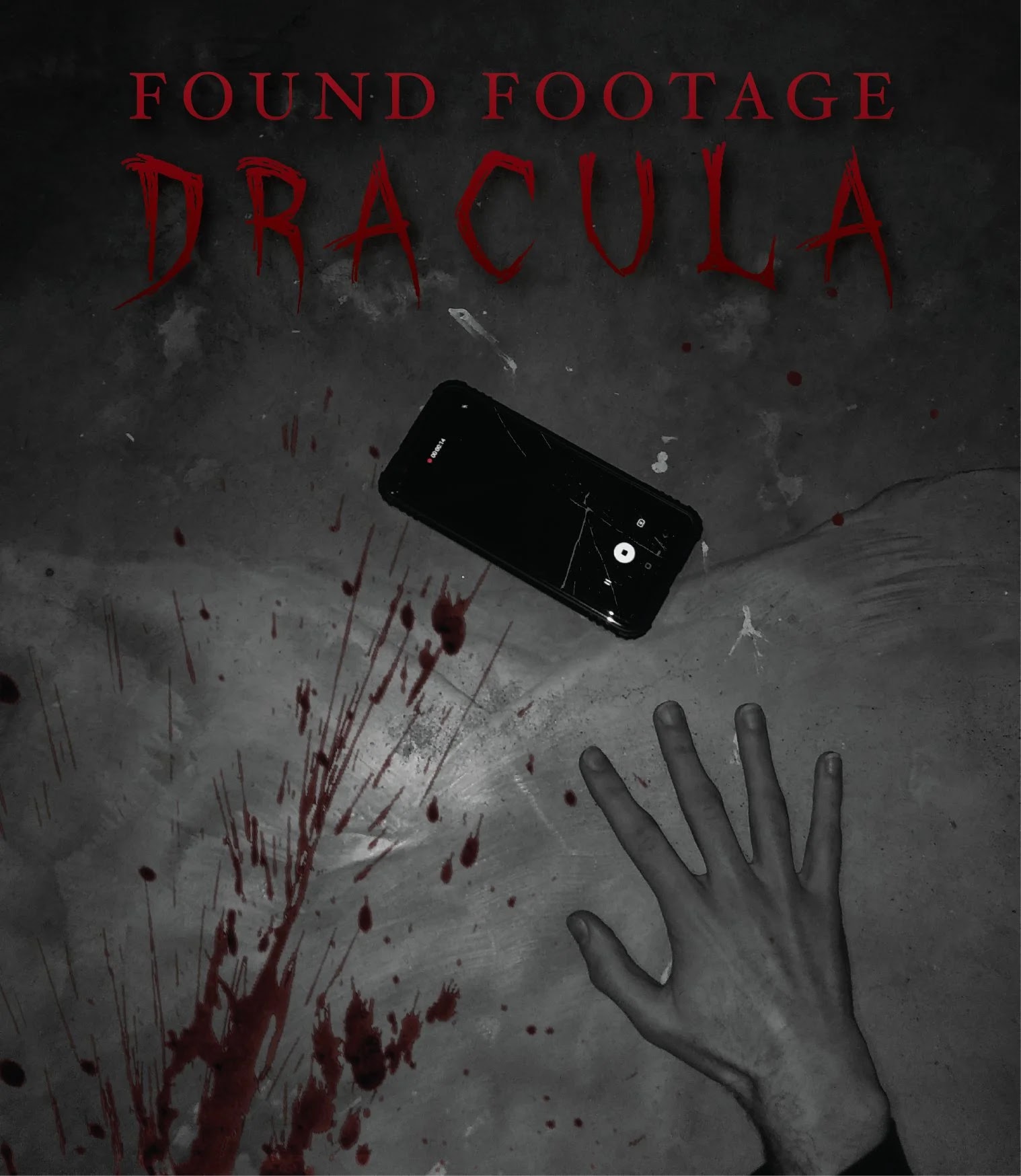
Found Footage Dracula
Directed by Hunter Farris

Bueller Studios
25:24 minutes, 2022
It’s an interesting thought. The director has stated that the original novel was a collection of letters, newspaper articles, etc., and therefore was a presentation of evidence, or a 19th Century found footage novel. So why not update the story and make it a modern found footage (FF) tale? To give you an example, rather than Jonathan Harker (Mitch Tyler) employing a horse and carriage to Castle Dracula, instead he takes an Uber. This is threadbare to the original novel, of course, considering the length and budget, but we have the main characters, including Lucy Westenra (Brookelin Backus), Mina Murray (Yvonne Bass), Doctor John Seward (director Farris) who runs the asylum, and Renfield (RJ Hall) as his chief patient. Of course, the Count himself is never seen because he casts no reflection and cannot be filmed. There is a lot of yelling in fear here, and I found it quite amusing (though not funny, I am glad to say). This is as indie as one can get, with a bunch of friends getting together and doing it on TikTok. I’m quite proud of the troupe, actually: they took a premise, executed it, and did a relatively decent job of it. The short is available in a computer-able version and one that can be watched on the phone. I am hoping that this leads to a full length attempt next. Or perhaps, an adaptation of another classic, like maybe Found Footage Frankenstein.
Full film HERE 


Host
Directed by Pat Baker
Postmortem Films; HarLau Productions
24:13 minutes, 2022
A young, yet struggling couple take some time off to a vacation house that’s more of a mansion (the Stoneleigh Estate in Martinsville, VA), with little around them. Annie (Josie Juliette Wert) is lonely and wants some attention from Jeff (JD Starnes), a workaholic, who has trouble leaving his job behind even with a sex scene (a longer short gives more time for stuff like that). Meanwhile, she is seeing visions from the past of previous residents from the 19th Century of an angry and brutal man, Jacob (Zach Ball) and his abused wife, Sara (Bethany Paulsen). Sort of like the television show “Ghosts,” but not a comedy; she can see them, though, but they don’t acknowledge her. Of course, Jeff doubts what Annie sees in demeaning ways. He may not be as physically brutal as Jacob, but he is verbally unsupportive and condescending. She is trying, and he is, too, but at, like, 50 percent. There is a mix of surprises and expectations in this lush tale, beautifully directed and shot. It’s long enough to give some form of exposition of the two main characters’ personalities, and yet short enough not to drag the story along. For a third short film by the director and producer of seven, it is a solid piece of work.
Full film HERE 


The Room Upstairs
Directed by Jacob Arbittier
Burnt Mill Road
4:27 minutes, 2020
Extremely prolific of late, this is one of Arbittier’s earlier films, and it is simple and to the point. A mother and daughter are trapped in a house with… well, the poster says it. It’s a bit of a nail biter, though it does not go into detail about how their sitch came about. The music is really creepy and effective at helping build the tension, and the ending is actually a surprise. Simple, short and to the point, and excellent.
Full film HERE 


Run
Directed by Alex Magaña
ACMofficial
3:18 minutes, 2022?
http://bit.ly/ACMofficial_Horror_Shorts
As Marshall McLuhan once said (among others), first you use technology, and then technology uses you (e.g., cell phones). For this film, it is FitnessTracker, the fictional equivalent of a Fitbit, that helps organize an exercise plan. However, thanks to a bug, it causes the uses to exercise to death. That is the problem facing the main character (Michael Glauser), as the device on his wrist takes control. And because of his relationship with his girlfriend (Esther Lane Montes), being that he’s the toxic masculinity type, this makes this a really sharp comedy that deals with both the human and tech. Wonder if this device is made by Skynet? Oh, and check out one of the director’s earlier films, which is one of my favorites, “Smiling Woman.”
Full film HERE 


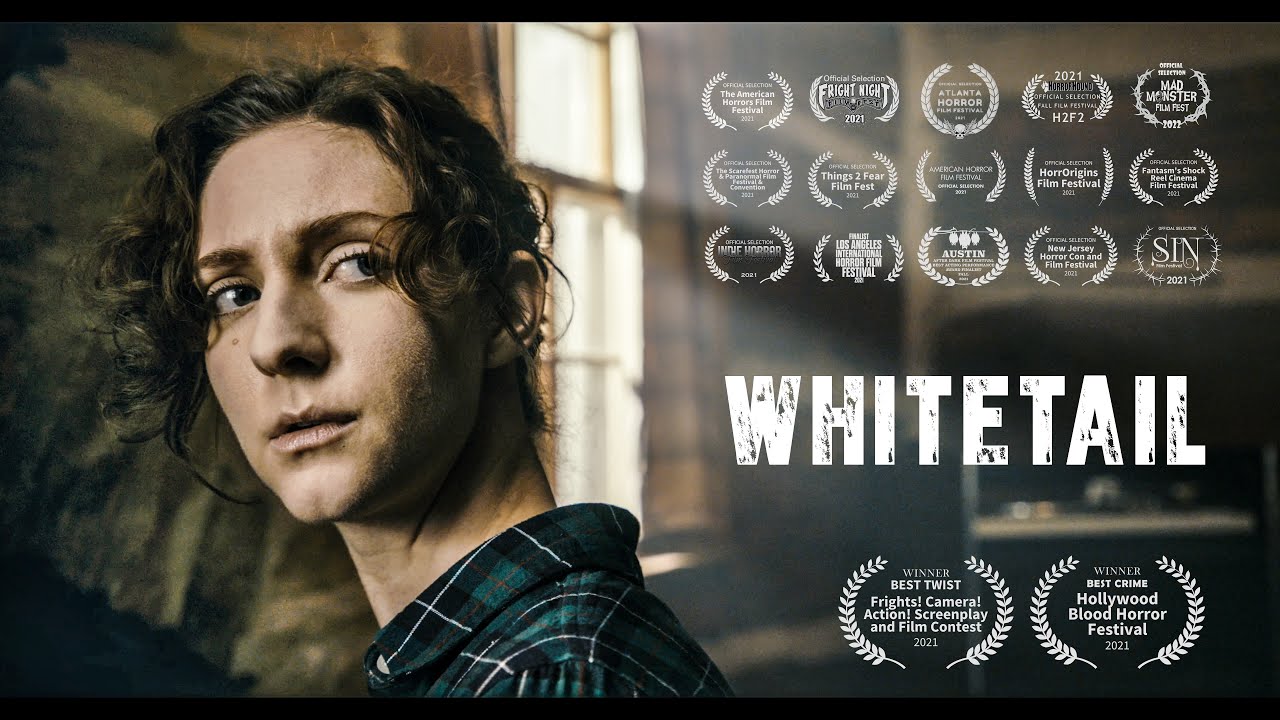
Whitetail
Directed by Josh Minyard
Sunhouse Entertainment
15:51 minutes, 2020
www.facebook.com/whitetailshort/?modal=admin_todo_tour
This short is multi-award winning, and it is easy to see why. Beautiful cinematography, well-paced, and well-packed with tension. The very end is a bit obvious, but works incredibly. A young couple on the verge of engagement, Robbie (Derek Evans) and Alex (Tara Parker) are on a hunting trip. It’s not clear if this is for food, or pleasure (personally, I have no problem with the former, uncomfortable with the latter). He goes off to a hunter’s blind in the woods, and she to the spare and isolated cabin. But in a Most Dangerous Game, things do not exactly go as planned. My question is the motive for the action, which is: is it a comment on the first or the second reason for hunting? It probably doesn’t matter, because it is the sheer tension of the actions that occur in the story that make this watchable. One could call the ending ironic.
Full film HERE 

Sunday, April 25, 2021

Review: Winifred Meeks

Text © Richard Gary / Indie Horror Films, 2021
Images from the Internet

Winifred Meeks
Directed by Jason Figgis
October Eleven Pictures; Figgis-West; BayView Entertainment
88 minutes, 2020
www.facebook.com/winnymeeks/

I was excited about getting the chance to review another film by director Jason Figgis. While he has been incredibly prolific over the last few years, I had seen and reviewed two of his previous output: Children of a Darker Dawn (2012) and Don’t You Recognise Me? (2016). Both of these films are very dark and intense, and quite beautifully shot.

Truthfully, I must admit that ghost stories are among my faves, especially with a gothic nod. And this doesn’t as much nod as headbang. Time to click on *play*.

Lara Belmont

Asthmatic Anna James (Lara Belmont) is a popular author of youth mysteries on a deadline, who has hit a dry patch. What better way to rekindle a writing block than to rent a stunning house in the middle of nowhere? This particular trope is well worn (e.g., 2004’s Secret Window, possibly 2007’s 1408); perhaps the underlying connection is that the creative mind is more open to spirituality.

Anyway, the Seaview House (the opening shot tells why) in Suffolk, England, is beautiful, but imbued with a darkness (camera filters help) that could have come right out of Shirley Jackson’s iconic opening paragraph of her novel, The Haunting of Hill House (1959). At once both modern (such as a flat-screen TV) and rustic (lead pane windows and a dial phone), it is a perfect place for a spookie to be hanging around, doncha think? Figgis, who was also the Director of Photography, does a very masterful job of capturing it in a loving-yet-mysterious manner. I really enjoyed how he would situate the camera in a different room, and you would watch the character of focus through the doorway.

The first act is mostly atmospheric, as Anna settles in for the night, with a beautiful score and long and luxurious shots at the start, other than a quick jump scare. We get familiar with the sadness of Anna, reflecting these moody views of her temporary life at the house. It definitely starts as a slow burn, with one subtle indication that there is something not right, shown almost as a throwaway line (okay image), and another warning of what’s to come. Which brings me to a digression, if you will forgive me: why do genre films (especially) need to have a scene of someone brushing their teeth? It’s a pet peeve, sorry. Now back to our scheduled program…

Julie Abbott and John West
Ever slowly, but increasingly so, the presence of a previous owner, the titular Winifred (Julie Abbott) makes herself known. She vacillates between sadness and anger, both reflecting the mood of Anna, but bringing her own story with it, which is the mystery behind the film of which Anna seeks to learn in the second act.

There are a few inside subtle signals, such as this youth mystery writer being forced to listen to a radio play version of Sherlock Holmes, and early-in-the-film showing of the rising dead in the form of Nosferatu: eine Symphonie des Grauens (1922), and the house haunting film House on Haunted Hill (1959), among others on the telly; gotta love public domain. In fact, there is a lot of radio talking programs disbursed throughout, such as writings by the “father of modern medicine, “Canadian physician Sir William Osler, who promoted euthanasia.

In the nothin’ for nothin’ department, I found the bookstore Anna goes into in Westleton, on Google Maps, thanks to the Snug Tea Room across the road. That made me feel good, for some reason. She goes to the store to research the house (though any author I know would stop to see if they could find their own books).

While this is a contemporary story – albeit with an older ghost from a hundred years ago – I would definitely define this as gothic, with its turn-of-the-century (at least) house and what inhabits within its walls (and beyond).

I believed I figured out the ending pretty early on, but I’m happy to say I was wrong, Figgis did not take the easy and obvious route, which is refreshing. With only two living on-screen characters and one un-, the rest of the cast is either on the phone or mostly the radio. Perhaps the disembodied voices are to reflect the spirits of the world, or specifically Winifred. It is a solid choice. As, in rare exception, no two people are seen together between the three characters, and in those cases, they are easily 6 feet apart. I am assuming this was shot during the COVID-19 epidemic, and was edited (by Figgis) in a very sharp and precise way. The photography and drone work are excellent, over the beautiful West Coast of England.

My only quibble about the film, and I know this is trivial at best, is I do not like the picture of Belmont on the poster as it does not do her justice.

There is no blood, no violence, no nudity (other than an upper back), and no contact, and yet this still manages to be extremely creepy, which is a credit to Figgis. My appreciation of his work just keeps growing.

Friday, October 25, 2019

Review: Loon Lake

Text © Richard Gary / Indie Horror Films, 2019
Images from the Internet

Loon Lake
Directed by Ansel Faraj
Round Town Productions / Hollinsworth Productions / Three Knots Entertainment / Indie Rights
95 minutes, 2019

As Kelly Erin Decker, one of the producers of this film explained in an email to me, “My friend Nate [Nathan Wilson, who also is the main protagonist of the story – RG] wrote the script based on a legend in the town [in Minnesota] where he grew up, and we returned to that same town to film...”

Nathan  Wilson and David Selby v.1
The basic premise is that Lewis (Wilson) had recently suffered a tragic loss, and to get away from his pain, he picks up from Minneapolis and takes a respite in Round Lake, a real and little community in the middle of nowhere whose two claims to fame are the story of the witch, which I will get into in a moment, and an actor that came from there (yep, I mean Wilson). But as Harry Chapin sang, “You can travel on 10,000 miles and still stay where you are.” (“WOLD”).

He rents a house and a few denizens at the bar tell him the story about a local woman, Mary Jane (Decker, who uses the name credit as Kelly Kitko here) who was beheaded as a witch in 1880 because she turned down the advances of the local pastor (David Selby… wait she refuted Quentin Collins?!?!).

Anyway, a local woman, Gracie (Brittany Benjamin), has her eyes on Louis but he is too distracted by his memories (Sierra Schermerhorn) … and the witch, who’s grave he possibly crossed too many times. Y’see, the legend goes – in Candyman and Bloody Mary fashion – if you walk over Mary Jane’s grave three times, she will come back to kill you in three days. But how much of it is “reality” and how much of the events that follow are in Louis’s head? This delves from possible supernatural to possible psychological, as we probe into Louis’s thoughts through dreams, and his own anger. This kind of gives a possible double meaning to the title of the film with Loon being both literal and figurative.

Kelly Kitko aka Kelly Erin Decker
This is smartly put together by director Faraj in the way that it plays with the two natural and supernatural elements, putting it on us to try to figure out which is which. Not a new premise, but when it’s handled well, as it is here, it keeps the tension going.

Another nice element to the story after the opening prologue, is that we keep returning to the 1880s throughout the story, to fill in the legend and possible history of events.

Religion plays a strong part in the story, and occasionally comes off as a bit preachy as certain characters question their own faith (e.g., what if there is no afterlife? Is there a God? Is there a Satan?) and those of others. While not a central theme, it certain is prevalent in various parts of the story. As someone who is non-religious, I was not bothered by it, but I was conscious of it.

 From what I understand, the director is a big fan of the original “Dark Shadows” television series (as was I), and he often casts members of the show into his films. Here, as I mentioned, he has not only David Selby playing dual roles as the Pastor and his great-grandson, but the Pastor’s spouse is an enjoyable cameo by Kathryn Leigh Scott (wait, Quentin Collins is reunited with Maggie Evans?!?!).

David Selby v2 and Kathryn Leigh Scott
It’s pretty easy to tell that this is shot on a budget somewhere between little and none, but it also is a perfect example of how much can be done with so little. Under the right circumstances, filmmaking is a collaborative art form (e.g., without one member, such as directors like Kubrick, who demands exactitude and subservience from his crew and cast; where would they be with a huge budget?). With everyone involved giving their all for something that means something to them,

This film was shot with a limited budget and crew. As Decker put it, “We had a total crew of 5 people (including me and Nate, who did double duty as actors and various crew functions). Everything in the film comes from our hearts and our hands, down to the loon models which I made myself.”

The acting here is quite solid, as Wilson and Decker dance around each other. Selby does the most work as two divergently difference characters (even if from the same gene pool). Everyone else in the cast is consistent, and that’s a good thing. Benjamin also does well as a strong woman who is smitten but not desperate (as so many female characters are written to be). Time wise, Scott is briefly there in her cameo role, so while she is fun to watch as always, especially ringing the nostalgia bell, she shines and her intensity level is set on high (I smiled through her performance).

As I’ve said before, it’s important to look at small budget indie films like this one through different eyes than blockbusters, or even those independents with some cash flow like the Annabelle or even the Freddy/Jason/Michael franchises. There is a lot of ingenuity and heart that goes into smaller films, and they usually deserve the love that is put into it. Yes, a bad film is a bad film, but this one is quite impressive. It’s worth turning your brain on, and giving it a thoughtful viewing.

PS: Please note that I did not have to look up any of the names of the “Dark Shadows” characters.


Sunday, January 20, 2019

Web-series Review: Under the Flowers: Season 1 and Season 2

Text © Richard Gary / Indie Horror Films, 2019
Images from the Internet

Under the Flowers: Season 1
Written and directed by Richard T. Wilson   
Mad Shelley Films / RTW Productions
17 minutes, 2016
www.madshelleyfilms.com
www.undertheflowers.com

Starting out as a ghost-themed short film called “The Halloween Girl,” it has been expanded into a Web series.

Jackie (Katie Stahl), who is about to drop out of college, is searching for a boy who seems to be in trouble. She’s been having visions and sees dead people, and it seems like everyone she meets knows more about this strange boy than her, including, Nick (Scott A. Evans) a guy by a campfire who appears when she passes out, or Poe (Lauren LaVera), who looks like she fell into a vat of goth.


Katie Stahl, Gabrielle Huggins
Helping her as she can is Jackie’s bestie, Ella (Gabrielle Huggins), who has a whiff on the situation, and seems to know more than she’s letting on. Meanwhile, Jackie keeps passing out and having these odd and scary visions.
 Broken up into four chapters (averaging 4+ minutes each), we enter Jackie’s world in Southern New Jersey (near Philly), and see things from her perspective, learning at the same time she does. This is an unusual take on a ghost story whose ending I didn’t see coming.

There is little blood and minimal onscreen violence, but rather it focuses more on the characters and the story, and thereby drawing the viewer in. With its short span, it manages to cover quite a lot of ground. There’s a bit of an artistic flair, with some quick editing, but none of that gets in the way of the most important part, which is the tale itself.

The cast is attractive, and happily for this rare moment seems age appropriate (i.e., they look college age, rather than about to go into their Middle Age).

There is one question I have about the ending, which I won’t posit here and give anything away, but I am assuming it will be resolved in Season 2. I’m looking forward to that. 


 Under the Flowers: Season 2: Circle of Hell
18 minutes, 2018

The second season focuses more on Poe (Lauren LaVera), who transforms into Rose (Amanda Kay Livezey), thanks to her Virgil-like guide, Nerissa (Kirsten Lee Hess), who is taking her through her paces as they are fleeing from evil forces trying to get Rose/Poe’s soul.  


Lauren LaVera
Along the way, they meet other travelers, some innocent, others not as much. With additional digital effects that are actually quite effective and striking, we flip locales, between the forest and elsewhere. In the latter, we once again meet Charlotte (Catherine Kustra), the character from the original “The Halloween Girl,” who had more of a cameo in Season 1.
The first season won some awards, and thanks in part to that, the second is a bit more grand in style and form, having a more solid looking foundation with better editing, effects as I mentioned, and is even more engaging than the first (and both kept my interest throughout its run, albeit short).

This second season kind of answers the question I had from the previous one, though of course there are questions raised about the ending here, which I’m sure will come to light in Season 3, which is now in development.