All genres of suspense, terror, and horror will be reviewed by Richard Gary. His address to send preview copies supplied upon request to rbf55@msn.com.
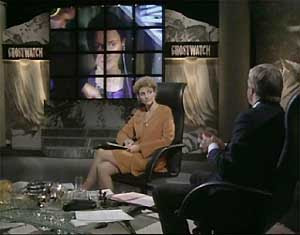
Ghostwatch Directed by Lesley
Manning BBC; Screen One; Sonopress;
MVD Entertainment
91 minutes, 1992 / 2022 www.sonopress.de www.mvdvisual.com
Right now, there is a
proliferation of Ghost Hunters type shows on cable television. I have watched a
couple of them, and they suck, so obviously made up or at the very least
stretching credulity. But this BBC1 film dates back to 1992, ahead of the
crowded market, and is presented as a real documentary. There is little
indication beyond the credits that it is fiction and exclaims itself as “live,”
and comes across as a news program like ”20/20” or “60 Minutes.” This is helped
by it being hosted by respected newsman Michael Parkinson and well-known
celebrity Mike Smith (d. 2014).
As with Orson Wells’
radio broadcast of “War of the World” (1938), some people did not realize it
was a scripted piece as this was way before the popularity of the Found Footage
genre, so much of the audience was caught unawares. And like Wells’ radiocast,
this was presented on October 31.
Mike Smith, Michael Parkinson, Sarah Greene
In a regular looking
home on Foxhill Drive (in England; I am assuming London), the Ghostwatch team
is arriving to investigate the ghostly happenings in that house (the example
they show is actually laughable for a number of reasons, but incredibly
reminiscent of Paranormal Activity in 2007, nearly a decade later). Hosting
the team is annoying comedian Craig Charles (of “Red Dwarf” fame). Note that
most of the main characters are playing themselves. The “reporter” from the BBC
and lead is Sarah Greene, who was married to Mike Smith at the time, which is acknowledged
in the program, thereby giving it more credibility.
Like Geraldo Rivera
and Al Capone’s vault (do you remember that?), for a while everything is pretty
mundane as they switch back and forth between the house and the studio, where Parkinson
and Smith interview a parapsychologist, Dr. Lin Pascone (Gillian Bevan), the
owner of the house, Pam Early (Brid Brennan), and take calls from people who have
possible ghostly experiences. Taking the counterpoint poo-pooing the events, is
American Dr. Emilio Sylvestri (Colin Stinton).
Brid Brennan and the Wesson sisters
One of the questions
in this show is whether or not the events are a poltergeist, due to the two
puberty-period (no pun intended) Early daughters and real-life sisters, Kimmy
(Cherise Wesson) and Suzanne (Michelle Wesson). Or, perhaps, could it be
something more sinister?
Before we get to the
meat of the matter, when the banging hits the walls, the film almost mocks
itself with a series of red herrings that I thought was really well written (by
Stephen Volk, who started his career with Gothic, the 1986 story of the
creation of the Frankenstein novel).
Craig Charles, Brennan
This is the first time
this has been released on Blu-ray, which looks incredibly crisp. There are some
nice extras. First up is a brand-new Audio Commentary with British film
historians Dr. Shellie McMurdo (University of Hertfordshire/University of
Roehampton, whose interests include the horror genre, trauma theory, Found Footage
horror, and torture horror) and Dr. Stella Gaynor (University of Salford;
author of Made for TV Monsters: How has the rise of horror on US television
impacted on the spectacle and acceptability of the genre?, as well
as being a horror make-up artist). They discuss how original this TV film was
at the time. The two Docs, who are personable, for quite a while discuss their
reactions to the film when they saw it as young’ns. Eventually, they mention
how certain scenes are culturally effective. It is a bit self-centered, but so
refreshing than most of the flat and clinical, “Here is how it got started,
cast stories, effect on culture” cliché commentaries.
Also new for the
Blu-ray is the documentary, “Do You Believe in Ghosts?: 30 Years of Ghostwatch”
(48 min). This is essentially a Making Of documentary, filled with interviews
with the cast (Greene and Bevan), crew (including director Manning and writer
Volk), among others. It is engaging and a bit of an historical document about
the filming. It is mixed with scenes of the film that you have probably just
watched, but using it as reference points to the conversations, works. It is
well put together, and worth the view.
Gillian Bevan
Also on the disc is an
archival commentary with writer Stephen Volk, producer Ruth Baumgarten, and
director Lesley Manning. They give a bit more details about both the technical
ends of the film and anecdotes. It amazes me that after all these hours of
commentary, there is very little overlap of information. My guess is that this
commentary was recorded for the DVD release in 2014. Last is the “Shooting
Reality” featurette by director Lesley Manning (8 min). This shows parts of the
script, the house floor plan, and Manning’s notes about it as she describes it,
among other things. There is also the only clear and close-up picture of the ghost,
Pipes (Keith Ferrari).
What kind of reaction
did the audience have during the show and after? Well, the BBC announced that
they received over a million phone calls that were both favorable and
complaints by people who thought it was real (despite the credits at the beginning
and end).
Greene
Just for the originality
in its format, this is as an important television moment as Captain Kirk mixing
it up with Uhura. There was no reality television frame of reference, and this
makes it all the more powerful, and worth remembering when you watch this, and
you really should. So much fun.
Oh, and there are
reportedly 11 appearances of the ghost, Pipes. I saw four. Drinking game? Or
maybe every time you see the two-liter bottle of Coke.
Holes in the Sky: The Sean Miller Story Directed by Ash Hamilton Moon Makers Media; Horror-Fix Films
114 minutes, 2021
www.facebook.com/HorrorFix
Some may call this
found footage but it actually falls into the separate sub-category (though
occasionally overlapping) of mockumentary. I realize most people think of that term as
comedy, such as in those directed by Christopher Guest, but it goes beyond that
narrow margin. In this case it is a realistic documentary style, albeit fictional.
Taking place mostly
over a five-day period in Illinois, the topic of this release is more science
fiction-based, though it uses the real names of the people involved, including
the first-time feature director, Ash Hamilton, his wife Chanell Hamilton, who
helped produce and was part of the crew, director of photography Brett Pearson,
interviewer Douglas McDonald, producer Laura Richter, and others along the way,
including well-known author and spook historian Eric Woods.
As the tag line
explains, Sean Miller disappeared for four days in 2013, and now in 2020, a
documentary crew is seeking to find out the truth about what
happened to him. Part of what I find interesting is for a long time, the reasons
for Miller’s disappearance is more hinted at than explained, though it is
pretty obvious from the gecko (yes, I know it’s “get-go”; in the words of that
great philosopher, Tommy Smothers, “Words to me are a plaything”) that the
topic is alien abduction. The beginning is shrouded in mystery as the crew
pulls up in front of Miller’s residence. Even at this point, Miller nor his family
have been shown on camera. Heck, the Millers are not even listed on IMDB
(neither is Pearson, but I find that may lead to part of the story; yes, I
write this as I watch it).
We finally get to
meet Sean and his wife Stacey nearly a third of the way through, and actually
hear the term – alien abduction – nearly at the half way point. Following the
formula from metaphysical films like Paranormal
Activity (2007), the
tension starts building as lights flicker, VHS-type visual noise appears on the
footage, and pots go flying off the wall by themselves, among other spooky
issues. Great! Two possibilities happening at once, both alien and
supernatural! Nice.
Ash Hamilton
Two really
interesting aspect to me about this moc is the way the mundane can suddenly turn into
something precise about the storyline, such as a conversation about television
cartoon shows that is downright creepy, and the other is the question of
whether the 2013 taking of Miller by the undocumented aliens (sorry, bad attempt
at political humor) is a random choice, or one that is planned and targeted. On
some level, though there is obviously no correlation, the latter had me
thinking of Xtro (1982).
One of my fave things
about the film, which I suggested before, is that even though this is about the
effects of an alien abduction, thematically there is a large element of nearly
poltergeist motifs thrown in to the mix.
The dialogue seems
to be non-scripted and free-flowing most of the time, even when it is obviously
pointed in a certain direction. This gives it an improv feeling of reality that
helps the picture and the tension to come.
The film is well
structured in a way that is, at first, fun and a bit confusing, but title cards
stating time-stamp information helps to clear this up in a-ha moments that reveal a bit of masterwork in the story’s chronological layout.
Sean Miller
There is also a
more subtle aspect of the film that I found intriguing, and that is the use of
technology. The two main video cameras are a somewhat professional level one and a
cell phone, and there are indications of polaroid snapshots when there are
issues with the digital captures. Also, there is the manipulation of images to make
them sharper and clearer through professional means. So, we are dealing with
high end and lower-level equipment, while contemplating a possible race of
aliens with even further futuristic technology.
This has nothing to
do with the film proper, but my one distraction was during a tense scene, when
the camera pans over a box of LPs and I wanted to look through them. It seemed
like the one in front was a picture disc. Yeah, I’m the kind of guy who stops a
story when someone is talking in front of a bookshelf, and I check to see if I
can tell what books are on the shelves. Sometimes I judge people by the books
and music they keep. But I digress…
At nearly two
hours, the film is a bit long, and some of the early footage (i.e., in the
first 20 minutes or so) could have been culled a bit, but I must say, this
could have been really dry, but Hamilton (the Hamiltons?), by mixing alien and
poltergeist-type styles, managed to put together a documentary(ish) that is
quite engaging and cohesive. As it delves on, it gets more compelling and
enjoyable, right to the end, even if you can somewhat figure out what may be
that conclusion.
The Land of Blue Lakes (aka Земля
Голубых Озер) Directed by Arturs Latkovskis [Self-produced] 72 minutes, 2021 www.facebook.com/landofbluelakes https://vimeo.com/ondemand/357056
Though I tend to find most
found footage flicks to be tiresome at best, right from The Blair Witch Project (1999), there have been some exceptions, such as M.O.M. (Mothers of Monsters)(2020) and Grave Encounters (2011). And, that being said, seeing one from the Latvian Soviet Socialist
Republic definitely piqued my interest.
So, yes, the film is in
Russian with very easy-to-read subtitles (white letters in black boxes), so
let’s be mature and get over that right now, ‘kay? With a miniscule budget of under
USD$1,200, which basically would cover the food, gas/transportation, and
perhaps kayak rentals, I wonder if Latvia has a film tax credit, or a Film
Board with subsidies, as does Canada. I know, however, that this film was
completely self-funded by the director (I asked).
As with Blair Witch, all five of the central characters are named after themselves,
including the director/writer, who plays a version of himself. These five go
into the wilderness of Latgale, to kayak along some beautiful waterways. If you
look at a map of Latvia, you can see that there is a lot of natural areas. This
makes me want to see it in person, even if that never happens. Of course, I’ll
pass on the spooky stuff.
I don’t believe I’m giving anything away as this starts with title
cards saying that all the participants were never seen again, and the footage
was found on “the dark Web” (it’s always the dark Web, ain’t it?). While this
intrigues the viewer (i.e., me), at the same time it also projects that the
odds are there may be no “final girl” – or guy – and no good will come from the
adventure. Of course, that is generally the direction found footage goes anyway,
and this is quite the common opening trope. No negative feelings here, it is
time to soldier on.
At the opening, we are introduced to the cast as they gather to head
off into the wilds. It feels very natural, and I am assuming that most of the
dialogue (if not the direction of the conversation) is ad-libbed on the spot. Arturs
is also the main cameraperson, trading off on occasions with the others,
especially his girlfriend Veronika Rumjanceva, which makes it easier without a
crew needed to tag along. I am assuming that all of the five are friends of the
director in the non-cinematic world as well, as this is their only IMDB credit
for all of them. This means they know each other well enough to riff off the
others’ personality, which is a good thing.
From this point, it almost feels like watching someone’s travel video,
but I have to say, for some reason, I found the kayaking scenes through tall
reeds visually stunning and interesting, more than even the somewhat mundane casual
conversations as our three guys and two gals (others are Alina Sedova,
Vladislavs Filipovs, and Edgars “Zuz” Jurgelans) float, eat and drink, going
further into the lake district (while we don’t see other visitors at this
point, there are roads/bridges and what looks like train tracks which they
paddle under (more about this later). It feels both isolated and civilized at
the same time, but they go further into remote areas.
Latgale is in the far eastern end of Latvia. The country is mostly
Lutheran, but Latgale is historically more Roman Catholic and “Old Believers”
Russian Orthodox (thank you Wikipedia). This Other view by the
mainstream religion plays a part in the story, as our intrepid kayakers meet up
with some “pagans” (I am assuming a distortion of non-Lutherans, as religious
folk of any stripe are wont to be). They may not be interpreted as ferocious
as, say, the Wrong Turn franchise, but these are
more mystical and mysterious, showing up at unexpected moments.
Ever so slowly, we are introduced to the pagans, through runes and
painted symbols, a dolls nailed to tree, and their own Point-of-View filming of
the sleeping kayakers. The tension starts to build, but there is more boating
yet to be done.
Another aspect I find interesting, as with, say, United States National
Parks, there is an odd mix of wilderness and civilization, such as an unmanned
weir and those road bridges that look forlorn. In the story, Latkovskis is a
student of the Pagan religions of the region, so along the way, in bits and
pieces, we get some nice exposition, such as about the angry Thunder Sky god,
Pērkons, setting up for an enjoyable visit to an island with an ancient stone
for sacrificing (surrounded by modern garbage from previous visitors) and
rotted, abandoned boats that I would have loved to have photographed, as well
(taking pictures of decay is one of my hobbies).
So, is it a supernatural thing that is haunting them, as in Blair Witch, or is it a more human element? Of course, I
will not say, but the ending did come as a bit of a surprise, I am happy to report.
I am not sure why I found this so interesting, perhaps because I enjoy
travelogues and seeing the cast’s real reactions to physical obstacles on their
journey (e.g., fallen trees blocking their waterway). It is definitely a slow
burn film, much in the way of Blair Witch or the Paranormal Activities franchise, and if you are a fan of those
types, this might be right up your lake.
Waynesville,
OH, where this was shot, is a far cry from the Long Island-based Amityville, NY
(approximately 666 miles away, actually), where the original Amityville
novel and film took place. I’ve been through Amityville any number of times,
usually along the Sunrise Highway or Merrick Avenue (Route 27A), and it’s
remarkably suburban. Its parks are completely manicured and filled with
baseball diamonds. Quite boring, actually.
The Amityville
of this story, however, is on the edge of a deep, dark woods, opening up the
possibility of a found footage wonderland filled with mystery, spirits and
evil. This concept is way more fun than its reality, even though as with most found
footage this is supposedly “based on the real tapes,” so let’s stick with this
one, whatcha say?
Josh Miller and Joni Durian
Actually, the mild
contrast of the reality of the Atlantic oceanside community with close neighbors
and the fictional woods-based town is quite amusing, as there are wild animals
and people with shotguns walking around in the No Escape version.
But there are
also added juxtapositions within the story itself that enhance the mood and
breaks up the walking-in-the-woods-by-camera-light syndrome. The timeframe is split
into two groups. The first is of a woman, Lina (Julia Gomez) who moves into the
house, and is preparing to send a VHS diary to her husband who is overseas
in the military. She starts off perky, and as events occur that are straight
out of Poltergeist (1982) and the Paranormal franchise, she gets
affected by the strange goings on. If you can get past her annoying constant verbal
“ummm” type ticks, her scenes are pretty effective.
Michael William Ralston and Alia Gabrielle Eckhardt
The other
segment take place in the “now” (2016) as a group of friends decide to do a
project to record themselves to see what “scares” them. And where better than
Amityville; though a meta comment by a one character is essentially the
confusion of why go there when there are haunted houses where they are. The
core of the group is George (Josh Miller), who has “daddy issues,” his lovely
and adoring girlfriend Sarah (Joni Durian), his snarky sister Elizabeth
(Allison Egan), their vegan New Age pal Lisa (Alia Gabrielle Eckhardt, who also
did the make-up FX), and the bearded pervy camera guy, Simon (Michael William
Ralston).
Another flip
is that the Lina sections are nearly all inside the house (with an occasional
bit in the backyard), and the group is almost always in the woods except for a The
Blair Witch Project (1999) moment indoors the supposed house. This is all
very clever writing to not only break up the way the found footage is
presented, but to be both claustrophobic and yet… not.
Allison Egan (right)
Is the film
scary? Well, I think creepy is a better way of putting it. A spooky child that
tends to appear and disappear is a nice way of playing with that, though I
would have liked some kind of back story about her (i.e., I don’t remember her
from the original Amityville story, though I do remember the pig face in
the window).
There is no
gore, but a nice amount of blood, and a surprising quantity of female nudity.
I’m not complaining, mind you. One of the good things is that most of the
effects are practical and make-up based.
The acting is well
done, and a lot comes across as natural, even if a character is annoying, which
is a bonus. For example, Miller’s “George” is often a demanding dick, which is
polar opposite of the pathetic schlub he played so well in Couto’s 2016 comedy Nothing
Good Ever Happens. Same with Durian, who is super-hyper in Couto’s 2019 Ouija Room, but here is more subtle and subdued (mostly). Even Gomez, with her “umm”
tic, shows a range well, going from giddiness to abject fear.
Much of the
cast is part of a collective in the Dayton area that shows up often in both Couto
films and that of Dustin Mills, though some of the obvious usual actors seem to
be missing here (who were probably busy with Mills). But that’s okay, since
everyone did well.
Julia Gomez
While I won’t
give away the ending (never do), there is an interesting twist that’s a bit of
a head scratcher and a conversation starter for the viewer(s) that I respect.
Getting back
to the use of the found footage trope, what I liked about this film more than most
others in the sub-genre is that while people may be walking in the woods with
camera lights (how do they keep their batteries charged?), there is little running
through the dark, which I find really annoying. Walking isn’t as bad on the
eyes and stomach.
The copy of
this film I reviewed was an online screener, but it is now available in
Blu-ray.
Despite being
very prolific and genre-jumping, Couto has once again shown that he knows his
way around a film, and I look forward to seeing more of his output. And check
out his numerous podcasts, which can be found linked on his Facebook page.
As promised in an earlier blog, here are a couple more of Creep Creepersin’s indie, shot-on-digicam full-length releases. He is fast becoming one of my favorite DIY directors, showing an artistic side to his releases. The reason I put these two reviews together is for a number of reasons: they both co-star Ariauna Albright (who RBF met in the early 1990s at a Chiller Theatre show in Rutherford, NJ) and Creep, himself, is the main actor. In both, they are unnamed. These are more psychological in nature than most of Creep’s works, and if fact, Peeping Blog could easily be considered as he’s sequel.
”…and drop a smile passing in the hall But there’s no laughs left ‘cause we laughed them all And we laughed them all in a very short time…” - Paul Simon
“You oughta scratch from the human race You are a waste of a name A waste of time and a waste of space You’ve only one claim to fame: I don’t like you.” - Stiff Little Fingers
For the opening of the “Making Of” short, director (etc.) Creep Creepersin states, “I don’t remember really writing it or doing it; I just remember we decided we were going to make a movie, and we made the movie.” From the detail given by him during the commentary, however, that is obviously not the case, but rather is Creep playing mind games in a film full of mental questions.
This is the third film of Creepersin’s I’ve seen in a row. While it’s one of his early full-length efforts, it’s also among his best. he is a tight psychological drama about an unnamed man and his ever increasing descent into mental illness.
When we first meet “he” (as the character is listed in the credits; apparently it is always lower case), played by Creepersin himself, he’s just gotten out of bed as we watch him bring his very crunchy feet into the shower, while still wearing his glasses. This is to symbolize, I’m assuming, his tenuous connection to what’s really going on in the world though he does his best to see it.
His long-suffering wife (listed in the credits as “the wife”), both touchingly and scarily played by scream queen Ariauna Albright, comes to the bathroom door in a thick leopard print robe open over a black, cleavage-exposing bra that she wears for most of the film. She is obviously unhappy and dour in her life, especially the one she shares with him. Wait, is that a kitchen knife in her hands?
As the credits roll over yet another Creepersin breakfast eating scene (is he obsessed with this meal and tooth brushing, or what?), we start to see how the cracks in the relationship are imbedded, as he obliviously drinks his coffee with long, loud slurps, and mashes the food into his mouth. Not a turn-on for her (or us), as we watch her winch at every sound and action. We also shortly learn that she wants a baby, and holds him responsible for her lack of progeny (despite neither having ever been tested). It becomes explicitly clear quite quickly that they both are having psychological problems. It almost seems like she has a form of severe depression, or PTSD.
After believing the wife has a kitchen knife early on, it become increasingly clear that he’s becoming delusional. For example, after being out of work for an undisclosed period of time (though the impression is it’s been quite the while), he receives a letter that to him says “Proceed,” in big, handwritten letters, but when she reads the same paper (i.e., the real world), it’s a job offer. The viewer gets the distinct impression that he is not exactly excited about it.
Along with these little bits of weirdness, he starts envisioning a hit man (Matt Turek) after him, (supposedly hired by his wife who, as we see, gets the idea from doing crossword puzzles; question is, is the puzzle his delusion, or hers?), two business men who hide in the house, a silent watcher with a thick head scarf over her face, a radio dj that talks directly to him in his car, and a couple of times he even sees himself laughing at him and taking physical control of a situation. His most frequent vision is a woman (Malina Germanova) who speaks only in Russian (with English subtitles, but he understands her and answers in English) and will only answer questions, between demanding he run out and buy her cigarettes. It is during this exchange that the viewer starts to realize the extent of his damage, as he keeps pleadingly asking her, “What am I supposed to do?” And then, of course, he’s convinced he’s being watched, in one of the few funny dialog moments that leads into a tense scene.
There are goofy moments here and there that could easily be snipped, such as he singing a nonsensical vagina-referenced song during an extended, unedited close-up shot of him driving for those cigarettes. This reminds me of a similar shot of the Doug character in Ding Dong Dead; it’s definitely the same car, too, by the “grey” alien figurehead on the dashboard.
Speaking of Creepersin-isms, there are some stylistic choices that are reminiscent of his excellent Frankenstein film here, such as someone talking another language with subtitles (in F, it was the voice played backwards) or just nonsense (as an open box does here) without any reference, but in both cases, the protagonist understanding and responding normally. I actually like this gimmick, but hope he doesn’t overdo it in the future. And as for the filming itself, Gary Griffith does an outstanding job of cinematography (or as it is put in the credits here, “shot, edit and manipulation”).
Creepersin does well to elicit the right emotions from the audience, and though he does a bit of scenery chewing here and there, his inexperience as an actor works for him as the clueless and frightened “he.” Albright absolutely shines as his long-suffering wife, her own anger and resentment usually held just below the surface. Despite the minimal dialog through the film, she is clear in her state of anxiety through her face and body motions. She really should be doing larger films (this being said though this is sadly the first of her in action I’ve seen, despite her long list of indie horror flicks).
There is an interesting 13.5 minute short on the “making of,” with Creep, Turek, and Griffith, who tell anecdotes of the filming. But the most attention-grabbing for me, in a bemused way, was how both Turek and Griffith say Creep’s real name, which is overdubbed by Creep himself saying, in a deep and creaky voice, “Creeeeep.” Of course, it’s easy enough to lip read that they’re actually saying [CREEEEEP]. There are also trailers to some of Creep’s releases.
In the solo director’s commentary, Creep describes in loving detail how the house used for this shoot was not only his home at the time, with his wife/producer Nikki Wall (who also plays one of the voices, as she did in Frankenstein) and their kids, but it’s where he grew up in Cypress, California. The house was also used in Ding Dong Dead and Peeper Blog (they have since moved to Burbank). It takes place at Christmas time (or, as “the wife” insists in the film for an unexplained reason, Xmas), and actually was filmed in December 2008, after a three-week pre-production, yet the house is full of Creepersin’s family horror memorabilia, making it look more like Halloween; this isn’t a complaint, just an amused observation…heck, I’ve had my share of posters, imitation skulls and monster models on my shelves during my day.
Creep goes on to point out continuity errors that would most likely be missed, like while he’s standing outside observing his neighbor’s (real) Christm…Xmas decorations, comparing it to his own, the audience can see the silhouette of his son in the upstairs window watching the filming. I love the humanity of that kind of thing, when a director not only admits to the flaws in his own films, but actually embraces them, as he should. It was also brave of Creep to admit that, “Watching it was harder than making it.”
Peeping Blog Written and directed by Creep Creepersin MVD Visual, 75 minutes; 2011 www.creepersinfilms.com www.MVDvisual.com
Let me start off by congratulating Creep for this film winning a Jury Award at the 2010 Polly Staffle Grindhouse Fest (aka Pollygrind), in Las Vegas.
That being said, lets discuss the film…
Didja ever see the Family Guy where Peter wins the Golden Ticket and runs home, tripping on the sidewalk in front of his house, and he sits there for a good minute or two holding his knee in pain, going “Oooo, ahhh”? Well, if you found that tiresome, you may want to hesitate before viewing this. Personally, I found that particular scene hysterical, even after numerous viewings.
After a brief intro where the unnamed protagonist (whom I shall refer to as the Peeper) creates a stalker blog site online (looks like Blogger to me, home of this very review), we are introduced to a scene that is one continuous shot that lasts for nearly 20 minutes. Filmed on digicam in the Peeper’s car (from the alien head on the dashboard, it’s obviously Creep’s car in real life, which was also used in he and Ding Dong Dead mounted on the dashboard, it follows another car (probably also belonging to the Creepersin clan, judging by the pirate skull head decal on the back window; perhaps Nikki Wall’s?) into a mini-mall full of chain stores. We then sit and watch the stalker’s prey (I’ll call her the Peepee…er, let’s make that Peeped), played by Ariauna Albright. She stops into a shop (won’t say the name, only that it is probably a Seattle First-Nations’ word for “bitter coffee”) and we watch while she sits at an outside table as she drinks her cup and talks to someone outside the camera range (perhaps a real-life fan?). After finishing the drink, she walks back to her car and we follow her out of the lot. Through all this, the only sound is the Peeper’s breathing and some minor ambient noise filtering through the car window.
That is one of the cool aspects of this film, that all the audience gets to see and hear is what the Peeper sees and hears through the very camera he’s using to stalk (hey, saves on having a camera and sound crew, too; this must be one of his lowest budget efforts yet).
The next extended shot is of the Peeper cooking what looks like either a hot pocket or burrito in a nuker (aka microwave oven), and we watch him eat it in extreme close-up (lifting a home-made full-face mask to do so). Yes, once again, a Creeper film where we get to watch someone eat a meal by themselves. He’s consistent, I must say, though I’m grateful we don’t watch anyone brush his or her teeth again. The following shot is as the Peeper hides behind a coat rack and the Peeped walks into a very white-motifed living room. She also nukes her food and eats it alone, perhaps a commentary on their mutual loneliness? A lot of Creepersin’s characters are lonely, even when they are with someone (such as in he or Creep Creepersin's Frankenstein). It’s then that the audience becomes aware that the plate she is using has the same design as the one he used, and he’s inside her apartment. How he got there is unexplained, and why she can’t see him standing behind a coat rack even though she walks directly past it a number of times is, I guess, a suspension of disbelief. Meanwhile, he watches her sit on the couch in front of the television while eating. When she steps out of the room, he runs out to smell her knee-high boot, and then runs back to behind the coat rack.
After a phone call, the Peeped leaves and the masked Peeper walks around the apartment and into her bedroom, opening drawers, smelling intimate objects, and laying down on her bed. He’s in his usual spot when she arrives back, but she is not alone. Her sister (I’ll call her Sister, played by indie scream queen Elissa Dowling), who has just had a big fight with her boyfriend, is with her. Sister is invited to stay while the Peeped goes out to work.
When the Sister steps out for a ciggy-butt, the Peeper walks around the apartment, putting down the camera to smell the Sister’s jacket. And, of course, the Sister comes back sooner than the Peeper expects. At that moment, things pick up more than a notch. Also, this is the point where I stop describing the plot (didn’t think I’d tell ya the whole story now, didja?).
If I had to describe this film in single words, what comes to mind is “dreary” and “humorless.” In fact, this is the least pleasing Creepersin release I’ve seen to date. With minimal editing, dialog, or any pleasantry whatsoever, it is a difficult show to watch, and it is all one chapter on the DVD, so you cannot jump to another scene. While not torture porn per se, such as the Saw or Hostel films, the violence of misogyny, both internalized and acted upon, makes this more than uncomfortable and claustrophobic. By putting the audience inside the camera with him, we are equally peeping voyeurs as well. For this reason, I think this is my least favorite of Creepersin’s work that I’ve seen to date. I’m not saying it’s badly done, and cinema violence is not something that I’ve shied away from in the past, but I was prickly watching this to its conclusion. Perhaps that’s the point? If so, then it is effective, and therefore not a bad film, just uneasy.
During an interview on the extras, Creep comments that Ariauna wanted to do a project where she was victimized because during all the years of her making indie horror films, she’s never been in that situation. Apparently, there was no script (despite Ariauna wanting one) to Peeping Blog, all of the dialog being spontaneous. Creepersin also goes to great lengths to show that the mask worn by the Peeper is not the same one worn by the imaginary he in he. Making masks, by the way, is one of Creepersin’s hobbies, he explains in a different film’s commentary.
Other than the trailer, another bonus feature is a 21-minute behind the scenes – err – documentary? Ariauna and Elissa lounge around the living room between shooting, and Ariauna comments on the hardness of a dildo she is smacked with in the film by the Peeper. That takes up a couple of minutes, and the rest of it is a very shaky camera following Ariauna around a Ralph’s supermarket (she even looks directly into it and smiles at one point as she passes by). Most of the image, however, is of the shelves, the ceiling, or Creeper’s thumb over the lens. Not the most exciting footage. Then they both get into their respective cars, and we watch as Ariauna sits in hers for a while (well, actually, we get to see the back of her car; is that the sound of Creeper’s real impatience I hear during this?), and then takes off. While the camera follows her out of the lot, she makes a left and the car with the camera makes a right. We follow along a few blocks until we get to the house Creepersin grew up in, where they filmed both he and Ding Dong Dead.
While this feels like a one-day project from inception to completion, it is at the least effective, even though I was turned off by the ending. And yet, I still look forward to more work by Creepersin.
The reason for these two films to be reviewed in this blog together is that they both purport to be about the making of a documentary regarding ghosts.
Unexplained Explained: Ghostly Paranormal Actvity Directed by Nick Padley and Nigel Albermaniche World Wide Multi Media 75 minutes, 2011 MVDvisual.com
Presented as a British television shot-on-video documentary, producer Paul Wookey of the Brit program[me] Quizworld, teems up with professional psychic Diane Howe, who has appeared on some shows like Psychic Interactive. She’s there as the ghost “attractor,” as you will, like the main characters from Medium or Ghost Whisperer.
They set off into the bucolic U.K. countryside to the town of Pendle, in Yorkshire Dales. There they reach their destination, an old pub called The Anchor, which is supposedly haunted by multiple spirits.
I’m not sure if the owners of the pub are looking to this as a serious documentary about the spirit world or as a chance to get some free publicity (or both), but they appear to be in earnest as the camera follows everyone as they walk through the darker places in the joint, such as a cellar that’s partially filled with water, or another room filled with tipped-over casks of booze (that seem to be quite old). “Oh, I have an odd feeling about this room!” someone says once in a while. As with most psychic readings, which drives me crazy (this includes you, Sylvia Brown – who is not on this DVD), there is no way to prove what they are saying, and no indication of research to verify. When she (or any psychic) describes a spirit, it could be an albino dwarf with three heads, but there is no way to substantiate it. I’m not saying people do not have the gift, but I’d like to see some confirmation before I go “wow! S/he nailed it!”
A centerpiece of the DVD is a sort of Ouija board set-up with a group sitting around an upside down glass which they all touch with a finger, and the glass goes round and round and round. I’d have been more impressed if the glass shattered (but not to the point where anyone is hurt, of course) or moved on its own, rather than just when touched. Too easily faked.
Usually, by this time I’d be getting the willies (yes, I have a touch of phasmaaphobia in real life, since I have had at least one pretty-sure experience), but not even a hair on the scruff of me neck raised. The pace is glacial, and the events are minimal. The camera is always in tight so you can’t see much of the surroundings, which also raises suspicions to me of being contrived through ocular claustrophobia, but that doesn’t ring true either.
Truthfully, part of the issue for me is everyone has somewhat thick accents (especially Howe, who mumbles often), and there is a throbbing dissonant musical tone that is played over the readings, making it even harder to understand what Howe is saying about whatever it is she is “reading” of the psychic world. A choice of turning on captions would have been a nice addition.
The revelations about one or more of the spirits during the séance is creepy to say the least, and at the end of the program, there are written updates title cards that don’t really say anything substantial (asking around if someone knows something about the events that allegedly happened between a 50 year period over a hundred years before; good luck with that). One of the cards even goes to state, “Opinions are divided regarding the plausibility of their findings.” Well, if even the show can’t stand by their own work, why should the viewer?
Usually, I like stuff like this, but this particular exercise left me kinda cold, and not the fun, unexplained-icy-spot-in-the-corner kind. Lastly, note that this is a DVR, with no extras whatsoever. In all, I found it a bit disappointing. The DVD box images are scarier than this film, quite honestly.
Haunted Changi Directed by Tony Kern Mythopolis Pictures / Seminal Films 81 minutes, 2010 Seminalfilms.com Hauntedchangi.com MVDvisual.com
The premise of this film is clearly stated on the box: In January 2010, a group of filmmakers began exploring old Changi Hospital in Singapore…with terrifying and tragic results. The film contains the crew’s original footage.
Apparently, The Blair Witch Project did more than scare most people, it created a whole new industry of the “found footage” films industry, spurring the likes of Cloverfield and [Rec] (though, to be fair, this style did exist before, with films like the classic 1980 Cannibal Holocaust).
So, supposedly, This group of four (well, actually five, but one of the women is not listed in any credits) decides to go check out Old Changi (pronounced Chang-ee) Hospital, a real place that is now abandoned and graffiti-riddled, but after the fall of Singapore to the Japanese, was locally known as a location for numerous Japanese beheadings (hence the DVD cover image) of prisoners and intellectuals that was said to be in the five figures. This led OCH being rumored to be highly haunted.
We watch as they prepare to set out to the hospital on an official permission of two days (one daylight, one evening), though they apparently are there more often than that. We watch early on as they prepare the credits to their “film,” which sets up the expository story about the Japanese invasion at the beginning of Dubya-Dubya Deuce, using film footage from an early U.S. television documentary. We also see what is probably real person-on-the-street footage of people discussing their own opinions and experiences dealing with hauntings at Old Changi. Nice mix-up of real and…maybe…
The film is obviously shot in Singapore, but is mostly in English, with some occasional Chinese thrown in; however, thanks to the heavy accents and colloquialisms, as you can hear in the trailer below, I found it easier with the captions turned on.
I will admit that this is one creepy film for the most part. I kept expecting, as one might, that at any second something was going to jump out into the camera range, like those ferstunkiner videos that get RE’d and FWD’d around on emails where they show some peaceful, idyllic scene, and at the end, something jumps out and screams (gets me every time, dammit!). But, of course, the real joy is of anticipation, much like never actually seeing the Blair Witch. There is an occasional glimpse of something that if you turn away for a second you can miss. I know I slo-mo’d the rewind more than once to make sure I saw that I thought I saw. That’s a good sign.
Yeah, as you’re walking along the real hallways of OCH seeing only what the camera is seeing in “real time” (and the occasional look back in an editing bay), this film is very effective in the creepy mode. I know I was squirming more than once thinking, “Okay, when are they gonna go boo?!?!” The last two-thirds are especially creepy in that way, though a run through the sub-basement corridors of the hospital in the dark toward the end was claustrophobic at best, expectant at its worst (meaning most scary). Yes, there are a couple of really good shocks and a creepy playback that are especially effective. The viewer definitely wants to be paying attention, despite the use of more anticipation than actual scare. Plus, the use of night-vision green is very effectively used here.
Amusingly, on the IMDB, there are two versions listed of the same film, the first as a fiction, and the second as a documentary with the names of the cast changed ever-so-slightly from their real ones to their characters..
As I said above, there are five people who are the focus of the film, though one woman is not mentioned in either listing. Curious. Perhaps she’s the real ghost? Anyway, the film is listed on one as being directed by Andrew Lau (played by Andrew Lua; see how that works?). He’s the hardest to understand among the filmmakers, and has the most dialog. Go figure. The sound guy is Farid Azlam (Faridino Assalam), who is seen more in the first half. The photographer is Audi Khalis (Audi Khalid), and the producer (and most convincing actor) is Sheena Chung (Sheena Chan). It feels like much of the dialog is spontaneous which either means it’s better acted than I realize, or they are good at improv.
There are a couple of tweaking points that make me ponder… First and foremost, although they don’t show much of the supernatural world, it still felt like a bit much. I won’t go into detail and ruin it, but note that this question may be a spoiler, so skip ahead: why is one of the ghosts a Japanese soldier. I thought the whole point was that the Japanese killed locals, Chinese, and British (who were defending the island), so shouldn’t the ghosts be primarily them?
There are some inspired extras here. First, there is the full 20 minute or so documentary about the fall of Singapore from which the clips at the beginning of the film are taken. There is also a BlogSpot page for the “crew” which is hard to read (it’s also available on the film’s website), and three chapters of a book by one of the crew (not well written).
Anyway, this is a pretty effective film and can get real creepy at times. Don’t watch it before bedtime.