All genres of suspense, terror, and horror will be reviewed by Richard Gary. His address to send preview copies supplied upon request to rbf55@msn.com.
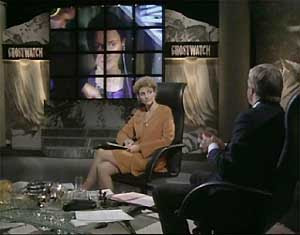
Ghostwatch Directed by Lesley
Manning BBC; Screen One; Sonopress;
MVD Entertainment
91 minutes, 1992 / 2022 www.sonopress.de www.mvdvisual.com
Right now, there is a
proliferation of Ghost Hunters type shows on cable television. I have watched a
couple of them, and they suck, so obviously made up or at the very least
stretching credulity. But this BBC1 film dates back to 1992, ahead of the
crowded market, and is presented as a real documentary. There is little
indication beyond the credits that it is fiction and exclaims itself as “live,”
and comes across as a news program like ”20/20” or “60 Minutes.” This is helped
by it being hosted by respected newsman Michael Parkinson and well-known
celebrity Mike Smith (d. 2014).
As with Orson Wells’
radio broadcast of “War of the World” (1938), some people did not realize it
was a scripted piece as this was way before the popularity of the Found Footage
genre, so much of the audience was caught unawares. And like Wells’ radiocast,
this was presented on October 31.
Mike Smith, Michael Parkinson, Sarah Greene
In a regular looking
home on Foxhill Drive (in England; I am assuming London), the Ghostwatch team
is arriving to investigate the ghostly happenings in that house (the example
they show is actually laughable for a number of reasons, but incredibly
reminiscent of Paranormal Activity in 2007, nearly a decade later). Hosting
the team is annoying comedian Craig Charles (of “Red Dwarf” fame). Note that
most of the main characters are playing themselves. The “reporter” from the BBC
and lead is Sarah Greene, who was married to Mike Smith at the time, which is acknowledged
in the program, thereby giving it more credibility.
Like Geraldo Rivera
and Al Capone’s vault (do you remember that?), for a while everything is pretty
mundane as they switch back and forth between the house and the studio, where Parkinson
and Smith interview a parapsychologist, Dr. Lin Pascone (Gillian Bevan), the
owner of the house, Pam Early (Brid Brennan), and take calls from people who have
possible ghostly experiences. Taking the counterpoint poo-pooing the events, is
American Dr. Emilio Sylvestri (Colin Stinton).
Brid Brennan and the Wesson sisters
One of the questions
in this show is whether or not the events are a poltergeist, due to the two
puberty-period (no pun intended) Early daughters and real-life sisters, Kimmy
(Cherise Wesson) and Suzanne (Michelle Wesson). Or, perhaps, could it be
something more sinister?
Before we get to the
meat of the matter, when the banging hits the walls, the film almost mocks
itself with a series of red herrings that I thought was really well written (by
Stephen Volk, who started his career with Gothic, the 1986 story of the
creation of the Frankenstein novel).
Craig Charles, Brennan
This is the first time
this has been released on Blu-ray, which looks incredibly crisp. There are some
nice extras. First up is a brand-new Audio Commentary with British film
historians Dr. Shellie McMurdo (University of Hertfordshire/University of
Roehampton, whose interests include the horror genre, trauma theory, Found Footage
horror, and torture horror) and Dr. Stella Gaynor (University of Salford;
author of Made for TV Monsters: How has the rise of horror on US television
impacted on the spectacle and acceptability of the genre?, as well
as being a horror make-up artist). They discuss how original this TV film was
at the time. The two Docs, who are personable, for quite a while discuss their
reactions to the film when they saw it as young’ns. Eventually, they mention
how certain scenes are culturally effective. It is a bit self-centered, but so
refreshing than most of the flat and clinical, “Here is how it got started,
cast stories, effect on culture” cliché commentaries.
Also new for the
Blu-ray is the documentary, “Do You Believe in Ghosts?: 30 Years of Ghostwatch”
(48 min). This is essentially a Making Of documentary, filled with interviews
with the cast (Greene and Bevan), crew (including director Manning and writer
Volk), among others. It is engaging and a bit of an historical document about
the filming. It is mixed with scenes of the film that you have probably just
watched, but using it as reference points to the conversations, works. It is
well put together, and worth the view.
Gillian Bevan
Also on the disc is an
archival commentary with writer Stephen Volk, producer Ruth Baumgarten, and
director Lesley Manning. They give a bit more details about both the technical
ends of the film and anecdotes. It amazes me that after all these hours of
commentary, there is very little overlap of information. My guess is that this
commentary was recorded for the DVD release in 2014. Last is the “Shooting
Reality” featurette by director Lesley Manning (8 min). This shows parts of the
script, the house floor plan, and Manning’s notes about it as she describes it,
among other things. There is also the only clear and close-up picture of the ghost,
Pipes (Keith Ferrari).
What kind of reaction
did the audience have during the show and after? Well, the BBC announced that
they received over a million phone calls that were both favorable and
complaints by people who thought it was real (despite the credits at the beginning
and end).
Greene
Just for the originality
in its format, this is as an important television moment as Captain Kirk mixing
it up with Uhura. There was no reality television frame of reference, and this
makes it all the more powerful, and worth remembering when you watch this, and
you really should. So much fun.
Oh, and there are
reportedly 11 appearances of the ghost, Pipes. I saw four. Drinking game? Or
maybe every time you see the two-liter bottle of Coke.
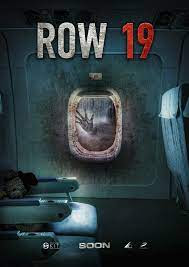
Row 19 (aka Ryad 19)
Directed by Alexander Babaev Central Partnership;
KIT Film Studios; Monumental Film; Red Media; Lka Film; Well Go USA Entertainment
78 minutes, 2021 / 2022 www.wellgousa.com/films/row-19
Hmmm. Sometimes one
must separate art from what is going on in the world. Normally, I would boycott
things Russian at the moment, in solidarity with Ukraine, but this is an independent
film, so I will give it a shot. Plus, it is being publicized by an American company,
Well Go USA Entertainment, so here we go – er – well.
I recently saw a German
film called Blood Red Sky (2021), which starts with a very similar
premise: a troubled woman on a plane with a preteen, when weird things begin to
happen. Except, in this case, of course, they are speaking Russian (subtitles
alert). In the prologue, a woman and her preteen daughter are sitting in a near
empty airliner, which crashes in South Central Russia. The daughter is the only
survivor and becomes, of course, a media sensation.
Marta Kessler, Svetlana Ivanova
For the main crux of
the story, it is 20 years later, and the girl is now a woman, Katerina (Svetlana
Ivanova), who has her own preteen daughter that is about the same age she was
when she crashed, Diana (Marta Timofeeva, aka Marta Kessler).
Of course, for our
story, a similar situation occurs: Katerina and Diana are on a nearly empty
plane that needs to be deiced traveling to the center of the country (to visit
grandpa and his big dog), sitting in the same seats (the titular Row 19) in the
same order (mom on aisle, daughter in center). We also start to get to meet
others on the flight, as I am sure we will get to know their motivations for
being on that very voyage.
Wolfgang Cerny
But there are also
strange things happening on the new flight, like the cryptic acting and blank
stares of the stewar… I mean flight attendants, to there being someone named
Evgeni, as there was on the one that crashed. Some of the others on the flight
are an ex-reporter, Alexey (Wolfgang Cerny), who sits across from and befriends
Katerina and Diana, and an uptight, whiskey-drinkin’ right-wing business man,
Nikolay (Anatoly Kot), the seemingly psychic bearded “hipster” Pavel (Denis
Yasik) who is constantly drawing frantically in a notebook, along with an
elderly couple, which includes Evgeni (Ivan Verkhovykh, whose wife, Galina
(Iringa Egorova) is afraid to fly. I can’t speak for any other Russian plane or
airline, but there are no televisions on the backs of the seats, considering it’s
an hours-long flight.
With horrifying dreams
and flashbacks, things seem to be repeating for the now adult Katerina that echo
20 years ago, or is it all in her head as the plane flies through a lightning
storm and bad turbulence? I once flew through turbulence so bad I hit my head
on the overhead even while buckled in, so I could empathize the fear.
One by one, the people
on the plane start to perish in sometimes gruesome ways, all reflecting on a “witch”
(Yola Sanko) who was on the first plane. Is this some kind of Final
Destination deal, or are they all really dead or in Purgatory already like
in Carnival of Souls (1962) or Jacob’s Ladder (1990)? Whatever it
ends up being, it is effectively creepy as hell, and plays well with memory,
imagination, and/or destiny. How much of it is real and how much is in Katerina’s
mind? And what is the darken shadow person(s) that keeps popping up, and the little
prescient girl (Katerina’s past self?) that Diana keeps talking to that only
they can see, individually? Katerina says it clearly that her visions are “becoming
more and more real. I’m starting to confuse reality with my nightmares.”
The tube of the plane
is claustrophobic, and yet due to the lack of people, it also feels quite roomy
at times. But no matter what, there are feelings of déjà vu and that there is nowhere
to escape whatever fate has in store for the survivors, which decrease as time
goes on. There are a lot of really nice effects and even some blood, and it all
works well in the story, which is taut right to the end.
The acting is solid
all the way around, including the two young girls who hold their own with the
adults. Ivanova is especially a stand-out. The cinematography by Nikolay Smirnov
flows well, and the effects by Eugene Antsiferov and Nikita Ovchinnikov, which
are quite complex considering all that is going on, are outstanding.
This may not be for
people who are afraid to fly, or are politically triggered by what is going on
in the world, but as a piece of art on its own, it is quite thrilling. I
understand there is also an English version floating around somewhere in the
sky.
“What Walks There Walks Alone”: A
Comparison of Shirley Jackson’s The Haunting of Hill House and Robert
Wise’s The Haunting
While going
for my advanced degree in Media Ecology at New York University, I took a class
with Professor Joy Boyum, “Fiction into Film,” and wrote this as a report. It matches
one of my favorite books with one of my best-loved films. The paper is dated
May 5, 1993. Please note for those who have neither read the book or viewed the
film, there are spoilers.
Clown:
“O mistress mine, where are you roaming?
O, stay and hear, your true-love’s coming.
That can sing both high and low
Trip no further, pretty sweeting;
Journeys end in lovers meeting.
Every wise man’s song doth know.”
– Twelfth Night, Act 2, Scene 1
Robert Wise’s direction of The Haunting (1963),
an adaptation of Shirley Jackson’s The Haunting of Hill House (1) (1959),
remains one of the more memorable psychological supernatural thrillers brought
to the screen. The film’s success has much to do with the cinematic elements
brought to the story as the tale itself.
Wise’s choice to not show the apparition(s),
with one brief exception a heartbeat long, is an effective tool for presenting
a stronger psychological narrative edge to the story that perhaps might have
been lost if he had chosen the easier “fright” route of wraith effects. The
doorknob jiggling and mysterious hand-holding is all the more convincing because
of the riddle of who or what is roaming the halls of Hill House.
Wise also emphasizes an element of
claustrophobia that is sometimes lacking in the novel. Jackson places much of
the action during the day on the grounds and hills surrounding the house;
invisible footfalls in the grass appear less horrific. Wise, however, used the darkness
of mahogany interiors, earth tones and shadows to give the viewer a sense of
entrapment and depraved evil. Once the lead protagonist, Eleanor, arrives at
Hill House, the only outdoor scenes are two on the terrace (first in daylight,
then at night) and two on the grounds, by the front door, when Mrs. Markway
arrives (day) and Eleanor’s final departure from the house (night).
One of the perplexities of Hill House is the
way the house is designed. Eighty years earlier than the story is set,
the house’s architect, the overbearing Hugh Crain, build a structure that was as
distorted and enigmatic as its contriver. Wise sets a somber tone through the
use of quick, jerky editing and especially irregular camera angles to reveal
the skewed house design and a conundrum of doors that shut themselves (by
design, not spirit).
The key theme of the film, as well as the
novel, is loneliness. Both are introduced by a prologue (narrated on film),
“Hill House, not sane, stood by itself against its hills, holding darkness
within… and whatever walked there, walked alone.” Entering into this dark
isolation are four characters, each lonely in his or her individual way.
Eleanor Lance (Vance, in the novel), played by Julie Harris, arrives after
years of isolation spent taking care of her domineering and sickly mother.
Eleanor views her stay at Hill House as a chance to flower, to belong. In the
novel, she repeatedly utters a line from Shakespeare’s Twelfth Night: “Journey’s
end in lovers meeting.” Though this is only quoted once in the film, the theme
remains the same: there is a sense of love’s absence, of a desire to find a
place in the universe where she is her own person, accepted by others for who
she is. Eleanor has no real home (she lives with her sister’s family), no one to
love, and no one to love her.
There is an almost claustrophobic feel of
dread and naivete about the world within her, as she created a dream life of an
apartment of her own with matching stone lions on the mantlepiece. Eleanor is desperate
to fit in and gain back what she believes she had lost through many years of
solitude.
The future owner of Hill House, Luke Sanderson
(Sannerson in the film, played by Russ Tamblyn), is also rejected by his
family. His lonely past has produced a “liar…also a thief.” The novel presents
Luke as an in-depth character who is a scalawag, but also has a heart, and is
merely acting out of his sadness and need to be accepted. He is presented as
the first possibly lover at “journey’s end” for Eleanor. In the film, however,
he remains undefined, reduced to comic relief.
Whereas in the novel, Dr. John Montague
(Markway in the film, Richard Johnson), who leads the supernatural “expedition”
into the house, is known by Eleanor to be married from his first introduction;
this fact is hidden from her in the film, setting up a possible liaison between
them. Is John the lover at “journey’s end”? Many of the romantic actions taken
by Luke in the book are given to John in the film, such as offering a steadying
hand to Eleanor as she looks up at the tower (nearly toppling over a balcony),
or rescuing her from the shaky ladder in the library. The novel presents John
as lonely, due to the shrewish nature of his wife, unnamed except as Mrs.
Montague. She is presented as a person who has no regard for her husband’s methods,
dismissive of Montague as a person, self-promoting, and a supernatural
“expert.” The film merely hints that John is lonely, and might end up in
the company of Eleanor.
A subplot of possible lesbian romance is then
presented by the last of the four main characters, introduced by Theodora
(Claire Bloom). This theme is interjected in the novel as Theo arrives at Hill
House after a painful fight with her “roommate,” feeling dejected and somewhat
bitter. In the film, Theo’s orientation is broached through dialogue, presented
more as the reason for her loneliness: “By the time I’m through with you
Nell, you’ll be a different person”; elsewhere asked what she is afraid of, Theo
responds, “Of knowing what I really want.” Her sarcastic manner is treated as
rooted in the sexual orientation, as well. Though Eleanor is repulsed by
Theodora’s sexuality in the film (“The world is full of inconsistencies.
Unnatural things. Nature’s mistakes, they’re called. You, for instance.”), in
both the film and the novel, Eleanor eventually wants to go off and live with
Theodora. The author posits this as another possibility of “journey’s end where
lovers meet”.
A third theme of the story is that of
parental/daughter relationships. Although Hugh Crain designed the house, he
barely resided there, and eventually died in Europe. It is his warped vision
that dominates the house, however, with a malevolent (male-violent) influence.
His evil is that of control. Even in designing the house, he materialized his
own vision rather than relying on others, with skewered angles and unmatched
lines, going against architectural conformity to express his will. It was with
this will that he ran his house while occupying it with his daughter(s). His
religious fanaticism, which evolved from his bitterness over his wife’s/wives’
demise led him to warn his daughter, “Honor thy father and thy mother,
daughter, authors of your being, upon whom a heavy charge has been laid, that
they lead their child in innocence and righteousness, along the fearful narrow
path of everlasting bliss…” Though his physical presence in the house was
minimal, his influence remains, and it is this warped domination which seems to
affect the weakest of those who enter the house, subduing them to the power of
his control.
Hugh Crain’s malevolence is directed at women.
All who die at Hill House are women: first the wife of Crain, who is killed in
an accident on the grounds before even viewing the house; second, their eldest
daughter (only daughter in the film), Abigail (Sophia in the novel), who dies of
pneumonia at an elderly age in her bedroom, the nursery (“the heart of Hill
House”), while her young servant/companion “dallied in the garden with some
village lout”; third is the companion, who inherits Hill House, who hangs
herself in the library. The last woman to die is Eleanor herself, a possible suicide
who seeks to remain at Hill House, under the influence of the evil will of Hugh
(2) Crain.
There are overlapping images in the context of
the story. An example is that both Eleanor’s mother and Hugh Crain’s daughter
die while banging on the walls for help. This “mother/daughter” parallel is
further mirrored by Eleanor’s guilt over presumed negligence in having slept
through her mother’s knocking, as did the companion, who “dallied” while her
mistress died in distress. Both Eleanor and the companion become obsessed with
the house and the staircase in the library. Both eventually commit suicide. Similarly,
Hugh Crain’s wife died without ever having entered the house, whereas Eleanor
dies driving into a tree at the same spot on the grounds so she does not have
to leave.
In Wise’s vision even more than Jackson’s,
Eleanor is treated by all as a woman-child, though she is in her early 30s,
because of her innocent and cloistered life. In a scene where she is seeking
permission to use what is essentially her half-owned car from her sister’s
family, the relatives reject her request because they view her as childlike and
consequently irresponsible. This scene is dramatized while a child’s melody is
played in the background. Also, throughout the film, again more than the novel,
Theo often calls her by the nickname “Baby,” sometimes in a patronizing tone.
This, of course, reflects back to the nursery, the heart of Hill House, which
has been collecting victims for years. The inflection is present in the novel,
but in a more subtle, sardonic way.
The characterization that is most changed from
novel to film is that of Mrs. Montague (named Grace for the film, played by
Lois Maxwell). Whereas she is a totally disagreeable character in the book
owing to her obnoxious ego and dismissal of concern for nearly all others, the
cinematic version lives up to her first name, presenting her as a strong and
decent person who is unintentionally triangled between John and Eleanor. In the
movie, Eleanor suggests Grace sleep in the “evil” nursery in a pique of jealous
spite, while in the novel, John makes this suggestion because he is acquiescing
to his wife.
Two other characterizations that are altered
from the original source are those of Dr. Montague/Markway and Luke Sannerson/Sanderson.
In the book, Montague, while the leader of the psychic exploration to Hill
House, is seen as a three-dimensional character who is sometimes flawed and
always human. In the film, perhaps because he is presented as a potential love-interest
for Eleanor, Markway becomes a near-swaggering Petruchio-type hero; one can
almost her him slap his knee in self-righteousness. Luke, on the other hand, is
treated the opposite: whereas Montague to Markway comes from human to hero,
Luke Sanderson to Sannerson goes from possible love-interest to practical
joking comic chorus.
An obvious problem in adapting the novel to
the film would be similar that of any phycological drama, the inner narrative
voice. Thought processes are the crux of psychological drama, as the
protagonist struggles with distressing events, and the consequences that are
faced become more severe. Wise takes the most direct approach, and has
Eleanor’s thoughts presented via voice-overs. Though this may be a potentially
overbearing and distracting technique, Wise uses it to optimum effect, holding
back and letting the actor’s expressions tell us of her own inner turmoil in particular
scenes, while voice-overs detail the trauma in others.
In the novel form, the horror story, be it temporal,
spiritual or psychological, has its work before it. Unless the subject matter touches
on the personal fear of the reader, such as something/someone hiding in a
closet or a phobia, like fear of heights (e.g., Vertigo, 1958), the
printed word needs to be worked harder to be shocking, especially to those who
grew up watching film. Historical horror novels such as Mary Wollstonecraft
Shelley’s Frankenstein (1818) or Nathaniel Hawthorne’s “Rappaccini’s Daughter” (1844), were
written when there were no moving images that could shock with a sudden “Boo!”,
so the imagination of the reader of the stories is needed to be able to
horrify. Present-day writers such as Clive Barker and sometimes even Stephen
King manage to frighten, but their shocks come from the gross and the gory. The
Haunting of Hill House was published during a period when the horror novel
was based more on the psychological than “visual” manifestations, therefore
crating a timeless horror that does not need to go “boo” or bleed.
Film has a great potential for
frightening the viewer. Whereas the novel can horrify by leaving the terror “unnameable”
(as H.P. Lovecraft was fond of doing) and inviting the reader to realize his or
her worst fear. A film can frighten by presenting a haunting image or a sudden
shock. For example, while the echoing, pounding on walls and jiggling of the
doorknob as “whatever walked there” searches for Eleanor and Theodora in the
Haunting of Hill House creates fear, in The Haunting, the dimension
of fear is heightened by watching the door bend under the weight of the
spirits, the wall- and door-pounding becomes deafening (especially as the
cadence gets perceptually louder, faster and more menacing), and the dissonant disembodied
voices of the mysterious forces (such as what sounds like hard fire and
brimstone preaching by Hugh Crain to his daughter) fill the senses by filling
the screen. Add to this the cinematic touches of shadow and light, juxtaposing
camera angles, eerie music (3) by Humphrey Searle, and dissonant editing
(4).
Through cinematic devices, Wise hold
back on visual information about the antagonistic spirits, to heighten the
sense of mystery and fear through the unknown. He uses the occasional lack
of music to make the terror feel more imminent and tangible, and skewed
closeups to place a fearful image immediately before the viewer in arresting
perspective. While Jackson has Eleanor see spirits in one form or another
(spying invisible foots falls in the grass or viewing ghostly picnics), Wise
chooses not to rely as much on the visual to frighten, but by way of a literary
perspective, employing the imagination, all the while using the cinematic
process to make the viewer’s imagination hold one in terror. The fear of the unknown
usually tends to be less challenging to accept on film because of the
temptation to show precisely what is there for which to be afraid. By choosing
not to display some blatantly showy special effects (other than an occasional
breathing door, for example), and relying on cinematic techniques, wise raises
the stakes from cheap thrills to high horror, without gore and without
hackneyed effects (5).
By viewing the film before reading
the novel, I was able to grasp some concepts that may not have been so obvious
from using the book as the primary source. Details in print are usually more
thorough in pointing out specifics, consequently more information is passed to
the reader. Due to the time in literary history the book was published,
however, less emphasis was placed on the homosexual aspects of the characters
of Theodora and, more subtly, Eleanor (6). The subtlety of this aspect
may have been lost on the reader, but to the viewer, these themes were clearer
and more straightforward.
Another interesting aspect of the
film that Wise added is having the final prologue spoken by Eleanor, after her
death. The closing line was changed from “Whatever walked there, walked alone,
to “We who walk there, walk alone.” By adding this change, Wise
solidifies the realization that the main character and antagonist in both the
film and the novel is Hill House itself. It is the neediest and most demanding.
It is the most appalling, and yet seductive. It is Hill House that is the lover
Eleanor meets at “journey’s end.”
Footnotes:
1. Screenplay by Nelson Gidding.
2. “Hugh” is Old German for “Will”.
3. Music by Humphrey
Searle.
4. Editing by Ernest Walter.
5. For the opposite school of thought, see the Roger Corman films of the same
period.
6. Though novels such as Radclyffe Hall’s The
Well of Loneliness (1928) and Lillian Hellman’s play, The Children’s
Hour (1934) had already been published with the themes, mainstream fiction
still apparently considered the subject a taboo.
Written and directed by Daniel
Falicki Rotomation Pictures / Sector5 Films Chemical Burn / World Wide Multi Media 139
minutes, 2014 www.Sector5films.net www.mvdvisual.com
This
is the second film I’ve reviewed by director Daniel Falicki (and have one more
in the queue), and I’m actually quite impressed. He has shown some artistic
flair in Awaken the Devil (2014; aka The Anti-American) and I was looking
forward to view this epic horror comedy and see a new side to the man.
For
this one, John Spinelli (Matthew J. Dennis) is basically a good guy who got into
a bad situation with substances, and ended up being arrested, but that’s all
backstory. Where we pick up is John being released and sent to a halfway house full
of weirdos, including the uptight proprietor, Ethel Kranski (a humorously
uptight Marly Green; “Your silence indicates consent! Do you understand?!”)
and the kindly nun, Sister Mary (Sheri Beth Dusek, who is also a producer and
co-writer), taking care of the spiritual side. Others include two brothers
named Robert and Bob who drink a lot
of their homemade beer and a couple into Cosplay and gaming, to name a few. The
small town locale of events is called Rapid Falls, and I’m guessing it’s supposed
to be Iowa due to a 515 area code shown on a television
Matthew J. Dennis as John Spinelli
In
the outside world, his girlfriend Ruby (Liz Nolan) is not pleased with him and
his legally forced upon him job as a bag boy at a supermarket (though it looks
like the location is actually a liquor store, but I digress…), where the name
on his apron is misspelled “Jon,” which introduces some other bizarre characters.
Somehow, you get the feeling worlds are going to collide, Jerry.
Next
to the halfway house is an century-long abandoned abode, which always has a
mysterious mist around it that no one seems to notice. And at 3:33 AM, there is
some mysterious light flashing action going on across the way, which leads to gruesome
murders (off-screen) in which people have limbs removed (and in one case, the
person had been beaten to death with their own arm; nice touch, no pun
intended).
Is
there any reason to think our chooch
of a hero is not the one who is going to get blamed? There is a police
detective on his trail, but we know there is something more sinister going on.
Hell (again, no pun intended), this is a
flippin’ horror film, after all. What I especially appreciate is that there is
a lot of assumptions (just shy of red herrings) the viewer (okay, me) can make
for certain reasons I won’t go into, so no spoilers, but the film doesn’t lead
where you expect. I’m grateful for that. There are some loose ends (e.g., why did
this mystery pick John?), but overall it’s a pretty fun ride.
The
performances are actually quite well done. Despite the occasional scenery
chewing, the leads – including Dennis, Nolan and Chris Kotcher as Father Stark –
do an excellent job at it. This is especially true of Dennis, despite moments
of madness, shouting and going a bit off the rail (because of the events in the
story), but generally he’s sympathetic and believable, even when he’s being a stronzo to others.
Part
of what makes this a fun film is not just the acting, but some of the dialog.
Sure, there is the (racist/xenophobic) comic relief of a character titled Sgt.
Shithead (Jason Roth, whose performance was very powerful in Awaken the Devil), but there’s lot to
listen to if you pay attention. This is considered a comedy, but many times the
humor is very subtle, such as playing with names or lines you could easily miss
if not pay any mind.
For
me, the one flaw was the length. Two hours and 18 minutes was just too long to
keep the attention totally focused. If it was tightened to a reasonable 90
minutes or so, I can see this being evenmore betterer, and it was pretty good
as it is. A few scenes lagged that could have been tightened (e.g., while
everyone was waiting for the 3:33 AM time), but I’m glad I saw it anyway, and
would recommend it.