Showing posts with label art film. Show all posts

Thursday, January 20, 2022

Reviews: Nocturna: Side A – The Great Old Man’s Night; Nocturna: Side B: Where the Elephants Go to Die

Text © Richard Gary / Indie Horror Films, 2022
Images from the Internet
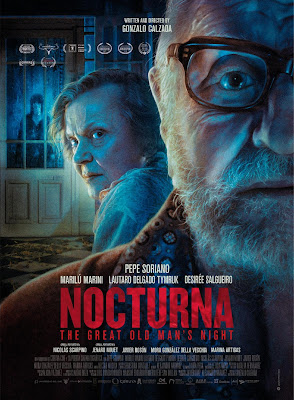
 Both these films are on iTunes/Apple TV, Amazon Prime Video, Google Play, Xbox, Vudu, Vimeo, DirecTv, local cable and satellite providers, and on a single-disc DVD. The trailers for the films will be at the very bottom of the blog.


Nocturna: Side A – The Great Old Man’s Night (aka Nocturna: Lado A – La noche del hombre grande)
Directed by Gonzalo Calzada
Cine Argentino; Coruva Cine; La Puerta Cinematografica; Breaking Glass Pictures
107 minutes, 2021
https://alief.co.uk/NOCTURNA

This will be the third and fourth film from Argentina that I will have reviewed on this blog, the others being Francesca (2015) and What theWaters Left Behind (2017; aka Los Olivados). Each of these films is quite different, but one thing that runs in common is the intensity. If you were expecting light fare like Mexican Santo releases, you have ladrò up the wrong árbol.

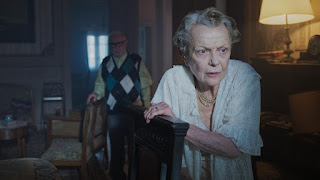
This is an intense study, focusing on a 100-year-old man, Ulises (actor and playwright Pepe Soriano, who has won the Argentine Critics Association Award three times, was also a Valladolid best actor winner, and was nominated for a Spanish Academy Goya Award; he is in his early 90s), facing his mortality, is working his way through remembrances and forgetfulness, as his age tugs at his present and past, and the holes of memory in between. His past is represented by a childhood self (Jenaro Nouet) from the day he met his wife, Dalia (Marilú Marini, who is often known for a number of French films from the 1970s and ‘80s) that is also represented by her younger version (Mora Della Veccia).

Pepe Soriano
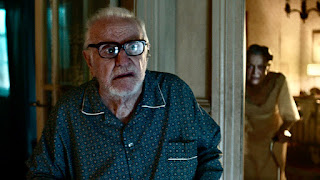
It almost appears as time is fluid in many ways, as the film plays with the reality of the moment and the tricky bits of memory and its holes. For example, an event might be mentioned at some point, and then it happens. While this is purposefully unsettling and occasionally confusing at some point, it shows the mind of this older man, and his relationship with his wife.

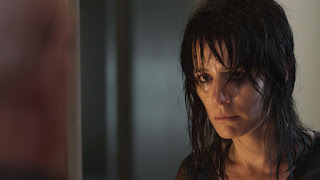
Also involved is the kind-hearted building manager, Daniel (Lautaro Delgato), who means well and is trying to help the occasionally befuddled Ulises as best he can. Then there is the mysterious and angry woman from upstairs, Elena (Desirée Salgueiro), who bangs on Ulises’ apartment door.

 While the film rolls out in its own time, getting the viewer a chance to get to know the characters a bit, what stands out is the emotions, which flow like rolling hills, as the old man’s chest continues to hurt and things are not always as they seem.

Marilú Marini

For some reason, some have categorized this a “horror” film, and on some level I understand why, but I beg to differ. Yes, there are intense moments filled with dread and possible ghosts, but is it corporeal remains of people or spirits of memories, or some level of senility? This is more emotional thriller that goes at its own slow, precise pace (with moments of chill thanks to the lightening storm sounds going on outside the window and the uncertainty of what is going on). That being said, when the film premiered at Screamfest Film Festival 2021, it won many awards including Best Film, Best Director, and Best Actor.

Desirée Salgueiro
The camerawork is gorgeous, especially a warped glass scene where the past and present unite in a blur of images. The lighting throughout is yellowed and dim, like an old light bulb to match the mood and perhaps to reflect Ulises’ dimmer brain functions. While most of the story takes place either in Ulises’ apartment or in the hallways of the building, it never feels claustrophobic thanks to the cinematography which is, again, fluid.

The orchestrated soundtrack fits the film perfectly, swelling and rising at the same time, to help hit emotional peaks. Yeah, this is more of an poignant film than a fright-fest, but do not be surprised if, by the end (or at the end), you have a couple of tears rolling down (yeah, I did).

IMBD Listing HERE 
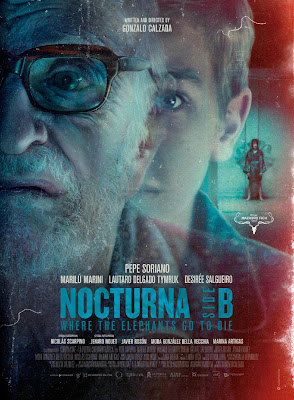
 

Nocturna: Side B – Where the Elephants Go to Die (aka Nocturna: Lado B – Donde los elefantes van a morir)
Directed by Gonzalo Calzada
Cine Argentino; Coruva Cine; La Puerta Cinematografica; Breaking Glass Pictures
67 minutes, 2021
https://alief.co.uk/NOCTURNA

While the first film was a bit longer than average, this one is a comparably shorter nearly featurette, at just over an hour. Likewise, this review will be relatively short, as well.

The footage here, broken up into many chapters (as was the main feature). However, there is no narrative. Images are shown that reflect the full story, and are manipulated to look like they are 8mm (or an equivalent), with grain and varying speeds, many in black and white or muted, manipulated colors. In the first chapter, the images were going by so fast, I was getting a bit of motion sickness, and I would skip this part if I were an epileptic, honestly. Or, hide the top part and just read the captions. As with Side A, the captions are incredibly easy to read, being an almost orange color, making it pop out. Also, I find most captions go faster than I can read them, but that rarely happened in either Side.

As for the text meanings, well, honestly again, it was a bit lost on me. It’s philosophical and whimsical, and often I had no idea what they were discussing (yes, I have a Master’s in Communications). This caused me to stop reading and just enjoy the footage as it went by. It feels more like an art instillation than a narrative film.

By modern U.S. standards, Side B would probably be delegated as an extra on a DVD or Blu-ray (especially the latter), which is why it makes sense that both are being released together. It kind of has the feeling of a Making Of featurette, but the footage is unique, albeit shot at the same time as Side A, almost like Outtakes of extra footage. It certainly is a curiosity, but I did find myself getting antsy by the end, but that was most likely due to my confusion than an opinion of the film proper.

IMBD Listing HERE 

Side A trailer:

Side B trailer:

Wednesday, September 5, 2018

Review: The Electric Chair

Text © Richard Gary / Indie Horror Films, 2018
Images from the Internet


The Electric Chair
Written, produced and directed by Mark Eisenstein
Wild Eye Releasing / MVD Visual
105 minutes, 
1985 / 2010
www.Wildeyereleasing.com
www.MVDvisual.com


Whether Mark (Marcus) Eisenstein’s work could be put into the transgressive film category is borderline, but he does have an aggressive style that has a large dose of religion (mostly Jewish), confrontation, and imagery.

His The Electric Chair, from 1985, has long (well, for 25 years) been considered a piece of “lost cinema,” directed by this film professor from Jersey City State College. Fortunately, Wild Eye Productions has not only seen fit to release this piece of unorthodox cinema, but has also added in a whole bunch of Eisenstein’s shorter pieces as extras, along with some trailers and a track commentary. But more of that later.

Written originally as a play that was mounted but once, Eisenstein (okay from now on I’m just referring to him as ME…deal with it) decided to make a film out of it, and offered the lead role to Harvey Keitel, who actually wanted to direct it as well. ME was all for it, but due to prior commitments, Keitel backed out and offered up his pal Victor Argo in the lead. Yes, the heavily Jewish role was handed to an actor of Puerto Rican heritage, who just nailed the part perfectly. There is a lot of dialog in long bursts, and being trained as a stage actor, Argo was more than up for it. After filming for no pay, it sat in the can in minimally edited form for years, even after Argo’s death in 2004.

Though filmed in the ‘80s, ME finally finished the black and white film by editing in some footage he took of decrepit buildings on Block Island in the Long Island Sound (or would that be considered the Atlantic?) in 1971, in splashes throughout the narrative, effectively adding a layer of mood to the zeitgeist of the story.

The basic premise of the plot is centered around a shoe salesman, Arnie Schwartz, a lonely man whose marriage has grown as tired as he is, and who spends nights doing a stand-up comedy and music show at a local bar in New Jersey (where most of ME’s films are located). An electric chair appears on the stage as he is bombing, and in front of an audience that represents his whole life, he is warned not to achieve several levels of intimacy with the object.

As the gig does on, the comedy act turns into a rant about the philosophy of comedy, and bit by bit focuses in on his life, God, and schtupping, which uses up most of the film. It takes a strong actor to be able to portray this level of anger and still remain somewhat sympathetic (though in the commentary, ME states that he was not going for sympathy, just the anger), if not pathetic. In front of his mother, himself as a young man dominated by her, his kid sister, a sax playing rabbi, a couple engaged in their own intimacy, and others, Arnie rails right to the climax, which comes as no surprise. However, it is the last shot of the film that I found the most effective and unnerving.

The time goes quickly, and Argo is more than up for the task of possibly his only starring role in his long career. Keitel would also have done well, but Argo brings some depth to his emotions, and can punch out the lengthy gunfire dialog, while in close-up, without ever making it redundant or boring. It’s hard to turn away as he gives his all, which is even more impressive considering, as I said, he wasn’t even paid for it. That’s dedication to a craft.

The images of the super 16mm film (except for the Block Island footage, which is a grainy 16mm) is exceptionally sharp, giving a near German Expressionist pastiche, with high contrasts and an occasional glow, with Argo’s white suit against a black background. It’s the facial close-ups where the shadows are the most effective. My only qualm is the editing, sometimes a bit too sharp and jarring, or perhaps that was the meaning (the other Eisenstein filmmaker, Sergei, was famously noted for proclaiming that “editing is motion”).

This is definitely not a date movie, nor is it a backdrop film. It needs special care and attention from the viewer to see the slow build-up to the finale, and all the subtlety in-between as the tone of the film changes.

The commentary was interesting all the way through, though I felt like I wanted a second one. ME is paired up with indie filmmaker Peter Crocker (I may have this name wrong) and Rob Hauschild of Wild Eye Productions; Crocker is an “expert” on the film, and runs off with the conversation a number of times; I just wanted to say “shut-up, this isn’t your film” more than once. A lot of technical questions are discussed about the film, the “hardware” as it were (pre-production, production, and post-production), but not enough, I feel, on the “software” (plot, meaning, intentions). I would have liked more insight on what ME was trying to “say,” and at key moments, such as the ending, I thought, “why are you talking about that instead of what’s on the screen?” Don’t get me wrong, the commentary is full of fascinating facts, it just left me wanting more than it offered.

The shorts by ME that are included, and there are several of them, run from the “mini-feature” of “The Roach,” which lasts more than 20 minutes, to a couple that are just a few minutes.

“The Roach” is an interesting set piece of a waterbug that suddenly becomes human, but still scuttles about, played well by 20-something hipster type Eric Mednis. He has no dialog, and flops around when he’s on his back. The Roach is as confused about the human world as it is about him. He keeps following a profane exterminator named Mr. Acme, played by Nick Taylor, and is nearly seduced by a lonely woman (Joan Moossy, who is in many of ME’s productions), before the film ends, Nero-and-Poppaea -style. The film is simple and smart, and obviously a reversal of Kafka’s infamous “The Metamorphosis,” and is one of his few works here in color.

Some of the shorts are extremely esoteric, such as “The Smog” (1967; 6.5 min.), where people are filmed talking in a smog while their voices are re-recorded; “Eight Tragedy Term Papers Plus Three by Maggie Murphy” (1967; 15 min.) in which a real-life poetic term paper by a student who passed away is read by ME as a typewriter types out newswire stories; and in “Mark Eisenstein: Inventor of the Frame” (1982, 1.5 min.), the director explains how he “invented” the frame for cinema (before, supposedly no one knew where to look). There are a couple of others of varying success, but interesting to help put The Electric Chair into a larger picture of Eisenstein’s process.

There are also some trailers put out by Wild Eye Productions, though there is also one for an unreleased Eisenstein film called “God Is On Their Side,” an (I am assuming) allegorical tale of trying to get God on one side or another during a war, while all he wants to do is sing, dance, and smoke cigars. Why am I so interested in this? Simply because God is played by (and credited to) Buster Poindexter, also known as New York Dolls’ vocalist and Staten Island’s own David Johansen.


Saturday, March 10, 2018

Review: Red Krokodil: Director’s Cut

Text © Richard Gary / Indie Horror Films, 2018
Images from the Internet


Red Krokodil: Director’s Cut
Directed and cinematography by Domiziano Cristopharo
The Enchanted Architect / Unearthed Films / MVD Visual
80 minutes, 2012 / 2018

I saw the first two films that Domiziano Cristopharo directed, House of Flesh Mannequins (2009) and The Museum of Wonders (2010). He’s released at least 20 since then, so I was curious. His style is very artistic and precise, so after nearly a decade, I’m glad to have the opportunity to see what this Italy-based artiste was working on – even if this film is five years old, though now it’s getting a new Blu-ray release.

As the opening title card tells us (and I am abbreviating a lot), Desomorphine, a real opioid drug that originated in the US in the early 1930s and is now made and used recreationally in Russia, Produced in this way, it’s made of corrosive materials mixed with Codeine from over the counter products, and is nicknamed “krokodil” due to the blistering skin around injection sites.

At a snail’s pace, we meet Him (Brock Madson). He’s a mess on so many levels, spiritually and physically. His clothes (when he’s wearing them) are filthy, including dark stains on the bottom of his untidy whiteys, there is what looks like mold everywhere, he is unwashed and unkempt, and is missing his two front teef.

We watch much of what happens to him, as he repeatedly gives himself shots from the same needle, goes through withdrawals until the next injection, and segments of overseeing him fitfully sleeping. The viewer gets the feeling of claustrophobia as he moves around his small room; he is practically the personification of the description of the Divinyls song, “Elsie.” 

While filmed in Italy, this takes place in Russia; however, the inner monologs we hear are in English. Because of his drug addled mental state, we get to share what he sees, be it a giant Bunny Man (Viktor Karam) or a bandage swathed Monster (Valerio Cassa), who are the only other characters in the film, albeit in brief snatches.

The only dialog we hear other than grunts and groans is Him’s inner thoughts, which are usually a mixture of stories of his life (e.g., why a stuffed crocodile is important to him), a description of his dream visions, or philosophizing about his hallucinations. One example is when he sees a mannequin face inside a hole in the wall, part of his existentialist treatise as he smiles is, “God is watching me inside the eye; the whole universe is inside the eye. Even I am inside the eye.”

Either because of the corrosive effect of the krokodil drug, or perhaps what is going on inside his mind (or both), his body is full of gross scabs and abscesses that we see in detail. Him is convinced he lives in a post-apocalyptic world, and perhaps he is, which would explain the lack of people in part, but he never ventures from his hovel. How much of it is in his mind and what reality is mostly up to the viewer.

Despite all the grossness of picking at the wearing down of the flesh, this is definitely in the category of art film. Sure, you may not see it on IFC due to its visual content, but philosophically and stylistically, it would actually be quite comfortable there.

Most of the time the color is drained out of the image we see, as it is missing from Him’s life; it’s only when we see him roaming around in nature (again, nude), do we see a natural hue of any time. The sharp contrast is alarming, and shows the levels to which Him has sunken – again, both spiritually and physically.

This is not exactly what one might call the feel good movie of the year, but it is a poetic and disarming – and sometimes visually stunning – vision of what I would imagine being desperately addicted to something that harsh to the body (I’m pretty straight-edge).

Madson co-produced the film, and he certainly gives a full emotional range, much of it without dialogue. It’s a strong character study, and he certainly is up for the task. This is good showcase for him, even considering all the visuals.

There are some nice extras, as there tends to be especially on a Blu-ray. First up is the 2:30 Alternate Music Ending, which shows the end of the film with, well, different music. It’s more piano based, with almost religious solemnity. It’s quite beautiful, and in my opinion, works as well as the film proper. The Deleted Scenes lasts 8:50. A combination of unused footage, some with inner comments, it’s nice and interesting, but having it out of the film makes sense, too. It does, however, help you get a little more depth on Him’s character.

The 2:42 Photo Gallery is set to the soaring “incidental,” neo-classical music. It’s all shots taken from production, such as make-up, fooling around the set, and scenery beyond the shoot premise; much better than just still from the film. Last is the Nuclear CGI Test, where we see different versions of a digital nuclear explosion that lasts for 1:14. There are also a bunch of trailers from Unearthed Films, nearly all of them reviewed on this blog at one point or another, such as the American Guinea Pig series and Atroz.

I’m still trying to figure out, visually speaking, if the film went too far, or if it didn’t go far enough. That’s part of what makes this such as interesting piece, though patience is definitely needed as you follow Him on his path, painful minute by painful hour.


Sunday, February 25, 2018

Review: True Love Ways

Text © Richard Gary / Indie Horror Films, 2018
Images from the Internet


True Love Ways
Directed by Mathieu Seiler
Grand Hotel Pictures; Klusfilm Berlin;
ARRI Film and TV Services; Synergetic Distribution; MVD Visual
95 minutes, 2015

Germany is familiar with cinema of the strange in the past few decades. Just look at the likes of the extremely other-there Nekromantic (1987), or even Run Lola Run (1998) as examples.

Anna Hausburg and Kai Michael Muller
For this film, named after a Buddy Holly posthumous rock’n’roll romantic classic from 1960 (which we hear more than once in the film), it opens on the strained relationship between our heroine, Séverine (the lovely Anna Hausburg) and her boyfriend Tom (Kai Michael Müller), with the former telling the latter that she doesn’t love him, but rather has given her heart to someone of whom that she dreamed; to me, his reactions says a lot about why she needs to dump his ass.

Speaking of reactions, the first couple of acts of the film are set at a very languid pace, like being on a rowboat meandering down a river, with little dialog, as Séverine sits in a park watching people, spending the night by herself, or driving down the road chewing both her hair and gum with the camera mainly focused on her face. Within those times, however, there are some disturbing moments of her wondering, “okay, who should I trust?” This paranoia also is placed on the audience by some creepy goings-on that I will very lightly touch on to not give too much away.

Muller and David C. Bunners
At a bar, after Séverine chucks Tom outta da co-joint for a few days, he goes to a bar where he meets Chef (David C. Bunners), who suggests that he will kidnap Séverine and then Tom would come to the rescue and be her “Tarzan.” With other events that happen in the meanwhile, during the ebb and flow of the day mentioned above, the audience can’t help wonder if this is part of a larger event.

About half way through the film, the pieces of some of the events that happened before and why the Chef is so interested in Séverine start to become clearer. And yes, it’s even creepier than you’d expect. We get to figure it out the same time as her, and that’s when the film shifts gears into overdrive. Yet, and this is where I find the film is playing with us, there are still moments of long silence and little movement, that in the heightened state of tension and adrenaline, are nail-biting thriller moments. Again, you know Séverine is feeling the same. It’s really well written that the audience gets to not just sympathize, but empathize, because you’re feeling a bit of what she is experiencing (without us being in real danger).

While definitely a sharp (and occasionally darkly humorous) thriller, some have referred to this as a kunstfilm (art film), and not just because it’s in black-and-white. It’s the pacing, the way the music works with the film beyond jump scares, but it’s not obnoxiously so. In other words, most art films try so hard to be ar-tay, that they become obtuse and confusing. There is none of that here. There are also few weird angles, other than multiple long close-ups of Séverine’s face.

The good news is that Hausburg is talented enough that with the extreme close-ups and lack of dialogue, it still is easy to read the broad emotional range she expresses (i.e., no “Blue Steel” vs. “Magnum”).

As always, the bad guys underestimate Séverine; while she’s no hired assassin like in the predictable and ordinary Final Girl (2015), she is extremely resourceful and works her way through situations (which we get to watch, step by step by facial expression).

The one cliché that is easy to predict in the film regards a tavern owner. I actually said, out loud as soon as she walked into the bar, “Oh, really?! C’mon!” But in a film that’s over 90 minutes, I can forgive it considering how much else is going on.

What really drove me crazy is the Tom character. Hero? Villian? No matter, he’s an asshole, that’s for sure. I’m not going to go into details, but like the male protagonist in Run Lola Run, I have no respect for him.

Sometimes arty films can be especially bloody, such as with Nekromantik, or Miike’s Audition (1999), and while it’s not overly done or in super-graphic detail like many Euro-body horror releases, there is definitely a spurting of the stuff. That being said, there will be a contingent with whom I agree to some level, who will argue that the males are killed pretty quickly, but it’s the women who receive the brunt of the brutality.

Okay, I know I’ve made a couple of complaints, and they seem valid to me, but overall this is quite the stunning picture. Sure, not necessarily a date flick (depending on your companion, of course), but it really is a beautiful piece of cinema, and much of that is directly is in the lap of Hausburg and her mighty-fine acting. My fear is that it will be remade in the Western Hemisphere, and the Séverine character will be played by someone like Chloë Grace Moretz or Abigail Breslin (who’s IMDB’s bio laughingly states is one of the “most sought after actors of her generation”), who cannot really do the heavy lifting acting that would be necessary to match Hausburg.

The only extra on this DVD is the chapters; the captions are imprinted onto the film.

Séverine certainly lives up to her name. Loving her would be severe, and threatening her would be even more so, judging by the actions here. She’s a bit nuts, but borderline enough that you’d have to be intimate with her to see just how around the bend she is. Part of the explanation and what is interesting on a few levels is that the ending is both a WTF and an Ohhhh-I-see moment. You certainly don’t see that occur much anymore.


Sunday, August 10, 2014

Review: Mara

Text by Richard Gary / Indie Horror Films, 2014
Images from the Internet


Mara
Directed by Jacob Kondrup, Fredrik Hedberg, and Åke Gustafsson
Filmkon©ept Scandinavia
MVD Visual
77 minutes, 2013
www.filmkoncept.com
www.mvdvisual.com

The Swedes make some interesting and surprising creepy films. For example the title of Mara can be translated as either a succubus, a spirit who brings mishaps, or as a name it means “bitter” (as does Miriam, Mary or Marie).

Mara has a basic plot theme which can be found in films from the late ‘70s on: told in flashback, a group of friends (here its three women, two dudes) go to a desolate country farm house in which a murder took place years before that was witnessed by the protagonist, Jenny (Angelica Jansson); her mother stabbed her father multiple times in a jealous rage. Of course, mom has been released from the asylum, and people are dying. You’re probably saying, “Been there, seen that.”

Ah, but we’re talking about Scandinavian cinema, where there is a lot of smoke and mirrors, along with a sense of cinemafantastique. For a while I figured out the story, but then realized, no, I didn’t. That was a pleasant surprise. I did not see the second reveal at all. Yes, there are multiple reveals, resulting in a very interesting picture.

I know I have recently complained about how walking around a house in the dark with tense music for some length of time can turn anxiety into impatience, but the directors do a splendid job at keeping your attention throughout multiple, “what was that noise/shadow/figure?” sequences.

Most of the cast is fodder for nudity and body count, of course, as some things shall not go rewritten, but it doesn’t matter because there are only two key figures to the story: the first is the creepy mom (Mia Möller) who shows up in sequences that are reminiscent of Boris Karloff in Mario Bava’s 1963 I tre volti della paura (aka Black Sabbath). The other, of course, is the lead of Jenny. It’s hard to believe this is Jansson’s first role because she grabs it and plays full tilt. I’m sure it helps that the film is in her native Swedish (with English subtitles), but she gives a stellar performance, full of nuance and body language, from surprised to bored to, well, terror. Plus she is an incredibly attractive woman who has… huge tracks of land, and the director puts her in clothes that play that off well without making it only a cleavage-fest. That’s left for the other actors (though Jansson does get a chance to appear with ample bosom showing as well, early on during a dinner scene).

The look of the film, with its bluish colors and artistic flair – especially the dream and remembrance sequences – reminds me a bit of the Giallo cinema of the 1970 and ‘80s, such as the aforementioned Bava and Dario Argento, without all the strange angles and extreme zooming close-ups. After all, this is mean-what-you-say-say-what-you-mean Lutheran Sweden, not the pomp and circumstance Roman Catholic Italy. Even spectacle is more subtle up there. But gore? That’s another story. There is a long history of shock cinema coming from Sweden since the 1960s, enough to literally fill a book [HERE].

While an enjoyable film from beginning to end, it is not perfect. For example, one of the questions I have, and this isn’t just this one but in general: When something is a flashback, why do they include scenes with dialog where the person telling the story is not present? How would she know what was discussed, especially if they were talking about her and it’s a family secret? Okay, perhaps that is nitpicking, but that doesn’t mean I’m wrong, does it?

There have been a lot of films of late from the European Theatre that have just dove head first into the muck and mire of gore, shock and, well, more gore. Here, however, they have taken a step back and kept the blood (most of it “after” the act), but put the suspense and terror to the front. Doing this, they have denied none of the artistic license of shadows moving, smart editing, spooky lighting and solid acting.

But this is Jansson’s picture, and a good one to start her portfolio (and as of this writing it remains her only credit in IMDB). She doesn’t let her beauty stand in the way of giving a strong performance where she must grimace, look confused, and terrified; then there’s the obligatory shower scene, of course. I’m hoping she’s given more chances than modeling in fashion and men’s mags.

There are some nice extras included. The first is a 75 minute day-by-day shooting diary for the seven-day gig. One nice thing is they show you how they set up the shot, and then they actually show you the scene, so you can see what they are talking about (don’t forget to turn on the English captions for the extras). What’s also enjoyable is you get to see some more, well, body parts. Third, one occurance that is on this extra that isn’t in the film as much is Angelica’s bright smile.

The second is a four-minute piece of Hedberg meeting Angelica for the first time to see if she is right for the part. This is followed by a brief phone conversation (while driving!) with one of the other directors on how it felt like a positive experience. Obviously, it all worked out.

Of course there’s the trailer for the film, and a three-minute in-house video interview with Jansson dressed in total model mode at the test screening, discussing her experience. She is definitely bright (a degree in Environmental Science!), and she says though she won’t chase roles, she would be happy to do another. Good. She also posits that the film turned out better than she expected. Amen, sister.

Saturday, December 15, 2012

Review: The Color Out of Space

Text © Richard Gary/Indie Horror Films, 2012
Images from the Internet

The Color Out of Space
Directed and screenplay by Huan Yu                  
Brink Vision                                      
86 minutes, 2010 / 2012    
Brinkvision.com
Die-Farbe.com
MVDvisual.com

This is hardly the first adaptation of HP Lovecraft’s well-known 1927 short story of a meteorite hitting the earth, and the evil effects it has on a household (or community, depending on the version). Just off the top of my head, there’s Die Monster Die (1965) with Boris Karloff and Nick Adams, The Curse (1987) with Claude Akins and Wil Wheaton, and arguably the Stephen King episode of Creepshow (1982).

This version is also known as Die Farbe, or “The Color,” because this is a German production, though early parts are filmed in English, and the rest, which takes place in the Germany countryside, is in Deutsche with English subtitles.

The previous versions were generally really bad, cheesy horror films (i.e., fun), but this one has an arty-indie feel to it (i.e., not pretentious), to which the number of world-wide festival winning and nominations bend. It’s filmed in black and white, except for when the “color” appears, drenching specific objects in a purplish-pink hue.

It has been way too many years since I’ve read the original story to speak to its accuracy, so I am going to take this film on its own story merits.

In present time, a scientist who was an American soldier stationed in rural Germany at the end of Dubya-Dubya Duce, goes back there and disappears. His son investigates in the small town in which he had been, and is told by a local (and we see in a series of long and detailed flashback) how a meteorite landed in the village even before the war. The stone, however, starts to disappear / evaporate.

Soon, all the fruit in the area start to grow Monsanto size, with a weird aftertaste. Hit the hardest is the farm on which the space rock landed. Everything starts to die, the mom goes mad, everyone gets sick, and slowly the family starts to melt into lavender droplets.

Over time, this effect would have a lasting influence that… well, I’m going to stop there, because the film is worth seeing, and I don’t want to give it all away. The effects, both physical and graphic are worth seeing. The look of the film is astonishingly crisp, thanks to a home-made camera (apparently called the DRAKE) that evidently makes HD looks like 55mm film stock. While the movie is nearly completely humorless (sans a scene where a German native mocks an American’s grammar), it is also uses the contrast of light and dark to its utmost, and the digital effects are sometimes quite understated, and others a bit shocking.

The extras has a couple of the film’s trailers, the availability of subtitles in many languages, a “lost” scene, a 22-minute day-by-day making-of featurette (in German with subtitles), and a fascinating 6-1/2 minute special effects explanation that shows how they used layers of mattes so effectively. The under 7-minute “Science Horror” short is the one to really watch, as it explains a bit of the subtle ending, and tells about how Lovecraft’s story about an alien parasite has some scientific lineage.

There is little gore (certainly no more than an episode of Bones or CSI), and certainly no sex, just a good story that will keep you at attention.