Showing posts with label arty cinema. Show all posts

Sunday, January 15, 2023

Review: Blood Daughter

Text © Richard Gary / Indie Horror Films, 2023
Images from the Internet

Blood Daughter
Directed by Bryan Enk
Third Lows Productions
112 minutes, 2022
www.facebook.com/bryan.enk

The director, Bryan Enk, seemingly is obsessed with the Dracula legend by Bram Stoker. A few of his previous films have this lineage, including two college productions: Dracula (1992) and Dracula Returns (1993), which may appear in some form as an extra on the disc, or should be, anyway. Note that some clips of those films also appear in a flashback form as a few of the actors appear in the same roles here. In more than one way this is a sequel to the sequel, but you do not have to have seen the earlier ones to watch this, as it can also be a stand-alone release.

Alexandria Johnson

Taking place in the here and now, rather than the gothic period of the novel, we are instantly informed that this is a beautifully arty work, with varying degrees of color (e.g., some muted colors, some black and white, some sharp clarity). The dialogue has nearly a modern Shakespearean tone of information and opaqueness, mirroring Stoker’s 1987 novel (e.g., “Let me be accurate in everything. For, though, you and I have seen some strange things together. You may think that I then, Helsing, am mad; that the many horrors and the so long strain on nerves has at the last turned my brain.”). They even use the infamous “children of the night” line. I was amused that someone states, “Something wicked this way comes,” as Enk also directed a film version of MacBeth (2003). There are generous uses of Shakespearean quotes thrown in for good measure, from Hamlet and Romeo and Juliet, for example. There is also a nice nod to the Stoker-inspired German 1922 film, Nosferatu: A Symphony of Horror (aka Nosferatu: Eine Symphonie des Grauens), as well as Francis Ford Coppola’s Bram Stoker’s Dracula (1992).

Johnson, Jeff Miller

The Blood Sisters is a group of both women and men who, it is pretty easy to figure out right off, an almost cult of vampires, under the tutelage of Rasputin-looking Sandor (Steve Bishop; not to be confused with the singer, though they both share facial hair), who works for the mysterious “Master” (Jeff Miller). Intent on joining the group, located in what is known as The Tower, is Lili (Arielle Hope), both “auditioned” and warned by June the Veil (Anna Stefanic). A focus of the opening is also introducing Inspector Claudius (Andy Hunsaker), who is searching for his daughter, Emilia (Emi Curia), who he fears has joined those in the Tower. .

Anna Stefanic, Bob Laine

Eventually, we meet the central character, Abby (Alexandria Johnson, real-life daughter of Van Helsing’s Chuck Johnson, who was playing the same part 30 years earlier in 1992 when she was born) and her almost split personality disorder consciousness discussing her inner conflicts (“the false company she keeps”), all played by Alexandria. By the blood around her mouth, it is evident what kind of creature is the real Abby.

The film, shot before Covid and just now released, is broken up into a series of set pieces, pieced together like a jigsaw puzzle, sometimes introducing characters that are never, or rarely seen again. This makes, again, some opaqueness to the story, keeping the viewer off-guard for both what has happened, and what is to come. Even the editing by Chris Martinez is as sharp as the dialogue, and often cuts dramatically. It is a wonder to see. My one quibble, however, is that at nearly two hours, it is a bit long to be hit with so much texture and deep diving dialogue (the film was also written by Enk).

Emi Curia, Andy Hunsacker

My description, at times, may seem heavy handed, but this was truly enjoyable to watch. It is also a brave posit, to assume the audience has an intelligence, rather than a mindlessly rabid fan of blood and gore. This is not a get drunk (well, perhaps high…I do not imbibe in either) with a point-and-mock attitude. It is erudite and intelligent, and yet quite playful at times, with moments of humor, and a strong breaking the fourth wall, to the point of Alexandria playing herself for a moment. Also, the camera becomes a character as a persona may turn and either acknowledge or talk directly to the lens.
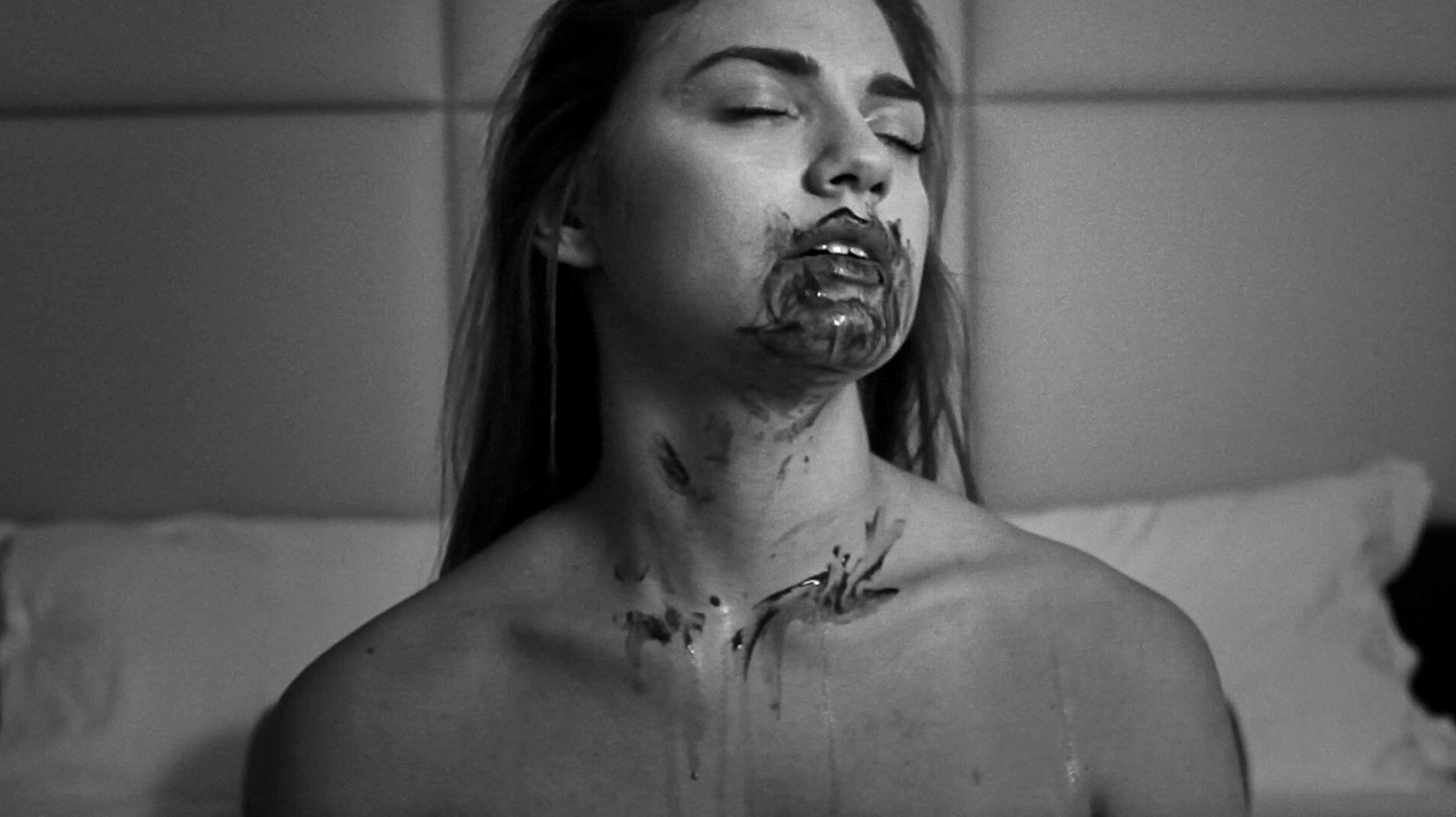
Johnson

The film is precious more than pretentious: the reading of the lines is stilted by the language and over-emoting, much as with hearing most versions of Shakespeare, or live theater in general. Actually, this aids the dialogue, which may resound false if it were presented straight. It is loyal to the ideal more than the idea brought forth. Oh my god, now they have me doing it!

IMBD listing HERE

Trailer is HERE

Wednesday, December 7, 2022

Review: Evil Dead Trap 2: Hideki

Text © Richard Gary / Indie Horror Films, 2022
Images from the Internet


Evil Dead Trap 2: Hideki (aka Shiryô no wana 2: Hideki)
Directed by Izo Hashimoto
Japan Home Video (JHV); Unearthed Classics; MVD Visual
97 minutes, 1992 / 2022
www.unearthedfilms.com
www.MVDvisual.com/
Before I begin this review in earnest, let us do a bit of house cleaning. First of all, this film is not actually connected to Evil Dead Trap (1981), per se. They have different writers and the director for Hideki is actually better known for writing the screenplay for the classic Japanese anime film, Akira (1988). And rightfully so.

That being said, there are some slim thematic similarities between the two Trap films. Both involve a television reporter/personality, and the other is that of a mysterious child whose origin is unknown: is it real? Imaginary? An evil spirit as in Ju-On: The Grudge (2002)? Though it may seem like slim connections, I would bring up, for example, how many of the more that 100 Amityville-titled films actually have anything to do with The Amityville Horror (1979)? It should be said, though, that Hideki is the name of the furtive child in both Evil Dead Trap releases.

There are three main characters here. First up is Aki Ôtani (Shoko Nakajima), who works as a film projectionist in a theater. She is dumpy and plumpy, preferring to be by herself, though is incredibly lonely at the same time. Her friend is television reporter and ex-pop idol, Emi Kageyama (Rie Kondoh), an ambitious and outgoing personality, but is also lonely in her own way, finding meaningless sex momentarily fulfilling. She is also obsessed with watching herself on television, via tape. Then there is Kurahashi (Shirô Sano), who is married to Noda (Kazue Tsunogae). And floating somewhere in the fringes of reality or fantasy is the titular Hideki (Shôta Enomoto).

Aki has a split personality, we quickly learn. The frumpy loner, and the red dressed serial killer who murders young women and rips out their ovaries with shears. You heard me. Or is she? Though at first we do not see the actual killings in detail (but hidden in arty camerawork which I will discuss later), but the aftermath is shown in quite gory details. Hey, remember, this is an Unearthed Films rerelease.

Meanwhile, Aki keeps seeing a child in the audience of her theater, and Kurahashi and Noda are waiting for their real or imagined child (demon?), Hideki. Kurahashi is a lothario, screwing around with Emi and promising to bed Aki. Most likely there are others, but let’s focus on the events, now that we have the exposition.

According to a psychic, Kan-nadzuki Chiyo (Shino Ikenami), Aki’s psychic powers are stronger than hers, and warns her not to let it control her. But as we have already seen, the other side of Aki shows that it may be too late. But Hideki’s power and influence may go beyond Aki.

I have to, as always, be honest with you. I have watched this twice now, and I have no fucking idea what the hell was going on by the second half. Was there some really good gore? Yes. Was there some really interesting violence? Yes. Did the story make any sense after the halfway mark? Hell, no. I knew what was going on in the moment, visually, but as for the overall arch of the story, I was lost. Perhaps this would make more sense if I was raised in the Japanese culture in a way I am unfamiliar, sort of like all the subtle wolf imagery in The Howling (1981), e.g., a big bad wolf cartoon on the television, which may be lost on other cultures.

I do have to say, the cinematography by Osamu Fujiishi is nothing short of astounding. Overwhelming neon city lights (nearly a cliché in Asian cinema these days), silhouettes, and shadows, play into the characters’ emotions so well. There were a couple of times I played back a certain scene because it looked so good. The editing was a bit choppy (no pun intended) here and there, with a few rough jump cuts, but I am guessing that was meant to be unnerving, and was probably intentional.

Surprisingly for a Blu-ray, there are only two extras, a Stills Gallery, and a bunch of trailers, including the two Evil Dead Trap releases.

 One could consider this Asian Extreme, I guess, but it does not match up to some of the classics, by the likes of Takashi Miike’s Audition (1999). However, I have heard this film compared to the likes of those by David Lynch and Dario Argento. I can see that. There are lots of weird goings on, strange angles, artsy visuals, and a convoluted story.

 If you liked Evil Dead Trap, I would recommend piggy-backing and seeing this as well right after, and then, perhaps, explain it to me.

IMDB listing HERE