Showing posts with label Dracula. Show all posts

Sunday, January 15, 2023

Review: Blood Daughter

Text © Richard Gary / Indie Horror Films, 2023
Images from the Internet

Blood Daughter
Directed by Bryan Enk
Third Lows Productions
112 minutes, 2022
www.facebook.com/bryan.enk

The director, Bryan Enk, seemingly is obsessed with the Dracula legend by Bram Stoker. A few of his previous films have this lineage, including two college productions: Dracula (1992) and Dracula Returns (1993), which may appear in some form as an extra on the disc, or should be, anyway. Note that some clips of those films also appear in a flashback form as a few of the actors appear in the same roles here. In more than one way this is a sequel to the sequel, but you do not have to have seen the earlier ones to watch this, as it can also be a stand-alone release.

Alexandria Johnson

Taking place in the here and now, rather than the gothic period of the novel, we are instantly informed that this is a beautifully arty work, with varying degrees of color (e.g., some muted colors, some black and white, some sharp clarity). The dialogue has nearly a modern Shakespearean tone of information and opaqueness, mirroring Stoker’s 1987 novel (e.g., “Let me be accurate in everything. For, though, you and I have seen some strange things together. You may think that I then, Helsing, am mad; that the many horrors and the so long strain on nerves has at the last turned my brain.”). They even use the infamous “children of the night” line. I was amused that someone states, “Something wicked this way comes,” as Enk also directed a film version of MacBeth (2003). There are generous uses of Shakespearean quotes thrown in for good measure, from Hamlet and Romeo and Juliet, for example. There is also a nice nod to the Stoker-inspired German 1922 film, Nosferatu: A Symphony of Horror (aka Nosferatu: Eine Symphonie des Grauens), as well as Francis Ford Coppola’s Bram Stoker’s Dracula (1992).

Johnson, Jeff Miller

The Blood Sisters is a group of both women and men who, it is pretty easy to figure out right off, an almost cult of vampires, under the tutelage of Rasputin-looking Sandor (Steve Bishop; not to be confused with the singer, though they both share facial hair), who works for the mysterious “Master” (Jeff Miller). Intent on joining the group, located in what is known as The Tower, is Lili (Arielle Hope), both “auditioned” and warned by June the Veil (Anna Stefanic). A focus of the opening is also introducing Inspector Claudius (Andy Hunsaker), who is searching for his daughter, Emilia (Emi Curia), who he fears has joined those in the Tower. .

Anna Stefanic, Bob Laine

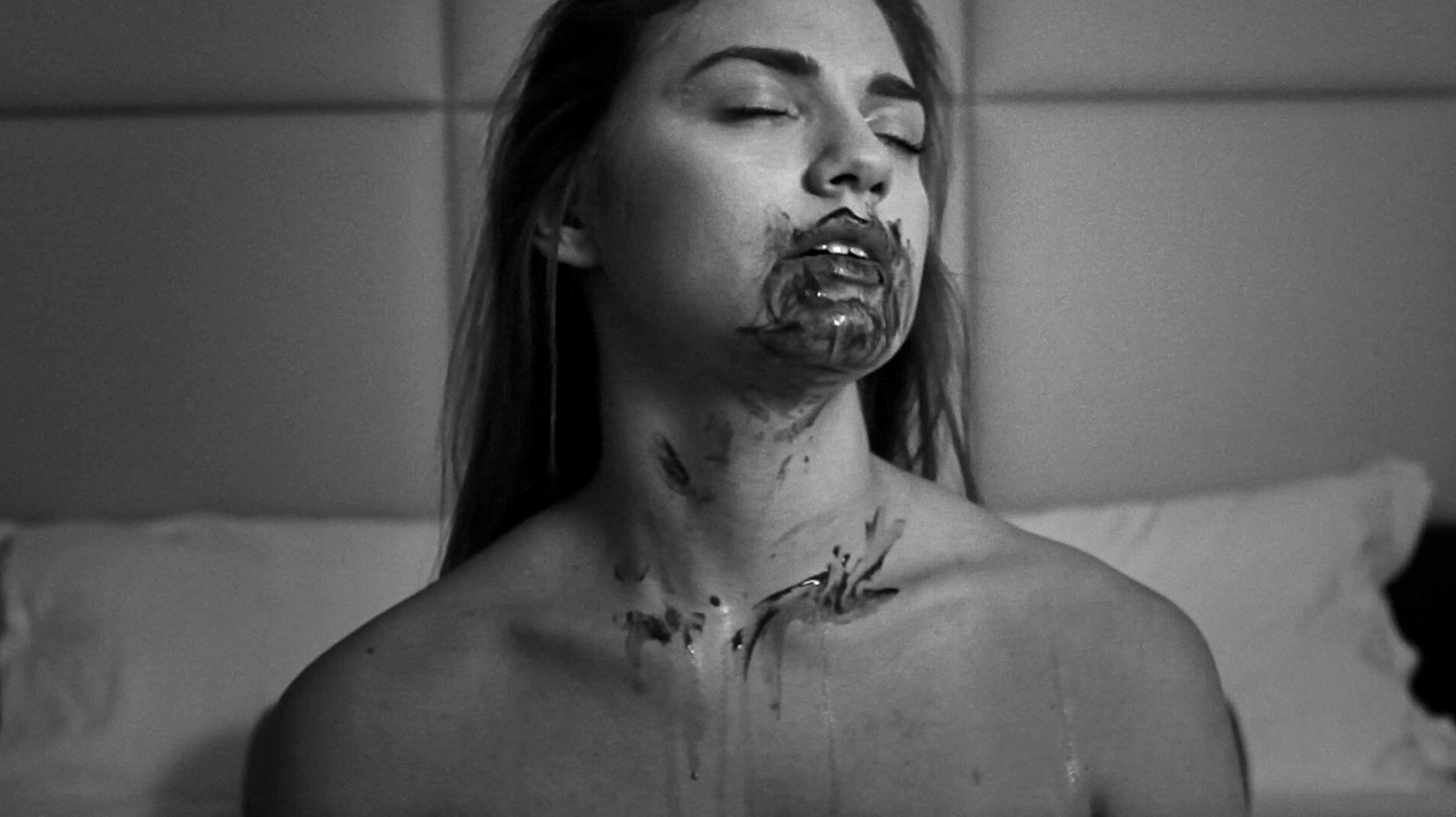
Eventually, we meet the central character, Abby (Alexandria Johnson, real-life daughter of Van Helsing’s Chuck Johnson, who was playing the same part 30 years earlier in 1992 when she was born) and her almost split personality disorder consciousness discussing her inner conflicts (“the false company she keeps”), all played by Alexandria. By the blood around her mouth, it is evident what kind of creature is the real Abby.

The film, shot before Covid and just now released, is broken up into a series of set pieces, pieced together like a jigsaw puzzle, sometimes introducing characters that are never, or rarely seen again. This makes, again, some opaqueness to the story, keeping the viewer off-guard for both what has happened, and what is to come. Even the editing by Chris Martinez is as sharp as the dialogue, and often cuts dramatically. It is a wonder to see. My one quibble, however, is that at nearly two hours, it is a bit long to be hit with so much texture and deep diving dialogue (the film was also written by Enk).

Emi Curia, Andy Hunsacker

My description, at times, may seem heavy handed, but this was truly enjoyable to watch. It is also a brave posit, to assume the audience has an intelligence, rather than a mindlessly rabid fan of blood and gore. This is not a get drunk (well, perhaps high…I do not imbibe in either) with a point-and-mock attitude. It is erudite and intelligent, and yet quite playful at times, with moments of humor, and a strong breaking the fourth wall, to the point of Alexandria playing herself for a moment. Also, the camera becomes a character as a persona may turn and either acknowledge or talk directly to the lens.

Johnson

The film is precious more than pretentious: the reading of the lines is stilted by the language and over-emoting, much as with hearing most versions of Shakespeare, or live theater in general. Actually, this aids the dialogue, which may resound false if it were presented straight. It is loyal to the ideal more than the idea brought forth. Oh my god, now they have me doing it!

IMBD listing HERE

Trailer is HERE

Wednesday, August 15, 2018

Review: Flesh & Blood – The Hammer Heritage of Horror


Text © Robert Barry Francos / Indie Horror Films, 2018
Images from the Internet

Flesh & Blood: The Hammer Heritage of Horror
Written and directed by Ted Newsom
Narrated by Peter Cushing and Christopher Lee
S’more Entertainment / Bosustow Media Group / Hammer Films / Act 3 – Heidelberg Films / MVD Entertainment
100 minutes, 1994 / 2015 / 2018

Before I started watching this update of a reissued 1994 British documentary television show about arguably one of the three most important horror film companies in the 20th Century – the other two being Universal Pictures and American International Pictures (AIP) – I tried to think back to the first Hammer Film Production I can remember seeing in the theater. It could have been She, The Nanny (which began my crush on Pamela Franklin for a couple of decades), Die! Die! My Darling!, or One Million Years BC (all released in 1965). However, I have a vague memory of seeing The Creeping Unknown as a second-bill feature years after its original release as Quatermass Xperiment (1955), probably as a back-up for one of the AIP Poe releases with Vincent Price; they helped cement my love of the genre through the decades. Since then, I saw so many of their films and franchises, Dracula and Frankenstein, especially.

It makes good sense that the narrators of this documentary are the biggest stars Hammer helped introduce to Western cinema: Christopher Lee (d. 2015) who was best known as Dracula in Hammer Films, and the man with the world’s greatest cheekbones, Peter Cushing (1994, soon after this was released; I was a member of his British Fan Club), who reimagined by Dr. Frankenstein and Van Helsing. It should be noted that Cushing’s career dates back to appearing in the Laurel and Hardy feature, Chumps at Oxford.
                                                                                                              
Wisely, it starts off right at the beginning, with how the name Hammer originated (which I did not know, or perhaps did not remember), into its formation as a viable force during the post-World War II period, and how they attained their admirable talent, such as director Freddie Francis.

There is a nice compendium of archival footage and early ‘90s modern interviews, so many of the stars of the early releases, as well as the classic ones, such as Francis (d. 2007), Hazel Court (d. 2008; one of the few to be in both Hammer and AIP films), Ingrid Pitt (d. 2010) and Veronica Carlson are present for first-hand accounts. We see original footage and modern interviews of both actors and crew. Also enjoyable are interviews with some American directors, and how they were influenced by the Hammer collection, such as Joe Dante, John Carpenter, and Martin Scorsese.

A point they make here but don’t dwell on (consider the name of the documentary, after all), is that early on there was hardly a genre that Hammer didn’t tackle, including swashbuckling, crime dramas, and science fiction. It was the Quatermass mash-up of sci-fi and horror that got them noticed to an Ameican audience, which is where the larger money was, and from there it was the revitalization and reboots of the classic Universal monsters where the studio became financially sound. Peter Cushing says at one point, paraphrasing the name of one of his films, “Frankenstein Created Hammer.”

Rather than follow the releases merely chronologically, wisely break the film up into “groups.” For example, there is a whole segment that just focuses on the Frankenstein films, some more successful in quality than others, in my opinion, and thankfully everyone looks at it both nostalgically and with a sense of whimsy, including David Prowse (he would go on to play Darth Vader in the original three Star Wars films) and Cushing himself, who comments at some point that his hair in a later film looked like Helen Hayes. Needless to say, this is an exciting part of the film for me.

After Frankie-Baby, there’s “The Count Also Rises,” discussing, well… Dracula (are you surprised? If you are, you need to see this and learn your horror history, Jack… or Jill). Actually, I do agree and disagree on a point they make in this segment. They comment that what makes Lee’s Dracula so special is the level of sexuality he brings to the character. Well, yes, onscreen he definitely made some in the audience swoon (both female and male, from those I’ve talked to), but to imply that Lugosi’s Big-D wasn’t sexy is just wrong. Lugosi was a major sex symbol in the 1930s and ‘40s (pre-drug addiction), and while there was no blatant sexuality on screen as there was with Lee (e.g., a woman lying in bed pulling down her neckline to be bitten), Lugosi’s portrayal just burned with sensuality, using his voice – as is true with Lee’s baritone – and eyes, specifically. Can I get an Amen?

Younger people may think of Lee as Saruman, but for those “kids” of my g-g-generation, Lee is Dracula and Dracula is Lee; and I say this with the utmost respect and admiration. When he plays other roles, such as Lord Summerisle in the wickedly great The Wicker Man (1973; not the Nic Cage travesty remake), it’s easy to accept. But when Lee’s name is mentioned, it’s his cape and red eyes that come to mind. The Dracula-based series was also extremely popular for the company, though Lee pulled the plug on himself continuing the role after the cartoonish and garish Dracula AD 1972 (1972) and The Satanic Rites of Dracula (1973). He explains why here, which is good to hear dripping from his lips directly.

The second half of the documentary is a bit more esoteric, covering many bases. For example, there is a look at a few films that did not make money, such as the sensationalist courtroom drama Never Take Candy From Strangers (1960) and the sci-fi thriller The Damned (1963) to how Hammer had one of the first full-time female producers with Aida Young (though Freddie Francis sorta poo-poos her role). On more a more technical side there is discussion about how Hammer used exceptional crews and eventually had their own look (they definitely did), and how they managed to score major talent, such as Oliver Reed, from both the UK and the US.

Adaptations of classics (e.g., Phantom of the Opera in 1962 and The Devil Rides Out in 1968) are discussed, including an interview with my personal favorite horror writer, Richard Matheson (d. 2013).

Now, Hammer kinda hit its stride, especially with me, in the late 1960s and in the early ‘70s, and I have no doubt looking back that part of it had do so with what is covered in a chapter here called “Hammer Glamour.” The stars were good looking; there were bountiful cleavage, and a strong sense of both horror sexuality and sensuality. Films like Dr. Jekyll and Sister Hyde (1971), Lust for a Vampire (1971) and Twins of Evil (1971) were fine examples of what fed a teenage boy the equivalent of what many superhero films do now with the same formula using Harley Quinn (Margot Robbie), Black Widow (Scarlett Johannson) and Wonder Woman (Gal Gadot). Wisely, this film looks at both the good (marketing) and bad (sexism/gender politics, as well as the overuse of the theme of sexy lesbian vampires*) of this aspect, though because it was filmed in the early ‘90s, perhaps not as deeply as it might since the emergence of the #metoo current history.

This logically leads into the prehistoric releases that seemed to begin with One Million Years BC, including interviews with its two major stars, Raquel Welch and the underrated Martine Beswick; the latter would go on to other dinosaur-and-human releases that seemed to come out quite often, and were often over-acted and over-melodramatic in joyful exuberance. There are also a couple of brief interviews with the man who designed many of them, the king of pixilation himself, Ray Harryhausen (d. 2013).

This was actually getting close to the end of the Hammer phenomenon, with their the horrible but (unintentionally) hilarious last horror film To the Devil and Daughter in 1975, and the 1979 horrible and not hilarious (unintentionally) comedy The Lady Vanishes. But thanks to extended footage added to this new version of the documentary, we are told of its somewhat limited revival in 2008, with the likes of Let Me In (2010) and The Woman in Black (2012).

This is a fun and informative way to spend a couple of hours of horror film history, and with the 40 minutes of added footage, all the more bettah. It’s well thought out, extensive in its clips and interviews, and pretty thorough.

I do need to add a comment, however, about something I felt was left out. In the late 1960s and through the ‘70s, Hammer wisely chose to go into the home distribution market, well before the advent of VHS. It was common to see 8mm and Super 8mm short versions of Hammer Films in 50’ (4 minutes) and 200’ (15 minutes) versions, both with sound and silent. I still have a batch of the silent ones somewhere, though no projector anymore. This was some solid marketing.


* It should be noted that one of the very first horror stories ever published in modern history, even before Dracula, was the 1871 Joseph Le Fanu novella, Carmella, about a lesbian vampire.

Tuesday, June 5, 2018

Review: Orlok, the Vampire

Text © Richard Gary / Indie Horror Films, 2018
Images from the Internet


Orlok, the Vampire
Directed by F.W. Murnau
Quality Cheese, MVD Visual
Appx 90 minutes, 1922 / 2009 / 2010
www.Qualitycheeseproductions.com
www.MVDvisual.com


It was a mix of cultures and styles, German Expressionist Cinema and British manners, and a legal battle that would be among the first in the burgeoning film business of Europe that resounded worldwide.

Nosferatu, eine Symphonie des Grauens, directed by F.W. Murnau in 1922, was more than loosely based on Bram Stoker’s gothic novel Dracula, nine years before Bela Lugosi would portray the villainous vampire on film, and decades before the throat-biters would narrowly be seen meekly as sensitive heartthrobs and adversaries for werewolves (and other, less brooding bloodsuckers).

Stoker’s family sued over the copyright, and won. All known copies were ordered destroyed, and it joined Edison’s Frankenstein as one of the great “lost” early film prints. But as with cinematic dinosaurs, nature finds a way, and prints started turning up over the years. As an ironic note, it was no longer under copyright during the advent of the VCR, so copies of it were everywhere, usually on cheap brands at low rez speed (ELP). I had an 8mm Blackhawk Films 200’-reel (20 minutes) version, and one of the bad VHS dubs.

Thus we come to this new release, retitled Orlok, the Vampire… in 3D, yet! Being an old black & white film, it makes total sense this could use the older technology of green and red separation. Two paper glasses are included, I should add.

All copies I’ve seen of this film over the years are a bit scratchy, and it seems each have a different set of title cards; the character names vary among the original book and the film. For example, the real estate agent in Dracula was Jonathan Harker, and in Nosferatu it was Thomas Hutter, but in this new release, it is Jonathan Hutter, a mixture of both.

It is easy to identify who is who from book to film, and Stoker's estate was right to sue (in subsequent copies, Stoker is listed as writer). There is a bit of a stir-up here, though (as Akira Kurosawa also did with Shakespeare’s plays), such as Hutter’s boss, Knock, turning into a “Renfield,” bug-eating character.

There is no denying that this is a groundbreaking and thoroughly effective, creepy film. Max Schreck, as Graf [Count] Orlok, is even taller, stiff, hunched, and lanky than Phantasm’s “Tall Man” (Angus Scrimm). Schreck presents a precedent-setting evil figure. Many elements of Murnau version have become iconic, such as Orlok’s raising out of his grave from horizontal to vertical while stiff as a board, used in Coppola’s Bram Stoker's Dracula in 1992, and the 1979 remake by Werner Herzog; it’s been copied more than Potemkin’s baby carriage step-bounce (just imagine all the scenes that Brian De Palma could have – err – honored if he had made a remake).

There are so many other moments of brilliance in Mureau’s version, such as Orlok's face sticking through his busted wooden coffin lid, when he stalks Ellen (Mina) from the window across the courtyard, or when the shadow of Orlok’s hand “grabs” Ellen’s heart. Without the over-exaggeration common in German Expressionism such as Metropolis and The Cabinet of Dr. Cagliari, this film still retains much of its eerie flavor nearly 90 years later.

The print here is decent, though I do dream of a “restored” version (but as far as I know one does not exist). As for the 3D effects, added by Chris Heuer, it should be pointed out that not all of it is in that format, reserved mainly for scenes with the vampire, the title cards, and the occasional bat used for separating acts (though it goes by so fast, it’s hard to tell if it actually is in 3D with the glasses). The new soundtrack is a bit too fluffy and not sinister enough though, and the grunts and noises the characters make are a bit distracting, so I recommend watching it with the sound off, or turned way down.

This film is a classic. It’s still a joy to watch for me, even after numerous viewings over the years. The camera work and editing is revolutionary, and the actors are still sharp – although they do the typical hands-flinging-about emoting that was common in silent films, a throwback from the non-amplified theater stages. Orlok – even in 3D – is worth a see, and re-viewing.

There are limited extras here, and in fact, there are strangely no chapter breaks, so if you stop and start again, you have to zoom to your last spot. However, there are two different versions on the DVD, one with the 3D and one in normal 2D. Also, there is a bizarre introduction by Troma master Lloyd Kaufman, who does what I’m pretty sure is an off-the-cuff spiel that is so ludicrous – and hysterically funny – that he even refers to this 1922 film as a remake of Schindler’s List! Can a 3D Toxie be far behind?

This review was originally published in FFanzeen.blogspot.com


Wednesday, August 31, 2016

Book Review: Dreaming of Nightmares – A Crash Course in Horror Movie History; by Nige Burton and Jamie Jones

Text © Richard Gary / Indie Horror Films, 2016
Images from the Internet

Dreaming of Nightmares: A Crash Course in Horror Movie History
By Nige Burton and Jamie Jones
Stripley Media Ltd.
28 pages, 2016

I’m old enough to have grown up with Olde Tyme monster movies, mostly in black and white, usually on WPIX, shown on New York’s “Chiller Theater,” sometimes hosted by Zacherle(y). Whether the Universal films, or even schlock like The Monster That Conquered the World (1957), Plan Nine from Outer Space (1959), The Monster of Piedras Blancas (1959), and even Attack of the Giant Crab Monsters (1957; where you could see the sneakers of the guy holding up the crab suit), it didn’t matter, you were glued to the screen. In fact, the first horror film I remember on TV (not counting The Wizard of Oz) was Abbott and Costello Meet Frankenstein (1948).

I’d often also go to the theater to see the latest AIP Poe adaptation with Vincent Price, enjoy bad gimmick films like Two on a Guillotine (1965) where a skeleton flew down on a wire in the theater…just once before it was knocked down by kids throwing candy and popcorn boxes), and the film that scared the shit out of me, Straight-Jacket (1964), where I couldn’t sleep for a couple of weeks (I was 9 years old). The last film I saw that really had a profound effect on my fear level was The Haunting (1963), which I saw when I was a teen in the early ‘70s (since then, I’ve probably read Shirley Jackson’s original novel, The Haunting of Hill House from 1959, about five times).I’ve been watching these kinds of films since as long as I can remember.

Magazines like Famous Monsters of Filmland [FMF] and Castle of Frankenstein were great primers and history lessons, telling stories and showing behind the scene photos of people like Karloff, Lugosi, Harryhausen, Lorre, Cushing, Lee, and the countless Hammer actresses (especially Castle…). Then came Classic Monsters mag at some point.

When I had the offer to see this book for free as a .pdf (you can do if you visit the website and sign up for the monthly newsletter), I figured, why not. I find that most younger fans’ knowledge of horror starts around the period of Night of the Living Dead (1968; yes, I know it’s a gross generalization, but that’s okay).

Other than being quite a slim volume, the first inside image I noticed was a full-page picture on page 2 of a close-up of William Henry Pratt (aka Boris Karloff), and I thought, “Oh, that’s from The Old Dark House (1932). That’s when I knew I was in the right place.

It’s pretty quick to see by the grammar and tone of the book that it is British. Well, first there’s the use of “s” instead of “z,” such as in “generalisation.” Then there are some quaint wordings like “whilst” and “behindhanded” (the last word not even recognized by Spellchecker). Who knows, perhaps “unbeknownst” will show up?

But what about the content? Okay, okay, stop badgering me. The book is broken up into six chapters, each covering a period of time or era. The first chapter, “Silent Shudders,” focuses on the advent of film in the late 1800s to the introduction of sound in 1929. The biggies are here, such as Murneau’s Nosferatu (1922), Edison’s Frankenstein (1910), and especially Lon Chaney (Sr.). I would argue they left out Metropolis (1927), but I suppose technically that’s science fiction (it can be both; I mean the Maria robot was creepy as hell). I understand why they put in George Méiliès since his films did have a sort of devil character, but there was no real narrative story. I propose that the first really frightening film was Edison’s Great Train Robbery in 1903: at the end of the western, one of the villain characters (who was killed in the story) is shown in a portrait level shot. Facing directly to the camera (i.e., the audience), pulls out a pistol, points it at the viewer, and fires. That may seem kind of benign now, but then, because of the lack of context, people in the theater screamed, ducked and some even fainted. 

The second chapter deals with “The Golden Age,” or for those of us fans of the period genre, the Universal monsters. Of course, the first up, and rightfully so, is Dracula (1931). While each chapter is short, there are some interesting tidbits, such as resting the myth of Lon Chaney being up for the Lugosi role, and that Lugosi turned down the Frankenstein (1931) monster due to its lack of dialog. Burton wrote books that were definitive histories of these two films, so I believe his credentials. It’s amusing to see the authors’ grammar rear up again when describing director James Whale as a Brummie (I looked it up; it’s someone from Birmingham, UK). However, their amusing bias comes through when they make sure to describe Karloff as British (where he lived until his early 20s, when he moved to Toronto).

Of course other films than Universal are discussed, such as RKO’s King Kong (1933). Again, they are correct that the Golden Age ended with the censorship boards, but they discuss it under the British Board of Film Censors, rather than the effect of the Motion Picture Production Code (MPPA, aka the Hay’s Code) in America, where the films actually originated, which had a more drastic and direct artistic negative effect (FYI, I did my Master’s Thesis, in part, on the Code).

In the third chapter, “Second Wind,” they delve into how the monster machine was turned off because of the gatekeeping Code, but thanks to a bill of Frankenstein and Dracula shown towards the end of the ‘30s, there was such a profit margin that the factory started again, with the first big star being Lon Chaney Jr. in The Wolfman (1941), and his revitalizing a new Egyptian myth with The Mummy’s Tomb (1942). The profitability of these monsters was the first time that the sequel train seriously pulled out of the station, with the likes of Frankenstein Meets the Wolf Man (1943) and House of Dracula (1945). They had mentioned the artistic success of The Bride of Frankenstein (1935), in the previous chapter, and acknowledge that many of the other sequels were more quickie B-films than A-line quality. Other studios, such as RKO, went in another direction and tended to focus on more human monsters, such as with The Body Snatchers and Isle of the Dead (both 1945 and both with Karloff, who was loaned to the studio).

“Out of this World,” the fourth chapter, delves into the 1950s paranoia of science fiction like This Planet Earth (1955) and Creature from the Black Lagoon (1954). While science was in some form in films like Frankenstein, it was dark and mysterious arts that paralleled alchemy. By the ‘50s, however, with the ending of World War II and huge leaps and bounds made by technology and science that affected everyday life, such as television and Jonas Salk’s serum, it became more of a daily reality rather than an electric and test tube filled hocus pocus. Radiation fear was a big factor that entered into mainstream culture in the ‘50s, with giant insects and bugs, as well as monsters (e.g., Godzilla in 1956), which were seen as nearly a possibility (much like fear of a viral Zombie Apocalypse seems now).

Burton and Jones are correct, moreover, that the Comics Code had some effect on the death of that type of sci-fi (though, of course, it didn’t end completely). What really brought the end of this period in the States was a series of lawsuits by foreign films (e.g., The Bicycle Thief) about unfair distribution; according to the Hays Code, the companies that played the films also owned the theaters, shutting out foreign and independent releases. The end result of a Supreme Court decision was the studios were no longer allowed to do both (anti-trust laws), which wore down the MMPA enough so that independent studios could open and get their films distributed (e.g., those by the likes of Hershell Gordon Lewis, David Friedman, and of course, Roger Corman).

Another positive function of this period was the sexing up of the cinema, where monsters met women in tight clothing or even (gasp) bathing suits, such as the Black Lagoon chap kidnaping Julie Adams, or astronauts finding a zaftig Zsa Zsa Gabor in The Queen of Outer Space (1958).

Rightfully so, this leads to the next and fifth chapter of British monsters in “New Blood.” Of course, a large portion this focuses on the most important and influential British (I would say European) film studio, Hammer Pictures, which was arguable the Universal Studios of the late 1950s into the mid-1970s, even reviving the Frankenstein and Dracula mythos. This led to the rise of new horror icons such as Christopher Lee and Peter Cushing. It also led to the further lowering of the cleavage line.

There is a whole section of American cinema that is not addressed in the book, namely the indies of the ‘60s that dealt heavily in gore and sex, such as Blood Feast (1964), Two Thousand Maniacs (1965), and Mantis in Black Lace (1968), in addition to the myriad of Corman releases.

The final and sixth chapter is titled “Slasher Suburbia.” The authors posit that the slasher films started in the vacuum of the end of Hammer as a force in 1972, but I would disagree. Night of the Living Dead (1968; it was not a slasher film per se, but the level of gore equaled one), The Texas Chain Saw Massacre (1974) and its predecessor Last House on the Left (1972) were all filmed while Hammer still existed and was a driving concern, and I do believe most would cite these films as a reference point more than Hammer (as wonderful as those films were, no argument with the authors). In fact, in modern extreme horror cinema, many do not even bother to go past these touchstone films, considering many of the Hammers were benign in comparison (I believe this is an error; it’s good to learn the history). To be fair, Burton and Jones do declare Psycho (1960) as the first slasher.

Nicely, they also give credit to the giallo for helping launch it, and of course it was the advent of video that made giallo have any real lasting impact. And it’s smart that they call it Suburban Horror, as many of the films take place at home (or someone’s house); another way they put it, I would postulate, is the events happen in “the ordinary.”

What follows the introduction of slashers is actually away from the ordinary, though in somewhat serene settings, leading to new icons to replace the Frankenstein monsters, Draculas, werewolves, etc. These came with the names Michael, Jason and Freddy. A neighborhood, a children’s camp in the woods, and in dreams are examples of what I’m going to call the “extraordinary ordinary.” That is part of where the story here ends, with the authors asking, “What’s next.”

Well, in part to answer that question by me is twofold. First, there is the introduction of digital production, with cheap cameras that look good and editing programs on the computer, creating a world in which anyone can be a filmmaker, even more so than with 8mm or 16mm thanks to means of distribution through the Internet and conventions. Films now are often more visceral and yet sometimes sillier, due to this. This gives rise to the likes of omnipresent zombies, torture porn, and handheld found-footage miasma, as well as some masterful works such as those by the likes of indie filmmakers like Richard Griffin and Dustin Wayde Mills (among many others).

This book is chock full of really fine stills, which thanks to it being a .pdf can be enlarged. That being said, perhaps I’m being a bit hard on what they didn’t put in, considering the thin volume, but I also believe it is also somewhat cultural, as they are looking from a British standard, and as I stated, some of these films didn’t play there, or the laws were different as far as content. Many of the more graphic films were banned in England in the 1980s as “Video Nasties.”

Most of this book could have been lifted right off the pages of FMF, but that is not meant as anywhere near an insult. It’s actually a really fun read, and the authors make some really fine points and history details, some I had never really thought of or known (remembered?) before.


To get the book you do have to join, but it’s still worth looking for, as it is associated with Classic Monsters of the Movies magazine. It is a fun read, as well.