Showing posts with label horror documentary. Show all posts

Tuesday, June 27, 2023

Documentary Review: The Dogman Triangle: Werewolves in the Lone Star State

Text © Richard Gary / Indie Horror Films, 2023
Images from the Internet

The Dogman Triangle: Werewolves in the Lone Star State
Directed by Seth Breedlove
Small Town Monsters; 1091 Pictures
74 minutes, 2023
www.smalltownmonsters.com/

www.facebook.com/smltownmonsters
#IndieHorrorFilms #DogmanTriangle #SmallTownMonsters #Cryptid #werewolf

Growing up watching the classic Universal monster films as a kid, creatures hold a soft spot for me. This is especially true for werewolves, for some reason. Where is Larry Talbot when you need him?

But director Seth Breedlove goes beyond into the realm of cryptids, urban legends that posits monsters like Bigfoot and the Jersey Devil are possibly real. While I do not believe so, I tend to enjoy stories about cryptids, and especially Breedlove’s take on them.

He has travelled around the country looking for them, and as far as were-creatures, he covered this topic in the more general American Werewolf (2022). For this one, he ends up more specifically in the second largest state in the Union, Texas, searching for the “Dogman” legend, a branch of werewolf. It would be easy to make a joke about ZZ Top at this point, but I will move on…

Aaron Deese

Based on the findings of author Aaron Deese’s 2023 book, The Dogman Triangle (he is also former Editor in Chief of Paranormality Magazine), Deese joins paranormal expert, author, podcaster (“Into the Fray Radio”), perennial Small Town Monsters host, and often Havana hat wearer Shannon LeGro on a tour of the Deep South, focusing on three points in the State (hence the “triangle” part), San Antonio, Dallas, and Houston, covering about 700 square miles. Each “point” is a chapter title.

It is important to note that though the word “werewolf” is bandied about because there is no official categorization, the term “dogman” is more accurate; in other words, it is not a person who converts into a wolf as in the lore, but rather falls into cryptozoology as a large wolf that can walk on two legs like a human. As with many cryptid monsters, the descriptions vary from “eyewitnesses” to the perceived form. I find this somewhat naturalistic version more interesting that the supernatural one in regard to transformations.

Shannon LeGro

There are three levels of observers scattered throughout the documentary. The first is the retelling of the folklore legends, usually dealing with the late 1800s to the 1950s, such as storytellers Ken Gerhard, Lyle Blackburn, and Nick Redfern from Britain. Then there are the third- and second-hand stories of people who knew people (e.g., neighbor, dad) that had a sighting, but did not have them on their own, like JoJo Santana and James Witter. Finally, there are those who claim they saw the dogman (or something like it), including Dawn and Michael Lucker, both of whom have different descriptions of size (a difference of 4 feet in height when upright). Worth noting, also, is Nick Losoya, an Apache who talks about a more skinwalker/loupagrou legend of the Indigenous people.

I like that the documentary addresses the possibilities of misidentification by the witnesses, such as a mangy bear (which can walk on its hind legs) or a wolf-dog hybrid (there are technically no wolves in Texas, but they explain it here), but fall back to it being a canid creature.

Deese, LeGro

Another direction they investigate that was keen to my interest was the “after effect” of a sighting, such as that of Tex Wesson, who suffered from PTSD for a while afterwards, and he is not the only one who mentions that in the film. In the many cryptid docs I have seen, this is an area that I do not remember being explored much, and honestly, I would love to see an entire film on just that: the psychology of the effects of seeing a cryptozoology subject in the flesh.

As for “tangible proof,” there is some given, such as footprints (though the two shown are totally different), a couple of grainy videos, and an audio track of howling. What we are mostly presented with are some incredible artwork by Johnathan Dodd (one of the financial supporters of this film, along with many, many others, is Swamp Thing illustrator Stephen R. Bissette) and animation by Chris Sealf. Also worth noting is the eerie music soundtrack by Brandon Dalo.

Considering the sheer volume of guns in the state (the most registered arms at 21 per 1,000 people), how are these things not hunted, extinct, and mounted on a mantlepiece like a deer head?

Fortunately for us, there is the promise that “Aaron Deese will return…” at the end of the credits. Goody!

Available on Cable VOD and Digital HD, as well as 1091 Pictures, iTunes, Amazon Prime Video, Vudu and FandangoNOW.

IMDB listing HERE

Monday, April 10, 2023

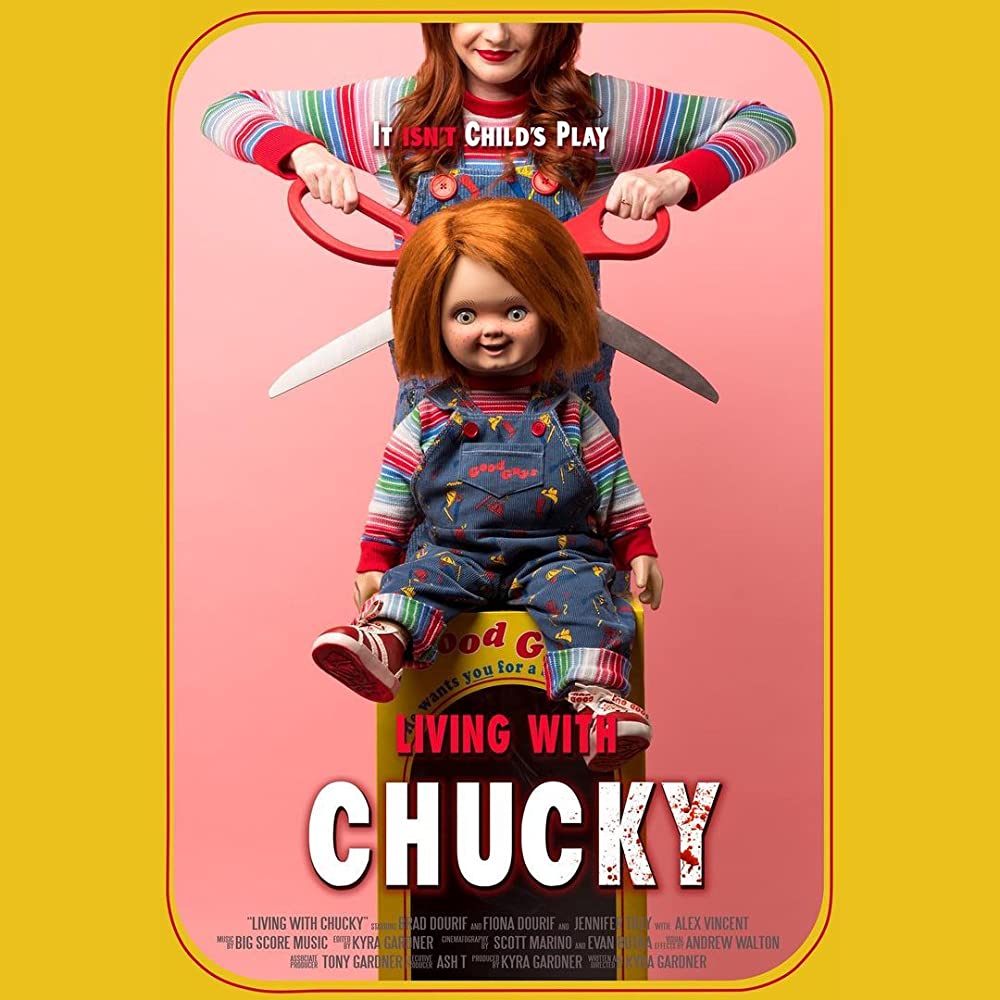
Documentary Review: Living with Chucky

Text © Richard Gary / Indie Horror Films, 2023
Images from the Internet

Living with Chucky
Directed by Kyra Elise Gardner
Yellow Veil Pictures; Lightbulb Film Distribution
105 minutes, 2022 / 2023
https://lightbulbfilmdistribution.com/
www.strike-media.com

It is wonderful that some of the modern classic horror films (mostly starting with the 1980 VHS boom) are getting some documentary attention, such as Pennywise: The Story of IT (2022), and Never Sleep Again: The Elm Street Legacy (2010). Even Netflix had “The Movies That Made Us(2019), an interesting series that focused on horror.

There is no question on where this film is focused, the title gives it away. But this is a deep-dive into the eight-film Child’s Play/Chucky franchise. Much of the documentary footage (other than scenes from the Chucky releases themselves), was shot a half dozen years ago for a student film by the director, when she attended Florida State University. She released an award winning 7:31 doc short under the title “The Dollhouse,” most of which is included in this full view of the Chucky universe.

The motif of this is that it is broken into three sections: the first two are kind of obvious, which is in no way meant as a negative, but rather a logical sequence. The first is how the idea of a killer doll came about, through the initial script, and into the release of Child’s Play in 1988. We meet Don Mancini, who created the original Child’s Play, and has since written and/or directed nearly all the Chucky-related franchise, including the recent “Chucky” television series (2021-2022). Also interviewed is David Kirschner, a producer of the Chucky films and series, the animated Curious George film, as well as the two Hocus Pocus releases.

Kyra Gardner, Good Guy Chucky

The description of the first film is kind of short, having more commentary on its cultural effect by the likes of Lin Shaye, star of the Insidious franchise (starting in 2010). She mentions how people were attracted to the Chucky “character” who became popular in the same way as Freddy Kruger started the trend in the first A Nightmare on Elm Street (1984) because he was a villain to love and used sharp humor. Most other slasher icons up to that point, such as Michael and Jason, do not speak, making them arguably less human than even Chucky, and certainly harder to identify with to the viewers.

There are a lot of talking heads here, including some actors in other horror films or franchises, such as Marlon Wayans (Scary Movie series), Abigail Breslin (Zombieland franchise), and Elle Lorraine (Bad Hair, in 2020). Many times these documentaries about media are filled with writers or podcasters, but here it is thankfully kept to a bare minimum, with the likes of Tony Timpone, editor of Fangoria magazine. Also making an appearance, I am happy to say, is beloved cult director John Waters, who had a cameo in one of the films.

What follows, almost as going from chapter to chapter, is that the films are discussed one by one, indicated in title card fashion by specific media: The first three Child’s Play films are represented by a VHS cassette, and the Chucky titled films are discs.

Brad Dourif, Chucky, Fiona Dourif

While the star of the first Child’s Play film, Catherine Hicks, is unfortunately absent (perhaps she was beamed up on the Enterprise?), we get to meet most of the rest of the cast as each film is discussed, such as Chucky/Charles Lee Ray himself, Brad Dourif, who becomes the killer doll by using an obscure voodoo rite; I initially saw him in his first credited role in One Flew Over the Cuckoo’s Nest (1975), though visually most people probably know him as Wormtongue, in two of The Lord of the Rings films. Alex Vincent, who played the kid Andy in the original stories, is interviewed; he is also in the new television series.

Christine Elise discusses how she won the role of Kyle, the main character (after Chucky) in 1990’s Child’s Play 2; she reprises the role in the new TV series, as well.

I was really happy when Jennifer Tilly (Bride of Chucky in 1998) comes into the spotlight. I have always been a fan. She is, happily, present throughout the rest of the documentary, as is Billy Boyd, the voice of Chucky and Tiffany’s transgender offspring, Glen/Glenda in Seed of Chucky (2004); Boyd was also in The Lord of the Rings trilogy, which explains the offspring’s British accent, which never made sense to me. Seed also introduced storied make-up artist and puppet master Tony Gardner (learned under Rick Baker, his work includes the Hocus Pocus and Zombieland franchises, among so many top horror hits). He has worked with the Chucky films since; he is also the father of the director of this excellent film, Kyra Gardner.

Jennifer Till, Tiffany, Chucky

Curse of Chucky (2013) was important for the introduction of a new main character, Nika (Fiona Dourif, the daughter of Chucky himself). As a sidenote, I really wanted to give her a hairbrush…

An interesting topic is when it is explained how the trajectory of the Chucky films mirrored that of the Elm Street releases, in that it started off as horror, devolved into a form of horror comedy with gore, and then became serious again towards the end (Curse and Cult of Chucky in 2017).

For me, the most interesting section of this film is the last, where more intimate topics are covered, such as VFX vs. practical, discussed by a number of actors and crew, the relationships between the crew and cast, as many of them have worked on multiple Chuckys, and culture influence, such as attending horror conventions. They also discuss the down points of the experience, such as being away from family and an ever decreasing budget from the studio; Dourif mentions the loneliness during his voice recordings, where he was in a sound booth for days. But what I found most intriguing is the correlation between Fiona and this film’s director, both being the daughters of the crew/cast, and both growing up with Chucky (hence the doc’s title) as an important part of their lives. Towards the end of this release is some newly shot footage tagged on regarding the television series, being filmed in Toronto.

John Waters, Glen (Glenda)

The often-reviled remake of Child’s Play (2019) was wisely ignored here, partly due to the fact that this was mostly filmed before this was released, and secondly, it is out-of-scope of the topic of a cast that is family.

Extras on the disc are a feature length commentary, interviews with the cast (8 min.), “Favorite Death Scene” (4 min), “Reception from Families” featurette (6 min), and the film’s Trailer. As I watched an online link, I did not see the bonus features.

IMDB listing HERE


Friday, November 25, 2022

Documentary Review: Bloodlines: The Jersey Devil Curse

Text © Richard Gary / Indie Horror Films, 2022
Images from the Internet

Bloodlines: The Jersey Devil Curse
Directed by Seth Breedlove
Small Town Monsters; 1091 Pictures
79 minutes; 2022
https://www.smalltownmonsters.com/

Being that I grew up in Brooklyn, New York, whenever the Jersey Devil was brought up, it was generally not attributed to a cryptid, but rather the drivers of that state. I know better now, and I am no longer Jersey Driver-phobic. The Jersey Devil creature? Well, that’s another story, and it is attentively given its due in this documentary, directed by Cryptid Master, Seth Breedlove.

The Jersey Devil (JD) is not omnipresent in the state, but is confined to an actually quite large reserve known as the Pine Barrens. I have been there and walked some trails, but never saw anything weird, just a beautiful pine forest.


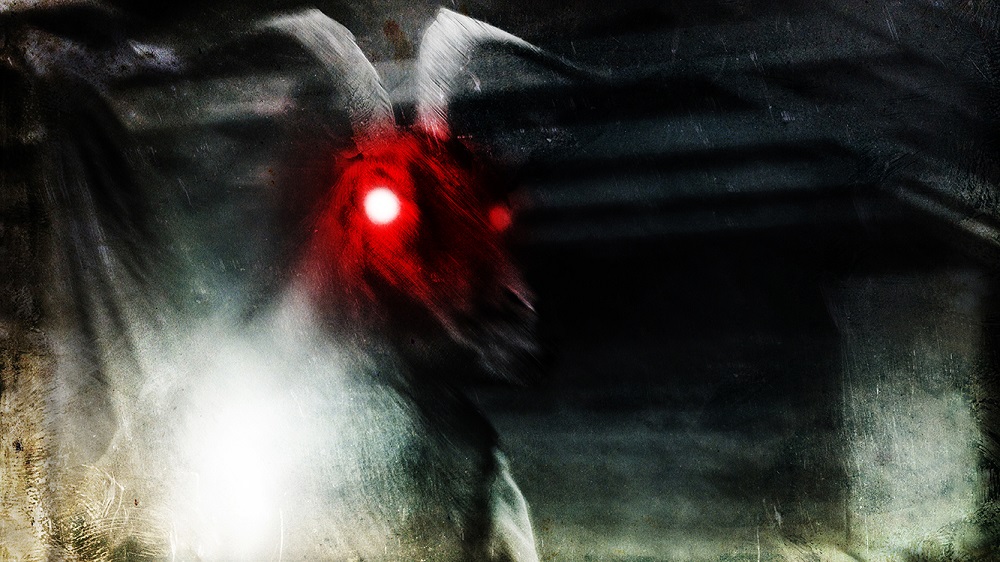
But the mainstream legend of the beastie started in earnest during the early 1900s, beginning originally as The Leeds Devil, and over time and newspaper articles, it became the name it now retains. The creature is supposedly the size of a large dog, looks like a deer with the head of a horse with long horns, bat wings to fly around, talons in front, either horse feet or cloven hooves in the rear, and eyes that glow red. It supposedly can easily rip people or other animals apart.

Breedlove’s films, which deal specifically on cryptids, have evolved quite well. His early documentaries embraced lots of talking head “experts” (such as writers on the topic, local historians, alleged eye witnesses, and supernatural investigators) and mixed between, separating the interviews were either short animation pieces or dramatizations.

Here, he goes a bit further, for the better interest of the viewer in a mode that I personally found more engaging (that is not to say his earlier films are not). He has a lesser number of interviewees, which makes it easier to associate with them, and there is a stronger reliance on the dramatizations, even going as far to show a 1909 sighting in silent movie form, and in sepia. It is effective. There are a number of animation images of what the Devil may look like dispersed through the documentary, sometimes in still images, occasionally in almost Claymation style, and then there are the really effective mixes of live action and animation.

The early 1900s were the boom of the period of yellow journalism (until FoxNews, of course), so named for the color of the newspapers. As a student of media and technological impacts, I found the detailed description of how these papers, especially in Philadelphia, helped foster the image of the Leeds Devil, and transformed it into the Jersey Devil.

Dr. Brian Regal

Some of the experts describing the history of the cryptid are Dr. Brian Regal, author of the book The Secret History of the Jersey Devil, folklorist Dr. Eleanor Hasken-Wagner, and researcher and writer Mark Matzke, all of whom, among the others, keep the story fresh and manage to engage the viewer (this one, anyway).

They give a history of the – er – history of possible origins of the JD legends, be it from Native Americans telling the story to Quakers who turned it into a devil image, of a longer narrative about the possibility of it being born of a witch in the mid-18th Century. This is dramatized in a lengthy and enjoyable black and white short that is reminiscent of the old Universal Monsters style, but without the overly theatrical acting (Megan Barylak does an excellent job as the midwife).

The Pine Barrens

Myself, I do not necessarily believe in cryptids, but I do enjoy the stories around them, from a cultural and historical perspective, and this documentary covers all of that. The film first premiered in Point Pleasant, WV, at the 2022 Mothman Festival, which seems appropriate.

Breedlove’s previous documentaries have set a very high bar of excellent films about regional monsters, and I do believe that this has topped them. Whether you are a hockey fan, a Jerseyite, or just into the weird world we live in, this might float yer boat.

IMDB listing HERE


Friday, September 30, 2022

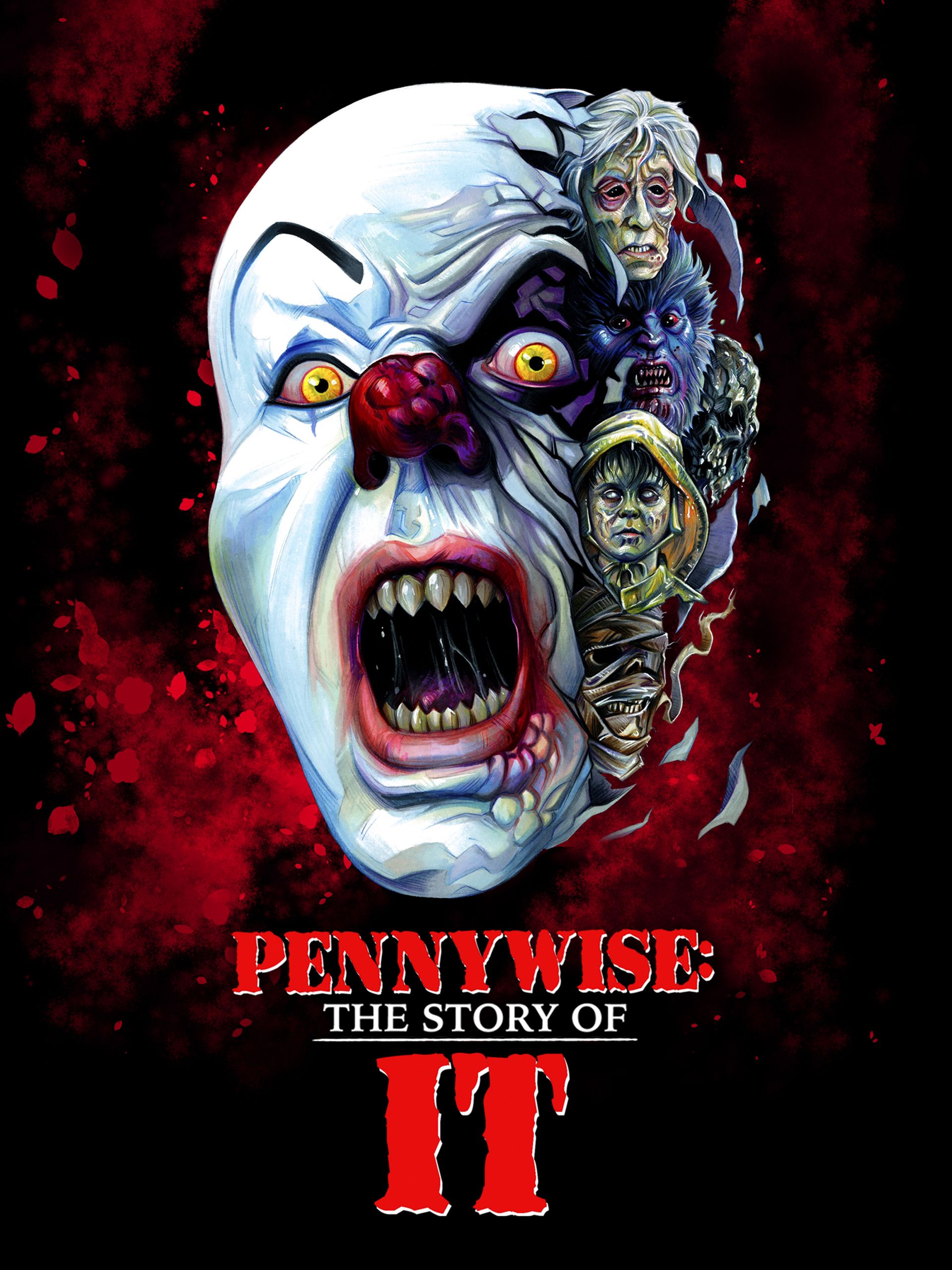
Documentary Review: Pennywise: The Story of IT

Text © Richard Gary / Indie Horror Films, 2022
Images from the Internet

Pennywise: The Story of IT
Directed by John Campopiano and Chris Griffiths
Dead Mouse Productions; Fuzz on the Lens Productions; Kaleidoscope Entertainment; Cult Screenings UK LTD
126 minutes, 2022
www.facebook.com/pennywisedoc

If you have ever been on any of the main horror groups on Facebook, you will know there is practically a rivalry between the fans of the original 1990 version of IT and the 2017 remake, with Tim Curry and Bill Skarsgård playing the role of Pennywise the intergalactic killer clown, respectively.

Well, there is no need to fight here, as this two-hour documentary focuses only on the original, 1990 two-part mini-series. Personally, I read the book, which pissed me off at the time (two many digressions, which is why I like King’s short story collections best) and saw the series on television when it originally aired. Again, I was unsatisfied with the ending: it seemed anti-climactic.

With an extremely large cast of the film’s writers (including Stephen King in both new and archival footage), directors, actors, etc., the film is wisely broken down into chapters to envelope the many sides of the production. Even the first one, about the of taking the book to screenplay to airing sounds like it should be cut and dry, but they manage to keep it incredibly interesting.

The second chapter discusses the cultural effects of the killer clown psychology that permeated the very fabric of not only the arts, but life itself. Brought up are how clowns can be scary, and how King made that more so, leading to the likes of clowns cropping up on sideroads to scare drivers, increasing the fame of serial killer John Wayne Gacy, films of real clown from circuses, and even Sid Haig’s (d. 2019) Captain Spaulding from House of 1000 Corpses (2003). This is, of course, followed by how they filled the role with Tim Curry.

Each chapter is like a deep footprint, filled with information, leading the way to and through the production. Both directors of this release have a history with horror documentaries, be it for Fright Night (1985) or Pet Sematary (1989), so they know how to build the story around and about the story.

The chapters are also inconsistent in length, which is a good thing. Rather than trying to push it to be longer or shorter, they let the narrative dictate timing. For example, the bit about filming in Vancouver is short and sweet, showing pictures of buildings then and now. For another one about casting the Losers Club, both kids and adults – and their similar features and working out their mannerisms – is quite long (and rightfully so); there is a nice mixture of archival and present interviews with the cast, especially since so many of them (the adults anyway) were so well known in the television world. Obviously, not all could be present as they have passed on, such as John Ritter (d. 2003), Harry Anderson (d. 2018), and Jonathan Brandis (d. 2003 at age 27). It was nice to see the likes of Richard Thomas, “Mod Squad’s” Michael Cole, “WKRP in Cincinnati’s” Tim Reid and Richard Masur (whose voice I will always hear in my head saying, “I don’t know, but it’s weird and pissed off” from 1982’s classic The Thing), but sorely missed Annette O’Toole, who does not appear in interview from the present (perhaps she was performing with her lucky hubby and songwriting partner, Michael McKean).

While there are a few other chapters, the last two are pretty obvious. The first is about the ending of the film, and apparently many of the crew felt as ambivalent as I did, which honestly surprised me. As Tommy Lee Wallace, director of the mini-series, states, “We had champagne ideas and a beer budget.” However, and smartly so, they hold no punches and give great detail about the final creature, whose face always reminded me of the end of The Fly (1986).

The last is the legacy of the mini-series, which I believe was short shrifted here. It had an enormous impact on so many, right into the modern day, setting off fierce machinations between the fans of the original and the remake (which is totally unmentioned here, even in the Legacy chapter, which surprised me; probably could not get the rights). It is important to remember that the SFX technicalities between the time differences is key. For me, both were equal, but the first was limited in what they could show because it was pre-cable being everywhere broadcast television, and the other was in the more accepting cinemas.

The editing in the documentary is worth noting because it is put together so well, there is no need for an overall narrator, the cast tells the story in a cohesive, nearly narrative way. The is a nice mix of archival backstage images that are both still frames and filmed (my favorite shot is of Tim Curry hanging on a light post, with a camera and microphone just inches from his face, and yet keeping his composure), and modern footage of the cast being “talking head” interviewed. Comparing the way the kids look now (they still seem so young to me, though they are now about the same age as I was when the film was originally aired), especially Emily Perkins who portrayed the young Bev (and would later play another iconic role as Bridgette in 2000’s Ginger Snaps).

For a documentary that is over two hours in length, I must say that it kept my attention all the way through, and that is saying a lot of positivity about the film. Whichever version of IT strikes your fancy, this will be worth the watch.

IMDB listing HERE

Sunday, July 10, 2022

Documentary Review: American Werewolves

Text © Richard Gary / Indie Horror Films, 2022
Images from the Internet

American Werewolves
Directed by Seth Breedlove

Small Town Monsters; 1091 Pictures
81 minutes, 2022
www.smalltownmonsters.com

It is always a good day when I get the chance to see a documentary from the king of the cryptids, Seth Breedlove. While one may watch his series of films, you never doubt the sincerity of the filmmaker (i.e., cash grab), but he appears to be dedicated to the topic. I respect that.

This is not the first werewolf he as covered, though the last one was more centralized in the Bayou with Skinwalker: The Howl of the Rougarou (2021). This is a hard film to find by title searching because an Internet exploration result is inundated with An American Werewolf in London (1981), which should come as no surprise to genre fans…or anyone else. In this case, he looks at the lycanthropy phenomenon on a more general basis, across Middle America, such as Ohio and Kentucky (especially Land Between the Lakes National Park).

Another difference, and one I am looking forward to, is that Breedlove’s approach is different this time. Usually, he uses a heavy mix of writers, scientists, fringe keepers, and eyewitnesses. Here, he relies on more on eyewitness testimony. He still presents some “paranormal investigators” to help the viewer situate themselves into the lycanthropic mentality and history, including the locations, but my issue is that “experts” are always second-hand accounts, whereas these witnesses are first-hand, making what they say more chilling. How much they believe in this is another story, but it is conveyed in non-professional talk, and more from the gut.

There are some interesting euphemisms given to the creatures right off the bat, such as “upright canids” and “Dogman” (should that be “Dogperson”?).

It is no surprise that most of the sightings have been in extremely rural areas, as is true with most cryptid encounters (with the possible exception of Mothman, also discussed in a previous Breedlove documentary, if you are interested). In cornfields. the woods, which would be a more natural habitat for a wolf of any kind, it makes sense. The main description is a six-to-eight-foot hairy dog headed creature that walks on two legs, a la The Howling (1981) or Dog Soldiers (2002).

Another difference between this and other Breedlove films is that there is no host nor narrator, and the interviewees do all the talking; though there are placards to let us know the location and the name of the person. Also dissimilar from earlier releases is that there is a discussion and description of possible cryptid killings, though they leave it open for interpretation, because it is not possible to prove in a court of law.

The two longest stories are held until the third act, and they are pretty intense. There is some waxing poetic along with the tales of the encounters, be it with a single creature or multiple ones. For me, it got even more of whaaaa? when Bigfoot is introduced in a cameo for Land Between the Lakes (Sasquatch in the north, Dogmen in the south, and overlap in the middle). Definitely more cryptid bang for the buck.

It is interesting how Breedlove lets his interviewees tell their experiences mostly uncut, other than some edits, to get the full effect of what they claim to have seen and how they felt. Most first-person interviews are all over the place and occasionally laughable, but these tell a story, which is intriguing and kept my attention.

Mixed between the stories is some b-roll clips of a man in a Dogman costume, for effect, that actually works. There is less animation than usual, and shots of the woods, sunsets, and the costume beastie with the amber glowing eyes, is perfect to accompany the stories.

Not fer nuthin’, but I find it interesting that both areas covered are Red States. One of the interviewees mentions that everyone who goes into the LBtL National Park should carry a gun, and I wonder about the connection with the location.

The film is available on iTunes, Amazon Prime Video, Vudu and FandangoNOW.

IMBD Listing HERE


Monday, September 20, 2021

Review: Skinwalker: The Howl of the Rougarou

Text © Richard Gary / Indie Horror Films, 2021
Images from the Internet

Skinwalker: The Howl of the Rougarou
Directed by Seth Breedlove

Small Town Monsters; 1091 Pictures
70 minutes, 2021
www.smalltownmonsterss.com

One of the things I enjoy about Small Town Monsters’ releases is that not only does each documentary focus on a particular cryptid, but they centralize the story; they will pick a part of the country and focus on that area, even if it covers a corner of multiple states, situating the events, including the more commonly widespread ones, such as Bigfoot.

So, after covering the likes of the Bell Witch, Bigfoot and Mothman, among many others, here they focus on one of my favorite topics, the werewolf. This mystical creature has been having a resurgence lately, with films like Bonehill Road (2017), Night Howl (2017), Lyncanimator (2018), and the upcoming The Beast Comes at Midnight, so it makes sense to check on one in the real world. in this case, southern Louisiana. This is a change since most of the previous films by STM I have seen involve the Northeast. It is great to see them stretching their (literal) boundaries.

Like Bigfoot, which has multiple names depending on the location (e.g., Yeti, Sasquatch), the “Skinwalker” down in the bayou is known by the Cajun (Acadians originally from Nova Scotia) term, Rougarou (or as I, as a Brooklyn boy heard it, Loup-garou). The story of a man-wolf hybrid has been around for centuries in those swampy areas, giving rise to multiple alleged sightings and stories of meaning.

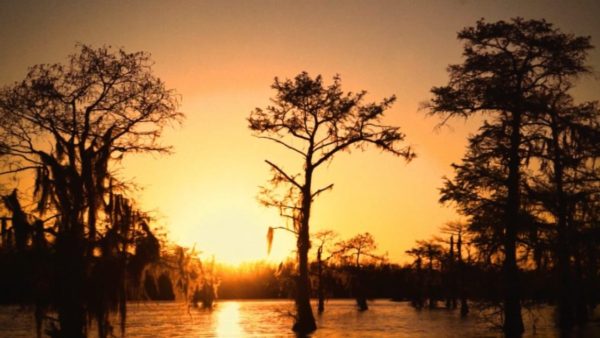
That is where this story takes off, into the swampy, spooky landscape that has appeared in so many horror releases, such as in Hammer Films’ The Mummy (1959) and many voodoo zombie B-films of the 1940s. It’s a mysterious place full of danger, like quicksand, poisonous snakes, alligators, and the legendary Rougarou.

The film is narrated by Lyle Blackburn, who has done so for a few other Breedlove releases, but he is also the lead vocalist and guitarist of the gothabilly band, Ghoultown, and has written an appropriate book to this film called Swamps: Monsters and Mysteries from the Mire (2020). He does a fine job in a slow and measured manner that’s appropriate for the location of the story, though without the drawl.

The film is broken into chapters. The first wisely mixed a few of the legends with a smattering of the background of the area, including some stunning photography as always; another is how the legend of the Rougarou started both by the American Indians/First Nations who lived in the area, and then by the French settlers. Apparently, the werewolf is historically common folklore in French literature.

The story continues in how the Rougarou is created, be it half-human, half-wolf, or mostly wolf but standing upright. It also includes some fun first- and second-hand stories by the locals, including the person who runs the Rougarou Fest held in Houma, LA, and members of the local Houma Tribe for whom the city is named.

An interesting aspect to me is the variations of the Rougarou. Most of the other cryptids tend to hold steady in their concept and aim, but because the Rougarou is a mixture of Indigenous tribes and European influence, the look, the means of transformation, and even modus operandi changes often. For some, the Rougarou almost takes the Boogeyman/Krampus role of being used to keep kids in line (e.g., “If you’re bad, the Rougarou will getcha!”), for others they are merely wood-and-swamp creatures, and mostly they are humans who have been cursed (one example is a wife who puts the lycanthropy on her good-fer-nuthin’ husband).

While there are certainly similarities between the various visions of the creature, there definitely appears to be a more human aspect, even with the occasional fear-mongering of either eating human flesh or souls. The latter is subtly explained by the very Catholic-based religions in the region. Most other beliefs, such as Baptist or Lutheran, would most likely (in my opinion) just express the Rougarou as either the work of the Devil, or to be a minion of such (Demon). Catholicism is often more varied in possibilities of evil entities, although Devils and Demons are right up there (ever hear of a Lutheran exorcism?).

Because of the addition of the human aspect of transformation, even though it is made clear that the Rougarou can appear as any animal or human, or even a bird or tree, it is usually associated with white clothing and fur (such as rabbits) except for the werewolf version. The consistent seems to be the red glowing eyes. This makes the creature more engaging in a The Thing (1983) way because it could be anyone, even the person sitting next to you in church, as one person interviewed posits.

As with most of the Small Town Monsters releases, there is a mixture of live interviews and travelogues of the area under discussion, some creative artwork and cartooning, and in this case, some really fabulous recreations. The wolf suits are stunning, easily as good as some of the more popular films like Dog Soldiers (2002), which relies more on man-wolf hybrids than, say, the mostly wolf shape of An American Werewolf in London (1981). It is these recreations that really flesh out the stories and give visuals beyond the talking heads syndrome.

With modern technology, salt-water flooding of the sweet water swamps thanks to climate change, and the different directions of the winds of culture, the documentary also tackles the possible future for the Rougarou.

For a company and director that is incredibly prolific, it is admirable that the quality of these films never diminishes. If you are into cryptids or just cryptid-curious, this will not disappoint, as is true with the other STM fare available at the link at the top of the page.


Sunday, June 20, 2021

Review: Malefice - A True Story of a Demonic Haunting

Text © Richard Gary / Indie Horror Films, 2021
Images from the Internet

Malefice: A True Story of a Demonic Haunting.
Directed by Billy Lewis
Orange St. Films; Scarenetwork.tv
91 minutes, 2021
www.scarenetwork.tv/

Let me start off by showing my hand: I am a religion skeptic. I believe there is no real evidence for the existence of a god, let alone the devil. I have never been a Christian, and was not raised in a Christian household. However, I do believe “good” energy attracts “good” energy, and “bad” attracts “bad,” even though I have no real basis for that belief, which is just as reliable as the Judeo-Christian heritage.

That all being said, I approach this documentary with the question of whether or not it is a Christian film. Sure, nearly all exorcism films have Christian elements, especially Catholic, as is the nature of the – err – beast, but there is a difference between, say, The Exorcist (1973) and the unintentionally funny and obscure Christian demonic possession film from the early 1970s, The Enemy.

Sean Austin, Eric Connor

What I am assuming is also driving this film (again, before seeing it) is the number of “psychic” and “supernatural” reality television shows that are readily available and common on cable. In fact, the head of the team here, Sean Austin, was the lead investigator on The Travel Channel show “Ghost Loop” (I do not believe I have ever seen it, as I do not watch TTC).

This film, we are told, was shot over a four-day period in a maskless COVID-19-heavy January 2021, on an acreage somewhere in Northern Ohio; the cast and crew drove up from North Carolina. We meet the two protagonists, Austin and “clairvoyant” Dave Spinks, who are heavily into prayer, start off by explaining a previous experience at the house in 2015, as we hear an electronic voice phenomena (EVP) recording of a demon and his victims talking. Honestly, the believability is already getting close to being out the window for me, but that does not mean it is not fun.

This definitely is preachy, and is directed towards the Catholic Christian god (apparently, if you envision in your mind’s eye a white dove, a female passes over to heaven, and for men, it’s a white horse), ignoring all the other thousands of gods that are worshiped around the world. But then again, Ohio is a “Red” state, so no surprise there.

Ralph Sarchie

Ten minutes in, we get a sermon on God and Jesus from Zoom guest star Ralph Sarchie, a Catholic Demonologist (and Austin’s mentor) who is a retired NYPD Sergeant, and was the model used in the film, Deliver Us From Evil (2014; Eric Bana played him). At this point, I am not sure if this is a film denouncing demons or an excuse for promoting Jeebus.

After the 30-minute or so introduction, Austin and Spinks return to the house with buddy and paranormal investigator Eric Conner (who wears crucifix earrings and says “dude” a lot). And what is their purpose? In the words of the film’s publicity: to rebuke the demon by “sending it back to where it belongs…HELL!” Will they succeed? I’m not tellin’.

Almost immediately there are sounds and screams (EVP). And while they do react to it, they also seem pretty damn calm. One of the questions I have is whether or not the three folks involved believe in this. I honestly would say, both yes and no. On one hand, I do believe that they are certain of God and the Debbil, and they are doing a service to try and convert the unbelievers. On the other hand, whether this story is real, I’m not convinced. If a demon is threatening them, especially Austin and Connor starting at about the halfway mark, they sure do not seem to feel overly nervous if this was real. Perhaps it is because they have JC on their side? Or perhaps foolish bravado? Or they are performing a narrative to preach?

What really got under my skin though, personally, is how anti-abortion the film is (fetuses are repeatedly referred to as “babies,” who are “screaming out”), with the “bad guy,” Robert (either influenced or possessed by a demon) having been an abortionist at the turn of the 20th Century, when the house was a brothel. Apparently, the demon made Robert enjoy his work, and torture women. Could it be any more of a Catholic pro-birth agenda (rather than pro-life)?

There are lots of images of a hillside with a huge cross on it that looks right out of a Hallmark card. And there aren’t just hints of religious fervor, there are actually sermons, like I said, and devotions, such as “The Lord’s Prayer” from “Matthew.” Despite the compelling and enjoyable story, there are so many hiccups and God stuff; it is distracting, for example, when Austin repeatedly says “Oh, shit” such as after a EVP conversation with the demon, and even the occasional F-bomb. Austin explains that anything in threes (such as knocking) is a mockery of the Holy Trinity, and their aim is to twist the human’s “free will.” Nearly all religions in the world do not have a holy Trinity, so does that mean every other religion is wrong? And even if they believe that, well, so does most other religions (my god can beat up your god).

There is an interesting meta-aspect of this documentary, which is not uncommon in ”reality” shows; in this case, the director, who calls himself a skeptic, describes what it was like to shoot the film, and events he found odd. I find this kind of aspect interesting, as the crew looks at its own production.

Through the first three days, there are lots of voices and sounds through the EVP, and the fourth is the actual exorcism of the property, which is essentially, you got it, more praying. Does the ritual work? Watch the film, and then you tell me. Maybe in 2025 or ‘26, after another five years or so, they should go back and follow-up. I would be interested in that.

Is this something that can be seen as a pseudo-event, in the words of Daniel Boorstein, or something more sinister? Either way, let’s talk about the production itself for a moment. Billy Lewis actually did a bang-up job here, putting the transcriptions of the “voices” from the EVP on the screen, making it easier to follow along. That was a really smart thing to do; as with every supposed EVP I have ever heard, it is really hard to make out (though sometimes the voices are suspiciously clear). Is it a case of we hear it because it is on the screen? Couldn’t tell you, but I am grateful they did that, otherwise it would be too distracting by trying to focus on that rather than the story.

As for distracting, the film is actually nicely compelling for the most part, but it is way too preachy to be completely comfortable. It comes off more as a religious propaganda tract than a fun flick to watch on a Saturday night, but even with that being said, it took a bit to get into it, but as time wore on and I was able to somewhat weed out a bit of the religious talk, I started to enjoy it more. Again, it is put together really well all things considered, and may be your cuppa if you like spirituality reality shows and/or need conformation of your beliefs. You just know this will be recommended in churches across every Red State, especially below the Mason-Dixon line, even though it is Catholic-based rather than evangelical.

The film is exclusive to the spankin' new streaming platform, ScareNetwork.tv.


Tuesday, June 15, 2021

Documentary review: Gorenography

Text © Richard Gary / Indie Horror Films, 2021
Images from the Internet

Gorenography
Directed by Tony Newton
Tony Newton Productions
161 minutes, 2021
www.facebook.com/TonyNewtonFilm/

Gore, at its core, is body horror, and one of its subgenres is torture porn, hence the title of this nearly three-hour documentary, a combination of the “gore” and “pornography” wording. While much of my enjoyment is in the monsters / supernatural realm, I certain do enjoy a fun gorefest.

Gore can flow on different levels, from the silly and cartoon, to the realistic, to the real. I’ll take the first two, as I do not want to see real. Had enough of that in the likes of Cannibal Holocaust (1980), even if it was animals and not human snuff films. I remember laughing at the ending of Snuff (1975) and laughing at how unrealistic it was; however, I would not watch the Faces of Death series. When I saw Fulci’s City of the Living Dead (1983) in the theater, I laughed at the gore; the next day, at work, someone cut their finger open, and I could not look at it. So you know where I stand.

There are a few levels of gore films: you have the upper level of ones like Miike’s Audition (1999), and then you have the middle level which is rougher, like some of the Unearthed Cinema run by Stephen Biro (who, surprisingly to me, does not appear in this documentary) with the new American Guinea Pig series. Then you have what this focuses on, the extremely independent, transgressive, low-budget insanity, which is more where my general interest lies, quite honestly. If you pick up a camera and make films with your friends in the basement, there is a certain level of cool in that.

In the opening of this film, horror historian / writer / director / actor Tony Newton explains its premise: “This is a twisted crazy film here… If you like blood, if you like gore, if you like shock, if you like horror, you’re going to love this film. If you don’t like extreme horror, if you don’t like nudity…you pretty want to turn away now. This film is very extreme. We’ve got some sick films to show you, some shorts films, tons of trailers, tons of trash, and a lot of interviews with a lot of cool filmmakers.”

He is right, there is a lot going on in this, and quite honestly, what I am going to do to explain it, is to just show you the cleaned-up notes I took during the watching of it. And please note, there is way more than I mention. The film isn’t totally coherent in its format, because it goes beyond the usual talking heads broken up with some clips. This has a completely indie tone, which is more appropriate. I certainly enjoyed the obscurity level that brings it more to light. It’s not the usual suspects of directors from his previous documentaries, but more of an international feel and more obscure.

Thanks to COVID, a lot of the material is pretty up-to-date, including films release in 2021. Leave it to a worldwide pandemic to bring a documentary about deathly horror. Many of these films are so extreme and underground, they are not even listed on IMDB (the ones mentioned below without release dates). The ones in Italics are full features, quote marks indicate shorts. Also, films without dates are not IMDB listed.

And now for the notes:

Random trailers include The Driller Killer (1979), Tony Newton’s own Snuff Video (aka Snuff Underground X). Sometimes the listing of influences of the directors sound like the ‘thanks to” speeches at The Oscars.

Jonathan Doe, director and host of the “Cinemas Underbelly” [sic] channel, talks about how he got into horror. Released Carving the Cadaver 1-3, which shows actual human autopsies and also vomit fetish films such as Barf Bunnies; be warned, the trailers and some short clips are shown. Not for me; his film clips are the only ones I fast-forwarded over.

Wilhelm Müller

Wilhelm Müller, body piercer and body horror director from Austria; fake trailer for The Doctor and real one for In Nomine Satanae (which is close to Dakota Ray’s style). Clips are also shown from his films Exzessiv and Neighbor No. 9.

Zach Shildwacter (wearing a t-shirt of 1970s amputee porn star Long Jeanne Silver; no, I did not need to look it up), director Powerbomb (2020); the complete short “Solid Gold” is presented, which includes many Republican symbolisms, such as someone wearing a Trump mask and drag, and hitting a victim with a (I’m going to presume upside down) Bible.

René Weisner, director and producer of Mondo Siam (2020). Mainly talks about his films (with very short clips shown). Includes trailers of Mondo Siam and ABC’s of Superheroes (2015; reviewed HERE). 

Tony Newton

Tony Newton. trailers for VHS Lives: A Schlocumentary (2017), and Troma released and participated anthologies Grindsploitation 666 (2018) and Grindsploitation 9 (2021). Actually, there is a few Troma references in this entire film.

Davide Pesca, director, including Gore Grind (2020).

Mercedes the Muse

Moses and fetish model Mercedes the Muse, writers / directors, and founders of the sex and cinema “cult” the Underground Front: trailers of Troma-released Rose and Viktor: No Mercy (2017; directed by Moses) and Evul Twinz (2020; directed by Mercedes the Muse). Mercedes is the only female filmmaker who shows off nudity during the interviews. Moses tends to wear a Star Wars stormtrooper mask but still comes off as nerdy (I do too, so not an insult).

Lucky Cerruti: director and runs an underground distribution company called Dead Vision Productions. Long take on how he got into filmmaking. We are shown the opening clip – i.e., the prologue – to his film, Freak (2020); I would like to see this one.

Rob Ceus is from Belgium; Director and producer. His company is Terrorvisions Productions. Multiple clips included are from shorts like “ Bride Zombie (2015; not to be confused with the yet released Zombie Bride) and Zombies from Sector 9 (2020).

Matti Soikkeli, a Finnish filmmaker who wears a skull mask to hide the lower half of his face and whose voice is digitally manipulated. We also see some clips of his films (probably taken from the trailers, considering the consistency of the music behind them, as with many of the short clips in the documentary), such as Born to Lose, Live to Die.

Michael "Mickey" Espinoza (d. May 2021) is also in a mask, full one this time, with an electronically altered, deep voice. Clips include ”The Games We Play” and others, such as “Pink Porcelain,” which looks like it was shot on a cellphone by the vertical frame.

Nathan Hine of Hardgore Core Productions. Writer, director and actor for a number of trailers we see, including the short teaser trailer for “The Last Days of Livermore” (2016) and The Sideling Hill (2019).

Super Tromette Double Dementia

Super Tromette Double Dementia: More like Double-D Dementia, with tons of cleavage, belly, legs and tatts. She plays a bimbo here in character, slinking back and forth in her trademark leather bikini like one of those hula dancers that sit on dashboards, while rubbing herself; but I’m willing to bet she is actually pretty damn smart in reality. I mean, she directed and edited the music video for “Cretins Sell Dope,” which we get to see, and is based on the Return to Nuke ‘Em High series. The band is Vanik and she’s the lead singer.

Harmony Filth keeps with the Troma theme, and presents a trailer for a short from the UK in which she appears, “Slutty the Clown” (2021). Speaking of which:

Joe Cash is the director of “Slutty the Clown” and shows a trailer for his “She Dogs of the SS” (2021), which gives away too much of the story, unless the trailer is actually the whole film.

End of notes.

For a three-hour sitting, this certainly kept my attention, waiting to see who was next, and so enjoying the interviews, clips, shorts, and trailers. The ending has a bit of a surprise that I wont reveal, but made me smile.

It is really worth checking out if you are into some of the extreme ends of horror, but like it cheap, down, and dirty. Tony is right in his introduction, this will not be for everyone, but you know your own tastes by this point, and if you like splatter, this will eat at your brains and give you a great list of new films to seek for your collection.

Trailer TBD