Showing posts with label Bigfoot. Show all posts

Tuesday, January 17, 2023

Review: Creature from Black Lake

Text © Richard Gary / Indie Horror Films, 2023
Images from the Internet

Creature from Black Lake
Directed by Joy N. Houck Jr.
Howco International; Multicom; Synapse Films; MVD Entertainment
95 minutes, 1976 / 2021
www.synapsefilms.com
www.MVDVisual.com/

I remember seeing this film early on, and thinking it was silly. But I was young, and now, all these years later, I don’t really remember it much, so it will be nice to see it under my present mental state in this new widescreen 4K restoration from the original 35mm camera negative.

This was one of a bunch of either Bigfoot or woodland creatures tearing up the place and causing human deaths that were released at that time, such as The Legend of Boggy Creek (1972) and Prophesy (1979). Here, we fall closer to the Sasquatch than a mutant bear.

John David Carson, Dennis Fimple

After the intro where we see a mash-up of an attack by said creature (Roy Tatum) in a Louisiana swamp in Oil City, in Caddo parish (yes, a real place, though it was also filmed around Shreveport, 20 miles away) on a couple of fishermen, including Joe (wild eyed Jack Elam; d. 2003), and a professor in Chicago, Dr. Burch (the director, J.N. Houck Jr.; d. 2003); the latter is essentially an exposition for the viewing audience on the creature at hand. This leads to two anthropology students, comedy relief and ‘Nam vet Pahoo (toothy Dennis Fimple, who is known to the modern horror crowd as Grampa Hugo in 2002’s House of 1000 Corpses; d. 2002), and prettyboy Rives (John David Carson, who was in the underrated Pretty Maids All in a Row in 1971, and 1974’s awful incest film The Savage is Loose; d. 2009) set off to the swamps to find Joe and the monster.

The reception the two receive is not pleasant, especially by the Sherriff, Bill Carter (Bill Thurman; d. 1995). Interestingly, the two asked the locals about Joe and the monster, and you get the feeling this is being done to actual residents of the town who seem baffled, much like in the overrated The Blair Witch Project (1999).

Jim McCullough Jr., Dub Taylor

Along the way, our two intrepid Yankees meet a bunch of colorful characters, such as one of the early witnesses of the creature, Orville (writer of this film, Jim McCullough Jr.; d. 2022); his grandpa is Western film star and a semi-regular on “The Andy Griffin Show,” Dub Taylor (d. 1994). Then there are the two romantic leads for our protagonists, high school students (saywhat?!) Michelle (Michelle Willingham), and the beautiful Becky (Becky Smiser, in her only listed IMDB role). In an unintended cameo, playing a toddler Orville in a flashback, is future WCW professional wrestler Chase Tatum (d. 2008).

Throughout, there are the requisite POV shots via a handheld, shaky camera. At least it wasn’t re-colored or distorted…well, occasionally it is fuzzy, but that’s about it. We occasionally see what the Sasquatch-ish thingy observes, often through the foliage.

Carson, Becky Smiser, Fimple, Michelle Willingham

Of course, our students are going to meet up with Joe, and then the young’ns will hunt the hunter. Or, perhaps, be prey? I will not tell. My question is, if the point is repeatedly made that Pahoo is a Vietnam Veteran, why is draft resister Rives responsible for holding the rifle?

The last act as they face the upright monkey-looking Sasquatch, seen mostly in silhouette, is pretty exciting in the third act, with a bunch of jump scares and some unexpected actions. The ending, though, is a bit anti-climatic and left open for a sequel which never came. And considering most of the cast is now passed on, I doubt it is going to happen, unless there is a remake at some point (and the way Hollywood is at the moment, that is not farfetched).

Bill Thurman, Jack Elam

There is a bit of a “Dukes of Hazzard” (TV series, not the film) vibe, and also a buoyancy, that makes this watchable. It is better than I remembered, but kinda goofy at the same time. It is also a piece of its period: there is little blood and no nudity, and barely cussin’. It was rated PG (content is not recommended for viewing by people under the age of 15 without adults). However, it does have quite a bit of clever and humorous moments, though not technically a comedy. At least there are some decent jump scares.

Notable extras are a full-length audio commentary with author/filmmaker Michael Gingold (whose bibliography includes 2017's Frightfest Guide to Monster Movies) and film historian, fanzine publisher, and blogger, Chris Poggiali. they come across as likeable and occasionally humorous, and give the usual information about the making of the film, historical info on the cast and crew, and its effect on the culture of the time. "Swamp Stories" (19 min) is an all-new featurette with Dean Cundey, who waas the Director of Photography. He discusses what it was like to be shooting in a swamp after coming out from Los Angeles, how it was working with some big-name actors and the crew (such as the director), and even some Bigfoot history. Last is the original theatrical trailer and radio spot. 

Roy Tatum
The cinematography by Cundey is exceptional and, for me, one of the strongest aspects of the film. This is the kind of release that would play as a second bill at a drive-in, especially in the South. I find it amusing that it is in widescreen, but was a big hit playing on television when the medium was a box, rather than the new, rectangular screens, so it had to have been serious cropped. Glad it is back to all its widescreen glory.

IMDB listing HERE 


Sunday, July 10, 2022

Documentary Review: American Werewolves

Text © Richard Gary / Indie Horror Films, 2022
Images from the Internet

American Werewolves
Directed by Seth Breedlove

Small Town Monsters; 1091 Pictures
81 minutes, 2022
www.smalltownmonsters.com

It is always a good day when I get the chance to see a documentary from the king of the cryptids, Seth Breedlove. While one may watch his series of films, you never doubt the sincerity of the filmmaker (i.e., cash grab), but he appears to be dedicated to the topic. I respect that.

This is not the first werewolf he as covered, though the last one was more centralized in the Bayou with Skinwalker: The Howl of the Rougarou (2021). This is a hard film to find by title searching because an Internet exploration result is inundated with An American Werewolf in London (1981), which should come as no surprise to genre fans…or anyone else. In this case, he looks at the lycanthropy phenomenon on a more general basis, across Middle America, such as Ohio and Kentucky (especially Land Between the Lakes National Park).

Another difference, and one I am looking forward to, is that Breedlove’s approach is different this time. Usually, he uses a heavy mix of writers, scientists, fringe keepers, and eyewitnesses. Here, he relies on more on eyewitness testimony. He still presents some “paranormal investigators” to help the viewer situate themselves into the lycanthropic mentality and history, including the locations, but my issue is that “experts” are always second-hand accounts, whereas these witnesses are first-hand, making what they say more chilling. How much they believe in this is another story, but it is conveyed in non-professional talk, and more from the gut.

There are some interesting euphemisms given to the creatures right off the bat, such as “upright canids” and “Dogman” (should that be “Dogperson”?).

It is no surprise that most of the sightings have been in extremely rural areas, as is true with most cryptid encounters (with the possible exception of Mothman, also discussed in a previous Breedlove documentary, if you are interested). In cornfields. the woods, which would be a more natural habitat for a wolf of any kind, it makes sense. The main description is a six-to-eight-foot hairy dog headed creature that walks on two legs, a la The Howling (1981) or Dog Soldiers (2002).

Another difference between this and other Breedlove films is that there is no host nor narrator, and the interviewees do all the talking; though there are placards to let us know the location and the name of the person. Also dissimilar from earlier releases is that there is a discussion and description of possible cryptid killings, though they leave it open for interpretation, because it is not possible to prove in a court of law.

The two longest stories are held until the third act, and they are pretty intense. There is some waxing poetic along with the tales of the encounters, be it with a single creature or multiple ones. For me, it got even more of whaaaa? when Bigfoot is introduced in a cameo for Land Between the Lakes (Sasquatch in the north, Dogmen in the south, and overlap in the middle). Definitely more cryptid bang for the buck.

It is interesting how Breedlove lets his interviewees tell their experiences mostly uncut, other than some edits, to get the full effect of what they claim to have seen and how they felt. Most first-person interviews are all over the place and occasionally laughable, but these tell a story, which is intriguing and kept my attention.

Mixed between the stories is some b-roll clips of a man in a Dogman costume, for effect, that actually works. There is less animation than usual, and shots of the woods, sunsets, and the costume beastie with the amber glowing eyes, is perfect to accompany the stories.

Not fer nuthin’, but I find it interesting that both areas covered are Red States. One of the interviewees mentions that everyone who goes into the LBtL National Park should carry a gun, and I wonder about the connection with the location.

The film is available on iTunes, Amazon Prime Video, Vudu and FandangoNOW.

IMBD Listing HERE


Thursday, June 30, 2022

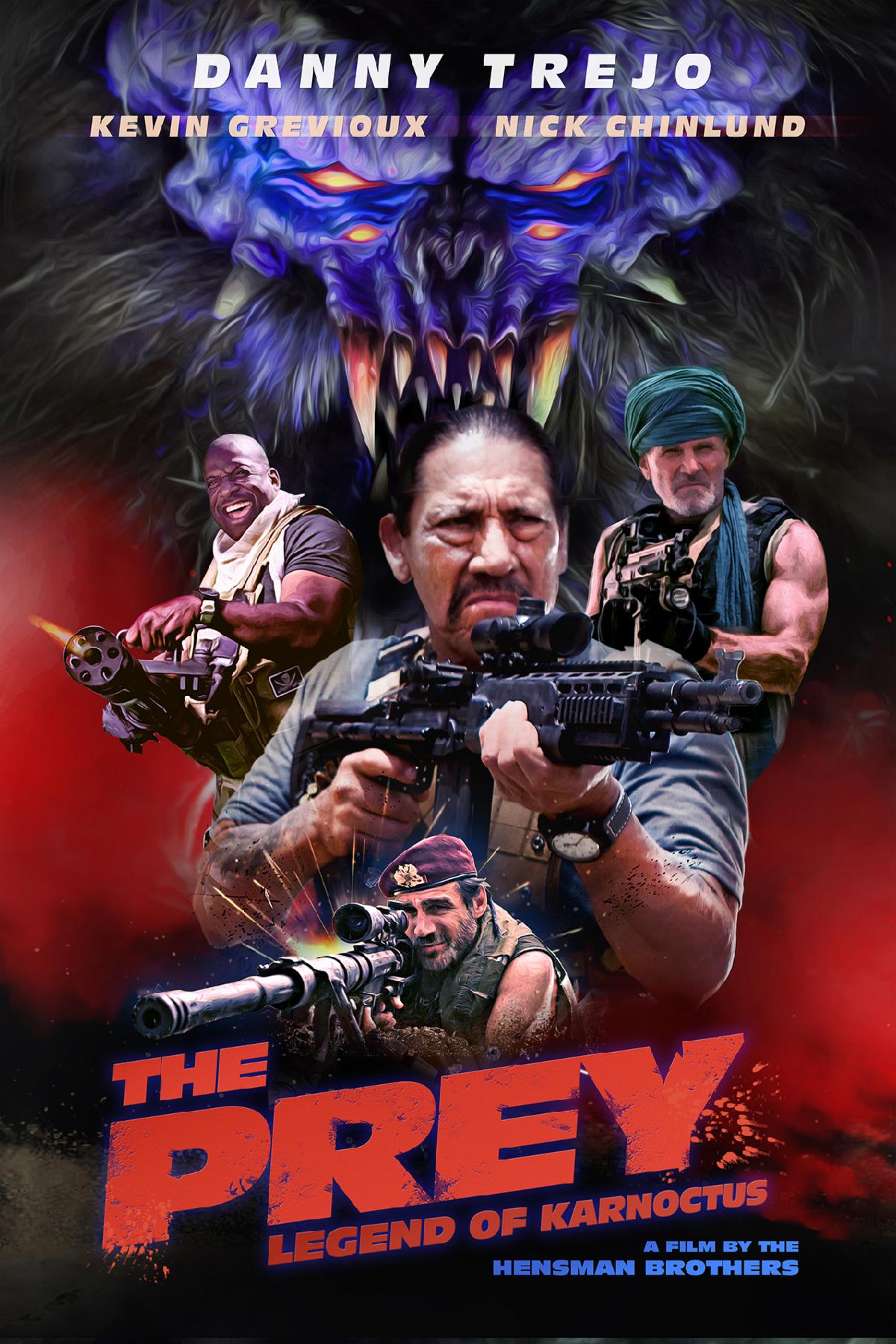
Review: The Prey: The Legend of Karnoctus

Text © Richard Gary / Indie Horror Films, 2022
Images from the Internet

The Prey: The Legend of Karnoctus (aka The Prey)
Directed by Cire Hensman and Matthew Hensman (aka The Hensman Brothers)

Lennexe Films; Mano a Mano Films; Chu Media; Chinematicrex Productions
93 minutes, 2022
www.facebook.com/ThePrey
www.thepreymovie.com/

First of all, just about any film in which Danny Trejo appears is worth seeking out, no matter what the story. The man is a legend. And that he’s playing an action hero – and making it work – into his 70s is even more stunning. He deserves a star on the Walk of Fame (more than some others that had a single hit show such as a certain morally bankrupt politician).

The story, which takes place during the war in Afghanistan (though filmed near Santa Clarita, California, without Drew Barrymore), focuses on three groups…well, maybe two-and-a-half. First, there the Afghans (i.e., the enemy), who we do not get to see much other than as an attacking force, mostly out of camera sight (hence the “half”). Then there is a platoon of American soldiers, and third, a group of seemly near-elderly mercenaries (Haliburton?), which includes Vega (Trejo), Reid (Kevin Grevioux), sniper Gunnar (Adrian Paul, in a role originally offered to Bruce Campbell), and led by Tagger (Nick Chinlund). Tagger and Reid, the two main mercenaries in the story as Trejo and Paul are mostly used as cameos (even though Trejo gets the ”And…” in the title credits), are essentially Hannibal (right down to the cigars) and Baracas (bulk and attitude) from “The A-Team” (1983-87), respectively.

Nick Chinlund, Danny Trejo

The latter group pulls a Three Kings (1999) and steals a bunch of gold from the Afghans, and hides it in a cave. Meanwhile, the platoon is under fire and retreats to same cave, where Afghan artillery seals them all in with – and we learn this early in the prologue – the titular four-eyed, flesh-eating, and wooly bully “demon,” the Karnoctus.

Of course, the two groups of Americans are antagonistic to each other at first (“What are you doing in my cave?” Tagger annoyingly asks), but even during that, it is not hard to figure out that they will eventually work (and some will die) together. Like in The Descent (2005), they are trapped in the cave with a killer creature of unknown origin. One could also throw in Predator (1987) as mercenaries (and soldiers) fight something that is hunting them.

Right off the bat, though, I have a question. Have any of the crew ever been in a cave before? If you seal the entrance way, it is going to be dark. Not just dark, but daaaaark. Pitch black. Sure, they have helmet flashlights to start, but pretty soon, even without going anywhere, there is plenty of light without their headgear most of the time. But even with the LED lights, rocks absorb light so it always seems darker, and the area covered by the light is more limited. Where is the illumination coming from? It’s one of those weird, quirky film things, like the car never being able to start or no cell service. But then again, we are dealing with a possible demonic creature, so I guess I should just smile and mosey on. It actually is the right thing to do. Besides, making it darker makes it easier for things to pop out of nowhere (e.g., jump scares), even if it is not as easy to see for the viewer.

The creature is reminiscent of Bigfoot (though being that hairy in a heat-based locale like Afghanistan – even if in a darkened cave – seems a bit extraordinary, beyond it possibly being a demon (as it is called by an Afghan in the prologue), albeit with four eyes that glow in the dark.

The first half of the film is pretty slow moving (especially the introduction conversation with the platoon which is at least twice as long as necessary), but even with a few kills thrown in, it starts to pick up after the crew starts hallucinating (leading to a T&A moment) thanks to some gas, while the beastie starts to pick them off mano a mano. The gore level also starts to increase, which is interesting for a few reasons.

For example, this is not some cheapie, quickie flick that people go to see specifically for the guts and gore; this film has a reported budget of over $3 million so they have the intentions of this having a wider audience. We gorehounds thrill at this kind of stuff, but with rare exceptions like the recent The Sadness (2022), most mainstream audiences are not usually attracted to this kind of fare, and this level of viscera may turn off more than not. I am not saying this in a negative tone, because as I say, I enjoy this kind of fare and it a positive for me more than not (i.e., makes up for the talkie, slower parts).

Kevin Grevioux

With the possible exception of Lake (Masika Kalysha), the lone woman soldier, and Lt. Menzies (John David Gregory), none of the main cast are all that likeable. As they start to “dance” with the creature, that makes cheering on the Karnoctus all the easier and the kills become additionally smile-worthy.

There is definitely a comic book feel to this, and it is certainly quite planned that way. In fact, some of the action towards the end and the beginning are in comic book form. They know their intended audience and play up to that. Cool.

While this film is just being released this year (2022), it has been in pre-production long enough that one of the roles was originally assigned to Michael Clark Duncan, who passed away in 2012. That’s 10 years in pre-production hell. I’m glad they finally got the chance to get this out. While the idea of Duncan starring with Trejo seems like dream casting, real-life microbiologist Kevin Grevioux and his deep voice fills the void to a “T”.

From the “To Be Continued” at the end, it looks like this is going to be a franchise. I would be okay with that.

IMBD Listing HERE 


Tuesday, August 10, 2021

Review: Feed the Gods

Text © Richard Gary / Indie Horror Films, 2021
Images from the Internet

Feed the Gods
Directed by Braden Croft
Random Bench; BMC Pictures; Compound B; MVD Marquee Collection
84 minutes, 2014 / 2021
www.facebook.com/FeedTheGodsFilm
www.randombench.com/films/
www.MVDVisual.com

Films that use the idea to feed local “gods” is not a new concept; just off the top of my head there is Jug Face (2013; reviewed HERE) and two others I won’t name because it is the plot twist of the end. One could even include the original King Kong (1933) as Faye Wray is chained to be sacrificed to the big ape. Actually, this Canadian film is closer to Kong than the others.

The prologue, of which I will not give too many details, is effective in a number of ways. First, it sets up the story of the two main characters, brothers William and Kris. Second, it is creepy and tense as hell at the border of the town of Tendale (population 60, filmed near Vancouver, British Columbia), and third, it can be seen as a social commentary about the heartlessness of the coyotes who work the southern border of the United States thanks to antiquated and cruel immigration laws. But I’m a proud liberal, so please excuse the politicizing. Anyhoo, if the rest of the film is of this caliber, it’s going to be interesting.

Emily Tennant, Tyler Johnston, Shaun Roberts

In the modern-day body of the main story, we meet the brothers as grown-ups: William (Shaun Roberts, who played Albert Wesker in the later Resident Evil franchise and was a semi-regular in the last season of the Canadian “Heartland” show) is a brutish, fly-by-night guy who wears sleeveless tees to show off his hulk and smokes pot, while Kris (Tyler Johnston, Samadriel on “Supernatural) is super uptight and looks like he just stepped out of High School Musical (2006). After finding some family artifacts, the sibs decide to head on back to Tendale (though the stress level is up to Elevendale…sorry) with Kris’s girlfriend in tow, Brit (Emily Tennant, who was the voice of 2017’s “Polly Pocket”). The bros are at odds (you know they will bond by the end, as all road movie companions do, no matter what the genre), with Brit in the middle as mediator. A bit formulaic, but one that tends to work.

On the way to search for their parents, William says prophetically, “Let the hunt begin.” Of course, at some point who is the hunter and who will be the – er – huntee? It’s telegraphed pretty early on (and hell, even on the front of the box), that there is a Bigfoot/Sasquatch problem and the town is living in fear.

Britt Irvin

For a place as isolated as Tendale, it seems to be hopping in the brothers’ perspective. They stay at a B&B run by Emma (Britt Irvin, Stargirl on “Smallville” and the voice of Sunny Flare on “My Little Pony”), which has a couple of extra guests from down undah beside our heroes. It’s not hard to figure out why they are there. Anyway, the film likes to telegraph itself, so while the tension remains (especially between Will and Kris), it remains not hard to figure out what is going to happen next in many cases, and who are the good and bad people.

While the film lulls for a while as we are fed necessary expository information, but somewhere about the half way point, it begins to pick up steam once our three stalwart explorers start to camp out to search for Bigfoot, since they aren’t having much luck with the parents.

Aleks Paunovic

With some really nice yet somehow sympathetic bad guys like the massive Pete (Aleks Paunovic; Julius in the recent “Van Helsing” series), and a couple of good double crosses in various directions, the story goes from predictable to… not. Sure, all the telegraphed things come to fruition, but surprises arise in around that, and there are even a few decent jump scares.

There isn’t a whole lot of blood, not to mention gore, but the story gives us a pretty decent body count, whether it is by the gods or in a Straw Dogs (1971) kind of scenario. The acting is well done, though I really wanted to smack the two brothers on a number of occasions due to some ridiculous and constant bickering for the first two acts, but that is more on the characters than the players.

The extras start with a full-length commentary by director/writer Braden Craft and associate producer and SFX/props builder Travis Shewchuk. Honestly, the commentary for this is kind of a wash-out. After about 20 minutes, I started to skip around a bit. There are large blank gaps, and when they do discuss the film, it is on mostly a superficial level, though the third act is the most interesting. If you listen to it, fine, but you really will not miss much if you do not. There is also a Behind the Scenes featurette (13 min). Again, it is with Craft and Shewchuk, but this is a bit more pertinent. One of the things they discuss that I found thought-provoking is that the original concept was as a found footage, and I am grateful they did it in narrative form instead; there is nothing I find more annoying than running through the woods at night by the light of a hand-held camera.

There is also the theatrical trailer, two other MVD coming attractions for relatively mainstream fare (with the likes of Zoë Bell and Jeff Goldblum), captioning, and a reversable cover.

The film helps show off the beauty of British Columbia. I have been there a few times, and it really is stunning (and recommended). Meanwhile, stick around for at least part way through the credits for more story information, and if there is a sequel, I will happily watch it.


Saturday, June 5, 2021

Review: On the Trail of Bigfoot: The Journey

Text © Richard Gary / Indie Horror Films, 2021
Images from the Internet

On the Trail of Bigfoot: The Journey
(aka On the Trail of Bigfoot: The Legend and the Search)
Directed by Seth Breedlove
Small Town Monsters; 1091 Pictures
96 minutes, 2019 / 2021
www.smalltownmonsters.com
https://onthetrailof.tv/

Who is the cryptozoology king creature in popularity? Is it Mothman? The Jersey Devil? Arguably, the big macher is Bigfoot, aka the Sasquatch (with its cousin, the Yeti, a close second). There are dozens of fictional movies about the mythical woodland beastie, often with it being a killer monster often stalking teens in wooded cabins. So, who better to do a self-involving documentary about the true legend than the leader in cryptid mythology films than Seth Breedlove, and his Small Town Monsters brand?

Seth Breedlove and tattoo on right

Starting off in Wadsworth, Ohio (I once stayed near there on a voyage to the Rock and Roll Hall of Fame and Museum in the early 2000s), Breedlove and some friends take a road trip to Upper New York State, specifically to Wells, New York (an over 7-hour drive), in the heart of the Adirondack Mountains. Apparently, this truly majestic range is a hot-spot for the hairy one, dating back to Colonial times when he was known as “The Wild Man.” Through the course of the film, they travel to various connecting free spaces, including the Green Mountains of New Hampshire and the Berkshires of Western Massachusetts. It’s easy to tell which one of the intrepid travelers is Breedlove by the “Small Town Monsters” logo tattoo on his arm. But I digress…

Breedlove wisely starts the film with both positing his reasons for the trip and this film (which I will discuss later), and as a expositional foundation, presenting some talking head experts on the topic, such as Aleksandar Petakov, who directed the 2016 television documentarySasquatch: Out of the Shadows”, Bruce Hallenback, author of the 2015 book, Monsters of New York: Mysterious Creatures in the Empire State, Paul Bartholomew (who also joins the Small Town Monsters group at some point), writer of 2020’s Bigfoot Encounters in New York and New England: Documented Evidence, Stranger than Fiction, podcasters Emily Fleur (“The Forest Fleur”) and Mark Matzke (“Monstoropolis”), as well as Dr. David Floyd, an English Professor at Charleston Southern University, who did a Bigfoot in Literature podcast (HERE). 

This gives the viewer a solid basis of why they picked this particular area, and its history with The Wild Man. One of my favorite parts is these historians telling stories they had heard about sightings. There is a fine mix of second-hand stories, with some first-person eyewitness accounts, including one anonymous tale (thanks to being hidden behind a COVID mask) by a guy originally from Brooklyn(!), but they were all fun to hear.

Joining the crew in this self-shot doc for the nearly a week in the area around Buck Mountain to Whitehall, New York, near Lake George, is a number of investigators of various types, including Steve Kulls, Michael Anne, and Ted Varamogiannis, one of whom claims to have had an encounter with the 8-foot, hairy creature about five years earlier.

Our crew has lots of adventures traveling around various areas, including Kinderhook, NY and the Savoy Mountain State Forest in Western Mass, where they talk to a group of enthusiasts called the Sasquachusetts Group.

The Journey also presents a number of really nice animations and illustrations, as well as a few short re-creations of encounters. The format of the documentary reminds me of paranormal search shows, where the participants walk around often after dark in green night vision lights with glowing human eyes, trying to find something out of place. For example, one of the investigators noticed that there had been some kind of “disturbance” among flowers. Could it have been Biggie? Sure. But it could have also been a dear, a bear, or a coyote (whether you pronounce it Kai-yow-tee or kai-yout). Amusingly, one of the trackers gives a howl out to try and attract the creature, but my question is, how does he know what the mysterious Bigfoot sounds like, to “imitate” it. While this seems kind of silly to me, I have to admit it is also part of the charm of almost innocence of the team, and the entire documentary (and is a motif of previous Small Town Monster cryptozoology-focused releases, as well).

You may ask, at this point, whether I believe in Bigfoot. Honestly, I am 100 percent on the fence. I feel there is a possibility, but I am skeptical, which I believe is an appropriate approach about any cryptid phenomena. Could there be a Sasquatch? Sure. Could there be a Mothman? Why not? The thing about cryptids, especially Bigfoot, is people seem to think of it as a singular, like the Loch Ness Monster. But there must be a troop of them unless they are immortal. They would need to breed, which means the ones sighted in the 1970s would be at least the grandparents of any that would be sighted today.

It seems odd to me that if they are that big, and even in a wide expanse of the Adirondacks through the Green Mountains, there should be more evidence of, say, sleeping places, if a number of them were together, especially in the winter. And with modern technology, motion sensor cameras are relatively inexpensive and could be placed in suspected spots, which are often used by human hunters to find prey like deer. Hunting season is generally in October through early December, if I remember correctly, and what are the odds of hunters not coming across them or their camps, even with the thickness of the woods?

All that being said, I am not arguing for or against their existence. Personally, I think it would be cool if they did, and also fear that they would be mercilessly hounded by those who would wish to exploit them, and put them in cages in zoos and circuses, or do experiments on them. Perhaps it would be better if they were not found?

And do our travelers on their quest find the hairy grail? Well, I will not say, but there is a feeling of satisfaction of the venture. Besides, the scenery is absolutely breathtakingly beautiful, especially on the last day when Breedlove rents a helicopter to fly him over the very heart of the vast wilderness of the treed and rock-faced mountains of the Adirondacks. I actually replayed that part over because it made me smile so much. Part of the reason for that is, like much of the cast – which ties in COVID-19 – as this was filmed in the summer of the rise of the pandemic and the following isolation, there is the desire to be out in nature after being locked up for so long.

Emily Fleur

There are many who have the Squatchitude of wanting to find the creature and learn about it, Jane Goodall style, as so beautifully expressed in the film by Fleur. Yeah, I would love if Bigfoot was proven as long as they get the respect they deserve. And the love for both the beast/s and its/their environment, is present and strong here, which is part of what makes this documentary so compelling, and a love story for the natural creature.

On the Trail of Bigfoot: The Journey is available on various platforms from 1091 Pictures, including iTunes, Amazon Prime Video, Vudu and FandangoNOW.

Trailer is HERE 

Tuesday, August 20, 2019

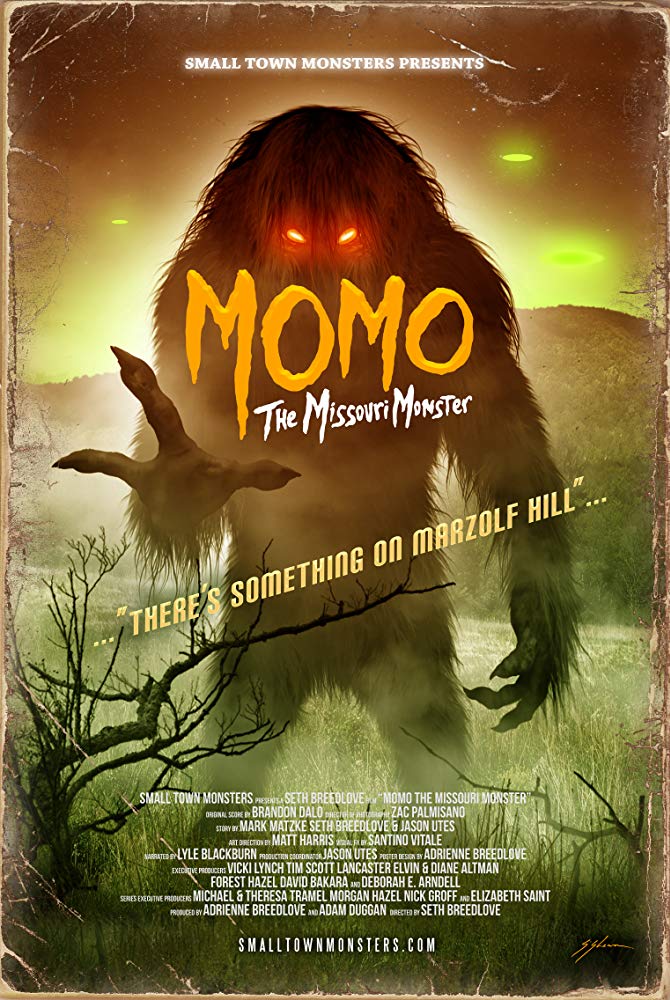
Review: MOMO: The Missouri Monster


Text © Richard Gary / Indie Horror Films, 2019
Images from the Internet


MOMO: The Missouri Monster
Directed by Seth Breedlove
Small Town Monsters
82 minutes, 2019

The Mothman of Point Pleasant; the Beast of Whitehall; the Flatwoods Monster; the Bray Road Beast; the Thunderbirds… These, among others, have two commonalities. First of all, they are local monsters like Bigfoot that have people talking about after sightings in regional woods or in the skies. The other is that each is represented in a film by Seth Breedlove.

His latest focus is the Missouri Monster known as Momo, a tall and hairy creature with glowing bug eyes. Oh, and three toes, did I mention that? Supposedly it was seen in the woods scaring the local populace of the riverfront town of Louisiana, MO at Marzolf Hill, in 1972. As the name of Breedlove’s film company states, they are interested in Small Town Monsters, and focus on that. I’m all in as cryptozoology is something akin to oral culture as film recordings tend to be rare of these beasties.

But Breedlove takes it a step further and gives the viewer not just a documentary, but a hybrid of documentary and a recently shot narrative that supposed to be from a 1975 cheesy film about the topic at hand. Y’know that film supposedly of Bigfoot walking through the forest that is obviously fake? It’s kinda like that, but with more fun and cheapness thrown in. It’s the kind of film you may have watched on VHS back in the day, with its grainy look and man-in-hairy-suit motif, but more on that later.

Lyle Blackburn
In other words, in it’s interesting style where there are three layers to this: first, we are presented with a “reality television show” called “Blackburn’s Cryptid Casefiles,” where a the host, Lyle Blackburn (playing himself, a real Bigfoot and other exotic creatures expert, writer and musician from Texas) is the wraparound story segueing into other layers as Lyle is shot from several angles though he mostly seems to be looking away from the camera while only looking at one of them. The second is the imaginary 1975 film, and the third is the documentary part where the “real” story lies. This is an appealing meta-look at the events at hand. It gives the director some freedom to “exaggerate” the narrative to make it less “talking heads” and overly dramatize the events.

Out of nowhere though, about halfway through, a new element is added, namely UFOs. Okay, maybe not flying saucers, but definitely lights in the skies that occurred the same time, which the filmmakers of the 1975 film and Blackburn’s show connect them into a creature that comes from the sky via these floating luminaries.

I’d like to break this down into two sections, namely the “1975 film” and the documentary parts. For the “previously unreleased film,” Breedlove takes his – err – love of exploitation cinema and presents us with a really cheesily amusing creature (aka the guy in the hairy suit, played by Ken Rose, who musta been sweating like crazy in that abominable thing… see what I did there?) and an absurd, over-the-top story with some really (purposefully I’m assuming) wooden acting that was quite common in those days in the indie film market (and quite often even today, and not just as an homage as is this one).

This fantastical film breaks up the talking heads of the documentary and keeps the story moving along and, as I said before, it especially works because of that. Also, anyone who lived through those early VHS days and are fans of these kinds of things will be joyous about it. For most of this part, the camera has a filter on it do give it that worn, speckled film look, though other parts don’t, and it looks a bit odd being that digital clear rather than cheap film fuzzy. But actually, I’m grateful too much attention wasn’t focused in that way because I remember how hard it was to see night scenes back in the day, and the viewer can make out what is happening here. For that, I’m grateful.

As for the documentary part, there are interviews with a half dozen or so residents of Louisiana at the time (senior citizens now), some of whom scoff at the story while still reliving it for the camera, and others who realize the importance in local history. Their stories are fun and interesting, and just the right touch of cynical in some cases. What was missing was a living member of the Harrison family that is the focus of much of the sightings to talk about what happened to them, or at least an explanation of why they were not on camera in the form of Blackburn’s retelling. Personally, if I was part of the government of the town, I would put up a monument or billboard, and use it as a tourist attraction because there are more people into cryptozoology than one might guess (Area 51, is an example).

Bigfoot stories, even those who may have come from the skies and have three toes, are fun. The fear of big hairy beasties living in the woods – even those who haven’t been seen in 40 years or so – is as palpable as, say, sharks or killer insects. This is true even though Momo never actually hurt anyone.

Breedlove has hit a different formula for his retelling of local legends, and the stories are improved by that. I’m not sure if this will become more standardized for him, or a one-off, but I certainly enjoy what I’ve seen of his series about creatures that may or may not exist in local legends. Hopefully, that will go on.


Friday, June 14, 2019

Documentary Review: Terror in the Skies


Text © Richard Gary / Indie Horror Films, 2019
Images from the Internet


Terror in the Skies
Directed by Seth Breedlove
Small Town Monsters
68 minutes, 2019

Folklore horror is a hidden gem that doesn’t get talked about much. Well, apart from the granddaddies of them all, the bigfoot/yeti and the Loch Ness monster. But nearly every corner of the world has their own equivalent mystical creature. For example there is the Jersey Devil, or the Mothman, or even the Gitaskog. Many of these tales arise from the oral cultures of the Indigenous people of the area, but there are many that rarely make it to the mainstream.

One of the things that makes this film different is that director Seth Breedlove has gone beyond the genre into the documentary realm, making it real. This is not a mocumentary like the extremely overrated The Blair Witch Project, but he takes a serious probe into the story we are to be presented.

For this case, we are looking at the giant birds of Illinois. Not birdmen, but birds proper, although to be fair, there is a correlation explained here with the West Virginia Mothman. But the focus here to start is Alton, Illinois, along the mighty Mississippi. The local natives (pre-settlers) called it the Paisa Bird, the stories of which were passed down to the French explorers of the area in the 17 Century.

We’re not talking about just big birds (and not the ones who live on a PBS street), but humungous ones that are described as the size of a Piper Cub airplane, and eats livestock and – you guessed it – human piggies, especially piglets (i.e., kids).

The film begins with a history of these sightings dating back to colonial times by bringing out a slew of experts in the field, including a world renowned crypto-zoologist (not my term). They tell of the eyewitnesses from long ago, where it’s necessary to have a secondhand experience because, well, we’re talking a span of hundreds of years. That being said, most of the sightings in the early part of the film are from the 1940s through the 1970s.

What is my opinion about all these gigantic birds? Y’know, I think it’s possible, though it seems strange that no one has ever captured one, and the tales of people shooting them posit that they burned the bodies because they were scared. I’m on the fence at the 40-minute mark because I do think it’s possible for there to be big birds. Ten to twenty-foot wingspans? Well, that’s easy to mistake. Most descriptions seem to be like condors, which can be believable. And that they come and go, well, there is migration and even small birds can fly thousands of miles away (though I’m still not sure about coconut laden sparrows who are African or European). Perhaps they end up in South America for stretches of time (lots of condors down there). Hell, big pelicans keep migrating up to Saskatoon from Mexico every summer, so I can see the possibility of it all. To sum it up at this point, I’m firmly perched on the fence.

At the 40-minute mark, the film takes a strange turn and for me kind of puts pressure on the vibe when the possibility of these Thunderbirds (as Native Americans call them) are of a mystical nature is introduced. From nature to paranormal, essentially. Suddenly there’s the question of whether they are supernatural harbingers of doom, or multi-dimensional beings. Oh, please.

As the tale moves north to the Chicago area, suddenly we’re introduced to the “Chicago Mothman,” a more human, bat-like creature, reminiscent of the film Mimic (1997). Wisely, the director chooses to be a bit skeptical at this point, mentioning the fact that there are 71 sightings in a city of millions, and not to mention the number of CCTV cameras around. But it is here that we get to start hearing directly from the “witnesses,” though there is still commentary by the experts; that being said, I found the addition of the belief in the paranormal aspect gave loose on their credibility a bit.

Despite my skepticism, which is not to be read as criticism, this is quite a well-put together film, that is the right length for its topic, rather than being longwinded like this sentence. Along with live footage and quite a bit of from-the-sky drone shots (and rightfully so considering the topic), there is also some decently done animation (nothing too elaborate) to demonstrate the eyewitness reports, or what the creature(s) looks like from description to description.

This documentary was actually quite fun, presenting one of the first crypto-zoological animals that I believe could be possible (at least in the first 40 minutes), and kept my interest throughout its hour length.