All genres of suspense, terror, and horror will be reviewed by Richard Gary. His address to send preview copies supplied upon request to rbf55@msn.com.
Bloody Muscle Body Builder in Hell Directed
by Shinichi Fukazawa
Dragodon Pictures; Visual Vengeance; Wild Eye Releasing; MVD Entertainment
62 minutes, 1995 / 2012 / 2022 www.wildeyereleasing.com www.MVDEntertainment.com/ Originally filmed in Japan (with
English subtitles) in 1995, this was not released until 2012. Presently, it has
finally been put out in a clearer print (from the master material) on Blu-ray.
And it retains its original amazing name. The first time I heard it, I knew I
had to see it from that alone. This is the director’s only film (other than one
unconnected acting gig), including lead actor, writer, editor, etc. It smacks
of a vanity project which means it can be cheesy fun or an ego trip. I am
looking forward to finding out.
After a prologue that
features a bloody murder regarding the protagonist’s father, who died young, we
are introduced to Naoto (the director). He’s the titular bodybuilder. Meeting
up with his ex-girl friend, Mika, they decide to check out his dad’s home,
where there is a secret buried under the floor. Joining them is psychic
Mizuguchi, as Mika is fascinated by ghosts and wants to photograph them.
Naturally, Naoto does not believe in the ethereal entities.
Once the trio get into the
house, all hell starts a poppin’ as they are locked in against an evil and vengeful
ghost. I have seen this compared to The Evil Dead (1981), and I can kind of see why: they are isolated in
a relatively small space of many rooms, but each at Manhattan single room
apartment sizes. The malevolent spirit wants to inhabit fresh bodies, and even
though there are only three of them, manages to do some damage. There is a
great amount of gore and also a large amount of humor, whether that is
intentional or not, I am not sure.
Is the body builder (the “Ash
Williams” of the story) strong enough to endure the “wonton” onslaught? (Note:
a year from now, that joke will probably be confusing.) He’s got the
wise-cracks near the end, the scared look at the beginning (though not to Ash
level…he’s a body builder), which builds some confidence in one’s own strength.
The film is just an hour
long, but the last 40 minutes is pretty non-stop, filled with guts, gore, and
some stop motion photography here and there. It is totally and beautifully
gruesome. Sure, the visuals are grainy as hell, being shot on VHS and all.
One thing that confuses
me, and this is true of many stuck-in-the-house films, if the windows are
locked, why not throw a chair through it? And if the front door is locked,
damn, they have both an ax and shotgun, so why not blast the lock? Nope, just grunge
against the window frame and try to kick in (out?) the door. This is the
equivalent nonsense of running upstairs rather than out the door that is quite
prevalent, and is a pet peeve of many a horror fan.
There are lots of bonus
material is included with the Blu-ray of course, being from Visual Vengeance, both
digital and physical. For example, there are two commentary tracks, one being
with directors and fans Adam Green (Hatchet, Frozen) and Joe Lynch
(Shudder’s Creepshow), the other with Japanese film historian James
Harper. There is also a new interview with the director, Fukazawa. Then there
is a Special Effects featurette, Outtakes, Behind the Scenes and Archival image
galleries, the original Japanese Archival Trailers, and some Visual Vengeance
trailers, as well.
On the physical side, there is a first
pressing limited edition slipcase, a folded poster, a four-page liner notes
booklet by Matt Desiderio of the Internet’s “Horror Boobs,” a vintage-style
laminated Video Store Rental Card, a reversible sleeve with the original
Japanese home video art, and a sheet of stickers from olde tyme video stores.
That’s a lot.
The SFX, all of which is
practical, works really well, even when it looks ridiculous at times. It is
quite lovingly over the top, such as a knife in the back of the head popping
out an eye, and then pulled back in when the knife is pulled out. True there is
a limited amount of cast of 5, but there manages to be nearly non-stop action
once it truly begins. It does not rely on a whole bunch of exposition, like
most films today, but you get to know the relationships – at least what the
viewer needs to know in reference to this film – and how they interact and move
the plot forward.
For an only-time director
using earlier and less easily manageable technology, Fukazawa manages miracles
here. With some exceptions, the film is shot well, especially considering the
miniscule space in which they were filming, and the editing is incredibly
effective.
Whether or not it is “The Japanese Evil Dead” or not, it is a whole lot of fun.
The indie filming scene
around Dayton, Ohio, is not to be ignored. There is a core of directors and
actors that overlap into a powerful and quite interesting clique of artists,
such as Henrique Couto and Erin R. Ryan, among others.
For this release,
director Couto has assembled some of his regulars and also new talent to
release a demonic tale involving a Ouija board and the requisite evil spirits.
Joni Durian
The center of the film
is troubled Sylvia (lovely Joni Durian), who has several mental ailing, such as
ADHD, agoraphobia (fear of leaving the house), OCD and seems to be somewhere on
the autistic spectrum. Durian does a strong job playing a wide range of
emotions right from the first scene, which is off-putting until the viewer
realizes pretty quickly that she’s not just quirky, but rather disturbed.
Her guardianship is in
the hands of her brother Sammy (Couto’s go-to actor John Hambrick), who
obviously cares for her, but is on the brink. He buys board games that she
likes to play solo and watches whatever Sylvia wants to see on television (but
no indication of a computer or cell phone for her). He also does his best to stop
her from self-destructive behavior and tries to help her focus on a task. He’s
getting to the point of burning out and drinking too much. Sammy’s girlfriend
is Rebecca (Ryan), who often comes to visit and is a seemingly calming
influence and supportive of Sammy’s taking care of Sylvia.
Among the stack of games
Sammy misguidedly brings home from a comic store, of course, is said Ouija board.
If there’s a Ouija and it’s on-screen, you know trouble and malevolent forces
are not far behind; especially when the dissonant note music starts on the
soundtrack when the board is introduced. Just so you know, I am not giving
anything away here, this is the basic set-up to the action in the first few
minutes of the film.
John Hambrick
Sylvia is obsessed
with two things: games of any sort and a desire to make friends (she feels like
those she watches on television are “friends” in the same way we believe that
people we don’t really know or have met on social media are “friends”). And it
is these two things that Sylvia’s trio of spirits of the Ouija board manipulate
for their own purposes.
The title of the film is
a bit of a double entendre because Sylvia is house bound by her OCD fears of
going outside since her parents died, and the much-desired friends/spirits are
also within the domicile. The second meaning for quite a while is that the trio
may actually be inside her mind as well. For example, the board’s planchette moves
in extremely fast circles, but she is still able to “read” it (without the audience
having to watch everything tediously spelled out). This is a nice touch that
enhances the complexity of the story, and of Sylvia’s mind; she’s not stupid,
just troubled with mental illness.
It’s understandable
that Sylvia is attracted to these spirits: they appear caring, tell her truthful
dark secrets about others in a blunt manner, and keep reminding her that they
are all in the middle of playing “a game.” The purpose of said game is the question
the audience will be asking, though it comes across as obvious very soon (hey,
it’s a relatively short – but perfect length – film).
Couto seems to do well
avoiding clichés, but he does have his tropes. As in many of his films, one of
the main characters is a struggling writer. Perhaps this is Couto’s own real-life
haunting inside (note that this film was written by Dan Wilder, but certainly Couto
had some influences on the story).
Dorian’s acting style can
be quite jarring here, as she shows the audience Sylvia’s brain trying to
process the information of what is happening around her. It took a couple of
minutes to get into the vibe of it until her situation is understood, so it works
well. Her moments of lucidity under the guidance of the spirits becomes the
oddity, which works really well. Most of the rest of the cast is pretty good in
their performances; the spirits can be a bit over the top in the acting
department here and there, but in the long run it all works together.
Erin R. Ryan
These spirits, wisely,
are very different from not only the principal characters, but among themselves.
Also, they are different from most other demons (I’m assuming) you would expect
from this sub-genre. They are a little girl obviously played by an adult (Alia
Gabrielle Eckhardt), a wise-acre wiseguy gambler in a sharp suit who
also helps Sylvia with recipes in the kitchen (Joe Kidd),
and a punk rocker who wears her hair in a distracting Misfits’ front rattail style
(Rachael Redolfi). As I said, Couto does not usually dwell in the house
of cliché.
While most of the cast
is attractive, there is no nudity or sex, a low body count per se, and little
bloody visceral material, but the story easily holds the attention of the
viewer anyway as this really is character based more than SFX. That being said,
there are some beautifully shot sequences that are effectively unnerving, such
as Sammy’s recurring dreams about Sylvia’s future.
If you’re looking for
knives and gore, there are other Couto films to check out, such as Babysitter
Massacre (2013), but this is, as I said, story- and character-based, and I
say it’s all the better for it.
Taken
loosely, the term inheritance can be more than merely objects; it can be
inherent within a group or liniage. This film nicely plays with a variety these
extrapolated terms.
Tyler
Savage, in his first full-length feature, uses what he has learned so far and
presents a picture that is a fine mix of storytelling and artistic endeavor,
without ever going into the opaque; in other words, he doesn’t “talk” over the
heads of his audience, but at the same time doesn’t talk down to them/us,
either.
Chase Joliet, Jake Carpenter
A
construction worker/contractor named Ryan (Chase Joliet), who believed he was an
orphan since childhood, quite unexpectedly receives a notice that he’s now the
heir to his recently deceased biological father’s property. It’s a beautiful beach
house facing the Pacific, just outside a small town in California. He is also informed
that it is worth more than a couple of mil. Unsure of whether he will sell, he
brings along his recently pregnant girlfriend, Isi (the lovely Sara Montez, who
sports some wickedly sculpted eyebrows) to check it out. Though I thought her
character was too physically absent through parts, I understand why: to see the
changes in her partner. Besides, she’s more excited about the coming kid than
he seems to be… awwwwwkawrrrrrd.
Not long
after they lay down their bones to adjust to the place, weird things begin to
perk. Well, to him anyway, both in the living and the… unknown. The first 20
minutes is a bit slow paced, and not much has happened other than some odd behaviors
of others, such as the store clerk (Alex Dobrenko) who’s sweet but ungainly
(and obviously develops a crush on Isi), that pesky real estate agent that’s the
equivalent of an ambulance chasing lawyer (Dale Dickey; many times the real
estate agent is a forward scout for whatever strangeness is afoot, but I’m not
saying if she is or not), the next door neighbor (Krisha Fairchild) who spies
on them, and a cousin (Drew Powell) who is just… ugh; there is, though, a mild jump scare or two.
While this
story does delve into the possible supernatural, this is definitely dips into
the psychological thriller genre (is it
all in Ryan’s head?: an old but effective trope), arguably more than the
horror. With the possibilities of ghosts we begin to wonder about the cause of
Ryan’s descent into… (cue spooky Theremin sound).
There’s a
little bit Amityville house in the effect on Ryan, a touch of Overlook Hotel with
negative influences of what went on earlier, and perhaps even a touch of the
first season of American Horror Story. Or,
as I said before, is it all in his head? For example, many of those he sees
from the past, such as his father (Tim Abel) or grandfather (Jake Carpenter),
occur after he sees photographs of them. So which one is it? Again, I ain’t
tellin’. Just know even though it’s a bit derivative, as is 99 percent of all
cinema, it tells a good story with some nice touches to keep the viewer
interested.
Beautiful cinematography
There is
some absolutely beautiful cinematography here. For example, in the first third,
we get to enjoy some close-up shots leaning towards the golden tone, such as amber
alcohol being poured into a glass followed by the sunset light on the house, eggs
frying in a pan, or Ryan’s hand caressing Isi’s bare belly. In other sections,
there is more of a blue tone, such as moonlight on faces. It’s all quite
luxurious, and fortunately doesn’t take one out of the moment, but rather links
one scene to the next.
Speaking
of being taken out of a scene, if you will offer me a moment of
self-indulgence: my biggest distraction early on was when Ryan was contemplatively
rummaging through a garage and comes across a box of old LPs, and for the next
few minutes I got lost wondering what were those albums. Fortunately, we get to
hear some of the music as that box becomes part of the story.
Sara Montez, Alex Dobrenko
One
interesting aspect of the film that really drew my attention and I would have
been pleased if it had been a stronger focus – even though it’s kind of a
backbone of the motif – is the historical mistreatment of the Indigenous people
by the white (especially male for several reasons) settlers, that is obviously
continuing.
For me,
the film’s one drawback is its length, as it could have been cut down some
through repetition and going beyond where it needs to, to establish the scene’s
motive. For example, there is a dinner conversation between Ryan and his sister
that is (purposefully) uncomfortable at best. This could easily have been
shorter – we get it, they don’t get along.
Don’t get
me wrong, it’s not like this is a bunch of padding with some story, it’s quite
the other way around. Savage tells a good tale that is engaging, even with an
ending that I kinda saw coming in some way in an aha moment about a third way through after I had enough information;
and even so, the film kept my interest for a number of reasons.
For
example, the cast is quite good. Joliet is in most scenes, and carries the film
with just the right amount of sullenness, anger, and fear, without playing it over
the top (as did James Brolin in Amityville
Horror, or especially Jack Nicolson in The
Shining – both actors I admire). Montez shines enough to not fall into
Joliet’s shadow. Actually, as far as presence, the entire cast holds their own.
There are
few scenes of violence, which of course make them a bit more unsettling for
their unexpected nature, and while there are a few steamy scenes, no real
nudity. Again, it’s not that kind of film, as it’s more story based than the biff-bang-boom of the day. Honestly, the
film is better for it.
For a
first full lengther (yes, I know it’s not a word, but should be), Savage show
some oomph, and I look forward to
seeing his growth, especially if this is only the ground floor.
When I see a film that has played
many festivals and numerous and very different posters, I get a mixture of
excited and cynically suspicious. But I’m keeping my fingers crossed. The
director, Jonathan Heap, was nominated for an Oscar in 1991 for a short called 12:01 PM. Since the millennium, most of
his work has been shorts and a television series. I willingly enter the bargain
of watching this with hope, however, considering the cast and the look of the
stills from it, but I’m jumping ahead.
The premise is simple: an ugly and evil
box gives you want you want, and then takes over your body and either kills others
or gets the body killed through its actions. For lack of a better term, I’ll
call this being a demon, though it’s never really quite specific on its
origins, and even complains when someone tries to name it.
We learn the box has been doing this
for quite a while as we meet an extended family, based on the children of the
previous “owner,” veteran badass Lance Henricksen, who in an extended cameo
still manages to outshine most. After the box had come into his life when the
now adults were mere kids, he had changed and became a cruel tormentor to his
children, leading the main and locus character, David (co-writer with the
director, David Lipper) to become housebound due to severe OCD (think of Monk with
agoraphobia and without the humor).
Lance Henricksen
Also joining him at his home after
the death of his dear old evil dad, to hear the reading of the will, are his
similarly abused and hyper-vain sister Michelle (Dina Meyer, who gets to show
off some impressive yoga moves), her brutish ex-husband Rich (Robert Rusler)
and his current fiancée Cheryl (the lovely Bree Williamson, who I remember from
the underrated television show, “Haven”), and cousins Kelly (Austin Highsmith),
who is a lawyer and enabler to her junkie brother, Darren (Jake Thomas).
Not a huge cast, but just enough for
a decent body count. But I’m jumping ahead of myself again here. The box itself
looks pretty cool, sort of like coal with a Cthulhu-similar raised octopus
design on it. There’s no denying that it’s bound to remind one of the Book from
Evil Dead. Fact of the matter is that
there is a lot here that is reminiscent of other films, which in itself I don’t
really find to be a bad thing most of the time. It’s like a game of “Oh, I know
that one! Take a drink!”
Dina Meyer
The film has moments of slow pacing
here and there, but mostly it’s a building story. That being said, it can
definitely use some editing and excising, such as how many times do we need to
see the water coming from Meyer’s shower head straight on? It’s almost like
you’re stuck a bit in David’s need to (rinse and) repeat. Luckily, this doesn’t
happen often enough to give up on the story, which mostly works pretty well, in
part thanks to its seasoned cast (meant as experience, not age).
Many of the characters are either not
likeable or a bit two-dimensional, though David’s seems to be the most thought
through (well, the actor playing him did
co-write it, remember); however, he is also the center of the story, so that
makes sense. We don’t get to learn too much about the others; well, more than
occupations and allegiances. There’s very little backstory other than bad dad.
My big question, though, is the
title. To me, it sounds kind of contradictory. Okay, here is what I mean by that:
the whole premise is based on all the characters volunteering to do something with
the box that I won’t give away, and then the box giving each what they want in
order to…well, you know (i.e., see the film for yourself). They make choices
about what they want, and follow through with the devil’s deal (or demon’s;
still not sure). That sounds more like willing
than unwilling. Is there something I
missed? It’s a similar theme to the Leprechaun
franchise where he grants wishes that brings along demise in it, or even as
far back as Goethe’s Faust. The
working title of the film was The
Gathering, and while The Unwilling
definitely sounds more chilling, the other seems more accurate. Yeah, I know
this is a bit nit-picky; do with it what you will.
Bree Williamson
The SFX in the film are occasionally
practical appliances (the blood consistency and color is really good, by the
way), but there is also a lot of
digital hoo-haa, such as swirling smoke,
mirror tricks (reminiscent of Carpenter’s 1987 Prince of Darkness) and a visual “ripple” that leads a character to
the box to get what he needs/wants. Other than one cheesy effect outside the
house, they all look decent, but it’s pretty obvious that it’s optical.
The press release for the film quite
proudly states (and rightfully so), that the crew includes the aforementioned
Oscar-nominated director, “Oscar-… and Emmy-winning Cinematographer David
Stump,” and multiple award-winning writer Philip Morton (second director and
co-producer on this film). With all this heavy power, it’s not surprising that the
film looks as good as it does. There is no one thing that is a standout to make
me say “Wow,” but it’s definitely a good film, though somewhat washed out of
color (I’m sure purposefully). Do I think it’s deserving of such praise? Well,
it’s been shown at two dozen festivals around the world, so you there is something there worth noting.
Austin Highsmith
Other than editing, my only real note
and quibble is that I think it didn’t go far enough. Except for a nice surprise
at the end with an equally enjoyable practical effect (well, it looks like it
is an appliance, so I’m assuming…), there is hardly any blood (even with the
one person stabbed in a strategic place), the sensuality is minimal other than
an affected nurse (Levy Tran, who is on the poster and most of her appearance
in the film is in the trailer) and a seduction that changes tone, there is no
nudity even with the obligatory shower scene (perhaps the Director’s Cut in a
decade or two?), and a low level of actual scares. The pace and angst definitely
increases over the course of the film, but it tends to get more shrill than
thrill.
Jake Thomas
And yet… I still had a bit of fun
watching it. Yeah, I’m critical, but I hope I am not harsh. Even with a seasoned
director, actors and crew, there’s the next level and I mean these comments as “notes”
and “critique” more than just “opinion” (i.e., where the problem are, rather
than “good/bad”).
For example, the acting level is fine,
with a bit over- and underacting on occasion. As I said, the cast are seasoned
pros and have quite a catalog behind just about all of them, from both film and
television, and it shows. The strongest weakness (an oxymoron!) in the writing
comes, I believe, from this being the first screenplay for Lipper, and director
Heap hasn’t had a writing credit since the early 1990s. But I hope they both
continue to stretch their writing wings because there is promise here, and I
think by a couple of more films they can be a force. I look forward to that.
Have
you ever noticed that many of the horror films that focus on African-Americans
are not only comedies, but really bad ones? I blame the Wayans family for that,
who took a fine family cinematic heritage and ruined it the likes of A Haunted House (2013) and any Scary Movie (2000) past the first sequel.
Sure there is the likes of indie director Sean Weathers who is taking a more
serious approach, but generally they tend to rely on either stereotypical
characters or ones that are so deep in the culture that it comes off as shrill
and hard for anyone else to identify: think Beauty
Shop (2005) as an example. This is a thankful reprieve from that: a serious
horror film where the main characters are Black, without it being “Minstrel
Show” as decried in Spike Lee’s Bamboozled
(2000).
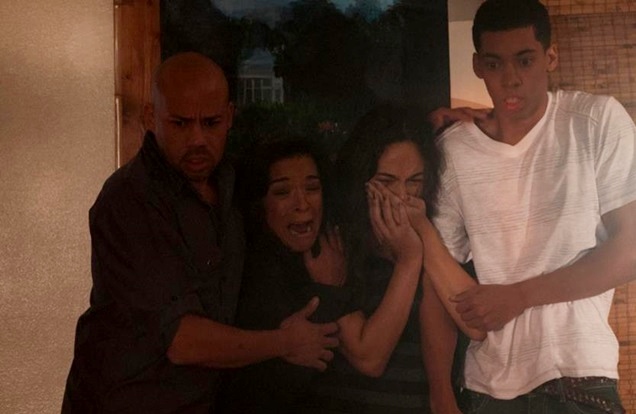
The loving
but self-described “dysfunctional” Williams family move into a stunningly
beautiful yet mysterious house where, we learn from the prologue (as they must always be a prologue, it’s the law), evil things are amiss, as if we
didn’t know already. There’s patriarch Ben (Gerald Webb, who has worked with
the director a number of times before both in front of the camera and behind it),
Linda (Emmy-award winning for actress Diahnna Nicole Baxter), 16-year-old
Ashley (Aurora Perrineau) and 15-year-old Alex (Vine Internet star Melvin
Gregg), the latter two playing much younger than their years.
As a
quick note, there were a couple of things that felt off pretty early on. First of all, while being shown the house by
character actor Bill Cobbs (who will forever be thought of by me for the
underrated 2000 show, The Others,
though most probably will remember him from the Night in the Museum franchise), there is the closed room the
Williams are not allowed into but they still buy they house. Nuh-uh, that Is
not gonna happen. When we bought our modest little house, we went over every
inch of it, and knew exactly what was there and what wasn’t, because we needed
to know what needed updating or fixing. I mean just to start, if the last
owners used a rotary phone, there may be some electrical updating needed, not
to mention painting, etc. Our house had all newly painted walls by the previous
owners, and then we repainted them
all to the colors we wanted. None of that goes on here, they just move in. Okay, okay, suspension of
disbelief, I get it. Thing is, it only works up to a certain number of times,
and then it becomes less ignorable. Also, you know the real estate agent is in
on/part of the mystery, because, well, they always
are (in fact, I feel like I would be giving something away if I said he wasn’t).
The loving-yet-dysfunctional Williams family.
From
the first night the troubled family moves in, things are already going wonky.
One member is finding murder photos, another feels like he’s being followed (of
course he is), another has creepy old dolls appearing that had been put away (Annabella anyone?). Oh, and the leather
tablecloth is growing veins. Let me repeat, that’s the first 24 hours.
Another
of the tropes strongly relied on here is The
Amityville Horror (1979). We met the previous owner in the form of the
driven-mad dad (which apparently must always be played by a television actor),
played with glee by a heavily made up Richard Grieco (yep, the dude from “21
Jump Street,” a co-producer of this film), who is still ghosting the house covered
with blood, more than hinting of a supernatural/evil force floating around.
During
the day, everything relatively human seems to be happening and somewhat normal
(if argumentative among the participants), but at night, things go bump and
shadows roam, even in dreams. I wonder about the weirdness at night and
normality in the morning; wouldn’t you talk about it with the family, or at
least be shaken up? My one (possible) real-life ghost experience was mentioned
the second my ass hit the chair for breakfast.
At
first, there are no characters you really interact with on a deep level at first,
and little character development to build on, even with their previous foibles
(affairs, drinking…you know the drill), until the viewer gets “comfortable”
with the family, just in time for, well, I’ll get there.
Nearly
everything happens inside or just outside the door of the house, surrounded by
trees, giving a claustrophobic feeling of a tiny budget. We hear the kids talk
about school once, but both the adults work from home: him as an architect and
her as a piano teacher. I have no doubt that it is exactly what was intended,
the feeling of no way out. While this
also helps with the budget, it also can be an effective tool to the story, as
it is here.
Truthfully,
the film drags a bit during the first half, but the mood and tone change drastically
at the nearly half-way mark, and the story amps up drastically and dramatically.
This begins with the introduction of a voodoo practicing college professor, Lucas
St. Michelle (Eddie Steeples, to be – like it or not – forever known to a
generation as “The Crabman,” from “My Name is Earl”), who comes to exorcise the
house. Dressed in a fine white suit and, for some reason that is never
explained even in the commentary, wearing whitish contact lenses similar to the
kind used by Marilyn Manson, he unites the Williams family and joins forces
with them to fight back. But is his mojo strong enough to rid the forces of
evil from the abode? In today’s cinema climate, it could go either way, and I’m
not going to say which.
Once
the battle begins, the film really draws the viewer in, and becomes a lot more
interesting. It seemed as if this part of the film was about half as long as
the first half. Perhaps that is a clearer example of a bit more towards what I
am trying to say.
As
they roam through the house, other tropes ignite, such as the rooms changing
order as they walk through the doors, as in Grave
Encounters (2011), or one nasty spirit sporting dark make-up a laInsidious
(2011). The smoke spirits were pretty cool looking, and the main villain, who
is mostly seen in silhouette, is particularly nasty and effective, though dressed
in something you might see in a 1970s gay leather bar.
The
one that drives me crazy though, and this is true of more films than I can think
of off the top of my head, is if the doors won’t open, why would the
protagonists not try to break a window (though you don’t seem to see many
windows in this house). Odds are nothing would happen, but still... Also, the
only phone seen throughout the film is a rotary one (a scare device is used in
relation to that object that I first saw on soap “Dark Shadows” in the late
‘60s to introduce the Quentin character, and it freaked me out as a kid); in
other words, teens with no cell phones? Say
what? No computers for that matter, either, that I can remember. The
kitchen’s appliances seems pretty modern, though. Perhaps the filmmakers wanted
to keep the timeframe questionable? If that’s the case, well, never mind.
While
the film has quite a serious atmosphere, there are some comedic tones that crop up once in a while, such
as a comment here and there by the son, one character giving a knowing smile at
the camera – both funny and very
creepily effective – and a phone number indicated as 666-1313 (with a Los
Angeles area code, though the location of filming is Mill Valley, just north of
San Francisco).
The
acting is all fine, especially Diahnna Nicole Baxter, who feels the most natural in a most unnatural situation. She’s
the one who seems the most annoyed and also the most scared of the lot. Grieco
also does well, even with his mostly silent role after the intro. His stares
are quite intense, and from what I gathered from the commentary, he was doing The Method method; I get the feeling
he’s actually a better actor than many of the roles he’s been given.
There
is zero nudity (again, serious film)
and while there is some blood and a couple of semi-gore effects, this story
isn’t necessarily about that: it’s more about arcing events than carnage
moments, and rightfully so. There are a few jump scares here and there, but I
don’t think this will really scare anyone who is reading this review. The
second half, however, is definitely entertaining, even while stretching
credulity at times.
The
soundtrack by DJ/musician Knappy is also moody and well done, but you know things
are getting really bad in the house when the same few discordant and tinny
notes on the piano play over and over (yes, another trope).
The
extras on the DVD include the trailer and a 10:25 Making Of documentary. Director Christopher Douglas-Olen Ray (aka Chris Ray) and actor / producer
Gerald Webb sit in what looks like a home theatre and discuss the production,
the cast (the core of whom also comment in on-situ interviews), and the reaction to the film, including winning
Best Film at the Burbank Film Festival where it premiered, and the two adult
leads also were nominated for best actor/actress.
There
is also a commentary with Olen Ray Webb is quite decent. Because they’ve been
friends and working together for years, they are obviously comfortable with
each other, which comes across in their banter. They are respectful and don’t
try to talk over each other, and they give mostly anecdotes and some information
about the film that is easy to take: not too technical, and not too fluffy; but
rather a conversation. There is a bit of redundancy (such mentioning Eddie
Murphy’s excellent bit about Black people and horror films from his seminal –
and hysterical – stand-up film Delirious
from 1983), but still worth the listen.
Considering
this was filmed in a single location over a mere eight days, it’s actually
quite accomplished, especially the second half. The atmosphere stays moody,
with some of the hue zapped out of the image; it’s not quite sepia, but it
certainly isn’t a blast of color, either. Douglas-Olen Ray, son of genre cult
figure Fred, has his own history of action horror (most of which borders on the
WTF), such as Mega Shark vs. Crocosaurus
(2010), 2-Headed Shark Attack (2011),
and 3-Headed Shark Attack (2015),
settles into the straight horror genre decently, without pandering to just an
African-American audience, but one we all can relate to, relative to the topic
of course.
Whether
you turn it on from its beginning or at the half-way point, by the end you may
feel satisfied with your time spent.
You
know what drives me crazy about found footage films? It’s not the shaky camera,
the grainy look, the too-dark scenes, the running with the camera on… okay, I
guess that, too. My problem though, is that you already know everyone is going
to die, because it says so right there on the box, so there’s no suspense in
that part: X group goes to Y remote
location where Z bad thing happened before, and were never found again. Then
add that this is a “reconstruction of their last days.” Not even ”original” found footage, but speculation?
While
I realize that it may sound like I am approaching this with a negative
attitude, it’s actually the opposite. You see, I am hoping it is going to be better, by turning old clichés into
something new.
I
totally admit to the reader that I wrote that above before seeing the film, which I am placing into my players now. See
you on the other side.
Aaaaaaaand,
I’m back.
The
plot is as follows: three filmmakers (why is it almost always three, just
because The Blair Witch Project [1999]
did it?) who go to investigate a mine in the Superstitious Mountains, a real
place in the Arizona desert where supposedly the Dutchman buried some gold
(this is an actual local legend there), and many people seem to have
disappeared looking for it.
With
cameras and lights that are used constantly and never seem to run out of juice,
our very attractive twenty-something trio, a couple (Sage Howard and Andrew
Simpson) and a friend (Shelby Stehlin), camp in the scrub and then run around a
lot – and I mean most of the picture – in the dark (like the Blair Witch Project [BWP]), with only the camera lights or
night-vision scope turned on.
The
picture starts with the woman of the trio sobbing in her tent, afraid [BWP; though happily no dripping snot
from the nose seen this time] before flashing back to some locals being interviewed
on camera documentary-style [BWP]
about the strange goings on and thereby helping with the exposition. These are
non-actors, and come across as the everyday public that they are [BWP].
Getting
back to our trio, they track through the desert on foot and camp out after
doing the interviews, so we’re already at the half-hour mark. Some cool
mysterious things happen with… no, I’m not going to tell you, but I liked it.
Of course this leads to more running around in the dark among the desert
shrubs.
There
are a couple of scenes in the titular dark mountain, but most of the action
actually occurs in the dark desert. Lots of mysterious things happen that are
unexplainable, but by the time any consistent action, other than teasingly
occasional flair-ups, there’s about 10 minutes left in the thing. And you’ll
never guess: it happens at night. In the dark. With just the camera lights.
Heck, maybe they should have planned it around a full moon?
This
isn’t the greatest film in the world¸ and can only be considered adequate, even
for the found footage genre. I am disappointed because I was rooting for the
female East Indian-American director to succeed.
The
filmmaking is full of genre clichés, right down to the being pulled backwards
by the feet into the dark gag that’s been in too many films in the past few
years (can we let that one go now, please?), as indicated by the cover art
above, but most of the action is right out of the BWP playbook, a release I
always thought was overrated film as it was.
But
the biggest annoyance of the film was the way the vocals were turned down, and
the music turned up. Even at top volume, I had trouble hearing what the trio
were saying most of the time, but the occasional music was so loud I jumped
from that suddenly coming on more than the action (or lack thereof) that was
onscreen. At first I thought the sound problem was my computer, but during the
extras (the only extras), which is extended
interviews of a few of the locals, the sound was crisp and clear. All things
considered, though, I thought the acting was top notch, and deserves to be
noted.
This
is a first and only full length release for directorAnaïse to date, but I hope she keeps filming, and comes up with
some cinematic ideas of her own. Make me proud, and Namaste!