Monday, May 26, 2014

Reviews: Bookending Jim Wynorski: Gila!; The Lost Empire

Text © Richard Gary / Indie Horror Films, 2014
Images from the Internet
 
Jim Wynorski is in good company. Although he arrived on the scene later in the game, starting in 1983, he deserves to be included with the likes of Roger Corman, Dave Friedman, and Hershell Gordon Lewis as purveyors of low budget and often transgressive cinema that is designed for fun and profit on a micro-budget. Wynorski has used many different directorial names (e.g., Sam Pepperman, Harold Blueberry) to cover 150 films within various genres, including horror, fantasy, exploitation and sexploitation. What I am reviewing here are re-releases of his films by Polyscope Media Group from the very beginning to the near recent.


The Lost Empire
Produced, written and directed by Jim Wynorski  
Polyscope Media Group Inc.                  
83 minutes, 1983 / 2013
 
The 1980s was to video indie micro-budget horror films what the 1950s were to, well, cinema house micro-budget horror films. In the case of the former, it was a new market desperate for new product to put on shelves, and the two most popular genres for quickie flicks were porn and horror. Fed on the big screen by the likes of the magic trio of Freddy, Jason and Michael, the nascent direct-to-video (D2V) hunger produced many a marvellously wondrous WTF fantasy world. This film is just one example of it.
 
I remember seeing this film on VHS back in the mid-1980s and thinking it was a piece of shit. Part of the problem with D2V is that back then it was rare to find letterboxing, which companies thought people would not like. It’s not surprising, really, since nearly all televisions had square screens and if a film presented was letterboxed, the image became really tiny. And if you had less than a 19”-er, it was unwatchable; don’t let me get started on foreign films and trying to read subtitles. They used a method called pan-and-scan, which meant you only saw as much as a third of the screen at a time. If two people were talking in one shot, it would flip back and forth between them, and action scenes became as muddled as, well, the new Transformer series (aka, “what the fuck just happened? All I saw was movement!”).
 
As televisions became larger and the quality of VHS gave way to more defined DVD (etc.), The Lost Empire became a lost film. It hadn’t made its way into the new technology, leaving it in the lost empire of grainy and pan-and-scan dimension. Thirty years later, Polyscope has given Wynorski’s early work a hand up, and have re-released the film in full-screen, cleaned-up, theater-ready glory. But is this film worth it?
 
Seeing it now again, after all these years, yeah, it was. Sure it’s not a great film, but it sure as hell is a fun one. I see lots of first releases by directors, and there are certainly problems due to small budget, writing, and acting that tend to be consistent that even remain right this very minute.
 
In the case of this film, it’s partially a feeling of “this may be my only shot, so I better cram as much as I can into it at once” (Wynorski confirms this on the commentary track). While it’s fun to play spot the reference¸ this can also lead to clichés. However, sometimes – as in this case – there are so many, it surprises you because you can never predict which homage he will use. The biggest and most obvious are Enter the Dragon, Dirty Harry, and James Bond, specifically Dr. No.
 
The premise is tough cop Angel Wolfe (Melanie Vincz) – as in savior / lone wolf – has a brother who was a cop, killed during a hysterically funny and bloody pre-credits robbery. She swears revenge when she learns that it was engineered by a sinister group that has an island where they are training beautiful women to fight, lured in by a large-prize contest. Leaving behind her porn-star looking boyfriend, federal agent Rick Stanton (Paul Coufos, a future Wynorski repeater), she sets on a path to investigate and seek retribution. Along the way she picks up two more associates to help in her plan. First there is Whitestar (Raven DeLaCroix, a star in Russ Meyer’s Up! and at the time Wynorski’s girlfriend; she also rightfully earned a producer’s credit here, a Native American who Angel once saved. DeLaCroix, who designed her own cleavage-bearing costumes, is mostly Native with some Métis thrown in). Despite her ample bosom, it was her blue eyes I actually found most beguiling. Go figure. Last there is the gum-poppin’, prison-sprung Heather McClure (the ill-fated Angela Aames, who would die of a heart condition not long after this), who had been placed there by Angel.
 
The premise behind the plot is the search for an ancient jewel that has mystical powers, and when combined with its twin already held by the island’s “mastermind,” supposedly brings enough power to control the world. Everyone is looking and killing for it, but it has a mind of its own. So the three women, who often crack wise, set off to the island kingdom to seek out and kick some cult butt, even before knowing about the gem, which ultimately makes itself known.
 
That’s about as much as I’m willing to give away, storywise. Let me say right off, that even though it was Wynorski’s first release (he has at least one previous that has never been publicly released), it actually looks quite good. Sure, some of the sets and matte painted backgrounds look a bit like the first season of Star Trek, but by using the Roger Corman playbook (and the Corman studio lot, among other locations), he manages to make the most out of what he has. The SFX look really cheezy, but unless you were at Lucas level, this is how most of it appeared for indie films at that technological juncture. The laser machine at the end, however, just made me laugh and laugh.
 
Despite his lack of directorial credits, there is actually a pretty impressive cast of secondary characters that is worth noting. For example, the villain (not giving away anything because it’s in the credits) is the Tall Man himself, Angus Scrimm, chewing scenery his entire time on screen, acting more with his eyes than anything else (squint…wide…squint…wide). Also from the Phantasm franchise (there is a new Phantasm scheduled to be released in 2015 with the original cast!) is Bill Thornbury, who played the older brother, and here plays Angel’s younger brother. Next up is softcore icon Angelique Pettyjohn, known mostly for an episode of Star Trek as a fellow “thrall” with Shatner, here is practically unrecognizable (to me) as a prison gladiator who wears a black leather dominatrix costume that she peels piece by piece.
 
As a police captain in a short cameo near the start is redheaded Kenneth Tobey, known mostly as the lead in the original version of The Thing From Another World (1951). Then for an even briefer moment there is Tom(my) Rettig, who was the original owner of Lassie in the first series of the television show (1954-57).
 
One other notable actor is Blackie Dammett, the one person who could out-scenery-chew Angus. I couldn’t remember where I had seen him before, and after looking it up, it was from National Lampoon’s Class Reunion (1982). Considering the way he overacts, it’s not surprising that (a) his last role was in 1990, and (b) he will be better known through history as the real-life drug dealing dad of the lead singer of the overrated Red Hot Chili Peppers. Man, is he a bad actor.
 
Wynorski had made some weird choices here. For example, no matter what the occasion, everyone is going to be showing lots of cleavage. In fact, when Angel goes to visit her brother in the hospital, she wears a shiny gold one-piece that is skin tight and cut down to nearly the navel. Even on the island, everyone’s hair is perfectly quaffed, and Angel’s changes from straight to poufy to having ringlets. Apparently, even on an isolated island used for women gladiators, girls will be girls.
 
Of course, in the story, there are so many holes, not even counting the lead henchman (stunt man and real-life bully, according to Wynorski’s commentary, Robert Tessier) and his ever-changing eyebrows. For example, the shuriken (Japanese throwing stars) are way too thick to stick into anything, the three female leads are constantly snarking at the island’s – er – management, as if the guards cannot hear them, and they manage to sneak out of the facility a few times, despite there being cameras everywhere, and more importantly sneak back, even after there is reports of “intruders.” There is one character that has a broken leg (portrayed well by Linda Shayne) in scene, and is walking around the next day.
 
Although it was “acceptable” at the time, in hindsight, there is a lot of less-than-subtle racism floating around here. For example, a Chinese character cameo is Charles Chang (yes, dressed identically to Charlie Chan), played by occidental character actor Art Hern, with all the stereotypical broken Engrish. For DeLaCroix’s character, she is constantly using clichés (and remember, she’s also one of the producers) such as, “Yes, kimosabe.” She bares her overly large cleavage while wearing a Native headdress. As for sexist, well, duh, that’s the genre, and that’s an enjoyable given.
 
While most of the electronic music is terrible, sounding like many of the television cop show themes of the period (electric keyboard going “ooo-wahhhhh ooo-wahhhhh”), it is hard to criticize it because it was the style for the time. What is notable, however, is that some of the humor – and there is a lot here – actually works. Groaners for sure, but bound to bring either a happy “Oy!” or genuine smile.
 
The disk has only two extras, a truly interesting commentary track by Wynorski that confirms many thoughts I had while watching the film, and a silly “stills” track that is merely screen grabs from the film itself, rather than during shooting. However, it was nice to see one shot of Shayne’s fate that Wynorski discusses but is really hard to see while watching the movie.
 
Looking back, this film is actually important in a way, in the larger scheme of things. It is a time capsule of a particular style that propelled the home-grown market in a time when even low-budget films had to be shot on film (in this case, Cinemascope!), and be opened to a greedy market that was in a sometimes painful growth spurt. Though I did not like it when it was first released, I can now appreciate it for what it was, and especially for what it was trying to be in the cultural arena.


Gila!
Directed by Jim Wynorski      
Polyscope Media Group Inc.                  
91 minutes, 2012 / 2014
 
Gila! Is actually a made for television (Sci-Fi Channel) remake of the 1959 low-budget monster film, The Giant Gila Monster. It was part of the popular subgenre of supersized creatures, such as Them!, The Giant Behemoth, The Killer Shrews (made by the same group that did …Gila Monster), Gorgo, Konga, and even Gojira.
 
In an very similar storyline, also taking place in 1959, a bunch of 30-year-old teenage hotroding friends discover there is a dinosaur sized poisonous (though this aspect is never used in the plot) Gila Monster roaming around their Texas-based, Indiana shot town. The head of this motley crew is hero Chase (played with gusto by Brian Gross, currently starring as Kirk on the Star Trek: New Voyages series) and his best gal is girl-next-door-with-a-smart-mouth Lisa (Madeline Voges). If this were a western, Chase (what else would you call someone who races hotrods?) would definitely be wearing a white hat, though he’s so goody-goody, it would probably be white bread. He makes Steve McQueen in The Blob (1958) look like Marlon Brando in The Wild One (1953).
 
Chase’s nemeses (i.e., the “black hat”) would be the stereotypical JD type “Waco” Bob (Jesse Janzen), who is a short-tempered, woman-abusing thug that spent three years in “juvie.” His squeeze is the hot Carla (Christina DeRosa, who looks like a rounder version of Alyssa Milano), who of course has the hots for Chase. While she is also cartoonish, Christina actually manages to make her into a fuller (no pun intended) character, which is actually a large compliment. Like most of the roles, hers is written quite two-dimensional, though she successfully gives her some nuances. She is also the one who supplies any form of sex appeal, with or without the cleavage and self-butt slaps.
 
The other two main characters are the local Sherriff (veteran actor Terence Knox, who was a regular on St. Elsewhere, among others; you’ll probably recognize his face, especially if you’re over 30). He’s sort of a substitute dad to Chase, who has a mother and baby sister suffering from the after-effects of polio, but no father.
 
As with previous films, Wynorski has managed to dig up some aging teen actors who look well beyond their years, and yet for some reason makes me happy (that they are there, that is). First up is the mayor’s wife, played by Julie McCullough, who infamously was future religious fanatic-tea party spokesperson-asshole Kirk Cameron’s steady in the Growing Pains television series. The wife is kind of a harpy, but her character sort of disappears after one scene. I was waiting for her to be swallowed whole, as that’s how they set up the tone. But more important (to me, anyway) is Kelli Maroney, who was in one of the only soapers I watched, Ryan’s Hope, and in such classics (seriously) as Night of the Comet (1984) and Fast Times at Ridgemont High (1982). She’s the deputy who doesn’t fare as well as McCullough (hey, it’s in the trailer). The coup d’état though is getting Don Sullivan in a minor role. Who that, you ask? He was Chase in the original …Gila Monster.
 
The monster is, in this case, caused by toxic waste hidden in a cave. The townsfolk have to find the scaly critter and get rid of it before it can lay eggs, which makes me thing about Lena Dunham’s comment about having, “like, a thousand follow-up questions, such as…” how do they know it’s female (i.e., does a male Gila monster have a dangling participle?), and doesn’t there need to be another that size for it to mate with, which means there would be at least two? There are lots of issues I have, but I believe this has more to do with the four (yes, four) writers more than director-for-hire Wynorski.
 
With an estimated budget of nearly a million buckerinos, I can think of so many micro-budget directors who would have been able to create much better effects for half that amount. I’m guessing most of the money went towards the CGI monster itself, but the CGI blood, CGI explosions, CGI feedings, CGI car crashes all look more 2002 than 2012. Perhaps1992. I will have to say, though, that there is a couple of really good face meltings toward the beginning of the film, which appear more appliance than graphic.
 
One of the highlights of the film is the soundtrack, which includes a number of rock and roll classics by the likes of Bill Haley and the Comets, the Everly Brothers, Dion and the Belmonts, and even the true king of rock and roll, Chuck Berry. There are a couple of decent original songs and a mediocre cover of “Fever” (using the pre-Peggy Lee-added text).
 
The best of the extras are the trailers for both this film and the original. The rest of them are kind of meh. There is a slide show, a text description about the original film, a text narrative of Drive-In culture, and the original recording of Don Sullivan’s “Mushroom Song” (with lyrics) from the first film. I like the way Wynorski does commentaries, but there is none here, again I am assuming because he didn’t write or produce.
 
So, do I recommend this? Yeah, without a doubt. Sure it lags in parts, but it is a fun escapist nonsense that has a relatively decent sense of humor when it wants, the acting is purposefully juuuust over the top, and the monster is, well, huge. Now if he can only bring back Traci Lords, like he did with Not of This Earth (1988). Oh, wait, that’s right, he is, in a new feature called Sharkansas Women’s Prison Massacre, due later this year.
 
 The Lost Empire trailer here: http://www.youtube.com/watch?v=Kng-5N7YCXk

Gila:


Thursday, May 15, 2014

Review: The Deadly Spawn: Millennium Edition

Text © Richard Gary / Indie Horror Films, 2014
Images from the Internet

 
The Deadly Spawn: Millennium Edition
Directed by Douglas McKeown            
Elite Entertainment
81 minutes, 1983 / 2012
www.thedeadlyspawn.com
www.mvdvisual.com

When this direct-to-video film first came out, it was a divisive moment. The general public saw this as a piece of cheezy shit to be mocked and used as an example of bad cinema. For the fan, especially a newbie to the nascent VHS home market, it was a touchstone moment in indie cinema that was one of the leaders in the explosion in micro-budget horror, opening the door to what was to come. And y’know what, it’s a pretty damn fine film.

My issue with it was that the tape looked terrible: grainy and too color saturated that made the creature and gore look unclear, especially since many of the scenes take place in a dark basement. So much was viewed through my squinted eyes trying to figure out just what was going on.

In a scene that could have come straight out of the original The Blob (1958), two campers find a fresh meteorite that apparently has a stowaway in the form of a multi-headed creature with massive rows of teeth and a hunger for blood, which helps it grow and reproduce. After the subtextual homoerotic tenters become spawn fodder, the blind creature finds its way into a suburban basement, where, for a while, people seem to be constantly going down to the basement (where are the Ramones when you need ‘em?) and are chomped on in various, and graphic and enjoyable fashions.

Although obviously a puppet-like appliance that apparently takes four people to operate, the creature looks great, having rows and rows of sharp teeth, looking much better in this release taken from the original 16mm print than the faded and fuzzy VHS one. The use of primary colors, the gore, and the creature are all clearer for personal enjoyment. There has been some controversy over an earlier Synapse released DVD version that is reported to be even clearer than this Blu-ray, but as I never saw it, I’ll go with what I have seen.

The story itself is kind of slim, as we are introduced to quite an extended New Jersey family (the state where this was filmed). In the house are a husband and wife (supplying the only shot of a mild milf midriff though a lacy nightgown). Their high school age son, Pete (Tom DeFranco), is a science nerd, presented in a positive light. The younger son, Charles (Charles George Hildebrandt), who is around Bar Mitzvah age, is also highly bright and probably easily identifiable by the presumed target audience, a horror film and effects fanatic (and the lead role in the film). He has cool 1950s-‘60s indie film posters on his bedroom wall. Then there are the visiting aunt and creepy uncle (who gets the best kill in the picture). The New Agey vegetarian (i.e., mocked) grandmother lives a few blocks away, and we meet her and her biddies – er – I mean buddies for social (herbal) tea and non-meat goodies. Lastly, we are introduced to the older son’s possible love interest, Ellen (Jean Tafler) who is as bright as he is, their clueless friend Frankie (Richard Lee Porter, wearing overalls like he just stepped out of a hillbillies cosplay), and the friend’s possible love interest, Kathy (Karen Tighe, a Farrah Fawcett type you actually want to see in the see-through nighty). Of course, a large cast means a larger amount of victims, so it’s all good.

Just about all the effects, by John Dods, from faces being chewed off to small-but-toothsome slithering eel like offshoots (an idea borrowed in Cloverfield [2008], perhaps?) are done with practical appliances, rather than then-crude digital effects. This gives it an interesting appeal that’s the equivalent of seeing a thrashing punk band like the Heartbreakers (JT, not TP), and thinking, I could do that; let’s make a movie!

Like much of the films of the period that used unknown actors, and for many here this is their only IMDB credit (including the director), the acting is occasionally iffy, but the filmmaking itself is actually very well done. With an inexperienced cast, a creature needing many handlers, an often confined space, and a budget of spit and tape, they manage to make a turning point production that deserves the accolades it has received, especially as the years roll on. However, whoever designed the décor of the house, be it a real one or just a set, deserves to be put in a pillory for making us look at the world’s fugliest wallpaper throughout. One eyesore after another! Obviously not much of the cost of $25,000 (equivalent to $60,000 in 2014) went into this aspect.

Extras include a dopey opening with producer Ted A. Bohus (who, for some reason, is better known than the director), commentary track, gag reel, interesting backstage slide show, some pointless images of a Deadly Spawn comic book (the whole comic, that would have been nice), local television coverage from the ‘80s, and the casting tapes.

Despite the controversy, and whether you buy this or the previous DVD, the film itself holds up after all these years, and in fact is more enjoyable over time. As the person I watched this with said, “This is awesome; how did I not see this before now?”


Monday, May 5, 2014

Review: Sean Weathers' Scumbag Hustler

Text by Richard Gary / Indie Horror Films, 2014
Images from the Internet


Scumbag Hustler
Directed by Sean Weathers and Issa Assad
Full Circle Filmworks
67 minutes, 2014

From the opening scene, while Solomon Crow (playing by co-director Sean Weathers) rolls his eyes and gnashes his jaw in a way that is reminiscent of Horace B. Carpenter in 1934’s Maniac, the audience is aware that this is a guy with issues. His two biggest problems are his full blown hard drug addiction, and the search for funds to pay for it.

Sean Weathers as Solomon
The storyline is more often episodic than narrative, which is appropriate since most junkies live from fix to fix (as Lou Reed put it in “Waitin’ For My Man”: “Until tomorrow, but that’s just some other time”).  We follow Solomon as he scams one person after another out of any money he can.  There is always a level of (literal) sweat soaking his body as he twitches and does that desperate quick thinking needed when a revealing question is asked by either a mark, a love – no, make that sex – interest, or a relative.

In some scenes, Solomon comes across as a bit cartoonish (such as some Miley-type tongue action or rotating jaw, but the desperation remains palpable throughout. He’s a hard guy to pity, and Weather’s rarely takes the softer road (hence the film title), but having known junkies in my time, it’s not far off from what I’ve seen in real life. However, he is also obviously a willing victim to his own demons.

While drugs and money are hard to come by for Solomon, for some reason sex is not. Now, junkies I’ve known have had problems performing in the bedroom arena, but not so our anti-hero. Woman after woman succumbs to Solomon’s – er – charms, and fall into the sack, which we see in semi-graphic detail from both the partners and Weathers (anyone who has seen a Weathers release in the past couple of years has also seen numerous parts of his sculpted body, though I have never seen a more buff druggie).  If Weathers is to be considered an auteur (and I believe that is accurate), this is especially true in these scenes, which look like the same one with different usually big busted or big butted babes (mouth on nipple? Check. Ass slap? Check. Head? Check. Doggy style? Check. Her on top? Check).Even being drug-free, I wish I had as much bedroom energy as this guy does, not to mention luck – well, for the last part, when I was single, anyway.

Waliek Crandall
Solomon will sleep with anyone (including those close to him), rip off multitudes (such as his dealer), and help the degradation of those who care about him, such as his uber-religious brother, Tyler. The latter is played well by Waliek Crandall, part of the Weathers recurring troupe, playing a role similar to the one in The Trade Off (2013). He is an excellent foil for Weathers, and they play off each other well.

Most of the female actors on display here are willing to drop more clothing than talent, especially a large (fake-looking) breasted Latina who is supposedly Solomon’s ex-, though they of course knock some boots. She can’t do a line reading, but has a bosom that won’t quit. However, there is one female breakout actor who has the cutes and talent to actually rise above, named Sybelle Silverphoenix, playing Tyler’s wife, Tamia. She has a decent C.V. on IMDB, and it’s not surprising.

Sybelle Silverphoenix
Tamia is tired of Tyler’s lack of interest when she’s burning up (apparently no sex until they want to have kids, because that’s what the Bible apparently says), so she slowly falls under the spell of Solomon’s lusts and addictions. Her slow tumble is painful to watch (i.e., well handled by Weathers and Issa), and you know it’s gonna turn out bad for everyone.

The one fault of the film is that Solomon seems unredeemable, and except for an occasional beat-down by someone he ripped off, there is no real comeuppance (or, as I could phrase it, “sequel”).  

Watching Solomon’s varied scams on people is one of the more fun parts. It’s also a hello! to anyone who encounters someone pulling these stings. Weathers is imaginative in his use of ways for Solomon to find the funds for the next needle, and you just know that every one of these is a real hustle used by people every day. People are generally either kind or greedy, and Solomon plays on these to trick people out of their hard earned (assumingly) bucks.  

Weathers is a decent writer and continually improves in developing characters.  Yes, I would love a bit more history of Solomon and what makes him tick, but that could just be the White liberal in me.  He uses his genre knowledge to create a world full of suspicious characters and victims who are both pure and as dirty as his protagonist.  By combining Blaxploitation, sexploitation (sometimes overlapping subgenres), and noir, he gets to create something new that has the feel of Cotton Comes to Harlem (1970) meets Panic in Needle Park (1971), mixing both the gritty and the occasional humor.

Another character Weathers uses quite effectively is the locations. With guerilla filmmaking (in other words, handheld camera), he uses his home turf of Brooklyn (Bushwick, and the like) and Manhattan (especially the Lower East Side, such as Delancey and Essex) to his advantage, showing the crumbling infrastructure to reflect the mind and life of Solomon. His use of direct sound rather than overdubs in these instances has shown a marked improvement over time.

Even with the occasional clichés (“Crack is wack”) and redundancies (“Check to see if you have more money in your [wallet] [purse]”), there is enough originality that flows through the script to keep it interesting. Weathers and Issa make a good team, and as time goes on, I hope they will find their niche actors, such as SilverPhoenix and Crandall, or Chrystal Claire, one of Solomon’s marks, who can be relied upon for more than just boobs and butts.  What I’m talking about is evident in the hilarious final credits, where some of the actor names are listed, and some are just not even bothered with, referring to them as “future pornstar,” “that other guy,” and the like.

A Weathers film may/can be an acquired taste, but it’s worth the journey to get there. The more of his films you see, the more you get a complete picture of what he’s trying to accomplish and admire that. But even as a single slice, this film is worth a view. Meanwhile, check out Weather’s podcast interviews with the likes of Hershell Gordon Lewis and Dustin Wayde Mills at his Facebook site listed above.

Thursday, April 17, 2014

Periscope dive, dive!

My apologies for the delay in new reviews, etc. My hard drive crashed and I am in the process of getting the recovered.  And, may I say sincerely, siiiiiiigh.


I'll get back to ya!

Friday, March 28, 2014

Review: Everyone Must Die!

Text © Richard Gary / Indie Horror Films, 2014
Images from the Internet


Everyone Must Die!
Directed by Steve Rudzinski
Dark Mullet Cinema
Central Keystone Productions
71 minutes, 2012
www.everybody-must-die.com
www.facebook.com/emdmovie
www.MVDVisual.com

Quite truthfully, I’ve kind of been hesitating reviewing this. Lately, it just seems that watching films with two or more commentaries is too time consuming. However, I just reviewed another film called Scream Park [HERE] which co-starred Steve Rudzinski, who directed Everyone Must Die! (EMD), and it got me curious. There are also a number of cast members that overlapped these two films.

EMD! takes a new spin on “death comes in threes” as a mysterious serial (or series of serial) killer(s) strikes three small towns at a time, starting in Maine and making his way southwest to “now,” in West Virginia (so much for being almost heaven, eh?).

After a brutal opening (among first killed going to the lead of Scream Park, Wendy Wygant, with one of my fave make-up effects in the film), we are introduced to four friends in the first set piece who would never, ever, ever be seen together in real life, never mind out in the woods on a camping trip. The two guys are the annoying white rap star (Seth Joseph, stealing his scenes) who only speaks in bad rhymes (and dresses in florescent pale reds because his nom d’rap is MC Pink – pronounced Paahnk; he has a CD called Fear of a Pink Planet), a chubby OCD who over enunciates and is extremely exacting. The two women are the backwards baseball cap-wearing social justice feminist with the arm-ring tattoo, and the busty New Ager that is into pseudo-spirituality and tarot. It’s nice that Rudzinski is trying different characters than the standard, but this is really a stretch. What I am proud of Rudzinski, though, is that the couple formation is not what you’re expecting. From the start, though, it doesn’t bode too well for the characters.

After the butchering, the main storyline group (yes, there are two fun opening set pieces) we get to follow to slaughter is a party of seven, again, most non-standard types and yet somewhat familiar. Yes, there’s the football jock who is dumb and obsessed with one of the women in the group, but there is also the guy obsessed with eggs, another equally obsessed with golf (film co-writer Derek Rothermund), and one obsessed with being Student Body President (played by the director). The women include the sexy redhead (Nicole Beattie, looking incredibly different than she did as a goth punk in Scream Park), the rich racist, and the other one who is a grumpy goth whiner (Aleen Isley, who was also on the crew). This cast really works well together. They are also not your standard slim-jim model types, but actually look like human beings (even Beattie, who actually does model). It’s great when you get a troupe dynamic of some sort going.

The motive behind the killings is never given, thankfully, which of course makes a perfect opening for a sequel (or, dare I say it, franchise), which I am happy to see. My theory is that it is all part of a cult, since it’s pretty obvious the assassins are different people (much of the cast filling in for the black Kevlar covered killers).

There is a very strong sense of humor that runs throughout that is quite smart, often in throwaway lines, such as someone commenting that DJ Pink missed out on being the fourth Beastie Boy when he argued that partying was a privilege, not a right. Or, one character is excited about a new video game called Misdemeanor Petty Larceny, where you score points by doing things like kicking over garbage cans. Gotta love it! Even the end credits have a fun moment in the warnings. Oh, and make sure you stay until after the credits, it’s a hoot.

What is also nicely added is some of the wrap-around killings that had nothing to do with the main groups of middle-20s “teenagers” (or, as the director keeps calling them in the commentary, “kids”), but adds some nice kills, more nudity (the prerequisite shower scene), and a large round of laughs, additionally added to by the reading of Dan Christmas (any relation to the late [d. 2000] actor Eric Christmas?).

Despite some pretty badly choreographed fight scenes (even on the commentary they note that the golfer can’t swing a club), the gore is plentiful without being overdone, and the appliances (and even a couple of CGI shots) look good. There is one scene though, where the blood on a sink looks like barbeque sauce, but I’m going to generously give that to them for balance. We get a bit of amble boobage (both figuratively and literally) and lots of ways of meeting the Lord, though sharp items are a favored method. The acting is iffy and over the top at times, such as the news reporter, and the guy who’s sister is offed and seeks revenge who often acting with his eyebrows and body tics; amazingly he has the most credits of the cast on IMDB.

Among the many extras is a decent blooper reel, the film’s trailer, a couple of music videos (especially check out Seth Joseph’s turn as MC Pink), an 22-minute interview short with Rudzinski, Rothermund, and a bunch of the actors, and two commentary tracks, as stated above.

The first track offered (which was recorded second) features Rudzinski, Rothermund, and some of the actors from the interview short. I usually hold that more than two or three people on an audio track is just plain annoying as people talk over each other, it’s hard to distinguish who’s who, and the macho (of all genders) tends to come through, making it just a silly mess. But here they make constructive use of their time, telling filming anecdotes and, even among the kidding around, still manage to stay mostly on point and don’t step on each other, which I believe goes to showing more professionalism, and makes this an interesting and enjoyable track.

The second is just Rudzinski and Rothermund, and amazingly, just these two come across goofier than the troupe on the other, but there is still enough information (yes, we get it, it was hot out during the filming) to keep the information interesting and flowing. In total, between the film and extras, you’re about four hours in.

 EMD! Is essentially an extremely fun genre flick that is well written and takes chances on adding to the canon without stepping all over it. Rudzinski and Rothermund make a great team, and I hope they continue to work together because it’s envelope stretching time and a job well done. Watching this was definitely time well spent.


Sunday, March 23, 2014

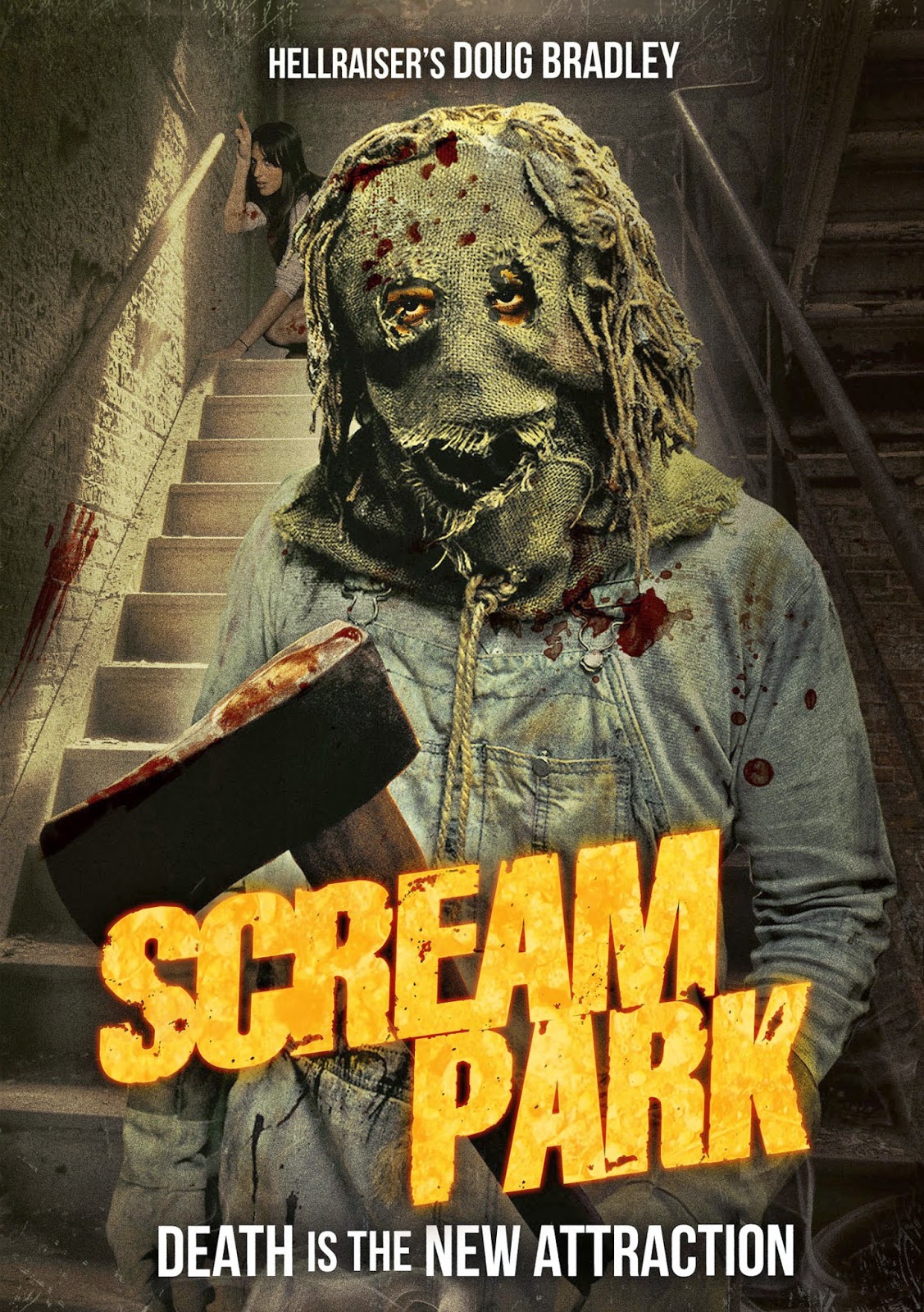
Review: Scream Park

Text © Richard Gary / Indie Horror Films, 2014
Images from the Internet


Scream Park
Written and directed by Cary Hill
Protomedia
Wild Eye Releasing
85 minutes, 2012 / 2014
www.screamparkmovie.com
www.wildeyereleasing.com
www.MVDVisual.com

First-time feature director Cary Hill is obviously a genre fan. Filmed in Pittsburgh, there is a number of nods to George A. Romero and zombies, even though there are none in the film; however, the copyright-free Night of the Living Dead  is shown in a couple of scenes on a monitor screen.

Shot in the spooky Conneaut Lake Park (where scenes from the more mainstream The Road was also filmed in 2009), Hill gives it an ‘80s/’90s slasher feel to the level that one of the characters (the punk guy) actually uses a cassette (before it was cool again), and the manager wears those really big framed glasses that we all wore back then. I dunno, it feels like a time warp with cell phones being the flip kind. Wouldn’t be the first time someone thought of that, but that also doesn’t take away from it being cool.

At a run-down local amusement park – which reminds me of when we used to go to Crystal Beach (d. 1989), Ontario, not to be confused with Camp Crystal Lake – we meet a half-dozen or so co-workers who show various levels of enthusiasm for the job, as the park is on the brink of closure from lack of public interest. We see mostly empty rides and sideshow games with a number of vacant seats. This group is typical of film teens, expressed through high school jackets, though it’s obvious they are at least in their mid-twenties and even some receding hairlines (I’m thrown back to MADTv’s “Pretty White Kids with Problems”). While there is the goth (or punk) girl in a corset with tutu, the horny couple, and the good girl, among others, happily Hill manages to steer away from too heavy handed clichés, such as the jock vs. the nerd. Bravo.

I promise I will try not to give away too much, but I do have to say, the one black guy (who isn’t part of the Pretty Kids group, though equally disgruntled) dies first by being hanged. Really? A black lynching? Things that make you go hmmm, indeed. In my own defense, it’s pretty clear he’s a character that is gonna get it quickly, so I hope I’m not giving away too much. Okay, I’m backing off on the spoilers now.

There are some subtle homages here and there, such as the orange-haired punk guy who is reminiscent of Linnea Quigley’s Trash character from Return of the Living Dead (1985), and one death is right out of The Toxic Avenger (1984). The lead character, Jennifer (Wendy Wygant), reminds me of a taller version of Jennifer Love Hewitt of I Know What You Did Last Summer (1997), and another’s (the exceedingly cute and diminutive Alicia Marie Marcucci) hair style, shirt and plaid skirt is right out of Drew Barrymore’s in Scream (1996). Also like that film, there are two killers (they make that clear from the beginning as they both wear different masks). Perhaps these are coincidences, or subconscious leanings, but I’m willing to bet that it is an honorarium, more than anything else.  Then, of course, there is Pinhead himself, Doug Bradley, in a 4 minute cameo flashback as the amusement park owner, Mr. Hyde (first name Henry?).

This film follows along with the model of Carol Clover’s excellent 1992 analysis, Men, Women and Chainsaws of the women actually being braver and more intelligent than the men. If you haven’t read this book and you’re a genre fan, it’s well worth it.

One flub that annoyed me, and I am saying this with a genuine smile and without a hint of sarcasm, is one person (male) is inside a building and is fumbling with the keys to open the door to let the heroine in before the guy with the ax gets to her, when it is obviously the door has a lever turn-latch, not a key one.  Oh, and why does one of the killers, played by Kevin "Ogre" Ogilvie (AKA Nivek Ogre) from the industrial band Skinny Puppy have (a wavering) southern accent in Pittsburgh? I truly believe it’s important to embrace these kinds of questions with these films, because it means you pay attention to what is going on. Man, I love indie cinema! Hey ho, let’s go! Punk rawk!

While the ending had a nice touch, the theory was clear to me pretty early on.

There is only one topless scene, by the extremely bodacious, attractive, and oddly grayish-toothed Kailey Marie Harris (yes, there are two actors whose middle name is Marie). As for the gore, there’s lots of it, most of it quite effective, even though the fresh blood is bit too dark and heavy on the viscosity (looks like motor oil); the splatter looks much better. Scalpings, beheading, axes, knives, they all look good and the after effects are successful, thanks to Arvin Clay. And that’s what matters, right? Of course, right.

The editing is sharp, the color over-saturation works in the retro genre nod, and the day-for-night functions well. There are the usual first-film inconsistencies (one of the fun things to find for me), such as after someone pulls out a huge bag of raw french fries from under a sink and is then called away, when she comes back she pulls it out again. Shades of Vincent Price’s sweater in The Last Man on Earth (1964). Sure there are the occasional holes here and there, as is fitting the micro-budget and genre, but here’s a thought. If the place is named “Fright Land,” wouldn’t that have made as good a name for the film as Scream Park?

The commentary track by the director is interesting with anecdotes and techniques, but it is a revelation at 1:06 that made a whole shitload of sense to me that I hadn’t thought of before, so kudos for that, Cary. There is also an amusing bloopers reel which is more the cast letting off steam than errors, and as usual with Wild Eye releases, some great company trailers.

As a directorial debut, this has been pretty highly accepted, with rightfully a bunch of festival nods. If you’re a fan of the ‘80/’90s pre-torture porn slasher films, I don’t believe you’ll be disappointed.


Saturday, March 1, 2014

Review: Mad In Italy

Text © Richard Gary/Indie Horror Films, 2014
Images from the Internet


Mad in Italy
Written and directed by Paolo Fazzini     
E2=G Production
Elite Entertainment         
60 minutes, 2011 / 2013    
www.MVDvisual.com

Let me say right at the start, the title of the film is a brilliant pun.

Director Fazzini is not only a filmmaker, but also a historian of Italian giallo films, especially from the ‘80s, and even put out an interesting documentary about the genre, titled Hanging Shadows: Perspectives on Italian Horror Cinema (reviewed directly below this one, or at HERE)

Like any genre, there are subgenres that make up the pie chart of the whole. And where does this one fit in? Well, it’s definitely closer to some of the noir works of Mario Bava and Dario Argento’s Deep Red (1975), say, than anything by Fulci or Lamberto Bava. Fazzini is certainly helped here by renowned cinematographer Mirco Sgarzi, who shot some incredibly beautiful works such as House of Flesh Mannequins (2009), reviewed by me HERE. His style various from artsy to perfectly lit reality, creating moods along the way that fit the tale

For this “inspired by true events” story, we meet our protagonist/antagonist, Davide (Gianluca Testa), a laborer who is let go from his blue collar job thanks to a downturn in the Italian economy (a result of the US collapse around 2008 thanks to the unelected president, Little Georgie Bush). But money is not his only problem, as we come to see him for the schizophrenic sadist that he is.

We come to realize that he has kidnapped a rich industrialist’s daughter (the beautiful Eleonora Bolla), and is keeping her tied up in his rented home in as hillside village on Sicily. But this is more than just a kidnapping, as his mental disease starts getting the better of him. After all, the tagline for this film is Witness the birth of anew serial killer.” While there is a healthy number of cast members, this really is about Davide and “the girl” (as she is known). As people come looking for her, or those who become involved with the drugs he has come to help sell to make some cash, bodies begin to pile up in somewhat gruesome ways.

Cinema giallo was recognized by a number of genre-specific elements, such as the quick zoom (I believe Mario Bava created it and Argento perfected it), and something that is used abundantly and quite effectively here, which is using primary colors to saturate a scene indicating affect or emotion. For example, while the girl is crying, Davide’s head cradled on her lap, they are bathed in a pale blue light; when Davide is having a scary hallucination, the room from where the fear is generating is a sharp red.

Some of the best of the gore and effects happen during these freakouts, such as a woman with a distorted mouth (check out the photos in the extras for a clear view of it), or being in the woods with a group of people biting chunks out of his flesh. While there is more story tension than gore (which is why this is a noir rather than horror), it looks incredibly well done, and the blood has just the right color and viscosity.

The location is also part of the story, with abandoned stone buildings contrasted by wooded areas. One of my favorite shots is of a wooded area you think is isolated, is revealed in a pan to be just on the outskirts of town. The best part of the genre, with this included, is that there are some truly unexpected moments that took me by surprise, which is a nice – er – surprise.

The extras are a 15-minute interview with the director as he walks us through some of the locations (no sets were used), back-scene photos, and two music videos.

There are some long gaps between physical violence, but the malevolence runs throughout. Gorehounds may balk at the space between kills, but those who understand these things will know that the tension building is all part of the fun, and Fazzini shows he knows how to do just that.
 
Trailer not embedding, so find it HERE.