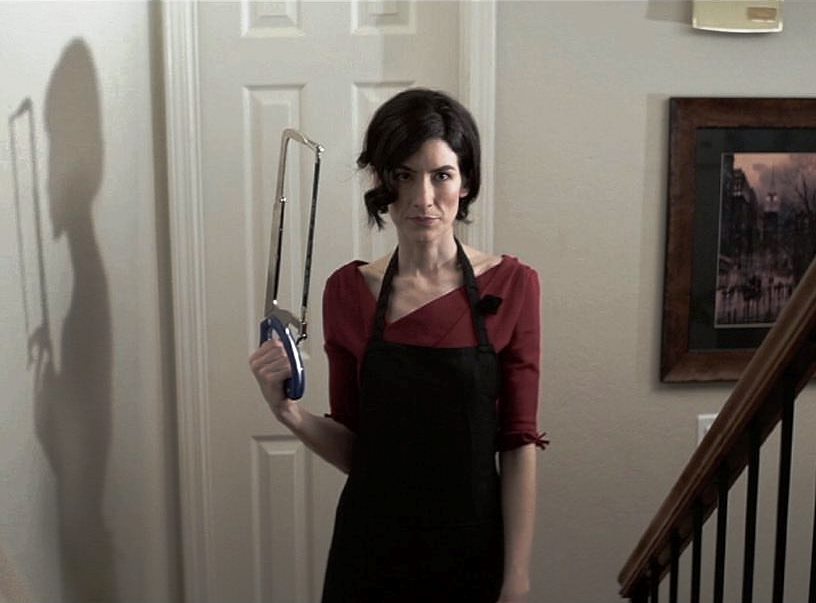
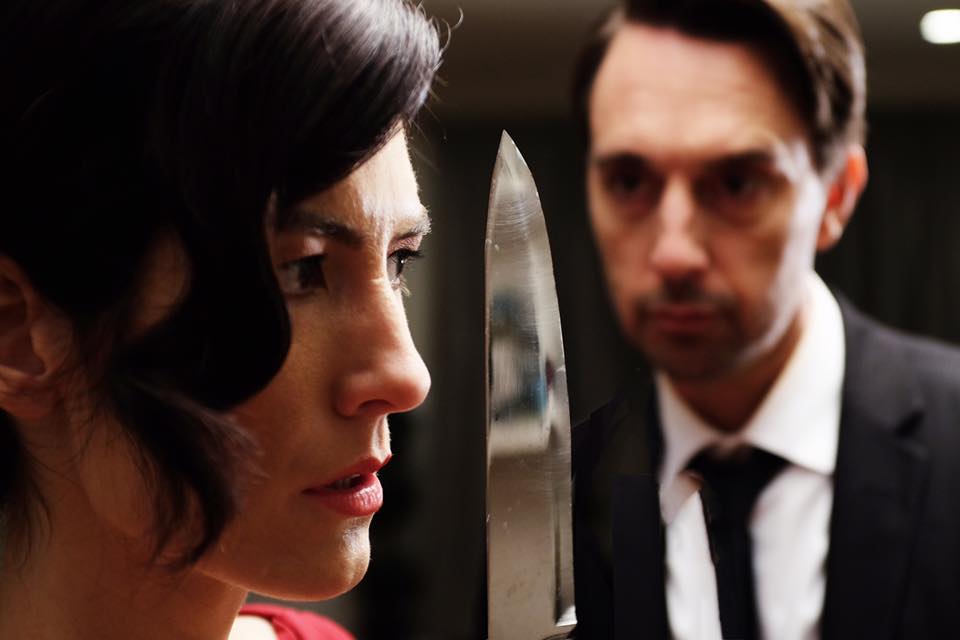
All genres of suspense, terror, and horror will be reviewed by Richard Gary. His address to send preview copies supplied upon request to rbf55@msn.com.
After a
health hiatus, long-haired director Todd Sheets came back stronger than ever with
the likes of House of Forbidden Secrets(2013) and Dreaming Purple Neon(2016). Now he’s dipped his toe into the waters of the even shaggier
werewolf genre.
I haven’t
seen many decent lycan films since Ginger
Snaps (2000), though there have been the occasional ones like Sheep Skin(2013) and Bubba the Redneck Werewolf(2014). No, I do not count the Twilight
series as werewolf films, nor decent (though the first Underworld [2003] was okay).
My theory
for the reason why werewolf releases are far and in-between is the cost of
either the costumes or making digi versions. Most are full body suits, which tend
to be cumbersome, or if digitized, take a full team to make it look good.
For this
film, Sheets takes an interesting approach, asking us to question which is
worse, the big bad trio of wolves outside the door, or the human monster inside
with the knife and sadistic attitude. That is the predicament in which Todd has
placed his main characters.
Anna Rojas-Plumberg and Eli DeGeer
Emily (Eli
DeGeer) and her teenage daughter Eden (Anna Rojas-Plumberg) are on the run from
one human monster, an abusive husband (Aaron Brazier, who has some great tats
on his forearms, including Karloff’s Frankenstein’s Monster and Johnny Rotten
Lydon). When their car is toast, in part due to the hairy trio, they wind up in
a house with serial killer Coen (Douglas Epps) and his hostages, Tina (Millie
Milan), Lucy (Dilynn Fawn Harvey), and Suzy (an extended cameo by Linnea Quigley).
Between
our furry friends outside and the less hairy one inside, there is a lot of
damage that happens to everyone involved, leading to tons of carnage and gore.
Luckily, both of those are Sheets’ specialities, and so is a touch of nudity
for which Harvey amply lends a – err – hand in that department.
Douglas Epps
While
presented more as a werewolf flick, there is equally, if not more so, the dichotomy
of what happens inside the house with the human monster as with the beasties
without. That’s part of what makes this so interesting, rather than being just the
dangers of a straightforward supernatural or shaggy human creature.
Also at
the heart of the whole visual is that all of the effects and wolfie-poos are
practical SFX rather than digital. Sure, the wolves kinda appear as people in full
body costumes, but they actually look really good most of the time. The masks are
also easily identifiable individually, so you know which is which. You can tell
a lot of effort was placed into the costumes, which made me smile. As for the
gore, other than sometimes the occasional innards looking a bit like pasta, the
effects are quite well done. Sheets tends to show the carnage in extreme close-up,
which is both fun for the viewer and I’m sure makes it easier for the filmmaker
to use body doubles (which is totally forgivable if it works, which it does in
this case).
Linnea Quigley (on the right)
Most of
the acting is quite powerful. Other than the occasional over-emoting, such as Epps
sporadic high-pitched maniacal laugh, the cast – including Epps – is pretty
solid. As the two leads, Plumberg and especially DeGeer hold their own as strong
women who are put in extraordinary circumstances. Even Quigley, who on occasion
has had trouble with her boundaries (under- or overacting, as do her
contemporaries, Brinke S. and Michelle B.), nails it here.
Generally speaking, there tends to be two types of werewolf films: the first is when the bearer of the curse becomes an out of control animal, such as in An American Werewolf in London (1981); the other is where they keep their wits and just like to screw with their prey, no matter what the form, like in The Howling (also 1981). This one falls into the latter category. While the werewolves,
who were able to break through doors and rip a tire to shreds with a swipe of
its claws, apparently could not seem to break through the windows of the house, even when
banging on the glass – when I saw this, I said an audible, “Hunh?” – it was then pointed out to me by Sheets that the monsters were playing "cat and mouse" with the occupants. That makes a lot more sense to me.
IThe rest of the film looks
great, with sharp editing and visuals. There is nothing really fancy here, no “artistic
flares,” which suits me just fine. A meat and ‘taters creature feature is just what
the witch doctor ordered for this Halloween.
If I had a
wish, it would be the occasional dark humor here and there, but you know what,
that’s my own thing and not the film’s fault. There are some nods, though, such
as Quigley’s tee, a character named after Stephen Biro from Unearthed Films,
another for Rolfe Kanefsky who recently directed The Black Room, and one called Tucker Woolf
Of course,
watch after the credits as an epilogue has become as nearly omnipresent as a
prologue. As werewolfian cinema goes, this is pretty impressive and another
positive notch on Sheets’ cinematic rap – err – sheet.
I
found it kind of humorous, for a number of reasons, that part of the story in
the film sprung from a previous play production of Agatha Christie’s The Mousetrap, in which many of the
characters performed together a few years earlier.
First
of all, the whole film production reads like a play. It’s heavy in dialogue,
mostly takes place in a single room, and the pacing of the whole thing could
easily be mounted on a stage. As far as Christie goes, this also feels very
Frank Capra-esk in the way the words are spoken in a quick and light patter.
This murder mystery has been compared to the game Clue, but I definitely believe that it’s more the source material of
the dining room murder mystery that they have in common rather than the end
piece.
In a
theatrical way, there are title cards announcing the various acts, and there’s
even an intermission (albeit brief), which helps keep track of just where the
viewer is in the process, and also giving us some point of reference about both
the story and the food.
Did
I mention the food yet? There’s plenty of it as we watch course after course
being consumed, each one unique and all looking very tempting – and occasionally healthy.
This
is a very dark comedy. How dark is it, I can hear Ed McMahon asking in my head?
If this film were chocolate, it would be 90% cacao or more. Of course, that is
definitely part of its charm. Like most murder mysteries – again, let’s use
Christie as an example – there are a lot of characters most foul, and even more
important, there is double-crosses upon double-crosses.
Jessica Graham
In
the story, Joan Chandler’s (Jessica Graham, who is also one of the film’s
producers and published author of a non-fiction book on good sex) husband Neil
(Neal?) has been dead for a year. Not happy with the way her husband was
treated by his friends, she and mutual pal Michael (Christopher Soren Kelly)
decide to take matters into their own hands, and make things right by… well,
the title is more than just a hint.
Each
of the guests, who arrive in serial fashion, are acquaintances of Neil, who have
either worked at the Theater Department of the local university, and have all
performed as a troupe in one of his productions. Guests are an amusing yet
annoyingly self-righteous vegan (Emilia Richeson), a self-quoting
psychobabbling passive-aggressive author (Sheila Cutchlow, who also is actually
a published author), a not-too-bright wannabe documentary filmmaker (Daniel Ahearn),
and a co-professor (Edmund Lupinski). Gifting each of their dinner companions
with objects that were Neil’s that reflect just why the widow feels slighted on
his behalf, it isn’t long before things get pretty tense.
Jessica Graham and Christopher Soren Kelly
The
cast is really tight, like they’ve been doing this particular piece for a
while. Solid professionalism. While there are some standout performances, there
is not a weak moment in the acting, from opening scene to close. That being
said, it feels like the camera loves Graham and either keeps gravitating to, or
lingering on her. Luckily, Graham can handle it, as she says so much with a
snide smile, a frown, or a subtle shift in mood. Kelly is the yin to her yang,
a ball of kinetic energy to her nuances. They spin around each other like a
double helix, boosting each other’s characters.
Of
course, though it needs not to be said if you are at all familiar with the style,
little is as it seems. There is a lot of smoke and mirrors, as there
should be in this kind of story, and I recommend giving yourself enough time to
watch it twice, to catch all the – err – clues you may have missed (I would say
the same about some of the more extensive Christie pieces).
In
case I haven’t made it clear, this is a strong and solid piece of work. The
writing is crisp and sharp as a razor, which never takes the easy way out, even
by the end (which, of course, I will not give away… no spoiler alerts). Considering
the confined space, the camera does not feel claustrophobic, which is quite the
accomplishment in itself.
With
the large amount of bodies piling up in corners of the house, there actually is
very little blood, and the violence is often blocked by the way the shots are –
err – blocked by the director.
For
a set piece with a lot of dialog and extremely lengthy shots (i.e., less
editing), there is also enough of a high energy level to transfer to the viewer
so it doesn’t seem as static as it actually is onscreen. While I tend of find
Christie a bit tedious, the pace remains fluid rather than stodgy even though
this is kind of modeled after that paradigm, so I was riveted by what was
unfolding before me. This is an example of good filmmaking.
The
only negative I can say about this movie is that I can almost guarantee you’re
gonna be hungry, and for something more substantial than fast food. Like this
film, which is a fine vintage, quality stands out.
So, here’s the thing: I have some
film reviews to catch up on, and am even in the middle of one I am enjoying,
but I was just given the opportunity to see this newest Richard Griffin film,
and my writing world fucking came to a halt. Despite Griffin’s tendency to be
extremely prolific by averaging two to three films a year up to this point, for
those of us who revel in indies, this is an event to be taken seriously, no
matter how ludicrous the premise of the film. As far as the ridiculousness
level goes, well, check out the trailer below. Needless to say, I am chomping
at the bit, as it were, in a non-S&M innuendo way.
Playwright Duncan Pflaster has come
up with a script that sort of crosses a host of genres such as Ocean’s 11 (et al.) and Thelma and Louise (1991) group crime
dramady, male stripper and drag queen love stories like Magic Mike (2012) and To Wong
Foo Thanks for Everything, Julie Newmar (1995), in addition to the wild
frat houses of Animal House (1978), and
then tossed the whole thing over the rainbow of any sense of sanity. But does
it all work? Let you know when I’m done…
The basic premise is as follows: Some
male strippers rob the club in which they dance, kidnap a copper, and hide out
in an accomplice’s ex-fraternity, which happens to be during pledge hell week.
While this takes place in Boston, it could be any college as in that city you
can just about throw a Trojan and hit one.
Anthony Gaudette
We meet non-exclusive strippers and lovers
Joey (Anthony Gaudette) who is the ringleader, and Matt (Diego Guevara), and
their pan-sexual-yet-semi-closeted always-in-sunglasses friend Chuck (Dan Mauro) at the Bigg Club,
where they work. And apparently where they rob, when they take off with the
joint’s money, the customer’s clothes and wallets, and a kidnapped police
officer named – of course – Rod (C. Gerlad Murdy).
With Rod’s partner Elaine (Anna
Rizzo) in hot (in more ways than one) pursuit, you know it’s all circling
around to a confrontation of a possible South-of-the-Border-named-stand-off
(see the film to get the joke).
Unlike, say, Magic Mike, the love focus of the story is not boy-meets-girl, but
boys-screw-boys, and there are a lot of
male genitalia on display. Luckily, I don’t have that cultural thing that many
straight guys have where they are put off by others’ peni because they are
under the belief it will make others think they are gay. Body parts are body
parts, and there’s always Sarah Reed’s nudity in the film to keep anyone else hopefully contented. But the male nipples and naughty bits, as it were, far
outnumber the female.
Diego Guevara
Which brings me to a point that I
find quite interesting: as I mentioned Thelma
and Louise above, this film is sort of the reverse side of it (and many
other “chick flicks” – a term I’m not always comfortable with, by the way),
where it’s the men who are the
dashing anti-heroes, and the women
are those who are obnoxious and overbearing. Please note that I find the idea
of this quite amusing. This is the flip of a much more common thread of women good/men bad motif.
There is a nice mixture of insane
love, real love, and just rubbing against each other to cause sparks. As he has
done in previous films such as The Sins
of Dracula (2014), Griffin shows straight sex as boring and missionary, but male-with-male as much
more exciting. But what makes this all work, honestly, is the level of humor
employed. Pflaster’s writing is sharp as a tack, and I found myself laughing
often. There’s no great Dickensian comeuppance, though I’m sure they could
figure out a way to make that into a suitable innuendo as they do often in the
story. However, there are many revelations and a few surprises in store. And my
favorite line may actually be an ad lib, spoken by Rizzo, who demands, “What in
the raging shits is this?” in a kind of updated Dorothy Parker query.
Speaking of which, let me discuss the
cast a bit. Anthony Gaudette can be seen as the – err – straight man, as it
were, as he is the one in charge, and he feeds the comic lines to others more
than he takes them on himself. In the ‘60s, his character would probably have a
name like Colt Steele. With dashing good looks in a pre-chub Ben Affleck kind
of way, his has a good handle on who his character is about. Guevara, on the
other hand, looks like a cute puppy with a biting wit and some killer dance
moves. He makes Matt loveable, yet sharp, and Guevara has the ability to play
to both sides well. The chemistry between the two is a large part of what makes
this film work so well.
Sarah Reed and Dan Mauro
As for the two main female characters,
Rizzo plays a classically hard-boiled, tabacca-chewin’ police officer who feels
the unrequited nth degree for her abducted
partner. She plays it a bit over the top, which is actually nice to see because
she usually plays her parts very subtly and nuanced. As I’ve seen her do some
quite serious and heavy roles, it’s nice to see her take a comic, anger-fueled
character that if the genders were reversed, might be played by someone like
Jack Nicolson or (and this is a stretch) Edgar Kennedy. The lead villain is the
hyper-sexualized (i.e., the frat slut)
Beverly, handled well by Sarah Reed. With a snort to punctuate the end of each
sentence and a Lawng Eyeland-ish accent reminiscent of the Lina Lamont character
from 1952’s Singin’ in the Rain and a
personality reminiscent of Nancy Spungen,
it’s hard to like her (which is the point, of course), yet you can certainly
understand what the Chuck character sees in her, as she can be cute beneath the
sneer.
Another funny side character is the
person running a WonderSpa in one scene, played with gusto by Lee Rush, who
only has a few lines and makes the most of it. During that one set piece,
Samantha Accampora does a wonderful and silent Sam Peckinpaw-ish slow motion
bit. The most sympathetic female character is a lonely quickie mart worker Carol,
portrayed by Hannah Heckman-McKenna. I wanted to give her a reassuring hug
after her scene.
Anna Rizzo and Johnny Sederquist
But the title of Scene Goniff Supreme by far is Johnny Sederquist’s turn as drag
queen Piñata Debris, who makes every scene she is in his own. Even with enough
face paint to make Lucille Ball seem bald and the exquisite Lady Bunny possibly
blush, Sederquist makes Debris seem both ridiculous and a bit sympatric in a
balls-out bitchy way (pun intended). He nails
the drag queen persona, I am assuming in part because he actually does drag
from time to time. Yeah, I’m a Sederquist fan.
There are the occasional weird
moments, like a college student at the frat house calling the library the “lie-berry,”
but it’s also part of the film’s charm, actually. But I want to make sure to
make a comment on John Mosetich’s cinematography. Some of the shots are
stunningly beautiful, such as one of a close-up of Guevara staring at the
camera as flower petals fall in slow motion. That was just one of the moments
where I verbally said, “wow.”
I haven’t delved much into the story
because I don’t want to prejudice the viewer. There is so much that can be
discussed that would give away too much of the story, and more importantly the fun.
It really is a hysterically funny film going to places that most viewers rarely
see. While taking wide swaths with its story direction, it’s actually a very
tight film with few locations (as is common with indies). I can’t wait to hear
the commentary track once it comes out on DVD. And fans of Griffin films are
bound to enjoy a particular cameo that I am sworn to secrecy about. While I’m
at it, be sure to watch after the credits.
Compared to most films that deal with
the male-on-male milieu, this makes The Rocky
Horror Picture Show look like Patton.
If it’s not too much of an oxymoron, you might say that this film is a gay
comedy that has very broad humor. But you don’t need to be either one to enjoy
it, just be glad it’s not in 3D, sit back, and prepare to laugh.
If you are familiar with any of the trilogies of
filmmaker Dakota Bailey’s work, you know his subgenre of super gritty and
grainy life of the denizens of the lowest of low, consisting of nothing but serial
killers, drug sellers and addicts, prostitutes and generally people with whom you
would not want to be on the same street as, never mind the same room.
Like most auteurs, Bailey started small with short
films as he developed his style that remains pretty unique, as there is no one
I can think of who presents characters and situations so socially corrupt with
a fly on the wall creepy feeling, and yet makes them feel alive and fearsome.
These three shorts have now been released in a collection as a companion to his
features.
As the director explains: “While these short films
are not masterpieces, they are important because this is where our filmmaking
style originated, and these shorts provided us with a template to build off of.
Without these shorts, films like The Acid
Sorcerer [2017, reviewed HERE], American
Scumbags [2016, reviewed HERE] or My
Master Satan: 3 Tales of Drug Fueled Violence [2016, reviewed HERE] may not
have existed."
As most of his features are three intertwining
tales, it only makes sense that this release is comprised of three of his
shorts. The consistency of his characters, even if he considers some of his films
in the horror genre and others not, makes this for an enjoyable WTF viewing (in
a good way). I’ve enjoyed all of the Bailey films I have watched, even though
they could practically all run together and it would still work. I have watched
the growth from his first film right to his latest. He also shows that if
someone wants to just pick up a camera and start filming, it can be done, much
in the way so many people heard the gritty guitar of Johnny Thunders and wanted
to start a band.
Scumbags:
A Day in the Life of a Drug Dealer
8:08
minutes, 2014
Despite it being Bailey’s first film, so many of
the footprints that would appear in his features are already there, such as the
insertion of character description and story bit title cards, and the travelog
footage of drug dealer Marshall (Matt Marshall) driving around giving way too
much information about his crimes away on a cell phone (hey, Marshall, that’s illegal!) which also works for passing
along exposition to the viewer. There is
an inconsistent sound quality as most of it is recorded straight onto the
camera as it is shot al(though the reliability of it will improve with time and
future films). In this story, Marshall wants to do away with ex-high school friend
and partner, and now rival dealer, the heroin addicted Johnny (Bailey, already
sporting his trademark knee-length short pants). The film, which is in mostly black
and white, is short, and yet covers some nice ground as bullets fly and vapes
are vaped. The pace is a bit meandering at times, yet there is still quite a
bit of action in this short amount of footage. It’s a bit on the rough side, as
it is most first films, but it’s also easy to see the kernel of what is to
come. I am certainly enjoying watching the progression of a style that Bailey
has since made great use of over the past couple of years.
Satan’s
Coming for You
19:37
minutes, 2015
The longest film on this set, it appears to be a
collection of outtakes and additional footage from one of Bailey’s other films,
My Master Satan. Then again, in a
chicken and egg paradigm, perhaps this was filmed first, and it was used to
make up one of the three stories from Master.
Again, in black and white with some color, especially during an acid trip,
this is a loose yet somewhat coherent story about the revenge for Bubba (again Matt
Marshall) and Alister (Bailey) against the person who was having the affair
with Bubba’s since-deceased wife. With body exhuming from a cemetery and a bit
of blowtorch behavior, Bubba and Alister go on said acid trip and meet up with
Satan. From there on in it’s the two friends working through the kinks of
getting away with literal murder.
I Spread
Hate Like Herpes
2:12
minutes, 2015
This is a short-yet-not-sweet uncompleted fictionalized
documentary starring “BK” (Brian Knapp). In its two scenes, BK discusses his
own psychopathic behavior (while driving of coruse, since this is a Dakota Bailey film, and it’s a
given someone will do that). There is no direction, no point, just a camera
pointed at BK as he riffs. What I’m not sure of and wonder about is whether
this is going to be part of a whole film on this character, if the footage is going
to be included into a future Bailey feature, or was this just some goofing
around that was too good not to do something
with it. Too short to be boring and just long enough for head scratching,
it makes a nice coda to the rest of the shorts.
I
have to admit that I was completely intrigued by the title, before even
becoming aware of Navy SEALS vs. Zombies (2015). They share producers, a member of the
writing team and one actor (playing different roles), but they’re pretty
independent of each other, it seems (though I could be wrong).
The
title indicates that this could be really
bad, or so bad it’s good. I’m
hoping for at least the latter, quite honestly. A good action horror film was
due to come over my threshold. I’ve seen a bit of both genres lately, but let’s
see how it works combined. The disc
is going in the Blu-ray player now.
Deep
in the heart of the Texas Bible Belt, there is a small town in Jack County
which is being overrun by five motorcycle-riding demons. They are intent on
gaining the virgin blood of a dozen early teen girls (a social commentary on the
sexual proclivity of older teens, even in the Religious South perhaps?) so they
can enter a church and get…well, I’m not sure. I’ll explain later.
Mikel Vega
These
nasty demons with putty on their face are easily killing males left and right via
disembowelling, and taking the girls, because even shot guns don’t work against
them. What’s a spy-in-the-sky government to do? Why use a cliché and find a
down-in-his-booze-due-to-tragedy ex-Navy SEAL to clean up the matter, along
with two of his buddies.
Of
course he first says piss off because
that’s the way these storylines work. The snobby Navy recruiter wants him to go
down there because the demons are going after Mexicans, and locally no one cares:
“Down there another dead illegal alien isn’t news.” Even the Navy doesn’t really
give a damn, he claims, but they don’t want demon-kind to spread. Again, social
commentary? Considering the director is Latino, this would make sense, and I
applaud it.
The
trio of ex-SEALS ride into town incognito as a motorcycle gang. Wait. Whaaa? Sure,
that’s not going to attract any attention
in a heavily armed, police-based zone. In a cool twist, instead of the old guy
who works the gas station warning the teens to stay away, it’s a young guy at
the gas bar waring the older guys to vamoose. I enjoyed that.
Before
the guys meet the demons, of course there is the mandatory bar fight with the
local Latino motorcycle gang, so they can become allies. After that…
Liana Mendoza
Well,
enough with the plot, let me get to the zeitgeist. Overall, I had some issues
with this film. For example, the female lead (Liana Mendoza) gets to do an uncomfortable
and gratuitous strip scene at a bar. All things considered, it is the only thing
close to nudity in the film, and it just doesn’t work. Mendoza is certainly attractive,
but her comments before and the strip itself feels… unsexy. Again, this is no
reflection of Mendoza; it’s the film’s presentation.
Part
of the reason for this is the extremely cumbersome editing throughout. There
are many jump cuts, inconsistencies of image (e.g., someone picks up a
cigarette, and the next angle her arms are down)¸and too many sharp jumps
between locations. Considering how dark the images often are (I significantly brightened
up the screenshot pictures included), this makes coherency an issue.
The
sound also tends to go in and out a bit, and some parts are hard to make out, hence
my not being sure why the demons
wanted to get into the church, and how that would “spread” the demons. Or
perhaps they said it and I zoned out? That happened on my end a couple of times
here and there.
A
strong feature is the three main characters. Reyes is a sharpshooter who served
in the Middle East, so he does have experience that certainly lends a bit of
texture to the characters. The central and tragic boozy Seal is played by Mikal
Vega, who was a military badass in real life, having 22 years of service in
Special Operations. Oh, and he’s freakin’ huge, man. His is the only character
that any back story. Even so, like most of the others in the film, he is still under-written.
And
there lies the biggest issue of the film, namely the writing. For a large cast,
there really isn’t that big a (on-screen) body count; also there are just a
couple of fights and a vacuum of action. This is a problem for an action film. For example, nearly
everyone rides motorcycles, but the only ones who wear helmets are…the demons?!
Another
annoyance is that while our three heroes and the bikers battle the demons face
on, the scene keeps cutting away to a team in some far off location watching
what happens in Texas from a satellite. How they see inside the buildings is
something I haven’t quite figured out, and honestly, those interjected parts
just feels like padding that was added after the fact.
Lead Demon
We
never really get a good look at the demons as the views are dark, and also distorted
by digi tricks. What one does see is…okay. However, there are a couple of decent
gore scenes, mostly gastrointestinal, but far between.
I
have an issue with the final battle, which I’m not going to give away, but it
all seemed too easy. And the finale was kind of telegraphed more than once
during the last act of the story.
Lastly,
it’s kind of odd that it’s Blu-ray, and yet an extra other than sound and chapters
is nowhere to be seen. How demonic! Though truthfully, I don’t know if I could
have sat through a commentary track and many other Behind the Scenes
featurettes.
All
that being said, I would actually like to see Reyes focus more on some
straightforward action films that aren’t filled with clichés that have been
done to death already. He seems capable, despite my whining. I think he just
needs a better script, and an film splicer/editor with some eye for narrative. Go
get ‘em Reyes, I’ll be waiting!
There
are actually a number of films called The
Black Room, dating back to one with Boris Karloff in 1935, but each has its
own flavor, and this one delves into more of an erotic and satanic Hammer-esque
realm. A few decades ago, the male lead would probably have been played by Ralph
Bates.
It’s
been a long time since I saw one as spicy as this one. It’s sort of a cross
between the semi-classics The Entity and
The Incubus (both 1982) and the
gateway-to-hell-is-in-the-basement subgenre, and then something you might have
seen on Cinemax in its day. That being said, it’s not exactly in the softcore
realm, but I’m getting ahead of myself.
In
the inevitable prologue, we meet an older woman (Lin Shaye) and her
nightie-clad granddaughter, who have retired to separate bedrooms; but there is
evil afoot as one is sensually stimulated and the other one gets angry (I’ll
let you guess which). A nice choice is that the scene actually goes beyond
where you would think it might, giving a fuller ride than just a set-up; although
yes, it is exposition in its way, or at least a whetting of the audience’s – err
– appetite for what’s to – err – come.
Lukas Hassel and Natasha Henstridge
In
most cases, the next scene where the new couple moves in usually takes place
decades later, but here it is a mere two years, which is a lot more realistic
(that is realistic in a genre sense).
In a brief cameo, the ever-cool and grossly underrated ex-Tromette Tiffany
Shepis plays the real estate agent who sells the demon house to married couple Paul
(Lukas Hassel) and Jennifer (Natasha Henstridge).
It’s
not long before they’re unintentionally playing footsie, as it were, with
Incubi and Succubae. Lights flash, cameras do a tilt-and-twirl, and, well, you
know. Gotta say Henstridge is still quite the looker, and so is Hassel. I’m
sure there are going to be a lot of both women and men who are going to be
paying attention to his often shirtless physique.
As
there usually is in this kind of film, since the two main characters need to go
on for a while in the story, numerous peripheral characters fall prey one by
one to the increasing number of demon denizens, including trades people,
friends and relations. By the end, there is quite the – err – satisfying body
count number. The story isn’t deep, but please, did you expect or even want it to be. It’s quite enjoyable and
most of the fine points are – err – touched upon, such as gore, SFX and sex.
Now,
I’m been kidding the film with all the innuendos, but truthfully it’s a fun
film to watch. It never really gets a chance to sag in the story thanks to some
sharp editing, decent lighting, and a fetching cast. And the story does hold up
throughout, without wearing out its welcome. It’s just sensual enough to keep
the eyes on the screen, and yet not enough to bludgeon anyone to the point of
numbness and being overdone. The pace builds, especially in the second half as
it should, and nowhere in the continuum did I ever to the point wanting to say,
“C’mon already, lets pick up the pace!” For example, as I’ve stated before, I
get really annoyed when someone is searching through a house or factory with a
light, and it goes on and on to the point where even when the jump scare happens, I’m too bored to
care. This never treads the water long enough to do that. I’m grateful.
One
question I do have, which is kind of a mundane one but for some reason it stuck
out because this happens occasionally in the haunted house milieu: Henstridge
and Hassel move into the already furnished house. They are not exactly, well, a
young couple. While I’m not sure how long their characters have been together,
but surely they must own something
either together or from previously by this age (both leads are in their 40s). In
the real world, of course, I realize that this way the film crew can use the leased
house without disturbing anything of the real
owners, but for some reason it stuck with me.
There
is, naturally, a high and exaggerated (and enjoyable) level of both sexuality
and sensuality, but oddly, cautious nudity. With one exception, an occasional breast
makes an appearance here and there, though we often get to see Hassel with his
shirt off or open. It’s almost like the director was obsessed with his
six-pack. Not that there’s anything wrong with that.
Arthur Brown is the "God of Hellfire!"
I will say the acting is top notch. No one in the main
cast gives a bad performance, and there are some interesting cameos, such as
the aforementioned Shepis, genre stalwart Shaye (who has been in a ton of films like A Nightmare on Elm Street right through the Insidious franchise),and two pivotal musicians who play a part in
the background story: Al Jourgensen of the band Ministry, and I’m happy to say
Arthur Brown (as in The Crazy World of Arthur Brown… we even get to hear a bit
of a re-recorded “Fire,” a song I’ve loved since the first time I heard it); I
recognized the make-up he wore here as being the same as he used in the ‘60s
during his height of fame. There are also the likes of model/actor Dominique
Swain, and bubbling under actors such as Nick Principe, Elissa Dowling, and
Michael Reed, most of whom you’ve probably seen a few times but never really
knew it (yet).
Speaking
of Ministry, there’s Jennifer’s diminutive sister, Karen (Augie Duke, who is a
full foot shorter than her co-star, Hassel). When we meet her, she is
supposedly punked out, with a buttons and a patch on her bag by British band
GBH. However, her make-up is completely goth (or emo, depending on how you look
at it). Of course, she’s snarky. Later on, she wears a tee of the Industrial
Metal group Ministry as a nighty. She’s musically all over the map; again, I
realize this has nuthin’ to do with nuthin’, but still…
The
gore is decent looking and smartly not overdone. The sets, especially near the
end, was decent, though looked a bit late ‘60s or ‘70s-ish, like a Star Trek planet. Still, it was fun and
lots to look at, which is impressive on a small budget. I also enjoyed that
many of the demons are seen merely through their red hands, another brilliant
(seriously) budget saver.
As
for the extras, as this is a Blu-ray, there are lots to choose from, such as
numerous extended and deleted scenes. This is why I commented about good
editing. While these were enjoyable to sit through independently, some were a
bit wordy, and were right to go, but I easily sat through all of them without a
problem. There is also a short Behind the Scenes piece that focuses on a
particular scene near the end. The Blooper Reel is not very long, but enough to
be entertaining. It certainly looked like they all got along. Add on both a
Storyboards and Slide Show featurette, for some more behind the process
moments. Of course, all this stuff should be watched after viewing the film. For example, part of what makes the
storyboards so interesting is to see the differences between it and the story,
such as the icon used to trap the demon. I’m also happy to say that the slide
show is by a photographer between scenes and of SFX tests, rather than just
freeze-frames of the film, as is often used.
The
weakest point of the entire package, however, is the commentary track. Featuring
the director, Henstridge, Duke and producer Esther Goodstein, there are some
nuggets in there, but as with too many people with egos talking, they
consistently make comments over each other so it’s hard to make out what’s
being said. But even worse, someone will actually interrupt an anecdote to make
their own unrelated remarks way too often. You won’t miss much by skipping
this.
However,
the film proper is worth the view. It’s fun, well written and acted, and keeps
a good pace. Yes, it’s also sensual (for both genders, which is a nice touch),
but not to the level of the old EI Entertainment stuff (with the likes of Tina
Krause and Erin Brown, known then as Misty Mundae). Definitely worth checking
out.
This
zombie extravaganza is a collection within a compilation. What I mean is that of
2-discs that was put together, one of which was already a set of two films. The
first was called Grindhouse Zombies: The
Dead Shall Inherit the Earth (WWMM loves the word “grindhouse”; that’s an
observation, nowhere near a complaint). The second is the solo film, Dead Walkers: The Rise of the Fourth Reich.
DISC ONE:
Zombie Factory (aka Zombie Field Trip, aka Zombie Isle)
Written
and directed by Robert Elkins
American
Eyesore Films / WWMM
110
minutes, 2014
While
played straight, this film is definitely handled tongue-in-cheek. It is
supposed to take place in 1978, and actually looks a bit like the style of Mother’s Day (1980). Though likely shot
on a digi-cam, the film has the appearance of washed out or discolored film
stock from the day. The tone of the
film is quite purposefully amateurish, reminding me of those ‘50s films they
used to show in schools like “My Body is Changing,” but without the rinky-dink
music behind it.
Also, it’s
obviously positing a miniscule budget; for example, when the local sheriff
gives one of the female students a business card, it’s hand-written. Mini-budget
in the 1970s or even 1980s was different than it is now. With a relatively
inexpensive camera, a film can be made for just a few hundred dollars or less
and still look damn fine. Back then, when it was shot on literal film, a micro-budget
meant inexpensive (sometimes past its expiration date) film stock and cutting
corners wherever possible.
The acting
isn’t quite as wooden as, say, Night of
the Living Dead (1968), but that is definitely the tone they seem to be
going for, and it is actually quite effective. Once you get used to the
discoloration (other than the red tones, which “pop”), the bad edits that are
supposed to look like the film broke and was edited back together (seen that
happen in person when I worked in a movie theater around the time this was
supposed to take place), the whirlpool of the effects become more secondary to
the action.
We join a
group of students and a randy professor named Grant Foster (no relation to the
sunglasses, I supposed…) with a stereotypical corduroy jacket, wool turtleneck,
pipe and beard, and his students as they look over a supposedly deserted island
for rare plants. The ship captain who takes them over is a decent additional comic
relief.
Once on
the island – excuse me, isle – they
set off in pairs, including the two dumb blondes who are actually more fun to
watch than annoying, the lustful girl and disinterested nerd, the militant
feminist and the horny chubby guy in the afro wig, and the professor and the smarter-than-the-professor
“cute one” (Kyle Billeter, who by far gives the best reading of the cast); he
tries to “mansplain” everything to her while doing a Cosby by spiking her drink
with booze. He continually proves he has possibly the least smarts of the
group. But to paraphrase the song, “Only the dumb survive” (for a while
perhaps…).
In pretty
quick order the last pair find a sign indicating the United States Army has
banned anyone from the isle (though that doesn’t stop them), and the zombies
come out in force exposing the viewer to a strong mixture of cheesy and well
done extreme gore. There are a lot of George Romero (d. 2017) references in
these zombie kills, but the better for it, in my opinion.
Then we
get introduced to the (of course) escaped Nazi scientist with the really
(purposefully) bad German accent that is behind it all. As escapist fun goes,
well, you are never taken out of the film, meaning that you are always aware
that you are watching a film thanks to all the jittery digital additions –
although all the appliances are real and well done – but that actually feels
like part of the parade, and this actually ended up being more fun than I was
even expecting. And don’t even get me started with the vengeful three-headed
monster added in for… well, why not?!
Who will
survive! Will the Nazi prevail? Will the zombies make it off the isle? Will the
living? All this and more!! Other
than being a bit too long, it was an enjoyable experiment in retro-zombie
cinema. I’m gonna like this film, even if the director is (still) a Trump supporter…
Zombie Holocaust (aka Flesh of the Living)
Written,
produced, cinematography and directed by Robert Elkins
American
Eyesore
70
minutes, 2012
What a
difference a couple of years make. Directed by the same person who did Zombie Isle, but a couple of years (and
films) before that one; there is a wide range of knowledge he seems to have
gained betwixt the two.
This
earlier film is less of a narrative than a series of set pieces intermingled
via editing. A solar flare has sent radiation to the earth, raising the dead to
become flesh-eating zombies. They are the stumbling kind rather than the
running, but they still manage to get up enough speed to cause some serious
damage.
The
earlier part of the film that introduces us to the gutmunchers takes place in a
cemetery (this definitely a love-letter theme to Romero, with his influence
present throughout), and then we move on to a night in downtown wherever this
is supposed to take place (filmed in Petersburg, VA), especially around the
fence of the IGA Supermarket, apparently.
The visual
effects are still quite well done with lots of ripping, biting and gnashing.
The exposed teeth appliances definitely look better in the than other film, but
are still nicely done. While it is certainly understandable due to budgetary constraints,
the digital effects, which consist of a lot of gunfire and explosions, look
just like what they are, relatively inexpensive digital effects… but I am
totally forgiving with that and it didn’t bother me, just that it was noticeable,
so when you see it, you will be aware.
While most
of the characters come and go, or are dispatched, there are some reoccurring
characters, such as the hard as nails Agent (Sarah Bella). Most of those who
reappear, though, are comic relief, like an often-interrupting news broadcast
with an increasingly sickened anchor named Harvey Leads (David Witt, who played
the Nazi scientist in the other film), some re-election adverts by right-wing
President Corman (Jerry E. Long, giving an anti-zombie agenda – “…for a
zombie-free America” – that actually sounds similar to what we are hearing now
with the anti-immigrant jibbing; I’m assuming the name of the president is a
nod to Roger), and Willie-Bob (director Rob Elkins) who, through a comic
character, is promoting not only his “indoor shooting restaurant and bar,” but
is also subtle-as-a-mallet pushing a pro-hunting message to the audience.
There is
lots of subtle humor scattered throughout, such as the newscasts, or a moment
when the zombies react to punk rock on a radio. While the film may be all over
the place, the effects are well done, which more than makes up where the plot
is lacking.
Also
included as an extra is Elkins’ 30-minute short, Chick’n-Head, from 2011. It’s a satisfying tale of revenge by a
homeless voodoo woman who strikes back at a trio of other street trash. I won’t
say much except Chick’n-Head looks just like the puppet that it is at first,
and a guy in a suit resembling an evil ball game mascot, but it’s easy for
forgive because the whole is greater than its parts here.
The only
other extra on this disk is some WWMM trailers, which are also fun.
British
director Philip Gardner has quite a few films under his belt, some of which are
fiction and many more “documentaries” dealing with the likes of conspiracy
theories and the occult.
The basic
plot elements here are that a secret agent of the British government, known
simply as Alpha One (Philip Barzamanis), is back from a mission and under
psychiatric care because of hallucinations and recurring dreams – make that
nightmares.
His
previous assignment, as we are shown, was to find a group of present-day Nazis
and eradicate them. However, they are using some occult or scientific force to
raise the dead to bring about, yeah, you got it, the Fourth Reich.
Most of
the film takes place in a warehouse, and it’s pretty easy to guess (not saying
I’m right, but it seems obvious) that the hospital scenes are shot in the same location.
Alpha One’s sleeping quarters just seems too…dingy, and the room where he is
questioned by Dr. Gavreel (Bob Lee, who reminds me a bit of a less slovenly Joe
Fleishaker [d. 2016]) looks like a shower room.
Through
flashbacks and dreams, we see either what Alpha One saw, imagined, or dreamed.
That’s actually something I liked about the film, that the question of what actually happened/is happening is left
up to the viewer (I definitely have my own opinions). In fact, that may be the
strongest positive in the film.
There are
a lot of references through the story, intentional or not (though I believe it’s
more in the former’s corner), such as the Wolfenstein
video game (no german shepherds, though), Ilsa
She Wolf of the SS (1975), and even Groundhog
Day (1993). The zombies, however, are based more on the Nazi undead subgenre,
such as Dead Snow (2009) or even as
far back as Shock Waves (1977, where the
living dead are more “killing machine soldiers for the cause” than just roaming
around for human flesh (unlike Zombie
Factory above, which takes the rare step to mix the Nazi and meat-eating zombie
genres).
One of the
problems with the film, right from the start, is that it tries way too hard to
be arty, but fails in that regard. For example, there is a lot of mixing of
color, grayscale, and especially blue or green monochrome to look like night
vision cameras, with electronic POV “noise” (such as when we saw through the Terminator’s
eyes). It is too distracting, especially since it’s never explained who is doing the watching (i.e., “them”
or “us”).
There are
a lot of fight scenes, especially with fists, but honestly they are even worse
and fakey looking than anything even Steven Seagal does. It reminds me more of
when MadTV did the Dolemite spoofs. I kept thinking, why
are all these Nazi pricks just attacking him barehanded. They have guns, so just shoot the fucker. This adds to the muddled mess of the story.
The male
Nazis are dressed in the typical – albeit modernized – Reich uniforms, but the
women are mostly seen in high boots and miniskirts, some with their cleavage
hanging out, and some in skin-tight leather (or was it vinyl?) clothes. While
the visuals were pleasing, it’s also seemed one-sided; that being said, at
least one reviewer commented on the attractiveness of the often bare-chested
and tattooed Barzamanis, so maybe I’m overreacting?
In all, it’s
not that great a film, and with all the repeating of action and bad fight choreography
(ironically, Barzamanis owns a company that supplies security to bars), it’s
easy to lose concentration on what the hell is actually happening pretty often.
Add in a fuzzy and low-toned vocal track often drowned out by the music, it
doesn’t do itself any favors in that regard.
Another
positive, though, is what few gore effects there are, they look decent, and it’s
a mostly attractive cast (male and female). Unfortunately, the acting is also not
that great, though considering what I could make of the storyline and dialogue,
there isn’t much really substantial to react against.
The extras
are a mostly electronic-based music video by Great Northern Hotel of “Cutz and
Collides,” and some decent and short interviews from Awesome Magazine Online’s “On
the Set of…” with lead actor Barzamanis, the DeNiro-looking (right down to the
mole) Nathan Head who plays the Nazi scientist Professor Matsema, and Eirian Cohen
who portrays the Nazi bitch Captain Orlax. All three of these are followed by
the trailer (yep, we see it three times, though it's different than the one below). There are also some other trailers by
the director included.
I’ve waxed
on about this before, but I’ll say it again: the biggest problem I see in indie
films is when a director also writes the script. There usually needs to be a
second writer or strong editing force to hone the story. A director knows what
the plot is about, but oft times has trouble getting that across. This release
is a good example of that.