Wednesday, December 5, 2018

Review: Creep Creepersin’s Frankenstein

Text © Richard Gary/Indie Horror Films, 2018
Images from the Internet


Creep Creepersin’s Frankenstein
Directed by Creep Creepersin
Creepersin’s Films
60 minutes, USD $14.95
creepersinfilms.com
MVDvisual.com


Sometimes films like this piss me off. I mean, $2 budget, single location, three or four actors, and it tells a story in an hour. Why does it make me angry? Because this nickel-and-dime job is better than a lot of what I see coming out of Hollywood these days. No, dummy, I’m not mad at this film, but those filmmakers who spend millions to bore me, when it really doesn’t take that much to put out a good show with some talent behind ya.

The Frankenstein of the title is, in reality, the name of the protagonist’s pet rat. Victor (all the main characters have names that are in some way related to Mary Shelley’s book), portrayed by James Porter, is a lonely man living on an acreage (filmed outside Eugene, OR). After a childhood of verbal violence by his mom and sexual abuse by his dad, Victor is a severely mentally damaged human.

His day consists of waking, brushing his teeth (which we watch from a distance for a good couple of minutes the first time), eating his scrambled eggs (a symbol for his mind, I gather) while reading porn, playing with his white rat companion (whom he often carries around), and sitting on the porch as the gray days pass. He keeps the television on while old horror flicks flash (scenes include Chaney Sr.’s Phantom and Hunchback, Night of the Living Dead, Carnival of Souls, White Zombie, and Nosferatu). As the action continues, bits of these films are edited in as they reflect the action in the story. This is very well done, I might add.

The run-down, less-than-homey house is obviously the residence in which he grew up, with skimpy bamboo curtains and dark shadows. As a nice touch, behind the kitchen table is obviously his childhood dresser, filled with the stickers, and a front of one of the drawers is missing. This one object alone, whether the director meant it or not, is completely symbolic of Victor’s entire life and frame of mind.

His only visitor is a social worker who occasionally peeks in on him named Shelley (get it?), played by cigarette-growl-voiced Nicolle Nemeth, who looks like she is or was a hot biker chick. She bullies and teases him, making fun of his handicap for her own amusement. Generally speaking, she is not a nice person. As an interesting directorial choice, whenever she speaks, the dialog is played backwards so the viewer cannot understand what she is saying. Victor responds, as obviously he does comprehend, and his speaking is played normally. Even though Shelley’s soundtrack is in reverse, the tone is clear in what she means. This touch is just one of the many pleasant surprises and twists that make this film more than the usual indie drop.

Ever so quickly, his mind starts going further and further around the bend from reality. Victor begins hearing voices (by the Creeper, himself) and seeing his mother who sits with her back to him (Nikki Wall, Creepersin’s real-life wife and film partner), tormenting him and calling him gay slurs because of his paternal molestation.

Distressed about his solitude, he has an idea by glancing around the room and seeing a copy of The Annotated Frankenstein, Grey’s Anatomy books, and a nudie mag: Victor decides to create his own human companion. So when a young couple trespasses on his property, he hammers the woman (literally) and brings her back to his cabin. Carefully, using a marker, he draws lines on her body that make up the classic scar and stitch marks on the filmed Frankenstein’s monster. As he does this, he paraphrases Colin Clive’s classic line, “She only sleeping, waiting for a new life to come.”

There is an argument in Victor’s mind between him and the rat (yes, they “talk”) whether to name ”his creation” Elizabeth or Mary (the rat wins, and the latter is chosen; of course in the book and film, the creature had no given name), bitchily played by Kelly Kingsbury. He imagines her getting up and joining him for breakfast, with her first words (in his mind) being, “This coffee tastes like shit,” which is the kindest thing she has to say in the next few scenes. Again, this is where the joyously unpredictable comes in and style takes over. When Mary is talking, she is in a red filtered lens and is presented as a silent film, complete with title cards. Victor (who is often bathed in blue light) even has a conversation with her in the same shot, with Mary in an enclosure within the frame (shown briefly in the trailer, below).

While I won’t say more about the plot, I would like to add that I am duly impressed by the imaginative way this film is presented. Yes, there is a bit of scenery chewing, but Porter manages to make his character both demented, yet highly pathetic. I’m not sure how much Kingsbury was actually acting, as she obviously was not having a good time and didn’t even show up for the second day of the two-day shoot (as explained in the 30 minute or so Making Of documentary bonus feature). I would have liked to have seen more of Nemeth’s character, perhaps an explanation for her cruelty at worst, uncaring at best.

While A.L. Smith, Cordell Stetson, and Creepersin certainly did a great job with the editing, it is worthy to note that there are also some lengthy shots (I am guessing they had one real camera, other than the one used for the Making Of, which likely was a mini-cam). I have been seeing a lot of recent indie films in the horror genre, and this is definitely one of the better ones around. There’s not really any gore (though some blood), no nudity (other than pans of a magazine), nor much of a boo! factor, but there is definite tension and suspense going on, and this is definitely story driven.

The Making Of documentary is called “A Test of Our Own Stupidity,” mostly taped by Stetson on the second day of shooting. My suggestion is to just fast-scan through the first 10 minutes, which lives up to the title, as the crew stands around, smoking, jabbering, and not really saying anything noteworthy (other than the off-hand comment about Kingsbury’s unhappiness about the first day, but no details). Once Creepersin starts talking about his filmmaking process, and we see them setting up shots and filming, it gets more interesting, if inconsistently.

There are three trailers for this film added in the special features section, which is good, but I would have liked to have seen some from Creepersin’s other flicks, such as OC Babes and the Slashers of Zombietown, Creep Creepersin’s Creepshow, The Corporate Cut-Throat Massacre or (and I kid you not) Vaginal Holocaust.


Friday, November 30, 2018

Reviews: The Devil's Camera; Virgin Genocide

Text © Richard Gary / Indie Horror Films, 2018
Images from the Internet

I have put these two Séan Weathers-directed reviews together because even though they were both released this year, Virgin Genocide is the sequel to The Devil’s Camera. - RG


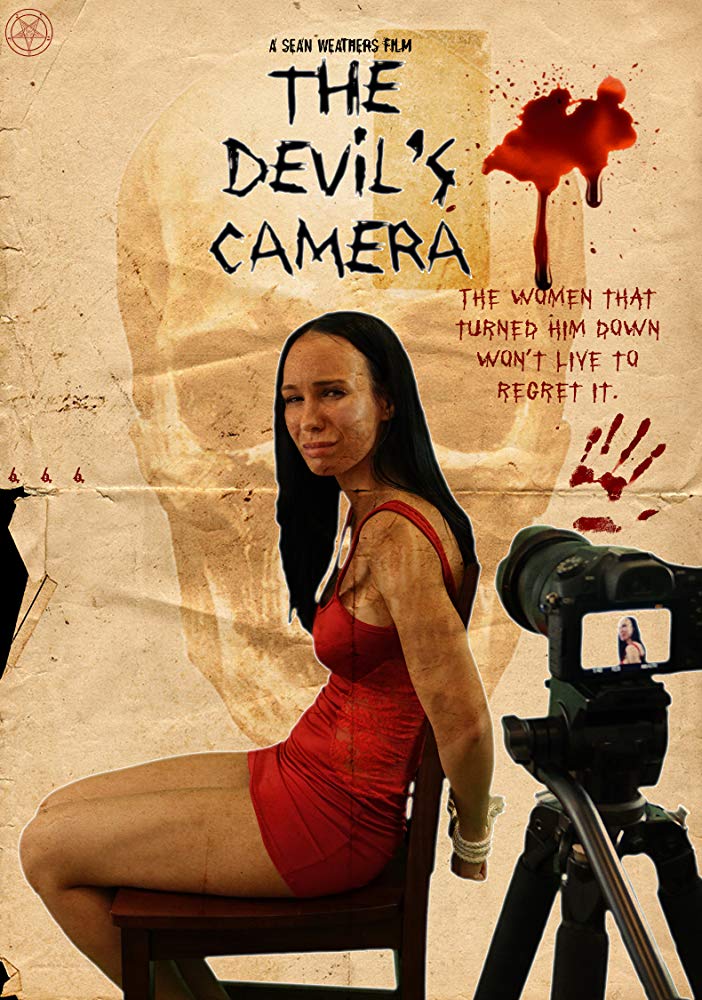
The Devil’s Camera
Written and directed by Séan Weathers
Full Circle Filmworks
51 minutes, 2018
www.facebook.com/Séanweathers

One of Brooklyn’s-own Séan Weather’s filmmaking shtick is to take a modern news story and adapt it into a murderous spree of gore and glee, such as with celebrity cell phone hacking in The Fappening (2015). As usual, Séan is also the central actor and in this case, also the villain of the piece.

This time, the news item is the subculture of the incel, an online group of ironically mostly white men who complain they can’t get laid, and so develop a deep misogynistic bent, and on some occasions to a murderous level.

The aptly named David Cross is – err – cross that he is a 40 year old virgin. Unlike the genial Steve Carrell character, Cross is triggered and armed. It’s hinted at a possible physical (brain tumor, perhaps?) as well as mental issues, but he definitely crosses the line (otherwise there would be no film, am I right?).

Like Creep Creepersin’s 2011 Peeping Blog, Cross follows women through his various cameras that we see laid out at the beginning of the him (and hence the title; though I wonder where he got the money for all this gear when he’s unemployed… But once again, I digress…), hoping to get somewhere and in his neediness and desperation, turns them off. This of course turns on his triggering of murderous rage.


Séan Weathers
Technically this is a found footage flick, but most of the shots are static (e.g., pre-set up in his apartment), so there’s little Cloverfield or The Blair Witch Project kind of shaky nonsense. There are, however lots of subtle (or not so subtle) nuances in the backgrounds, such as the his camera focusing on the Gillie and Marc Puparazzi statues on a Manhattan street, or a six-pack of Angry Orchard beer off to the side, but in the camera’s eye.
As with many of Weather’s films, being the auteur he is (again, compliment intended), this film is episodic in that it is a series of set pieces stitched together. Most of it seems to be his planning or incidental moments (such as phone calls to his mom), which I actually found kind of interesting, and the kills tend of be messy and quick. The body count is nice, and you can take that comment any way you wish to read it.

Séan does a riveting job as David. Even at his most emotional, for example as he’s pounding on a wall in anger and frustration, or when he’s holding his head in literal physical pain, he never goes into the bizarre like he did in his Scumbag Hustler (2014), a film I liked a lot by the way. As for the fodder (i.e., victims), they tend to run from competent acting to a bit on the wooden side, even if their screen time is mostly pretty short. A rare exception to the time frame is with a beautiful woman (Elma Bayliss) who he meets on the High Line in Manhattan. Bayliss does a great job onscreen.

Of course, there could be a reaction to the film with cries of misogyny, and I can certainly understand why considering all the victims are female, but I would like to interject that this is film is a social commentary on a particular sub-set of dudes who hate women. Even with the woman he professes to love, with a chance of return affection, he spews out gender hatred. Yeah, it could be argued about what was Weathers’ motivation to choose a topic like this, but I’m going to pick the side of an indie, no-budget filmmaker who has the opportunity to film guerilla style when he can (episodic), while he can (short scenes), to make a cohesive story about a deranged serial killer. As he explains to mommy on the phone, “I’m not crazy, I have mental issues.”

For me, the one aspect of this that feels weird, other than all the victims being female (even though it fits the storyline) is that Weathers is a handsome and ripped dude. This is presumptuous of me, but I wouldn’t imagine him having trouble scoring. Hey, dude, that’s meant as a compliment, so chill. Besides, I’m not into guys and I know you’re not either. No, put away that knife! Aaaaaarrrrgggg.


Virgin Genocide
Written and directed by Séan Weathers
Full Circle Filmworks
50 minutes, 2018
www.facebook.com/Séanweathers

Of course, it’s the virgin who is doing the genocide, not a genocide of virgins. But I start by digressing…

The sequel to The Devil’s Camera picks up from where it left off, with David Cross (Séan Weathers) being angry and decrying his anger at the opposite sex into his/the camera, portraying himself the victim (lessons from Trump?) as he swears a murderous path for himself.

Again playing with visuals, one woman enters a (real) restaurant on 14 Street in New York called The Crooked Knife while Cross is stalking her. I smiled at that one.

Of course, being the sequel, the violence ramps up a bit, though other than fighting and choking, most of the time we see the results of the violence rather than the contact of non-flesh objects (after so many explicit torture porn releases, honestly, it’s somewhat of a relief). So you get the bloody SFX usually without the need to cover your eyes (if yer so inclined). Though I should point out this is more true of the first film than this one.

What’s also a help is that the names of the characters are mentioned this time, so it is easier (or, as they said in my neck of Brooklyn, more better) to tell who is playing whom. For example, I know it’s Shayla (Talisha Lee) who tells Cross the obvious truth that he will get nowhere picking up women by sticking a camera in their face and being rude. Like most Republicans who voted for the present Trumpville administration, Cross is pushing against his own self-interests into a self-fulfilled prophesy.

One of the subthemes is that Cross seems to be obsessed by the film The Sadist, a 1963 so-over-the-top-it’s-great B-indie starring the underappreciated Arch Hall, Jr.; clips of the film are shown throughout both these Weathers’ flicks.


Sara Rosenberg
Of course questions arise as the film plays out: how far will David go before he gets what he wants? Or after? And is there a comeuppance for his behavior? Well, I ain’t-a a gonna answer any of these questions, you’ll have to see for yourself.

Meanwhile the actresses are, again, attractive with varying talents (though they do better in this film), and there is even a cameo from scream queen Sara Rosenberg (who also played in Weather’s 2016 The New York Butcher).

Weathers really does have a style of his own, and yet it’s grown over the years as he becomes more prolific with his output. The themes may occasionally be similar (serial murderers, serial rapists, serial drug abusers), but still worth the view for the nuances. Or just for the story. For guerilla filmmaking, you don’t hear much from Brooklyn, so let’s remedy that, okay, and see one of his films. It may inspire you to make your own, and that would be a good thing.


Sunday, November 25, 2018

Review: Predator World

Text © Richard Gary / Indie Horror Films, 2018
Images from the Internet

Predator World (aka Aliens vs. Titanic)
Directed by Jeff Leroy
Girls and Corpses / Tom Cat Films / Sterling Entertainment /
Wild Eye Releasing / MVD Entertainment

85 minutes, 2017 / 2018
www.girlsandcorpses.com
www.wildeyereleasing.com
www.mvdb2b.com

By looking at the poster or case for this film, one would hardly know this was a futuristic Love Boat-ish broad comedy filled with sex and drugs, and lots and lots of CGI, including nearly everything except the hills outside Los Angeles and some of the alien rubber suits. Actually, this part of a sci-fi sub-genre that includes such titles as Spaced Out (1979; aka Outer Touch) and Zeta One (1969; aka The Love Factor).


Survivors?: Brenton Jones, Jin N. Tonic,
Kelly Erin Decker, William Gabriel Grier  
The initial flight of the party space boat this time is called Titan-1C (aka Titanic, hence the original title). After a CGI meteor shower of rocks containing CGI scorpion like creatures take over and destroy the ship, a group of six survivors wind up on said planet, unintentionally taking the alien creatures with them.
Between the sex and the drugs (pills that seem to be a cross betwixt ecstasy and Viagra) is a story of survival on a hostile planet, with these scorpionish thingies crawling in and out of people’s various holes and turning them into rubber suited, full size aliens and back to human-looking form.

Now, if the viewer of this film is going in expecting a high-end Predator kind of thing, well, that’s a problem. This is as cheesy as they come, with cheap special effects, over the top acting, and taking the easy way out as often as possible (most likely due to budget constraints). But the sets and the rubberized creatures are no worse that the first season of the original Star Trek or Lost in Space, the latter of which was also cheesy fun when it came to costumes, sets and storylines.
 
Tasha Tacosa
The problem, though, is while the cover doesn’t necessarily looks like a mega-budget blockbuster, it also falls short of its promise with the likes of wannabes, such as Richard Thomas’s Battle Beyond the Stars (1980). Personally, I do not hold it against the viewer who was annoyed by the film as it stands. At least under its original name, there’s some indication of spoof; its present moniker is nothing short of confusing.
Anyway, getting back to the meat of the film, there is a lot of cartoon violence, nudity and sex, especially in the beginning with Victoria De Mare and Bree Olsen giving a cameo nude quickie before being infested by space bugs that makes them and the captain (Leroy’s go-to-guy, Robert Rhine, who was also a producer) look like bug-eyed Snapchat photo apps.

The crash survivors include two couples, some other guy, and possibly the only smart person among them from the crew, Lana (Tasha Tacosa). Of course, no one pays attention to her when she says, “We need to stick together,” and before you can say losing your virginity, there’s drug-fueled sex, metamorphoses, and alien infestation of various shapes and sizes.
 
Decker and Grier
Honestly, of the six, the women fare better than the men. Tacosa mostly does a fine job though she seems to use a bit too much face squinting to show emotion. I have to say I am quickly becoming a fan of nerdy cute Kelly Erin Decker as hesitant lover Terri, who I’ve seen play very different roles in a couple of other films now (Devil’s Domain in 2016, and she was especially effective in Halloween Pussy Trap Kill! Kill! in 2017). Pink wigged Diamond, played by Jin N. Tonic (aka Jin Miller), is an empath who can feel the emotions of others. The guys are Terri’s boyfriend Kenny (William Gabriel Grier), Diamond’s lover Dirk (Brenton Jones), and Zak (Harlan Post). The latter three play to the lowest common denominator; Grier seems to act here more with this eyebrows. But I have to say, they all look like they are having fun, and that is kind of cathartic for the viewer, as well.


Bree Olsen and Robert Rhine

Of course, references abound, such as the Alien franchise (of course), Night of the Living Dead (1968), Snakes on a Plane (2006), The Thing (1982), Invasion of the Body Snatchers (various), and even South Park. Also, the smaller CGI alien creatures (which we see much more than the rubber suited ones) have a lot of humanistic mannerisms, such as high-fives and rubbing their own head when confused, in one case for example.

The only extras are a wack of Wild Eye Releasing trailers, including this one (though it contains way too many spoilers, if you ask me).

While this film will certainly never win any prestigious awards, it serves its true purpose to be mindless (and I mean mind-less) fun. The six survivors are attractive, and don’t really have to put in much work to make the film happen, because it is what it is, once you know what it is – and it’s pretty obvious within the first minute of viewing, if one is paying attention, whether it’s a disappointment of a promise of higher quality or not. And it’s certainly no worse than the likes of Sorority Babes in the Slimeball Bowl-O-Rama (1988) or Sexsquatch: The Legend of Blood Stool Creek (2013). Sometimes one is in the mood for a sloppy joe rather than steak.
 

Monday, November 5, 2018

Documentary Review: The Walking Dead Girls!

Text © Richard Gary / Indie Horror Films, 2018
Images from the Internet


The Walking Dead Girls!
Directed by Tyler Benjamin
Cheezy Flicks / MVD Visual
70 minutes, 2011
www.Cheezyflicks.com
www.MVDvisual.com


There has been a rash of zombie-related tribute films of late, such the cartooned Night of the Living Dead: Reanimated, and Nicolas Garreau’s Fan of the Dead. Now there is the new 75-minute documentary, The Walking Dead Girls!, which further celebrates the newly coined and arguably questionable term, “zimbie” (equivalent of zombie bimbo).

There are some interesting interviews here, conducted on the fly by actress Luna Moon (who also hosted the episodic soft-core Vamp Vixens). Let’s start with that…

It would almost be pointless to have a documentary about zombies in any fashion without interviewing the man, himself, George A. Romero (even though this is supposedly about women zombies). He appropriately comments how none of his films are actually about zombies, but the humans who are put in the extraordinary circumstance of being surrounded by the creatures, and how the living interact socially. It’s been documented how his flicks, such as The Night of the Living Dead series, have a strong socio-political bent (consuming ideology, consumerism, fascism, etc.). As always, he’s a master talker, and his brief comments are interesting. It just amazes me that he’s getting old, because it means I am, too… [Note: most likely you know; Romero passed away in 2017.]

Another interview is with Lloyd Kaufman, who created Troma Films. Though most of his films are not zombie related (e.g., Toxic Avenger [and the sequels], Class of Nuke ‘Em High, Tromeo and Juliet, and Terror Firma), he did direct Poultrygeist: Night of the Chicken Dead. No matter, the admirable Kaufman, who refers to himself here as “a married gay man” (he is hitched to Patricia Kaufman, Film Commissioner of New York State; they have three children) talks about how he went to Yale with Oliver Stone and George W. Bush, and goes on to discuss how hard it is now to get his (and other indie) films distributed in theaters and television, since the Clinton media deregulations. Oh, and though not mentioned here, his book, All I Need to Know about Filmmaking I Learned from the Toxic Avenger, is worth looking up.

There is a talk with one of the original ‘80s “scream queens,” Linnea Quigley, who’s short, butch haircut is a bit of a shocker. She explains how hard it was to play Trash in her breakout Return of the Living Dead (and how much she is happy having done it), and also her role in Night of the Demons. I had a chance to meet her at a Chiller Theatre convention in New Jersey in the early ‘90s, and she was really sweet and charming to me and the rest of the nerdfanboys.

Evil Dead is given a couple of nods, despite it not actually being about zombies. There’s a brief but very humorous interview with the very-underrated Bruce Campbell, talking about his early career. Also, there is a reunion of the three women from the first film, Betsy Blake (who does her demonic giggle), Ellen Sandweiss (who was attacked by a tree in the film), and Sarah York (was credited as Theresa Tilly). They look a bit matronly now, but prove that they can still scream quite effectively. It was a joy.

Some of the other interviews include Martin and Day of the Dead’s John Amplas (who is now an Associate Professor that teaches acting in Pennsylvania), Terry Alexander, the Jamaican pilot in Day, and Boyd Banks, a stand-up comic who appeared in some of the later Dead films and remakes.

We are shown some shots of a couple of conventions (where many of the interviews took place), such as ZomBcon, held in October 2010 in Seattle, and Portland, Oregon’s very humorous Zombie Walk, performed that same month (just coz it’s zombies, do all of them have to have a Thriller dance? Sheesh).

As a connecting thread (threat?) to all the interviews and conventions, we watch the shooting of a zimbie cheesecake calendar, which is shot in pretty straightforward poses, other than the models being made up to look undead (post-dead?) We watch seven of the month’s models as they arrive (i.e., “before”), are made up, their shoot, and on their way out of the studio. Luna gets to ask some Q&As, including asking the participants whether they prefer “slow or fast zombies?” and “brains or flesh?”

The mannequins’ occupations vary from, well, models, to adult actresses and exotic dancers, with ages ranging from 21 to 34. Some come across as kinda vacuous, but others are pretty sharp, with monikers like Mandy Apple, Sexy Lexi, Dara Davey, Lilith Eve, and Natasha Timpani; others just use first name only. While none of them inspired me to desire buying the calendar, it was interesting to see the process from beginning to end.

There’s not a lot of social value to this documentary, but hey, we’re talking about zombies, so the point is the fun quotient, not whether this will inform us about world hunger (unless they desire human flesh, of course). It’s a cool breeze way to enjoy an afternoon with fiends. And as for me? Slow zombies if I'm avoiding, and quick zombies if I'm one of them. And flesh over brains (as food) because it’s less work and quicker to be eating; I like chicken over lobster for that very reason.

Originally published at ffanzeen.blogspot.com.


Friday, October 5, 2018

Review: Alien 2: On Earth

Text © Richard Gary / Indie Horror Films, 2018
Images from the Internet


Alien 2: On Earth
Directed by Ciro Ippolito (as Sam Cromwell)
Midnight Legacy
85 minutes, USD $19.95
Midnight-legacy.com
MVDvisual.com


Fulci. Argento. Deodato. These are names that will sound familiar to those who find joy in the Italian horror sub-genre generally referred to as giallo. The more current ultra-horror films such as Hostel, Saw, and Wolf Creek, may not have existed without these extreme and surgically efficient foreign bloodfests (then again, would the giallo have seen any light without the likes of American pioneer Hershell Gordon Lewis? But I digress…).

Perhaps the biggest promoter of these European films, especially in the New World, was the advent of the new videotape market. During the 1980s, the two largest renters were the extreme horror films and porn. Part of the reason was accessibility. Sure, one could have gone to any of the Times Square theaters and gotten their fill, but anyone away from these kinds of grindhouse theaters would probably be clueless. But then there was the VHS…

One of the problems of seeing these films via video in those heady days of the ‘80 is that the ever-hungry market would release just about anything that might sell, even if it was an incomplete copy; sometimes the story made no sense at all due to sections being removed by a specific European country’s moral codes. This may vary from country to country, so there were many different versions of these releases floating around.

Alien 2: On Earth (originally Alien 2 Sulla Terra) is a supposed sequel to the original Alien, from 1980. While never having an official theater showing stateside, like many of these foreign films, it was released under various names, including Alien Terror and Strangers. Another quirk of the early VHS days was the tendency of the production companies to call just about any film a sequel to anything that did well at the box office. This is a bit of an exception though, because director Ciro Ippolito (who also went by the pseudonym Sam Cromwell for this, his first directorial effort) meant this as an “unofficial” sequel, even though the bonds to the original James Cameron opus are negligible, at best (i.e., human hosts and snake-like creatures eventually popping out).

Alien 2 is, in hindsight, best described as having aspects of Alien, the underground spelunking death-trap of The Cave or The Depth, just a smidgen of The Night of the Living Dead, and the deserted streets scenarios of, well, so many others. The story is pretty simple: an American spacecraft returns to earth, and somehow, between starting its descent and the at-sea rescue (great Mercury-period stock footage is used during the opening shots), the astronauts have mysteriously disappeared. Around the same time, a strange sparkling rock is found by a group of friends (with big period hair, both female and male) in a small town near San Diego, before they head into a large cave system they plan to explore. For some reason, the main character, Thelma (Belinda Mayne), who is sometimes psychic and can tell that something is going to happen (unless it ruins a plot surprise moment, apparently), takes the football-sized rock, puts it in her backpack, and takes it with her from the surface into the cave (why not leave it in the car rather than schlepping it?). This shiny stone ends up actually being an egg for creatures brought back on the spaceship, and when it comes out of the rubbery-looking stone its destination is the host’s body.

From there, it’s a race to get to get out of the cave through alternative directions before becoming lunch. And once outside, will it be much better? Yes, there is gore, as a very puppet-looking creatures busts through a head with an eyeball hanging, or a head slides off a body (both seen in the trailer), for example. Despite the blood and guts, it is more really? than stomach-churning (unless you’re sensitive to these things). However, it is still a pleasure to see devices used rather than CGI.

Oh, and the inconsistent mistakes are wonderful. For example, while running through a supposedly empty city, as the camera follows the main character(s) while a street is crossed, the viewer can see a red light down the block and a car with its brake-light on. When the light turns green, the brake-light goes off and the car starts to move.

Just as with manga cinema, there are definite cues that this is giallo, almost like a checklist. There’s the close-up of the face with a light on it while a mysterious wind blows the flowing hair, the even closer shots of wide-eyes (though the “whites-only” eyes, usually a standard, is missing here), the shrill and two-tone electronic music (ooo-waaaa-oooo-waaaa), the shaky monster-cam view, and the very quick zoom in and out in Dr. Tongue’s House of Horror style. And like many Japanese films, the dubbed, over-enunciated voices are familiar to anyone who has watched a few of these films. In much of this release, while it is obvious that the actors are speaking English, the vocal track is recorded over back into English nevertheless.

Mayne’s character is the only one with any substance (relatively speaking), though there is no history given to her. Everyone else, including her (boyfriend?) (husband?), are inconsequential, or at least the equivalent of the members of the away crew of the Enterprise who were not in the main cast.

Okay, this is a silly film, granted, but as giallo goes, it is a fun flick that will fill an appetite for this genre. Yeah, if you’re a fan of these films as I am, leave your suspension of any disbelief before you slip this disc into your player, and you’re bound to have a fun time. Oh, here are some official things to note about this particular release: it’s in both DVD and Blu-Ray, it’s the first release by new company Midnight Legacy (let’s hope they let a lot more come our way), and it’s widescreen, taken from the original 35mm negative (rather than just copied from one of the myriad of VHS releases) They claim it is the most complete version available. All good news for giallo fans around the world.

So, grab some ‘corn, because it’s just what’s in order for watching this release.

This was originally published on FFanzeen.blogspot.com


Tuesday, October 2, 2018

Review: A Meowy Halloween

Text © Richard Gary / Indie Horror Films, 2018
Images from the Internet

                                  
A Meowy Halloween
Directed and edited by Steve Rudzinski
Silver Spotlight Films
48 minutes, 2018
                                                                                                            
Yeah, I know, this isn’t really the kind of film you’d expect me to be covering. Well, it’s an indie, it has a horror topic, and it’s directed by the creator of the likes of CarousHELL, Everyone Must Die, and Captain Z and the Terror of Leviathan (all of which, and more, have been reviewed on this blog). The fact that it’s geared towards children (kinda sorta) is a positive thing, as it helps bring in the next generation of fans to keep genre films going. Besides, this is also a sequel to last year’s also holiday-themed A Meowy Christmas.

Most of Rudzinki’s stories revolve around a mysterious force that comes from the unknown, or in the case of Captain Z, conjured up, but even then the force behind it is a supernatural entity that originates from occult worlds.

Our main cast of characters in this live action comedy (who we hear think) are a cat named Whiskers (played by Gizmos and voiced by Amie Wrenn), a pet rat who goes by Chuck (Kida, d. 2018; voiced by Aaron Fletchersmith with a cartoonish Noo Yawwk axc’nt), and a human who is a New York City Police Detective called Wally Griswold (played and voiced by Rudzinski). As you may devise from Rudzinski’s character’s name, this film is a non-stop pun mobile. Oh, and Griswold’s police partner is Rick (Ben Dietels, who directed and starred in last year’s horror comedy, Slaughter Drive, also reviewed on this blog).

There are two plotlines going on at the same time, which is never confusing. On the job, Griswold is staking out a house where he believes a witch, Lisa (Cerra Atkins), is doing something nefarious, as kids go in normal and come out monsters. He is obsessed with this. Oh, and Griswold is not very bright, but generally cheerful, which is explained in the film’s prologue.

Meanwhile, the household animals are trying to figure out if the house is haunted, and will go to wild measures and expenses to figure out the mystery. While Whiskers is not exactly anywhere near a rocket scientist (after all, she’s a cat), she certainly more computer savvy than your average kitty; for example, she uses Griswold’s credit card to order a copy of the Nekkomeownicon. But she is also a bit obsessed in her own right with a television show hosted by a guy (Bill Murphy, co-writer of the story) who has his own mumbled and rambling fixation on conspiracy theories (an obvious smirk at InfoWars).

This is a silly film, and is intended to be, as nods of self-reference and word play abound. It’s a kids film the way Bugs Bunny was a kid’s cartoon, with humor that will obviously go over the head of wee ones.

Short and sweet, it’s worthy of a gander if you’re after a hoot, or you have some 10-ish kids around (it may be scary for younger than that, though with what’s available online these days, who knows). It is being made available on Prime Video, free with subscription, or as low as 99 cents to rent. You can get a physical copy from the company website.

Bonus Review:

A Meowy Halloween
Directed and edited by Steve Rudzinski
Silver Spotlight Films
55 minutes, 2017

As I said, although this came out first, I saw it second, so please accommodate some of my comments in that direction.

Underachieving and over-emphatic Wally Griswold (Rudzinski) lives in a neighborhood that is being besieged by robbers during the holidays who like to open the Christmas presents and they pick and choose what to take. Meanwhile, one of the victims, Irene (Renee DiAlisandro) has asked Wally to watch over her family heirloom, a huuuuge ruby worth… a lot.

The two burglars, Barb (Aleen Isley) and Larry (Blake O’Donnell), get wind of this, and decide to make the Griswold household the last stop down the chimney, as it were, and get the jewel as they head out of the country. However, they don’t realize what they are up against with Wally’s pets: Chuck the rat (voiced by Aaron Fletchersmith) and the kitty Whiskers (voiced by Amie Wrenn), who has a fear of Extra-terrestrials taking over the world thanks to the InfoData show she watches, misunderstanding the term “illegal aliens” (again, she’s a cat)

Steve Rudzinski
Both films are full of references to other ones, such as part of this nod to Home Alone (1990), but rather than a bratty little kid setting up snares and traps, it’s a cat and a rat. And they’re practically as successful without actually putting the burglars’ lives in danger (seriously, a paint can on a string, Kevin?; you’re lucky you weren’t sent away).

Also like HA, the burglars are bumbling, though not as nasty as Pesci and Stern, but rather are merely more incompetent. An amusing aspect is that Larry and Wally are probably equal on level of brain power, and both get glee out of little things such as opening presents or pets.

Are these two slices of short cinema a bit over-the-top saccharine? Oh, you bet, but because of the context of the film and the way it is written and acted – not to mention it’s short length – that’s more part of the charm than a hindrance.

Fun stuff.


Sunday, September 30, 2018

Review: Lost Child


Text © Richard Gary / Indie Horror Films, 2018
Images from the Internet


Lost Child (aka Tatterdemalion)
Directed by Ramaa Mosley
Green Hummingbird Entertainment / Laundry Films /
Variant Pictures / Breaking Glass Pictures
101 minutes, 2018

Have to say, I really like many of the local legend subgenre releases, whether the mythical beings are “real” (e.g., can be found on Wikipedia) or made up simply for a particular film. It seems many of them refer to backwoods areas like the Ozarks regions. This one, y’all, is one-a-‘em, about a life-draining spirit that comes in the form of a child called the Tatterdemalion (translated as a person in tattered clothing, or being dilapidated). This film actually began titled with the name of the creature, but they were wise enough to change it to its present, more accessible one.

Leven Rambin
Here, we meet redheaded Fern (a glamoured-down Leven Rambin, o the mainstream-level. The Hunger Games, Percy Jackson: Sea of Monsters, and “True Detective”), who has come home to said Ozarks after nearly a decade to look for her brother, bringing with her a strain of PTSD from multiple tours of combat. While ramblin’ about looking for her kin, she stumbles into a kid named Cecil (newcomer Landon Edwards) roaming around the woods by his own self, and takes him in.

Of course, everyone is nervous that the kinder is said tatten… you know what, I’m really glad they changed the name. Anyway, people keep giving Cecil different kinds of tests (like to see if he avoids salt). The response is left kind of open of course, not to show a hand one way or another.

That’s one of the things I like about the film, that you really don’t know what’s going on between suspicion, fear and reality. Meanwhile, Fern has been fading and weakening, having trouble sleeping and eating. While they take place, the viewer is left to try and guess if these tests prove if it’s the PTSD or perhaps the Tattythingie.

As a side note, one of the things that drives me a bit crazy and seems inconsistent in the storyline is that if Fern grew up in these here woods, why has she never heard of the Tattsrats if everyone else has? This seems like a bit of a plot hole. And let’s not talk about that Cecil wears the same clothes throughout most of the first half of the film, that are unstained while living in the woods, being tan cargo pants and a white tee.

Landon Edwards
Anyway, like most psychological or supernatural dramas, whatever this turns out of be, it has a pretty slow build, so the viewer gets some perspective about the people and the area, though a bit of patience is needed as an uneasy bond builds between Cecil and Fern. Luckily, it’s beautifully shot with hues that are of earth tones, nice angles, and the camera isn’t afraid to linger on a shot for more than five seconds, as with most modern releases; usually the bigger the budget, the less space between edits.

The film seems to take place in the early 1990s, considering the huge size of computer, lack of cell phones and internet, and I’m pretty sure Fern is coming back from the first Gulf War. It was a tipping point in history, just before different cultures would collide and then splinter even further thanks to the World Wide Web. But it also makes people to not be able to look things up and get instant answers (such as me looking up the Tattentinkle on Google).

There’s also three dudes that come acallin’ in one form or another. The first one is Mike (Jim Parrack), a relative Southern Gentlemen social worker type who isn’t afraid of a one night stand, another is Billy (Taylor John Smith) her estranged brother who is a patch of rough and violent southern gravel, and the third, Fig (Kip Duane Collins) is neck deep in the local mythology. Some extremes to choose from, but I’m willing to bet that not everyone is as they seem, even though I haven’t gotten that far (yes, I’m writing as I’m watching).

 One of the things I really like about this film is that it does not shy away from social commentary about the first Bush years. There is extreme poverty shown, a kids in custody problem (which currently still exists, even in the North, by the way), drug use, and essentially backwoods ignorance that one would hope has improved somewhat (though the occupant of present White House may show different).

Jim Parrack
A fanatical belief in creatures in the woods is similar to religious fervour, which brings fear, blame, and then anger in a misdirected way to adapt to what is going on around one; in logic it’s known as a fallacy from ignorance: my sheep died so there must be something evil out there as I don’t know why else.

As slow a start as the film kicks off on, it gradually builds, and the entire third act is an incredible thriller that comes as a surprise due to its step-by-step building of events and personae. If you’ve started the story, give it the time. There’s no jump scares, no viscera, but there is violence and hardship coming to a very satisfying conclusion.

This film has a lot to unpack. It’s more than just about some Untiddytang creature, it’s also about the overarching social and governmental routine as monster, which did not take care of veterans, was unsupportive of extreme poverty, and a social system of child custody, which is one scary mofo (I have loosely been involved with the latter, and see the results of government policy as it stands).

This is definitely from a female perspective, of a female character in a male society, but even with all the political and social standings it presents, it never takes away from the story nor does it hit the viewer over the head. It’s all subtle and emphasizes the points of the story rather than distracts from them.

Again, to be overly redundant, it’s good they changed the name of the film.