All genres of suspense, terror, and horror will be reviewed by Richard Gary. His address to send preview copies supplied upon request to rbf55@msn.com.
A nice thing
about animation is that you can do things that cannot be done on a small budget.
Created in the stiff but “humanesque” iClone software, the shorts are
entertaining to look at. While the movement is a bit boxy, the faces look sharp.
All these films were written (with one exception) and directed by Jason J.
Cross, and are available in links at the bottom of each review. They are
released by Four Sides Cross Productions. These are not in a ranked order, but rather how they were sent to me.
What is
consistent in at least three of these four releases is that the central character
is a strong woman. That makes me happy.
Got to Eat 6:41 minutes, 2020 There is a masked serial killer on the loose, and he has chosen his next
family. They are transient and a bit oddball, but can they handle this young murderer?
The results are quite humorous and bloody. Very simple and to the point, which
is nice. And what is with the very end? Is there going to be a sequel?; I ask
because many of Cross’ releases are serials. This is off to a great start. Full film HERE
To Do 3:11 minutes, 2023 A serial killer ponders over a bound and gagged woman. We hear his
internal monologue of what he plans to do, which the viewer gets to viscerally
see. His thoughts are a poem including such things as biting off her nose.
Creepy and gruesome. Nice. Full film HERE
A Mother’s
Love 13:15 minutes, 2021 A woman is on a first date at her home with a nice man, and they are
just starting to get to know each other, when her daughter gets into some physical
trouble. The crux of the story is how the mother takes care of business and how
far she will go to protect her daughter. It is certainly not what one might
expect. It was cool and she is hot. As with the first story above, there is a
nice self-referential to Four Sides Cross. Full film HERE
Wanted 2:44 minutes, 2021 This is the only story not written by Cross, but rather his 11-year-old “Daughter
(Victoria) and staring my other daughter (Samantha), my wife (Carla), and myself,”
the director explained. Short and simple, a mother and her two young twin daughters
are being questioned at a police station, where the coppers are looking for her
ex-. But there is more going on than that. This may have been written by a
child, but it has a nice twist element to it. Full film HERE
Supercell Directed by Herbert James Winterstern
Thomasville Pictures; Bay Point Media; Short Porch Pictures; Streamline Global
Group; Volition Media Partners; Highland Film Group; Strike Media
101 minutes, 2023 www.strike-media.com
Natural disaster films are
hardly new. The first I remember is Earthquake (1974), but it goes back
at least until The Hurricane(1937), or arguably even Steamboat Bill Jr. (1928). In recent years, cheapie weather-related knockoffs
have been prolific on cable. It is worth mentioning, and I certainly
will not be the last, that the bar to beat, especially in the “wind” category,
is Twister (1996). And rightfully so.
Another aspect worth
mentioning is that there are occasions where an A or B-plus level actor will
appear in an independent film, usually in a cameo or as a favor to someone
associated with it. Here, there are three who are main characters: Alec
Baldwin, Anne Heche (in her next-to-last film; d. 2022), and Skeet Ulrich. This
is rare for an indie flick.
Daniel Diemer, Skeet Ulrich
Tornado alley is where the
film is situated, such as Texas, Oklahoma, and Kansas; the former has recorded more
tornados than anywhere else in the country (it was actually filmed in Montana).
The often-sweaty High Schooler William Brody (Daniel Diemer) has lost his storm-chaser/scientist
father, Bill (Richard Gunn), to a cyclone. But the big Bill has passed down his
fascination with the storms to his young’n.
Much like “Dorothy,” the
weather reader thingamabob from Twister, here there is a machine in a
nascent stage made by Bill that can read the possibility of tornados by
soundwaves that William now works on. That is when he is not hanging out with
love interest, Harper (Jordan Kristine Seamón).
Alec Baldwin, Ulrich
William wants to
understand about tornados and about what it meant to his dad, much to the
chagrin of Quinn (Heche), his scientific genius mom who now makes a living
cleaning other people’s houses. He takes off solo and phoneless in search of
Oz…I mean wild weather. In this day of climate change, it is a topical – er –
topic. He goes to see “Uncle” Roy (Ghostface himself, Ulrich) who drives for a bus
tour to see tornados that uses the Brody name that was bought out during bankruptcy
when big Bill was blowin’ in the wind. It is run and led by the antagonist of
the piece, Zane (Alec Baldwin) – as in “inzane” – who is more interested in the
bucks of his passengers than their safety.
Let me address this for a
second: the women in this film (Quinn and Harper) are reasonable and
level-headed, when it comes to the danger level, but the men (e.g., Bill, Will,
Roy and Zane) are like the videos on social media of macho ubersports
proponents who risk their lives for a thrill (and perhaps some clicks).
Anne Heche
Naturally, Quinn and
Harper set off to find the testosterone-filled tornado chasers, thus bonding
(road trip!!) going from Florida to the west. Wait, so Quinn moved William away
from the Tornados after his father’s death to Hurricaneville? Hmm.
With a ton of exposition
that fills the first act, the wind…I mean the pace does not pick up until about
half way through, when the first tornado for William comes into the picture
while on the tour bus. You know each tornado experienced is going to get more
and more intense, cinematically, as is the paradigm. Again, an observation, not
a criticism. Building up is the way it is supposed to be, otherwise it would be
anticlimactic.
Jordan Kristine Seamón, Diemer
There are some nice
cinematic touches, like never seeing Bill’s face other than family photos, or
going from a storm to watching clothes going around a washing machine. Another
is Quinn asking Harper “Have you ever been to Kansas, Dorothy?” as Harper has
twin ponytails. There are some cool Easter eggs, as well, such as William looking
up Bill on the computer, and for just a brief second, Bill Paxton’s (d. 2017)
name comes up in the search engine.
The soundtrack is – and
really should be for this type of topic – orchestrated and swelling, when need
be, especially reflective of the weather situated on-screen. It is lush and
beautiful, like a rainstorm.
Baldwin and Heche share no
scenes together, but they did in an earlier film, The Juror (1996). While
Baldwin is arguably the biggest current star here, and Diemer is the central
character, it is Ulrich who steals the film with his complex reading of Roy,
who is torn by past occurrences and taking care of the son of the person he
most admired.
There are a lot of Twister
moments, such as one with a car van (though no cows), but at least no one shouts,
“It’s here!!” I will say that the CGI is better, and the storms look more realistic,
as they slash through the countryside. While I found the survivability in Twister
a bit unrealistic, here is it more real feeling, even though the excitement
level is a bit less. Do not get me wrong, there is lots of relatively scary
weather moments, and it is beautiful to watch. My only real issue with the film
is its length. There are lots of exposition moments that could have been edited
down and still arrived at the required destination. I get the feeling it is so
the star power have their own monologues and scenes. Again, understandable.
If you like big storms,
like me (though I have zero interest in storm chasing any more than, say,
paragliding), there is a lot to like about this: adrenaline, rain, hail, and
fast paced weather.
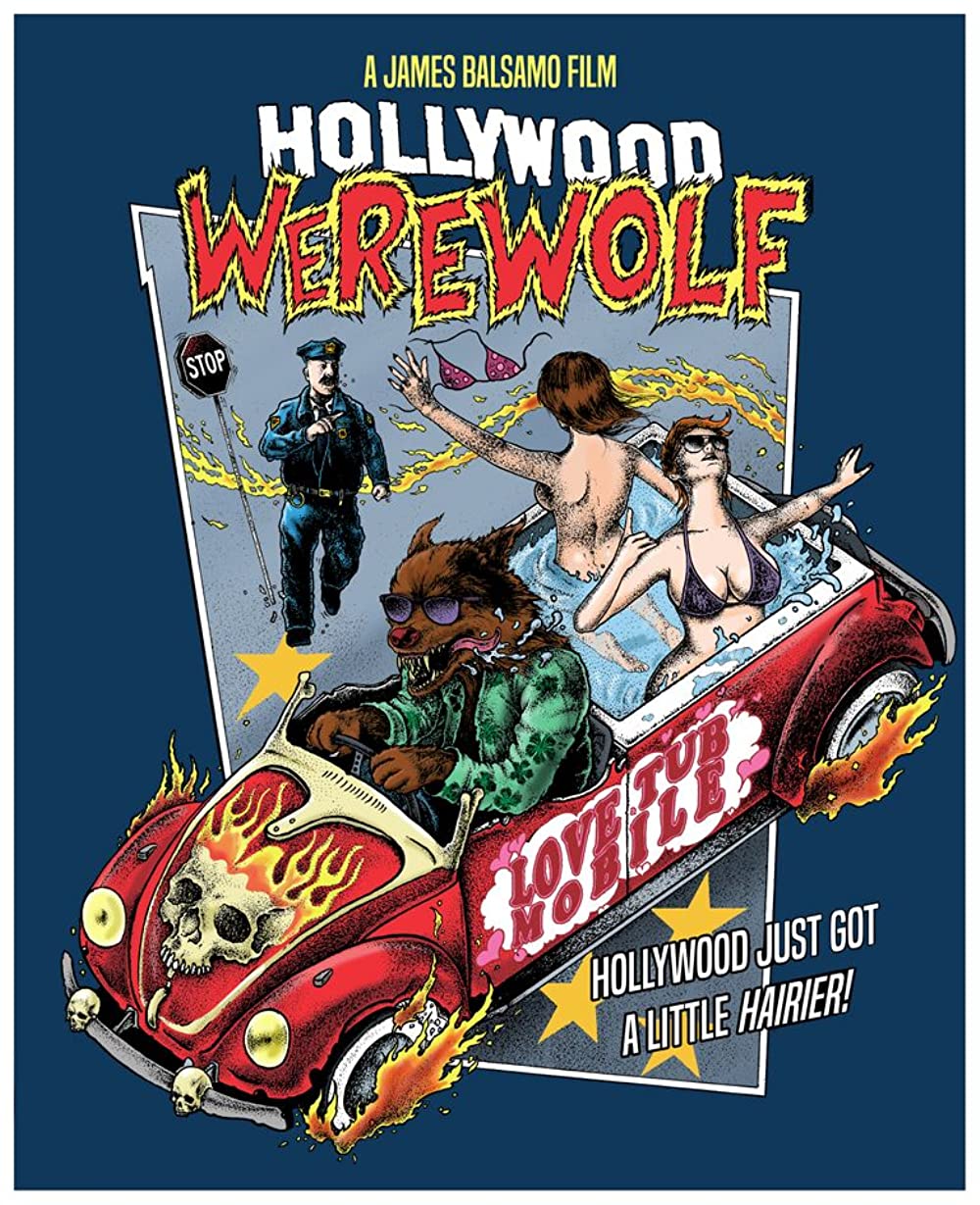
As I have said before,
when you get a James Balsamo film, you get consistency: bizarre silliness,
puns, cameos, and it rarely rises above ridiculous. And yet, every time I hear
a new one is out, I get excited. If you are looking for some deep, serious
narratives, meaningful acting, and arty motifs, well, you just have not been
paying attention.
Andy Dick, James Balsamo
For his latest, he has
managed to rope in Andy Dick (most known for “NewsRadio” and bad behaviour) as
the titular Elliot Wolf. He was a child star who hit the lowest points
possible, not including being a werewolf (which we see right off the bat). But
it was this that led him to the lead part of (a different, as is pointed out multiple
times) visionary director Elliot Wolf’s new film, Hollywood Werewolf.
The premise of this film
is a mock documentary by director Wolf about actor/werewolf Wolf. Confusing? I
think not. This style sets up well for the inclusion of many and many a cameo
by cult musicians, actors and filmmakers, a motif that is omnipresent in Balsamo’s
films.
Documentary films tend to
be short segments strung together in a common theme or topic. This gives a chance
for multiple people to ad lib and have some obvious fun as they promote their
own characters, such as “Saved by the Bell’s” Troy Fromin’s audition tape for (director)
Wolf’s next art film, “The Life and Death of an Avocado.” Mixed in are insults
to (actor) Wolf by the likes of a fired cue-card guy, his limo driver (who
turned Wolf in when he killed three strippers, but still drove him to the trial),
and his poor bedraggled manager, Marvin Orange (Balsamo regular and voice actor
for multiple Manga films, G. Larry Butler).
Then, of course, there are
interviews with (actor) Wolf’s ex-girlfriends, whose talking heads are mixed
with “sex tape” scenes of them in a shower, covering themselves with various
food substances, such as chocolate sauce and baked beans/hotdogs (surely to
show up in Balsamo’s nudity Sexy Time collections).
I will say that some of
the jokes that are bandied about throughout generally work pretty well here,
many dealing with the names of films, or insults to actors (such as Lindsay Lohan;
see the trailer below). Some people interviewed are given names like Chet Taint
and David Davidson, and have descriptor titles like “Wind Enthusiast” or “Urethral
Sound Enthusiast.”
Balsamo has come a long
way from cameos where some band member(s) or actors were obviously filmed in an
alleyway or on the street during a convention where they just insult Balsamo’s
character, whichever it is in a particular film. Here his drop-ins play parts
and seem more connected to the storyline (and from what I can tell, this ain’t
nuthin’ compared to one of his next films, Robot Dracula), such as Eric
Roberts, who has also appeared and starred in a number of Balsamo releases.
As for Andy Dick being the
star of this, well, I will say he was physically present. He did not seem very
engaged with what he was doing, but he actually is not in the film very much
(which is probably a good thing), but the name recognition works. I liked the
sparse werewolf make-up, though, which reminded me – in part – of Michael J.
Fox’s in Teen Wolf (1985)
Despite the bouncing boobies
and petulant puns, there is an interesting sociological aspect to this film.
No, I’m serious! On one hand, it is a commentary on the temporary fame of child
stars and how it can screw up one’s life. There are so many examples of this,
like Anissa Jones (d. 1976, age 18), Aaron Carter (d. 2022, age 34), Todd
Bridges, Erin Moran (2017, age 56), and Dana Plato (d. 1999, age 36), as well
as so many others. Child actor Paul Peterson even “founded a child-actor
support group, A Minor Consideration, to improve working conditions for child
actors and to assist in the transition between working as a child actor and
adult life” (Wikipedia).
Another aspect worth
noting is the effects of fame on those unprepared for it, and how the need to
sustain that level of notoriety even when undeserved for any real talent (think
Kardashians). That is where our titular Wolf stands, at the crossroads of both
of these junctures.
The Green Hornet Directed by Ford I. Beebe (d. 1978); Ray Taylor (d. 1952)
Universal Pictures; VCI Entertainment; MVD Visual
258 minutes (appx. 20 min per episode), 1940 / 2023 www.VCIentertainment.com www.MVDVisual.com
The last serial I reviewed
was 1946’s The Monster and the Ape. And now, here we are with an even earlier one, The Green Hornet. No,
do not expect Bruce Lee (d. 1973) as Kato, the role on the television series that
arguably made him a household name in North America.
Not counting the extras on
this Blu-ray, which I will get to later, there are over four hours of the main
attraction. In the day, you would have to wait week-by-week to see the
entire piece, which would be over 3 months. Now, it is all in one go, and
thanks to the new habit of binge-watching entire seasons of shows, this is
quite doable (though it will probably take me a few days to get through all of
them, and the extras… I have a life…).
Unlike most modern heroes,
such as Batman and Spider-Man, both of which came later, the Green Hornet character
started out as a radio series in 1936, created by George W. Trendle (d. 1972),
transferring into the serial and adapted by Fran Striker (d. 1962), thanks to
its esteem. It was popular enough to snag the original radio series, two
different film serials in the 1940s, the infamous television show in the 1960s,
and a major film in 2011 with Seth Rogan of all people as the title character. The
13 Chapters of this program are listed below. One of the most recognized theatrical
serials released, this is naturally in black and white, but it is a crisp, new
2K scan of the original 35mm master.
In this first of two
series, the focus is not exclusively on the enemies of the State (i.e., spies) from
the War in Europe, but the good old Racketeers and gangsters. Right off the Bat-man,
in an unnamed city, we meet rich newspaper heir Britt Reid (Gordon Jones; d.
1963; note that the voice of the Green Hornet is Al Hodge, d. 1979, who played
him on the radio and would go on to portray “Captain Video” on television) and
his Korean scientific genius sidekick/”valet” Kato (Keye Luke; d. 1991, known
as Master “Snatch the pebble…” Po from the “Kung Fu” television series). In the
heavy exposition (as it is the first episode), Reid saved Kato’s life in Asia, and
he is now working for him in gratitude; in the opening scene, Kato invents a
new and faster car motor, which Reid states, “Wait until I release this on the
world.” Wait, it was invented by Kato… Oh, yeah, it is the 1940s. Also helping
in the house is brogue-speaking ex-cop/reporter/bodyguard Michael (Wade Boteler;
d. 1943) who, unlike Alfred the Butler in Batman, is unaware of the Green
Hornet’s identity; he is, however, the comic relief.
The other two main “good
guys” are the only returning female in the cast, Reid’s feisty secretary, Lenore
Case (Anne Nagel, who would star opposite Lon Chaney Jr. in 1941’s Man-Made
Monster; d. 1966) and on occasion, the fast-talking reporter at The
Sentinel, Jasper Jenks (Phillip Trent, d. 2001). Notably, there are only
three other women who appear, all in a single chapter, and all uncredited.
Future star Alan Ladd (d. 1964) has a bit part as a novice pilot (also
uncredited).
A line that comes up often
is “a new Robin Hood” as the incentive for the vigilante. The Green Hornet’s
goal is to wipe out corruption between politicians and a variety of other scams,
such as construction company who are using kickbacks to use faulty equipment
and materials in their building sites, insurance fraud, a car thief ring, and
so on over the course of the 13 chapters, though most of the topics are
revolved around transportation. The syndicate is run by a mysterious man on the
phone.
Like Batman in the early
days especially, Greenie is seen by the police establishment as a bad guy,
possibly trying to get rid of the syndicate to start his own. Only a loyal
employee sees the good side.
The Green Hornet’s car, Black
Beauty, is souped up by Kato (who was originally Japanese on the radio show but
switched due to the war in the Asian Theater), makes a buzzing sound like a
hornet, that I have learned is made by a Theremin. It is supposed to go 200
miles an hour, but as it speeds past the camera (in sped up footage), the sound
is flat, without a doppler effect. Even that is not mentioned in the IMDB list
of goofs. Strangely, most people get into their vehicles from the passenger
side, rarely from the driver’s. The soundtrack that is worth noting is the
nearly constant use of Rimsky-Korsakov’s 1900 “Flight of the Bumblebee,”
for obvious reasons.
The acting is completely
wooden as is true of nearly all B-films of the period (not just serials), as if
doing stage acting, and the dialogue is laughable. However, this is truly fun
to watch, and it really is better done than most other serials I have seen. It
also mixed footage shot for the series, as well as adding in some historical
b-roll (e.g., mining, dam building, etc.), especially in the first chapter. As
for the car chases, well it is pretty obvious they play the same footage
throughout all the chapters. I am sure this was a wise budgetary decision: remember,
the B in B-films could stand for low Budget. These features were
not made to make money on their own, but to draw people in with a stream of
cliffhangers (a term originated in serials) to see the feature film and its
lesser budget companion (e.g., double bill).
It is also fun to check
out the tropes of the time, just before gangster films were phasing out for war
propaganda and a hint of realism, though one story deals with illegal arms
shipments by someone with a slight German accent (Fredrik Vogeding; d. 1942). For example, everyone wears dark
suits and ties, fedora hats, and when guns are fired, they are always handguns,
with the shooter standing straight up, one foot slightly behind the other, and
shooting at waist level. There are numerous fist fights in every episode, and
all are unintentionally humorous and cliché. Love this stuff.
Wade Boteler, Anne Nagel, Gordon Jones, Phillip Trent
There are lots of fine,
subtle moments, such as the visual of a phone dial spinning melding into
another location of a truck tire going ‘round. In another, Chase saying a line
and cutting to one of the bad guys saying the same line. It is reasons like
this that this serial was so popular.
The extras are on the
second disc. They start with Don Blair and Chris Rowe reading from Clifford
Weimer’s “I Am…The Green Hornet:’ Chapter Six: The Hornet in Hollywood’” (8
min). This is part of an “autobiography” taken from the perspective of The
Hornet, “himself.” It is done with old-radio style vocals discussing the jump
from aural to visual. Continuing with the audio aspect are two earlier radio
episodes of “The Green Hornet”: “The Parking Lot Racket” (1939) and “The
Highway that Graft Wrote” (1940; appx. 30 min each). The last digital extra is
a Trivia (e.g., Reid is the grand-nephew of The Lone Ranger) and Photo Gallery.
On the physical side is a lengthy booklet written by prolific cultural
historian Martin Grams Jr.
Serial title list (disc
1): Chapter 1: The Tunnel of Terror
Chapter 2: The Thundering Terror
Chapter 3: Flying Coffins
Chapter 4: Pillar of Flame
Chapter 5: The Time Bomb
Chapter 6: Highways of Peril
Chapter 7: Bridge of Disaster
Chapter 8: Dead or Alive Serial title list (disc 2): Chapter 9: The Hornet Trapped
Chapter 10: Bullets and Ballots
Chapter 11: Disaster Rides the Rails
Chapter 12: Panic in the Zoo
Chapter 13: Doom of the Underworld
More Americans were killed in the War Between the States, aka The Civil
War (1861-1865), than in any other war in which the United States fought either
before or after. Both sides were abusive to the other in so many ways, both the
northern Union Army, and the slave-loving Confederates. Amazingly, so many
years later, the traitorous Rebels are still honored for some reason (“The
South will rise again!!”). Their symbol, the Confederate Flag, now stands for
treason and racism, but for a while there in the 1970s-‘80s, it was the representation
of rockabilly and the good ol’ boys (and girls) of “The Dukes of Hazard.” But I
sort of digress…
One aspect you may notice about
this film from 30 years ago is that there are many stars that have basically past
their prime since that time, and others that were on their upward trajectory.
Let me start right off the
bat that wherever the story takes, even in the beginning, the work of director
George Hickenlooper is a force to be reckoned with. For example, the opening
sequence is shot in sepia (though full color comes after the credits), that
brownish tone that was present in early photography. Also, there is no shying
away from the blood and gore of that war. Many men had limbs amputated due to
the shattering effect of the weaponry and infections that would follow, sans
anesthetics, and this is reflected early on.
Adrian Pasdar, Corbin Bernsen
As Capt. John Harling
(Adrian Pasdar; 1987’s Near Dark), who is also a preacher, is getting
ready to retire, he is called back to duty by General Haworth (a cameo by
Martin Sheen) to serve under Col. George Thalman (underrated Ray Wise, of “Twin
Peaks” fame). It seems soldiers are being killed via crucifixion, St. Peter
style: upside down on an X-shaped cross (e.g., the symbol of the Stars and Bars
flag), by an alternative army led by confederate Maj. Josiah Elkins (Roger
Wilson). To help Harling, is Union prisoner and confederate leader Col. Nehemiah
Stryan (Corbin Bernsen, of “L.A. Law”). As with the tropes of the likes of Hell
in the Pacific (1968) and Enemy Mine (1985), two sworn enemies will join
to survive.
Seems there are some
undead soldiers who are attacking and killing both sides, and when they do,
those combatants also become zombies. Not the slow, flesh-eatin’ kind, but
nearly human with their intelligence intact. The revenge of those killed,
especially Confederates apparently, is a motif that had been used before and
after in the likes of Two Thousand Maniacs! (1964) and its remake 2001
Maniacs (2005), and The Fog and its remake (1980; 2005). The
difference is that while the Maniacs and Fogs are ghosts, for
this film they are the undead; heck, they are even horny. The only ones that seem
to not come back are those crucified.
With Thalman in charge,
and being an obvious bad guy, the regiment sets out to find the zombies. The
group includes a runaway slave, Rebecca (Cynda Williams, who was married to
Billy Bob Thornton at the time). This leads to an interesting exchange, where Stryan
claims, “God is a Southerner, John,” to which Harling replies, “You think he
keeps slaves, too?” The obvious answer is, no he does not keep them, but
according to the Bible, he permits people to do so: Exodus 21. For me, the argument
is that the whole threat of hell is meant to enslave humanity to God. But I
digress, again… Rebecca is more than she appears, being a mute voodoo priestess
(and what would the Bible say to that?).
Matt LeBlac (right)
Some of the soldiers,
sometimes in cameos, include David Arquette, pre-Sling Blade (1996) Thornton,
Alexis Arquette, A.J. Langer (who plays a boy, so this can never be shown in
the state where it is supposed to take place), and in his first film role, Matt
LeBlanc, who never gets to ask, “How you doin’?”
I have learned (from IMDB)
that the dead soldiers were written to be vampires, but the director turned
them into zombies having been raised by an evil voodoo entity, so he did not
have to do as many night shoots. But knowing this, helps makes sense of certain
scenes and dialogue (e.g., biting and not crossing running water). Personally,
I think the story makes more sense as blood-drinkers. Just an FYI I am passing
on.
Willaims, Bernsen
There is a surprising amount
of blood and gore (by René Dashiell Kerby, who also worked on 2003’s Cat
in the Hat and Star Trek in 2009) for a film of this level at that
time. The cinematography and pacing occasionally looks and feels a bit like an “ABC
Movie of the Week,” but it does not shy away from the bloodletting, so I am
good with it.
One thing I found frustrating
was the lack of the evil entity/entities in the cave that “turned” the
soldiers. It is discussed, but never shown. Were they planning on a sequel? I
do believe that this would be a good film for a reboot and up the violence ante.
Honestly, with this cast,
I was not sure what I was anticipating, but I will admit that my expectations
were low. It was much better than I anticipated, even with some slow moments
here and there. It also make me think of 30 Days of Night (2007) more than any of the ...of the Dead releases.
This is ridiculous because
it is anachronistic, but I was kinda hoping the soundtrack would play Duane
Eddy’s “Rebel Rouser” and/or Billy Idol’s “Rebel Yell,” possibly over the final
credits. We do, however, get a version of “Dixie” and “Yankee Doodle,” which is
more appropriate.
Bonus materials are English
Subtitles for the Deaf and Hard of Hearing, DTS-HD Master Audio, High-Definition
Blu-ray 1080p Widescreen Presentation (1.78:1), and a new 2020 HD Master. Also,
there are a nice stack of B-film trailers from the 1970s-1980s, both genre and mainstream, as well as a surprisingly blurry version for this one.
As much as this is a thriller
(rather than horror) about a fear of one’s environment, it is also an
acknowledgement of a dread of AI technology in what is supposed to be the sanctity
of the safety of home. A recent subgenre has focused on home invasions,
such as with Becky (2022), but those deal with the human element. This is more in the line of Demon Seed
(1977), as self-aware digital manipulation rather than, say, robots are the
issue. But it seems there may be even another side to this.
After a quick prologue
that gives a whole new meaning to the idea of the monster in the closet, we
meet Eva (Natasha Esca) and Miguel (Carlo Mendez), who are house hunting in Los
Angeles after moving from Mexico City thanks to some violence by a gang called
El Diablo that occurred there. The shady real estate agent, Julie (Katelyn MacMullen
in a cameo, who has been Willow Tate on “General Hospital” since 2018 for over
450 episodes), is a bit of a cliché for these kinds of films, although usually
appearing in renting haunted houses in the trope.
The casa in question is a “smart
house” that has controls, cameras, security systems, and so much more, run by –
get this – Diablo Controls. The voice (Jasmin Walker) of the system talks in a
steady monotone, reminiscent of a female version of HAL in 2001: A Space Odyssey
(1968), or even Siri and the “Read Aloud” feature on Microsoft Word. Wonder
where this is going… Hmmmm. Meanwhile, PTSD-ridden Eva is stuck alone in the
house on the first night by her husband who returns to New Mexico for a
business trip. ‘Natch. So now we know who is the main character.
Eva is struggling to
figure out her own paranoia and fear, and the new system in the house. Plus,
bad dreams are not helping. Meanwhile, something glitchy this way comes as a digital,
staticky looking CGI figure is seen roaming about.
A nice touch is a mixture
of possibly malevolent technology and perhaps something else, mixed with an older
Latinx religious aspects as Eva visits the dark, mystical version of Christian
voodoo (if you will) Templo Santa Muerte, a real place on Melrose. Love it when
both religion and technology mix in a story, with it being in conflict rather than
on the same side. Another thing I noticed is that although they had all the
modern tech, such as phones, computers, etc., there was no television in the
house. Again, hmmmm.
There is a bit of overlaps
from previous films, seen in moments that could have been influenced by the
likes of the Paranormal Activity franchise (starting in 2007), spooky kitchen
action via Poltergeist (1982), and Prince of Darkness (1987).
There is no doubt that
this is Esca’s film, as she is in nearly all scenes. She carries the role well,
being both sympathetic and still giving a vibe of strength within the PTSD from
the past (other than giving into a vice or two under stress). Everyone else in
this limited cast is there fleetingly, including Mendez, such as Diablo technician
Ray (Roland Buck III), Eva’s on-line therapist Dr. Olivares (KIimberli Flores),
nosy neighbor Nancy (Julie Brister), and rattled co-Diablo client Reed (Bob
Clendenin, a semi-regular on “Scrubs” and “Cougar Town”). A cast this minimal
gives me the impression it was possibly filmed during the COVID period.
My one issue with it,
though, is that it is too long for the actual story, with a lot of roaming
around the house and grounds with dissonant music playing on the soundtrack. It
was the only time I was truly distracted and taken out of the story. And this
has nothing to do with anything really, but why do so many genre films have gratuitous
scenes of someone brushing their teeth? It seems to have replaced the nude shower
moments that used to be so prevalent. Pet peeve, sorry.
On the other hand, the
soundtrack is sparkling, filled with Latin music that is both contemporary, and
yet feels somewhat traditional at the same time (think of the equivalent of a
new band who plays classic rock).
My feeling is that they are thinking of doing this as a franchise, for three reasons: first, there are a lot of users indicated that use Diablo Controls, so that leaves room for many more stories. Second and third, is the what and why of Diablo. What is the reason for this all happening, and what is the motive behind it. Perhaps they will continue with the stories, or perhaps, at some time do an origin piece, all of which I would be interested in seeing.
This is an enjoyable entry
into the ghost in the machine category, stretching the envelope a bit
here and there, mixing and matching genres and tropes effectively. A great
start for the directorial debut of both Gallaher and Roseme, who are known more
for screenplays and producing.
This film is available on Digital
HD and VoD, including iTunes, Amazon, Vudu, Comcast and Verizon.
La Petite Mort 2: Nasty
Tapes (aka La Petite Mort II) Directed
by Marcel Walz;
Matador Film; Bogatzki-movie.com Movie Production; Unearthed Films; MVD Visual
90 minutes, 2014 / 2023 www.facebook.com/la.petite.mort.2/ www.unearthedvideo.com https://mvdb2b.com/s/LaPetiteMort2NastyTapes/UN-1149
This is the second chapter
of this German transgressive cinema directed by goremaster Marcel Walz (who as
since moved and started filming in Los Angeles). In the first installment, the yucky
stuff was handled by Olaf Ittenbach, who is absent this time. Still, I have no
doubt that will not slow down the ultraviolence. Again, the film is in German
with English subtitles. But honestly, I get the feeling, the libretto is not
going to matter as much as the visual. The gore effects this time are handled
by The Gruesome Twosome, and Megan and Ryan (d. 2019) Nicholson. A cult SFX
wizard, Ryan also directed the likes of the Gutterball franchise, Hanger
(2009), and Star Vehicle
(2010).
In the first piece, LaPetite Mort, released in 2009 (though taking place in 1998), we
are introduced to the Masion La Petite Mort in Frankfurt, where travelers are
tortured for the deep web viewing pleasure, as well as an opportunity for rich
people to fill their violent fantasies (a la the Hostel franchise), but
online. Honestly, I would not be surprised if this actually happens, but as I
have never been on the dark web and have no intentions of doing so, I will
never know, nor do I want to see that.
Yvonne Wolke, Annika Strauss
The new owner of La Petite
Mort is sexually amorphous Monsieur Matheo Maxime (Mika Metz; d. 2017), with
his two hench – er – women, brunette Dominque (Annika Strauss), who returns
from the first film, and blonde Monique (Yvonne Wölke). Both could have been in
the video for the Divinyls’ song “Pleasure and Pain.” They are aided by others,
such as the Sexy Nurses (Gabriela Wirbel and Nicole Neukirch), the well-named
Eva Brown (Bea La Bea), and Matheo’s wife, Jade (Micaela Schäfer).
In the first film, we are
introduced to some tourists who end up at the Jail Bar, and how they end up in
Masion La Petite Morte, as well as the follow-up. Here, there is no context,
just torture broken up into segments that have title cards such as “Sushi Time”
with info on the victim, and how much someone is paying to have them
eviscerated. As Ralph Kramden may say, “Pins and needles, needles and pins…” Victims
are of both sexes, so there is that. There are also “between” segments with
testimonials from happy customers who either paid for the chance to kill, or do
the body work themselves. And all of it on camera.
Micalea Schafer, Mika Metz
Much of it is from the
perspective of the Web cameras, so it is nearly found footage style, but there
is also some “backstage” drama with Matheo and the women who work for him. Even
this internal tension is caught on video, as the characters occasionally look
directly at the camera and comment.
A sort of by-product of
this style is that the person watching this is not just a viewer, but is a
participant of the feed.
Gabriela Wirbel, Nicole Neukirch
Stylistically, it is
actually shot beautifully, focusing on the faces (or parts thereof) in close-ups
of most of the characters, in a darkish, reddish tone. Also, for some reason,
there is some clips of Carnival of Souls (1962) and Night of the
Living Dead (1968) shown on a monitor (the former also of facial close-ups).
Each set piece has a
slightly different feel, such as one called “Gasrechnung” (“Gas Bill”) which
has a definite World War II feel, with Eva Brown giving herself a Hitler
moustache in blood. Most of this segment is in black and white as in a Leni Riefenstahl-style
propaganda film. Interestingly, there is an added censor image over certain
parts of the uniforms, which show Nazi iconography. German film: detailed
torture permitted, but no symbols of the “fatherland.”
Like Tod Browning in films
like Freaks (1932), some odd humans are thrown into the mix, such as The
Twins (Barbara and Patrizia Zuchowski). There are also some cool cameos
throughout from cult genre filmmakers and/or actors, such as Dustin Mills, Haley Madison, Uwe Bowl, Mike Mendez, Adam Ahlbrandt, and Ryan
Nicholson (d. 2019).
Despite splashes (drips?)
of laughter in a couple of moments, everyone seems to be unhappy, be it through
body dysmorphia, boredom while inflicting pain out of repetition, and of
course, the subjects of the sharp objects. This is a pretty joyless film, with
minimal humor, though there are some dark moments of it scattered throughout.
The first extra on the
Blu-ray is the “Making of La Petite Mort 2” (13 min), which is
essentially extended scenes showing more detail of some of the tortures. Then
there is an “Alternate Scene” (4 min) that is the “Gas Bill” part, without the edited-out
images of the Iron Cross, the “SS” Schutzstaffel logo, and of course the
swastika armband (wonder if they ever play Lech Kowalski’s 1980 documentary D.O.A.
over there).
The ”Behind the Scenes
Gallery” (3 min) is lots of nice shots of the make-up and the cast, and I quite
enjoyed it. As for the “Advert” (30 sec), I have no idea what I was looking at.
Last, there are a few company trailers, as well as two from this film, and the
first La Petite Mort.
As I stated in my review
of the first film, “The problem with stories like this, and this is my opinion,
is the plot revolves around the action, rather than the action being a result
of the story…sometimes it goes beyond what even I can tolerate. If this is your
idea of fun, well, please, have at it.”
I realize that this film
is a few years old now, but I have to say, the whole premise of strangers being
tortured for the pleasure of the rich and/or on the Net for clicks/cash, is
becoming a bit cliché, and is merely an excuse for some graphic body horror.
Sure, I like a bit of ultraviolence, but my tastes run more to the cartoonish
violence, even when explicit, than just someone being tied up and put through
the wringer. Also, I like more of a narrative than a string of events. How can
one feel anything about any character if there is nothing to bolster the why,
other than greed.




.jpg)

