Thursday, December 15, 2022

Review: Christmas Cruelty!

Text © Richard Gary / Indie Horror Films, 2022
Images from the Internet

Christmas Cruelty! (aka O’Hellige Jul!)
Directed by Per-Ingvar Tomren, with Magne Steinsvoll
Stonewall Productions; Unearthed Films; MVD Visual
96 minutes, 2013 / 2022
www.facebook.com/profile.php?id=100063498340661&ref=bookmarks
www.unearthedfilms.com
www.MVDvisual.com

Norway is known for the fjords, nice people, social equity (though debatable Sami/Indigenous relations), and snow. So much like Canada. Anyway, I have reviewed a few Norwegian films lately, and they were mostly stylish and arty. But there is a dark side, represented by the likes of Krampus Day (December 5), days filled with no or little sunlight, and the Vikings, who were known for their barbarism (among many other things). Note that this film is in Norwegian with English subtitles.

Right from the start, this film lives up to its name with an ultraviolent and transgressive prologue, fading into the backstory. Also, one of the first things the viewer will notice is that the film has a brownish-yellow tint to it.

Krampus masks: Magne Steinsvoll, Per-Ingvar Tomren, Eilne Aasheim

We meet three friends who are making Krampus masks, giving exposition to just who or what the Krampus is and the story behind it, as well as other Christmas fable baddies. There is Eilne (Eilne Aasheim), Magne (Magne Steinsvoll), and Per-Ingvar (director Per-Ingvar Tomren). Per-Ingvar is wheelchair bound and thanks to an accident, not of full mind, but he is kind; Magne is a toxic masculinist asshole who treats Per-Ingvar badly and has nothing positive to say about women. Eilne is the strongest of the three, and personally, I cannot see why she has not dumped Magne as a friend.

Tormond Lein (left0

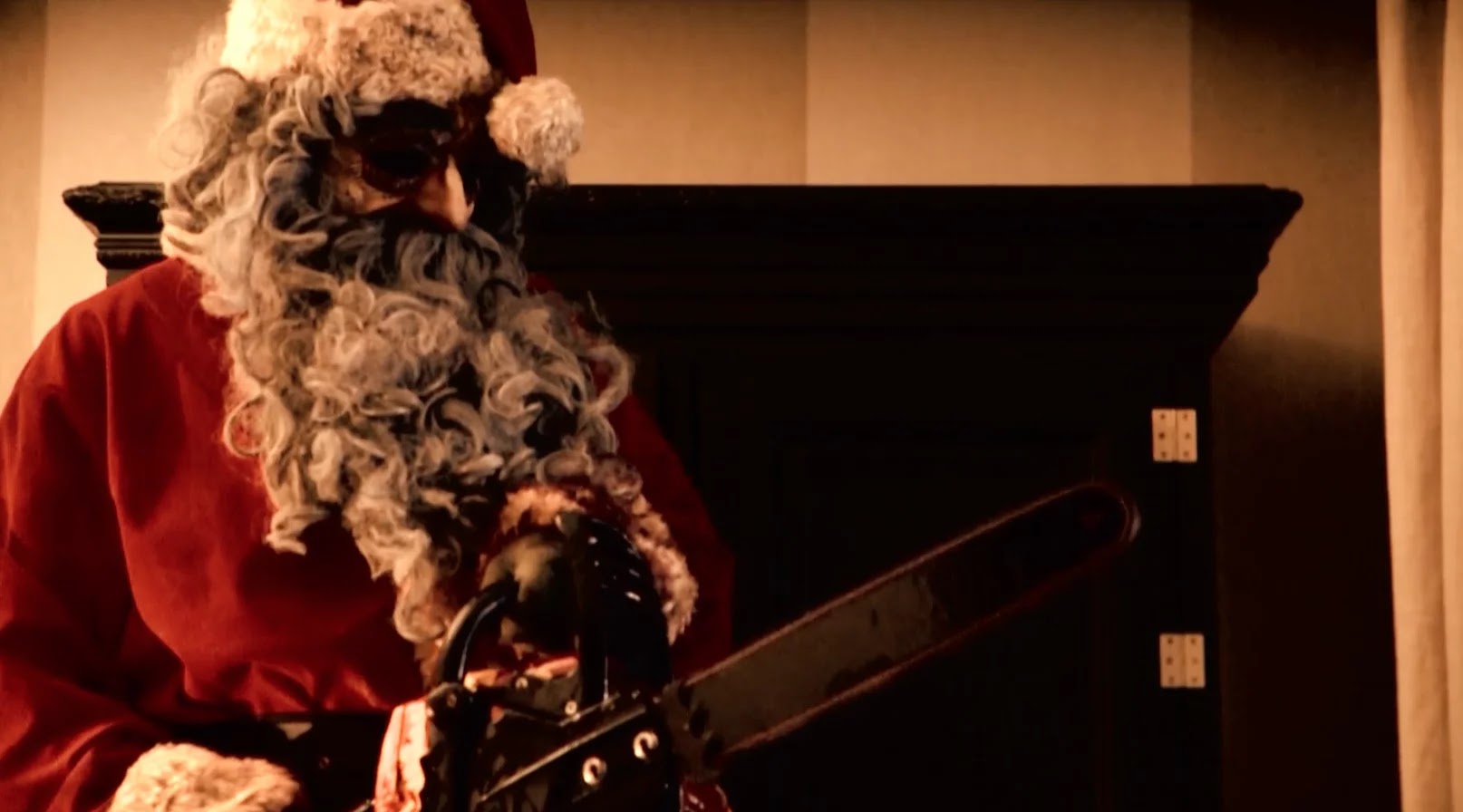
In another scene, we meet our Santa serial killer (Tormod Lein), a middle-aged and balding office worker and family man. The film shows his fractured personality by very fast (and for me, nauseating) edits. The viewer is also introduced a bit to his mindset, which is full of violence and carnality. His grooming of his young daughter to carry on after him is chilling. Ironically, Lein is a devout Christian, and would not watch the film once it was released, even though he performed all the acts of wanton killing.

In a brief shot of his desk, we see a snow globe that has a frozen Jack Nicholson from The Shining (1980). There are actually a lot of references to many other films throughout, sometimes in images and others in actions, such as Jaws (1975), The Big Lebowski (1998) and Goodfellas (1990), which could be a drinking game.

After the shocking opening, the film, well, it lulls for way too long. Too much talking and lingering on scenes of dialogue that can be considered exposition, but actually do nothing to really advance the story much, and was a chore for this particular viewer. But it did not build tension and I really fought the desire to skip ahead, though since there were subtitles, I did occasionally go to double speed, especially during an extended drunken scene between the three friends. Honestly, this film could have been a good 20 minutes shorter and have been just as effective.

Tomren, Aasheim

Both our trio of – whatever they are – and the nameless killer are seen preparing for Christmas, but in wholeheartedly different ways, though all will end up at the same party, for better or mostly worse.

Once the unnamed madman starts on his rampage, though, which comes quite unexpectedly even though it is predictable that it will happen at some point, the sheer velocity of it makes the third act ramp up to 12, never mind 11. It is actually hard to look away, though perhaps for others, they might have the opposite reaction. The SFX sometimes looks cartoonish, but the actions themselves are so brutal that it actually overrides that. I would say if you watch the film, and want to view it a second time as I did, I watched the first 10 minutes and then skipped to the 1-hour mark.

Steinsvoll

Now, as for the bonus material. Unearthed Films tends to overload the Blu-rays with features, which is kinda cool in my opinion. It starts with a full-length commentary with Per-Ingvar Tomren and producer/cinematographer Raymond Volle. For some reason, the volume was quite low and even turning it way up, I had trouble hearing it; could be my age, seeing bands like the Ramones too many times, or they were just too far from the damn microphone. Again, I watched the first 10 and final 30 minutes with the commentary on, which was interesting. Next is yet another full-length commentary titled “Watch-a-long with Flesh Wound Horror,” where Tomren talks with, well, the person behind FWH. He was mic’d fine, but Tomren, again, was too far from the recorder, so I did the same 10/30 spiel.

One of the major additions is the “How Cruelty Changed Our Lives” featurette, which is broken up into three parts. Sorry, I just did not have the patience to watch all of them. Over the opening credits of the film proper, there is a scene at a bar and the band the Last Rebels are playing on stage. Here we get the music video for their song, “Endless Highway” (not a C&W song). “Interview with Morten Haagensen” (7 min), who runs the Rama Skrik film fest in Norway, follows as he discusses this film playing there in 2013, including the reaction of the audience. It makes sense what comes next is a “Press Conference” (23 min), also in 2013. It consists of most of the major cast, the directors, cinematographer, SFX, etc. Again, the sound is a bit low, but that is okay here as it is held in Norwegian with English subtitles.
“The Blooper Reel” (7 min) is amusing in parts, and then there are the Teaser Trailer and Photo Gallery. The final is a short film, “Tradisjon” (Tradition) (2013; 6 min), directed by Severin Eskeland. It is also holiday themed, and my mouth watered a bit when during the credits they show some krumkake, but I digress… I was not quite sure where this was going, and it certainly didn’t go where I thought it would, but I just loved it.

If you are a gorehound, you really do need to see Christmas Cruelty! at least once, because the violence is both gruesome and beautiful at the same time. If your idea of extreme is the Marvel Universe, however, yeah, step back and take a breather on this one.

IMDB listing HERE


Monday, December 12, 2022

Review: Massacre at Central High

Text © Richard Gary / Indie Horror Films, 2022
Images from the Internet

Massacre at Central High
Directed by Rene Daalder (d. 2019)
Brian Distributing Corp; Synapse Films; MVD Entertainment
87 minutes, 1976 / 2022
www.synapsefilms.com
www.MVDVisual.com/
High school bully films are a nice subgenre of thrillers and possible violent (did I mention bullies) murder tales. This theme is more common in Japan where there are strict social rules in instructional institutions, such as was in England in the 19th Century (e.g., Tom Brown’s School Days), but that is another story. This film was obviously a launching pad for the likes of cult release, Heathers (1988), which has a very similar revenge theme. There are differences between, for example, this film and Heathers in that the latter is a vicious comedy and the former a vicious drama.

I don’t know why this subgenre tend to group the bully social construct as a three- or foursome, but that is true here. Perhaps this release set the pathway? The leader of the baddies is Mark (Andrew Stevens; at one time I could honestly say, in the words of the SoCal punk band VOM, “I’m In Love With Your Mom”). His cohorts are Bruce (Ray Underwood; d. 1993), blond and really tall Paul (Damon Douglas; d. 2006) and Craig (Steve Bond). From the opening shot of them walking side-by-side down the narrow school corridor, like it was theirs, gives all the indication you need for who and what they are. And we see their behavior right off when the run into the film’s hippie rebel, Spoony (Robert Carradine), who is wise and sharp-tongued, but seems to get away with much.

Darrel Maury

We quickly meet the hero/anti-hero of the piece, in the form of transfer student David (Derrel Maury). The baddies are out to groom him to be one of “theirs,” as David was friends with Mark at a previous school. However, David has flirted with Theresa (Kimberly Beck), who unknowingly is actually Mark’s girl. Okay, enough with the exposition, since we now have all the main characters (though I’d like to give a nod to Rambeaux Smith, aka Cheryl Smith, who plays secondary character, Mary; d. 2002).

While it is obvious that these guys are no good, but the film take the wise choice to escalate their actions in steps. At first, they “just” harass and intimidate, but as the story progresses, they get more aggro, justifying the actions/reactions to come. One nearly amusing deed they take is to knock books off several library shelves onto nerdy Arthur (Dennis Kort). Thing is, there is something these goons, who obviously do not read library books, do not realize; the Dewey Decimal System. To put the books in order, just follow the numbers. Anyway, tensions mount between the turdettes and David, when the latter starts helping those who have been injured by his – er – pals.

Andrew Stevens, Kimberly Beck

Another interesting choice is that these bozos – well, conflicted Mark anyway, really wants David to join rather than rebel. Mark’s friends are not so keen, and they actually have a say. In many bully films, the main bad guy is king and the rest are his followers, but here, while Mark is the alpha male, he is surprisingly thoughtful at times and not just a bully cliché. Yet, he is still pressured by the rest of the crew.

The shift in the story, where it escalates, is a series of three events (which I will not describe; no spoilers). By the third, as my grandmother would say, “Enough is enough” (speaking of which, one of the characters, Jane, is played by Lani O’Grady, who would go on to “Eight is Enough” fame, and even has the same haircut here as in the TV show; d. 2001), and the revenge aspect of the story starts, and it becomes more, if a tad predictable (i.e., you know when something is going to happen, just before it does).

Damon Douglas, Ray Underwood, (Maury), Steve Bond

One of the common themes of the bully movie, is it usually turns into a violent revenge scenario, and then goes a step further and there are some times where the bullied become the new bullies. For example, Mark was bullied and then became one himself. With the absence of this hierarchy, the school turns into a Lord of the Flies situation, with past victims demanding their due and wanting influence in whatever form over the others.

This is where the film gets political, as each faction has its own social focus (misinterpreted social justice, rich vs. poor, intellect vs. brawn, brawn vs. intellect, etc.). Well, David’s to the “rescue,” like Christian Slater in Heathers.

Robert Carradine

Along with the original theatrical trailer, a TV and radio spot, and a still gallery, the main extra is “Hell in the Hallways,” a Making Of featurette created for this Blu-ray (42 min; 2020). While it follows the pattern of so many Making Ofs (cast interviews, getting the roles, crew interviews, anecdotes, impact on culture), this one is pretty interesting because – especially the actors – seem really engaged when they talk about their experiences. Also, what is fun, is that they dissect specific effect scenes that are quite amusing. Worth the watch.

There are some aspects of the film worth noting (and I am not the first), there is no official authority figures present through the whole story, except for the last scene. There are no teachers, administration, parents or police. That was a stylistic choice for which I approve, although it makes no sense that classes would continue after so many acts of violence in such a short period of time. And the fact that they go on with Prom? Wow.

But the most egregious thing about the whole film has to be the theme song, “Crossroads,” sung by Tommy Leonetti, is just plain gawd-awful. Lyrically, musically, and vocally, it is just horrendous. It is so bad, and was hated so much by the director, he refused to watch the film for 30 years. For myself, I worked in a movie theater as an usher and had to stay inside the main room my whole shift. If I had to hear this song three times a day, five days a week, I would have torn my ears off.

For  film of this sort, and the date of its release, there is no surprise in the amount of nudity (kudos to Beck). However, there is a nice level of gore that was unexpected, and pre-CGI. I also liked that while it was predictable on who would die, I was surprised by some of the survivors.

Even through some stilted dialogue and ‘70s style acting, this film is a cult classic. It is easy to see why,

IMDB listing HERE 


Saturday, December 10, 2022

Review: Karate Ghost

Text © Richard Gary / Indie Horror Films, 2022
Images from the Internet

Karate Ghost (aka Black Belt Joe)
Directed by Bobby Canipe Jr.
Acid Bath Productions; Is This Las Vegas Productions
90 minutes, 2022
www.jamesbalsamo.com/#/

If you are wondering if this is serious or a goofy comedy, well, I mean, look at the title. If you dig a little closer, the name of the titular character, Black Belt Joe is a pun named after a much beloved blaxploitation era character played by Jim Kelly (d. 2013). 

Now, when I say “goofy,” please note that I am not saying bad, but I am saying stupidly silly with a very broad (and yes puns) comedy. In other words, this is like the Keystone Kops as opposed to, say, Lenny Bruce. And there is also a need for that level of broad and bawdy humor. That this was co-written and produced by James Balsamo, who also appears in the film wearing a ridiculous wig in an astoundingly purposefully overacted role where he even stares directly at the camera and often talks to it, should say a lot. But this is directed by Bobby Canipe Jr, and I will take it from that point of view.

Joe Balsamo

Black Belt Joe (Joe Borlik) is a Ju-Jitsu expert, but with a mean streak (and not just for his puns) that likes to kill his opponents, rather than just subduing them. One of them is the brother of Nick Laser (Balsamo), who vows revenge, by adventuring to learn the martial art, after a few drinks, ‘natch.

After a vision in the clouds reminiscent of god’s appearance in Monty Python and the Holy Grail (1975), this leads Laser to a ju-jitsu master, Wong Chong Smitch (Garrick Lane). I was amused how they make it as though the Japanese passive martial art sound like some secret wonder system, like the one taught to Uma Thurman by Sonny Chiba in Kill Bill, Vol 1 (2003).

Joe Borlik

Of course, there is the mandatory training montage, but it certainly is not up to the level of Rocky IV (1985), The Karate Kid (1984), or any of the Shaw Brothers releases. Laser is incompetent, confused and overwhelmed, which is quite amusing.

Of course, the actual fighting choreography is somewhere akin to the “MadTV” spoof of Rudy Ray Moore’s Dolemite (1975), but what else would you expect? This is a broad comedy, and fighting authenticity is not quite a requirement, even in a film about fighting. And rightfully so.

I love the posturing over-the-top machismo, where people talk (especially Laser in a forced gravelly voice) with extended last words (e.g., “You’re not leaving here aliiiiiive. You’re leaving in a body baaaag.”). I do get the feeling that much of Balsamo and Borlik’s dialogue was ad libbed, which would make sense of the two of them having co-writer credits, along with Canipe. And Joe does not leave the tournament alive (am I giving away too much, considering the name of the damn film?).

Cagney Larkin

Later (and 30 minutes into the film), Laser is a maintenance man at a Dojo recently bought by boob-obsessed to the point of cringy Allen (Cagney Larkin), who has a cute and heavily tatted girlfriend, Selena (Morrigan Thompson). They set forth an event that brings back BB Joe, who also likes to orate directly into the camera. And he is out for revenge against not only Dick – I mean Nick; damn that Allen – Laser, but anyone else who crosses his path. This leads to some fun if cartoonish gore.

And who gets killed? People who happen to wander into the Dojo when no one is around, such as a homeless guy played by Canipe, the director. But you know the big rematch showdown is coming between Laser and zombie Joe. But I wonder how they will fight each other while both looking at the camera (I kid).

Morrigan Thompson

Most of the action, be it the training, the newly bought Kali Filipino Martial Arts Dojo, and the martial arts tournaments are actually all in the same space that the crew (I am guessing Balsamo as he is the Producer) managed to find that works well. I would not be surprised if they found the place first, and then wrote the story after (that was sort of the philosophy of some of Roger Corman’s pictures: if he liked the poster, he created the film).

As ridiculous as the film is on so many levels, it is also so obvious that the cast had a lot of fun making it. What is more, that level of enjoyment is passed along to the viewer. If you are expecting to see a film with the technical capabilities and budget of, say, the Insidious franchise, you are barkin’ up the wrong cinema. However, if you delight in the likes of low budget action films like Dolemite, and “get it,” you might find yourself smiling as I did.

Much as one can almost tell when a film is under the Unearthed Films banner by its content, it is easy to watch this release and know that it is an Acid Bath Productions, and not just because Balsamo has such a central part in it; it is more the style, the laissez-faire attitude as far as storyline consistency and acting, and cheesy gore. There is also a cast, but not the overflow of celebrity cameos. However, it is nice to see this under Canipe’s direction, giving a bit of a different-yet-familiar feeling to the piece. I hope he gets to direct more.

IMDB listing HERE

Trailer TBD

Wednesday, December 7, 2022

Review: Evil Dead Trap 2: Hideki

Text © Richard Gary / Indie Horror Films, 2022
Images from the Internet


Evil Dead Trap 2: Hideki (aka Shiryô no wana 2: Hideki)
Directed by Izo Hashimoto
Japan Home Video (JHV); Unearthed Classics; MVD Visual
97 minutes, 1992 / 2022
www.unearthedfilms.com
www.MVDvisual.com/
Before I begin this review in earnest, let us do a bit of house cleaning. First of all, this film is not actually connected to Evil Dead Trap (1981), per se. They have different writers and the director for Hideki is actually better known for writing the screenplay for the classic Japanese anime film, Akira (1988). And rightfully so.

That being said, there are some slim thematic similarities between the two Trap films. Both involve a television reporter/personality, and the other is that of a mysterious child whose origin is unknown: is it real? Imaginary? An evil spirit as in Ju-On: The Grudge (2002)? Though it may seem like slim connections, I would bring up, for example, how many of the more that 100 Amityville-titled films actually have anything to do with The Amityville Horror (1979)? It should be said, though, that Hideki is the name of the furtive child in both Evil Dead Trap releases.

There are three main characters here. First up is Aki Ôtani (Shoko Nakajima), who works as a film projectionist in a theater. She is dumpy and plumpy, preferring to be by herself, though is incredibly lonely at the same time. Her friend is television reporter and ex-pop idol, Emi Kageyama (Rie Kondoh), an ambitious and outgoing personality, but is also lonely in her own way, finding meaningless sex momentarily fulfilling. She is also obsessed with watching herself on television, via tape. Then there is Kurahashi (Shirô Sano), who is married to Noda (Kazue Tsunogae). And floating somewhere in the fringes of reality or fantasy is the titular Hideki (Shôta Enomoto).

Aki has a split personality, we quickly learn. The frumpy loner, and the red dressed serial killer who murders young women and rips out their ovaries with shears. You heard me. Or is she? Though at first we do not see the actual killings in detail (but hidden in arty camerawork which I will discuss later), but the aftermath is shown in quite gory details. Hey, remember, this is an Unearthed Films rerelease.

Meanwhile, Aki keeps seeing a child in the audience of her theater, and Kurahashi and Noda are waiting for their real or imagined child (demon?), Hideki. Kurahashi is a lothario, screwing around with Emi and promising to bed Aki. Most likely there are others, but let’s focus on the events, now that we have the exposition.

According to a psychic, Kan-nadzuki Chiyo (Shino Ikenami), Aki’s psychic powers are stronger than hers, and warns her not to let it control her. But as we have already seen, the other side of Aki shows that it may be too late. But Hideki’s power and influence may go beyond Aki.

I have to, as always, be honest with you. I have watched this twice now, and I have no fucking idea what the hell was going on by the second half. Was there some really good gore? Yes. Was there some really interesting violence? Yes. Did the story make any sense after the halfway mark? Hell, no. I knew what was going on in the moment, visually, but as for the overall arch of the story, I was lost. Perhaps this would make more sense if I was raised in the Japanese culture in a way I am unfamiliar, sort of like all the subtle wolf imagery in The Howling (1981), e.g., a big bad wolf cartoon on the television, which may be lost on other cultures.

I do have to say, the cinematography by Osamu Fujiishi is nothing short of astounding. Overwhelming neon city lights (nearly a cliché in Asian cinema these days), silhouettes, and shadows, play into the characters’ emotions so well. There were a couple of times I played back a certain scene because it looked so good. The editing was a bit choppy (no pun intended) here and there, with a few rough jump cuts, but I am guessing that was meant to be unnerving, and was probably intentional.

Surprisingly for a Blu-ray, there are only two extras, a Stills Gallery, and a bunch of trailers, including the two Evil Dead Trap releases.

 One could consider this Asian Extreme, I guess, but it does not match up to some of the classics, by the likes of Takashi Miike’s Audition (1999). However, I have heard this film compared to the likes of those by David Lynch and Dario Argento. I can see that. There are lots of weird goings on, strange angles, artsy visuals, and a convoluted story.

 If you liked Evil Dead Trap, I would recommend piggy-backing and seeing this as well right after, and then, perhaps, explain it to me.

IMDB listing HERE


Monday, December 5, 2022

Review: The Leech

Text © Richard Gary / Indie Horror Films, 2022
Images from the Internet

The Leech
Directed by Eric Pennycoff
Doomcroak Pictures; Arrow Video
82 minutes, 2022
www.arrow-player.com.

This is a Holiday film (in this case Christmas) that will not make it to the Hallmark Channel. Supposedly, the holiday represents love and profits, but the New Testament is built on the Old Testament, which is filled with fire, brimstone, and a whole lot of violence. This release dips into the themes of both books.

The film also delves into other motifs, such as the power of charity for both good and evil, and (in my opinion), the absence of reality in faith-belief. If you are still reading, let us start this rolling.

Graham Skipper

The church run by Father David (Graham Skipper, who was also in 2019’s Aliens, Clowns and Geeks), is struggling to find parishioners, which in the real world is actually becoming a problem for local houses of worship outside of the mega churches and their fear mongering diatribes (yes, and profits). The “lack” is shown brilliantly in the opening shot of the church steps, with its snow unbroken by feet entering the building, while the good father is sermonizing.

This sermon actually is important because it sets up the whole concept of charity, and what it means to the priest. I will also note that it is interesting that the few parishioners are faceless in the dim light, and we see only their backs as they silently glide, ghost-like, out of the church without even acknowledging David. Holiday cheer is certainly not present. Less than four minutes in, and I am already impressed.

Jeremy Gardner

When he meets ramshackle Terry (Jeremy Gardner), David is put into a situation where he needs to live up to what he literally preaches, and tries to help Terry out, but they find out that Terry’s girlfriend, Lexi (dimpley Taylor Zaudtke) has thrown him out, leaving his clothes out on the lawn. David offers him to stay the night with him at his deceased mom’s home. Terry, with a bit of a Southern drawl, has absolutely no filters on what he says, and starts to take advantage of David right from the start (“Mind if I smoke?” Terry states as he lights up in the car, not waiting for a response, as an example). The visit is intended for one night, for him to reconnect with Lexi the next day. But the film’s title says otherwise.

Ironically, Terry’s long hair and beard are reminiscent of the classic Jesus image, but he is more inclined to cause some ruckus overturning tables in the temple than healing the sick. He is definitely a house pest more than a house guest, chain smoking (after being asked not to do so) and blasting his boom box in the middle of the night. You know the type. And when his equally repulsive ex-, Lexi, who has been evicted (surprise surprise) shows up, David is in quite the quandary, allowing these two losers and abusers to stay with him for the Holidays, out of charity. In this case, he probably should have called for back-up (Bishop? social services? police?) in some form.

Watching this unfolding is the church pianist, Rigo (Rigo Garay), who seems a bit overwhelmed by the two, which is understandable, especially after some racist comments by our good ole boy. If this couple even thought about voting, you know which side of the aisle they would choose.

Taylor Zaudtke

At some point, I was a bit pissed at David. He concedes too often and too easily. For example, he lets himself get involved in a drinking game, when he is not interested. Screw that. I have been to plenty of parties where they wanted me to drink (academics and wine are nearly synonymous), and as I do not drink (uninterested), I did not. David should have had that will of character.

There are so many (purposefully, I am assuming) cringy moments throughout the whole film, but especially by the things done and said by the couple from hell (pun intended). And yet, I have definitely met people who were like this, I just did not invite them into my life, or on the rare occasion, had to get them out of my spectrum.

There is a lot of sermonizing at the beginning as David struggles with the lack of funds due to lack of attendance at the church (the Catholic church is the richest religious organization in the world, but treats its poorer churches as dead weight and closes them; this is not a screed against the Catholic church, just a statement of fact; I am opposed to all religious financial organizations), and a good-hearted leaning toward helping his fellow humans especially during Yuletide, but that just makes what happens all the more intense. The sermonizing is less a proselytizing point, but a device to show David’s state of mind, and how far he will travel in his own path.

Of course, there comes a tipping point (after all, it is the third act of a psychological horror film), and David has been wrestling with the Angel (Jesus and Rigo) on one shoulder, and the Devil (Terry and Lexi) on the other. The escalation is obvious, and wonderous, making this a magical time of year, especially during a psychotic break from reality

My one complaint is that – and it is not very often – the image is really dark and hard to make out, such as after the “Never Have I Ever” game. I realize it symbolizes the darkness and toxicity that is brought on by Terry and Lexi on David’s spirit and belief system, but it nulls out because it is visually unclear.

The cast is small at four speaking parts, which is not surprising considering it was shot during the height of the Covid pandemic (you heard me), in Fort Wayne, Indiana. We do not get to see much of the town, as nearly everything takes place either in the church or David’s home, but the film is a spirited experience of psychological Holiday horror and breakdowns.

IMDB listing HERE


Friday, December 2, 2022

Review: The Kindred

Text © Richard Gary / Indie Horror Films, 2022
Images from the Internet

The Kindred
Directed by Stephen Carpenter and Jeffrey Obrow
Kindred Limited Partnership; F/M Entertainment; Synapse Films; MVD Entertainment
93 minutes, 1987 / 2021
www.synapsefilms.com
www.MVDVisual.com/
I know I saw this when it first came out, but honestly, I do not remember it at all. Happily, I will now get a chance to revisit it with fresh new eyes (among other sensory organs).

The film certainly begins with a BANG! Bodies fly, and EMTs are abused. And that leads to introducing our hero, researcher Dr. John Hollins (David Allen Brooks, giving off a Ryan O’Neal or William Katt vibes, or maybe it is just the hair). Seems his mom, another researcher of questionable studies of a gene called hemocyanin (according to Wikipedia, hemocyanin “are proteins that transport oxygen throughout the bodies of some invertebrate animals”; it is usually found in marine life), Dr. Amanda Hollins (a cameo by Kim Hunter, more famous for 1968’s The Planet of the Apes and especially non-horror but brutal A Streetcar Named Desire in 1951; d. 2002), is out of a coma and tells her son to destroy her research, and that he has an unknown brother named Anthony in a shade from Basket Case (1982), who also must be destroyed, which the viewer quickly learns why, but exposition must follow first.

David Allen Brooks

Amanda has a rival in bad toupee-wearing also researcher of human and non-human hybridization, ala Island of Lost Souls (1932)/The Island of Dr. Moreau (1995), Dr. Phillip Lloyd (Rod Steiger, better know to horror fans as the priest in 1979’s The Amityville Horror, but especially in the, again, brutal non-horror On the Waterfront in 1954; d. 2002). He is trying to steal Dr. Amanda’s research before John can do anything with/to it.

John goes to his mom’s house with his girlfriend, Sharon (Talia Balsam), in which Amanda turned his childhood bedroom into a laboratory. Just for the heck of it, he asks a bunch of his friends to join along (the fodder to be killed off?), and is also join by a mysterious British researcher of the bizarre that he meets at a funeral, Melissa (Amanda Pays), who seems to have her own agenda. In this way it becomes sort of a cabin in the woods type scenario. Meanwhile, there is something tentacled under the floorboards (trigger warning: pet endangerment)

Talia Balsam

The various Anthonys look a bit like a cross between It’s Alive (1974) and the alien in the poster from Xtro (1982), but with tentacles, as well as arms. Could this be a reference to Cthulhu?. But it’s the adult Anthony that is lurking around the property. Despite all the scientific lingo here and there, the base of this is obviously that it is a creature feature.

Without surprise, things pick up exponentially in the third act, and adult Anthony makes its presence not only known, but takes command, fighting the puny human folk. Who will win this life-and-death battle? I will say, there was way less of a body count than I was expecting.

Amanda Pays

That being said, this was quite the joy ride, with some excellent all practical and in-camera SFX (i.e., no CGI), with creature effects built by Michael McCracken; yes, the infamous watermelon scene is a great example of that (I won’t give it away). Throughout there is solid acting all the way around. Major cast choices for a B-film. Even Steiger, who has chewed his amount of scenery in his career (I once interviewed him a while back before even Amityville, and bombastic is the word I would use to describe him even off the set), mostly comes off as, well, “acting” rather than shouting, even though there is some of that, as well. It is also worth noting that one of the five writers of this film was Joseph Stefano (d. 2006), who wrote the screenplay of the classic Hitchcock game changer, Psycho (1960).

The extras start off with a commentary track with directors Jeffrey Obrow and Stephen Carpenter, moderated by horror journalist Steve Barton. While it is occasionally hard to tell who is talking (other than gravelly voiced Carpenter), honestly, it does not matter. It is the contents, and this is a really good commentary with lots of information and stories, with emotion, rather than just a flat read. Worth listening to for fun information.

Rod Steiger

Next is “Inhuman Experiments – The Making of The Kindred” (52 mins.), an all-new featurette produced by Synapse Films for the Blu-ray. While it is typically generally chronological as many “Making Of” docs, from the genesis (let there be film) of the idea (e.g., changing the character of “Matt” to “Melissa”), but some of this is quite interesting, such as interviews with two of the leads (seeing what they look like now, as well as their stories, for example). My favorite parts were the stories about working with the actors, especially Steiger and Hunter. There is also a broad overview such as the SFX , the sets (which are quite phenomenal, done on the same soundstage as 1939’s Gone With the Wind), the music by David Newman (including being interviewed), and of course its place in culture. Originally, my idea was to skip around, but ended up watching the whole thing, despite the length. That says a lot.

And speaking of SFX, there is a special compilation of creature effects artist McCracken Jr.’s never-before-seen archival, on-set footage (18 min). The first half of this, I watched at 2x speed, but the second, when it became black and white grainy footage, when there was actual informative information, I turned it back to normal speed. It’s not brilliant thanks to the visual quality, but can be interesting for at least one viewing

There is also a still gallery and original storyboards, TV spots, the original theatrical trailer, the original video promotional trailer, and optional English subtitles for the deaf and hard of hearing.

While this has absolutely nothing to do with this film, in a-degree of separation, Marlon Brando has starred in the break-through releases with both Kim Hunter (Streetcar) and Rod Steiger (Waterfront), and he also was one of the leads in the similar thematic Island of Dr. Moreau.

Despite some visually dark scenes, the film quality itself is superb, which is not surprising considering it is a new 4K remaster of the unrated version, and the sound is quite sharp, with different versions of the tracks available in both 5.1 stereo surround sound and the original 2.0 mono theatrical mix.

With a mix of imagery and ideas amalgamated from other films, this one manages to have lots of pop power, and for those who like the ‘80s monster films, this is right up that alley.

IMDB listing HERE


Wednesday, November 30, 2022

Review: Slice!

Text © Richard Gary / Indie Horror Films, 2022
Images from the Internet

Slice!
Directed by James Balsamo
Acid Bath Productions; Apokalupto Enterprises
73 minutes, 2022
www.jamesbalsamo.com

Generally speaking, other than Putt-Putt, I find golf and golf-related films exceptionally boring, be it The Legend of Bagger Vance (2000), Happy Gilmore (1996) or cult comedy Caddyshack (1980). However, this is a James Balsamo release, so my interest is piqued.

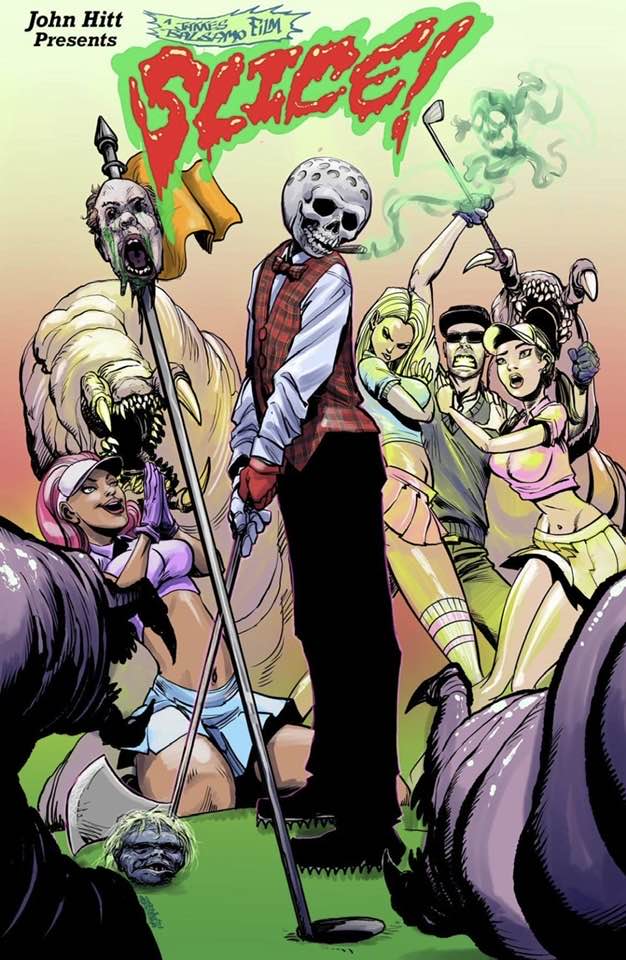
Sorry to give this away, but you gotta love a film that starts in the short, pre-credit-prologue with the killing of Robby Krieger of the Doors on the Tender Holes Golf Course (get it?)…with a door. His acting is horrendous, but who the hell cares!

James Balsamo, Robby Krieger, John Hitt

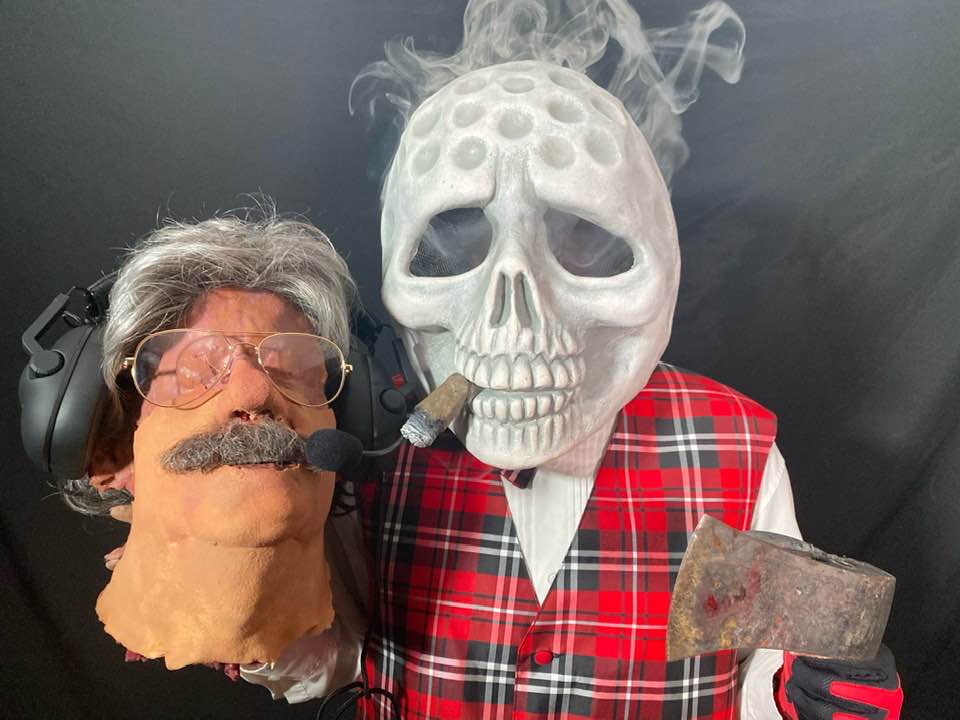
This helps introduce our main villain, Iver Rose, aka the Bogeyman (get it?) who has a human body, but whose cigar chompin’ skull head is huge and round, and has the golf ball dimples on the top of its head, which was designed by Tom Martino. Somehow, it reminds me of the killer in Killer Waves. He is silent and is happy to make divots of golfers whenever (just because I am not a fan of the sport, does not mean I do not know the lingo; I have multiple family that live or lived at golf resorts in Boca Raton, not at Mar-A-Crapo). He kills mostly with a golf club with an ax handle at the end (nice touch). While the Bogeyman is not played by Balsamo (different body shape), but he is certainly voiced by him.

Right off the ball – er – iron, we are introduced to the mayor of the town, Eric Roberts, who has been in a few of Balsamo’s later films, mostly sitting, as usual. The mayor is as slimy as they come as he refuses to acknowledge the deaths on the golf course to keep it open for a money-soaked Tournament (shades of the mayor in Jaws).

There are tons of cameos, as in all Balsamo’s efforts, such as (but hardly only) Rikki Rockett (drummer of Poison), PJ Soles (the Riff Randall), Mark Scheffler (Last House on the Left), and director Brian Yuzna (Bride of Re-Animator and Faust). A complaint I have had, but had not mention in earlier reviews, is that many of the cameos went over my head; even if I knew who they were, I may not have recognized them (such as CJ Graham, who was Jason in Friday the 13th Part 6: Jason Lives, or John Kassir, who was the voice of the Cryptkeeper on “Tales from the Crypt”). But here, in many cases the Bogeyman mentions both the names and affiliations of the guests, for which I am very grateful.

My one true issue with the film is that there is obviously no redubs of the voices, so there is a lot of echoes and mumbling, sometimes making it hard to understand what purposefully ridiculousness they are saying (which is why I watched this with the subtitles on).

The Bogeyman
Lots of blood splatter and gore, which has steadily been better looking as Balsamo’s film go on. That is not to say some of it is pure cheese, but in general, the splatter gives the film its center, and there is an enormous body count, some off camera (i.e., the celeb cameos, one obviously taken at a horror convention table). Who could ask for anything more?

This is completely pun-filled, as is the wont of Balsamo, including a short but hilarious bit concerning the sheriff (Casey Orr, aka Beefcake the Mighty), who has a southern drawl despite the film taking place in California, and his two violent deputies, the punny Officer Downs (Danielle Stampe) and Sy Borgg (Hunter Jackson) (get them?). One of the Sheriff’s targets is the main hero of the tale, Chase (co-writer John Hitt). He’s just one of the many characters who show up on occasion, such as Rodney Callaway (Balsamo, who also plays Alabaster Dick, a heavily made-up sports announcer).

Speaking of which, in many of his films, there is oral narration by Balsamo to give us some exposition and occasional puns. Well, while he voices the Bogeyman that sort of does the same thing, here there is a series of set pieces, introduced by title cards, such as “The Mayor’s Office,” or “Pro golfers daughters [sic] slumber party.”

Speaking of the daughters, there is a lot of gratuitous full-frontal nudity with pillow fights, showers, and dancing by (I am assuming) three strippers, combined with the amusingly gratuitous poster on the wall of Balsamo’s film, Alien Danger! With Ravenvan Slender. Heck, why not both?

My idea of a Brooklyn slice...

The ending is bat-shit crazy what-the-hell. While I will not give it away, there’s lots of stop-motion creatures, puppets, full-sized rubber suits, and even a cameo by the bat from Bite School. 

Films like this defy convention and are in a whole subgenre of their own, such as those by Balsamo or Bill Zebub. Their work cannot be categorized, have a lean towards sexism in the form of said gratuitous nudity, and are so off the wall in weird productions, gaffs, and just plain nonsense, that the end product is all the better for it. I generally admire that. They also almost always have the director in some role, often as the lead, which is just fine and dandy. Films like this are non-pretentious, and clearly are self-promotional in a way that is enjoyable. They tend to push the envelope, and while both these directors have a different motivation, they have a similar style that one could call amateurish, but I call just non-clean fun.

And, it looks like there may be a sequel. Yay.

IMDB Listing HERE